
2027 CMA vs RMA vs CCMA: Explaining The Difference

Co-Founder and Chief Data Scientist
Medical assistant certifications can look almost identical at first glance, but CMA, RMA, and CCMA credentials are not interchangeable in every job market. The right choice depends on your training background, the type of work you want to do, employer preferences in your area, and whether you want a faster entry route or a broader clinical-and-administrative credential.
This guide is for students, career changers, and entry-level healthcare workers comparing the Certified Medical Assistant (CMA), Registered Medical Assistant (RMA), and Certified Clinical Medical Assistant (CCMA) certifications. You will learn how the credentials differ, what each one costs, how long each path takes, where certified medical assistants work, and how to decide which option best supports your career goals in 2026 and beyond.
Quick Answer: CMA vs. RMA vs. CCMA
The CMA is often the strongest fit for students completing an accredited medical assisting program and seeking a broad credential that covers both clinical and administrative duties. The RMA is a flexible option for candidates who may qualify through formal education or work experience. The CCMA is best suited for candidates who want a clinically focused credential and may be looking for a shorter training path into hands-on patient care.
Key Things You Should Know About CMA, RMA, and CCMA
- CMA and RMA routes commonly take 9 months to 2 years, while some CCMA programs can be completed in as little as 4 months, depending on the training provider.
- Exam fees generally fall between $120 and $250, although candidates should also budget for review books, practice tests, prep courses, and possible retake fees.
- All three credentials can support employment in physicians’ offices, hospitals, clinics, and outpatient care centers, with average salaries around $42,000 and job growth projected through 2033.
- In 2025, about 70.9% of allied health employers require or encourage certification, so choosing a recognized credential can affect hiring opportunities.
- CMA vs. RMA vs. CCMA: What is the difference?
- Education and eligibility requirements for each certification
- How long each certification takes
- How to apply for and prepare for the exams
- Certification costs and extra expenses
- Career opportunities for certified medical assistants
- How training cost should shape your decision
- Using medical assistant certification to move toward healthcare administration
- How additional education can speed up advancement
- How to choose the certification that fits your goals
- Renewal and continuing certification requirements
- Whether advanced education after certification is worth considering
- Average salary for CMA, RMA, and CCMA professionals
- Continuing education options after certification
- Common challenges and mistakes to avoid
What is the difference between CMA, RMA, and CCMA certifications?
CMA, RMA, and CCMA are national medical assistant credentials, but they are issued by different organizations and emphasize different eligibility routes and skill areas. The distinction matters because employers may name a preferred credential in job postings, and some programs prepare students for one exam rather than another.
This type of credential decision is similar to other healthcare certification comparisons, such as CPC and CCS certification differences, where the better option depends on the candidate’s work setting and long-term specialization.
| Certification | Issuing organization | Best fit | Main focus |
| CMA | American Association of Medical Assistants (AAMA) | Graduates of accredited medical assisting programs who want a broad credential | Clinical, administrative, and general medical assisting knowledge |
| RMA | American Medical Technologists (AMT) | Candidates who qualify through approved education or work experience | Clinical and administrative duties in medical office settings |
| CCMA | National Healthcareer Association (NHA) | Candidates focused on direct patient care and clinical tasks | Clinical medical assisting skills |
CMA (Certified Medical Assistant)
The CMA credential is issued by the American Association of Medical Assistants and is widely used by medical assistants who want a comprehensive certification. It can be a strong foundation for healthcare workers who may later explore advancement routes such as medical assistant to LPN programs.
- The credential is awarded by the American Association of Medical Assistants (AAMA).
- Candidates must graduate from an accredited medical assisting program.
- The exam includes administrative responsibilities, clinical procedures, and general medical knowledge.
RMA (Registered Medical Assistant)
The RMA credential is issued by American Medical Technologists and is often attractive to candidates who want a respected medical assisting certification with more than one eligibility pathway.
- The certification is administered by American Medical Technologists (AMT).
- Applicants may qualify through an accredited program or through a combination of education and field experience.
- The exam addresses both front-office and back-office medical assisting responsibilities.
CCMA (Certified Clinical Medical Assistant)
The CCMA credential is designed for medical assistants whose work centers heavily on clinical support, patient interaction, and hands-on care tasks.
- The credential is issued by the National Healthcareer Association (NHA).
- The certification places stronger emphasis on clinical medical assisting functions.
- Candidates must pass an exam built around clinical knowledge and patient care responsibilities.
None of these credentials automatically guarantees a job, a specific salary, or advancement. However, because many employers prefer certified applicants, selecting the certification most commonly requested in your local job postings can make your application stronger.
What are the education and eligibility requirements for each certification?
Eligibility rules are one of the biggest differences among CMA, RMA, and CCMA credentials. Before enrolling in a program, confirm which exam the curriculum prepares you for and whether the school meets the certifying organization’s requirements.
| Credential | Minimum education | Training or experience requirement | Important caution |
| CMA | High school diploma or equivalent is typically required before entering training | Graduation from a CAAHEP- or ABHES-accredited medical assisting program | Not every medical assistant program qualifies graduates for the CMA exam |
| RMA | High school diploma or equivalent | Accredited medical assisting program or one year of work experience in the field | Applicants should verify the current AMT eligibility route before applying |
| CCMA | High school diploma or GED | Completion of a medical assisting training program or one year of relevant work experience | Clinical preparation is especially important because the exam is clinically focused |
Certified Medical Assistant (CMA)
To qualify for the CMA exam, candidates must complete a medical assisting program accredited by the Commission on Accreditation of Allied Health Education Programs (CAAHEP) or the Accrediting Bureau of Health Education Schools (ABHES). This requirement makes accreditation especially important for students who already know they want the CMA credential.
Registered Medical Assistant (RMA)
RMA candidates can qualify by completing an accredited medical assisting program or by documenting one year of qualifying field experience. The exam is administered by American Medical Technologists, and applicants should review the current eligibility pathway before paying fees or scheduling a test.
Certified Clinical Medical Assistant (CCMA)
CCMA candidates need a high school diploma or GED and may qualify by completing a medical assisting program or by having one year of experience in the field. The National Healthcareer Association administers the CCMA exam.
The 2025 figure showing that approximately 70.9% of allied health employers require or encourage certification underscores why eligibility should be checked early. A program that is inexpensive or fast may not be the right investment if it does not lead to the certification your target employers expect.
How long does it take to become a CMA, RMA, and CCMA?
The timeline depends on whether you enter through formal training, prior experience, or an accelerated program. The full process includes prerequisite documentation, coursework or experience, externship requirements when applicable, exam preparation, application review, and test scheduling.
| Certification | Typical timeline | What usually takes the most time | Who may finish faster |
| CMA | 9 months to 2 years | Accredited program completion and clinical training | Students in shorter certificate or diploma programs |
| RMA | Similar to the CMA path through the education route | Completing at least 720 hours of instruction, including 160 hours of externship | Candidates who qualify through prior work experience |
| CCMA | 4 to 12 months | Clinical training and exam readiness | Students in accelerated clinical medical assistant programs |
- Certified Medical Assistant (CMA): Candidates must finish an accredited medical assisting program, which often takes 9 months to 2 years and includes classroom learning plus clinical practice. After graduation, they must pass the CMA exam through the American Association of Medical Assistants.
- Registered Medical Assistant (RMA): Students using the education route generally follow a timeline close to the CMA pathway. The program must include at least 720 hours of instruction and 160 hours of externship.
- Certified Clinical Medical Assistant (CCMA): CCMA-focused training programs often take 4 to 12 months, making this option appealing to candidates who want a faster clinically oriented pathway.
How do you apply and prepare for the CMA, RMA, and CCMA exams?
The exam process is manageable if you treat it like a project: confirm eligibility, choose the correct exam, submit documentation, schedule the test, and prepare with the official content outline. Do not assume that finishing a course automatically registers you for the certification exam.
1. Match the exam to your target jobs
Start by reviewing job postings in the city or region where you plan to work. If most clinics list CMA, RMA, or CCMA by name, that should influence your choice. CMA may be better for broad clinical and administrative roles, RMA can work well for candidates with flexible eligibility needs, and CCMA may be the stronger fit for patient-care-heavy clinic roles.
2. Create an account with the certifying organization
Apply through the official organization connected to your chosen credential:
- CMA candidates apply through AAMA.
- RMA candidates apply through AMT.
- CCMA candidates apply through NHA.
Expect to submit personal information, eligibility documents, and payment before you receive testing instructions.
3. Schedule the exam only after checking requirements
Once approved, candidates receive directions for choosing a testing location or online option when available. Scheduling too early can backfire if you have not reviewed the content outline or gathered the identification documents required on test day.
4. Study the official exam content outline
All three exams draw from areas such as anatomy, physiology, medical terminology, safety, patient care, and healthcare procedures. If you are still comparing programs, reviewing typical medical assisting coursework can help you see whether a curriculum lines up with certification exam topics.
5. Use practice exams and targeted review
Practice tests help identify weak areas before exam day. Review tools are most useful when they are tied to the official exam blueprint rather than generic medical trivia.
6. Build a realistic study schedule
Many candidates study 10–15 hours weekly for 2–3 months. Across the three exams, average preparation time is 120–140 hours, so a written schedule can prevent last-minute cramming.
7. Rehearse test-day conditions
Timed practice exams can reduce surprises on test day. Candidates who experience test anxiety may benefit from full-length practice sessions, planned breaks during study, and simple techniques such as slow breathing before beginning each section.
How much do the CMA, RMA, and CCMA certifications cost?
Certification exam fees are only one part of the total cost. Candidates should compare exam charges, tuition, application fees, review materials, retake policies, transportation, technology requirements, and lost work time. For comparison, students considering a different allied health track may also want to review the process for becoming CPC certified, since coding certification costs and preparation are different from medical assistant certification.
Exam Fee Breakdown
| Certification | Listed exam fee | Cost note |
| CMA (AAMA) | $125 for members; $250 for non-members | Membership status affects the fee |
| RMA (AMT) | $120 | Generally paid during the application process |
| CCMA (NHA) | $155 | Some schools may include this in tuition |
Depending on the certifying body, the common base range is often described as $120 to $160, although the CMA non-member fee reaches $250. Always verify the current fee directly with the certifying organization before budgeting.
Additional Costs
Study guides, prep courses, and practice exams can add $50 to $300. Retake fees, when required, are often close to the original exam fee. If your program advertises certification preparation, ask whether the exam voucher is included or whether you must pay separately.
Financial Assistance
Some students may qualify for support through the Workforce Innovation and Opportunity Act (WIOA), school payment plans, or workforce training grants. Financial aid availability varies by school, program type, and student eligibility.
Employer Reimbursement
Some employers reimburse certification or training expenses for eligible workers. Companies such as Amazon, Walmart, and Target have education or certification support programs for qualifying employees, but benefits vary by role, location, and policy. Check with human resources before assuming reimbursement will apply.
A certification can improve your competitiveness, but it should still be evaluated like any other career investment: total cost, time to completion, local employer demand, and whether the credential supports the roles you actually want.
What are the career opportunities for CMA, RMA, and CCMA holders?
CMA, RMA, and CCMA holders commonly work in ambulatory care, clinics, physician practices, hospitals, outpatient centers, and offices of other health practitioners. The right credential can help candidates qualify for entry-level medical assistant positions, but the exact duties depend on employer policy, state rules, and the clinical setting.
Where Medical Assistants Work
| Employment setting | Share of medical assistants | What the work may involve |
| Physicians' offices | 62.06% | Rooming patients, taking histories, preparing charts, assisting with basic procedures |
| Hospitals | 16.7% | Supporting clinical teams, documenting patient information, coordinating care tasks |
| Outpatient care centers | 10.16% | High-volume patient intake, clinical support, procedure preparation |
| Offices of other health practitioners | 8.7% | Administrative and clinical support in specialty practices |
The medical assistant occupation is projected to grow by 15% from 2023 to 2033. Demand is connected to an aging population, preventive care, and the continued need for support staff in outpatient and ambulatory settings.
Employer Preferences
Some employers accept any nationally recognized medical assistant certification, while others list a specific credential. A large hospital system may standardize around one certifying body, while a private practice may care more about clinical readiness, EHR skills, phlebotomy experience, or bilingual communication.
Regional Employment Trends
Medical assistants work across the United States, with large employment markets in states such as California, Texas, and Florida. Nonmetropolitan areas, including East Kentucky and South Central Kentucky, also show high employment levels.
The medical assistant role is expanding in many workplaces. Employers are increasingly assigning duties such as phone screenings and triage support, which makes communication, documentation, and judgment especially important.
Candidates asking how to get a medical assistant job without experience should understand that certification can help, but it works best when paired with a strong externship, a focused resume, and evidence of patient-care readiness.
How Does Medical Assistant Training Cost Impact Certification Decisions?
Training cost should be weighed against more than the exam fee. A low-cost program may be a poor choice if it lacks hands-on practice, externship placement, exam preparation, or the accreditation needed for your chosen credential. A higher-cost program may be worth considering if it includes clinical hours, exam fees, career services, and strong employer connections.
When comparing programs, calculate the full cost of attendance rather than tuition alone. Include books, uniforms, background checks, immunizations, transportation, technology, exam fees, and retake costs. Students comparing affordable routes can use this guide to medical assistant training cost as a starting point for evaluating program affordability.
| Cost factor | Why it matters | Question to ask before enrolling |
| Accreditation or approval | It can determine whether you qualify for the CMA or another exam | Does this program meet the eligibility rules for my target certification? |
| Exam voucher | Some schools include certification fees; others do not | Is the CMA, RMA, or CCMA exam fee included in tuition? |
| Externship | Hands-on experience can help with hiring | Does the school arrange an externship or do students find their own? |
| Retake support | Failing an exam can add cost and delay employment | What happens if I do not pass on the first attempt? |
Can these certifications facilitate a transition into healthcare administration roles?
CMA, RMA, and CCMA credentials can support a move toward healthcare administration, but they usually do not replace management education or supervisory experience. They are most useful as a clinical foundation because they help professionals understand patient flow, scheduling, documentation, compliance, and front-office operations from the ground level.
Medical assistants who enjoy coordination, workflow improvement, and team communication may later consider an online healthcare administration program. That type of education can build skills in budgeting, healthcare law, staffing, quality improvement, and organizational leadership.
How can further education accelerate career advancement in healthcare administration?
Additional education can help certified medical assistants move from task-based clinical support into supervisory, administrative, or operations-focused roles. The strongest candidates typically combine patient-care experience with formal training in management, policy, finance, and healthcare systems.
An accelerated online bachelor's degree in healthcare administration may be useful for working adults who want a faster academic pathway into nonclinical leadership. Before enrolling, compare transfer credit rules, schedule flexibility, accreditation, employer tuition assistance, and whether the curriculum matches your desired role.
Which Certification Best Aligns with My Career Goals?
The best certification is the one your target employers recognize, your background qualifies you for, and your long-term plan can build on. Do not choose only by speed or price. A four-month option may be appealing, but a longer accredited program may offer better clinical practice, externship support, and eligibility for a preferred credential.
| Choose this path if... | Certification to consider | Reason |
| You are enrolling in a CAAHEP- or ABHES-accredited program and want broad recognition | CMA | The credential covers a wide range of clinical and administrative competencies |
| You already have qualifying experience or want a flexible eligibility route | RMA | AMT offers pathways that may fit candidates with education or work experience |
| You want a clinically focused role and a potentially shorter training timeline | CCMA | The exam emphasizes direct patient-care skills |
| You are unsure which credential local employers prefer | Research all three before enrolling | Job postings and employer calls can prevent choosing the wrong exam |
Some students also consider broader science or healthcare education alongside certification. A program such as the cheapest biochemistry degree online may strengthen scientific knowledge for certain long-term goals, but it is not a substitute for medical assistant certification or clinical training.
How do you maintain and renew your certification?
Certification does not end after you pass the exam. CMA, RMA, and CCMA credentials require renewal, usually through continuing education and a formal recertification process. Missing a renewal deadline can create extra fees, additional requirements, or temporary loss of active certification status.
Because renewal rules differ by certifying organization, review the official instructions for your credential and track deadlines early. Professionals looking for structured skill updates can compare online healthcare certificate programs that align with their renewal needs and career goals.
Is investing in advanced education post-certification beneficial?
Advanced education can be worthwhile when it clearly supports a specific next step, such as lead medical assistant, clinic supervisor, healthcare administration, nursing, health information, or another licensed healthcare role. It is less useful when chosen only because it sounds impressive or because a school promises broad career advancement without evidence.
Before pursuing a higher credential, compare tuition, time commitment, transfer credits, employer reimbursement, and the jobs that actually require the degree. For some healthcare professionals, an affordable online doctorate in pharmacy program may fit a long-term pharmacy-related path, but medical assistants should confirm prerequisite, licensure, and career requirements before assuming it is the right next move.
What is the average salary for CMA, RMA, and CCMA certified professionals?
As of 2023, certified medical assistants, including CMA, RMA, and CCMA holders, earn an average annual salary of about $42,000, or approximately $20.19 per hour, based on U.S. Bureau of Labor Statistics data. Pay varies by experience, location, employer type, schedule, specialty, and local labor demand.
Salary by Experience
| Experience level | Approximate pay | What can affect earnings |
| Entry-level, less than 1 year | Around $19.12 per hour | Externship quality, certification, location, and schedule |
| 3–5 years of experience | Approximately $23.52 per hour | Specialty skills, reliability, EHR experience, and employer type |
| 10+ years of experience | About $25.11 per hour | Lead duties, specialty clinics, training responsibilities, and region |
Geographic Impact on Salary
Location can create large pay differences. Alaska reports a median annual salary of $52,530, while Alabama reports a median annual salary of $34,050. Cost of living, staffing shortages, employer size, and regional healthcare demand can all influence pay.
Additional Compensation
Eligible hourly employees may earn overtime at at least 1.5 times their regular hourly rate for hours worked beyond 40 per week. Overtime availability depends on employer policy, staffing levels, and applicable labor rules.
Salary Growth
The healthcare industry plans a median salary increase of 5.5% for medical assistants in 2025, reflecting continued demand for support roles in healthcare settings.
If you are comparing medical assisting with health information roles, review how long medical billing and coding school takes, because coding programs, work settings, and salary patterns can differ from medical assistant pathways.
What continuing education options are available after certification?
Continuing education helps medical assistants keep their credentials active, stay current with clinical procedures, and prepare for specialized duties. It can also show employers that you are serious about professional growth, especially in practices that use electronic health records, telehealth workflows, and expanded patient screening.
Students who want a flexible academic pathway after certification can compare online medical assistant programs to find schools that fit their schedule, credential goals, and budget.
CE Requirements by Certification
| Credential | Continuing education requirement | Renewal cycle |
| CMA (AAMA) | 60 continuing education units (CEUs) | Every five years |
| RMA (AMT) | 30 CEUs | Every three years |
| CCMA (NHA) | 10 CEUs | Every two years |
CMA CEUs must include administrative, clinical, and general content areas. NHA offers an online library that can help CCMA holders complete renewal education.
Career Growth Through Additional Credentials
Many medical assistants use continuing education to add targeted skills rather than stopping at the minimum renewal requirement. Credential stacking can make sense when the added certification matches your employer’s needs or a role you want to pursue.
Common add-on credentials include:
- Phlebotomy Technician
- EKG Technician
- Medical Billing and Coding
Short courses in electronic health records, telehealth, patient communication, or specialty procedures can also be valuable. Ask employers whether they offer tuition support, paid training time, or internal advancement tracks before paying out of pocket.
What are the challenges of each certification?
Each credential has trade-offs. CMA may require a specific accredited program, RMA candidates must carefully document eligibility, and CCMA candidates should be ready for a clinically focused exam. Regional employer preferences can also make one certification more useful than another in a specific market.
Exam Difficulty and Pass Rates
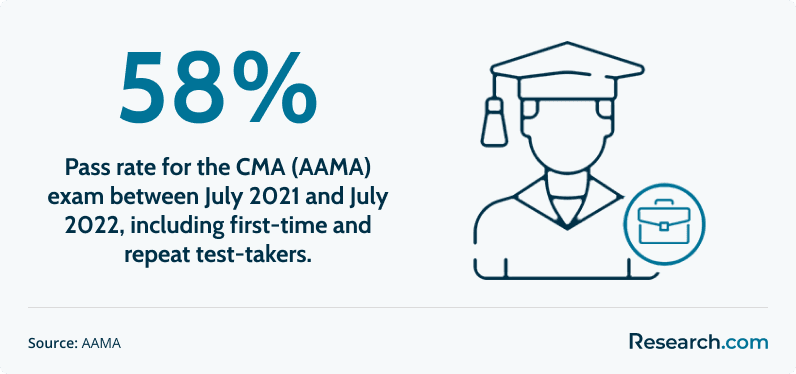
- CMA (AAMA): The CMA exam is broad and includes clinical, administrative, and general competencies. Candidates must pass within three attempts over three years; otherwise, they must wait 12 months before testing again.
- RMA (AMT): As of 2021, the RMA exam had a pass rate of 73%. Candidates can make up to four attempts, with a required 45-day waiting period between attempts.
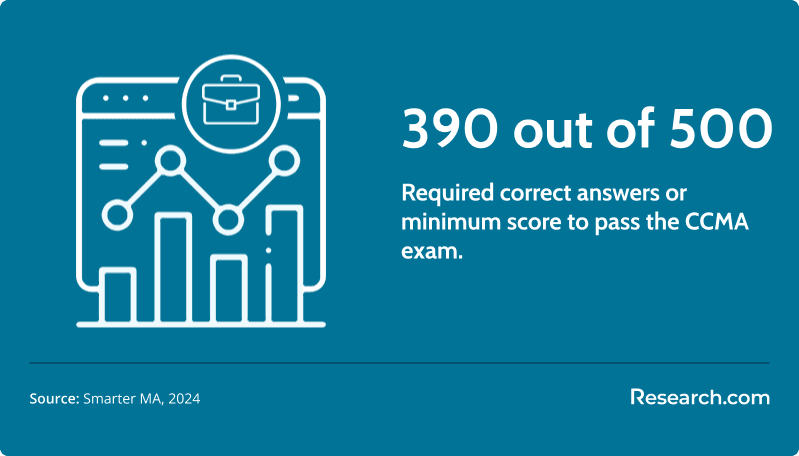
- CCMA (NHA): A passing CCMA score is at least 390 out of 500, which equals correctly answering 78% of the questions.
Regional Recognition and Employer Preferences
All three certifications are nationally recognized, but local hiring patterns matter. Before choosing an exam, search job postings, contact nearby clinics, and ask externship coordinators which credential employers request most often.
How you present your credential also matters. A strong resume should show certification status, clinical competencies, EHR experience, externship details, and measurable responsibilities. This guide to medical assistant skills for a resume can help you translate training into employer-friendly language.
Common Mistakes to Avoid
| Mistake | Why it can hurt you | Better approach |
| Choosing the cheapest program without checking eligibility | You may finish training but not qualify for the certification you wanted | Confirm exam eligibility before enrolling |
| Assuming all certifications are viewed the same locally | Some employers may prefer one credential | Review job postings and ask local healthcare employers |
| Ignoring externship quality | Weak hands-on experience can make job interviews harder | Ask where students complete externships and what duties they perform |
| Budgeting only for the exam fee | Books, prep tools, retakes, and transportation can increase total cost | Create a full program-and-certification budget |
| Confusing medical assistant roles with nursing roles | Scope of practice and advancement paths differ | Compare medical assisting with LPN, RN, or other licensed paths before deciding |
If you are still deciding between assisting and nursing, this LPN and medical assistant comparison can clarify differences in duties, training, licensure, and long-term growth.
Here’s What Graduates Have to Say about CMA, RMA, and CCMA
Earning the CMA helped me qualify for healthcare jobs where I could work directly with patients. I like knowing that my certification supports the skills I use every day, and it has made me feel more secure in my role. – Elysia
The RMA gave me credibility when I wanted to move forward in medical assisting. I have been able to work in different settings, including clinics and hospitals, and the credential helped me show employers that I was prepared. – Casey
I chose the CCMA because I wanted a role centered on patient care. The clinical skills I built through the certification process gave me more confidence and made the work feel meaningful. – Oliver
Key Insights
- CMA, RMA, and CCMA credentials all support medical assistant careers, but they differ in eligibility rules, exam focus, and the type of candidate they best serve.
- The CMA is often best for graduates of accredited programs who want a broad clinical-and-administrative credential; the RMA offers flexible eligibility; the CCMA is strongest for clinically focused roles.
- Training timelines vary: CMA and RMA paths often take 9 months to 2 years, while CCMA programs may take 4 to 12 months.
- Exam fees range from $120 to $250, but total costs can rise when you include study materials, prep courses, retakes, uniforms, transportation, and program tuition.
- Physicians' offices employ 62.06% of medical assistants, making them the largest employment setting for these professionals.
- The medical assistant field is projected to grow by 15% from 2023 to 2033, but certification alone does not guarantee employment or a specific salary.
- As of 2023, certified medical assistants earn about $42,000 annually, or approximately $20.19 per hour, though experience and location can significantly affect pay.
- Entry-level certified medical assistants earn around $19.12 per hour, while those with 10+ years of experience earn about $25.11 per hour.
- The smartest way to choose is to check local job postings, confirm program eligibility, compare total cost, and select the certification that matches your target workplace.
References:
- Comparing the different medical assistant certifications. (n.d.). https://www.medicalassistants.net/blog/comparing-the-different-medical-assistant-certifications.html
- Types of Medical Assistant Certifications | CHCP. (2024, July 10). CHCP. https://www.chcp.edu/blog/medical-assistant-certification-how-to-choose
- Concorde Career College. (2025, March 14). RMA vs. CMA: Comparing Medical Assistant Certifications. https://www.concorde.edu/blog/rma-vs-cma-comparing-medical-assistant-certifications
- American Career College. (n.d.). How Long is a Medical Assistant Program? Complete Training Guide. https://americancareercollege.edu/blog/how-long-is-medical-assistant-program
- C, R. (2024, October 7). Medical Assistant Trade School vs. Traditional College | Allen School. Allen School of Health Sciences. https://www.allenschool.edu/key-differences-between-attending-a-medical-assistant-trade-school-and-a-traditional-college
- Finding the right Medical Assistant Training Program | CHCP. (2024, August 23). CHCP. https://www.chcp.edu/blog/how-to-find-the-right-medical-assistant-training-program
- Ressler, K. (2019, May). NHA News Center: Survey Results Show Employers Increasingly Require or Encourage Certification for Allied Health Professionals. NHA. https://info.nhanow.com/mediacenter/survey-results-show-employers-increasingly-require-or-encourage-certification-for-allied-health-professionals
- Test anxiety. (2023, October 3). Academic Resource Center. https://academicresourcecenter.harvard.edu/2023/10/03/test-anxiety/
- Asad, M. (2025, April 7). Certified Medical Assistant Exam Cost — AMBCI. AMBCI. https://ambci.org/medical-billing-and-coding-certification-blog/certified-medical-assistant-exam-cost
- Comp-Login. (2023, March 28). The A – Z of Medical Assistant Certifications: Your complete guide to getting certified Part 1. Compu21. https://www.compu21.edu/the-a-z-of-medical-assistant-certifications-your-complete-guide-to-getting-certified-part-1
- Medical assistants. (2023, April 25). Bureau of Labor Statistics. https://www.bls.gov/oes/2023/may/oes319092.htm
- Medical assistants. (2024, August 29). Bureau of Labor Statistics. https://www.bls.gov/ooh/healthcare/medical-assistants.htm
- Kalosieh, J., & Kal, J. (2025, April 14). 2024–2025 Medical Assistant salary: Facts, figures, salaries by state. IntelyCare. https://www.intelycare.com/career-advice/medical-assistant-salary-facts-figures-salaries-by-state/
- Smarter MA. (2024, April 13). Medical Assistant salary | Ultimate Medical Assistant Wage report. https://smarterma.com/guide/medical-assistant-salary/
- How much do medical assistants make? (2025 salary by state). (2025, January 2). All Allied Health Schools. https://www.allalliedhealthschools.com/medical-assisting/medical-assistant-salary
- Workforce Management software news, blog, and resources. (n.d.). Workforce.com. https://workforce.com/news/overtime-laws-by-state
- MGMA | MGMA Stat | Budgeting medical practice staff cost-of-living, merit increases for 2025. (2024, September 11). https://www.mgma.com/mgma-stat/budgeting-medical-practice-staff-cost-of-living-merit-increases-2025
- MedAssisting. (2024, November 22). Earn Medical Assistant Continuing Education Units [CEUs]. Med Assisting -. https://medassisting.org/earn-medical-assistant-continuing-education-units-ceus-how-to-stay-up-to-date
- Recertification. (n.d.). https://www.aama-ntl.org/certification/recertification
- Blog, K. H. (2024, October 28). Medical assisting continuing education. American Medical Technologists (AMT). https://americanmedtech.org/blog/blog-post/medical-assisting-continuing-education
- Adrianarodriguez. (2024, May 16). Benefits of continuing education for medical assistants. Northwest Suburban College. https://nwsc.edu/continuing-education-for-medical-assistants
- Jordan, A. (2022, June 14). How to pass the RMA certification exam. Eagle Gate College. https://www.eaglegatecollege.edu/blog/how-to-pass-the-rma-certification-exam
- Registered Medical Assistant (RMA). (n.d.). https://americanmedtech.org/medical-assistant
- Smarter MA. (2024b, April 27). NHA CCMA Certification: Everything you need to know. https://smarterma.com/ccma/nha-ccma-certification-test
- How to Become a Medical Assistant. (2022, September 8). Medical Assistant Certification | CMA, RMA, NCMA, CCMA Certification. How to Become a Medical Assistant | Education Requirements. https://www.medassistantedu.org/certification
- Sarkar, L. (2023, November 20). What are the most in-demand digital skills in the healthcare industry in 2024? Safalta. https://www.safalta.com/online-digital-marketing/digital-skills-in-the-healthcare-industry
- Cjimenez. (2024, January 18). Digital skills to develop in Medical Assisting | Allen School. Allen School of Health Sciences. https://www.allenschool.edu/digital-skills-to-develop-in-medical-assisting
Other Things You Should Know About CMA, RMA, and CCMA
The CMA credential is issued by the American Association of Medical Assistants (AAMA), the RMA by the American Medical Technologists (AMT), and the CCMA by the National Healthcareer Association (NHA). Each certification is governed by these separate bodies.
The CMA exam is administered by the AAMA and the RMA exam by AMT; both are typically proctored certification tests. The CCMA exam is offered by the NHA and includes multiple-choice questions focused on clinical and administrative skills. Each exam has its own content outline and eligibility rules.


