2027 Medical Assistant vs. Pharmacy Technician: Explaining the Difference

Co-Founder and Chief Data Scientist
Medical assistant and pharmacy technician are both practical entry points into healthcare, but they lead to different daily work, training choices, work environments, and long-term opportunities. A medical assistant usually works closer to direct patient care and medical office operations. A pharmacy technician works closer to medication preparation, prescription processing, pharmacy systems, and pharmacist support.
This guide is for students, career changers, and working adults comparing two healthcare roles that can often be entered without a four-year degree. You will learn how the jobs differ, what training and certification may be expected, how salaries compare, where each role is commonly employed, and which path is likely to fit your strengths, schedule, and career goals.
Quick answer: medical assistant vs. pharmacy technician
If you want a healthcare role with more patient interaction, clinical tasks, and front-office responsibilities, medical assisting may be the better fit. If you prefer medication accuracy, prescription systems, inventory, insurance processing, and working under a pharmacist, pharmacy technology may be a stronger match.
- Medical assistants have a projected 15% employment increase from 2023 to 2033, compared with 7% for pharmacy technicians during the same period.
- Medical assistants commonly work in physicians' offices, outpatient care centers, hospitals, and specialty clinics.
- Pharmacy technicians are most often found in retail pharmacies, hospitals, outpatient healthcare services, and other pharmacy-based settings.
- Medical assistants combine clinical and administrative work; pharmacy technicians focus on prescriptions, medication handling, customer support, and pharmacy operations.
- Medical assistant vs. pharmacy technician: the main difference
- Medical assistant responsibilities
- Medical assistant salary
- Pharmacy technician responsibilities
- Pharmacy technician salary
- Education and training requirements
- CMA vs. CPhT certification
- Why accreditation and continuing education matter
- Long-term advancement options
- Return on investment comparison
- Job growth outlook
- How ongoing education affects promotion potential
- Skills needed for each role
- Work settings and salary by employer type
- Technology trends affecting both careers
What is the difference between a medical assistant and a pharmacy technician?
The clearest difference is the focus of the work. Medical assistants support patient visits from the front desk to the exam room, while pharmacy technicians support medication dispensing and pharmacy operations under pharmacist supervision.
| Comparison point | Medical assistant | Pharmacy technician |
| Main purpose | Helps clinicians deliver patient care and keeps medical offices running smoothly. | Helps pharmacists prepare, label, process, and manage prescriptions safely. |
| Typical duties | Takes vital signs, prepares exam rooms, assists with procedures, schedules visits, updates records, and supports billing or front-office tasks. | Fills prescriptions, prepares medications, manages inventory, processes insurance claims, supports customer service, and maintains pharmacy records. |
| Patient interaction | Usually frequent and direct, especially in clinics and physician offices. | Often customer-facing, but the interaction is usually centered on prescriptions, refills, insurance, and medication questions that may be referred to the pharmacist. |
| Training path | Often a certificate, diploma, or associate degree in medical assisting, commonly taking about 1-2 years depending on the credential. | Often a high school diploma plus employer training or a certificate program in pharmacy technology, commonly taking 6 months to 1 year. |
| Common credential | Certified Medical Assistant (CMA) or another recognized medical assisting credential. | Certified Pharmacy Technician (CPhT), often earned through the PTCE or ExCPT route. |
| Best fit for | People who like patient care, varied tasks, clinic workflow, and a blend of clinical and administrative work. | People who prefer medication systems, accuracy, pharmacy operations, and structured technical tasks. |
Neither role is automatically “better.” The better choice depends on whether you want your workday built around patient visits or medication management.
What are the responsibilities of a medical assistant?
A medical assistant supports physicians, nurses, and other healthcare providers before, during, and after patient visits. For a deeper role breakdown, Research.com also explains what medical assistants do in clinical and administrative settings.
- Measuring vital signs: Medical assistants record information such as blood pressure, temperature, pulse, and respiration rate so providers have current data before evaluating the patient.
- Preparing patients for exams: They guide patients into exam rooms, explain basic steps, help patients get positioned, and make sure the room is ready for the provider.
- Supporting medical procedures: Depending on state rules and employer policy, they may hand instruments to providers, prepare supplies, assist during minor procedures, and help patients stay comfortable.
- Administering injections or medications: In some practices, medical assistants give vaccines, injections, or medications when permitted and supervised appropriately.
- Collecting specimens or drawing blood: Some medical assistants collect urine, sputum, or other samples and may perform phlebotomy if trained. This is also part of many clinical medical assistant responsibilities.
- Updating medical records: They enter health histories, visit notes, treatment details, and other patient information into medical records.
- Scheduling and office coordination: Medical assistants may book appointments, confirm visits, manage provider schedules, and keep patient flow organized.
- Answering patient questions: They often serve as a first contact for patients, route messages to providers, and help patients understand next steps without giving advice outside their scope.
- Sterilizing instruments and preparing rooms: Proper cleaning and infection-control practices help reduce risks during procedures and routine care.
Who is medical assisting best for?
- You are comfortable interacting with patients throughout the day.
- You want both clinical and administrative responsibilities.
- You can stay organized while switching between tasks quickly.
- You are interested in outpatient clinics, physician offices, hospitals, or specialty practices.
How much do medical assistants earn on average?
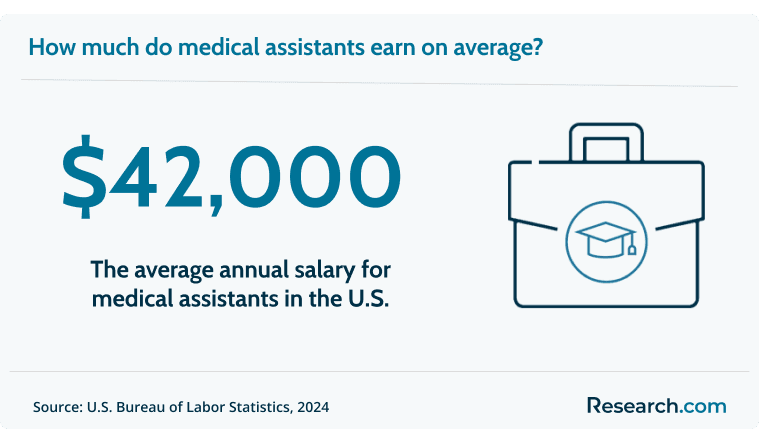
Medical assistants earn an average salary of $42,000 per year, or about $20.19 per hour, according to recent labor statistics. For many people, the appeal is the combination of healthcare exposure, relatively short training, and access to outpatient and physician-office roles.
Pay varies by employer type, location, certification, experience, and specialty. The lowest 10 percent of earners make less than $33,500 annually, while the highest 10 percent earn more than $56,480. Certification, strong clinical skills, electronic health record experience, and work in higher-paying healthcare settings may improve competitiveness.
If you are comparing several patient-facing support roles, it may also help to review the differences between a medical assistant and a certified nursing assistant, since the two jobs can differ substantially in duties, settings, and advancement options.
What are the responsibilities of a pharmacy technician?
A pharmacy technician helps pharmacists dispense medications accurately and keep pharmacy operations moving. The role requires precision, confidentiality, customer service, and a careful understanding of pharmacy procedures.
- Preparing prescriptions: Pharmacy technicians count tablets, measure liquids, package medications, and apply labels based on prescription instructions and pharmacy procedures.
- Processing prescription orders: They enter prescription information, check that key details are present, and prepare orders for pharmacist review.
- Maintaining inventory: Pharmacy technicians track stock, identify expired medications, organize storage areas, and help order replacement inventory.
- Helping patients and customers: They answer basic questions about refills, pickup times, insurance status, and over-the-counter products, while referring clinical medication questions to the pharmacist.
- Supporting medication dispensing: They prepare filled prescriptions for final pharmacist verification and make sure packaging and labeling are complete.
- Reducing medication errors: Pharmacy technicians help protect patient safety by double-checking details, watching expiration dates, and following pharmacy protocols.
- Handling insurance claims: They enter insurance information, troubleshoot rejected claims, verify coverage details, and communicate with patients about approval or denial issues. This medication and payer knowledge can also be useful for people later exploring pharmaceutical sales career paths.
- Compounding medications when allowed: In some settings, pharmacy technicians help prepare customized medications, such as creams, ointments, or special dosage forms, under required supervision.
- Keeping pharmacy records accurate: They help maintain prescription histories, refill documentation, patient profiles, and other records needed for compliance.
Who is pharmacy technology best for?
- You like detail-heavy work where accuracy matters.
- You are interested in medications, dosage forms, and pharmacy systems.
- You prefer a structured workflow with clear procedures.
- You are comfortable with customer service, insurance questions, and fast-paced prescription processing.
How much do pharmacy technicians earn on average?
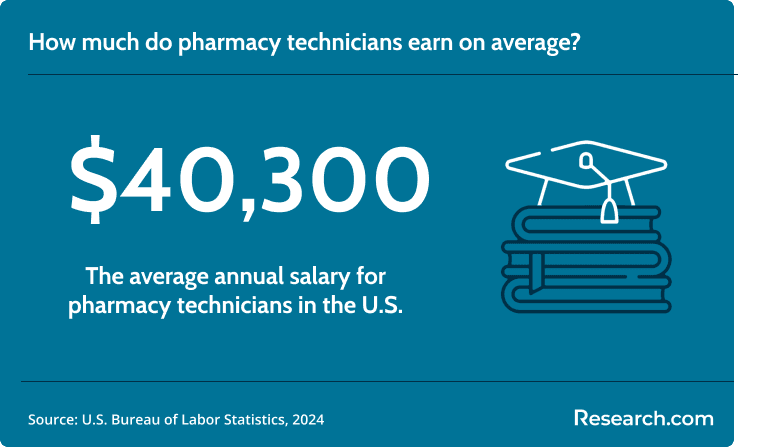
Pharmacy technicians earn around $40,300 per year on average, or approximately $19.37 per hour. The role can be a practical way to enter healthcare for people interested in medication safety, pharmacy operations, and prescription systems.
Income depends on workplace, location, experience, and certification. The lowest 10 percent of pharmacy technicians earn less than $32,720, while the highest 10 percent earn more than $57,130 annually. Hospital and outpatient settings may offer higher pay than some retail settings, especially when the role involves more technical or specialized pharmacy duties.
If compensation is one of your main decision points, compare this role with nearby healthcare support jobs as well. For example, Research.com covers patient care technician salary information, which may help you decide whether you prefer pharmacy-based work or more direct bedside support.
What education is required to become a pharmacy technician vs. a medical assistant?
Both careers can be entered faster than many licensed healthcare professions, but the training emphasis is different. Medical assistant programs usually teach both clinical and administrative office skills. Pharmacy technician programs focus on medication preparation, pharmacy law, drug safety, and prescription processing.
| Requirement | Pharmacy technician | Medical assistant |
| Minimum starting education | High school diploma or equivalent. | High school diploma or equivalent. |
| Common training route | On-the-job training or a pharmacy technician certificate program. | Certificate, diploma, or associate degree in medical assisting. |
| Typical program length | Usually 6 months to 1 year for many certificate programs. | Often 1 year for a certificate or 2 years for an associate degree. |
| Main subjects | Pharmacology, prescription processing, medication safety, pharmacy law, inventory, and dosage calculations. | Vital signs, injections, exam-room support, basic lab procedures, medical records, scheduling, billing, and patient communication. |
| Certification | Often preferred by employers; common options include PTCE or the Exam for Certification of Pharmacy Technicians (ExCPT). | Often preferred by employers; common options include CMA and RMA credentials after eligible training. |
| Continuing education | Certified pharmacy technicians are required to complete continuing education credits every two years. | Certified medical assistants may need continuing education to maintain credentials and keep skills current. |
Education path for pharmacy technicians
- Finish high school or an equivalent credential: This is the usual starting point before formal training, certification, or employer-based pharmacy training.
- Complete pharmacy technician training when needed: Programs may be offered by community colleges, vocational schools, and online providers. Students interested in advanced pharmacy education can also explore how pharmacy education continues into higher-level options such as online pharmacy school pathways.
- Pursue certification if it supports your goals: Certification may improve employability and is commonly preferred in many pharmacy settings.
- Maintain continuing education: CE helps certified technicians stay current with pharmacy laws, technology, and medication safety practices.
Education path for medical assistants
- Complete high school or an equivalent credential: This is the baseline requirement before entering most medical assisting programs.
- Choose a medical assisting program: Many students compare community colleges, vocational programs, and medical assistant trade schools for program length, hands-on training, cost, and certification eligibility.
- Consider certification: Although certification may not be legally required in every setting, many employers prefer applicants who hold a recognized credential.
- Keep skills updated: Medical assistants need to adapt as office systems, patient-care practices, and healthcare technology change.
Which certification is more valuable: CMA or CPhT?
The more valuable certification is the one that matches the job you want. CMA is more relevant for medical assistant roles. CPhT is more relevant for pharmacy technician roles. Employers usually value credentials that prove you are trained for the specific tasks of the position.
| Certification | Best for | What it signals to employers | When it makes sense |
| Certified Medical Assistant (CMA) | Medical assisting jobs in clinics, physician offices, outpatient centers, and similar settings. | You are prepared for a mix of clinical and administrative medical office duties. | Choose this if you want patient intake, exam-room support, vital signs, injections where permitted, records, and office workflow. |
| Certified Pharmacy Technician (CPhT) | Pharmacy technician jobs in retail, hospital, outpatient, and other pharmacy environments. | You are prepared to support prescription processing, medication preparation, inventory, and pharmacy safety. | Choose this if you want a medication-focused role and plan to work directly in pharmacy operations. |
The CMA credential is awarded by the American Association of Medical Assistants (AAMA) and is widely recognized for medical assisting. The CPhT credential is widely valued in pharmacy settings, especially when employers want evidence of pharmacy-specific knowledge and accuracy.
In practical terms, CMA may offer broader use across clinical office environments, while CPhT is more specialized for pharmacy work. If you are unsure, look at job postings in your area and note which credential employers request most often.
How do accredited programs and continuous education shape long-term career success?
Accreditation matters because it can affect certification eligibility, employer confidence, transfer options, and the quality of training you receive. A program that teaches the right skills but does not meet recognized standards may create problems later if you need a credential, want to move employers, or plan to continue your education.
Continuing education also matters because both roles operate in regulated healthcare environments. Pharmacy technicians need to stay current on medication safety, pharmacy rules, and technology. Medical assistants need to keep up with clinical procedures, documentation systems, patient privacy expectations, and office workflows.
For medical assistants who lean toward administrative healthcare work, related skills in records, billing, coding, and documentation can expand options. Research.com’s guide to accredited medical billing and coding programs online may be useful if you want a more office-based healthcare path.
What are the long-term career advancement opportunities beyond entry-level roles?
Both roles can be starting points, but advancement usually requires experience, strong performance, certification, and sometimes additional education. The right next step depends on whether you want to move deeper into clinical care, pharmacy operations, administration, management, or another healthcare field.
| Starting role | Possible next steps | What usually helps |
| Medical assistant | Lead medical assistant, specialty clinic assistant, medical office coordinator, billing or coding role, healthcare administration support, or further education in nursing or allied health. | CMA or other credential, EHR proficiency, phlebotomy or specialty experience, strong patient communication, and leadership experience. |
| Pharmacy technician | Lead pharmacy technician, hospital pharmacy technician, compounding technician, inventory specialist, pharmacy operations support, or further pharmacy education. | CPhT credential, hospital or sterile preparation experience where applicable, inventory skills, insurance knowledge, and strong accuracy record. |
Some workers also use these roles to test whether healthcare is the right long-term field before pursuing more advanced credentials. Others move toward management. If you eventually want broader operations or administrative leadership outside clinical healthcare, comparing management-oriented programs such as online sports administration master's programs can help you understand how graduate management training differs across industries.
What is the return on investment for pharmacy technician and medical assistant careers?
Return on investment depends on training cost, time out of the workforce, certification expenses, local wages, job availability, and whether the role helps you move toward a higher-paying healthcare career. Pharmacy technician training may require a shorter upfront time commitment in many cases. Medical assistant training may take longer but can provide a broader mix of clinical and administrative skills.
| ROI factor | Medical assistant | Pharmacy technician |
| Training time | Often 1 year for a certificate or 2 years for an associate degree. | Often 6 months to 1 year for a certificate program, or employer-based training in some cases. |
| Average salary | $42,000 per year, or about $20.19 per hour. | Around $40,300 per year, or about $19.37 per hour. |
| Projected growth | 15% from 2023 to 2033. | 7% from 2023 to 2033. |
| Career flexibility | Broader exposure to patient care, medical records, office operations, and clinical workflow. | More specialized exposure to medications, pharmacy law, prescription processing, and pharmacy systems. |
| Best ROI when | You choose a reasonably priced accredited program, earn a credential employers value, and work in a setting with advancement opportunities. | You complete training efficiently, earn certification if employers prefer it, and pursue higher-skill pharmacy settings when possible. |
Neither path guarantees a specific salary or promotion. To assess ROI honestly, compare total program cost against local job postings, employer credential preferences, schedule flexibility, and the next role you may want. If your long-term goal is to move into more advanced clinical or administrative careers, you may also want to compare these roles with pathways leading to some of the highest paid medical jobs.
What is the job growth rate for pharmacy techs vs. medical assistants?
Medical assisting has the stronger projected growth rate in the available data. Employment for medical assistants is expected to rise 15% from 2023 to 2033, while employment for pharmacy technicians is projected to increase 7% over the same period.
- Medical assistants: Employment is projected to grow from 783,900 jobs to 901,900 jobs between 2023 and 2033. This reflects the continued need for support staff in physicians’ offices, clinics, outpatient care, and other medical settings.
- Pharmacy technicians: Employment is projected to increase from 463,900 jobs to 497,200 jobs from 2023 to 2033. Demand remains steady as pharmacies, hospitals, and outpatient services continue to rely on technicians for prescription and medication-support work.
For job security, the growth rate is only one factor. You should also look at local openings, employer type, certification requirements, pay ranges, commute options, and whether the work setting matches your personality.
How does ongoing education impact career advancement?
Ongoing education can help both medical assistants and pharmacy technicians stay competitive, especially when employers adopt new software, update workflows, or expand responsibilities. It also shows supervisors that you are serious about accuracy, compliance, and patient safety.
- For medical assistants: Continuing education may support recertification, improve clinical confidence, strengthen documentation skills, and prepare workers for lead or specialty roles.
- For pharmacy technicians: Continuing education helps maintain certification, reinforces medication safety, and supports movement into more advanced pharmacy environments.
- For career changers: Additional education can help you pivot from an entry-level role into health administration, billing and coding, nutrition, nursing, pharmacy, or another allied health area.
If your interests shift toward nutrition, wellness, or advanced health education, Research.com’s overview of accelerated online master’s programs in nutrition can help you compare a different graduate-level healthcare direction.
What skills are needed to be a successful pharmacy tech or medical assistant?
Both roles require professionalism, confidentiality, communication, and attention to detail. The difference is how those skills are used: medical assistants apply them in patient visits and clinic operations, while pharmacy technicians apply them in prescription and medication workflows.
| Skill area | Medical assistant | Pharmacy technician |
| Accuracy | Needed for vital signs, records, patient histories, specimen labels, and procedure support. | Essential for prescriptions, dosage forms, labels, inventory, and insurance information. |
| Communication | Used with patients, providers, front-office staff, and insurance contacts. | Used with pharmacists, patients, prescribers’ offices, and insurance systems. |
| Technical knowledge | Basic clinical procedures, medical terminology, EHR systems, infection control, and office workflow. | Medication names, pharmacy law, dosage calculations, dispensing systems, and inventory procedures. |
| Customer service | Important for greeting patients, calming concerns, explaining visit steps, and routing messages. | Important for prescription pickups, refills, insurance issues, and general pharmacy support. |
| Multitasking | Frequent switching between patients, exam rooms, calls, records, and provider requests. | Balancing prescription queues, phone calls, customers, inventory, and pharmacist requests. |
| Empathy | Especially important because medical assistants often work with patients who are anxious, sick, or in pain. | Important when helping customers who may be confused, frustrated, or worried about medications or coverage. |
If you are comparing hands-on healthcare roles more broadly, you may also want to review the difference between a medical assistant and an EMT, especially if emergency care interests you.
Where do pharmacy technicians usually work compared to medical assistants?
Medical assistants and pharmacy technicians work in different parts of the healthcare system. Medical assistants are usually attached to patient visits and clinical offices. Pharmacy technicians are attached to medication dispensing, prescription services, and pharmacy operations. Research.com also provides a separate guide on the pharmacy technician career path if you want a step-by-step route into that role.
Medical assistant work settings and average pay
| Work setting | Average annual salary | What the work is often like |
| Outpatient care centers | $46,090 per year | Medical assistants may support preventive care, diagnostic visits, patient intake, and minor procedures in a fast-moving outpatient environment. |
| Hospitals, including state, local, and private hospitals | $44,350 annually | The role may involve patient intake, procedure preparation, lab-related support, and coordination with larger care teams. |
| Offices of physicians | $40,670 per year | Medical assistants often handle both front-office and exam-room duties, including scheduling, room preparation, vital signs, and chart updates. |
| Offices of other health practitioners | $36,480 per year | Work may be tied to specialized practices such as chiropractic, podiatry, physical therapy, or other focused healthcare services. |
| Specialty clinics, including OB-GYN and pediatrics | Not separately stated in the provided data | Medical assistants may work closely with a specific patient population and develop specialty-specific workflow knowledge. |
Pharmacy technician work settings and average pay
| Work setting | Average annual salary | What the work is often like |
| Ambulatory healthcare services | $48,270 per year | Technicians may support outpatient pharmacy services, medication preparation, compounding, or specialized pharmacy workflows. |
| Hospitals, including state, local, and private hospitals | $47,940 annually | The work can be more technical and urgent, with a focus on inpatient medication preparation and accurate dosing support. |
| General merchandise retailers | Approximately $44,500 per year | Technicians balance prescription duties with retail customer service in large store pharmacy departments. |
| Grocery and specialty food retailers | $37,420 annually | Work commonly includes refills, customer questions, inventory support, and routine prescription processing. |
| Pharmacies and drug retailers | Around $37,370 annually | Traditional retail pharmacy roles often involve high prescription volume, customer service, inventory, and insurance processing. |
The best setting depends on your tolerance for pace, customer interaction, clinical exposure, and technical complexity. Hospitals and outpatient environments may offer different responsibilities than retail or small-office settings.
Will technological advancements reshape pharmacy technician and medical assistant careers?
Technology is already changing both roles. Pharmacy technicians increasingly work with automated dispensing systems, digital inventory tools, electronic prescription platforms, and pharmacy management software. Medical assistants increasingly use electronic health records, telehealth systems, patient portals, digital scheduling tools, and connected clinical devices.
These tools do not remove the need for careful workers. They shift the value of the role. Employers may place greater emphasis on people who can use technology accurately, notice errors, protect patient information, and communicate clearly when systems create confusion for patients.
Workers who enjoy science and technology may eventually explore broader healthcare or life science paths. For example, Research.com covers higher-paying careers for biology majors, which can be useful if you later decide to pursue more advanced education.
Common mistakes to avoid when choosing between these careers
| Mistake | Why it can hurt your decision | Better approach |
| Choosing only by average salary | The salary difference is not the only factor, and local pay may differ by employer and setting. | Compare job postings near you, including certification requirements, schedules, benefits, and advancement options. |
| Ignoring accreditation and certification eligibility | A low-cost program may not prepare you for the credential employers prefer. | Ask whether the program meets recognized standards and whether graduates are eligible for relevant certification exams. |
| Assuming both jobs involve the same kind of patient care | Medical assistants usually have more direct clinical interaction; pharmacy technicians usually focus more on prescriptions and medication systems. | Shadow, interview workers, or review detailed job descriptions before enrolling. |
| Focusing only on program length | The fastest option is not always the best if it limits training quality or employer recognition. | Balance speed with cost, hands-on practice, certification outcomes, and local employer preferences. |
| Overlooking work environment | A retail pharmacy, hospital pharmacy, physician office, and outpatient clinic can feel very different day to day. | Decide whether you prefer clinic workflow, pharmacy workflow, hospital pace, or retail customer interaction. |
| Assuming a credential guarantees a raise | Certification can help, but pay depends on location, employer, experience, and role scope. | Ask employers which credentials they reward and how advancement decisions are made. |
Questions to ask before enrolling in a program
- Is the program accredited or otherwise recognized by employers in my area?
- Which certification exam does the program prepare students for?
- How long does the program take full-time and part-time?
- What is the total cost, including books, fees, uniforms, background checks, exam fees, and supplies?
- Does the program include hands-on practice, externship experience, or clinical placement support?
- What percentage of graduates find work in the field, and how is that measured?
- Do local employers prefer CMA, CPhT, or another credential?
- Can credits transfer if I later pursue a higher credential or degree?
- What schedule options are available for working adults?
- What support is available for resume writing, interviews, and job placement?
How to decide: medical assistant or pharmacy technician?
Use your preferred workday as the deciding factor. If you want to greet patients, take vitals, prepare exam rooms, assist with clinical procedures, and support medical office operations, medical assisting is likely the stronger match. If you prefer prescriptions, medication preparation, insurance processing, inventory, and working with pharmacists, pharmacy technology is likely the better fit.
| Choose medical assistant if... | Choose pharmacy technician if... |
| You want frequent direct patient interaction. | You are interested in medications and prescription systems. |
| You like variety between clinical and administrative tasks. | You prefer accuracy-driven technical routines. |
| You want experience in clinics, physician offices, or outpatient care. | You want experience in retail, hospital, or outpatient pharmacy settings. |
| You may later pursue nursing, allied health, office management, or clinical specialty roles. | You may later pursue advanced pharmacy roles, hospital pharmacy work, compounding, or pharmacy education. |
| You are comfortable helping patients who may be nervous, sick, or uncomfortable. | You are comfortable handling customer questions, insurance issues, and medication-related workflows. |
Graduate perspectives: what workers often value in each path
-
: "
Medical assisting gave me a way to work with patients every day while learning how clinics operate. I like that no two shifts feel exactly the same. – Gwen
"
-
: "
Pharmacy technology appealed to me because the work requires focus and precision. Knowing that accuracy supports medication safety makes the responsibility meaningful. – Tom
"
-
: "
I chose medical assisting because I wanted both office responsibilities and clinical work. The variety keeps me engaged, and I feel connected to the care team. – Stacey
"
Key Insights
- Medical assistant is generally the better fit for people who want direct patient care, clinic workflow, and a mix of clinical and administrative duties.
- Pharmacy technician is generally the better fit for people who prefer medication safety, prescription processing, insurance systems, and pharmacy operations.
- Medical assistants earn an average salary of $42,000 per year, while pharmacy technicians earn around $40,300 per year on average.
- Medical assistant employment is projected to grow 15% from 2023 to 2033, compared with 7% projected growth for pharmacy technicians.
- Training timelines differ: pharmacy technician certificate programs often take 6 months to 1 year, while medical assistant programs often take 1 year for a certificate or 2 years for an associate degree.
- CMA is most useful for medical assistant roles; CPhT is most useful for pharmacy technician roles. Choose certification based on the job you actually want.
- Before enrolling, verify accreditation, certification eligibility, total cost, hands-on training, employer recognition, and local job demand.
- Do not choose based on salary alone. Work environment, daily tasks, advancement options, and your comfort with patients or prescriptions matter just as much.
References:
- U.S. Bureau of Labor Statistics. (2024). OOH: Medical Assistants. https://www.bls.gov
- U.S. Bureau of Labor Statistics. (2024). OOH: Pharmacy Technicians. https://www.bls.gov
Other things you should know about medical assistants vs. pharmacy technicians
Most pharmacy technicians pursue the Pharmacy Technician Certification Exam (PTCE) from the Pharmacy Technician Certification Board or the Exam for the Certification of Pharmacy Technicians (ExCPT) from the National Healthcareer Association. Many states also require registration with the state board of pharmacy before work starts.
Medical assistants often handle patient care tasks such as measuring vital signs and assisting with exams, while pharmacy technicians focus on tasks like medication dispensing and inventory management. This distinction highlights their differing roles in healthcare settings as of 2027.