2027 How to Become a Pharmacy Technician

Co-Founder and Chief Data Scientist
Becoming a pharmacy technician can be a practical way to enter healthcare without spending years in school, but the path is not the same in every state. Requirements can include a high school diploma or GED, formal training, national certification, state registration or licensure, background checks, and continuing education. This guide explains what pharmacy technicians do, how to qualify, what certification means, how salary and location affect earnings, and which career paths can help you move beyond entry-level retail roles.
Use this guide if you are comparing pharmacy technician training programs, deciding whether certification is worth it, checking state requirements, or planning a longer healthcare career. You will also learn how technology, specialization, and business skills are changing the role so you can make a more informed decision before paying for a program or applying for jobs.
Quick Answer: How Do You Become a Pharmacy Technician?
Most pharmacy technicians start with a high school diploma or GED, complete a pharmacy technician training program or employer-based training, pass a national certification exam such as the PTCB or NHA exam if required or preferred, and register or become licensed if their state requires it. Certification is not always legally required in every state, but it can improve employability, support advancement, and help technicians qualify for specialized pharmacy roles.
Key Things You Should Know About Becoming a Pharmacy Technician
- Education: A high school diploma or equivalent is commonly the first requirement. Many candidates then complete a pharmacy technician certificate program, diploma program, or associate-level option.
- Certification: Employers often prefer technicians who hold national certification from organizations such as the Pharmacy Technician Certification Board or the National Healthcareer Association.
- State licensure or registration: Many states require pharmacy technicians to register, obtain a license, complete a background check, pay fees, or meet state-specific training rules before working.
- Specialized practice areas: Technicians can build expertise in sterile compounding, nuclear pharmacy, informatics, home infusion, medication reconciliation, billing, or inventory control.
- Professional credentials: Earning certification helps demonstrate baseline competency, but advanced credentials may be useful for hospital, compounding, or supervisory positions.
- Continuing education: Certified and licensed technicians usually need continuing education to renew credentials and stay current with pharmacy law, safety practices, and medication systems.
- Core skills: Accuracy, math ability, organization, communication, confidentiality, computer literacy, and calm decision-making are essential because medication errors can affect patient safety.
- Work environment: Pharmacy technicians often work in busy settings, stand for extended periods, handle repetitive tasks, and balance patient service with strict accuracy standards.
- Pay factors: Earnings depend heavily on location, employer type, certification, experience, shift, and whether the technician moves into a specialized or lead role.
- Job outlook: Demand is supported by prescription volume, healthcare access needs, and pharmacy workflow changes, but automation is also reshaping the tasks technicians perform.
- Professional qualities: Reliability, integrity, discretion, attention to detail, and a strong work ethic matter because technicians handle medications, patient records, and controlled workflows.
- Steps to become a pharmacy technician for 2027
- What pharmacy technicians do at work
- Education and training requirements
- Skills employers expect from pharmacy technicians
- Certification, registration, and licensing
- Legal and ethical responsibilities
- Pharmacy technician salary and pay factors
- How technology is changing the job
- How online training can support advancement
- Continuing education and long-term career securityOnline pharmacy technician training options
- Job outlook and hiring settings
- Specialties and advancement paths
- ROI of pharmacy technician education
- Business skills for pharmacy career growth
- Challenges to consider before choosing this career
- Pharmacy technicians and community health
- Leadership and administration pathways for techniciansCommunity health responsibilitiesCareer challenges to review
How can you become a pharmacy technician for 2027?
The route to becoming a pharmacy technician is usually shorter than many healthcare careers, but it still requires careful planning. Your exact path depends on your state, the employer you want, and whether you plan to work in retail, hospital, long-term care, compounding, or another setting.
- Earn a high school diploma or GED. This is the baseline credential for most training programs and pharmacy technician jobs.
- Check your state board of pharmacy requirements. Before enrolling in a program, confirm whether your state requires registration, licensure, specific training hours, certification, background screening, or renewal.
- Choose a training route. You may complete a pharmacy technician certificate, diploma, associate-level program, employer-sponsored training, or a combination of classroom and clinical experience.
- Build practical experience. Externships, internships, simulations, and entry-level pharmacy work help you practice prescription processing, inventory tasks, customer service, and medication safety procedures.
- Prepare for national certification. Many candidates take a certification exam through the Pharmacy Technician Certification Board or National Healthcareer Association, depending on employer and state expectations.
- Apply for state registration or licensure if required. This may involve an application, fee, background check, proof of training, or proof of certification.
- Keep credentials active. Renewal usually requires meeting continuing education rules, following state regulations, and paying renewal fees when due.
The best first step is not choosing a school; it is checking your state’s rules. A program that looks convenient or inexpensive may not meet certification eligibility or state practice requirements where you plan to work.
| Step | Why it matters | Questions to ask before moving forward |
| Confirm state rules | Requirements vary and may affect whether you can work legally after training. | Does my state require registration, licensure, certification, background checks, or specific training? |
| Select a training option | The right program can prepare you for certification, externships, and job applications. | Is the program aligned with the certification exam and employer expectations in my area? |
| Gain hands-on practice | Pharmacy work requires accuracy under time pressure, which is difficult to learn from reading alone. | Does the program include labs, simulations, externships, or employer partnerships? |
| Earn certification | Certification can strengthen job applications and support advancement into specialized roles. | Which exam do local employers prefer: PTCB, NHA, or another credential? |
| Maintain credentials | Technicians must stay current with medication safety, law, technology, and practice standards. | What continuing education will I need and how often must I renew? |
What does a pharmacy technician do?
Pharmacy technicians support pharmacists by handling many of the operational, administrative, and medication-preparation tasks that keep a pharmacy running safely. They do not replace pharmacists, and they work under pharmacist supervision, but their responsibilities are central to prescription accuracy, patient service, inventory control, and workflow efficiency.
- Prescription processing: Receive prescription information, enter patient and medication details, prepare labels, and route items for pharmacist verification.
- Medication dispensing support: Count, package, measure, or prepare medications according to established procedures and supervision rules.
- Inventory management: Order, stock, rotate, and organize medications and supplies while monitoring shortages, expiration dates, and controlled workflows.
- Sterile compounding support: In qualified settings, assist with IV solutions and sterile preparations using strict safety procedures.
- Patient and customer service: Answer basic questions within scope, collect information, process payments, and refer clinical questions to the pharmacist.
- Insurance and billing tasks: Submit claims, troubleshoot rejections, update coverage information, and communicate with patients about billing issues.
- Recordkeeping: Maintain accurate prescription, inventory, and patient information according to workplace policy and law.
- Technology use: Operate pharmacy management systems, automated dispensing tools, barcode scanning systems, inventory software, and electronic health record interfaces where applicable.
The work differs by setting. A retail technician may spend much of the day interacting with patients and processing prescriptions, while a hospital technician may focus more on medication distribution, unit-dose packaging, sterile products, and coordination with clinical teams.
| Work setting | Typical technician duties | Best fit for candidates who want |
| Retail or community pharmacy | Prescription intake, patient service, insurance processing, refills, inventory, payment support | Frequent public interaction and a fast-paced customer-facing role |
| Hospital pharmacy | Medication distribution, sterile compounding support, unit-dose preparation, coordination with nurses and pharmacists | Clinical workflow exposure and more specialized medication systems |
| Long-term care pharmacy | Medication packaging, cycle fills, facility coordination, medication records, delivery support | Structured processes and service to nursing homes or care facilities |
| Home infusion pharmacy | Compounded preparations, supply coordination, patient delivery support, sterile workflow tasks | Specialized preparation and coordination for patients receiving care at home |
| Managed care or insurance setting | Prior authorization support, claims review, benefits coordination, documentation | Administrative pharmacy work with less direct dispensing |
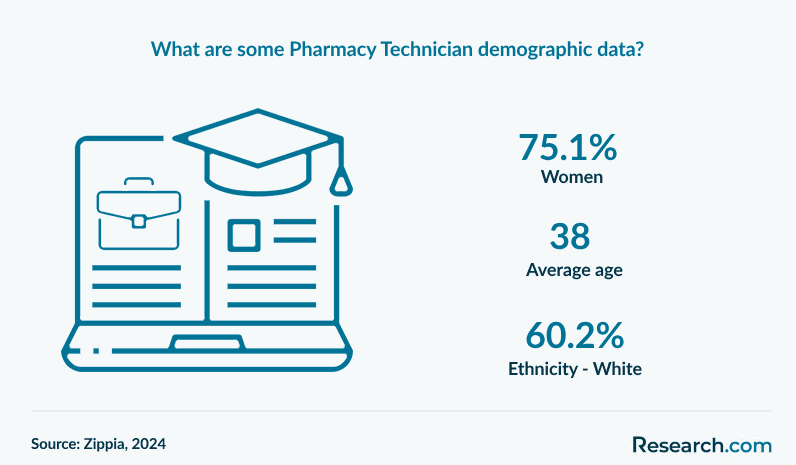
According to Zippia's 2024 data, women account for 75.1% of the pharmacy technician workforce. The average age of a pharmacy technician is 38 years old. By ethnicity, White technicians make up 60.2% of the workforce, Hispanic or Latino technicians account for 14.5%, Asian technicians represent 10.1%, and Black or African American technicians account for 8.6%. These figures, summarized in the visual below, point to a workforce that is majority female and includes meaningful ethnic diversity.
What are the educational requirements for becoming a pharmacy technician?
Pharmacy technician education ranges from employer training to formal certificate, diploma, or associate-level programs. The right option depends on your budget, schedule, state rules, and career goals. A short program may be enough for an entry-level community pharmacy role, while a more structured program with externship experience may be better for hospital or specialized practice.
- High school diploma or GED: Most employers and training providers expect applicants to have completed secondary education or an equivalent credential.
- Formal pharmacy technician program: Programs often cover pharmacy law, ethics, medication safety, pharmacology, dosage calculations, medical terminology, sterile and nonsterile preparation concepts, and pharmacy operations.
- Externship or practical training: Many programs include supervised practice in a pharmacy setting so students can apply classroom concepts to real workflows.
- Program entry requirements: Depending on the school or employer, students may need background checks, drug screenings, immunization documentation, or technical standards clearance.
- Career bridge options: Some pharmacy technicians later move into other healthcare fields. For example, those considering patient-care roles may compare pharmacy work with online nursing programs for non nurses.
| Training option | Potential advantages | Possible drawbacks | When it makes sense |
| Employer-based training | May let you earn while learning and gain immediate workplace exposure. | Training quality and certification preparation can vary by employer. | You need a low-cost entry route and have employers nearby that train new technicians. |
| Certificate or diploma program | Focused curriculum, shorter route than many degree programs, and often designed around certification preparation. | Costs and externship quality vary, so program comparison is important. | You want structured preparation for entry-level pharmacy technician jobs. |
| Associate-level pathway | May include broader general education and more time for healthcare coursework. | Usually takes longer than a certificate route and may cost more. | You want a broader academic foundation or may later transfer credits into another healthcare degree. |
| Online or hybrid program | Flexible scheduling can help working adults and caregivers complete didactic coursework. | Hands-on labs, externships, and state eligibility must be verified carefully. | You need flexibility but can still complete required practical training. |
What skills are required for pharmacy technicians?
Pharmacy technicians need more than basic medication knowledge. The role combines precision, speed, professionalism, technology use, and patient service. Small errors can create serious risks, so employers look for candidates who can follow procedures consistently even during busy shifts.
- Accuracy and detail orientation: Prescription information, medication names, quantities, labels, and patient records must be handled carefully.
- Math skills: Technicians use calculations for measurements, dosages, conversions, quantities, and compounding support.
- Computer literacy: Pharmacy management software, electronic records, claims systems, barcode tools, and automated equipment are part of daily work.
- Communication: Technicians must communicate clearly with pharmacists, patients, prescribers’ offices, insurers, delivery teams, and other healthcare staff.
- Organization: Inventory, refill queues, phone calls, prescriptions, and documentation all compete for attention.
- Problem-solving: Insurance rejections, missing information, inventory issues, and patient concerns often require quick escalation or troubleshooting.
- Customer service: Community pharmacy technicians frequently work with patients who may be ill, frustrated, rushed, or confused about coverage.
- Medical terminology: Understanding common medical and pharmaceutical terms helps technicians process prescriptions and communicate with care teams.
- Medical coding awareness: Pharmacy technicians do not need to become coders for most roles, but understanding healthcare codes can be useful in billing-heavy settings. Some of the cheapest medical coding certification online options introduce coding systems used across healthcare administration.
- Law and ethics: Technicians must respect scope-of-practice limits, privacy rules, controlled substance procedures, and pharmacist supervision requirements.
- Sterile technique: In hospital, infusion, and compounding environments, technicians may need training in sterile preparation processes.
- Inventory control: Ordering, stocking, shortage management, recalls, expiration checks, and storage requirements affect pharmacy operations.
- Pressure management: The job can involve long lines, phone calls, insurance delays, urgent prescriptions, and strict accuracy expectations.
- Teamwork: Technicians work closely with pharmacists and other staff, so dependable collaboration is essential.
- Time management: Successful technicians know how to prioritize work without cutting safety corners.
| Skill area | Why employers value it | How to build it |
| Medication accuracy | Reduces dispensing risks and supports pharmacist verification. | Practice label reading, double-checking routines, and medication safety procedures. |
| Pharmacy math | Supports measurements, quantities, conversions, and compounding tasks. | Use dosage calculation exercises and repeat practice until calculations are consistent. |
| Patient communication | Improves service and helps route clinical questions appropriately. | Practice professional scripts, active listening, and escalation to the pharmacist. |
| Technology fluency | Pharmacies increasingly rely on software, automation, scanning, and electronic documentation. | Choose programs with software exposure and ask employers about system training. |
| Confidentiality | Patient information must be protected under privacy and workplace rules. | Study HIPAA expectations and follow secure documentation practices. |
What is the certification and licensing process for pharmacy technicians?
Certification and licensure are often confused, but they are not the same. Certification is usually a professional credential earned by passing an exam from a national organization. Licensure or registration is a state-level authorization process that may be required before you can work as a pharmacy technician in that state.
- National certification: Candidates commonly pursue exams through the Pharmacy Technician Certification Board or the National Healthcareer Association. Employers may prefer one credential over another.
- Certification maintenance: Certified technicians typically need continuing education and periodic renewal to keep credentials active.
- State registration or licensure: State boards of pharmacy may require applications, fees, background checks, age or education minimums, training documentation, exams, or proof of certification.
- Scope of practice: State rules and employer policies determine which tasks technicians may perform and which duties must remain with pharmacists.
Before paying for training, verify three things: whether your state accepts the program, whether the program prepares you for the certification exam you plan to take, and whether local employers recognize the credential.
Certification vs. Licensure vs. Registration
| Requirement type | Who controls it | What it usually shows | Why it matters |
| Certification | National credentialing organization | You met exam and credential standards. | Can improve job prospects and may be required by some employers or states. |
| Licensure | State board or regulatory authority | You are authorized to practice under that state’s rules. | May be legally required before working. |
| Registration | State board or regulatory authority | You are listed with the state as a pharmacy technician. | Often required for tracking, compliance, and public protection. |
Additional Credentials That May Improve Marketability
Specialized credentials can help technicians compete for roles in compounding, hospitals, medication safety, billing, informatics, or lead technician positions. If you want to broaden into healthcare administration or revenue-cycle work, reviewing a medical coding certification comparison CBCS vs CPC can help you understand how billing and coding credentials differ from pharmacy technician certification.
Location Matters
Where you work can affect job availability, pay, and licensing requirements. Among the states highlighted in the source data, Kentucky has the highest concentration of pharmacy technician jobs, with 10,160 jobs. Tennessee also shows a substantial concentration, with 12,350 jobs. Florida has the largest total employment figure at 37,980. Alabama reports 8,340 jobs, while West Virginia reports 3,530. The chart below shows why total job count and job concentration should be interpreted differently: Florida has the largest number of jobs, while Kentucky and Tennessee stand out for concentration relative to population size.
What ethical and legal guidelines should you observe as a pharmacy technician?
Pharmacy technicians work with medications, personal health information, controlled systems, insurance details, and patients who may be vulnerable. Ethical conduct is not optional; it is part of safe pharmacy practice.
- Protect patient privacy: Follow HIPAA and workplace privacy procedures when handling patient records, prescriptions, conversations, and electronic information.
- Prioritize dispensing accuracy: Use verification steps, avoid shortcuts, and escalate any uncertainty to the pharmacist.
- Follow pharmacy laws and regulations: Comply with federal rules, state board requirements, controlled substance procedures, and employer policies.
- Stay within scope: Do not provide counseling, clinical judgment, or advice that must legally come from a pharmacist or other licensed professional.
- Report errors and near misses: Medication safety improves when technicians promptly report concerns, discrepancies, and workflow risks.
- Avoid conflicts of interest: Patient welfare, safety, and legal compliance should guide decisions.
- Maintain professional boundaries: Interactions with patients should remain respectful, appropriate, and focused on care and service.
Technicians interested in the legal side of healthcare compliance may also explore related education in law-focused support roles, including affordable paralegal certificate programs.
How much can you earn as a pharmacy technician?
Pharmacy technician pay varies widely by state, employer, role level, certification, shift, and specialization. Entry-level community pharmacy jobs may pay less than hospital, lead, specialty, or supervisory positions. Location also matters because state wage levels and local labor markets differ substantially.
Pharmacy technician salaries generally do not match some higher-paying healthcare career tracks. If you are still comparing health-related options, you may want to review top paying careers exercise science degree to understand how salary potential differs across healthcare and wellness roles.
For workers who want to move into higher-level healthcare roles beyond technician work, accelerated graduate education may be one option. Some candidates compare career ladders with online master's degree programs you can complete in 6 months, especially if they already hold a bachelor’s degree and want broader advancement options.
According to Salary.com and the U.S. Bureau of Labor Statistics, pay differs by role and geography. The Pharmacy Technician Supervisor role has the highest average salary among the roles cited, at $68,276, while Pharmacy Technician I has the lowest, at $36,486. At the state level, California reports the highest average salary at $55,710. Texas, Florida, New York, and Illinois fall in a range from approximately $41,620 to $43,760. The chart below illustrates how advancement level and location can meaningfully influence earnings.
Certification, experience, specialty training, employer type, and location can all affect pay. Technicians who want to move toward supervisory, operations, or administrative roles may eventually compare healthcare management options, including the cheapest online healthcare management degree programs.
| Factor | How it can affect earnings | What to do before accepting a job |
| State and metro area | Wages often reflect local cost of living, labor demand, and employer competition. | Compare local postings, not just national averages. |
| Employer type | Hospitals, specialty pharmacies, and supervisory roles may differ from retail settings. | Review duties, shifts, benefits, and advancement pathways. |
| Certification | Certified technicians may qualify for more roles or higher-level responsibilities. | Ask whether certification changes starting pay or promotion eligibility. |
| Experience | Lead, senior, and supervisor positions usually require proven reliability and workflow knowledge. | Ask how promotions are handled and what skills are required. |
| Specialization | Sterile compounding, informatics, billing, and inventory roles may open different pay paths. | Find out which specialty skills local employers actually value. |
How is technology transforming pharmacy technician roles?
Technology is changing what pharmacy technicians do each day. Automated dispensing systems, barcode verification, electronic health records, inventory platforms, telepharmacy workflows, and digital communication tools can reduce some manual tasks while increasing the need for technicians who understand systems, documentation, and workflow safety.
This does not mean the role is disappearing. Instead, routine tasks are becoming more technology-supported, while technicians are increasingly expected to troubleshoot systems, manage data accurately, support remote pharmacy services, and work with pharmacists to reduce medication errors. Technicians who are comfortable with software, claims systems, automated packaging, and digital records may have an advantage in more advanced pharmacy settings.
Cross-training can also be useful. For example, learning how healthcare documentation and billing connect to patient care can help technicians understand adjacent roles; a guide on medical coding certification salary may be helpful for those comparing pharmacy work with coding or revenue-cycle careers.
How can online training bolster a pharmacy technician’s career advancement?
Online pharmacy technician training can be useful for working adults, parents, career changers, and students who cannot attend campus every day. However, online convenience should not be the only factor. You still need to verify certification preparation, state eligibility, externship support, technology requirements, and whether the program gives enough practice with pharmacy calculations and medication safety.
Strong online or hybrid programs typically include structured lessons, practice quizzes, pharmacy math support, medication safety content, pharmacy law, and preparation for certification exams. Some also coordinate local externships or practical experiences. Weak programs may provide flexible access but little support, limited faculty interaction, or no clear connection to certification eligibility.
If you are evaluating online healthcare training more broadly, reviewing other allied health formats such as ultrasound tech programs online can help you understand how hands-on requirements are handled in programs that include technical clinical skills.
| What to check in an online program | Why it matters |
| Certification exam alignment | The program should prepare you for the credential employers or your state expect. |
| State eligibility | Online programs may not meet requirements in every state. |
| Externship or practical experience | Hands-on workflow practice can make you more job-ready. |
| Faculty and student support | Pharmacy math, law, and medication topics can be challenging without guidance. |
| Total cost | Compare tuition, books, exam fees, background checks, technology, and renewal expenses. |
| Employer recognition | Ask local pharmacies whether they hire graduates from the program. |
How can ongoing professional development secure your long-term success?
Pharmacy technicians who keep learning are better positioned for changes in medication systems, regulations, automation, sterile compounding standards, and patient service expectations. Continuing education is also needed to maintain many credentials and state authorizations.
Professional development can include certification renewal courses, sterile compounding training, medication safety modules, inventory management, leadership training, billing and reimbursement education, informatics, and employer-provided system training. Technicians who want broader healthcare flexibility may also compare related programs such as accredited medical billing and coding schools online.
Common Professional Development Priorities
- Medication safety: Learn how errors happen and how pharmacy teams prevent them.
- Technology fluency: Build confidence with automated dispensing, inventory systems, electronic records, and digital communication tools.
- Regulatory updates: Stay current on state board rules, controlled substance procedures, privacy standards, and workplace policies.
- Specialty skills: Consider sterile compounding, informatics, home infusion, medication reconciliation, or managed care support.
- Leadership readiness: Develop scheduling, training, conflict resolution, process improvement, and documentation skills.
What is the job market like for pharmacy technicians?
The pharmacy technician labor market is supported by the need for prescription services across retail pharmacies, hospitals, long-term care facilities, mail-order pharmacies, specialty pharmacies, and other healthcare settings. However, competition, pay, and responsibilities vary by location and employer.
- Employment growth: The BLS projects 7% employment growth for pharmacy technicians from 2023 to 2033, which is faster than the average for all occupations.
- Job settings: Pharmacy technicians work in retail, hospital, long-term care, mail-order, managed care, military, veterinary, specialty, and home infusion settings.
- Pay variation: Salaries depend on location, experience, certification, employer, shift, and specialty. Candidates comparing long-term income may also research other fields, including the cheapest online PhD psychology programs, though that path requires a much longer education timeline.
- Technology trends: Automation, electronic records, telepharmacy, and inventory systems are changing technician workflows and increasing the value of digital skills.
- Specialized services: Sterile compounding, medication reconciliation, medication therapy support, billing, and informatics can create advancement opportunities for experienced technicians.
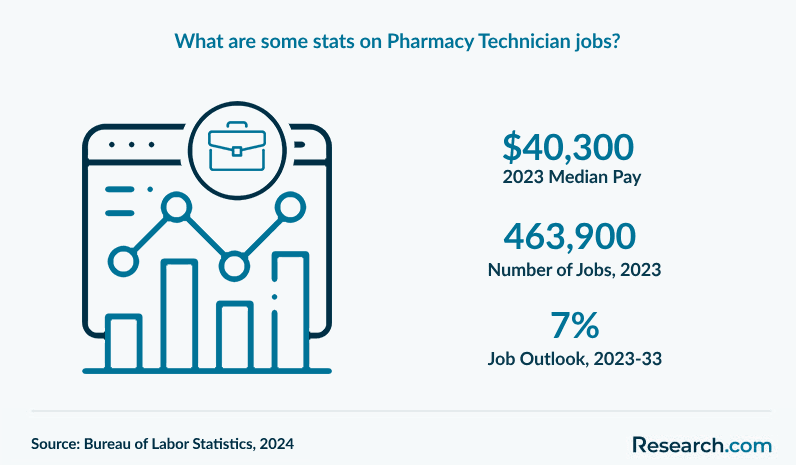
According to the Bureau of Labor Statistics in 2024, pharmacy technicians earned a 2023 median pay of $40,300 per year, or $19.37 per hour. The occupation had 463,900 jobs in 2023. For 2023 to 2033, the BLS projects 7% growth and an employment change of 33,300 jobs. The figure below summarizes these labor market indicators and shows why pharmacy technology remains a stable entry point into healthcare.
The strongest opportunities often go to technicians who combine certification, dependable work habits, technology skills, and experience in higher-complexity pharmacy settings.
What subspecialties and career paths are available for pharmacy technicians?
Pharmacy technician advancement usually comes from specialization, leadership, employer mobility, or further education. Some technicians remain in community pharmacy and become lead technicians. Others move into hospitals, compounding, informatics, managed care, home infusion, inventory control, billing, education, or administration.
- Certified Compounded Sterile Preparation Technician: Focuses on sterile medication preparation and cleanroom-related procedures.
- Nuclear pharmacy technician: Supports work with radioactive medications in specialized pharmacy environments.
- Informatics pharmacy technician: Works with pharmacy information systems, data, software workflows, and technology implementation.
- Home infusion pharmacy technician: Helps coordinate medications, supplies, and preparation processes for patients receiving therapy at home.
- Retail pharmacy technician: Provides prescription processing, inventory support, insurance assistance, and patient-facing service.
- Hospital pharmacy technician: Supports medication distribution, sterile products, unit-dose systems, and inpatient pharmacy operations.
- Long-term care pharmacy technician: Serves residents in nursing homes, assisted living, or other long-term care settings through packaging and coordination workflows.
- Managed care pharmacy technician: Supports pharmacy benefits, claims, prior authorizations, and documentation in payer or managed care environments.
- Military pharmacy technician: Provides pharmacy support within military healthcare systems.
- Veterinary pharmacy technician: Works with medications used for animal patients.
- Pharmacy technician educator: Trains future technicians in academic, employer, or continuing education settings.
- Medication reconciliation technician: Helps verify and update patient medication lists to support safer transitions of care.
- Inventory control specialist: Manages ordering, shortages, storage, expiration dates, and supply workflows.
- Insurance and billing specialist: Handles claims, coverage issues, reimbursement support, and billing documentation.
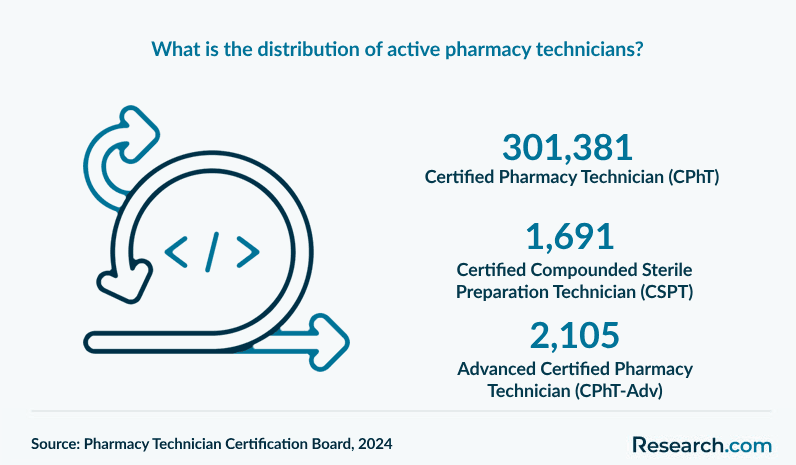
As of December 31, 2024, the Certified Pharmacy Technician credential is far more common than advanced or specialized pharmacy technician credentials, with 301,381 active holders. The Certified Compounded Sterile Preparation Technician credential has 1,691 active holders, while the Advanced Certified Pharmacy Technician credential has 2,105 active holders. The figure below shows the large gap between the standard CPhT credential and more specialized credentials.
Some technicians use pharmacy experience as a foundation for a different healthcare or human services career. For example, those interested in behavioral health may compare technician work with addiction counseling degree programs.
| Career goal | Useful next step | Why it may help |
| Move from retail to hospital pharmacy | Earn certification, strengthen pharmacy math, and seek sterile compounding exposure. | Hospitals often value technicians who can handle complex workflows and documentation. |
| Become a lead technician | Build scheduling, training, quality control, and conflict-resolution skills. | Lead roles require reliability and the ability to support other technicians. |
| Specialize in sterile compounding | Pursue appropriate training and learn cleanroom procedures. | Sterile preparation roles require strict technique and safety knowledge. |
| Enter informatics or systems support | Develop pharmacy software, workflow, and data skills. | Technology-heavy pharmacies need staff who understand both operations and systems. |
| Shift into administration | Study healthcare management, operations, billing, or business fundamentals. | Administrative roles require broader knowledge of budgets, compliance, and team management. |
Is the ROI of pharmacy technician education competitive?
The return on investment for pharmacy technician education depends on what you pay, how quickly you finish, whether the program qualifies you for certification or state requirements, and how strong the local job market is. A lower-cost program can offer good value if it leads to certification eligibility and employment. A more expensive program may not be worth it if it does not provide practical experience, employer recognition, or clear credential preparation.
When comparing ROI, include tuition, books, exam fees, background checks, uniforms, transportation, technology costs, lost work time, and renewal costs. Then compare those costs with local starting wages, promotion potential, and the likelihood of moving into hospital, specialty, or supervisory roles. Also compare pharmacy technology with unrelated or adjacent career paths, such as a cheap online sports management degree, because different programs lead to different timelines, industries, and earnings patterns.
| ROI question | Why it matters |
| Will this program meet my state’s requirements? | A program has poor value if it does not qualify you to work where you live. |
| Does it prepare me for certification? | Certification may improve hiring options and advancement potential. |
| What is the total cost, not just tuition? | Fees, supplies, exams, and lost work time can change the real cost. |
| Are local employers hiring graduates? | Employer recognition affects how quickly training turns into employment. |
| Is there a path beyond entry level? | ROI improves when training supports long-term advancement, not only first jobs. |
Can business skills boost a pharmacy technician’s career growth?
Business and operations skills can help pharmacy technicians move beyond task-based roles. Pharmacies rely on efficient scheduling, inventory control, billing workflows, compliance documentation, customer service metrics, and process improvement. Technicians who understand both pharmacy operations and business basics may be stronger candidates for lead, supervisor, inventory, billing, or administrative positions.
Useful business skills include budgeting awareness, resource planning, workflow analysis, team communication, documentation, quality improvement, and basic project coordination. Technicians who want a broader business foundation may compare flexible options such as accelerated online business degrees, especially if they are considering management outside the pharmacy counter.
What challenges should you consider as a pharmacy technician?
Pharmacy technician work can be rewarding, but it is not easy. The role can involve high prescription volume, upset patients, insurance delays, staffing shortages, repetitive tasks, and strict accuracy standards. Before enrolling in a program, be honest about whether the daily environment fits your strengths.
- High workload and stress: Technicians often juggle prescriptions, phone calls, insurance issues, inventory tasks, and patient questions at the same time.
- Difficult patient interactions: Patients may be frustrated by wait times, medication costs, shortages, or insurance denials.
- Accuracy pressure: Medication errors can have serious consequences, so technicians must stay focused even when the pharmacy is busy.
- Potential exposure risks: Some roles involve handling hazardous medications, chemicals, or sterile preparation materials.
- Physical demands: Standing, walking, reaching, and repetitive hand tasks may be common during long shifts.
- Technology changes: New systems, automation, and workflow tools require ongoing adaptation.
- Insurance complexity: Claims rejections, prior authorizations, and coverage issues can slow service and create patient frustration.
- Continuing education: Maintaining certification or state authorization requires attention to renewal deadlines and education rules.
- Irregular schedules: Pharmacies may need evening, weekend, holiday, or shift coverage depending on the setting.
Common Mistakes to Avoid
| Mistake | Why it can hurt you | Better approach |
| Choosing a program before checking state rules | You may complete training that does not meet your state’s requirements. | Start with your state board of pharmacy and certification eligibility rules. |
| Looking only at tuition | Exam fees, supplies, background checks, and travel can increase total cost. | Compare full program cost and expected local wages. |
| Assuming online means fully remote | Some programs require labs, externships, or in-person components. | Ask exactly which requirements must be completed in person. |
| Ignoring employer preferences | Local pharmacies may prefer specific credentials or experience. | Review job postings and speak with hiring managers before enrolling. |
| Expecting salary guarantees | Pay varies by location, employer, certification, and experience. | Use local job postings and official labor data to estimate realistic earnings. |
| Underestimating stress | Busy pharmacy environments require patience and focus. | Shadow or speak with technicians before committing to the career. |
If you are comparing other allied health careers with different duties and education timelines, dental hygiene may be worth researching. Dental hygienists clean teeth, screen for oral disease, provide preventive care, educate patients, and work with dentists during patient care.
If you are asking how long does a dental hygienist program take, typical programs take two to three years depending on the institution and whether the student pursues a certificate, associate degree, or bachelor's degree in dental hygiene. Dental hygienists can expect competitive salaries, with an average annual income of around $94,260 in 2024.
How do pharmacy technicians support community health initiatives?
Pharmacy technicians often work in one of the most accessible parts of the healthcare system: the community pharmacy. Their work can support medication adherence, immunization workflows, patient education handoffs, prescription access, medication safety, and public health outreach, depending on state law and employer policy.
Technicians may help patients understand refill timing, identify when questions should go to the pharmacist, assist with vaccination appointment workflows, support medication synchronization, and help maintain accurate patient records. In public health-related settings, technicians who understand prevention, health communication, and population health can be especially useful. Those interested in broader health outreach may compare pharmacy experience with online public health nursing programs and related public health education pathways.
Can pharmacy technicians transition into leadership or administration roles?
Yes. Experienced pharmacy technicians can move into lead technician, senior technician, inventory specialist, billing specialist, trainer, supervisor, pharmacy operations, or healthcare administration pathways. Advancement usually requires more than time on the job. Employers look for technicians who can solve workflow problems, train others, document accurately, communicate professionally, and understand compliance.
Technicians considering administration should build skills in scheduling, quality improvement, inventory control, budget awareness, billing, team leadership, and pharmacy systems. Additional education in healthcare management or administration may help if the goal is to move away from daily dispensing work. A useful next comparison is healthcare administration jobs that pay well, especially for technicians planning a long-term move into management.
Questions to Ask Before Choosing a Pharmacy Technician Program
- Does this program meet the requirements of the state where I plan to work?
- Which certification exam does the curriculum prepare students to take?
- Are exam fees, books, supplies, background checks, and externship costs included?
- Does the program provide hands-on labs, simulations, or externship placement?
- What support is available for pharmacy math, certification exam preparation, and job placement?
- Do local employers hire graduates from this program?
- Can credits transfer if I later pursue another healthcare degree?
- What is the program completion rate and certification pass support?
- Will online coursework require in-person labs or local clinical placement?
- What continuing education will I need after certification or state registration?
Key Insights
- The path is state-specific. Start with your state board of pharmacy before choosing a school, because registration, licensure, certification, and training rules vary.
- Certification can strengthen your options. National credentials from organizations such as PTCB or NHA are often preferred by employers and may be required for certain roles or states.
- Salary depends on role and location. The BLS reported 2023 median pay of $40,300 per year, or $19.37 per hour, while Salary.com data cited Pharmacy Technician Supervisor at $68,276 and Pharmacy Technician I at $36,486.
- The job market is growing but changing. BLS data shows 463,900 jobs in 2023 and projected 7% growth from 2023 to 2033, with an expected employment change of 33,300 jobs.
- Technology skills are increasingly important. Automation, pharmacy software, electronic records, inventory systems, and telepharmacy workflows are reshaping daily technician responsibilities.
- Specialization improves career mobility. Sterile compounding, informatics, medication reconciliation, managed care, billing, inventory, and lead technician roles can help technicians move beyond entry-level positions.
- Program ROI depends on outcomes, not marketing. A good program should meet state rules, prepare you for certification, offer practical training, and connect with real local employment opportunities.
- The work is detail-heavy and pressure-filled. Pharmacy technicians must combine accuracy, confidentiality, service skills, and stamina in fast-paced environments.
- Advancement is possible. With experience, continuing education, and leadership or business skills, technicians can move into supervisory, administrative, specialty, or adjacent healthcare roles.
References:
- Pharmacy Technician Certification Board. (2024). Credentials by the numbers. Pharmacy Technician Certification Board.
- Salary.com. (2025, January 1). Certified Pharmacy Technician Salary in the United States. Salary.com.
- Salary.com. (2025, February 16). Pharmacy Technician Lead CMOP IL (Key Personnel). Salary.com.
- Salary.com. (2025, January 1). Senior Pharmacy Technician Salary in the United States. Salary.com.
- Salary.com. (2025, March 1). Pharmacy Technician Supervisor Salary in the United States. Salary.com.
- U.S. Bureau of Labor Statistics. (2024, April 3). Occupational Employment and Wages, May 2023: 29-2052 Pharmacy Technicians. U.S. Bureau of Labor Statistics.
- U.S. Bureau of Labor Statistics. (2024, April 17). Pharmacy Technicians. Occupational Outlook Handbook. U.S. Bureau of Labor Statistics.
- Zippia. (2024, November 8). Pharmacist Technician demographics and statistics in the US. Zippia.
Other Things You Should Know About Becoming a Pharmacy Technician
In 2027, pharmacy technicians must obtain certifications like PTCB (Pharmacy Technician Certification Board) or NHA (National Healthcareer Association). Certification requires passing an exam and completing continuing education. Check state-specific requirements, as some states may have additional certification mandates.
Yes, in many states a pharmacy technician can work without PTCB or NHA certification, but the employer and state board may still require registration, training, or an exam. Federal law does not require national certification; state rules and employer policies control entry.