
2027 Best Online Nursing Degree Programs for Non-Nurses

Co-Founder and Chief Data Scientist
With the increasing demand for healthcare professionals, many individuals without a nursing background seek ways to enter the field. Our team of experts aims to guide prospective students in finding the best online nursing degree programs explicitly designed for non-nurses. In this article, we help them transition into a rewarding healthcare career efficiently and effectively.
What are the benefits of getting an online nursing degree for non-nurses?
- Graduates of Bachelor of Science in Nursing (BSN) qualify for entry-level registered nurse (RN) positions. Meanwhile, those with a Master of Science in Nursing (MSN) can obtain advanced practice roles like nurse practitioners, nurse administrators, or clinical nurse specialists. Lastly, graduates of Doctor of Nursing Practice (DNP) qualify for leadership roles in administration, policymaking, and executive-level nursing practice.
- The average annual salary of RNs in the United States is $87,710.
- Non-nurses can benefit from enrolling in nursing degree programs online. First, they can enjoy flexibility. They can balance work, family, and studies by taking courses asynchronously. Online nursing degree programs require no relocation or commuting to a physical campus, allowing access to accredited programs from reputable universities nationwide.
What can I expect from an online nursing degree for non-nurses?
An online nursing degree for non-nurses, such as a BSN or MSN, offers a pathway for individuals with a non-nursing bachelor's degree to enter the nursing profession. These programs teach essential nursing concepts, theories, and clinical skills needed for nursing practice.
The comprehensive curriculum includes courses in the following:
- Anatomy
- Physiology
- Pharmacology
- Nursing fundamentals
- Specialized areas like pediatrics or geriatrics
Students gain practical experience through clinical placements at local healthcare facilities, where they can apply theoretical knowledge in real-world settings under the supervision of experienced nurses.
Online programs provide flexibility for working professionals, allowing them to balance studies with other commitments. Graduates of these programs are prepared to take the National Council Licensure Examination (NCLEX-RN) for licensure as registered nurses or pursue advanced practice roles like nurse practitioners for those with an MSN.
Where can I work with an online nursing degree for non-nurses?
Non-nurses with a BSN, MSN, or DNP can pursue diverse career opportunities across various healthcare settings and industries. Hospitals and healthcare facilities remain primary employment destinations, where BSN-prepared nurses can work as RNs. They can work in areas like:
- Medical-surgical units
- Emergency departments
- Intensive care units
- Specialty clinics
Meanwhile, MSN graduates can take on advanced practice roles like nurse practitioners, nurse educators, or nurse administrators, while those with a DNP can qualify for leadership roles within the healthcare industry.
How much can I make with an online nursing degree program for non-nurses?
Non-nurses with online nursing degrees earn based on their specific degree and role. Here are typical salary ranges:
- Registered Nurse Level 1: $70,000
- Licensed Practical Nurse (LPN): $53,700
- Certified Nursing Assistant: $36,105
- Nurse Practitioner: $124,325
- Nurse Administrator: $86,824
- Clinical Nurse Specialist: $94,545
- Chief Nursing Executive: $285,800
- 2027 List of the Best Online Nursing Degree Programs for Non-Nurses Best Programs
- How long does it take to complete an online nursing degree program for non-nurses? Completion Time
- How does an online nursing degree program for non-nurses compare to an on-campus program? How does an online nursing degree program for non-nurses compare to an on-campus program?
- What is the average cost of an online nursing degree program for non-nurses? Average Cost
- What are the financial aid options for students enrolling in an online nursing degree program for non-nurses? Financial Aid
- What are the prerequisites for enrolling in an online nursing degree program for non-nurses? Requirements
- What courses are typically in an online nursing degree program for non-nurses? What courses are typically in an online nursing degree program for non-nurses?
- What types of specializations are available in an online nursing degree program for non-nurses? What types of specializations are available in an online nursing degree program for non-nurses?
- How to Choose the Best Online Nursing Degree Programs for Non-Nurses How to Choose the Best Online Nursing Degree Programs for Non-Nurses
- What are the key challenges and solutions for non-nurses pursuing an online nursing degree? What are the key challenges and solutions for non-nurses pursuing an online nursing degree?
- What career paths are available for graduates of an online nursing degree program for non-nurses? What career paths are available for graduates of an online nursing degree program for non-nurses?
- What is the job market for graduates with an online nursing degree program for non-nurses? Job Outlook
- Are direct-entry DNP programs a viable option for non-nurses? Are direct-entry DNP programs a viable option for non-nurses?
- What supplementary certifications can further enhance your nursing career? What supplementary certifications can further enhance your nursing career?
- How do online nursing programs support clinical placements for non-nurses? How do online nursing programs support clinical placements for non-nurses?
- What additional support services are available to ensure success for non-nurses in online nursing programs? What additional support services are available to ensure success for non-nurses in online nursing programs?
- How Do Bridge Programs Enhance Transition for Non-Nursing Graduates? How Do Bridge Programs Enhance Transition for Non-Nursing Graduates?
- Affordable Accelerated Nursing Programs for a Cost-Effective Path to Nursing Affordable Accelerated Nursing Programs for a Cost-Effective Path to Nursing
- Can Dual-Degree Options Expand Career Opportunities for Non-Nurses? Can Dual-Degree Options Expand Career Opportunities for Non-Nurses?
- Affordable MSN Programs for Non-Nurses Affordable MSN Programs for Non-Nurses
- What is the success rate of online nursing programs for non-nurses? What is the success rate of online nursing programs for non-nurses?
- How can non-nursing graduates optimize their application for online nursing programs? How can non-nursing graduates optimize their application for online nursing programs?
Best Accelerated BSN and Online Nursing Degree Programs for Non-Nurses in 2027
Changing careers into nursing is a major decision: you need a program that can prepare you for licensure, fit your schedule, satisfy clinical requirements, and make financial sense. Accelerated BSN and other online nursing pathways for non-nurses are designed for students who already have college experience or a bachelor’s degree in another field and want a faster route into registered nursing.
This guide explains how accelerated and online nursing programs for non-nurses work, how long they take, what they cost, how to compare online and campus formats, what admissions teams usually expect, and which career paths may be available after graduation. It also includes a 2027 ranked list of accelerated BSN options, plus practical questions to ask before applying.
Quick Answer: What Is the Best Path Into Nursing for Non-Nurses?
For many career-changers who already hold a bachelor’s degree, an accelerated BSN is the most direct route to becoming eligible for RN licensure because it focuses on undergraduate nursing preparation and clinical readiness. Direct-entry MSN programs may make sense for students who want a graduate-level pathway, while bridge programs are better suited to learners who already have nursing credentials or related healthcare training.
The right choice depends on your prior credits, state licensure rules, clinical placement access, budget, timeline, and whether you want to enter practice quickly or pursue advanced nursing roles later.
How Research.com ranks schools
A nursing degree can be expensive, time-intensive, and closely tied to licensure outcomes, so transparent program comparison matters. Research.com evaluates online nursing degree options for non-nurses using current, large-scale education datasets and program-level factors that help students compare quality, accessibility, and student outcomes.
Our ranking process draws from the following sources:
- The Integrated Postsecondary Education Data System (IPEDS) database
- Peterson’s database, including the Distance Learning Licensed Data Set
- College Scorecard database
- National Center for Education Statistics
Research.com experts also review indicators such as graduation rate, student-faculty ratio, and program focus. You can read more about our ranking process on our methodology page.
1. Emory University
Emory University offers a Distance Accelerated Bachelor of Science in Nursing, or DABSN, for students who already completed a bachelor’s degree outside nursing. The program is structured as a full-time, one-year route into BSN-level nursing preparation.
- Program length: 1 year
- Tracks/concentrations: N/A
- Cost per credit: $1,656
- Required credits to graduate: 48
- Accreditation: Commission on Collegiate Nursing Education (CCNE)
2. Chamberlain University
Chamberlain University provides an online Bachelor of Science in Nursing pathway that combines web-based coursework with in-person skills development. Students complete didactic courses online while participating in hands-on skills training and simulation lab experiences.
- Program length: As few as 3 years
- Tracks/concentrations: N/A
- Cost per credit: $705
- Required credits to graduate: 120
- Accreditation: CCNE
3. Herzing University
Herzing University offers an online BSN option for learners who hold a bachelor’s degree in a field other than nursing. The program blends online classes with clinical experiences that are arranged in students’ local communities.
- Program length: 36 months
- Tracks/concentrations: N/A
- Cost per credit: $695
- Required credits to graduate: 120
- Accreditation: CCNE
4. Kent State University
Kent State University offers an Accelerated second-degree BSN for students who already earned a bachelor’s degree. The curriculum can lead to a BSN in as few as 15 months and is designed to prepare graduates for professional nursing practice.
- Program length: 15 months
- Tracks/concentrations: N/A
- Cost per credit: $451
- Required credits to graduate: 59
- Accreditation: CCNE
5. Marymount University
Marymount University has an online accelerated BSN for students preparing for clinical nursing practice. The program pairs online didactic instruction with clinical skill development for learners making a career transition into healthcare.
- Program length: 16 months
- Tracks/concentrations: N/A
- Cost per credit: $1,106
- Required credits to graduate: 65
- Accreditation: CCNE
6. Methodist College
Methodist College offers a Bachelor of Science in Nursing Second Degree program in an online and weekend format. Full-time students can complete the pathway in as little as 16 months while studying core nursing areas such as pharmacology and maternal-newborn nursing.
- Program length: 16 months
- Tracks/concentrations: N/A
- Cost per credit: $677
- Required credits to graduate: 68
- Accreditation: CCNE
7. Roseman University of Health Science
Roseman University of Health Science offers an accelerated BSN with on-campus and hybrid-online learning options. The program prepares students to begin practice as nurse generalists.
- Program length: 18 months
- Tracks/concentrations: N/A
- Cost per credit: $757
- Required credits to graduate: 77
- Accreditation: CCNE
8. University of Texas at Arlington
The University of Texas at Arlington offers an online Bachelor of Science in Nursing for students who have already finished prerequisite coursework. The accelerated format combines online classes with faculty-supervised clinical experiences at partner hospitals throughout Texas.
- Program length: 15 months
- Tracks/concentrations: N/A
- Cost per credit: $21,675 (total tuition)
- Required credits to graduate: 51
- Accreditation: CCNE
9. University of Wisconsin - Oshkosh
The University of Wisconsin-Oshkosh provides a 12-month accelerated BSN option in a hybrid format. Designed for students with a prior bachelor’s degree, the program has been offered since 2003 and has produced over 1,100 accelerated nursing graduates.
- Program length: 12 months
- Tracks/concentrations: N/A
- Cost per credit: $894
- Required credits to graduate: 52
- Accreditation: CCNE
10. Wilkes University
Wilkes University offers an online Accelerated Bachelor of Science in Nursing for career-changers with a bachelor’s degree in another discipline. Applicants should be prepared for science-based coursework because the accelerated format moves quickly.
- Program length: 15 months
- Tracks/concentrations: N/A
- Cost per credit: $1,180
- Required credits to graduate: 48
- Accreditation: CCNE
What Students Say About Online Nursing Study
- : "“Online nursing study helped me keep working and caring for my family while moving toward a new career. Being able to review lessons on my schedule made the program manageable.” — Shane"
- : "“The virtual study groups and instructor support made the online format feel less isolating. I still felt guided, connected, and encouraged throughout the program.” — Laurice"
- : "“The mix of online simulations and clinical practice helped me build confidence before working directly with patients. It changed the direction of my career.” — Rein"
Key Findings
- Accelerated BSN programs for non-nurses can be intensive, with listed program lengths ranging from 12 months to 36 months depending on structure, credits, and prior coursework.
- Online does not mean fully remote in nursing. Students should expect in-person clinical rotations, skills labs, simulations, or supervised practice requirements.
- CCNE accreditation appears across the listed programs, but students should still confirm state licensure eligibility before enrolling.
- Program cost varies widely, so applicants should compare total tuition, fees, clinical travel, technology costs, books, and lost work time rather than looking only at cost per credit.
- NCLEX-RN preparation, clinical placement support, and state authorization are among the most important factors for non-nurses evaluating online nursing programs.
How Long Does an Online Nursing Degree for Non-Nurses Take?
The completion timeline depends on the degree type, whether you attend full time, how many prerequisites you have already completed, and whether the program accepts transfer credits. Non-nurses should also account for clinical scheduling, since hands-on experiences can affect the pace of completion.
- Bachelor of Science in Nursing program: An online BSN program for non-nurses often takes around 36 months, though students with transfer credits who enroll full time may finish in as few as 12 months.
- Master of Science in Nursing Direct Entry program: A direct-entry MSN for non-nurses usually takes 20 to 24 months and commonly requires 60 to 77 credits. If you are comparing graduate pathways, our guide to the cheapest MSN programs online can help you start evaluating options.
- Accelerated nursing programs: Some accelerated programs can be completed in as little as 16 months. If your goal is to start earning sooner and you are open to a different credential pathway, you can also review 6 month LPN to RN program options.
| Pathway | Typical Fit | Timeline Mentioned | Main Decision Point |
| Accelerated BSN | Students with a non-nursing bachelor’s degree seeking RN preparation | As few as 12 months to 36 months | Best when you want a BSN-level entry route and can handle an intensive pace |
| Direct-entry MSN | Career-changers considering graduate-level nursing education | 20 to 24 months | Best when the curriculum aligns with your licensing and long-term career goals |
| Bridge or LPN-to-RN route | Students with prior nursing or practical nursing credentials | Program-dependent | Best when you already have healthcare training that can shorten the pathway |
Online vs. On-Campus Nursing Programs for Non-Nurses
Online nursing programs for non-nurses can offer more scheduling flexibility than campus-based programs, but they are not easier by default. Nursing education requires clinical judgment, patient-care skill development, and supervised practice, so even online programs include in-person components.
- Course delivery: Online programs usually place lecture-based coursework online, while campus programs meet in person. Both formats require clinical training in healthcare settings.
- Program pace: Some online and hybrid programs support accelerated completion, while many campus programs follow a more traditional term structure. Accelerated online options for non-nurses can be completed in as little as 12-16 months.
- Student interaction: Online learners communicate through learning platforms, discussion boards, email, and live virtual meetings. Campus students usually have more face-to-face interaction.
- Cost structure: Online study may reduce commuting or relocation expenses, but private online programs can still have high tuition and fees.
The cost comparison below shows examples of attendance-related expenses associated with online and in-person instruction.
| Online Instruction | In-Person Instruction |
| Rental – $1,504 monthly | Housing – $1,513 monthly |
| Food/Groceries – $345 monthly | Campus Meal Plan – $562 monthly |
| Internet – $50 monthly | Campus Computer Lab – Free |
| Electricity and Heat – $175 monthly | Parking Permit – $269 per semester |
| Online Learning Fee – $25-$100 per semester | Health Services Plan – $2,000 yearly |
| Books – $1,295 yearly | Transportation Costs – $1,425 yearly |
| Books and supplies – $1,295 yearly | |
| Room Furniture – $970 | |
| Used car – $7,000-$11,000 |
How Much Does an Online Nursing Degree for Non-Nurses Cost?
Costs vary by school, degree level, residency status, credit requirements, fees, and clinical placement expenses. According to our experts, career-changers may see tuition rates ranging from $2,750 to $6,211 yearly. For a two-year RN to BSN program, that equals approximately $5,550 to $12,422 in total tuition. If you want a closer look at RN to BSN online costs, Research.com provides additional comparisons.
Broadly, private institutions charge $60,593 for an online degree compared with $185,252 for an in-person degree. At public universities, an online degree costs roughly $54,183, compared with $85,348 for the same degree in person. Students trying to reduce costs can also review Research.com’s guide to the cheapest online college options in the U.S.
Cost factors students often overlook
- Clinical travel, parking, immunizations, background checks, and uniforms
- Technology fees, online learning fees, simulation fees, and testing fees
- Prerequisite courses not included in advertised nursing tuition
- Reduced work hours during intensive clinical terms
- State authorization or relocation issues if clinical sites are not available nearby
Financial Aid Options for Non-Nurses in Online Nursing Programs
Non-nursing students entering an online nursing program may qualify for several types of aid, but eligibility depends on the institution, enrollment status, degree level, and personal financial situation.
- Federal financial aid: Students can submit the Free Application for Federal Student Aid, or FAFSA, to be considered for federal loans and work-study programs.
- Scholarships: Nursing schools, healthcare organizations, foundations, and local employers may offer awards for nursing students, including online learners and career-changers.
- Employer tuition assistance: Some employers reimburse or support tuition for employees pursuing nursing or healthcare education. Check policy details before enrolling because grade, work-hour, and repayment rules may apply.
- Private loans: Private student loans may help fill funding gaps, but applicants should compare interest rates, repayment terms, and borrower protections carefully.
Admission Prerequisites for Online Nursing Programs for Non-Nurses
Admission requirements vary, but non-nurses should expect nursing schools to review academic preparation, science readiness, prior degrees, and fit for an intensive clinical program.
- Bachelor's degree: Many direct-entry MSN and second-degree BSN programs require applicants to hold a bachelor’s degree in a non-nursing field.
- Prerequisite courses: Schools may require Anatomy and Physiology I and II, General Chemistry with Lab, Abnormal Psychology, and Introduction to Psychology or Sociology.
- Cumulative grade point average: Admissions teams often evaluate prior undergraduate performance and prerequisite grades to determine readiness.
- Work experience: Some programs prefer or require healthcare exposure, volunteer work, or relevant professional experience.
- Program-specific requirements: Applicants should confirm deadlines, prerequisite expiration rules, entrance exams, references, interviews, and state eligibility before applying.
Common Courses in an Online Nursing Degree for Non-Nurses
Course titles differ by institution, but programs for non-nurses usually begin with foundational nursing concepts and build toward clinical decision-making, leadership, ethics, and patient care.
- Health Assessments: Teaches students how to collect, interpret, and document patient health information to identify needs, risks, and changes in condition.
- Health Ethics: Examines ethical principles that guide healthcare decisions, including patient rights, confidentiality, and professional responsibility.
- Health Policy: Introduces the policies, systems, and regulations that influence healthcare access, delivery, and public health planning.
- Introduction to Professional Nursing: Covers the role, standards, scope, and expectations of professional nursing practice.
- Leadership and Management in Nursing: Builds skills for coordinating care, working in teams, managing resources, and navigating healthcare organizations.
Specializations and Focus Areas in Online Nursing Programs
Some online nursing programs for non-nurses include specialty coursework or allow students to explore focus areas through electives, clinical experiences, or later graduate study. Availability depends on the school and degree level.
- Mental Health Nursing: Focuses on assessment, care planning, treatment support, and communication with patients experiencing mental health conditions. Students interested in broader counseling preparation can review online master degree programs in counseling.
- Nursing Care of Adults: Prepares students to care for adult patients with acute and chronic health conditions.
- Nursing Care of Women, Children, and Families: Covers nursing care across life stages, including maternal-child health, pediatrics, and family-centered care.
- Nursing of Geriatric Populations: Emphasizes care for older adults, including chronic disease management, prevention, and health promotion.
- Health Policy: Develops the ability to analyze healthcare systems, policy decisions, advocacy issues, and access challenges.
- Health Ethics: Explores ethical questions in clinical care, including autonomy, privacy, informed consent, and end-of-life decision-making.
- Leadership and Management in Nursing: Introduces supervision, team leadership, and healthcare management concepts. Students interested in advanced leadership may also compare the cheapest PhD nursing programs or online doctoral programs in leadership.
- Nursing Informatics: Covers the use of technology, electronic health records, health information systems, and data in clinical environments.
- Population Health: Focuses on health needs across groups and communities, including prevention, education, and public health strategies.
How to Choose the Best Online Nursing Degree Program for Non-Nurses
The best program is not simply the fastest or cheapest one. For nursing, the safest choice is the program that meets licensure rules, provides credible clinical preparation, supports students through placements, and fits your financial and personal limits.
- Program type and length: Decide whether an accelerated BSN, direct-entry MSN, or bridge route matches your prior education and timeline.
- Accreditation: Look for programs accredited by CCNE or the Accreditation Commission for Education in Nursing, known as ACEN.
- Total cost and aid: Compare tuition, fees, prerequisites, clinical expenses, and financial aid rather than relying on advertised cost per credit alone.
- Clinical requirements: Confirm whether the school places students locally, expects students to find sites independently, or requires travel.
- Program reputation: Review outcomes, student support, faculty qualifications, and employer relationships, not just rankings.
- NCLEX pass rates: NCLEX-RN performance can help show how well a program prepares students for licensure. Ideally, these rates should be over 90%.
Questions to ask before applying
- Will this program meet RN licensure requirements in my state?
- Who is responsible for securing clinical placements?
- Are all prerequisites included in the published timeline and cost?
- What happens if I cannot find a clinical site near my home?
- What are the most recent NCLEX-RN pass rates and graduation outcomes?
- Can I realistically work while completing labs, clinicals, and accelerated coursework?
Challenges Non-Nurses Face in Online Nursing Programs—and How to Handle Them
Non-nurses often enter accelerated programs with strong academic or professional backgrounds but limited exposure to clinical language, patient care, and healthcare systems. Planning for the most common challenges can make the transition less overwhelming.
| Challenge | Why It Matters | Practical Response |
| Learning healthcare concepts quickly | Students without clinical experience may need time to master anatomy, pharmacology, terminology, and patient-care thinking. | Use prerequisite refreshers, tutoring, simulation tools, and structured study groups early rather than waiting until exams become difficult. |
| Balancing school with work and family | Online delivery adds flexibility, but accelerated nursing coursework and clinicals can still be demanding. | Create a weekly calendar around clinical days, exams, care responsibilities, and protected study blocks. |
| Finding clinical placements | Hands-on practice is required, and some regions have competitive placement environments. | Prioritize programs that actively coordinate placements. Students comparing online ABSN programs should ask exactly how clinical placement support works. |
| Managing education costs | Career-changers may already have student debt or family obligations. | Compare affordable tuition, scholarships, employer support, and accelerated completion options before committing. |
Career Paths After an Online Nursing Degree for Non-Nurses
Graduates of qualifying nursing programs may pursue RN licensure and begin in entry-level registered nursing roles, depending on state requirements and exam outcomes. Some roles require additional graduate education, certification, or experience.
- Nurse practitioners: These advanced clinicians provide health promotion, disease prevention, and care for acute and chronic conditions. This path usually requires graduate education and advanced practice preparation.
- Advanced practice registered nurse: APRN roles include nurse practitioners, nurse anesthetists, nurse midwives, and clinical nurse specialists. These professionals may diagnose conditions, manage chronic disease, and deliver primary or specialty care within state scope-of-practice rules.
- Home health nurse: Home health nurses care for patients in residential settings and often support recovery, chronic disease management, and medication education.
- School nurse: School nurses support student health, respond to medical concerns, and help manage health-related needs in educational settings.
According to the Bureau of Labor Statistics (BLS), the largest employers of registered nurses are:
| Employers | Percentage |
| Hospitals; state, local, and private | 59% |
| Ambulatory healthcare services | 18% |
| Nursing and residential care facilities | 6% |
| Government | 5% |
| Educational services; state, local, and private | 3% |
If your long-term goal is advanced practice, Research.com’s guide to the cheapest online NP programs can help you compare future graduate pathways.
Students who are still comparing healthcare careers may also consider physical therapy assistant roles. PTAs generally need an associate degree, and the cited PTA salary is $83,170 annually.
Job Market and Salary Outlook for Nursing Graduates
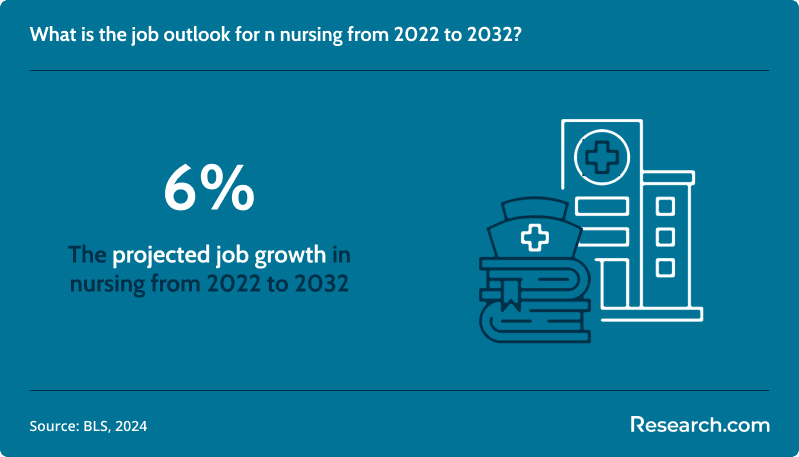
The nursing field is projected to grow by 6% from 2022 to 2032. On average, about 193,100 openings for registered nurses are expected each year, with many openings tied to workers changing occupations or retiring.
In May 2023, median annual wages for registered nurses in the top industries were:
- Government: $99,840
- Hospitals: state, local, and private: $88,430
- Ambulatory healthcare services: $81,230
- Nursing and residential care facilities: $79,280
- Educational services; state local, and private: $71,550
Actual earnings depend on location, employer, shift, union coverage, specialty, experience, education, and licensure. No program can guarantee a salary or job outcome.
Are Direct-Entry DNP Programs a Good Option for Non-Nurses?
Direct-entry DNP programs may be an option for non-nursing graduates seeking an advanced clinical or leadership pathway, but they require careful evaluation. These programs combine foundational nursing preparation with advanced clinical training, research-based practice, and leadership-focused coursework.
Before applying, confirm the required prerequisites, clinical hours, licensure sequence, state eligibility, and whether the program’s design matches your career goal. For a broader look at doctoral nursing options, see Research.com’s guide to DNP programs online.
Certifications That Can Strengthen a Nursing Career
Additional credentials can help nurses demonstrate focused expertise after completing the required degree, licensure, and experience for a specialty area. Certifications may be especially useful for nurses pursuing advanced practice, acute care, family practice, leadership, informatics, or population health roles.
For example, focused certificate pathways such as an online post-master's FNP can help nurses build specialized clinical preparation after graduate study. Students should verify eligibility rules before assuming a certificate will qualify them for a specific role or state credential.
How Online Nursing Programs Arrange Clinical Placements
Clinical placement is one of the most important parts of any online nursing program because students must practice under supervision in real healthcare environments. Non-nurses should pay close attention to how placements are handled before enrolling.
- Local healthcare partnerships: Some programs work with hospitals, clinics, and healthcare facilities so students can complete rotations near where they live.
- Clinical placement coordinators: Dedicated staff may help match students with approved sites and confirm that placements meet program and accreditation requirements.
- Preceptor matching: Some schools connect students with experienced nurse preceptors who supervise learning and help students apply classroom knowledge in practice.
- Simulation labs and virtual reality: Programs may use simulation and VR-based activities to help students develop confidence before in-person care experiences.
- Flexible scheduling: Some programs offer evening or weekend clinical options, though availability depends on site capacity and program rules.
Support Services That Help Non-Nurses Succeed Online
Students entering nursing from another field often need more than course access. Strong programs provide advising, technical help, tutoring, clinical support, faculty access, and career guidance tailored to students who are new to healthcare education.
Look for academic advisors who understand prerequisite planning, mentors with nursing experience, technical support for virtual learning tools, and career services that can help with résumés, clinical networking, and interview preparation. Students comparing graduate-entry options can also review MSN direct entry programs online to see how support structures differ by pathway.
How Bridge Programs Help Non-Nursing Graduates Transition
Bridge programs connect prior education with targeted nursing coursework so students do not repeat unnecessary material. They may use transfer credits, accelerated modules, and structured clinical experiences to help learners move into a nursing pathway more efficiently.
These programs are not interchangeable. Some are designed for students who already hold nursing credentials, while others support broader healthcare or academic transitions. Prospective students should compare academic rigor, credit-transfer policies, clinical access, and licensure preparation. Research.com’s guide to ADN to MSN bridge programs explains one common bridge pathway.
Affordable Accelerated Nursing Programs: When Cost Should Drive the Decision
For career-changers, a second degree in nursing can create financial pressure. Affordable accelerated nursing programs can reduce borrowing while still providing a faster route to BSN preparation. Some programs are designed to be completed in as little as 12 to 18 months.
Students looking for lower-cost options should compare public universities, in-state tuition opportunities, institutional scholarships, grants, and programs that reduce relocation or commuting expenses through online components. However, low tuition should not outweigh accreditation, clinical placement quality, NCLEX preparation, and state licensure eligibility.
If affordability is your top priority, Research.com’s guide to cheap accelerated nursing programs can help you compare cost-conscious options with strong graduation rates.
An affordable accelerated nursing program can be a smart investment when it helps you complete required training efficiently without compromising licensure preparation or clinical experience.
Can Dual-Degree Options Improve Career Flexibility?
Dual-degree programs may appeal to students who want both clinical nursing preparation and business or management training. Some programs combine nursing with business topics such as healthcare finance, policy, operations, and organizational leadership.
This route may be useful for learners aiming for healthcare administration, executive leadership, or advanced practice roles with management responsibilities. Students interested in integrated graduate study can explore MBA MSN online programs to compare how nursing and business coursework are combined.
Affordable MSN Programs for Non-Nurses
Non-nurses considering graduate-entry nursing often focus on cost because MSN programs can require significant tuition, time, and clinical commitment. Affordable MSN programs can make the transition more realistic, but students should still evaluate curriculum quality, clinical placement support, and NCLEX-RN preparation.
When comparing online MSN pathways for non-nurses, weigh tuition against student services, placement assistance, licensure alignment, graduation outcomes, and schedule demands. Lower cost is helpful only if the program still prepares students for required exams and clinical practice.
Public universities and community colleges may offer lower-cost options, especially for in-state students. Some schools also provide accelerated MSN formats that reduce the time spent away from full earning potential.
To compare lower-cost graduate options, review Research.com’s guide to the cheapest MSN programs.
An affordable MSN program can improve return on investment when it limits debt, supports clinical completion, and helps students enter the nursing workforce efficiently.
What Is the Success Rate of Online Nursing Programs for Non-Nurses?
Program success should be evaluated with measurable outcomes, not marketing language. Prospective students should review NCLEX-RN pass rates, graduation rates, clinical placement completion, student support services, and job placement information when available.
Many accredited online nursing programs report high NCLEX-RN pass rates and strong job placement statistics within months of graduation. These indicators can help show whether a program effectively supports students from non-nursing backgrounds. For a related look at program accessibility, read Research.com’s article What nursing programs are easy to get into?
How Non-Nursing Graduates Can Strengthen Their Nursing School Application
Applicants can improve their chances by showing academic readiness, healthcare motivation, and transferable skills. Admissions committees often look for evidence that students can handle accelerated science coursework, communicate well, solve problems, and commit to patient-centered care.
- Complete prerequisite science courses early and keep documentation organized.
- Use the personal statement to connect prior work or academic experience to nursing skills such as judgment, empathy, communication, and resilience.
- Gain healthcare exposure through volunteering, shadowing, patient support roles, or relevant certifications when possible.
- Confirm each program’s prerequisites, deadlines, GPA expectations, clinical rules, and state authorization before applying.
- Ask recommenders to speak specifically about reliability, ethics, teamwork, and ability to learn quickly.
Students comparing accessible pathways can also review an easy online RN to BSN degree to get into, especially if they are considering future advancement after earning an RN credential.
Common Mistakes to Avoid
- Choosing a program before checking accreditation: CCNE or ACEN accreditation can affect licensure, transferability, employer acceptance, and graduate study options.
- Assuming online means no campus or clinical attendance: Nursing requires supervised hands-on learning, even when coursework is delivered online.
- Comparing only tuition: Fees, clinical travel, books, supplies, technology, prerequisites, and lost work hours can change the real cost.
- Ignoring state licensure rules: A program may be accredited but still not meet requirements in every state.
- Overlooking clinical placement responsibility: Some programs help secure sites; others expect students to do more of the search themselves.
- Assuming an accelerated format is automatically better: Faster programs can be efficient, but they may also limit your ability to work or manage family obligations.
- Treating rankings as the only decision tool: Rankings help narrow choices, but fit, licensure eligibility, cost, clinical access, and support services matter more.
Current Trends Affecting Online Nursing Programs
- Hybrid learning is becoming normal: Many nursing programs now combine online didactic courses with in-person labs, simulations, and clinical rotations.
- Clinical placement support is a major differentiator: As healthcare sites manage competing student demand, applicants should ask how placements are secured and supervised.
- Technology is changing nursing education: Virtual simulation, electronic health record training, and online collaboration tools are increasingly used to prepare students for modern clinical workflows.
- Employers still value licensure readiness: Flexible delivery matters, but programs are ultimately judged by whether students are prepared for safe practice and licensure exams.
- Cost transparency matters more: Students are comparing total program cost, borrowing needs, and time to employment before committing to accelerated pathways.
Key Insights
- Accelerated BSN programs are often the most direct option for non-nurses who already have a bachelor’s degree and want a BSN-level path toward RN licensure.
- Online nursing programs are usually hybrid in practice because clinical rotations, labs, and supervised patient-care experiences remain in person.
- Accreditation, state licensure eligibility, NCLEX-RN preparation, and clinical placement support should carry more weight than speed alone.
- Published tuition is only part of the cost. Include prerequisites, fees, supplies, clinical travel, technology, and reduced work hours in your budget.
- Non-nurses should ask detailed questions before applying: who arranges clinicals, whether the program works in their state, what support services exist, and what outcomes recent students achieved.
- The best program is the one that aligns with your prior education, learning style, financial limits, state requirements, and long-term nursing goals.
References:
- Bureau of Labor Statistics, U.S. Department of Labor, Occupational Outlook Handbook, Registered Nurses, at https://www.bls.gov/ooh/healthcare/registered-nurses.htm
- Hanson, M. (2023, August 23). Cost of online education vs. traditional education. EducationData.org. Retrieved from https://educationdata.org/cost-of-online-education-vs-traditional-education
- Salary.com. (2024). Certified nursing assistant salary in the United States. Retrieved from https://www.salary.com/research/salary/benchmark/certified-nursing-assistant-salary
- Salary.com. (2024). Chief nursing executive salary in the United States. Retrieved from https://www.salary.com/research/salary/alternate/chief-nursing-executive-salary
- Salary.com. (2024). Licensed Practical Nurse (LPN) salary in the United States. Retrieved from https://www.salary.com/research/salary/alternate/licensed-practical-nurse-lpn-salary
- Salary.com. (2024). Nurse administrator salary in the United States. Retrieved from https://www.salary.com/research/salary/posting/nurse-administrator-salary
- Salary.com. (2024). Nurse practitioner salary in the United States. Retrieved from https://www.salary.com/research/salary/benchmark/nurse-practitioner-salary
- Salary.com. (2024). Registered nurse (RN), level 1 salary in the United States. Retrieved from https://www.salary.com/research/salary/alternate/registered-nurse-rn-level-1-salary
- Salary.com. (2024). Registered nurse (RN) salary in the United States. Retrieved from https://www.salary.com/research/salary/general/registered-nurse-rn-salary
- ZipRecruiter. (2024). Clinical nurse specialist salary. Retrieved from https://www.ziprecruiter.com/Salaries/Clinical-Nurse-Specialist-Salary
Other Things You Should Know About the Best Online Nursing Degree Programs for Non-Nurses
Most programs require proof of current immunizations, a physical exam, a tuberculosis test, drug screening, and a criminal background check before clinicals begin. Schools commonly ask for influenza, hepatitis B, MMR, varicella, and Tdap records, plus CPR certification through the American Heart Association.
Prerequisites typically include completing courses in biology, chemistry, and anatomy prior to enrollment. Some programs may also require a background check or CPR certification. Each program may have specific requirements, so it's crucial to verify these details directly with the institution.


