
2027 Most Affordable Online MSN Programs

Co-Founder and Chief Data Scientist
In the rapidly evolving landscape of healthcare, pursuing a Master of Science in Nursing (MSN) has become a pivotal step for nursing professionals seeking advanced knowledge and specialized skills. However, those who plan on pursuing an MSN are usually employed and typically have financial obligations that require them to consider the costs of an MSN carefully.
Fortunately, I have found affordable online MSN programs for nurses, including some of the cheapest online MSN programs. In this article, I will outline a few examples to get you started.
What are the benefits of getting an online MSN degree?
- With an MSN, you can pursue leadership positions, contribute to healthcare policy, or focus on specialized areas like pediatrics or gerontology.
- An MSN can help you make a median salary of $125,900 (US BLS, 2023).
- Opting for an online MSN program provides the benefit of flexibility, allowing working nurses to advance their education while maintaining their careers.
What can I expect from an MSN degree?
Graduates of nursing master’s degrees gain advanced clinical and leadership skills, positioning them for diverse roles within the field of nursing. With specialized tracks such as nurse practitioner, nurse anesthetist, nurse educator, and nurse administrator, MSN graduates are equipped to assume pivotal positions in healthcare. They may diagnose and treat patients, manage healthcare facilities, educate the next generation of nurses, or contribute to policy-making and research.
Furthermore, an MSN opens doors to leadership and managerial positions, allowing graduates to guide healthcare teams and influence organizational strategies. The knowledge they gain through an MSN enables them to implement evidence-based practices, contribute to healthcare innovation, and address complex challenges in patient care. As of 2023, there are 175,823 nurses who work as managers in the US.
Where can I work with an MSN?
- Most nurses work in hospitals, with about 61% employed in state, local, and private hospitals.
- According to my research, those who complete MSN programs tend to find opportunities in various healthcare settings contributing their advanced skills to enhance patient care.
- Many MSN graduates work in hospitals, taking on roles such as nurse practitioners, nurse anesthetists, or nurse managers, where their expertise is crucial in providing specialized and high-quality care.
- MSN graduates are also sought after in community health clinics, private practices, and outpatient care facilities, where they play pivotal roles in preventive care, chronic disease management, and community health education.
- Other MSN graduates leverage their leadership skills in administrative positions within healthcare organizations, taking on roles such as nurse administrators, directors of nursing, or healthcare executives.
How much can I make with an MSN?
- On average, nurse practitioners and nurse anesthetists, common roles for MSN graduates, earn a median annual salary of around $125,900 (US BLS, 2023).
- These figures underscore the financial benefits of pursuing an MSN, as these salaries tend to surpass those of registered nurses with bachelor’s degrees.
- In addition to competitive salaries, MSN graduates may enjoy increased earning potential over their careers as they gain experience and establish themselves in specialized roles.
- Moreover, I have observed that leadership positions within healthcare organizations, such as nursing directors or chief nursing officers, can further elevate earnings.
- List of most affordable online MSN programs for 2027 List of Programs
- How long does it take to complete an online MSN? Program Length
- How does an online MSN program compare to an on-campus program? How does an online MSN program compare to an on-campus program?
- What is the average cost of an online MSN? Program Cost
- What are the financial aid options for students enrolling in an online MSN? What are the financial aid options for students enrolling in an online MSN?
- What are the prerequisites for enrolling in an online MSN? Admission Requirements
- What courses are typically in an online MSN? What courses are typically in an online MSN?
- What types of specializations are available in an online MSN program? What types of specializations are available in an online MSN program?
- How to choose the best online MSN program? How to choose the best online MSN program?
- What career paths are available for graduates of online MSN programs? Career Paths
- What is the job market for graduates with an online MSN? Job Outlook
- What are the admission requirements for direct-entry MSN programs? What are the admission requirements for direct-entry MSN programs?
- How Can You Verify the Quality and Accreditation of an Online MSN Program? How Can You Verify the Quality and Accreditation of an Online MSN Program?
- Are there hidden costs that can influence your online MSN experience? Are there hidden costs that can influence your online MSN experience?
- Should I Pursue a post master's FNP certificate to Enhance My Career? Should I Pursue a post master's FNP certificate to Enhance My Career?
- Alternative Pathways to an MSN for Non-Nurses Alternative Pathways to an MSN for Non-Nurses
- What are the common challenges faced by students in online MSN programs? What are the common challenges faced by students in online MSN programs?
- What factors should you consider when choosing a nurse practitioner specialty in an online MSN program? What factors should you consider when choosing a nurse practitioner specialty in an online MSN program?
- What is the return on investment for an affordable online MSN program? What is the return on investment for an affordable online MSN program?
- Licensure and Certification after MSN Licensure and Certification after MSN
- What professional support services and networking opportunities do affordable online MSN programs provide? What professional support services and networking opportunities do affordable online MSN programs provide?
Most Affordable Online MSN Programs for 2027: Compare Costs, Tracks, Timelines, and Accreditation
Choosing an online Master of Science in Nursing is not just a tuition decision. The right MSN program must fit your license status, clinical placement needs, preferred specialty, state authorization rules, schedule, and long-term career plan. A low-cost program can still become expensive if it adds travel requirements, out-of-state tuition, technology fees, certification preparation costs, or clinical placement expenses you did not expect.
This guide is designed for registered nurses, BSN graduates, RN-to-MSN applicants, and career changers comparing affordable online MSN programs. You will learn which programs made this list, how online and campus formats differ, what prerequisites to expect, how much online MSN programs may cost, which specializations are available, and how to evaluate accreditation, licensure preparation, clinical support, and return on investment before applying.
Quick answer: What is the most important thing to know about affordable online MSN programs?
An affordable online MSN can be a strong option for working nurses who want graduate-level preparation without relocating, but cost should never be the only filter. Prioritize programs that are accredited, authorized in your state, transparent about tuition and fees, realistic about clinical placement support, and aligned with your intended role, especially if you plan to become a nurse practitioner, nurse educator, nurse administrator, or clinical nurse specialist.
How do we rank our schools?
Research.com evaluates affordable online MSN programs using institutional and program data that help students compare cost, access, quality indicators, and student outcomes. The goal is to make the ranking useful for real enrollment decisions, not simply to list programs with the lowest advertised tuition.
To support transparency, Research.com uses information from IPEDS, Peterson’s database including the Distance Learning Licensed Data Set, and College Scorecard. Data from the National Center for Education Statistics is also used to add context about institutional quality and student outcomes. You can review the full process in Research.com’s methodology.
Affordable online MSN programs at a glance
| Rank | School | Program length | Credits | Cost information provided | Accreditation |
| 1 | Georgetown University | 19 to 27 months | 40 to 49 credits | $2,441 per credit hour | Commission on Collegiate Nursing Education (CCNE) |
| 2 | University of Central Florida | Up to two years | 31 to 36 credit hours | $327.32 in-state; $1,151.72 out-of-state per credit hour | CCNE |
| 3 | University of Louisiana at Monroe | At least two years | 40 credit hours | $22,449 estimated total cost | CCNE |
| 4 | California State University-Dominguez Hills | At least two years | 30 to 61 credits | Starts at $ 2,745 per 6 credits, part-time | CCNE |
| 5 | Utah Valley University | At least two years | 34 credits | $3,135 resident; $8,915 non-resident per semester | Accreditation Commission for Education in Nursing (ACEN) |
| 6 | New Mexico State University-Main Campus | Two years part-time; Three years full-time | 32 credits | $345.46 per credit | CCNE |
| 7 | Indiana University | Two to three years | At least 42 credits | $18,924 per semester | CCNE |
| 8 | Appalachian State University | At least two years | 39 credit hours | $319 per credit | Southern Association of Colleges and Schools Commission on Colleges (SACSCOC) |
| 9 | McNeese State University | At least two years | 35 to 46 credit hours | Starts at $20,130 per year | CCNE |
| 10 | Florida Atlantic University | At least two years | 22 to 66 credit hours | $371.82 resident; $1,026.81 non-resident per credit | CCNE |
1. Georgetown University
Georgetown University delivers several online MSN options through Nursing@Georgetown. Available pathways include Adult-Gerontology Acute Care Nurse Practitioner (AG-ACNP), Family Nurse Practitioner (FNP), Nurse-Midwifery/Women’s Health Nurse Practitioner (NM/WHNP), and Women’s Health Nurse Practitioner (WHNP). The program is built for registered nurses preparing for advanced clinical practice and combines live online classes, interactive coursework, and clinical placements. Students also receive support during admissions, clinical placement planning, and career preparation.
- Program length: 19 to 27 months
- Tracks/concentrations: Adult-Gerontology Acute Care Nurse Practitioner; Family Nurse Practitioner; Dual Nurse-Midwifery/Women’s Health Nurse Practitioner
- Cost per credit hour: $2,441
- Required credits to graduate: 40 to 49 credits
- Accreditation: Commission on Collegiate Nursing Education (CCNE)
2. University of Central Florida
University of Central Florida offers an online MSN through the College of Nursing with 31 to 36 credit hours. The program is intended for nurses who want graduate preparation in leadership, teaching, simulation, and health systems improvement. UCF’s format can serve licensed RNs with a non-nursing bachelor’s degree, and the curriculum includes graduate nursing topics such as health promotion, advanced pathophysiology, and theory for advanced practice nursing.
- Program length: Up to two years
- Tracks/concentrations: Nursing And Health Care Simulation; Nurse Educator; Nursing Leadership And Management
- Cost per credit hour: $327.32 (in-state), $1,151.72 (out-of-state)
- Required credits to graduate: 31 to 36 credit hours
- Accreditation: CCNE
3. University of Louisiana at Monroe
University of Louisiana at Monroe offers an online MSN with a Family Nurse Practitioner concentration. The FNP option includes a minimum of 640 clinical contact hours in primary health care settings under an approved clinical preceptor. Students develop advanced assessment, clinical decision-making, evidence-based practice, health promotion, and disease prevention skills for settings such as primary care clinics, specialty practices, walk-in clinics, and school-based clinics. The program is aligned with national expectations for FNP preparation and is designed to support eligibility for national certification and advanced practice registered nurse licensure with prescriptive authority annually on April 1.
- Program length: At least two years
- Tracks/concentrations: Business Practice for Nurse Practitioners; Educational Concepts for Nursing Education; Genomics and Family Healthcare Across the Lifespan
- Estimated total cost: $22,449
- Required credits to graduate: 40 credit hours
- Accreditation: CCNE
4. California State University-Dominguez Hills
California State University-Dominguez Hills offers an MSN with multiple role options for nurses pursuing advanced practice, leadership, administration, or education. The curriculum emphasizes advanced nursing knowledge, scientific evidence, ethical decision-making, health technology, leadership, and equitable patient care. Role options include Clinical Nurse Specialist pathways in Adult/Gerontology, Neonatal, and Pediatric practice, along with Family Nurse Practitioner, Nurse Administrator, and Nurse Educator options. Graduates may be prepared to pursue national certification examinations in their selected specialty.
- Program length: At least two years
- Tracks/concentrations: Clinical Nurse Specialist Adult/Gerontology; Family Nurse Practitioner; Nurse Administrator
- Cost per 6 credits: Starts at $ 2,745 (part-time)
- Required credits to graduate: 30 to 61 credits
- Accreditation: CCNE
5. Utah Valley University
Utah Valley University offers an online MSN for post-baccalaureate nursing students who want to become nurse educators in academic or clinical environments. The program supports full-time or part-time enrollment, which can help nurses continue working while completing graduate study. UVU reports that over 90% of graduates obtain job roles that require the MSN degree within a year of completion. Coursework emphasizes evidence-based practice, leadership, nursing science, health policy, research evaluation, and educational outcomes.
- Program length: At least two years
- Tracks/concentrations: Advanced Nursing Assessment; Advanced Nursing Theory; Teaching Nursing In the Clinical Settings
- Cost per semester: $3,135 (resident), $8,915 (non-resident)
- Required credits to graduate: 34 credits
- Accreditation: Accreditation Commission for Education in Nursing (ACEN)
6. New Mexico State University-Main Campus
New Mexico State University-Main Campus offers an MSN through NMSU-Global focused on nursing leadership and administration. The program is designed for registered nurses with a Bachelor of Science in Nursing who want to move into leadership roles while remaining in their communities. Students can choose full-time or part-time study, with degree plans structured over two years and three years. The program also follows state authorization reciprocity agreements for out-of-state students.
- Program length: Two years (part-time), Three years (full-time)
- Tracks/concentrations: Advanced Field Work in Nursing; Nursing Informatics; Health Policy
- Cost per credit: $345.46
- Required credits to graduate: 32 credits
- Accreditation: CCNE
7. Indiana University
Indiana University offers an MSN with eight tracks, including Nurse Practitioner, Clinical Nurse Specialist, Nurse Educator, and Nurse Leader options. Based at the IUPUI campus, programs are available in online or hybrid-distance formats, and students may complete clinical or practicum work in their home communities within Indiana. The curriculum includes leadership, ethics, inquiry, evidence application, information technology, collaboration, culture, problem-solving, and lifelong learning. The school also provides information about Indiana licensure and certification for advanced nursing roles.
- Program length: Two to three years
- Tracks/concentrations: Clinical Nurse Specialist (CNS); Education & Leadership; Nurse Practitioner (NP)
- Cost per semester: $18,924
- Required credits to graduate: At least 42 credits
- Accreditation: CCNE
8. Appalachian State University
Appalachian State University offers an online MSN with coursework in nursing theory, advanced nursing content, nursing education, practicum experience, and a thesis or research project. Students complete practicum experiences in clinical and nursing education settings. Applicants are expected to have a BSN degree, a minimum GPA of 3.5, an RN license, and one year of nursing experience. Graduates may pursue roles such as nurse educator, health educator, or clinical nurse educator.
- Program length: At least two years
- Tracks/concentrations: Contemporary Issues in Nursing; Nursing Program Development and Evaluation; Pathophysiology for Advanced Nursing
- Cost per credit: $319
- Required credits to graduate: 39 credit hours
- Accreditation: Southern Association of Colleges and Schools Commission on Colleges (SACSCOC)
9. McNeese State University
McNeese State University offers a 100% online MSN with three concentrations and CCNE accreditation. The program requires 35-46 credit hours and is designed for nurses who want graduate preparation in advanced clinical practice or nursing education. The curriculum is connected to the Intercollegiate Consortium for a Master in Science of Nursing (ICMSN) and includes evidence-based care, clinical training, certification exam preparation, and professional networking through the Louisiana Intercollegiate Consortium. Applicants must meet graduate admission requirements, including a BSN degree, a minimum GPA of 3.5, and an RN license.
- Program length: At least two years
- Tracks/concentrations: Family Nurse Practitioner; Nursing Education; Psychiatric Mental Health Nurse Practitioners
- Cost per year: Starts at $20,130
- Required credits to graduate: 35 to 46 credit hours
- Accreditation: CCNE
10. Florida Atlantic University
The Christine E. Lynn College of Nursing at Florida Atlantic University offers an MSN for graduate students pursuing leadership, clinical, or teaching preparation. The program supports full-time and part-time study, allowing many students to continue working while enrolled. Depending on the track, students may complete coursework through face-to-face or online learning options. Specialized pathways include options such as Adult/Gerontological Nurse Practitioner and Psychiatric Mental Health Nurse Practitioner, along with other tracks connected to administration, education, and holistic nursing.
- Program length: At least two years
- Tracks/concentrations: Advanced Holistic Nursing; Nursing Administration and Financial Leadership; Nurse Educator
- Cost per credit: $371.82 (resident), $1,026.81 (non-resident)
- Required credits to graduate: 22 to 66 credit hours
- Accreditation: CCNE
How long does it take to complete an affordable online MSN?
Most traditional full-time MSN programs take about two years. Accelerated or fast-track options for BSN-prepared nurses can take 12 to 18 months, while part-time online programs may require three years or more. Your timeline depends on the number of credits, specialty requirements, clinical hours, transfer credits, bridge coursework, and whether you enroll continuously or take breaks between terms.
Students planning to continue beyond the MSN should also compare doctoral timelines. Many online DNP programs take about two to four years of full-time study.
| Enrollment path | Typical completion time | Best fit |
| Accelerated MSN | 12 to 18 months | BSN-prepared nurses who can handle a heavier course load |
| Traditional full-time MSN | About two years | Nurses who want a structured graduate timeline |
| Part-time online MSN | Three years or more | Working nurses balancing shifts, family obligations, or clinical placement schedules |
| MSN to DNP pathway | About two to four years of full-time study | MSN graduates pursuing doctoral-level practice or leadership preparation |
How does an affordable online MSN program compare to an on-campus program?
Online and on-campus MSN programs can lead to similar academic credentials, but the learning experience, costs, scheduling, networking, and clinical logistics differ. The better option depends on your work schedule, location, learning style, state authorization status, and need for in-person support.
| Factor | Online MSN | On-campus MSN |
| Flexibility | Often better for nurses who need to study around work shifts and family responsibilities. | Usually follows fixed class meeting times and may require regular commuting. |
| Campus resources | Uses virtual libraries, online advising, remote faculty meetings, and digital learning platforms. | Provides easier access to simulation labs, faculty offices, campus events, and in-person services. |
| Clinical placement | May require students to help identify local clinical sites, depending on the school. | May have stronger local clinical partnerships near campus. |
| Cost considerations | Can reduce commuting, relocation, parking, and housing-related costs. | May include additional expenses for transportation, campus fees, and time away from work. |
| Networking | Relies on virtual networking, online cohorts, alumni events, and professional associations. | Provides more spontaneous in-person interaction with classmates, faculty, and local employers. |
Online learning can also be a practical next step for nurses completing affordable RN to BSN online programs, especially if they want to continue into graduate education without relocating.
What is the average cost of an affordable online MSN?
Program cost varies widely by school type, residency status, specialty, clinical requirements, and fee structure. Based on the cost ranges commonly observed in the programs reviewed, tuition at public universities for in-state residents typically ranges from $15,000 to $30,000, while private institutions may charge $30,000 to $60,000 or more for the full program.
- Public in-state programs: Often the lowest-cost option for residents, especially when online students qualify for resident tuition.
- Public out-of-state programs: Can be much more expensive if the school charges non-resident rates for online learners.
- Private programs: May offer strong support and national reputation but often have higher per-credit tuition.
- Additional expenses: Budget for fees, books, clinical compliance requirements, travel to clinical sites, background checks, immunization documentation, technology, and certification exam preparation.
An online masters in nursing may offer similar tuition to campus-based programs, but the format can reduce indirect costs for students who avoid relocation or continue working while enrolled.
What are the financial aid options for students enrolling in an affordable online MSN program?
Graduate nursing students often combine several funding sources instead of relying on one option. Before applying, ask each school for a full cost estimate that includes tuition, fees, clinical expenses, and expected out-of-pocket costs.
- Federal financial aid and grants: Complete the Free Application for Federal Student Aid. Depending on eligibility, graduate students may qualify for federal aid options, including subsidized or unsubsidized loans. Some state programs may also support graduate nursing education.
- Scholarships and fellowships: Look for awards from nursing associations, foundations, employers, health systems, and universities. Scholarship options mentioned for nursing students include the CVS Health Nurse Practitioner Scholarship, the Nurses Educational Funds (NEF) Scholarship, and the AACN Foundation Scholarships.
- Employer tuition assistance: Nurses working in hospitals, clinics, long-term care organizations, public health agencies, or health systems should ask about tuition reimbursement, loan repayment, or advancement programs tied to hard-to-fill roles.
- Institutional payment options: Some schools offering graduate pathways, including online BSN to DNP programs, may provide tuition discounts, payment plans, or employer partnership benefits. Confirm terms directly with the institution.
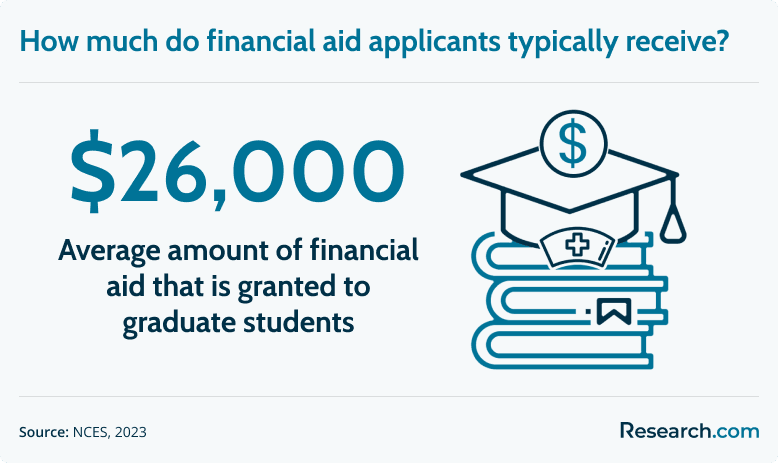
NCES reported that the average amount graduate students receive in financial aid is $25,300, as shown in the image below (NCES, 2023). Aid packages can include loans, grants, assistantships, or other funding, so compare net cost rather than relying only on the posted tuition rate.
Borrow carefully. Speak with the school’s financial aid office, compare repayment obligations, and avoid taking on more debt than you need to complete the program.
What are the prerequisites for enrolling in an affordable online MSN?
Admission requirements differ by school and track, but most online MSN programs look for evidence that applicants can succeed in graduate nursing coursework and, when applicable, advanced clinical training.
| Requirement | What it usually means | Why it matters |
| Bachelor’s Degree in Nursing (BSN) | Most programs require a BSN from an accredited institution. Some accept ADN-prepared RNs with a non-nursing bachelor’s degree but may require bridge courses. | Confirms that the applicant has undergraduate nursing preparation before graduate-level study. |
| RN licensure | Applicants usually need an active, valid, unencumbered RN license. Some online RN to MSN programs may also require professional nursing experience. | Licensure is essential for clinical coursework and many advanced nursing pathways. |
| Recommendations | Schools may ask for letters from supervisors, faculty, or professional colleagues. | References help admissions teams evaluate readiness, professionalism, and leadership potential. |
| Statement of purpose | Applicants often explain career goals, reasons for choosing the MSN, and fit with the specialty. | A strong statement connects the program to a clear professional plan. |
| Resume or CV | Applicants document education, RN experience, certifications, achievements, and leadership roles. | Graduate nursing programs often value professional experience and readiness for advanced roles. |
| Prerequisite courses | Some students need additional coursework if their previous nursing degree or non-nursing degree does not satisfy program requirements. | Prerequisites reduce academic gaps before advanced nursing coursework begins. |
| Technology access | Online students typically need reliable internet, a computer, and access to platforms such as Moodle, Blackboard, or Canvas through a modern browser such as Google Chrome or Mozilla Firefox. | MSN coursework, discussions, assignments, assessments, and faculty communication often occur online. |
| Clinical requirements | Students may need approved clinical sites, preceptors, background checks, immunizations, and health documentation. | Clinical readiness is especially important for nurse practitioner and clinical specialist tracks. |
| Interview | Some programs use an interview, either in person or remotely. HireVue reported that 70% of interviews are conducted virtually. | Interviews help schools assess communication skills, motivation, and program fit. |
The chart below shows how technology is used in hiring processes.
What courses are typically in an affordable online MSN?
Coursework varies by specialization, but most high-quality low-cost online MSN programs combine graduate nursing theory, research, leadership, policy, population health, and role-specific practicum experiences.
- Advanced Nursing Theory: Examines nursing frameworks and advanced concepts that guide graduate-level practice and professional judgment.
- Health Policy and Advocacy: Explores how health policy is created, analyzed, and influenced, with attention to healthcare access, quality, equity, and regulation.
- Nursing Research and Evidence-Based Practice: Builds skills in reading research, evaluating evidence, applying findings to patient care, and improving clinical outcomes.
- Advanced Pharmacology: Covers drug therapy principles used in advanced practice decision-making.
- Health Systems and Policy: Reviews healthcare organizations, delivery models, financing structures, and policy environments that shape nursing leadership and practice.
- Healthcare Quality Improvement: Teaches methods for identifying care gaps, measuring performance, implementing improvements, and sustaining safer patient outcomes.
Many MSN programs also include Ethical Issues in Healthcare, Legal Aspects of Healthcare, Research Methods in Nursing, a Capstone or Thesis Project, and a Clinical Residency or Practicum. For nurse practitioner tracks, expect advanced assessment, pathophysiology, pharmacology, diagnosis, and population-specific clinical coursework.
What types of specializations are available in an affordable online MSN program?
Specialization is one of the most important MSN decisions because it affects clinical hours, certification exams, state licensure, job options, and work setting. Common online MSN specializations include:
| Specialization | Focus | Best for students who want to... |
| Family Nurse Practitioner (FNP) | Primary care across the lifespan, including acute and chronic conditions, prevention, and family-centered care. | Work in broad primary care roles. Students seeking a faster but demanding path may compare the cheapest BSN to FNP online programs. |
| Adult-Gerontology Nurse Practitioner (AGNP) | Care for adult and older adult populations, often including chronic and complex conditions. | Focus on adult primary care, acute care, or aging-related practice. |
| Nurse Educator | Teaching, curriculum design, assessment, simulation, and clinical education. | Prepare nurses in academic programs, hospitals, or clinical training environments. |
| Public Health Nursing | Community health, population-level prevention, public health policy, and health promotion. | Work with communities, agencies, or policy-focused organizations. |
| Forensic Nursing | Care connected to legal evidence, trauma, violence, and forensic science. | Combine nursing practice with legal and investigative contexts. |
| Telehealth Nursing | Remote care delivery, digital communication, care coordination, and technology-supported practice. | Use virtual care tools in patient management and access-focused roles. |
| Palliative Care Nursing | Care for patients with serious, chronic, or life-threatening illness. | Support symptom management, communication, care planning, and quality of life. |
How to choose the best affordable online MSN program
The best affordable online MSN is the one that meets your professional goal at a cost and pace you can realistically manage. Use the checklist below before you apply.
- Confirm accreditation: Look for programmatic accreditation from a recognized nursing accreditor such as the Commission on Collegiate Nursing Education (CCNE) or the Accreditation Commission for Education in Nursing (ACEN), and verify institutional accreditation as well.
- Match the specialization to your career goal: If you want to become a nurse practitioner, nurse educator, nurse informaticist, administrator, or clinical specialist, choose a program built for that outcome. Students comparing traditional and online FNP programs should pay close attention to clinical hour requirements and certification eligibility.
- Check state authorization and licensure alignment: Online does not always mean available in every state. Ask whether the program accepts students in your state and whether it meets your state board’s requirements for your intended role.
- Evaluate flexibility honestly: Review whether classes are asynchronous, synchronous, hybrid, part-time, full-time, or accelerated. Also ask about required campus visits or in-person intensives.
- Review faculty credentials: Faculty with advanced degrees, clinical expertise, research experience, or leadership experience can strengthen the academic and practical value of the program.
- Ask about clinical placement support: A low-cost program may be difficult to complete if you cannot secure approved preceptors. Ask whether the school places students, assists students, or expects students to find sites independently.
- Look for networking and career support: Professional networking for nurses can help with mentorship, clinical placement leads, job search support, and long-term advancement.
- Review outcomes carefully: Graduation, certification pass, and employment data can indicate whether the program supports student success. AACN reported that the employment rate of MSN graduates is 95% within four to six months of graduation as of 2023 (AACN, 2023).
The chart below shows job placement rates for nursing graduates by degree level.
What career paths are available for graduates of affordable online MSN programs?
MSN graduates may pursue advanced clinical practice, education, leadership, administration, policy, or specialty care roles. Your options depend heavily on your MSN track, certification, state licensure, clinical experience, and employer requirements.
- Family Nurse Practitioner (FNP): Provides primary care for patients across the lifespan, often with an emphasis on prevention, chronic condition management, and family-centered care.
- Adult-Gerontology Nurse Practitioner (AGNP): Cares for adults and older adults with acute, chronic, and complex health needs.
- Psychiatric-Mental Health Nurse Practitioner (PMHNP): Assesses, diagnoses, and treats mental health conditions and may provide therapy and medication management depending on state scope of practice.
- Women’s Health Nurse Practitioner (WHNP): Provides care related to reproductive health, gynecology, family planning, and women’s health across the lifespan.
- Adult-Gerontology Clinical Nurse Specialist: Supports advanced practice, education, consultation, and quality improvement for adult and geriatric populations.
- Pediatric Clinical Nurse Specialist: Focuses on improving care for children and families through advanced practice, education, consultation, and systems improvement.
- Psychiatric-Mental Health Clinical Nurse Specialist: Applies advanced psychiatric and mental health nursing expertise to improve patient, family, and community outcomes.
- Nurse Educator: Teaches nursing students, trains clinical staff, designs curriculum, and evaluates learning outcomes in academic or healthcare settings.
- Nurse Administrator or Nurse Leader: Oversees teams, budgets, quality initiatives, staffing, policy implementation, and operational improvement.
What is the job market for graduates with an affordable online MSN degree?
The MSN job market is shaped by healthcare staffing needs, demand for advanced practice clinicians, regional shortages, telehealth adoption, nursing faculty needs, and expanding leadership demands in complex health systems. Employment outcomes are not guaranteed, but graduate nursing credentials can open roles that are not typically available to BSN-prepared nurses alone.
- Demand for advanced practice nurses: Nurse practitioners, clinical nurse specialists, and other advanced practice nurses remain important in preventive care, chronic condition management, and access to care.
- Shortages in some specialties: Psychiatric-mental health and primary care nurse practitioner roles may be especially important in regions with provider shortages.
- Telehealth expansion: The COVID-19 pandemic accelerated the use of telehealth, increasing the value of nurses who can work effectively with remote care platforms and digital communication.
- Leadership and administration needs: Healthcare organizations need nurse leaders who understand quality improvement, staffing, budgets, safety, compliance, and patient outcomes.
- Nursing education demand: Nurse educator roles are important as nursing schools and healthcare organizations train future nurses and upskill current staff.
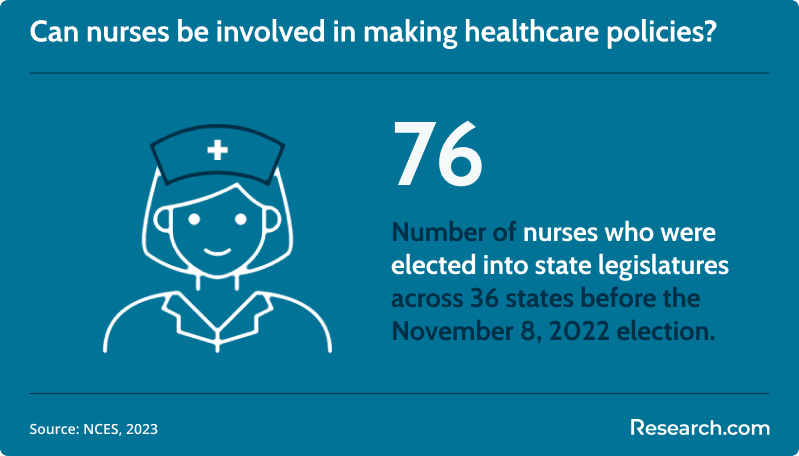
- Policy and research opportunities: MSN graduates interested in advocacy, policy, and public health may work beyond direct patient care. Before the November 8, 2022, election, 76 nurses had been elected to state legislatures across 36 states on a statewide level, as shown in the image below (Reifsnider, 2023).
What are the admission requirements for direct-entry MSN programs?
Direct-entry MSN programs are designed for students who hold a non-nursing bachelor’s degree and want to transition into nursing. Admissions teams typically review undergraduate performance, science prerequisites, communication skills, readiness for intensive clinical learning, and evidence of critical thinking. Some programs may use interviews, standardized assessments, simulation activities, or aptitude evaluations.
These programs can be rigorous because students must build foundational nursing skills while moving toward graduate-level expectations. If you are comparing entry options, Research.com’s guide to the easiest direct entry MSN programs to get into can help you identify programs with accessible admissions structures while still maintaining academic and clinical standards.
How can you verify the quality and accreditation of an online MSN program?
Start with accreditation, then move to licensure alignment and outcomes. A quality online MSN should be offered by an accredited institution and, when applicable, hold nursing program accreditation from CCNE or ACEN. Accreditation can affect financial aid eligibility, transferability, employer recognition, certification eligibility, and state licensure review.
- Search the accreditor’s official database rather than relying only on the school’s marketing page.
- Confirm whether the program meets education requirements for your intended license or certification in your state.
- Ask how clinical placements are approved, supervised, and documented.
- Review graduation, certification pass, and employment data when available.
- Compare total program cost with educational quality, including bridge pathway expenses such as RN to NP cost.
Are there hidden costs that can influence your online MSN experience?
Yes. Tuition is only one part of the total cost of an online MSN. Students may also pay technology fees, course fees, simulation fees, background check fees, drug screening costs, malpractice insurance, clinical placement expenses, travel costs, certification exam preparation, graduation fees, and state licensure or certification application fees.
Ask for a full cost breakdown before enrolling. Students moving through earlier nursing pathways may also find it useful to understand how supplemental expenses appear in other programs, including the practical nursing program cost.
Should I pursue a post master's FNP certificate to enhance my career?
A post master's FNP certificate may make sense if you already hold an MSN but want focused preparation for family nurse practitioner practice. This credential can add primary care expertise, strengthen advanced assessment and diagnostic skills, and help align your background with current clinical practice expectations.
Before enrolling, verify accreditation, clinical practicum requirements, state licensure rules, certification eligibility, and whether your prior MSN coursework will reduce the number of credits required.
Alternative pathways to an MSN for non-nurses
Students with a bachelor’s degree outside nursing may pursue direct-entry MSN programs that combine foundational nursing preparation with graduate-level coursework. These programs are intended to help non-nurses build clinical skills, prepare for RN licensure, and move toward MSN-level roles in areas such as family practice, psychiatric-mental health, public health, leadership, or nursing education.
Direct-entry MSN programs typically take two to three years and include intensive coursework with clinical placements. If you are considering this route, compare affordability, clinical support, licensure preparation, and flexibility. Research.com’s guide to affordable direct-entry MSN programs for non-nurses online can help you compare options that balance cost and academic preparation.
What are the common challenges faced by students in online MSN programs?
Online MSN programs can be flexible, but they are not easy. Graduate nursing students often work while completing demanding coursework, clinical hours, group projects, and certification preparation. Planning ahead can reduce avoidable stress.
| Common challenge | Why it happens | Better approach |
| Time management | Work shifts, family responsibilities, clinical hours, and coursework can overlap. | Build a weekly study calendar before classes begin and protect clinical time early. |
| Self-motivation | Online programs require independent study without the structure of daily campus attendance. | Set weekly goals, join study groups, and use faculty office hours consistently. |
| Limited interaction | Students may miss the informal connection of in-person classes. | Participate in discussion boards, virtual events, cohort chats, and professional organizations. |
| Clinical placement barriers | Some areas have high competition for preceptors and clinical sites. | Ask about placement support before enrolling and start networking early. |
| Technology problems | Online learning depends on stable internet, learning platforms, webcams, and testing software. | Test your technology before each term and keep backup access options ready. |
| Financial pressure | Fees, books, compliance costs, and travel can exceed the advertised tuition price. | Request a full cost sheet and build a term-by-term budget. |
What emerging trends are influencing affordable online MSN programs?
Online MSN programs are adapting to changes in healthcare delivery and graduate nursing education. Many programs now use telehealth content, virtual simulations, digital collaboration tools, learning analytics, and interprofessional assignments to help students practice decision-making in online environments. These tools do not replace clinical experience, but they can strengthen preparation for modern care settings where remote communication, data use, and team-based care are increasingly common.
Students interested in faster academic progression may also want to compare bridge pathways, including the easiest and fastest RN to BSN program, before choosing a graduate route.
What factors should you consider when choosing a nurse practitioner specialty in an online MSN program?
Your NP specialty determines the patients you serve, the certification exam you take, the clinical sites you need, and the roles you can pursue after graduation. Do not choose a track only because it sounds broad or popular. Choose it because it matches your preferred population, work environment, schedule, and state practice goals.
1. Your clinical interests
Think about the patient populations and conditions that keep you engaged. Pediatrics, adult-gerontology, family care, mental health, women’s health, and acute care can lead to very different daily responsibilities.
2. Local and regional demand
Job demand can vary by region and specialty. Before enrolling, review openings in your target location, speak with local employers, and ask the program where recent graduates have been hired.
3. Salary expectations
Compensation can differ by specialty, employer, setting, region, and experience. Use salary data as one factor, but do not assume a specific outcome from the degree alone.
4. Work-life balance
Some specialties may involve predictable clinic hours, while others may include evenings, weekends, hospital coverage, or more intense acute care responsibilities. Choose a pathway that fits the life you want, not only the title you want.
5. Admissions competitiveness
Some NP specialties and schools are more selective than others. If admissions access is a concern, compare program requirements, prerequisite expectations, and acceptance factors. Research.com’s guide to the easiest nurse practitioner specialty programs to get into can help you identify less restrictive options.
What is the return on investment for an affordable online MSN program?
The return on investment for an MSN depends on total program cost, debt, time to completion, specialty, licensure success, geographic location, employer demand, and whether the credential qualifies you for a higher-paying or more advanced role. A lower-cost program can improve ROI, but only if it meets accreditation, clinical, and licensure requirements.
Students should compare tuition against realistic career outcomes, including data on entry level masters in nursing salary. Also consider non-salary returns such as leadership access, teaching opportunities, clinical autonomy, schedule flexibility, and long-term advancement potential.
Licensure and certification after MSN
Completing an MSN is not always the final step. Advanced nursing roles often require state licensure, national certification, or both. Requirements differ by specialty and state, so confirm expectations before enrolling rather than after graduation.
State licensure
Nurses must meet the licensing rules of the state where they plan to practice. After earning an MSN, graduates may need to apply through the state nursing board and submit documentation specific to their role.
- Educational verification: Confirm that the MSN program is accredited by a recognized accrediting body such as the Commission on Collegiate Nursing Education (CCNE), especially if your goal requires advanced licensure or certification.
- NCLEX-RN or advanced practice exams: Depending on your background and specialty, you may need the National Council Licensure Examination for Registered Nurses (NCLEX-RN) or a role-specific advanced practice exam such as Family Nurse Practitioner (FNP) or Nurse Anesthetist (CRNA) certification.
- Background checks: State boards commonly require criminal background checks for licensure and public protection.
- Continuing education: Licensed nurses must complete continuing education according to state board rules to keep credentials active.
Certification for advanced practice roles
MSN specialties often lead to national certification. Certification requirements depend on the role and certifying body.
- Family Nurse Practitioner (FNP): Certification through the American Nurses Credentialing Center (ANCC) or the American Association of Nurse Practitioners (AANP) is commonly required for FNP practice.
- Nurse Educator: Certification from the National League for Nursing (NLN) can strengthen qualifications for teaching roles in academic and clinical settings.
- Nurse Administrator: Certification from the American Organization for Nursing Leadership (AONL) can demonstrate leadership and management expertise.
Maintaining certification
Advanced certifications usually require renewal and continuing education. Staying current protects your credentials and supports safe, evidence-based practice as healthcare standards change.
Transitioning through direct-entry MSN programs
For students entering nursing from another field, direct-entry MSN programs may combine foundational nursing education with graduate coursework. If this pathway fits your background, an online direct entry MSN program may provide a structured route toward nursing licensure and advanced credentials.
Final steps
- Apply for licensure: Submit required materials and fees to the state nursing board.
- Pass required exams: Complete any role-specific licensure or certification examinations.
- Secure certification: Apply through the appropriate certifying organization after meeting eligibility requirements.
- Maintain credentials: Renew licenses and certifications through continuing education and required documentation.
What professional support services and networking opportunities do affordable online MSN programs provide?
Support services can make a major difference in an online MSN program, especially for students balancing work and clinical requirements. Strong programs may offer academic advising, faculty mentorship, career coaching, resume review, mock interviews, licensure exam guidance, alumni connections, and virtual networking events.
Ask whether support is proactive or student-initiated. A program that helps students plan clinical placements, connect with alumni, and prepare for certification may provide more practical value than a cheaper program with limited advising. If you are still exploring entry points into nursing, Research.com’s guide to the easiest nursing program may also help you compare supportive learning environments.
What graduates say about online MSN study
- Sarah: "Completing my MSN online helped me keep working while advancing my education. The format gave me more control over my schedule, and the online discussions introduced me to nurses from different practice settings. The experience strengthened both my clinical thinking and my confidence in using digital communication tools."
- Michael: "The online format made graduate nursing coursework more accessible without removing the challenge. Multimedia lessons, virtual collaboration, and faculty feedback helped me work through difficult concepts. I also became more comfortable communicating in digital healthcare and education environments."
- Emily: "Starting an online MSN while managing work and family responsibilities required discipline, but the flexibility made the goal possible. Interactive forums and virtual simulations kept me engaged, and the professional connections I built during the program continued to be useful after graduation."
Common mistakes to avoid when choosing an affordable online MSN
| Mistake | Why it can hurt you | What to do instead |
| Choosing only by tuition | Low tuition may not include fees, travel, clinical costs, or certification expenses. | Compare total program cost and ask for a written cost estimate. |
| Ignoring accreditation | Accreditation can affect licensure, certification, employer recognition, and financial aid. | Verify institutional and nursing program accreditation through official databases. |
| Assuming online programs work in every state | State authorization and licensure rules can limit enrollment or practice eligibility. | Confirm state authorization and board alignment before applying. |
| Underestimating clinical placement | Finding preceptors can delay graduation, especially in high-demand areas. | Ask exactly how the school supports, approves, and tracks placements. |
| Choosing the wrong specialty | A mismatched track can lead to a role you do not want or cannot pursue in your state. | Work backward from your target job, patient population, and certification exam. |
| Assuming salary outcomes are guaranteed | Pay depends on specialty, location, employer, experience, and licensure. | Use salary data as a planning tool, not a promise. |
Questions to ask before applying to an online MSN program
- Is the program accredited by CCNE, ACEN, or another recognized nursing accreditor?
- Does the program accept students from my state?
- Does the curriculum meet licensure and certification requirements for my intended role?
- Who is responsible for finding clinical placements: the school, the student, or both?
- Are there required campus visits, intensives, simulations, or in-person exams?
- What is the total cost, including tuition, fees, books, clinical compliance, travel, and certification preparation?
- Can I enroll part-time, full-time, or in an accelerated format?
- What are the graduation, certification pass, and employment outcomes?
- How accessible are faculty, advisors, career services, and alumni networks?
- What happens if I cannot secure a preceptor on time?
Key Insights
- An affordable online MSN is worthwhile only if it is accredited, state-authorized, clinically feasible, and aligned with your target role.
- Program cost should be evaluated as total cost, not just tuition. Fees, clinical expenses, travel, certification preparation, and residency-based tuition can change the real price.
- Online MSN programs can be ideal for working nurses, but students need strong time management, reliable technology, and early clinical placement planning.
- Specialization choice matters. FNP, AGNP, PMHNP, nurse educator, nurse administrator, and clinical nurse specialist pathways lead to different exams, licenses, schedules, and job markets.
- Accreditation and licensure alignment should be verified before applying, especially for nurse practitioner and direct-entry MSN pathways.
- Financial aid can reduce upfront cost, but borrowing should be tied to a realistic repayment plan and career outcome expectations.
- Strong support services, including clinical placement guidance, career coaching, mentorship, and alumni networks, can make a lower-cost online MSN more manageable and valuable.
References:
- AACN. (2023). New graduate employment data. https://www.aacnnursing.org/news-data/research-data-center/new-graduate-employment-data
- Gould, R. (2023, April 6). The 28 Most In-Demand Nursing Jobs of 2022. Aspen University. https://www.aspen.edu/altitude/2022-in-demand-nursing-jobs
- HireVue. (2023). HireVue Global Trends Report: The State of Hiring 2023. hirevue.com. https://www.hirevue.com/blog/hiring/hirevue-global-trends-report-the-state-of-hiring-2023
- NCES. (2023). Press Release Nearly Three-Quarters of undergraduates received some type of financial aid in 2019-20 July 26, 2023. https://nces.ed.gov/whatsnew/press_releases/7_26_2023.asp
- US BLS. (2023). Healthcare Occupations: Occupational Outlook Handbook:: U.S. Bureau of Labor Statistics. https://www.bls.gov/ooh/healthcare/home.htm
- US BLS. (2023). Nurse Anesthetists, Nurse Midwives, and Nurse Practitioners: Occupational Outlook Handbook:: U.S. Bureau of Labor Statistics. https://www.bls.gov/ooh/healthcare/nurse-anesthetists-nurse-midwives-and-nurse-practitioners.htm
- Zippia. (2023). Nurse Manager Demographics and Statistics [2024]: Number of nurse managers in the US. https://www.zippia.com/nurse-manager-jobs/demographics
- Zippia. (2022). Where do nurses work? https://www.zippia.com/answers/where-do-nurses-work.
Other Things You Should Know About Affordable Online MSN Programs
In 2027, the most affordable online MSN programs should be accredited by the Commission on Collegiate Nursing Education (CCNE) or the Accreditation Commission for Education in Nursing (ACEN) to ensure quality education that meets national standards. Accreditation affects licensure and employment opportunities.
In 2027, the most affordable online MSN programs typically have tuition fees ranging from $10,000 to $20,000 per year. These programs are offered by public universities and state colleges that aim to provide quality education at a reasonable cost.
Many affordable online MSN programs require no entrance exam at all. When a test is required, schools usually ask for a passing TEAS, HESI, or GRE score, plus a current RN license, a BSN degree, and a minimum 3.0 GPA.


