2027 Fastest Online MSN in Health Systems Management Programs

Co-Founder and Chief Data Scientist
Across the United States, more than 6,000 hospitals rely on skilled administrators to ensure effective, efficient healthcare delivery. As demand for leadership in health systems grows, professionals are seeking ways to earn their Master of Science in Nursing (MSN) in health systems management as quickly as possible.
This article helps prospective students find fast, flexible online MSN programs designed to accelerate career advancement in healthcare administration.
What are the benefits of getting a fast online MSN in Health Systems Management?
- Graduates often move into positions like clinical manager, healthcare administrator, or director of nursing operations.
- Medical and health services managers had a median annual wage of $117,960 in May 2024.
- Accelerated online programs let working professionals complete coursework on their own schedule—often in as little as 12 to 18 months.
What can I expect from a fast online MSN in Health Systems Management?
A fast online MSN in health systems management combines advanced nursing knowledge with strategic leadership and healthcare operations training. These programs typically include courses in healthcare policy, quality improvement, finance, and organizational leadership. Students also complete practicums or capstone projects that apply learning to real-world settings.
Designed for registered nurses (RN), many of these programs offer 100% online coursework and accelerated paths that compress semesters or allow continuous enrollment. This format allows you to finish the degree quickly while balancing work and other commitments, all while building the credentials needed for mid- to upper-level management roles in healthcare organizations.
Where can I work with an MSN in Health Systems Management?
Graduates with an MSN in health systems management often work in hospitals, outpatient care centers, rehabilitation facilities, long-term care institutions, and home health agencies. The degree prepares professionals to oversee departments, lead interdisciplinary teams, or manage entire facilities, depending on experience. Other employers include insurance companies, public health organizations, and government agencies where healthcare policy and system efficiency are key.
Some may also work in consulting roles or health IT companies, helping institutions implement electronic health records, improve patient safety, or ensure compliance with regulatory requirements. The need for healthcare leaders is widespread, making this degree highly versatile across clinical, corporate, and community-based settings.
How much can I make with an MSN in Health Systems Management?
According to the U.S. Bureau of Labor Statistics (BLS), medical and health services managers earned a median annual wage of $117,960 in May 2024. Those working in hospitals earned slightly more—around $129,000 annually—while those in outpatient care centers made roughly $121,000. Salaries vary depending on location, experience, and employer type, but many roles offer six-figure pay.
Advanced nursing managers with MSNs may also receive performance bonuses, benefits, and additional compensation for managing large teams or overseeing complex systems. With healthcare management jobs projected to grow significantly, earning potential is likely to increase alongside job demand, especially for those with advanced, specialized education.
- List of the Fastest Online MSN in Health Systems Management Programs for 2027 List of Programs
- How long does it take to complete a fast online MSN in Health Systems Management? Completion Time
- How does a fast online MSN in Health Systems Management compare to an on-campus program? Online vs. Traditional
- What is the average cost of a fast online MSN in Health Systems Management? Program Cost
- What are the financial aid options for students enrolling in a fast online MSN in Health Systems Management? Financial Aid
- What are the prerequisites for enrolling in a fast online MSN in Health Systems Management? Prerequisites
- What courses are typically in a fast online MSN in Health Systems Management? What courses are typically in a fast online MSN in Health Systems Management?
- What types of specializations are available in a fast online MSN in Health Systems Management? What types of specializations are available in a fast online MSN in Health Systems Management?
- How do you choose the best among the fastest online MSN in Health Systems Management programs? How do you choose the best among the fastest online MSN in Health Systems Management programs?
- What career paths are available for graduates of fast online MSN in Health Systems Management programs? What career paths are available for graduates of fast online MSN in Health Systems Management programs?
- What is the job market like for graduates of a fast online MSN in Health Systems Management? What is the job market like for graduates of a fast online MSN in Health Systems Management?
- What accreditation standards and support services guarantee quality? What accreditation standards and support services guarantee quality?
- What challenges might you encounter in an accelerated online MSN in Health Systems Management program? What challenges might you encounter in an accelerated online MSN in Health Systems Management program?
- Can an Accelerated MSN in Health Systems Management Open Doors to Advanced Clinical Roles? Can an Accelerated MSN in Health Systems Management Open Doors to Advanced Clinical Roles?
Fastest Online MSN in Health Systems Management Programs for 2027
An online MSN in health systems management is designed for registered nurses who want to move from bedside or unit-based roles into leadership, operations, quality improvement, policy, or executive nursing administration. The “fastest” programs matter because many nurses cannot pause their careers for a traditional graduate timeline, but they still need a credible degree that fits work schedules, licensure requirements, practicum expectations, and long-term career goals.
This guide helps you compare accelerated online MSN programs in health systems management, nursing administration, nurse executive leadership, and related tracks. You will learn how long these programs take, what they cost, which admissions requirements to expect, how online study compares with campus-based learning, what careers may follow, and how to choose a program without relying only on speed.
Quick answer: What is the fastest online MSN in health systems management?
The fastest online MSN in health systems management programs can be completed in as little as 12 months, while many accelerated options take 18 to 24 months. The shortest route is usually available to nurses who already hold a BSN, maintain an active unencumbered RN license, can manage intensive online coursework, and choose a program with accelerated terms, competency-based pacing, or multiple start dates. Speed should not be the only factor: accreditation, total cost, practicum expectations, faculty support, and alignment with career goals are just as important.
How do we rank schools?
Research.com created this ranking to help prospective graduate nursing students compare fast online MSN in health systems management programs using transparent, verifiable information. Because a graduate nursing degree can affect your finances, schedule, licensure pathway, and leadership opportunities, the ranking considers data that students can use to make practical decisions rather than relying on marketing claims alone.
Our evaluation uses reputable education data sources, including the IPEDS database, Peterson’s database and its Distance Learning Licensed Data Set, College Scorecard, and the National Center for Education Statistics (NCES). To understand the ranking process in more detail, review our methodology page.
| Rank | School | Online MSN focus | Fastest stated completion time | Accreditation |
| 1 | University of Alabama at Birmingham | Health Systems Administration | As few as four semesters | CCNE |
| 2 | Drexel University | Leadership in Health Systems Management | 18 months full-time | CCNE |
| 3 | University of South Carolina | Nursing Administration/Organizational Leadership | 18 to 24 months | CCNE |
| 4 | University of Texas at Arlington | Nursing Administration | As few as 18 months | CCNE |
| 5 | Capella University | Nursing Leadership and Administration | As little as 12 months | CCNE |
| 6 | Chamberlain University | Nurse Executive | 18 to 24 months | CCNE |
| 7 | Purdue University Global | Executive Leader | 18 months full-time | CCNE |
| 8 | Walden University | Nursing Leadership and Management | 15 to 24 months | CCNE |
| 9 | Liberty University | Health Policy and Management | 18 months | CCNE |
| 10 | Western Governors University | Leadership and Management | As little as 12 months | CCNE |
1. University of Alabama at Birmingham
The University of Alabama at Birmingham offers an online MSN in Nursing Health Systems Administration for RNs who want to build administrative, strategic, and evidence-based leadership skills. The program launched in 2011 and is structured for working nurses who need asynchronous coursework. A capstone project gives students an opportunity to connect graduate-level leadership concepts to an applied health system problem.
- Program length: As few as four semesters
- Track/concentration: Health Systems Administration
- Cost per credit: $682 in-state, $1,243 out-of-state
- Required credits to graduate: 36
- Accreditation: Commission on Collegiate Nursing Education (CCNE)
2. Drexel University
Drexel University provides an online MSN in Leadership in Health Systems Management for BSN-prepared RNs preparing for executive, policy, or administrative roles. Introduced in 2005, the program blends leadership theory with applied healthcare management training. Its 100% online delivery and quarter-based schedule can help full-time students move through the curriculum more quickly than a traditional semester format.
- Program length: 18 months (full-time)
- Track/concentration: Leadership in Health Systems Management
- Cost per credit: $1,011
- Required credits to graduate: 45 quarter credits
- Accreditation: CCNE
3. University of South Carolina
The University of South Carolina offers an online MSN in Organizational Leadership for experienced RNs who want to influence care delivery, budgeting, quality improvement, and policy. The program began offering distance learning in 2012 and is built to accommodate nurses who continue working full-time. Students may complete locally arranged clinical placements, which can reduce relocation barriers.
- Program length: 18 to 24 months
- Track/concentration: Nursing Administration/Organizational Leadership
- Cost per credit: $572
- Required credits to graduate: 30
- Accreditation: CCNE
4. University of Texas at Arlington
The University of Texas at Arlington offers an accelerated, 100% online MSN in Nursing Administration for BSN-prepared nurses seeking a faster path into leadership. The university’s online division launched in 2008, and the program uses rolling start dates and seven-week courses to support steady progress through the curriculum.
- Program length: As few as 18 months
- Track/concentration: Nursing Administration
- Cost per credit: $515
- Required credits to graduate: 36
- Accreditation: CCNE
5. Capella University
Capella University offers a FlexPath MSN in Nursing Leadership and Administration for students who prefer a self-paced, competency-based format. The program has been part of Capella’s online offerings since 2004 and allows motivated learners to advance by demonstrating mastery rather than waiting for a fixed course schedule. This model can shorten the path to graduation for students who can commit consistent time and progress independently.
- Program length: As little as 12 months (self-paced)
- Track/concentration: Nursing Leadership and Administration
- Cost per credit: $2,800 per 12-week billing session (FlexPath model)
- Required credits to graduate: 36
- Accreditation: CCNE
6. Chamberlain University
Chamberlain offers an online MSN Nurse Executive track for nurses preparing to lead teams, manage operations, and contribute to organizational strategy. The online program began in 2009 and offers multiple start dates. Coursework emphasizes strategic leadership, finance, healthcare policy, and career readiness, with local practicum options available for students who meet site requirements.
- Program length: 18 to 24 months
- Track/concentration: Nurse Executive
- Cost per credit: $650
- Required credits to graduate: 36
- Accreditation: CCNE
7. Purdue University Global
Purdue University Global offers a fully online MSN with an Executive Leader concentration for nurses interested in advanced management, operational decision-making, and systems-level leadership. The program uses flexible start dates and 10-week terms. Students participate in virtual discussions and complete a capstone leadership project. Purdue Global has offered online MSN programs since 2010.
- Program length: 18 months (full-time)
- Track/concentration: Executive Leader
- Cost per credit: $420
- Required credits to graduate: 60 quarter credits
- Accreditation: CCNE
8. Walden University
Walden offers an MSN in Nursing Leadership and Management for nurses pursuing supervision, operations, quality assurance, and administrative responsibilities. Walden has a distance-learning history dating back to 2001, and the program offers rolling admissions and flexible scheduling. Students may choose traditional course-based study or a self-paced tempo learning model, depending on how they prefer to progress.
- Program length: 15 to 24 months
- Track/concentration: Nursing Leadership and Management
- Cost per credit: $695
- Required credits to graduate: 53 quarter credits
- Accreditation: CCNE
9. Liberty University
Liberty University offers an online MSN in Health Policy and Management for nurses who want to influence healthcare systems, policy decisions, and organizational leadership. Liberty launched its online graduate nursing programs in 2008. The program uses eight-week courses and multiple annual start dates, and it incorporates Christian ethical leadership and health policy advocacy.
- Program length: 18 months
- Track/concentration: Health Policy and Management
- Cost per credit: $565 (full-time)
- Required credits to graduate: 36
- Accreditation: CCNE
10. Western Governors University
Western Governors University offers a competency-based online MSN in Leadership and Management for working nurses who want to progress as they master course material. The program launched in 2003 and uses six-month terms. Instead of relying only on traditional exams, students complete assessments that connect leadership theory to real workplace applications.
- Program length: As little as 12 months
- Track/concentration: Leadership and Management
- Cost per credit: $4,795 per 6-month term (flat-rate tuition)
- Required credits to graduate: Varies by pace; approximately 36
- Accreditation: CCNE
How long does it take to complete a fast online MSN in health systems management?
A fast online MSN in health systems management usually takes 12 to 24 months, depending on the program format, credit load, clinical or practicum expectations, and whether the student enrolls full-time. Traditional MSN programs may take two to three years, but accelerated online options compress the schedule through shorter terms, year-round enrollment, asynchronous coursework, competency-based progress, or multiple start dates.
The fastest route is usually most realistic for nurses who already have a BSN, an active RN license, recent clinical experience, and enough weekly time to handle graduate-level readings, discussion boards, projects, leadership assessments, and practicum coordination. A shorter timeline can be useful if you want to move quickly into management or related areas such as informatics; for example, nurses exploring how to become a nurse informaticist may use an accelerated MSN as a planning benchmark.
| Program pace | Typical completion range | Best fit | Main trade-off |
| Self-paced or competency-based | As little as 12 months | Highly disciplined students with strong availability and prior professional knowledge | Requires consistent momentum; falling behind may reduce the benefit of the format |
| Accelerated full-time online | 18 months | Nurses who can manage intensive graduate coursework while limiting outside obligations | Fast completion can mean a heavier weekly workload |
| Flexible accelerated online | 18 to 24 months | Working nurses who need a balance between speed and schedule control | May take longer but can be more sustainable |
| Traditional graduate pace | Two to three years | Students who prefer fewer courses at once or need more time for work and family responsibilities | Slower path to credential completion |
How does a fast online MSN in health systems management compare with an on-campus program?
Online and campus-based MSN programs can lead to the same graduate credential, but the student experience is different. The better choice depends on your work schedule, learning style, access to local practicum sites, need for face-to-face support, and comfort with online collaboration.
| Factor | Fast online MSN | On-campus MSN |
| Schedule flexibility | Often built for working nurses, with asynchronous modules, evening study options, and remote access | May require commuting, fixed class times, and campus attendance |
| Pace | Can use seven-week courses, 10-week terms, competency-based progress, or accelerated sequencing | Often follows a semester or quarter calendar with a steadier pace |
| Interaction | Relies on discussion boards, video meetings, online group work, email, and virtual office hours | Offers in-person class discussion, campus resources, and immediate peer contact |
| Practicum logistics | May allow local placements, but students should confirm how sites are approved | May have more established local clinical or administrative partners near campus |
| Best for | Self-directed nurses who need geographic flexibility | Students who prefer structured classroom engagement |
Flexibility and access
Online programs are usually the stronger option for nurses who work shifts, live far from a university, or need to study around family responsibilities. Accelerated online nursing tracks, including options such as fast track online MSN AGACNP programs online, show how many graduate nursing programs now use flexible formats to support working professionals.
Learning environment
Fast online study requires planning, self-discipline, and comfort with technology. Students who need immediate in-person discussion may prefer campus-based learning, while students who already communicate well online may find virtual classes efficient and accessible.
Curriculum pacing
Accelerated online programs deliver substantial content in compressed timeframes. Related clinical graduate programs, such as the fastest adult gerontology primary care nurse practitioner online programs, often use similar accelerated structures. Before enrolling, ask how many courses students typically take at once and how much weekly time the school recommends.
What is the average cost of a fast online MSN in health systems management?
The cost of a fast online MSN in health systems management depends on the school, credit requirement, tuition model, fees, transfer policy, and whether the institution charges different rates for online students. A shorter program may reduce the number of terms you are enrolled, but it does not automatically mean the lowest total cost. Some accelerated programs have higher per-credit tuition or flat-rate billing models that benefit only students who move quickly.
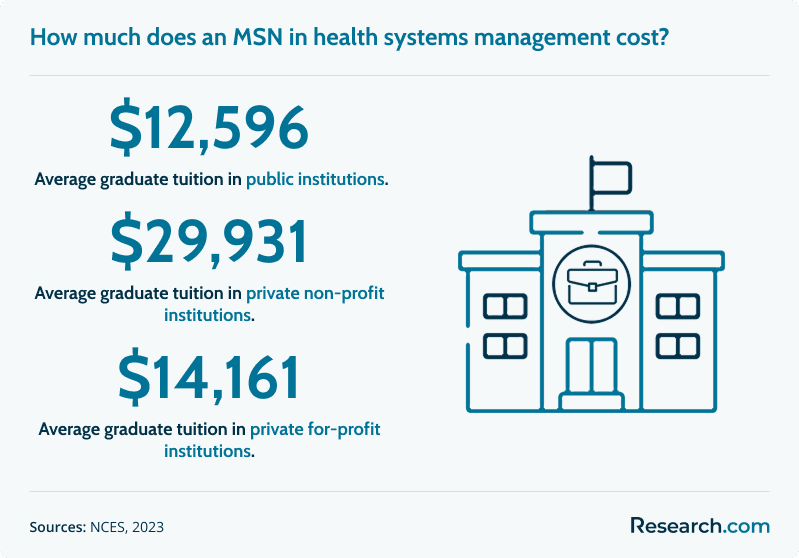
Based on recent NCES data, average graduate tuition and required fees at degree-granting postsecondary institutions differ by institutional control: public institutions average around $12,596 per year, private nonprofit institutions average approximately $29,931, and private for-profit institutions average about $14,161. These are broad averages, so students should calculate program-specific tuition, fees, books, technology expenses, travel for any required campus visits, and practicum-related costs.
When thinking about return on investment, compare the total cost of the MSN with realistic career outcomes, employer tuition support, and your current income. Nurses considering adjacent technology-focused pathways may also compare program costs with information about Master's in Health Informatics salary to understand how different graduate routes may align with their goals.
| Cost item | Why it matters | Question to ask |
| Per-credit tuition | Determines the base cost for credit-based programs | Is the online rate different from the campus rate? |
| Flat-rate billing | Can reward faster progress but may cost more if you slow down | What happens financially if I need to take fewer courses? |
| Required fees | Technology, graduation, clinical, or program fees can raise the total cost | Which fees are mandatory for online MSN students? |
| Practicum expenses | Students may need background checks, immunizations, travel, or site documentation | Who helps secure and approve practicum placements? |
| Transfer credits | Accepted credits can reduce time and tuition | How many graduate credits can transfer into the program? |
What financial aid options are available for fast online MSN in health systems management students?
Graduate nursing students may be able to combine federal aid, scholarships, employer support, payment plans, and private funding. The right mix depends on enrollment status, school eligibility, employer policy, and personal finances.
Federal financial aid
Start by submitting the Free Application for Federal Student Aid (FAFSA). Graduate students commonly use federal student loans such as Direct Unsubsidized Loans and Graduate PLUS Loans. If you are in a bridge pathway that includes undergraduate-level coursework, ask the school’s financial aid office whether any grant eligibility applies; aid rules vary by program structure and student status.
Scholarships and grants
Scholarships and grants for graduate nursing students may come from universities, professional nursing organizations, state workforce initiatives, private foundations, or healthcare associations. These awards are competitive, so apply early, watch deadlines, and prepare a strong statement connecting your leadership goals to patient care, quality improvement, workforce needs, or healthcare access.
Employer tuition reimbursement
Hospitals, clinics, long-term care organizations, and health systems may offer tuition reimbursement for nurses pursuing advanced education. Before enrolling, ask your employer about annual reimbursement caps, grade requirements, eligible schools, covered fees, and work commitments after graduation. Employer funding can materially change whether an accelerated program is affordable.
What are the prerequisites for enrolling in a fast online MSN in health systems management?
Admissions requirements vary, but most fast online MSN programs in health systems management expect applicants to show both academic readiness and current nursing credentials. Similar standards may apply to related leadership-focused pathways such as accelerated online MSN in care coordination programs, where students prepare for roles centered on coordination, outcomes, and quality improvement.
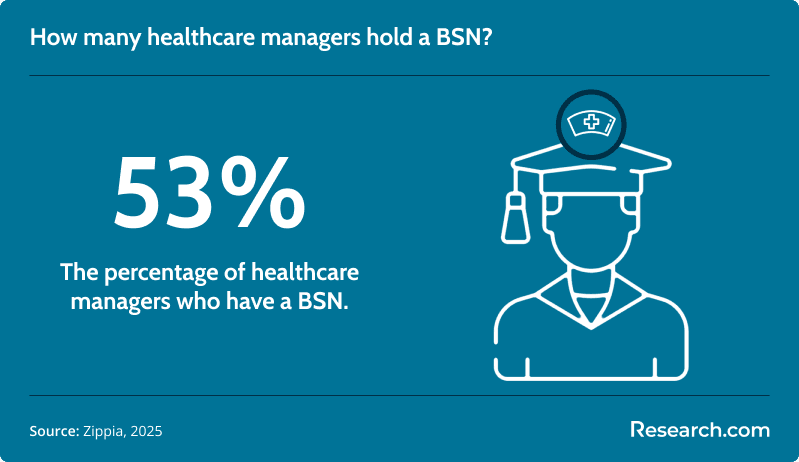
- BSN: Most programs require a Bachelor of Science in Nursing from an accredited institution. 53% of healthcare managers hold this credential.
- Active, unencumbered RN license: Applicants generally need a current RN license in good standing.
- Minimum GPA: Many programs expect a competitive undergraduate GPA, often 3.0 or higher on a 4.0 scale.
- Professional experience: Some schools prefer applicants with one to two years of clinical nursing experience, especially for leadership-oriented tracks.
- Letters of recommendation: Programs commonly request two or three letters from academic or professional references who can address leadership potential, judgment, and readiness for graduate work.
- Statement of purpose or essay: Applicants may need to explain why they want the degree, how it fits their career plans, and what experiences have prepared them for systems-level nursing leadership.
- Resume or CV: Schools typically ask for a current record of education, RN experience, certifications, professional accomplishments, and leadership responsibilities.
If you are comparing nursing leadership with broader healthcare administration, reviewing guidance on why get an MHA can help clarify whether an MSN, MHA, MBA, or another graduate option best matches your goals.
What courses are typically included in a fast online MSN in health systems management?
Course titles differ by school, but most health systems management MSN programs focus on leadership, finance, policy, quality improvement, informatics, and organizational change. The curriculum is usually designed to help nurses make decisions at the unit, department, service line, or system level.
| Course area | What students learn | How it applies at work |
| Healthcare policy and ethics | Regulation, legal responsibilities, compliance, advocacy, and ethical decision-making | Helps leaders make policy-aware decisions and navigate complex care delivery issues |
| Organizational leadership and management | Leadership models, strategy, staffing, team development, change management, and human resources | Supports nurse manager, director, and executive responsibilities |
| Healthcare finance and economics | Budgeting, financial analysis, resource allocation, revenue cycle concepts, and market pressures | Prepares nurses to manage departments, justify resources, and understand operational trade-offs |
| Healthcare quality and patient safety | Quality improvement methods, risk reduction, patient outcomes, safety culture, and performance measurement | Builds skills for quality, safety, accreditation, and process improvement roles |
| Healthcare information systems and technology | Electronic health records, informatics, data use, analytics, and technology-enabled decision-making | Helps leaders use data to improve workflows, staffing, outcomes, and system efficiency |
Students who are weighing business-focused healthcare leadership may also compare the curriculum with programs tied to the salary after MBA in Healthcare Management, especially if their long-term goal is executive administration rather than nursing-specific leadership.
What specializations are available in a fast online MSN in health systems management?
Health systems management is a broad category. Some programs use titles such as nursing administration, nurse executive, leadership and management, organizational leadership, or health policy and management. Others allow students to choose more focused areas. Nurses interested in specialized practice may also compare leadership programs with niche graduate tracks such as shortest online MSN forensic nursing programs.
Nurse executive or nurse administrator
This specialization is built for nurses pursuing roles such as nurse manager, director of nursing, or chief nursing officer. Coursework usually emphasizes strategic planning, staffing, finance, policy, organizational behavior, and leadership across hospitals and healthcare facilities. Medical and health services managers held approximately 562,700 jobs in 2023, and hospitals employed about 30% of them, making this a direct pathway into a major employment setting.
Nursing informatics
Nursing informatics combines nursing practice with information systems, data, analytics, and technology-enabled improvement. Students learn how to support EHR implementation, improve workflows, interpret operational data, and connect technology decisions to patient care. Nurses who want to move into advanced academic, leadership, or research roles may also explore what can you do with a doctorate in nursing after completing a master’s degree.
Healthcare quality and patient safety
This focus prepares nurses to reduce preventable harm, improve outcomes, monitor quality measures, support accreditation readiness, and lead performance improvement initiatives. It can be a strong fit for nurses who enjoy analyzing processes, coaching teams, and building safer systems of care.
Clinical Nurse Leader
A Clinical Nurse Leader focus centers on improving care at the point of delivery through interdisciplinary coordination, evidence-based practice, and outcome measurement. While many health systems management programs are more administrative, some incorporate CNL-related concepts or offer a separate track.
Specialization choice should reflect where you want to work. Health services managers are employed across settings including offices of physicians, which account for 12% of health services managers; nursing and residential care facilities at 9%; government at 7%; and outpatient care centers at 7%.
How do you choose the best fast online MSN in health systems management program?
The best program is not necessarily the shortest one. A strong choice matches your career target, budget, schedule, learning style, and licensure situation while maintaining recognized nursing accreditation.
- Confirm accreditation first: Look for programmatic nursing accreditation from the CCNE or the Accreditation Commission for Education in Nursing (ACEN), along with institutional accreditation.
- Define what “fast” means: Ask whether the advertised timeline assumes full-time study, transfer credits, year-round enrollment, self-paced work, or a specific course load.
- Compare total cost, not only tuition: Add required fees, technology costs, books, practicum expenses, and the financial impact of reducing work hours.
- Review practicum expectations: Clarify the number of hours, site approval process, preceptor qualifications, and whether the school helps with placement.
- Match the curriculum to your goal: A nurse executive curriculum is different from a health policy, informatics, or quality improvement focus.
- Evaluate online support: Strong advising, accessible faculty, technical support, library access, writing help, and career services matter more in accelerated programs.
- Ask about outcomes carefully: Graduation rates, alumni roles, certification preparation, and employer partnerships can be useful, but no program can guarantee a specific salary or promotion.
| Common mistake | Why it can hurt you | Better approach |
| Choosing only the shortest program | The workload may be unrealistic or the specialization may not fit your goals | Compare speed with curriculum, support, cost, and practicum feasibility |
| Ignoring accreditation | Accreditation can affect credit transfer, employer recognition, and future education options | Verify nursing program accreditation before applying |
| Looking only at per-credit tuition | Fees, billing models, and required credits can change the actual cost | Request a full program cost estimate |
| Assuming online means self-paced | Many online programs still have weekly deadlines and fixed term schedules | Ask whether courses are asynchronous, synchronous, competency-based, or cohort-based |
| Waiting too long on practicum planning | Placement delays can slow graduation | Ask about site requirements before enrollment and start planning early |
What careers are available after a fast online MSN in health systems management?
Graduates of fast online MSN programs in health systems management can pursue leadership and administrative positions in hospitals, outpatient centers, long-term care organizations, public health agencies, consulting firms, and health systems. The degree is especially relevant for nurses who want to influence staffing, quality, operations, budgeting, policy, and patient care systems.
| Career path | Typical responsibilities | Good fit for nurses who... |
| Hospital administrator or manager | Oversee departments, budgets, staffing, compliance, and operational performance | Want to lead service lines or facility operations |
| Clinical director | Manage clinical teams, develop protocols, monitor outcomes, and coordinate care delivery | Enjoy balancing patient care priorities with administrative decision-making |
| Nursing director or supervisor | Lead nursing staff, scheduling, performance improvement, policy implementation, and workforce planning | Want to move from charge nurse or unit leadership into formal management |
| Healthcare consultant | Advise organizations on efficiency, workflows, strategy, technology, or quality improvement | Prefer project-based problem solving across multiple healthcare settings |
| Health services manager in government | Manage programs, policies, public health operations, or healthcare delivery systems | Want to influence population health, public systems, or healthcare policy |
Pay varies by role, employer, location, experience, and scope of responsibility. For these career options, the pay can get as high as $132,520 annually. Nurses drawn to data, EHRs, analytics, and technology-driven care improvement may also consider a career in health informatics.
What is the job market like for graduates of a fast online MSN in health systems management?
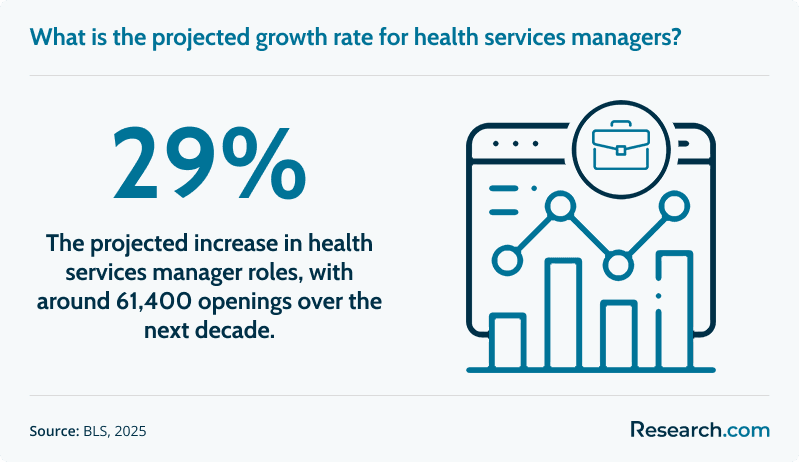
The job market for health systems management graduates is supported by healthcare expansion, aging patient populations, technology adoption, and the ongoing need for efficient, coordinated care. The BLS projects employment of medical and health services managers to grow 29% from 2023 to 2033, with approximately 61,400 openings projected each year, on average, over the decade.
Many openings are expected to come from workers retiring or moving into other roles. Demand is also shaped by the growth of healthcare facilities, broader use of EHRs, increased attention to quality metrics, and the need to manage complex health systems. An MSN in health systems management can help nurses compete for these roles by combining clinical credibility with graduate-level leadership and operational training.
Current trends affecting MSN health systems management graduates
- Data-driven leadership: Healthcare leaders increasingly use dashboards, EHR data, and quality metrics to guide staffing, safety, and performance decisions.
- AI and automation: AI tools may support documentation, scheduling, analytics, and decision support, but nurse leaders still need judgment, ethics, change management, and workflow expertise.
- Value and quality pressure: Employers continue to emphasize patient outcomes, cost control, safety, and care coordination.
- Credential expectations: Leadership roles often favor candidates with graduate education, management experience, and evidence of measurable improvement work.
- Online education growth: Working nurses have more online graduate options, which increases access but also makes accreditation and program quality checks more important.
What accreditation standards and support services indicate program quality?
Accreditation is one of the most important quality checks for any MSN program. Students should verify that the nursing program is accredited by a recognized agency such as CCNE or ACEN and that the institution itself is appropriately accredited. Programmatic accreditation signals that the curriculum, faculty qualifications, student outcomes, and academic processes have been reviewed against nursing education standards.
Support services also matter, especially in accelerated online programs. Look for academic advising, technical help, library access, writing support, faculty availability, career services, and practicum coordination. Affordability should be reviewed alongside quality; students comparing lower-cost nursing options may also find value in researching cheapest online RN to BSN programs as part of a broader education planning strategy.
What challenges might you face in an accelerated online MSN in health systems management program?
Accelerated online MSN programs can be demanding. Students must manage graduate coursework, clinical or practicum requirements, professional responsibilities, and personal obligations within a compressed schedule. The challenge is not only the amount of work; it is the pace at which students must absorb finance, leadership, policy, quality improvement, and systems-management concepts.
- Time pressure: Short terms can leave little room to recover from missed deadlines.
- Self-management: Online students need reliable study routines and proactive communication with instructors.
- Practicum planning: Local placement arrangements may require early coordination and documentation.
- Work-life strain: Full-time work plus accelerated graduate study can lead to burnout without realistic scheduling.
- Virtual collaboration: Group projects and discussions require clear communication across different work schedules and time zones.
Students considering other advanced accelerated pathways can compare the workload and career outcomes with 1 year DNP programs online, especially if they are weighing leadership, practice, and doctoral-level options.
Can an accelerated MSN in health systems management lead to advanced clinical roles?
An accelerated MSN in health systems management is primarily a leadership and administration pathway, not a substitute for a nurse practitioner or advanced clinical practice program. However, the skills can complement clinical advancement by strengthening decision-making, care coordination, quality improvement, staffing strategy, and systems thinking.
If your goal is direct advanced clinical practice, confirm whether the program leads to the credential you need. A leadership MSN may support management roles, but a nurse practitioner pathway requires focused clinical training and eligibility requirements. Nurses who want a more direct clinical route may need a direct entry nurse practitioner program or another NP-focused graduate program.
What graduates say about fast online MSN in health systems management programs
- Sarah: "I did not expect to finish a master’s degree while continuing to work full-time as a charge nurse, but the online format made it possible. I studied after shifts and on weekends, and the flexibility helped me keep progressing. The courses in strategic planning and financial management were immediately useful in my hospital role, and I now feel more prepared to contribute to operational decisions and lead with confidence."
- David: "A traditional two- or three-year classroom program felt hard to fit into my life, so the accelerated online format was the right option for me. It was intense, but it forced me to become much more organized. In 18 months, I gained practical knowledge in policy, quality improvement, and leadership that I now use as a clinical director to support better patient outcomes."
- Emily: "I was worried that an online program would feel disconnected, but the faculty communication, virtual discussions, and group projects helped build a real learning community. The case-based work in healthcare finance and leadership prepared me for the issues I manage every day as a nursing administrator in a long-term care facility. I also built a network of nurses from different parts of the country, which turned out to be one of the most valuable parts of the experience."
Questions to ask before applying
- Is the MSN program accredited by CCNE or ACEN?
- Does the advertised timeline assume full-time enrollment or self-paced acceleration?
- How many hours per week do successful students typically study?
- What is the total program cost, including fees and practicum expenses?
- Are courses asynchronous, synchronous, competency-based, or cohort-based?
- Does the school help locate practicum sites, or is the student responsible?
- Will the specialization support my target role, such as nurse executive, quality leader, informatics manager, or healthcare administrator?
- What student support is available for online learners?
- Can I use employer tuition reimbursement or federal aid?
- What happens if I need to slow down or take a break?
References:
- AHA. (2025, January 31). Fast Facts on U.S. hospitals, 2025. aha.org.
- BLS. (2025, August 28). Medical and health services managers. bls.gov.
- NCES. (2023). Average and percentiles of graduate tuition and required fees in degree-granting postsecondary institutions, by control of institution: Academic year 1989-90 through 2021-22. nces.ed.gov.
- Zippia. (2025, January 8). Best Colleges and Degrees for Health Care Managers. zippia.com.
- Zippia. (2025, January 8). Best Colleges and Degrees for Health Services Managers. zippia.com.
Key Insights
- The fastest online MSN in health systems management programs may take as little as 12 months, but many realistic accelerated timelines fall between 18 and 24 months.
- Speed should be balanced against accreditation, practicum support, workload, total cost, and specialization fit.
- Most programs expect a BSN, an active unencumbered RN license, a competitive GPA, and evidence of professional readiness for graduate nursing leadership study.
- Common coursework includes healthcare finance, policy, ethics, organizational leadership, quality improvement, patient safety, informatics, and systems management.
- Graduates may pursue roles such as nurse manager, nursing director, clinical director, hospital administrator, healthcare consultant, or health services manager.
- The BLS projects medical and health services manager employment to grow 29% from 2023 to 2033, but individual outcomes depend on experience, location, employer needs, and leadership preparation.
- The best program is the one that fits your schedule and career target without compromising accreditation, affordability, or support.
Other Things You Should Know About the Fastest Online MSN in Health Systems Management Programs
The typical curriculum for these programs includes courses in healthcare policy, financial management, leadership in healthcare settings, and informatics. Programs are designed to be completed quickly, often within 12-18 months, and require around 30-36 credit hours.
To enroll in a 2027 online MSN in Health Systems Management program, ensure a stable internet connection, updated operating system, and compatibility with course software. Schools typically require a webcam for virtual interactions and specific browsers for accessing course materials.
The program should hold regional institutional accreditation and, when possible, nursing accreditation from the Commission on Collegiate Nursing Education or the Accreditation Commission for Education in Nursing. These accreditations help confirm that the MSN meets accepted academic and professional standards and is more likely to support employer recognition.