2027 Is a Master’s in Healthcare Administration a Good Career?

Co-Founder and Chief Data Scientist
A master’s in healthcare administration (MHA) is designed for people who want to lead healthcare organizations rather than provide direct clinical care. It can be a strong option for nurses, clinicians, business professionals, public health workers, and early-career administrators who want to move into management roles in hospitals, clinics, insurance companies, long-term care facilities, consulting firms, government agencies, or health technology companies.
The decision matters because healthcare organizations are expanding, digitizing, and operating under tighter financial, staffing, compliance, and quality pressures. The U.S. healthcare industry is projected to add 2.1 million new jobs between 2022 and 2032, and medical and health services managers—a common career category for MHA graduates—are expected to see 29% growth, far above the national average for all occupations.
This guide explains what you can do with an MHA, how much graduates may earn, which roles and industries tend to pay more, how costs affect return on investment, and what questions to ask before enrolling in a program.
Quick Answer: Is a Master’s in Healthcare Administration Worth It?
An MHA can be worth it if your goal is to move into healthcare leadership, operations, strategy, compliance, finance, policy, or health information management. The degree is most useful for people who want a healthcare-specific management credential and who are prepared to build experience through internships, residencies, capstone projects, or current healthcare employment.
It may not be the best choice if you want a broad business degree, plan to leave healthcare entirely, or expect the degree alone to guarantee an executive salary. Salary outcomes depend heavily on location, employer type, work experience, leadership track record, and specialization.
Key Things You Should Know About Master’s in Healthcare Administration Careers
- Healthcare management remains one of the strongest career areas in the U.S. labor market, with management roles projected to grow by 29% through 2033. MHA graduates may work in hospitals, clinics, insurers, biotech firms, public agencies, and consulting organizations.
- MHA programs are offered in full-time, part-time, online, hybrid, and executive formats. Some programs also allow students to focus on areas such as health policy, informatics, long-term care, quality improvement, or healthcare finance.
- Total tuition commonly ranges from $30,000 to $120,000, depending on institution type, delivery format, residency status, and program length. Scholarships, employer tuition benefits, assistantships, and federal financial aid can reduce the amount students pay out of pocket.
- Most healthcare administration jobs do not require a license, but nursing home administration is a major exception. Voluntary credentials such as FACHE, CMM, or PMP may strengthen a resume and support advancement into specialized or senior roles.
- Strong MHA programs often include internships, administrative residencies, consulting projects, or capstones. These practical experiences matter because healthcare employers typically value applied experience, professional networks, and evidence of leadership ability.
- What can you do with a master’s in healthcare administration for 2027?
- What is the average salary for someone with a master’s in healthcare administration?
- What are the highest-paying jobs with a master’s in healthcare administration?
- How much does a master’s in healthcare administration cost?
- What healthcare administration roles are available in public vs. private sectors?
- Which states offer the highest pay for MHA graduates?
- How does an MHA salary compare to an MBA in healthcare?
- What critical skills are essential for effective healthcare administration?
- What role does specialized online training play in advancing healthcare administration careers?
- What emerging trends are shaping the future of healthcare administration?
- What is the Return on Investment for an MHA Degree?
- What challenges do healthcare administrators face in a rapidly evolving healthcare landscape?
- Do salaries increase significantly with experience in healthcare administration?
- What are the top-paying industries for MHA degree holders?
- Is there a demand for healthcare administrators in the U.S.?
What can you do with a master’s in healthcare administration for 2027?
A master’s in healthcare administration prepares graduates for management roles that connect patient care, business operations, policy, staffing, finance, technology, and compliance. Demand for healthcare administration talent is especially visible across hospitals and health systems, but MHA graduates are not limited to hospital jobs.
The degree is most valuable when paired with practical healthcare experience, leadership exposure, and a clear career direction. Below are common paths for MHA graduates and the type of work each role usually involves.
| Career Path | What the Role Focuses On | Best Fit For |
| Hospital Administrator | Hospital operations, budgets, staffing, compliance, service quality, and patient care coordination | Professionals who want broad operational responsibility in a hospital or health system |
| Healthcare Consultant | Performance improvement, cost control, strategy, regulatory readiness, and organizational change | Analytical professionals who enjoy project-based work and advising multiple organizations |
| Clinical Manager | Department-level leadership in areas such as surgery, radiology, cardiology, or outpatient services | Clinicians or administrators who want to manage a specific care unit or service line |
| Health Information Manager | Patient data, electronic health records, privacy, data governance, and reporting systems | Students interested in the intersection of healthcare operations and information systems |
| Practice Manager | Staffing, billing, scheduling, patient experience, vendor coordination, and daily office operations | People who prefer managing physician offices, specialty clinics, or group practices |
| Health Services Manager | Service delivery, resource allocation, workflow improvement, and team performance | Graduates seeking flexible management roles across many healthcare settings |
| Policy Analyst or Public Health Administrator | Health policy research, program design, public health operations, and population health planning | Professionals motivated by community health, equity, government programs, or nonprofit work |
| Pharmaceutical Project Manager | Project timelines, regulatory coordination, clinical trial operations, or product launch support | Administrators interested in biotech, pharmaceuticals, research, or commercial healthcare |
| CEO or COO | Organizational strategy, financial performance, operational execution, and executive leadership | Experienced leaders with a record of managing teams, budgets, risk, and stakeholder expectations |
| Long-Term Care Administrator | Nursing home or assisted living operations, compliance, staffing, resident care, and quality standards | Professionals willing to meet state requirements for long-term care leadership |
Who Should Consider an MHA?
- Clinicians who want to move from bedside care into leadership, operations, or quality improvement
- Healthcare employees who need a graduate credential to compete for director-level roles
- Business professionals who want to specialize in healthcare systems, reimbursement, compliance, and patient-centered operations
- Public health or policy professionals who want stronger administrative and financial management skills
- Early-career professionals who can use internships, residencies, or capstone work to build experience
Who May Be Better Served by Another Degree?
- Students who want broad corporate management roles outside healthcare may prefer an MBA.
- Professionals focused on epidemiology, community health research, or disease prevention may prefer an MPH.
- Students who want to become licensed clinicians need a clinical degree rather than an MHA.
- People who want to work primarily in analytics, cybersecurity, or data science may need a more technical program.
What is the average salary for someone with a master’s in healthcare administration?
The average salary for someone with a master’s in healthcare administration generally falls between $80,000 and $120,000 per year in the United States. Actual pay depends on job title, employer, region, years of experience, organization size, and whether the role includes responsibility for budgets, staff, compliance, or executive decision-making.
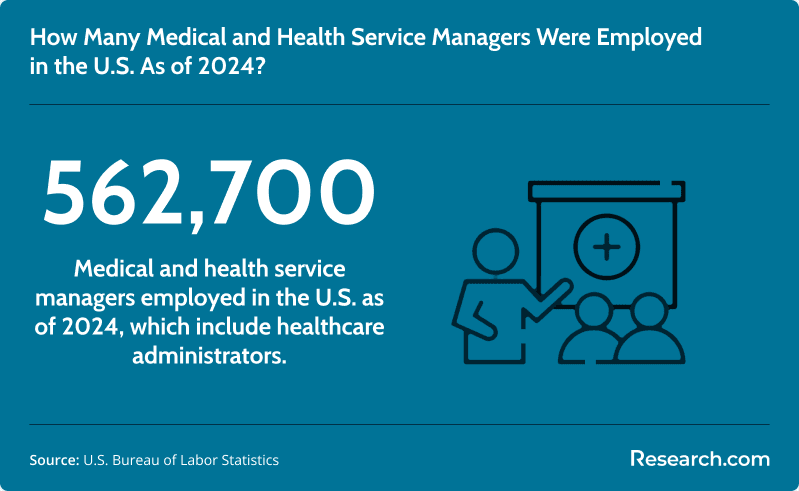
As of 2024, there were 562,700 medical and health service managers in the U.S., a category that includes many healthcare administration roles. The table below shows commonly cited salary ranges by experience level.
| Experience Level | Average Salary Range |
| Entry-Level (0–2 years) | $60,000 – $80,000 |
| Mid-Level (3–7 years) | $80,000 – $110,000 |
| Senior-Level (8+ years) | $110,000 – $150,000+ |
| Executive-Level (COO/CEO) | $150,000 – $300,000+ |
Location can change the value of a salary offer. Higher pay in large urban markets or high-cost states such as California, New York, and Massachusetts may be offset by housing, taxes, commuting costs, and other living expenses. When comparing offers, look at total compensation, benefits, retirement contributions, bonuses, relocation support, and advancement potential—not salary alone.
What are the highest-paying jobs with a master’s in healthcare administration?
The highest-paying MHA careers are usually senior leadership roles that involve complex operations, large budgets, regulatory risk, financial accountability, and organization-wide decision-making. As with shorter healthcare degree pathways that can lead to well-paid roles, compensation varies by experience, location, employer size, and sector.
Common high-paying options for MHA graduates include:
- Hospital Chief Executive Officer (CEO): Sets the strategic direction for a hospital or health system and is accountable for financial performance, quality, compliance, community relationships, and executive leadership.
- Hospital Chief Operating Officer (COO): Leads daily operations, coordinates service lines, improves workflows, and helps ensure that care delivery is efficient and compliant.
- Senior Healthcare Consultant or Partner: Advises healthcare organizations on strategy, cost reduction, digital transformation, compliance, mergers, or performance improvement.
- Pharmaceutical or Health Services Project Manager: Directs complex healthcare or life sciences projects, including clinical, operational, regulatory, or product-related initiatives.
- Health Informatics Director: Oversees electronic health records, analytics systems, reporting infrastructure, and digital health transformation.
- Long-Term Care Facility Administrator: Manages nursing homes or assisted living facilities, often with responsibility for regulatory compliance, staffing, resident safety, and care quality.
Graduates of traditional programs and graduates of one-year online MHA programs can both pursue leadership roles, but accelerated timelines do not replace experience. Employers still look for evidence that candidates can manage people, budgets, compliance requirements, and high-pressure operational decisions.
| High-Paying Role | Why It Pays More | Typical Advancement Requirement |
| CEO or COO | Executive accountability for strategy, operations, risk, and performance | Years of leadership experience and measurable operational results |
| Healthcare Consultant | Specialized expertise applied to complex organizational problems | Strong analytical skills, client management, and industry knowledge |
| Health Informatics Director | Growing importance of health data, EHR systems, reporting, and privacy | Healthcare operations knowledge plus technical or data leadership experience |
| Pharmaceutical Project Manager | High-value projects involving regulation, timelines, research, or commercialization | Project management ability and familiarity with regulated healthcare environments |
| Long-Term Care Administrator | Operational responsibility in a heavily regulated care setting | State-specific requirements, compliance knowledge, and facility leadership experience |
How much does a master’s in healthcare administration cost?
The total cost of an MHA depends on the school, program format, residency status, credit requirements, fees, travel, books, and whether you study full time or part time. Many programs cost between $30,000 and $120,000 for the full degree. Students comparing options should review both published tuition and the full cost of attendance.
An online program is not automatically cheaper, but some online options can reduce relocation, commuting, and housing costs. Students comparing affordability may want to review low-cost online healthcare administration degree options alongside local public universities and employer-supported programs.
Typical MHA Cost Ranges
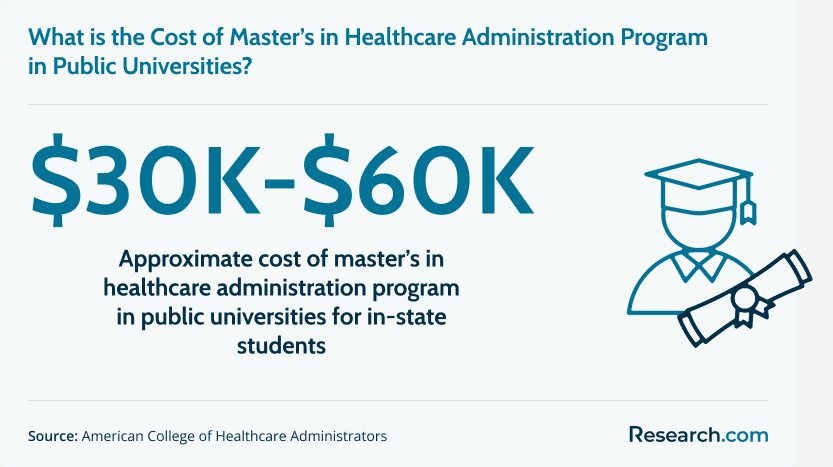
- Public Universities (In-State): $30,000 to $60,000
- Public Universities (Out-of-State): $40,000 to $80,000
- Private Universities: $60,000 to $120,000
- Online Programs: $20,000 to $80,000, often with lower commuting or relocation costs than campus-based study
Accelerated, executive, and dual-degree programs may have different pricing structures. For example, some students consider an accelerated online healthcare management degree to finish faster, while others choose a dual MHA/MBA for broader business training. A faster program can reduce time out of the workforce, but it may also require a heavier course load.
Costs Students Often Forget
| Cost Factor | Why It Matters |
| University fees | Technology, student services, graduation, and program fees can raise the final bill. |
| Residency or internship travel | Online programs may still require campus visits, site placements, or travel to approved facilities. |
| Lost income | Full-time study may reduce work hours or delay promotion opportunities. |
| Books and software | Courses in finance, analytics, and informatics may require paid tools or materials. |
| Licensure or certification costs | Long-term care administration or voluntary credentials may involve exams, applications, or continuing education. |
Before enrolling, ask the school for the full program price, not just the per-credit tuition. Also ask whether scholarships, fellowships, assistantships, employer tuition assistance, military benefits, or federal aid are available.
What healthcare administration roles are available in public vs. private sectors?
Healthcare administration careers exist in public, nonprofit, and private organizations. The work may look similar on the surface—budgets, staffing, compliance, quality, and operations—but the priorities can differ. Public-sector roles often emphasize access, equity, regulation, and community outcomes. Private-sector roles may place greater weight on growth, market position, profitability, and operational efficiency.
A recent survey of hospital administrators found that 48% cite compensation as the most important employee-retention factor, while 37% point to clear career advancement opportunities. Those concerns affect both public and private employers, although each sector may have different budget flexibility and promotion structures.
Public Sector Roles
- Public Health Administrator: Directs health programs at the local, state, or federal level and coordinates services that affect community health.
- Policy Analyst: Studies healthcare issues, evaluates program impact, and helps develop policy recommendations for agencies or public organizations.
- Health Program Manager: Oversees publicly funded initiatives such as vaccination programs, Medicaid services, or community health interventions.
- Regulatory Affairs Manager: Helps public institutions comply with healthcare laws, reporting requirements, and oversight standards.
- Veterans Health Administrator: Manages programs or operations connected to Veterans Health Administration or military-related healthcare services.
Private Sector Roles
- Hospital Administrator, COO, or CEO: Leads operations, finance, staffing, strategy, and quality improvement in private healthcare organizations.
- Healthcare Consultant: Helps organizations improve performance, reduce costs, adopt new systems, or prepare for regulatory and market changes.
- Practice Manager: Runs the daily business operations of physician offices, specialty practices, or outpatient clinics.
- Health Information Manager: Oversees EHR systems, privacy, data integrity, reporting workflows, and compliance requirements.
- Pharmaceutical Project Manager: Coordinates clinical, regulatory, operational, or product-related projects in pharmaceutical or biotech environments.
| Sector | Common Priorities | Potential Advantages | Possible Trade-Offs |
| Public Sector | Population health, access, equity, policy compliance, public accountability | Mission-driven work, program impact, government or nonprofit experience | Budget limits, slower hiring processes, complex regulations |
| Private Sector | Operational performance, growth, innovation, finance, competitive positioning | Higher earning potential in some roles, faster innovation, varied employer types | Greater pressure around revenue, productivity, and market performance |
Some affordable online MHA programs include coursework relevant to private-sector leadership, but students should review electives, faculty expertise, employer partnerships, and internship options before choosing a program.
Which states offer the highest pay for MHA graduates?
The states that tend to offer the highest pay for MHA graduates are often those with high living costs, major health systems, academic medical centers, insurers, consulting firms, biotech employers, and dense urban healthcare markets. California, New York, Massachusetts, New Jersey, and Washington consistently rank among the strongest states for compensation. In these states, MHA graduates in mid- to senior-level positions can earn well over $120,000 annually, particularly in large markets such as San Francisco, New York City, and Boston.
Illinois, Texas, and Maryland also offer strong compensation opportunities in cities such as Chicago, Houston, and Baltimore. These markets include major hospitals, managed care organizations, public health agencies, and specialty healthcare employers. Executive roles, consulting positions, and jobs in large systems can reach six-figure earnings earlier than smaller-market roles, but high salaries should always be compared with cost of living and career mobility.
Students who need flexibility can compare online healthcare management degree programs with local campus options in their target state. If your goal is to work in a specific region, prioritize programs with alumni networks, internship placements, and employer relationships in that area.
How to Evaluate a High-Pay State
- Compare salary ranges with housing, taxes, commuting, and childcare costs.
- Look at the concentration of hospitals, insurers, biotech firms, government agencies, and consulting employers.
- Check whether the program you choose has internship or residency connections in your target market.
- Consider whether you want a large metro leadership track or a smaller-market role with broader responsibilities.
How does an MHA salary compare to an MBA in healthcare?
MHA and healthcare MBA salaries are often comparable, but the better degree depends on the roles you want. An MHA is usually more specialized for healthcare delivery, hospital operations, health systems, policy, compliance, quality, and patient-centered administration. An MBA with a healthcare concentration offers broader business training and may be useful for finance, consulting, corporate strategy, entrepreneurship, or roles that extend beyond healthcare providers.
MHA vs. MBA in Healthcare: Salary Comparison
- Entry-Level Roles: Graduates from both pathways often begin in the $60,000 to $90,000 range, depending on role, employer, location, and prior experience.
- Mid-Career: MHA graduates in hospitals, health systems, or public health roles may earn $90,000 to $120,000, while healthcare MBA graduates in corporate healthcare, finance, or consulting may reach $100,000 to $130,000+.
- Executive-Level: MBA graduates may have an advantage for CFO, COO, finance, or corporate strategy roles in for-profit settings, with earnings often reaching $150,000–$250,000+. MHA graduates in hospital CEO or COO roles, especially in nonprofit or health system leadership, can reach similar levels.
| Degree | Best For | Potential Limitation |
| MHA | Healthcare operations, hospital leadership, health services management, quality, compliance, policy, and care delivery systems | Less portable outside healthcare than a general MBA |
| MBA in Healthcare | Healthcare consulting, finance, corporate strategy, entrepreneurship, payer organizations, and business leadership | May offer less depth in healthcare policy, delivery systems, and provider operations |
If your long-term goal is hospital administration or health system leadership, the MHA is usually the more targeted credential. If you want flexibility across industries or a stronger finance and corporate strategy foundation, a healthcare MBA may be the better fit.
The industry you choose can significantly affect compensation as a medical and health services manager. The chart below shows industries that employ the largest number of these professionals.
What critical skills are essential for effective healthcare administration?
Healthcare administrators need a mix of business judgment, healthcare knowledge, ethical decision-making, and people leadership. The role often requires balancing patient needs, staffing realities, regulatory requirements, financial limits, and technology change at the same time.
Core Skills MHA Students Should Build
- Financial management: Budgeting, forecasting, reimbursement awareness, cost control, and resource allocation.
- Operations leadership: Workflow design, staffing models, process improvement, capacity planning, and service-line management.
- Data-informed decision-making: Using metrics, dashboards, quality indicators, and patient data responsibly to guide decisions.
- Regulatory and compliance awareness: Understanding privacy, safety, reporting, accreditation, risk management, and legal expectations.
- Communication: Translating complex information for clinicians, executives, patients, vendors, regulators, and community stakeholders.
- Change management: Leading teams through system implementations, staffing changes, mergers, quality initiatives, or new care models.
- Conflict resolution: Managing tension among clinical teams, administrators, patients, and external partners.
- Technology fluency: Understanding EHR systems, telehealth, analytics platforms, cybersecurity concerns, and AI-supported workflows.
Students who want foundational exposure to clinical office operations may also compare related training options such as affordable online medical assistant programs, although those programs prepare students for a different career level and role type than an MHA.
What role does specialized online training play in advancing healthcare administration careers?
Specialized online training can help healthcare administrators update specific skills without committing to another full degree. This can be useful for professionals who already have an MHA or are working toward one but need sharper expertise in areas such as health information management, analytics, compliance, project management, or digital health.
For example, professionals interested in records, privacy, coding systems, reporting, and health data operations may explore online health information management programs. These credentials are not a substitute for an MHA, but they can strengthen a candidate’s profile for informatics, revenue cycle, EHR, or data governance roles.
When Additional Online Training Makes Sense
- You want to move into a specialized area such as informatics, compliance, analytics, or project management.
- Your current role requires new technical knowledge that your original degree did not cover deeply.
- You need continuing education for a certification or employer requirement.
- You want to test a career direction before committing to another graduate degree.
What emerging trends are shaping the future of healthcare administration?
Healthcare administration is being reshaped by digital tools, new patient expectations, workforce shortages, compliance pressure, and the need to deliver care more efficiently. Administrators are increasingly expected to understand how technology affects staffing, budgets, patient access, data security, quality measurement, and care coordination.
Trends MHA Students Should Watch
- AI and analytics: Healthcare leaders are using data tools to support forecasting, scheduling, quality monitoring, risk identification, and operational decision-making.
- Telehealth and hybrid care: Administrators must manage virtual care workflows, patient access, reimbursement issues, staffing, and technology adoption.
- Population health and integrated care: Health systems are placing more emphasis on coordinated care, prevention, chronic disease management, and community-level outcomes.
- Cybersecurity and privacy risk: As healthcare data systems expand, administrators need to work closely with IT and compliance teams to protect sensitive information.
- Workforce retention: Staffing shortages and burnout make compensation, advancement, scheduling, culture, and leadership development central management issues.
- Cost and value pressure: Employers expect administrators to improve outcomes while controlling waste, inefficiency, and avoidable costs.
Short-term credentials, including options such as accelerated medical assistant certification courses, can help some workers enter healthcare quickly, but MHA careers usually require broader leadership, finance, policy, and operations preparation.
What is the Return on Investment for an MHA Degree?
The return on investment for an MHA depends on what you pay, how quickly you finish, whether you continue working while enrolled, and how effectively the program helps you move into higher-responsibility roles. ROI is strongest when the degree leads to a clear promotion path, a better-paying employer, a specialized leadership role, or a transition from clinical work into administration.
| ROI Factor | Questions to Ask Before Enrolling |
| Total program cost | What is the full cost after fees, books, travel, and required residencies? |
| Time to completion | Can you finish while working, or will you need to reduce income? |
| Employer support | Does your employer offer tuition assistance, promotion pathways, or paid practicum options? |
| Career services | Does the program provide residencies, internships, mentorship, alumni contacts, or employer connections? |
| Career target | Does the curriculum match your goal: hospital operations, policy, consulting, informatics, long-term care, or executive leadership? |
| Opportunity cost | Would a certificate, MBA, MPH, or internal leadership program meet your goal at a lower cost? |
Accelerated options, including an accelerated online health information management degree, may help some students enter or advance in healthcare faster. However, speed should not be the only factor. A shorter program should still provide respected accreditation, strong faculty, relevant coursework, and practical experience.
How to Improve MHA ROI
- Choose an accredited program with coursework aligned to your target role.
- Use employer tuition assistance before taking on loans.
- Keep working in healthcare while studying if possible.
- Prioritize programs with internships, residencies, consulting projects, or capstones.
- Build a portfolio of measurable accomplishments, such as cost savings, workflow improvements, quality metrics, or staff development outcomes.
- Network with alumni, faculty, preceptors, and local healthcare executives before graduation.
What challenges do healthcare administrators face in a rapidly evolving healthcare landscape?
Healthcare administrators operate in a high-pressure environment where operational decisions can affect patient safety, staff morale, compliance exposure, and financial stability. The job can be rewarding, but it is rarely simple.
Common Challenges in Healthcare Administration
- Regulatory complexity: Administrators must keep up with changing federal, state, payer, accreditation, privacy, and safety requirements.
- Budget pressure: Leaders are expected to control costs while maintaining quality, staffing, access, and patient satisfaction.
- Workforce shortages: Recruiting, scheduling, retaining, and supporting healthcare staff are major operational priorities.
- Technology adoption: New systems can improve efficiency, but implementation often brings training needs, workflow disruption, cybersecurity concerns, and change resistance.
- Data management: Administrators must use data responsibly while protecting privacy and avoiding poor decisions based on incomplete metrics.
- Patient expectations: Patients increasingly expect accessible, transparent, coordinated, and digitally enabled care.
Professionals who want stronger analytical preparation for data-heavy healthcare environments may explore related technical pathways such as online bioinformatics master’s programs, though those programs serve different career goals than healthcare administration.
Do salaries increase significantly with experience in healthcare administration?
Yes. Healthcare administration salaries often rise substantially with experience because higher-level roles involve broader responsibility, larger budgets, more staff, greater compliance exposure, and more complex organizational decisions. Advancement also depends on leadership ability, not just years in the field. The connection between pay and leadership scope is one reason many professionals study the value of organizational leadership in management careers.
Early-career healthcare administrators with 0–3 years of experience typically earn $60,000 to $80,000. Mid-level professionals with 4–9 years of experience often move into the $90,000 to $120,000 range as they become managers, department leaders, or directors. Professionals with 10+ years of experience, especially in large systems or high-paying sectors, may earn $130,000 to $200,000+ in senior or executive roles such as COO, CFO, or CEO.
Specialized expertise can also accelerate salary growth. Health IT, compliance, strategic planning, revenue cycle, quality improvement, consulting, biotech, and large-system operations can all increase a candidate’s value when combined with strong leadership results.
What are the top-paying industries for MHA degree holders?
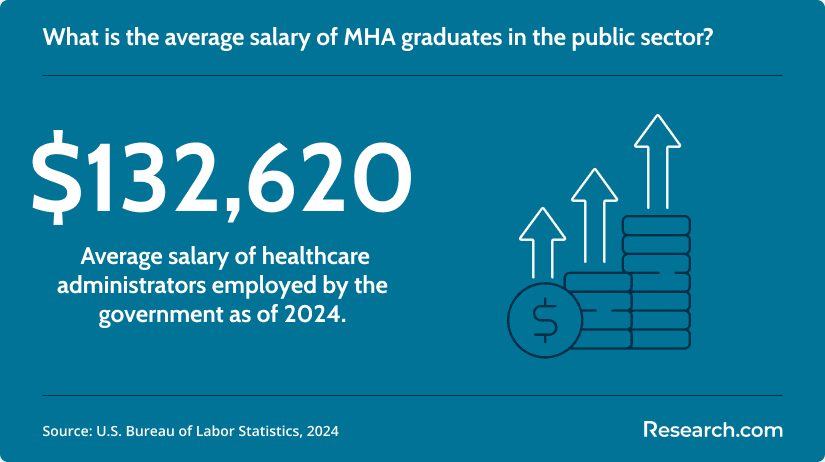
The top-paying industries for MHA graduates are usually those with complex operations, significant financial resources, strict regulatory requirements, and high demand for strategic leadership. In 2024, healthcare administrators working in government positions earned an average salary of $132,620.
Some professionals compare MHA outcomes with other advanced business credentials. For example, candidates researching DBA degree salary outcomes may be considering whether a doctoral business credential could support executive or academic leadership goals beyond the MHA level.
Pharmaceutical and Biotech Companies
Average Salary: $100,000 – $150,000+
Pharmaceutical and biotech employers hire administrators for project management, regulatory coordination, drug development support, commercialization, and operational leadership. These organizations often pay well because projects are complex, highly regulated, and financially significant.
Health Insurance Companies
Average Salary: $95,000 – $130,000+
Insurers such as UnitedHealth Group, Anthem, and Cigna employ healthcare administrators to manage claims operations, compliance, provider networks, member services, cost control, and care management processes.
Consulting Firms
Average Salary: $100,000 – $140,000+
Healthcare consulting firms, including McKinsey & Company, Deloitte, and PwC, hire MHA graduates to support strategy, performance improvement, digital transformation, operational redesign, and healthcare reform projects.
Private Hospitals and Healthcare Systems
Average Salary: $100,000 – $150,000+
Private hospitals and health systems need leaders who can manage staffing, revenue, service lines, patient experience, compliance, and quality while also meeting business performance goals.
Medical Equipment and Health Technology Companies
Average Salary: $95,000 – $130,000+
Medical device, health technology, and health IT companies such as Cerner, GE Healthcare, and Siemens Healthineers rely on administrators for implementation planning, client operations, compliance coordination, and product-related healthcare workflows.
Academic Medical Centers and Teaching Hospitals
Average Salary: $90,000 – $120,000+
Academic medical centers and teaching hospitals often combine patient care, research, training, specialty services, and complex administrative structures. MHA graduates may manage departments, research operations, training-related functions, or service-line performance.
Is there a demand for healthcare administrators in the U.S.?
Yes. Demand for healthcare administrators in the United States is strong. The U.S. Bureau of Labor Statistics projects 29% employment growth for medical and health services managers from 2023 to 2033, nearly four times faster than the average for all occupations. This growth is expected to create about 61,400 job openings annually, including openings from workers who change occupations or leave the labor force.
Healthcare administration demand is supported by an aging population, expanded healthcare access, larger healthcare facilities, more complex reimbursement models, technology adoption, and the need for organizations to manage quality and cost. In April 2025 alone, the healthcare sector added more than 51,000 jobs, showing continued hiring strength even amid wider economic uncertainty.
Healthcare administrators are also increasingly involved in areas that overlap with sustainability, facilities planning, supply chain resilience, and operational efficiency. Students interested in broader management pathways may also compare related guides on becoming a sustainability manager or building supply chain management qualifications.
Healthcare occupations are projected to account for approximately 1.9 million openings annually due to employment growth and the need to replace workers who leave occupations permanently. For MHA graduates, this demand can create opportunities across hospitals, outpatient care, public health agencies, long-term care, health technology, insurance, consulting, and government programs.
How to Choose the Right MHA Program
The best MHA program is not always the highest-ranked or most expensive option. It is the program that fits your career goal, budget, schedule, experience level, and target healthcare market.
Questions to Ask Before Applying
- Is the program accredited, and does that accreditation matter for my target employers?
- Does the curriculum match my goal: hospital leadership, policy, consulting, informatics, long-term care, or healthcare finance?
- Can I complete the program while working, or will I need to reduce my income?
- Are internships, residencies, capstones, or consulting projects required?
- Where do graduates work after completing the program?
- Does the school have employer partnerships in my preferred state or city?
- What is the full cost after tuition, fees, books, travel, and residency requirements?
- Are scholarships, assistantships, employer benefits, or financial aid available?
- Will the program help me prepare for optional certifications or state-specific long-term care requirements?
- How strong are the alumni network, career services, and mentorship opportunities?
Common Mistakes to Avoid
- Choosing based only on tuition: A low-cost program may be a good value, but only if it offers credible academics, relevant experience, and career support.
- Ignoring accreditation: Accreditation can affect employer trust, credit transfer, financial aid eligibility, and graduate school options.
- Assuming online means flexible: Some online programs have fixed meeting times, campus residencies, or placement requirements.
- Overlooking practical experience: Students without healthcare experience should prioritize programs with internships, residencies, or applied projects.
- Expecting an executive salary immediately: An MHA can support advancement, but senior pay usually requires years of results and increasing responsibility.
- Failing to check licensure rules: Most healthcare administration roles do not require licensure, but nursing home administration may have state-specific requirements.
- Relying only on rankings: Rankings can be useful, but curriculum fit, cost, location, alumni network, and employer connections often matter more.
Key Insights
- An MHA is most valuable for people who want healthcare-specific leadership roles in operations, policy, compliance, finance, informatics, consulting, public health, or executive administration.
- Healthcare management demand is strong, with BLS projecting 29% growth for medical and health services managers between 2023 and 2033 and about 61,400 job openings annually.
- Salary potential rises with experience. Entry-level administrators often earn $60,000 to $80,000, while senior and executive leaders can reach much higher ranges depending on role, employer, and market.
- Program cost matters. MHA tuition often ranges from $30,000 to $120,000, so students should compare full cost, financial aid, employer support, and expected career advancement.
- The MHA and healthcare MBA can lead to similar salary levels, but they serve different goals. Choose the MHA for provider-side healthcare leadership and the MBA for broader business, finance, consulting, or corporate strategy options.
- Practical experience is critical. Internships, residencies, capstones, and healthcare work experience can be as important as coursework when competing for management jobs.
- Do not choose a program without checking accreditation, career outcomes, internship support, total cost, and whether the curriculum fits your target role.
References:
- Agency for Healthcare Research and Quality. (2024). 2024 SOPS hospital database report: Part I.
- American College of Health Care Administrators. (n.d.). In the news.
- Bureau of Labor Statistics. (n.d.). Medical and health services managers. U.S. Department of Labor.
- Bureau of Labor Statistics. (n.d.). Occupational employment and wage statistics. U.S. Department of Labor.
- Business Group on Health. (2024). 2024 large employer health care strategy survey: Introduction.
- Health Care Compliance Association. (2024). 2024 healthcare compliance benchmark report.
- Health Facilities Management. (2024). Results of the 2024 Hospital Operations Survey.
Other Things You Should Know About Master’s in Healthcare Administration Careers
Most MHA programs require a supervised practicum, internship, or administrative residency of about 120 to 300 hours. Accrediting standards from the Commission on Accreditation of Healthcare Management Education often expect real-world leadership exposure in hospitals, clinics, or health systems before graduation.
Admission requirements for MHA programs in 2027 typically include a bachelor's degree in a related field, minimum GPA criteria (often around 3.0), and letters of recommendation. Some programs may require relevant work experience or a personal statement detailing career goals.