
2027 Legal Studies Careers: Guide to Career Paths, Options & Salary

Co-Founder and Chief Data Scientist
Choosing a legal studies career is not the same as deciding to become a lawyer. A legal studies background can lead to courtroom support roles, compliance work, dispute resolution, human resources, policy analysis, legal technology, investigations, and eventually law school for students who want to practice law. The challenge is knowing which path matches your education level, salary goals, timeline, and interest in legal work.
This guide is for students comparing legal studies degrees, working adults considering a career change, and graduates who want to understand what legal studies can realistically lead to. You will learn which jobs are commonly connected to legal studies, how degree levels differ, what skills employers look for, how salaries vary by role, and how to evaluate whether a certificate, associate degree, bachelor’s degree, master’s degree, or JD is the right next step.
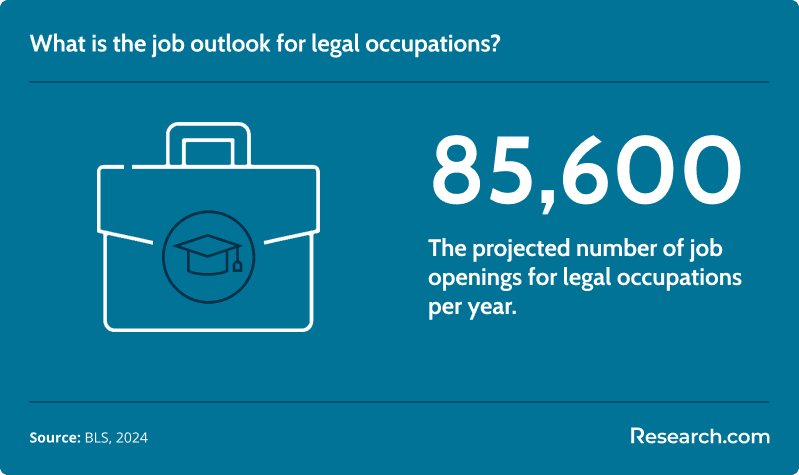
According to the Bureau of Labor Statistics (BLS), legal occupations are projected to grow at an average rate from 2023 to 2033, with about 85,600 openings expected each year because of both growth and worker replacement. The field can be rewarding, but outcomes vary widely by credential, location, employer, experience, and whether a role requires licensure or specialized training.
Quick Answer: What Can You Do With Legal Studies?
A legal studies education can prepare you for jobs such as legal assistant, paralegal, court reporter, private investigator, compliance officer, HR manager, law clerk, arbitrator, mediator, policy analyst, legal consultant, and compliance director. It can also support law school preparation, though a legal studies degree by itself does not make someone an attorney.
- Legal occupations employ 29% of law and legal studies graduates, with common paths including paralegal, mediator, compliance officer, and related legal support roles.
- Legal studies builds transferable skills in research, writing, legal analysis, communication, risk assessment, and problem-solving.
- Graduates with a bachelor’s degree in legal studies earn an average salary of $58,106 in the government sector and $46,938 in the manufacturing industry.
- The best path depends on your goal: a certificate may support entry-level legal support work, an associate degree can prepare you for paralegal or assistant roles, a bachelor’s degree can open broader business and compliance options, and a JD is required for those who want to become attorneys.
- Why pursue a legal studies career?
- What is the career outlook for legal studies graduates?
- What skills do legal studies careers require?
- How can I start a career in legal studies?
- How can I advance my career in legal studies?
- What certifications can strengthen a legal studies career?
- How do I choose the right legal studies program?
- How is technology changing legal studies careers?
- What are the advantages of online legal studies programs?
- What interdisciplinary careers connect well with legal studies?
- How can legal studies support a homeland security career?
- Can intelligence training improve legal career options?
- What financial aid options can help pay for legal studies?
- Why consider ABA-approved paralegal programs?
- What are alternative careers for legal studies graduates?
- Is a legal studies degree worth it?
Why pursue a legal studies career?
A legal studies career can make sense if you are interested in law but do not necessarily want to spend years in law school. Many roles involve researching legal issues, preparing documents, interpreting regulations, supporting attorneys, managing compliance programs, or helping people resolve disputes outside of court.
The field is broader than many students realize. Legal studies graduates may work in law firms, courts, government agencies, healthcare organizations, insurance companies, corporate legal departments, real estate firms, cybersecurity teams, higher education, and nonprofit organizations. Some roles are highly procedural, such as legal assistant or court reporter. Others are more strategic, such as compliance officer, HR manager, policy analyst, or legal consultant.
Legal studies can also be appealing because it combines practical workplace skills with public-facing impact. Professionals in this field may help clients understand legal processes, support access to justice, prevent organizations from violating regulations, or help resolve conflicts before they become expensive lawsuits.
Roles such as paralegals and compliance officers can also offer solid earning potential, with reported average salaries of $94,070 and $94,400, respectively. However, salaries should not be treated as guaranteed outcomes. Pay depends on experience, geography, employer type, credentials, specialization, and job responsibilities.
The chart below shows the average legal studies major salary by industry.
Legal Studies Career Paths at a Glance
| Career Direction | Best Fit For | Typical Credential | Important Consideration |
| Legal support | Students who want to assist attorneys, prepare documents, and organize case materials | Certificate, associate degree, or bachelor’s degree | Some employers prefer formal paralegal training or ABA-approved programs. |
| Compliance and risk | Students interested in business rules, audits, ethics, and regulatory requirements | Bachelor’s degree or master’s degree | Industry knowledge can matter as much as legal coursework. |
| Dispute resolution | Students who want to help parties negotiate settlements and avoid court proceedings | Bachelor’s degree, graduate study, or specialized training | Experience and credibility are important because many roles involve sensitive conflicts. |
| Law school pathway | Students who want to become attorneys | Bachelor’s degree followed by a JD | A legal studies major may help with preparation, but a JD and bar admission are required to practice law. |
| Policy, consulting, or research | Students who enjoy analyzing laws, institutions, public issues, and organizational decisions | Bachelor’s, master’s, or doctoral degree | Strong writing, research, and subject-matter specialization are essential. |
What is the career outlook for legal studies graduates?
The BLS projects that employment in legal occupations will grow at an average rate from 2023 to 2033. About 85,600 openings are expected each year, largely because employers need to replace workers who permanently leave these occupations and because some roles continue to expand.
The field also has higher-than-average earnings at the occupational-group level. In May 2023, the median annual wage for legal occupations was $99,220, compared with $48,060 for all occupations. This figure includes a wide range of legal careers, including high-paying attorney and judicial roles, so students should compare salary data for their specific target job rather than relying only on the broad legal-occupations median.
Meanwhile, the chart below shows the employment distribution of workers with a law and legal studies degree by occupational group.
How to Read Legal Studies Salary and Outlook Data
- Separate legal support jobs from licensed attorney roles. The salary range for legal occupations is broad because it includes different education levels and responsibilities.
- Look at the employer type. Government, corporate, law firm, healthcare, finance, and nonprofit employers may compensate legal studies graduates differently.
- Consider geography. Legal salaries often reflect local labor markets and cost of living.
- Evaluate advancement requirements. Some positions can be reached with experience and certifications, while others require graduate education, licensure, or a JD.
- Do not assume a degree alone determines pay. Internships, writing ability, technology skills, compliance experience, and professional networks can strongly affect outcomes.
What skills do legal studies careers require?
Legal studies careers require a mix of legal knowledge, technical workplace abilities, and strong professional judgment. Employers need people who can interpret rules carefully, write clearly, meet deadlines, maintain confidentiality, and communicate with attorneys, clients, regulators, executives, or the public.
Core Legal and Analytical Skills
| Skill | Why It Matters | Where It Is Used |
| Legal research and analysis | Professionals must find, read, and apply statutes, regulations, case law, policies, and legal sources accurately. | Paralegal work, law clerk duties, compliance research, policy analysis |
| Legal writing | Clear writing helps legal teams prepare memos, briefs, contracts, reports, correspondence, and internal guidance. | Law firms, courts, corporate legal departments, government agencies |
| Regulatory explanation | Many jobs require translating complicated rules into plain language for employees, clients, managers, or the public. | Compliance, HR, healthcare administration, business operations |
| Application of legal principles | Legal studies graduates must connect legal concepts to real workplace facts, risks, and decisions. | Risk management, contract review, investigations, dispute resolution |
| Critical thinking | Legal problems often involve incomplete information, competing interpretations, and practical consequences. | Research, litigation support, consulting, policy work |
| Risk assessment and compliance | Organizations rely on legal professionals to identify exposure, improve processes, and reduce violations. | Finance, healthcare, cybersecurity, manufacturing, government |
Professional Skills Employers Value
- Communication: Legal professionals need strong verbal and written communication to explain legal concepts, ask precise questions, summarize findings, and work with clients or colleagues.
- Time management: Legal work is deadline-driven. Missing filing dates, court deadlines, contract review timelines, or compliance reporting requirements can create serious problems.
- Leadership: As professionals advance, they may supervise case teams, lead audits, manage investigations, train staff, or advise executives.
- Ethical judgment: Confidentiality, conflicts of interest, accurate recordkeeping, and honest communication are central to legal and compliance work.
- Technology fluency: Legal databases, e-discovery platforms, case management software, document automation, and AI-supported research tools are increasingly common.
How can I start a career in legal studies?
The right starting point depends on the kind of work you want to do. If your goal is to enter the legal workforce quickly, a certificate or associate degree may be enough for some legal assistant or paralegal-related openings. If you want broader options in compliance, policy, human resources, or business, a bachelor’s degree may provide more flexibility. If you want to become a lawyer, you will need to complete a bachelor’s degree, earn a Juris Doctor, and meet bar admission requirements.
Common Education Routes
| Credential | Typical Use | Good Fit For | Limitations |
| Certificate in legal studies | Introduces legal terminology, research, writing, ethics, and selected areas of law | Career changers or students seeking entry-level legal exposure | May not be enough for competitive paralegal roles without experience or additional education |
| Associate degree | Provides foundational legal training and can support legal assistant, paralegal, and related support roles | Students who want a faster and lower-commitment path than a bachelor’s degree | Advancement may require a bachelor’s degree, certification, or specialized experience |
| Bachelor’s degree | Covers legal systems, legal reasoning, research, writing, and applied law-related topics | Students seeking compliance, HR, business, government, or law school pathways | Does not qualify graduates to practice law as attorneys |
| Juris Doctor | Provides professional legal training for aspiring attorneys | Students committed to becoming lawyers | Requires significant time, cost, and bar admission after graduation |
- Associate Degree: This two-year option introduces legal concepts, legal terminology, research methods, and major areas of law. It can prepare students for roles such as legal assistant or paralegal, depending on employer expectations and local market conditions.
- Bachelor’s Degree: A four-year legal studies degree usually provides broader preparation in legal systems, legal communication, applied law, and specialized areas such as criminal law, cybersecurity, business law, or legal compliance. Students interested in the intersection of law and cyber risk may also compare the cheapest online cyber security degree options to build complementary technical knowledge.
What can I do with an associate degree in legal studies?
| Role | What the Work Involves | Average Salary |
| Legal Assistant | Supports attorneys by preparing documents, scheduling, organizing files, communicating with clients, and helping legal offices run efficiently. | $70,308 |
| Paralegal | Researches legal issues, drafts documents, manages case files, assists with trial preparation, and communicates with clients under attorney supervision. Students who want structured preparation can compare paralegal certificate online options. | $94,070 |
| Court Reporter | Creates accurate transcripts of legal proceedings and must understand legal terminology, transcription standards, and record accuracy. | $63,941 |
| Private Investigator | Collects information for legal, business, or personal matters through interviews, surveillance, records searches, and documentation. | $52,002 |
What can I do with a bachelor’s degree in legal studies?
| Role | What the Work Involves | Average Salary |
| Compliance Officer | Helps organizations follow laws, regulations, internal policies, and ethical standards through audits, training, monitoring, and documentation. | $94,400 |
| Human Resources Manager | Oversees hiring, employee relations, workplace policies, benefits administration, and employment-law compliance. | $122,860 |
| Law Clerk | Assists judges or attorneys by researching legal questions, preparing drafts, reviewing case materials, and supporting legal decision-making. | $99,488 |
| Arbitrator/Mediator | Guides parties through negotiation or structured dispute resolution outside the courtroom. | $54,108 |
Can you get a legal studies job with only a certificate?
Yes, a legal studies certificate can help some students qualify for entry-level legal support jobs, especially when paired with office experience, strong writing skills, or prior work in business, healthcare, government, or administration. Certificate programs usually cover legal vocabulary, legal research, writing, ethics, and introductory areas such as criminal, civil, and business law. Many students complete this type of program in under a year.
A certificate is most useful when your goal is targeted and realistic. It may help you get started as a legal assistant, administrative legal support worker, or paralegal trainee, but competitive paralegal roles may still prefer an associate degree, bachelor’s degree, ABA-approved training, certification, or prior legal office experience.
How can I advance my career in legal studies?
Advancement in legal studies usually comes from a combination of education, experience, specialization, and professional credibility. Moving from entry-level support into higher-paying roles often requires more than simply staying in the field. You may need to build expertise in compliance, contracts, healthcare regulation, cybersecurity, litigation support, employment law, policy analysis, or legal operations.
Graduate Education and Professional Development Options
- Master of Legal Studies (MLS): This degree is designed for professionals who need legal knowledge but do not plan to become attorneys. It can be useful for compliance, HR, healthcare administration, contracts, risk management, and regulated industries.
- Juris Doctor (JD): A JD is the professional law degree for students who want to become attorneys. It is typically required before taking the bar exam.
- Professional Certifications: Credentials such as Certified Paralegal (CP) or Certified Legal Assistant (CLA) can signal job readiness and professional commitment. Specialized credentials in compliance, healthcare law, privacy, or digital evidence may also support advancement.
- Internships and Apprenticeships: Practical experience helps students learn how legal work is performed in real offices, courts, companies, and agencies. It also builds references and professional contacts.
What can I do with a master’s in legal studies?
| Role | What the Work Involves | Average Salary |
| Contract Negotiation Manager | Leads contract review and negotiation, coordinates with internal teams, manages legal and regulatory requirements, and helps reduce business risk. | $86,089 |
| Compliance Director | Builds compliance systems, oversees audits and reporting, monitors legal requirements, and helps leadership manage regulatory risk. | $128,297 |
| Medical Health Services Manager | Manages healthcare operations, programs, and administrative functions while navigating rules that affect patient care and organizational compliance. Professionals in this area may also consider healthcare certifications to strengthen field-specific knowledge. | $95,625 |
What kind of job can I get with a doctorate in legal studies?
| Role | What the Work Involves | Average Salary |
| Law Professor | Teaches legal subjects, mentors students, conducts research, and publishes scholarly work in areas such as constitutional law, criminal law, or international law. | $190,635 |
| Legal Consultant | Advises organizations on legal risks, regulatory issues, policies, contracts, investigations, or specialized legal questions. | $86,450 |
| Policy Analyst | Studies laws, regulations, and public programs to evaluate their effects and develop research-based recommendations. | $82,926 |
| Chief Compliance Officer (CCO) | Leads enterprise-wide compliance strategy, manages legal and regulatory risk, and promotes ethical operations across an organization. | $254,701 |
What certifications can strengthen a legal studies career?
Certifications can help legal studies graduates show specialized ability, especially when employers want proof of practical skills beyond a degree. The best certification depends on your target role. A future paralegal should prioritize paralegal credentials and applied legal research skills, while a compliance-focused professional may benefit from credentials tied to regulation, privacy, healthcare, finance, or risk management.
For students who want to enter legal support work quickly, an accelerated paralegal program may provide a more direct route to job-focused training. Before enrolling, confirm what the program covers, whether it includes legal research and writing, and whether local employers recognize it.
How to Choose a Legal Studies Certification
- Start with your job target. Do not collect credentials randomly. Match the certification to paralegal, compliance, privacy, contracts, healthcare, cybersecurity, or litigation-support goals.
- Check employer preferences. Review job postings in your area to see which credentials are actually requested.
- Verify eligibility requirements. Some certifications require education, experience, exams, or continuing education.
- Compare cost with career value. Certification fees, prep courses, exam costs, and renewal requirements should be weighed against realistic advancement benefits.
How do I choose the right legal studies program?
The best legal studies program is the one that matches your career goal, meets quality standards, fits your budget, and gives you practical experience. A program that is excellent for law school preparation may not be the best option for someone who wants immediate paralegal employment. Likewise, a broad legal studies bachelor’s degree may be useful for compliance or HR, while a focused paralegal program may be better for legal support work.
Students sometimes search for the easiest law degree, but ease should not be the main decision factor. A program should be manageable, but it should also develop legal research, writing, analysis, ethics, and applied problem-solving skills that employers value.
Questions to Ask Before Enrolling
| Question | Why It Matters |
| Is the school accredited? | Accreditation affects credit transfer, financial aid eligibility, employer perception, and graduate study options. |
| Does the curriculum match my career goal? | Paralegal, compliance, law school, and policy paths may require different coursework. |
| Are internships, practicums, or legal clinics available? | Hands-on experience can make a major difference in employability. |
| What legal technology tools will I learn? | Employers increasingly expect familiarity with research platforms, case management systems, and digital documents. |
| What are the total costs? | Tuition is only one part of the price; books, fees, technology, transportation, and time away from work also matter. |
| Does the program prepare students for certification or further education? | If you plan to pursue paralegal certification, an MLS, or law school, the program should support that pathway. |
How is technology changing legal studies careers?
Digital tools are reshaping legal work. Legal research platforms, e-discovery systems, document automation, contract management software, compliance dashboards, remote collaboration tools, and artificial intelligence are changing how legal professionals gather information and complete routine tasks.
This does not mean legal studies careers are disappearing. It means employers increasingly value professionals who can use technology responsibly while still applying human judgment. AI may help summarize documents or locate patterns, but legal professionals must still verify sources, protect confidentiality, interpret context, identify risk, and communicate clearly.
Students who want advanced legal knowledge for technology-influenced roles can review What can you do with a MLS degree? to better understand how graduate legal training may connect to compliance, operations, and regulated industries.
Technology Skills Worth Building
- Legal database research and citation checking
- Electronic document management
- Contract lifecycle management basics
- Data privacy and cybersecurity awareness
- E-discovery concepts
- AI tool evaluation, verification, and ethical use
- Remote collaboration and secure communication practices
What are the advantages of online legal studies programs?
Online legal studies programs can be a strong option for students who need flexibility because of work, family responsibilities, military service, location, or commuting limits. A well-designed online program can teach the same core legal research, writing, ethics, and analytical skills as a campus program while allowing students to study on a more flexible schedule.
However, online format alone does not guarantee quality. Students should compare accreditation, faculty experience, student support, internship options, technology requirements, and career services. Those seeking an entry-level pathway can explore an associate of applied science in legal studies online as one possible route to foundational legal training.
Online vs. Campus Legal Studies Programs
| Format | Best For | Potential Drawbacks |
| Online | Working adults, remote learners, students needing schedule flexibility | May require more self-discipline and proactive networking |
| Campus | Students who prefer face-to-face learning, local legal networking, or structured schedules | Less flexible for students balancing work or family responsibilities |
| Hybrid | Students who want online convenience with some in-person interaction | May still require commuting or scheduled campus attendance |
What interdisciplinary careers connect well with legal studies?
Legal studies combines well with fields that depend on rules, investigations, documentation, privacy, safety, contracts, risk, and public accountability. Students who pair legal knowledge with another specialty may qualify for roles that are more focused than general legal support work.
Common interdisciplinary combinations include legal studies plus cybersecurity, healthcare administration, business, human resources, public policy, criminal justice, law enforcement, intelligence, data privacy, and emergency management. Students interested in the public safety side of the field may compare law enforcement degrees online to see how legal knowledge and enforcement-focused education can overlap.
Examples of Interdisciplinary Legal Studies Paths
- Legal studies + cybersecurity: Privacy, data breach response, cyber policy, digital evidence, and compliance.
- Legal studies + healthcare: Patient privacy, healthcare compliance, risk management, and administration.
- Legal studies + HR: Employment law, workplace investigations, labor relations, and policy development.
- Legal studies + business: Contracts, corporate governance, regulatory operations, and consulting.
- Legal studies + public safety: Criminal justice policy, investigations, emergency management, and agency compliance.
How can legal studies support a homeland security career?
Homeland security work often involves legal rules, constitutional issues, privacy concerns, emergency powers, public safety regulations, interagency cooperation, and documentation. A legal studies background can help professionals understand how security decisions must fit within laws, policies, and civil protections.
This combination may be useful for careers connected to emergency management, critical infrastructure, compliance, investigations, public safety administration, and security policy. Students who want a faster academic path in this area can review the fastest online homeland security degree programs to compare related options.
Can intelligence training improve legal career options?
Intelligence training can complement legal studies for careers involving investigations, cyber risk, national security, fraud analysis, regulatory monitoring, and corporate compliance. Legal studies teaches how rules apply; intelligence training can strengthen evidence evaluation, threat assessment, analytical writing, and decision-making under uncertainty.
This combination is especially relevant for students interested in information-heavy roles where legal, regulatory, and security issues overlap. An online masters in intelligence may be worth considering for professionals who want advanced analytical preparation alongside legal knowledge.
What financial aid options can help pay for legal studies?
Legal studies students should compare funding sources before choosing a program. Common options include institutional scholarships, grants, work-study, employer tuition assistance, military or veteran education benefits, payment plans, and federal student aid for eligible accredited programs. Professional associations and local legal organizations may also offer scholarships for students pursuing paralegal or legal education.
Cost control matters because legal studies programs vary widely in price and career outcomes. Students seeking a lower-cost route into legal support work can compare accredited online schools for paralegal and ask each school about transfer credits, fees, textbooks, technology requirements, and internship access.
Ways to Reduce the Cost of Legal Studies
- Choose an accredited program that accepts transfer credits.
- Compare total program cost, not only tuition.
- Ask whether prior learning, military training, or professional experience can count toward credits.
- Look for employer tuition reimbursement if you already work in a law firm, government agency, corporate office, or regulated industry.
- Consider starting with a certificate or associate degree if your goal is entry-level legal support and you want to limit upfront costs.
- Confirm that online students receive the same career services and internship support as campus students.
Why consider ABA-approved paralegal programs?
ABA-approved paralegal programs have gone through a formal review process that evaluates whether the program meets standards connected to curriculum, instruction, administration, student services, and legal specialty coursework. ABA approval is not required for every paralegal job, but it can strengthen credibility in markets where employers recognize it.
Students should still compare cost, format, internship access, faculty experience, and completion requirements. If paralegal work is your primary goal, reviewing ABA-approved paralegal programs can help you evaluate recognized options while keeping affordability in mind.
What are alternative careers for legal studies graduates?
Legal studies graduates are not limited to law firms or courtrooms. The degree develops research, writing, reasoning, documentation, ethics, and policy interpretation skills that apply to many industries. Alternative paths may be a better fit for students who enjoy legal concepts but do not want traditional legal office work.
What else can a legal studies professional do?
- Law Librarian: Law librarians manage legal research collections, support attorneys and students, teach database use, and help users locate legal information. A librarian degree with legal research preparation can support this path.
- Business Consultant: Consultants help organizations improve operations, manage risk, understand contracts, and comply with regulations. Legal studies graduates can bring strong analytical and communication skills to consulting work.
- Legal Journalist: Legal journalists explain court cases, legislation, regulatory changes, and public legal controversies. This path fits students who combine legal understanding with strong writing and public communication skills.
Students who already have legal work experience and want broader advancement options can also compare specialized credentials or an online master of legal studies.
Is a legal studies degree worth it?
A legal studies degree can be worth it when it clearly supports a realistic career goal. It is usually a stronger investment for students who know whether they want legal support work, compliance, HR, policy, law school, or another law-adjacent path. It may be a weaker investment if a student enrolls without checking accreditation, career outcomes, local employer expectations, or total program cost.
To evaluate return on investment, compare the degree’s full cost with likely job options, salary ranges, time to completion, and advancement requirements. Students comparing adjacent fields may also want to review criminal justice degree online cost when deciding whether legal studies, criminal justice, homeland security, or another field offers the better fit.
Who Should Consider Legal Studies?
- Students interested in law but unsure whether they want to become attorneys.
- Working adults in regulated industries who need stronger legal and compliance knowledge.
- Future paralegals, legal assistants, compliance officers, HR professionals, mediators, or policy analysts.
- Students preparing for law school who want undergraduate exposure to legal concepts.
- Professionals who enjoy research, writing, rules, documentation, and structured problem-solving.
Who May Want a Different Path?
- Students who want to practice law but are not prepared for the JD and bar admission process.
- Students seeking a highly technical cybersecurity, accounting, or data role where another major may be more direct.
- Students who dislike detailed reading, writing, deadlines, and document-heavy work.
- Students choosing a program only because it is convenient, without checking career outcomes or accreditation.
Common Mistakes to Avoid
| Mistake | Why It Can Hurt You | Better Approach |
| Assuming legal studies automatically leads to law practice | A legal studies degree does not make someone an attorney. | If you want to practice law, plan for a JD and bar admission requirements. |
| Choosing a program without checking accreditation | Accreditation can affect financial aid, credit transfer, and employer confidence. | Verify institutional accreditation before applying. |
| Focusing only on tuition | Fees, books, software, transportation, and lost work time can change the true cost. | Compare total cost of attendance and expected time to completion. |
| Ignoring practical experience | Legal employers often value hands-on skills and professional references. | Prioritize internships, practicums, legal clinics, or work-based learning. |
| Choosing a degree level that does not match the job | A certificate, associate degree, bachelor’s degree, MLS, and JD serve different goals. | Start with job postings for your target role, then choose the credential that aligns. |
| Assuming salary averages are guaranteed | Pay depends on location, experience, employer, specialization, and credentials. | Use salary data as a planning tool, not a promise. |
Key Insights
- Legal studies is a flexible field, but it is not one single career path. Decide first whether you want legal support, compliance, HR, policy, dispute resolution, law school, or another law-related role.
- The BLS projects average growth for legal occupations from 2023 to 2033, with about 85,600 openings each year and a May 2023 median annual wage of $99,220 for legal occupations.
- Degree level matters. Certificates and associate degrees can support entry-level legal work, bachelor’s degrees broaden options, master’s degrees can help with advanced non-attorney roles, and a JD is required for aspiring lawyers.
- Legal studies skills are widely transferable: research, legal writing, communication, risk assessment, ethics, technology use, and regulatory analysis are useful across law firms, corporations, government, healthcare, and public safety.
- Before enrolling, check accreditation, curriculum fit, internship access, employer recognition, total cost, transfer policies, and whether the program supports your target credential or certification.
- Technology is changing legal work, so students should build digital literacy in legal research tools, e-discovery, document systems, compliance platforms, and responsible AI use.
- A legal studies degree is most worthwhile when it is tied to a specific career plan and a realistic understanding of costs, salaries, advancement requirements, and local job-market expectations.
References
- Indeed. (n.d.). Policy analyst salary in the United States. Retrieved February 17, 2025, from https://www.indeed.com/career/policy-analyst/salaries
- Salary.com. (2025, February 1). Arbitrator salary. https://www.salary.com/research/salary/hiring/arbitrator-salary
- Salary.com. (2025, February 1). Chief compliance officer salary. https://www.salary.com/research/salary/alternate/chief-compliance-officer-salary
- Salary.com. (2025, February 1). Compliance officer salary. https://www.salary.com/research/salary/alternate/compliance-officer-salary
- Salary.com. (2025, February 1). Court reporter salary. https://www.salary.com/research/salary/benchmark/court-reporter-salary
- Salary.com. (2025, February 1). Human resources manager salary. https://www.salary.com/research/salary/benchmark/human-resources-manager-salary
- Salary.com. (2025, February 1). Judicial law clerk salary. https://www.salary.com/research/salary/posting/judicial-law-clerk-salary
- Salary.com. (2025, February 1). Legal assistant salary. https://www.salary.com/research/salary/listing/legal-assistant-salary
- Salary.com. (2025, February 1). Paralegal salary. https://www.salary.com/research/salary/general/paralegal-salary
- Salary.com. (2025, February 1). Private investigator salary. https://www.salary.com/research/salary/alternate/private-investigator-salary
- Salary.com. (2025, February 1). Professor - Law salary. https://www.salary.com/research/salary/benchmark/professor-law-salary
- U.S. Bureau of Labor Statistics. (2024, August 29). Legal occupations. https://www.bls.gov/ooh/legal
- U.S. Bureau of Labor Statistics. (2025, January 15). Field of degree: Law and legal studies. Occupational Outlook Handbook. https://www.bls.gov/ooh/field-of-degree/law-and-legal-studies/law-and-legal-studies-field-of-degree.htm
- Zippia. (n.d.). What jobs can you get with a legal studies degree? Retrieved February 17, 2025, from https://www.zippia.com/legal-studies-major
- ZipRecruiter. (2025). Compliance director salary. ZipRecruiter. https://www.ziprecruiter.com/Salaries/Compliance-Director-Salary
- ZipRecruiter. (2025). Contract negotiation manager salary. ZipRecruiter. https://www.ziprecruiter.com/Salaries/Contract-Negotiation-Manager-Salary
- ZipRecruiter. (2025). Medical health services manager salary. ZipRecruiter. https://www.ziprecruiter.com/Salaries/Medical-Health-Services-Manager-Salary
- ZipRecruiter. (n.d.). 25 of the highest paying legal jobs in 2025. Retrieved February 17, 2025, from https://www.ziprecruiter.com/g/Highest-Paying-Legal-Jobs
- ZipRecruiter. (n.d.). Legal consultant salary. Retrieved February 17, 2025, from https://www.ziprecruiter.com/Salaries/Legal-Consultant-Salary#Yearly
Other Things You Should Know About Legal Studies Careers
A successful career in legal studies in 2027 requires strong analytical skills, effective communication, attention to detail, and understanding of legal systems. Proficiency in legal research and writing, critical thinking, and technology use, especially legal software, is also crucial for navigating the evolving legal landscape.
Advanced legal studies roles typically require certifications like the Certified Paralegal (CP) or Advanced Paralegal Certification (APC) from NALA. These certifications validate specialized skills and can enhance career prospects significantly in 2027. Requirements include passing examinations and completing continuing education credits.
Courses in administrative law, corporate law, ethics, and regulatory compliance strengthen a legal studies graduate’s case for compliance roles. Many employers also look for training in AML, GDPR, or contract law, plus a bachelor’s degree and internship experience for entry-level compliance analyst positions.


