
2027 Best BCBA Degree Programs & Schools Certification (In-Person & Online)

Co-Founder and Chief Data Scientist
Choosing a BCBA degree or certification pathway is not just a question of which school has the highest exam pass rate. The bigger decision is whether a program will help you meet certification requirements, complete supervised fieldwork, pass the BCBA exam, and enter the type of behavior analysis role you actually want. For working adults, educators, psychology graduates, and health professionals, the right choice often depends on format, cost, practicum access, faculty support, and whether the curriculum aligns with the current Behavior Analyst Certification Board requirements.
This guide explains what to expect from BCBA-focused graduate programs, how online and campus options compare, what programs may cost, which schools are commonly considered, and how to evaluate career outcomes without relying on one metric alone. It is designed to help you narrow your options, ask better questions, and choose a program that fits your timeline, budget, learning style, and professional goals.
Quick Answer: What Is the Best BCBA Program for You?
The best BCBA program is the one that meets certification coursework expectations, offers reliable access to qualified supervised fieldwork, fits your schedule, and has transparent outcomes such as BCBA exam preparation support, faculty expertise, and graduate career pathways. A high pass rate can be useful, but it should not be the only deciding factor. Students should also confirm ABAI accreditation or Verified Course Sequence status where applicable, institutional accreditation, cost, fieldwork arrangements, and whether the program format works for their life.
Why earn BCBA certification?
- Broader career options: BCBA preparation can lead to work in schools, clinics, healthcare settings, autism services, research, consulting, community programs, and private practice.
- Flexible study formats: Many BCBA pathways are available online or in hybrid formats, which can help working professionals continue earning income while completing graduate coursework.
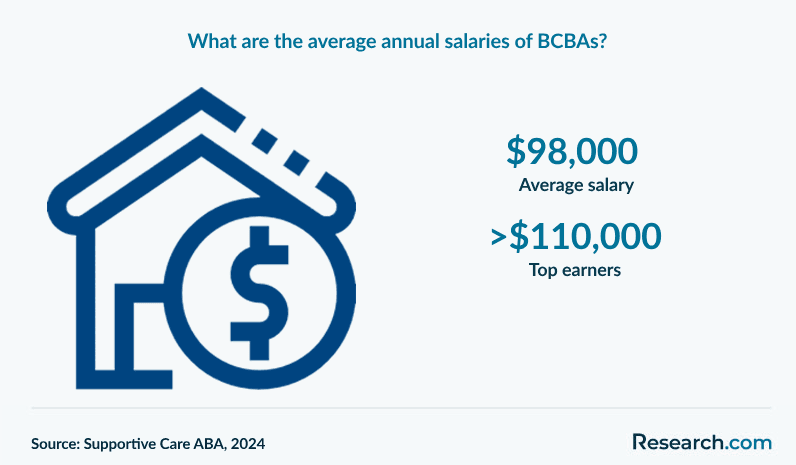
- Stronger earning potential: The article’s cited salary data reports an average annual salary for BCBAs of $98,000, with top earners making over $110,000 per year, though pay varies by state, employer, experience, and role.
What can I expect from a BCBA degree certification program?
A BCBA degree certification program usually combines graduate-level behavior analysis coursework with supervised fieldwork preparation. The goal is to help students understand why behavior occurs, how to measure it, how to design ethical interventions, and how to evaluate whether those interventions are working.
- Core behavior analysis coursework: Students typically study behavioral principles, ethics, assessment, intervention design, research methods, and data-based decision-making.
- Evidence-based practice: Programs train students to use research-supported methods rather than intuition or one-size-fits-all behavior plans.
- Online learning systems: In online programs, students usually access lectures, assignments, faculty feedback, discussion boards, and exams through a digital platform.
- Supervised practical experience: Many pathways include, support, or require supervised practicum or fieldwork in approved behavior analysis settings.
- Schedule flexibility: Online and part-time options can make BCBA preparation more manageable for students balancing employment, caregiving, or other responsibilities.
- Career mobility: BCBA certification can support advancement into roles involving assessment, intervention planning, supervision, consultation, and program leadership.
Where can I work with a BCBA degree certification?
BCBAs apply behavior analysis in many environments. The right setting depends on the population you want to serve, the level of clinical responsibility you want, and whether you prefer direct client work, consultation, supervision, research, or program management.
| Work setting | Common BCBA responsibilities | Good fit for students who want to... |
| Schools | Conduct assessments, create behavior intervention plans, collaborate with teachers, and support students with behavioral needs. | Work in education, special education, consultation, or school-based intervention. |
| Healthcare facilities | Provide behavior analysis services in hospitals, clinics, mental health programs, and developmental disability services. | Join interdisciplinary care teams and serve clients with complex needs. |
| Private practice | Serve individuals, families, and organizations through assessment, treatment planning, staff training, and ongoing consultation. | Build a flexible or entrepreneurial career after gaining sufficient experience. |
| Research | Study behavioral interventions, evaluate outcomes, and contribute to evidence-based practice in applied behavior analysis. | Focus on data, academic work, doctoral study, or intervention development. |
| Community services | Partner with agencies serving diverse populations, including people with developmental disabilities and behavioral support needs. | Use ABA in community-based, nonprofit, or public service roles. |
How much can I make with a BCBA degree certification?
Salary depends heavily on location, employer type, years of experience, supervision responsibilities, and specialization. The cited salary figures in this article compare earnings for BCBA-certified professionals with earnings for professionals without certification.
| Compensation measure | BCBA-certified professionals | Professionals without certification |
| Hourly wage | Average of $65 per hour | Average of $50 per hour |
| Monthly salary | Approximately $11,240 per month | Approximately $8,680 per month |
| Annual salary | Around $135,000 per year | Around $104,000 per year |
These figures should be treated as planning benchmarks, not guarantees. Before enrolling, compare program cost with realistic salaries in your state and preferred work setting.
- Best BCBA Degree Programs & Schools Certification (In-Person & Online) for 2027
- How long does it take to complete a BCBA degree program?
- How does an online BCBA degree compare to an on-campus program?
- What is the average cost of a BCBA degree program?
- What are the financial aid options for students enrolling in a BCBA degree program?
- What are the prerequisites for enrolling in a BCBA degree program?
- What courses are typically in a BCBA degree program?
- What types of specializations are available in BCBA degree programs?
- Should You Pursue a PhD in ABA for Advanced Career Opportunities?
- How do you choose the best BCBA degree program?
- What career paths are available for graduates of BCBA degree programs?
- How Can BCBA Graduates Expand Their Counseling Expertise?
- Can further clinical training enhance my BCBA career?
- What is the job market for graduates with a BCBA degree?
- What Challenges Do Students Face and How Can They Overcome Them in BCBA Programs?
- Can Integrating Counseling and Cultural Competence Training Expand a BCBA’s Impact?
- Can a BCBA Degree Open Pathways to Family Therapy?
- Can Combined Clinical Degrees Broaden a BCBA’s Impact?
- How Do BCBA Programs Ensure Effective Clinical Training?
- How Can BCBA Graduates Continue Their Professional Growth Post-Certification?
- Can Additional Qualifications Enhance a BCBA Career?
- Can Forensic Psychology Insights Amplify a BCBA Career?
Best BCBA Degree Programs & Schools Certification (In-Person & Online) for 2027
How do we rank schools?
Because a BCBA graduate program can require a major investment of time and money, program comparisons should rely on transparent data rather than marketing claims alone. Research.com reviews information from sources including the IPEDS database, Peterson's database and its Distance Learning Licensed Data Set, the College Scorecard database, and the National Center for Education Statistics. Students should still confirm current tuition, certification alignment, fieldwork expectations, and admission requirements directly with each school.
Program comparison snapshot
| School | Program format and focus | Length | Credits | Tuition and accreditation details |
| Auburn University | Master of Education (M.Ed.) in Applied Behavior Analysis with online coursework and in-person practicum experiences; emphasizes skill acquisition, ethical practice, and behavior intervention strategies. | 2 years | 30-36 credits | $13,332/year (in-state), $39,132/year (out-of-state); Verified Course Sequence by the Association for Behavior Analysis International (ABAI); regionally accredited by SACSCOC. |
| California State University, Fresno | M.A. in Applied Behavior Analysis designed as a full-time pathway with coursework and supervised practicum; focuses on behavior analytic applications for children and adults with developmental disabilities. | 2 years | 44 credits | $15,147/year (in-state); approximately $30,294/year (out-of-state); Verified Course Sequence by ABAI; regionally accredited by WASC. |
| California State University, Northridge (CSUN) | Master of Science in Applied Behavior Analysis delivered in a cohort model; includes ethics, behavior assessment, intervention strategies, research methods, and supervised practicum experiences. | 2 years | 37 credits | $770/unit (self-supported program); Verified Course Sequence by ABAI; regionally accredited by WASC. |
| Endicott College | Fully online Master of Science (M.S.) in ABA for working professionals, with concentrations in Autism, Childhood Clinical Disorders, Mental Health, Organizational Behavior Management (OBM), ABA in Public Schools, and a general track. | 15–24 months for the M.S., depending on the track. | 36–40 credits for the M.S., depending on previous coursework. | Approximately $745 per credit hour; program fees may apply. Verified Course Sequence (VCS) approved by the Association for Behavior Analysis International (ABAI); institutional accreditation through NECHE (New England Commission of Higher Education). |
| Florida Institute of Technology | Online and on-campus ABA options, including Applied Behavior Analysis, Organizational Behavior Management, combined ABA and OBM, and an online Master of Arts in Behavior Analysis Practice. | Two years for most master’s programs (full-time). | 33 credits for the online M.A.; similar for on-campus programs. | Approximately $1,197 per credit hour (online). Specific on-campus costs may vary. Association for Behavior Analysis International (ABAI) and Behavior Analyst Certification Board (BACB). |
| Florida State University | Master's in Applied Behavior Analysis through the Panama City campus; includes three practicum placements over five semesters, with opportunities at the Early Childhood Autism Program (ECAP) or approved external agencies. | Five semesters (approximately two years, full-time). | 39 credits. | $444 per credit hour (in-state); $1,076 per credit hour (out-of-state). Association for Behavior Analysis International (ABAI) and Southern Association of Colleges and Schools Commission on Colleges (SACSCOC). |
| Oregon Institute of Technology | Master of Science (MS) in Applied Behavior Analysis through Klamath Falls and Portland Metro campuses; includes fieldwork, a thesis, behavioral assessment, ethics, interventions, and electives. | Typically 2 years (full-time). | 45–54 credits, depending on fieldwork requirements. | In-state: $427 per credit; Out-of-state: $717 per credit. Northwest Commission on Colleges and Universities (NWCCU); ABA coursework is verified by the Association for Behavior Analysis International (ABAI) for BCBA certification eligibility. |
| University of Georgia (UGA) | Graduate pathways through the Mary Frances Early College of Education, with practical training and research connected to the Applied Behavior Analysis Clinic. | Varies by program; typical master's completion in 2 years. | Dependent on program, approximately 30-36 credits. | In-state: $8,716 (graduate programs annually); Out-of-state: $24,724 (graduate programs annually). Southern Association of Colleges and Schools Commission on Colleges (SACSCOC). |
| University of Houston-Clear Lake (UHCL) | Master’s program in Behavior Analysis and Graduate Certificate in Applied Behavior Analysis with coursework, research, and practicum options through the Center for Autism and Developmental Disabilities. | Typically 2 years for the master’s program; certificate length varies depending on prior coursework. | Master’s program: 33 credits; Certificate program: 27 credits (if eligible for credit transfers). | In-state: $4,686 per term for up to 9 credits. Out-of-state: $9,321 per term for up to 9 credits. Additional costs include $550 per credit for part-time students and approximately $500 per semester for books and supplies. Program-specific: Accredited by the Association for Behavior Analysis International (ABAI) through 2025. Institution-wide: Accredited by the Southern Association of Colleges and Schools (SACS). |
| University of North Carolina Wilmington (UNCW) | Master of Science in Psychology with an Applied Behavior Analysis concentration; includes advanced research methods, clinical behavior analysis concepts, and a thesis. | Typically completed in 2 years (full-time). | 45 credits. | Approx. $4,719/year (in-state), $18,504/year (out-of-state). Association for Behavior Analysis International (ABAI). |
| University of Kentucky | Master of Science in Applied Behavior Analysis for work as behavioral consultants in schools, homes, and healthcare settings; also offers a fully online Graduate Certificate in Applied Behavior Analysis. | 1 year (full-time) | 42 credits | $6,485 (in-state), $17,685 (out-of-state) per semester. Association for Behavior Analysis International (ABAI). |
| University of Miami | Full-time, cohort-based Master of Science in Applied Behavior Analysis through the Department of Psychology; focuses on developmental disabilities, autism spectrum disorder, and related areas. | 6 consecutive semesters (2 years) | 42 credits | Approximately $2,313 per credit hour. ABAI Verified Course Sequence; University accredited by the Southern Association of Colleges and Schools Commission on Colleges (SACSCOC). |
| University of Southern Maine (USM) | M.S. in Educational Psychology with a Concentration in Applied Behavior Analysis; available fully online through synchronous and asynchronous instruction or in hybrid formats. | 2 years (part-time option available) | 36 credits | $488 per credit for in-state; $1,307 per credit for out-of-state. ABAI Verified Course Sequence. |
| Western New England University (WNE) | Online Master of Science in Applied Behavior Analysis with coursework in behavioral assessment, intervention, ethics, and research methods. | 2 years (full-time) | 37 credits | $1,365 per credit hour ($50,505 total) for both in-state and out-of-state students. New England Commission of Higher Education (NECHE). |
| University of Northern Colorado (UNC) | Online Master of Arts in Special Education with an Intervention Specialist emphasis and applied behavior analysis focus. | Approximately 2 years (can vary depending on course load and practicum completion) | 36 credits | $540 per credit (in-state and out-of-state). Higher Learning Commission (HLC); BCBA Verified Course Sequence (VCS) approved by the Association for Behavior Analysis International (ABAI). |
How long does it take to complete a BCBA degree program?
Most BCBA-focused master’s programs take 1-2 years of full-time study, but your actual timeline can be longer if you attend part time, need prerequisite coursework, or must arrange supervised fieldwork separately. Students should ask each program whether coursework and fieldwork are integrated or whether fieldwork is the student’s responsibility.
| Factor | How it affects completion time |
| Course load | Full-time students usually finish faster, while part-time students may need additional terms to complete courses and fieldwork expectations. |
| Prior academic preparation | Students who already have psychology, statistics, research methods, or related coursework may move through graduate requirements more smoothly. |
| Program design | Accelerated, cohort-based, hybrid, and customizable programs can all affect sequencing and graduation timelines. |
| Fieldwork access | Delays in finding qualified supervision or approved placement sites can extend the certification timeline even after coursework is complete. |
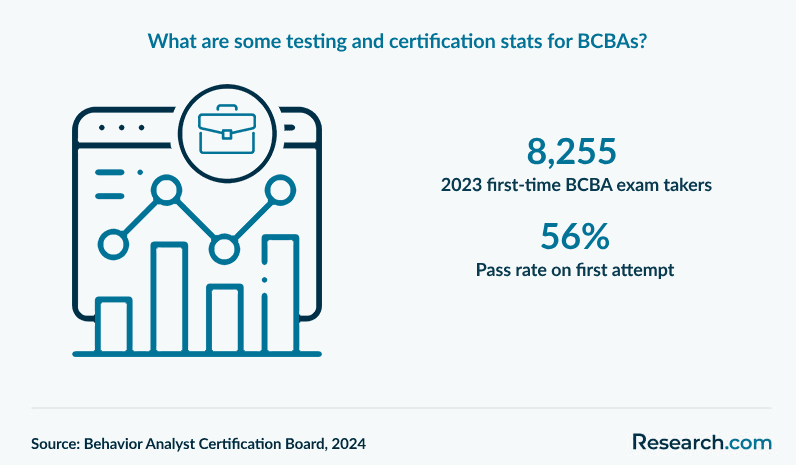
In 2023, 8,255 candidates took the BCBA exam for the first time, with a 56% pass rate on the first attempt according to the: Behavior Analyst Certification Board, as shown below.
How does an online BCBA degree compare to an on-campus program?
Online and campus-based BCBA programs can both prepare students well, but they serve different types of learners. The key distinction is not whether the format is online or in person; it is whether the program provides strong instruction, timely faculty access, clear fieldwork guidance, and enough structure for you to stay on track.
| Program format | Strengths | Trade-offs | Best for |
| Online BCBA programs | Flexible scheduling, reduced commuting, and the ability to study while working or managing family responsibilities. | Requires strong self-discipline, careful time management, and proactive communication with instructors and supervisors. | Working adults, rural students, career changers, and students who already have access to fieldwork sites. |
| On-campus BCBA programs | More face-to-face contact with faculty, classmates, guest speakers, labs, campus resources, and structured schedules. | May require relocation, commuting, housing costs, or less flexibility around work schedules. | Students who prefer live interaction, campus resources, built-in practicum networks, and a more structured academic environment. |
| Hybrid BCBA programs | Combines online convenience with periodic in-person learning, supervision, or clinical activities. | May still require travel and careful scheduling around required campus or site visits. | Students who want flexibility but still value direct interaction and hands-on learning. |
Notwithstanding these, in 2019, 5,000 new BCBAs were certified. In 2020, 5,500 new BCBAs were certified. In 2021, 6,200 new BCBAs were certified. In 2022, 6,800 new BCBAs were certified. In 2023, 6,948 new BCBAs were certified, as shown below. This steady increase suggests expanding professional interest in behavior analysis and continuing demand for qualified practitioners.
What is the average cost of a BCBA degree program?
BCBA program costs vary widely. Public universities may charge different rates for in-state and out-of-state students, while private or self-supported programs may use a flat per-credit price. Online programs can reduce relocation and commuting expenses, but they are not always cheaper once technology fees, books, supervision costs, and program fees are included.
| Cost category | What to check before enrolling |
| Tuition | Compare per-credit and annual tuition, and verify whether the advertised rate applies to graduate students, online students, or self-supported programs. |
| Fees | Ask about application fees, technology fees, clinical or practicum fees, graduation fees, and course material costs. |
| Fieldwork expenses | Confirm whether supervision is included, arranged through the school, paid separately, or completed through your employer. |
| Living and transportation | For campus programs, include rent, commuting, parking, food, and possible relocation costs in your budget. |
| Opportunity cost | Consider whether you will reduce work hours while completing coursework, practicum, or exam preparation. |
A lower tuition price is helpful only if the program still supports certification readiness, supervised experience, academic advising, and career preparation. Build a total cost estimate before comparing schools.
What are the financial aid options for students enrolling in a BCBA degree program?
Students pursuing BCBA education may be able to use several financial aid options, depending on the institution, enrollment status, and program type.
- Federal student loans: Eligible graduate students may use federal loan programs, including Stafford Loans and PLUS Loans, to help cover tuition and eligible education costs.
- Scholarships and grants: Universities, professional organizations, and community groups may offer awards for students in applied behavior analysis, education, psychology, autism services, or related fields.
- Employer tuition reimbursement: Some schools, clinics, districts, and healthcare employers help pay for graduate education when the credential supports the employee’s current role.
- Private loans: Private education loans may be available, but students should compare interest rates, repayment options, cosigner requirements, and long-term cost against federal options.
On the positive side, the average annual salary for BCBAs is $98,000, with top earners making over $110,000 per year, as shown below.
What are the prerequisites for enrolling in a BCBA degree program?
Admission requirements differ by school, but many BCBA-focused graduate programs look for applicants with academic preparation in psychology, education, behavior analysis, human development, or a closely related area. Some programs admit career changers, while others expect specific undergraduate coursework.
- Bachelor's degree: Most programs require a completed bachelor’s degree, commonly in psychology, education, or another related discipline.
- Relevant undergraduate coursework: Courses in psychology, statistics, and research methods may be required or strongly recommended.
- GRE scores: Some programs may ask applicants to submit Graduate Record Examination scores, although requirements vary by institution.
- Experience with relevant populations: Work or volunteer experience with children, individuals with autism spectrum disorder, students with disabilities, or behavioral health populations can strengthen an application.
If you are comparing BCBA preparation with counseling careers, review behavioral health counselor requirements to understand where the education, licensure, and practice scopes overlap and where they differ.
Students entering from adjacent health fields may also compare certificate-based options, including the shortest online PMHNP certificate programs, before deciding which graduate pathway best matches their long-term clinical goals.
What courses are typically in a BCBA degree program?
BCBA programs are built around the science and application of behavior analysis. Strong programs do more than teach terminology; they train students to define behavior clearly, collect valid data, identify behavior functions, design interventions, monitor progress, and practice ethically.
- Principles of behavior analysis: Foundational study of behavior, including operant conditioning, classical conditioning, reinforcement, punishment, and behavior-change procedures.
- Assessment procedures: Training in behavioral assessment methods, including functional behavioral assessments, to understand why challenging behaviors occur.
- Intervention planning and implementation: Coursework on building effective behavior intervention plans and positive behavior support plans.
- Data collection and analysis: Instruction in measurement systems, graphing, interpretation, and decision-making based on observable data.
- Ethics and professional conduct: Study of confidentiality, informed consent, boundaries, supervision, documentation, and responsible practice.
- Research methods: Training in research design and analysis relevant to applied behavior analysis and intervention evaluation.
- ABA with specific populations: Application of behavioral principles with groups such as individuals with autism spectrum disorder, intellectual disabilities, and older adults.
Students from clinical or healthcare backgrounds may recognize some overlapping concepts. For example, graduates from the cheapest ABSN programs may already be familiar with assessment, documentation, ethics, and evidence-based practice, even though ABA uses a distinct behavioral framework.
What types of specializations are available in BCBA degree programs?
Some BCBA programs offer concentrations or electives that let students focus on a specific population or practice setting. Specializations are useful when they match your intended career, but they should not replace strong core training in ethics, assessment, data analysis, and intervention.
| Specialization | What it usually covers | Best fit |
| Autism Spectrum Disorder | Assessment and intervention for individuals with ASD, including topics such as early intensive behavioral intervention, pivotal response training, and social skills instruction. | Students planning to work in autism clinics, schools, early intervention, or developmental services. Related clinical programs, such as Masters Clinical Social Work online degrees, may also address autism and family support from a different professional lens. |
| Intellectual and Developmental Disabilities | ABA strategies for supporting communication, adaptive behavior, self-care, and daily living skills for individuals with developmental disabilities. | Students interested in lifelong support services, community programs, schools, or residential settings. |
| Geriatric Behavior Analysis | Behavior analytic approaches for older adults, including dementia-related behavior support and interventions that promote independence and quality of life. | Students interested in aging services, long-term care, and behavioral gerontology. |
| Organizational Behavior Management | Use of ABA principles to improve workplace performance, safety, motivation, and organizational systems. | Students who want to work in business, human services administration, training, operations, or performance consulting. |
| School Psychology | Functional behavior assessment, behavior intervention planning, educator collaboration, and inclusive learning supports in educational settings. | Educators, special education professionals, and students targeting school-based consultation roles. |
Specialization availability differs by institution. Some programs offer several formal tracks, while others rely on electives, practicum placements, research projects, or faculty mentorship to shape a student’s focus.
For salary planning by location, see BCBA salary by state. The average annual salary for BCBAs varies significantly by state. California boasts the highest average salary at $110,000, followed closely by Massachusetts at $105,000. Texas, a large state with a high demand for ABA services, has an average salary of $100,000 for BCBAs. Florida and Georgia, while still offering competitive salaries, have slightly lower averages at $98,000 and $95,000 respectively. These figures, shown below, suggest that geographic location plays a significant role in determining a BCBA's earning potential.
Should You Pursue a PhD in ABA for Advanced Career Opportunities?
A doctoral degree in Applied Behavior Analysis can make sense for BCBAs who want to move beyond clinical service delivery into research, university teaching, senior leadership, program evaluation, or policy-related work. A master’s-level BCBA pathway is usually the practical route for certification-focused practice, while a PhD adds deeper preparation in research design, theory, publication, and advanced supervision.
The trade-off is time and cost. Students considering doctoral study should compare their expected career path with the additional years of education required. Data on PHD in ABA salary can help frame the decision, but salary alone should not drive a doctoral choice. Research fit, faculty mentorship, funding, and long-term professional goals matter just as much.
A common advancement route is moving from registered behavior technician work to BCBA-level practice. The difference between RBT certification vs BCBA is substantial in responsibility, education requirements, supervision authority, and earning potential.
How do you choose the best BCBA degree program?
The strongest BCBA program for one student may be a poor fit for another. Your decision should start with certification eligibility and fieldwork access, then move to cost, schedule, faculty expertise, and outcomes.
| Selection factor | Questions to ask before applying |
| Certification alignment | Does the coursework meet current BCBA educational expectations? Is it ABAI-accredited or a Verified Course Sequence where applicable? |
| Institutional accreditation | Is the university regionally accredited or otherwise appropriately accredited for graduate study? |
| Fieldwork support | Does the school arrange placements, help identify supervisors, or expect students to secure supervision independently? |
| Faculty expertise | Do faculty members have BCBA experience, research productivity, clinical specialization, or expertise in your target population? |
| Exam preparation | How does the curriculum prepare students for the BCBA exam, and what support is available for students who need remediation? |
| Format and schedule | Are courses synchronous, asynchronous, hybrid, cohort-based, full-time, or part-time? |
| Total cost | What is the full price after tuition, fees, books, supervision costs, travel, and lost work time? |
| Career services | Does the program help students connect with employers, practicum sites, alumni, or supervised post-graduate opportunities? |
If you are considering adjacent behavioral health fields, online addiction counseling degree programs may offer a different route into client support, prevention, and recovery-focused work. Compare scope of practice, licensure expectations, and populations served before choosing between fields.
Common mistakes to avoid when choosing a BCBA program
- Using pass rate as the only ranking metric: Exam outcomes matter, but they do not show whether a program fits your schedule, budget, supervision needs, or career goals.
- Ignoring fieldwork logistics: Coursework alone is not enough. Ask exactly how supervised experience will be completed and documented.
- Looking only at tuition: Fees, books, travel, technology, supervision, and lost income can change the real cost significantly.
- Assuming online means easier: Online BCBA programs still require rigorous coursework, deadlines, data-based assignments, and professional discipline.
- Not checking accreditation and eligibility language: Confirm institutional accreditation, ABAI status where relevant, and current BCBA certification requirements directly with official sources.
- Choosing a specialization too early: A niche track is valuable only if the core program is strong and the specialization supports your intended job market.
What career paths are available for graduates of BCBA degree programs?
BCBA graduates can work in direct service, supervision, consultation, education, research, and organizational roles. Career options expand with experience, strong supervision skills, and the ability to communicate data clearly to families, educators, clinicians, and administrators.
| Career path | Typical responsibilities |
| Direct service | Provide behavior analytic assessment and intervention for individuals with autism spectrum disorder and other developmental disabilities in homes, schools, clinics, or community settings. |
| Consultation | Support schools, hospitals, agencies, and families by designing behavior support plans, training staff, and monitoring intervention outcomes. |
| Supervision | Oversee BCaBAs, RBTs, paraprofessionals, or trainees while ensuring ethical and data-based practice. |
| Research | Study interventions, evaluate treatment outcomes, and contribute to applied behavior analysis literature. |
| Education | Teach behavior analysis concepts, mentor students, or train future practitioners at colleges, universities, or professional training organizations. |
| Program development and management | Design, operate, and improve ABA programs in clinics, schools, community organizations, and service agencies. |
| Organizational Behavior Management | Apply behavioral principles to employee performance, safety, training, productivity, and organizational systems. |
Professionals with healthcare backgrounds may also compare clinical education pathways. Some RN to BSN without clinicals programs include elective options that can help students explore behavioral health, leadership, or population-focused work.
How Can BCBA Graduates Expand Their Counseling Expertise?
BCBA training is grounded in behavioral science, while counseling education focuses more directly on therapeutic relationship skills, mental health frameworks, and client processing. Some BCBAs pursue workshops, supervised experiences, or additional credentials to communicate more effectively with families, collaborate with mental health professionals, and support clients with complex needs. If you are considering a broader counseling pathway, review how to become a counselor to compare education, supervised experience, and licensure requirements.
Can further clinical training enhance my BCBA career?
Additional clinical training can help BCBAs collaborate more effectively in mental health, school, and healthcare environments. Clinical psychology coursework may strengthen understanding of diagnosis, assessment, treatment planning, and interdisciplinary care. For BCBAs who want advanced clinical depth beyond behavior analysis, an online Psy D program may be worth exploring, especially if their long-term goals involve broader psychological assessment or clinical leadership.
What is the job market for graduates with a BCBA degree?
The job market for a board certified behavior analyst BCBA remains strong in the data cited for this article. Demand is tied to autism services, school-based behavioral support, developmental disability services, and wider recognition of applied behavior analysis in clinical and organizational settings.
Job Growth and Demand
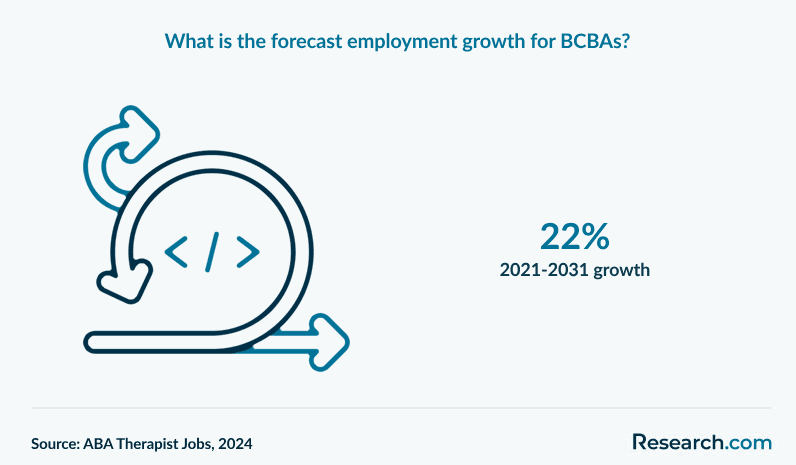
- Projected Growth Rate: The job outlook for BCBAs is very positive, with a projected growth rate of 22% over the next decade, as shown below. This is much faster than the average for other occupations.
- Increasing Demand: Demand is associated with the rising need for autism and developmental disability services, along with broader use of ABA-based intervention models.
Industries and Settings
- Multiple employment environments: BCBAs work in schools, clinics, hospitals, residential programs, community agencies, and private practices.
- Education sector demand: Schools continue to need professionals who can support special education teams, behavior intervention planning, and staff training.
Salary Information
- Average Salary: The average annual salary for BCBAs is around $98,000, with top earners making over $110,000 per year.
- Variation by Location: Salary can differ substantially by state, with higher figures cited for California, Massachusetts, Texas, Florida, and Georgia.
Global Demand
- Worldwide Growth: The number of BCBAs worldwide has grown significantly, reflecting the global increase in professionals entering the field to meet the rising demand.
Students entering from allied health or support roles may find behavior analysis to be a viable career shift. For example, graduates of a medical assistant accelerated program may already understand patient interaction and healthcare environments, though BCBA preparation requires a separate graduate-level certification pathway.
What Challenges Do Students Face and How Can They Overcome Them in BCBA Programs?
BCBA students often juggle graduate coursework, fieldwork hours, supervision documentation, employment, and exam preparation at the same time. The workload can be especially difficult for students who must locate their own fieldwork site or coordinate expectations between a university advisor and an external supervisor.
| Challenge | Better strategy |
| Falling behind in asynchronous courses | Create a weekly study schedule, set assignment milestones, and communicate early with instructors. |
| Difficulty securing supervision | Ask programs before enrolling whether they provide practicum placements, supervisor lists, or employer partnerships. |
| Balancing work and fieldwork | Choose a program with realistic pacing and confirm whether your current workplace can support qualifying supervised experience. |
| Exam anxiety | Use practice questions, study groups, faculty review sessions, and a structured preparation plan rather than cramming late. |
| Unclear career direction | Speak with alumni, attend information sessions, shadow practitioners, and compare settings such as schools, clinics, and OBM. |
Students comparing programs that balance coursework and clinical expectations can review the top applied behavior analysis graduate programs for additional context.
Can Integrating Counseling and Cultural Competence Training Expand a BCBA’s Impact?
Cultural competence and counseling-informed communication can improve how BCBAs collaborate with families, schools, and interdisciplinary teams. Behavior plans are more likely to be implemented consistently when practitioners understand family context, cultural values, communication preferences, and barriers to care. BCBAs who want deeper family systems or counseling preparation may compare ABA training with online MFT master's programs, while keeping in mind that MFT licensure and BCBA certification are separate professional pathways.
Can a BCBA Degree Open Pathways to Family Therapy?
A BCBA degree can support family-centered work by helping practitioners assess behavior patterns, coach caregivers, and design interventions that fit daily routines. However, family therapy is a distinct profession with its own education and licensure expectations. BCBAs who want to move into therapy roles should review how to become a family therapist before assuming that behavior analysis credentials alone are sufficient.
Can Combined Clinical Degrees Broaden a BCBA’s Impact?
Combining behavior analysis with advanced clinical psychology training can expand the way professionals assess client needs, collaborate with mental health providers, and contribute to integrated treatment planning. Programs such as MS/PsyD programs may appeal to students who want both graduate-level psychology depth and a broader clinical toolkit, although these pathways require careful review of cost, time, accreditation, and licensure implications.
How Do BCBA Programs Ensure Effective Clinical Training?
Effective BCBA preparation depends on supervised practice, not coursework alone. Strong programs connect classroom concepts with real cases, ethical decision-making, data collection, assessment, intervention design, and supervisor feedback. Before enrolling, ask whether the program provides practicum sites, how supervisors are vetted, how student performance is evaluated, and what happens if a placement falls through.
Students who need flexible coursework should compare BCBA online options carefully, paying close attention to how each program handles clinical supervision and fieldwork support.
How Can BCBA Graduates Continue Their Professional Growth Post-Certification?
Professional growth after BCBA certification often comes from supervision experience, advanced workshops, conference participation, research engagement, mentoring, and specialization in areas such as autism, school consultation, OBM, or developmental disabilities. Some BCBAs also pursue broader psychology education, including accelerated psychology programs online, when they want a stronger foundation in psychological science or are exploring longer-term academic goals.
Can Additional Qualifications Enhance a BCBA Career?
Additional credentials can be valuable when they strengthen your work with a specific population or setting. For example, deeper training in child and adolescent development may help BCBAs design more age-appropriate interventions and collaborate more effectively with families, educators, and clinicians. Students interested in this direction can compare child psychology masters programs online with ABA-focused graduate study to understand the difference in scope and outcomes.
Can Forensic Psychology Insights Amplify a BCBA Career?
Forensic psychology can complement behavior analysis for professionals interested in legal, correctional, risk assessment, or court-connected settings. BCBAs considering this direction should understand that forensic work often involves specialized ethical, legal, and assessment considerations beyond standard clinical ABA practice. Programs such as the cheapest forensic psychology masters programs online may offer a way to explore those competencies while comparing affordability and career relevance.
Key Insights
- A BCBA program should be evaluated on certification alignment, fieldwork support, faculty expertise, cost, format, and outcomes—not exam pass rate alone.
- In 2023, 6,948 individuals became newly certified BCBAs, and as of October 1, 2024, there are 71,660 BCBAs in the USA.
- The job outlook for BCBAs is very positive, with a projected growth rate of 22% over the next decade, much faster than the average for other occupations.
- The demand for BCBAs has significantly increased, with a 14% rise in demand from 2022 to 2023.
- California, Massachusetts, Texas, Florida, and Georgia have the highest demand for BCBAs, accounting for 40% of recent demand. The average annual salary for BCBAs varies significantly by state, with California boasting the highest average salary at $110,000.
- 71.1% of BCBAs are women, and the average age of a BCBA is 38 years old.
- Autism spectrum disorder is the primary area of focus for 75% of BCBAs.
- The average annual salary for BCBAs is $98,000, with top earners exceeding $110,000.
- In 2023, 8,255 candidates took the BCBA exam for the first time, with a 56% pass rate on the first attempt.
- The overall number of certificants (including BCaBAs and RBTs) was 187,034 as of October 1, 2024.
- Online BCBA programs can be a strong option for working adults, but students must verify how supervised fieldwork is handled before enrolling.
- Before committing, ask each school for current tuition, fees, practicum requirements, certification alignment, exam support, and graduate outcomes.
References:
- Advanced Autism Services. (2024). BCBA Programs and Schools. Advanced Autism Services.
- Behavior Analyst Certification Board. (2024). BCBA Certification Data. Behavior Analyst Certification Board.
- Behavior Analyst Certification Board. (2024). BCBA Exam Data. Behavior Analyst Certification Board.
- Behavior Analyst Certification Board. (2024). BCBA Certificant Annual Report Data. Behavior Analyst Certification Board.
- Golden Steps ABA. (2023. Average BCBA Salary By State & City. Golden Steps ABA.
- Supportive Care ABA. (2024). ABA Therapist Demographics. Supportive Care ABA.
Other Things You Should Know About BCBA Degree Programs
Many BCBA programs require a criminal background check before enrollment or before practicum placement, especially if fieldwork involves children or clinical sites. Schools may also require drug screening and immunization records. Requirements are set by the university or the practicum site, not by the BACB itself.
To obtain BCBA certification in 2027, candidates usually need a master's degree in applied behavior analysis or a related field, completion of required coursework approved by the Behavior Analyst Certification Board, and supervised fieldwork experience. Additionally, passing the BCBA certification exam is mandatory.


