
2027 BCBA vs. RBT: Explaining The Difference

Co-Founder and Chief Data Scientist
If you are comparing BCBA vs. RBT careers, the main decision is how much responsibility, education, time, and cost you want to take on before entering behavior analysis. Both roles support people with behavioral, developmental, and mental health needs, but they operate at different levels: BCBAs assess clients and design intervention plans, while RBTs deliver much of the direct, day-to-day support under supervision.
This choice matters because demand for behavioral health services continues to grow. In 2024, Mental Health America reported that nearly 60 million adults in the US experienced a mental illness in the past year. For students, career changers, and current behavioral health workers, understanding the difference between these credentials can help prevent expensive missteps, unrealistic salary expectations, or choosing a role that does not match your preferred type of work.
This guide explains what BCBAs and RBTs do, how their certification requirements compare, what each path costs, where they work, how salaries differ, and how to decide which option fits your long-term goals.
Quick answer: BCBA vs. RBT
A BCBA is the higher-level credential for professionals who want to assess behavior, create treatment plans, supervise staff, review data, and lead ABA-based services. An RBT is an entry-level credential for professionals who want to work directly with clients and implement behavior plans under the supervision of a BCBA. The BCBA path takes longer and costs more, but it typically offers higher pay and more leadership opportunities. The RBT path is faster, less expensive, and useful for gaining hands-on experience before committing to graduate education.
Key Things You Should Know About BCBA vs. RBT
- BCBA preparation usually requires a master’s degree and may take 2 to 3 years, while required RBT training can be completed in as little as 40 hours.
- BCBA programs at private nonprofit universities cost around $40,700 annually, while RBT certification training programs can cost $100 to $500.
- In 2024, BCBAs earn an average annual salary of $89,075, compared to $42,702 for RBTs.
- Demand for BCBAs increased by 14% from 2022 to 2023, while jobs for RBTs are projected to grow by 13% between 2023 and 2033.
- Becoming a BCBA requires a master’s degree, 1,500 supervised hours, and passing the BCBA exam. RBTs need 40 hours of training, passing the RBT exam, and ongoing supervision.
| Factor | BCBA | RBT |
| Best fit for | People who want clinical leadership, assessment, supervision, and treatment-plan design | People who want fast entry into direct client care and hands-on ABA experience |
| Typical education level | Master’s degree in behavior analysis, psychology, education, or a related field | High school diploma or equivalent to begin |
| Core responsibility | Evaluate needs, develop plans, analyze data, and supervise implementation | Carry out behavior plans, collect data, and support clients during sessions |
| Time commitment | Usually 2 to 3 years for graduate study plus supervised fieldwork | Required training can be completed in as little as 40 hours |
| Career ceiling | Higher earning potential, independent practice options, leadership roles | Strong entry point, but advancement often requires additional education |
- What does a BCBA do, and what makes the role different?
- What is an RBT, and why is the role important?
- What education and certification requirements apply to BCBAs and RBTs?
- How much does it cost to become a BCBA or an RBT?
- How do BCBA and RBT salaries and job prospects compare for 2027?
- Where do BCBAs and RBTs usually work?
- What skills help BCBAs and RBTs succeed?
- Can online education help you move toward BCBA roles?
- What trends and challenges are shaping behavioral health careers?
- Can advanced degrees expand behavior analysis opportunities?
- What continuing education and renewal rules apply?
- Can an online PhD in psychology support research and leadership goals?
- Where can BCBA and RBT professionals find mentorship and networking?
- How can a bachelor’s in psychology support a behavior analysis career?
- Why does cultural competence matter in ABA and behavioral health?
- What financial support options can help aspiring BCBAs and RBTs?
- What career growth paths are available for BCBAs and RBTs?
- How do BCBAs and RBTs affect clients and families?
- How should you choose between BCBA and RBT?
- What ethical and legal duties should guide practice?
What does a BCBA do, and what makes the role different?
A BCBA, or board certified behavior analyst, is a credentialed professional who evaluates behavior, identifies patterns, and designs intervention plans using Applied Behavior Analysis, often called ABA. BCBAs commonly support clients with developmental, behavioral, or mental health needs by creating structured strategies to build communication, social, self-care, academic, or daily living skills.
The BCBA role is different because it carries clinical and supervisory responsibility. A BCBA does not simply follow a plan; they decide what the plan should include, how progress will be measured, when goals should be adjusted, and how staff should implement procedures. In many settings, BCBAs supervise Registered Behavior Technicians, coordinate with families, train caregivers, review session data, and document client progress.
BCBAs often work in schools, clinics, homes, hospitals, community programs, and private practices. Their work overlaps with other behavioral health and mental health professions, but the focus is distinct. Many counseling careers emphasize talk therapy, emotional processing, or diagnosis-informed counseling, while BCBA practice centers on observable behavior, skill development, data collection, and measurable intervention outcomes.
Typical BCBA responsibilities
- Conduct behavioral assessments and review client history, environment, and skill needs.
- Create individualized behavior intervention plans and skill-acquisition programs.
- Train and supervise RBTs and other direct-care staff.
- Analyze data to determine whether interventions are working.
- Meet with families, educators, caregivers, or clinical teams to coordinate care.
- Maintain ethical documentation and adjust treatment plans when client needs change.
What is an RBT, and why is the role important?
An RBT, or Registered Behavior Technician, is a direct-service professional who implements behavior plans created by a supervising BCBA. RBTs are often the professionals who spend the most time with clients during therapy sessions, skill-building activities, and behavior support routines.
The role is practical and hands-on. RBTs may help a child practice communication, support a teenager with daily living skills, reinforce positive behaviors, collect session data, or follow a crisis-prevention plan as directed. They do not independently design treatment plans, diagnose clients, or make major intervention changes without supervision.
RBTs are essential because treatment plans only work when they are implemented consistently. Their notes, observations, and data help BCBAs decide whether a strategy is effective or needs revision. RBT roles are also common entry points for people who want to test their fit for ABA before investing in graduate education. If you want a broader academic foundation before moving deeper into the field, an online psychology degree can support future options in behavior analysis, counseling, child development, or related areas.
Typical RBT responsibilities
- Deliver ABA-based interventions under BCBA supervision.
- Collect data during sessions and report observations accurately.
- Help clients practice communication, social, academic, or daily living skills.
- Use reinforcement procedures according to the behavior plan.
- Communicate with supervisors about client progress, barriers, and safety concerns.
- Maintain professional boundaries, confidentiality, and ethical conduct.
The chart below lists the most common degree levels for RBTs, as reported by Zippia in 2024.
What education and certification requirements apply to BCBAs and RBTs?
The BCBA and RBT credentials are not interchangeable. They differ in educational level, supervised practice expectations, testing, and scope of responsibility. The BCBA path is designed for professionals who will assess, design, supervise, and make clinical decisions. The RBT path is designed for professionals who will provide direct services while working under close supervision.
| Requirement | BCBA | RBT |
| Minimum education | Master’s degree in a related field such as psychology, education, or applied behavior analysis | High school diploma or equivalent |
| Training/coursework | Verified course sequence and graduate-level preparation tied to behavior analyst education requirements | 40-hour training program covering ABA principles and RBT task areas |
| Supervised experience | 1,500 supervised hours in one pathway; at least 2,000 hours of supervised experience in ABA is also listed as a requirement | Ongoing supervision by a BCBA or qualified supervisor |
| Exam | BCBA certification exam | RBT competency assessment and RBT exam |
| Ongoing requirement | Continuing education and certification maintenance | Continued supervision, renewal requirements, and competency expectations |
BCBA requirements
- Graduate education: To meet behavior analyst education requirements, candidates generally need a master’s degree in a relevant area such as psychology, education, or applied behavior analysis.
- Approved coursework: Candidates must complete the required behavior analysis coursework, commonly through a verified course sequence.
- Supervised fieldwork: The path requires documented supervised experience. The article’s reported figures include 1,500 supervised hours and at least 2,000 hours of supervised experience in ABA, depending on the fieldwork route.
- Certification exam: Candidates must pass the BCBA exam after meeting eligibility requirements.
- Maintenance: BCBAs must keep their credential active through continuing education and professional conduct requirements.
RBT requirements
- Basic education: RBT candidates need a high school diploma or equivalent.
- Required training: Candidates complete a 40-hour training program focused on ABA fundamentals and the RBT role.
- Competency and exam: Candidates must complete a competency assessment and pass the RBT exam.
- Supervision: RBTs must work under the direct oversight of a BCBA or qualified supervisor and cannot practice independently.
If you are comparing behavior analysis with counseling, requirements can look similar at first but lead to different scopes of practice. Review what it takes to become a behavioral health counselor if you are deciding between ABA-focused and counseling-focused career paths.
How much does it cost to become a BCBA or an RBT?
The RBT path is much less expensive because it does not require a graduate degree. The BCBA path requires a larger investment because candidates must complete advanced education, supervised fieldwork, and certification steps. The right choice depends on your budget, timeline, and whether you want a long-term clinical leadership role.
| Cost category | BCBA path | RBT path |
| Education or training | Master’s degree required; tuition varies by institution type | 40-hour training program typically costs $100 to $500 |
| Reported tuition examples | Public universities average $9,800 per year; private for-profit institutions charge about $18,200 per year; private nonprofit universities average $40,700 per year | No degree requirement beyond a high school diploma or equivalent |
| Estimated two-year tuition range | $19,600 to $81,400 or more | Usually not applicable unless pursuing additional education |
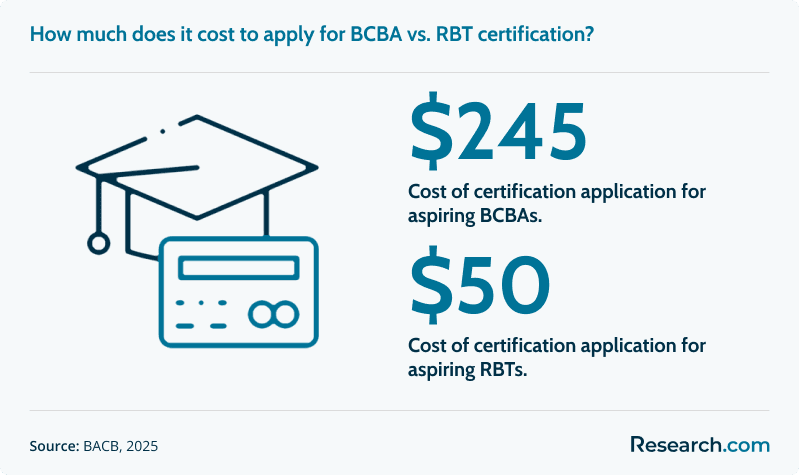
| Exam and application fees | BCBA exam costs $245; coursework and supervised fieldwork costs can add several thousand dollars | RBT certification exam costs $50, and the initial application fee is $45 |
| Typical total barrier to entry | High, because of graduate tuition, time, and supervision requirements | Usually under $600 for most candidates |
BCBA cost factors
- Graduate tuition: According to 2024 NCES data on the cost of tuition, public universities average $9,800 per year, private for-profit institutions charge about $18,200 per year, and private nonprofit universities average $40,700 per year.
- Total tuition: A two-year master’s program could range from $19,600 to $81,400 or more before fees, books, travel, and other expenses.
- Certification: The BCBA exam costs $245, and required coursework or supervised fieldwork expenses can add several thousand dollars.
RBT cost factors
- Training: The required 40-hour RBT training program typically costs $100 to $500, depending on the provider.
- Certification: The RBT certification exam costs $50, and the initial application fee is $45.
- Total entry cost: Most candidates can complete the core certification process for under $600, not including optional study materials, transportation, background checks, or employer-specific onboarding costs.
How to reduce your cost
- Ask employers whether they pay for RBT training, exam fees, or supervision.
- For BCBA preparation, compare public, private nonprofit, and private for-profit tuition carefully.
- Check whether a master’s program includes the required behavior analysis coursework or charges separately for it.
- Ask whether supervised fieldwork is built into the program or must be arranged independently.
- Compare total cost, not only tuition. Fees, textbooks, technology charges, travel, and lost work hours matter.
How do BCBA and RBT salaries and job prospects compare for 2027?
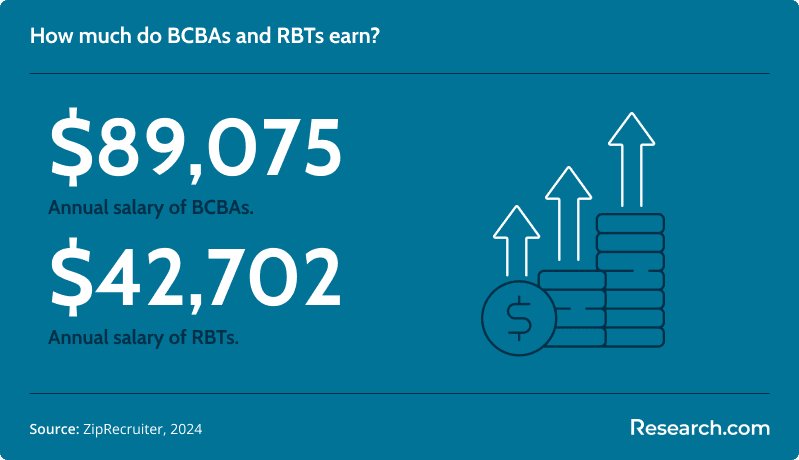
In 2027, the salary difference between BCBAs and RBTs reflects the difference in education, certification level, responsibility, and autonomy. BCBAs earn an average annual salary of $89,075, while RBTs earn an average annual salary of $42,702. These figures should be treated as averages, not guarantees. Pay can vary by state, employer, experience, caseload, setting, and whether the role is full time, part time, hourly, or salaried.
Demand indicators are positive for both roles. According to the Behavior Analyst Certification Board, demand for individuals with BCBA or BCBA-D certification has increased each year since 2010, including a 14% increase from 2022 to 2023. This suggests that employers continue to seek professionals who can design, supervise, and evaluate ABA services.
RBT employment is also supported by broader growth in behavioral and psychiatric support roles. Employment of psychiatric technicians and aides, which includes RBTs, is projected to grow 13% from 2023 to 2033. That outlook points to continued need for direct-care workers who can support behavioral health services in schools, clinics, residential settings, and community programs.
| Career factor | BCBA | RBT |
| Average annual salary | $89,075 | $42,702 |
| Demand indicator | Demand increased by 14% from 2022 to 2023 | Related employment is projected to grow 13% from 2023 to 2033 |
| Main reason for pay difference | Graduate education, independent clinical responsibilities, supervision, and treatment design | Entry-level credential, direct implementation role, and required supervision |
| Best salary-growth strategy | Gain experience, specialize, supervise teams, or move into leadership or private practice | Build experience, seek employer-paid training, and pursue further education if aiming for BCBA roles |
Where do BCBAs and RBTs usually work?
BCBAs and RBTs often work in overlapping settings, but their daily responsibilities differ. A BCBA may spend more time assessing clients, designing programs, meeting with families, reviewing data, supervising staff, and documenting treatment decisions. An RBT usually spends more time in direct sessions, helping clients practice skills and following the written behavior plan.
Common BCBA workplaces
Graduates of BCBA degree programs often move into supervisory, clinical, or program-management roles. Common settings include:
- Behavioral health clinics: BCBAs oversee ABA programs, supervise staff, and monitor client progress.
- Hospitals: BCBAs may support patients with behavioral needs connected to mental health conditions, developmental disabilities, or chronic illness.
- Schools: BCBAs collaborate with teachers, special education teams, and families to support students with behavioral or developmental needs.
- Private practice: Experienced BCBAs may provide consultation, assessment, training, or direct behavior analysis services.
Common RBT workplaces
RBTs are often placed where direct implementation is needed. Their work may change by client age, diagnosis, service model, and employer type. Common settings include:
- Homes: RBTs support clients in familiar environments where daily routines and family involvement are central.
- Daycare centers: RBTs may help young children practice developmental, social, or communication skills.
- Community programs: RBTs may support social interaction, independence, and life skills in real-world environments.
- Residential care facilities: RBTs may help clients with daily activities while implementing behavior plans under supervision.
The chart below illustrates the upward trend in the annual demand of BCBAs, as reported by the BACB in 2024.
What skills help BCBAs and RBTs succeed?
Both careers require patience, professionalism, and a strong commitment to ethical client care. The difference is how those skills are applied. BCBAs need stronger assessment, analysis, and leadership skills. RBTs need strong implementation, observation, communication, and consistency in direct service.
| Skill area | Why it matters for BCBAs | Why it matters for RBTs |
| Communication | Explaining plans to families, staff, schools, and interdisciplinary teams | Following instructions, reporting progress, and interacting clearly with clients |
| Data accuracy | Using data to make treatment decisions and adjust goals | Collecting session data correctly so the BCBA can evaluate progress |
| Ethical judgment | Protecting client rights while designing and supervising services | Maintaining confidentiality, boundaries, and fidelity to the treatment plan |
| Emotional regulation | Leading teams through difficult cases and complex family dynamics | Staying calm and supportive during challenging client behaviors |
| Problem-solving | Adjusting interventions when progress stalls or environments change | Responding appropriately within the plan and asking for help when needed |
Skills BCBAs should develop
- Analytical thinking: BCBAs must interpret behavior data and identify what is working, what is not, and what should change.
- Leadership and supervision: BCBAs train RBTs, provide feedback, and make sure interventions are implemented correctly.
- Clinical problem-solving: Treatment plans often need adjustments based on client progress, family context, and setting-specific barriers.
- Advanced ABA knowledge: BCBAs need deep understanding of behavior principles, assessment methods, and intervention design. Professionals interested in research or high-level leadership may compare ABA PhD programs.
- Ethical decision-making: BCBAs must balance client needs, family preferences, organizational policies, and professional standards.
Skills RBTs should develop
- Patience and empathy: Direct-care work can be rewarding, but progress may be gradual and inconsistent.
- Clear communication: RBTs need to explain tasks, follow supervisor guidance, and document what happens during sessions.
- Attention to detail: A behavior plan may require exact procedures, timing, prompts, and reinforcement steps.
- Flexibility: Clients’ needs, energy levels, schedules, and environments can change quickly.
- Consistency: Repetition, encouragement, and reliable implementation are central to client progress.
Can online education help you move toward BCBA roles?
Online education can be useful for working RBTs, teachers, paraprofessionals, and behavioral health staff who want to move toward BCBA eligibility without leaving their jobs. The main advantage is flexibility: online courses may make it easier to complete graduate coursework while continuing to earn income and build supervised experience.
However, online does not automatically mean easier, cheaper, or better. Before enrolling, confirm whether the program is properly structured for BCBA preparation, whether required coursework is included, whether fieldwork support is available, and whether the schedule fits your work hours. If cost is a major concern, compare affordable online BCBA programs and ask each school for a full cost breakdown before applying.
What trends and challenges are shaping behavioral health careers?
Behavioral health professionals should expect continued emphasis on measurable outcomes, interdisciplinary care, ethical documentation, and technology-supported service delivery. Employers increasingly value practitioners who can use data responsibly, communicate across care teams, and adapt services to different environments, including schools, homes, clinics, and telehealth-supported models where appropriate.
At the same time, the field can be demanding. RBTs may face emotionally intense direct-care situations, variable schedules, and physically active work. BCBAs may face high caseloads, supervision demands, documentation pressure, and responsibility for treatment quality. Professionals who want broader clinical options may also compare ABA careers with counseling routes, including the fastest way to become a counselor.
Can advanced degrees expand behavior analysis opportunities?
Advanced degrees can support specialization, leadership, research, program administration, or interdisciplinary clinical work. For BCBAs, additional graduate study may be useful when moving into university teaching, policy, complex clinical roles, or executive leadership. For RBTs, degree completion can be the bridge toward BCBA eligibility or related careers in psychology, education, counseling, and social services.
Advanced education should be chosen carefully. A degree is only worth the investment if it aligns with your intended scope of practice, licensure or certification goals, cost limits, and career timeline. Some professionals compare behavior analysis with clinical psychology routes, including online PsyD programs, when deciding whether they want practice-oriented doctoral training.
What continuing education and renewal rules apply?
Certification is not a one-time step. BCBAs and RBTs must maintain their credentials and stay aligned with current practice standards. BCBAs generally complete continuing education requirements across renewal periods, including learning tied to ethics, supervision, practice updates, and professional competence. RBTs must remain supervised and meet ongoing renewal and competency expectations.
Continuing education is more than a credential requirement. It helps professionals respond to new research, client needs, workplace expectations, and ethical issues. Some professionals also use additional coursework to prepare for advancement; for example, accelerated psychology programs may help students build academic momentum toward future graduate study.
Can an online PhD in psychology support research and leadership goals?
An online doctoral program in psychology may be relevant for professionals who want to focus on research, teaching, policy, organizational leadership, or advanced behavioral health scholarship. This route is different from simply becoming an RBT or BCBA. It usually makes the most sense for professionals who already understand their long-term goals and need doctoral-level research training to reach them.
Before choosing a doctoral route, compare program focus, faculty expertise, dissertation expectations, cost, residency requirements, and whether the degree supports your intended career outcome. If your goal is research or leadership in behavioral health, an online PhD in psychology may be worth exploring.
Where can BCBA and RBT professionals find mentorship and networking?
Mentorship can make a major difference in behavior analysis careers. New RBTs often need support with session management, documentation, professional boundaries, and deciding whether to pursue BCBA training. New BCBAs may need guidance on supervision, ethical decision-making, caseload management, parent training, and career specialization.
Useful networking options include workplace supervisors, peer consultation groups, professional associations, conferences, alumni networks, and online communities focused on ABA practice. Interdisciplinary networking can also be valuable. Professionals interested in development, family systems, and child-focused services may benefit from learning about child psychology careers alongside ABA pathways.
How can a bachelor’s in psychology support a behavior analysis career?
A bachelor’s degree in psychology can build a strong foundation in human development, learning, research methods, abnormal psychology, and communication. For someone starting as an RBT, undergraduate study can also clarify whether graduate-level behavior analysis is the right next step.
A bachelor’s degree alone does not make someone a BCBA, but it can be a practical steppingstone toward graduate study. If affordability and flexibility matter, compare affordable online psychology bachelor’s degree programs and ask how credits, transfer policies, and advising support future graduate goals.
Why does cultural competence matter in ABA and behavioral health?
Cultural competence is essential because behavior does not occur in isolation. Clients and families bring different languages, values, routines, socioeconomic realities, communication styles, and expectations into treatment. A plan that ignores those factors may be less effective, less respectful, or harder for families to use consistently.
For BCBAs, cultural competence affects assessment, goal selection, family collaboration, consent, and supervision. For RBTs, it affects day-to-day interactions, rapport, communication, and respect for family routines. Professionals considering broader clinical psychology training may compare programs such as the cheapest online PsyD programs, but any path should include serious attention to ethics, diversity, and client-centered care.
What financial support options can help aspiring BCBAs and RBTs?
Funding options depend on the credential, employer, school, and student status. RBT candidates should first ask employers whether training, exam fees, supervision, or renewal costs are covered. Some employers use RBT training as part of onboarding because it helps build a qualified direct-care workforce.
BCBA candidates usually need a larger funding plan because graduate tuition is the biggest cost. Options may include scholarships, grants, employer tuition reimbursement, payment plans, and student loans. Always compare total program cost, not just advertised tuition. If you are comparing ABA with related graduate fields, reviewing online MFT programs may help you understand how different behavioral health degrees are priced and funded.
What career growth paths are available for BCBAs and RBTs?
Career growth looks very different for BCBAs and RBTs. BCBAs can move into higher-responsibility roles because they already hold the credential needed for assessment, supervision, and treatment design. RBTs can grow within direct-care work, but major advancement usually requires additional education and certification.
Career growth for BCBAs
- Specialization: BCBAs may focus on autism intervention, early childhood development, school-based behavior support, severe behavior, or organizational behavior management.
- Supervisory leadership: Experienced BCBAs may become clinical supervisors, program managers, clinical directors, or administrators.
- Advanced education: Additional graduate training can support research, teaching, counseling-related skills, or leadership. Some professionals compare affordable options such as the cheapest online master’s in mental health counseling when broadening their clinical background.
- Private practice: Some BCBAs eventually provide independent consultation, parent training, assessment, or direct services, depending on state rules, payer requirements, and professional competence.
Career growth for RBTs
- Progression toward BCBA: Many RBTs use direct-care experience to decide whether to complete a bachelor’s degree, graduate study, supervised fieldwork, and BCBA certification.
- Senior direct-care roles: Experienced RBTs may mentor newer staff, support training, or take on specialized assignments, depending on employer policy.
- Related fields: RBT experience may support future work in special education, social work, counseling support, child development, or residential care.
| If your goal is... | Better starting choice | Why |
| Start working in the field quickly | RBT | The training path is shorter and less expensive. |
| Design treatment plans and supervise others | BCBA | The BCBA credential is built for assessment, planning, and oversight. |
| Test whether ABA fits before graduate school | RBT | Direct work can clarify whether the field matches your strengths. |
| Increase long-term earning potential | BCBA | BCBAs earn a higher reported average annual salary and have broader leadership options. |
| Move into research or university teaching | BCBA plus advanced graduate study | Doctoral or specialized training may be needed for research-focused roles. |
How do BCBAs and RBTs affect clients and families?
BCBAs and RBTs can have a meaningful effect on clients and families because their work targets practical skills that affect daily life. Progress may include improved communication, safer behavior, stronger routines, more independence, better school participation, or reduced family stress. Outcomes vary by client, service quality, consistency, family involvement, and the appropriateness of the treatment plan.
How BCBAs support clients and families
- Individualized planning: BCBAs assess needs and design interventions around specific behaviors, goals, environments, and supports.
- Family training: BCBAs often teach caregivers how to use strategies outside therapy sessions so skills can generalize into daily routines.
- Long-term monitoring: BCBAs review data and adjust goals to support sustained progress rather than one-time improvements.
How RBTs support clients and families
- Direct implementation: RBTs help clients practice skills repeatedly and consistently during sessions.
- Encouragement and rapport: RBTs often build trusted relationships that help clients stay engaged with learning activities.
- Session-level feedback: RBTs observe what happens in real time and provide data that helps the BCBA refine the plan.
How should you choose between BCBA and RBT?
The best choice depends on your timeline, budget, preferred work style, and long-term career goal. Choose the RBT route if you want quick entry into the field, lower upfront cost, and direct client work. Choose the BCBA route if you are ready for graduate education and want responsibility for assessment, treatment design, supervision, and leadership.
Consider becoming a BCBA if:
- You want clinical authority: BCBAs create behavior plans, supervise staff, review progress, and make intervention decisions.
- You are comfortable with graduate study: The path requires a master’s degree, supervised experience, and a certification exam.
- You want higher earning potential: BCBAs have a higher reported average annual salary than RBTs.
- You enjoy leadership: Much of the BCBA role involves training, supervising, collaborating, and making decisions for a care team.
- You are ready to compare programs carefully: If this is your goal, review ABA programs in the US and verify that each option supports your certification timeline.
Consider becoming an RBT if:
- You want a fast start: RBT training can be completed far more quickly than the BCBA education pathway.
- You prefer direct service: RBTs spend much of their time working hands-on with clients.
- You need a lower-cost entry point: RBT certification costs are much lower than graduate tuition.
- You want to gain experience before committing: Working as an RBT can help you decide whether ABA is the right long-term field.
- You are not ready for graduate school: The RBT route allows you to enter behavioral health while deciding whether to pursue further education.
Questions to ask before choosing
- Do I want to design treatment plans or implement them under supervision?
- Can I afford graduate school now, or should I start with a lower-cost credential?
- Am I comfortable with data collection, documentation, and ethical responsibilities?
- Do I prefer direct client sessions, supervisory work, or a mix of both?
- Will my target employers support training, supervision, or tuition reimbursement?
- Does the program I am considering align with certification requirements?
Common mistakes to avoid
| Mistake | Why it can hurt you | Better approach |
| Choosing a BCBA program based only on tuition | A low sticker price may not include required coursework, fees, or fieldwork support. | Ask for total cost, certification alignment, supervision support, and completion timeline. |
| Assuming RBT work is easy because training is short | Direct-care work can be emotionally, physically, and ethically demanding. | Shadow professionals, ask about caseloads, and understand client populations before accepting a role. |
| Believing salary averages are guaranteed | Pay varies by location, employer, experience, hours, and setting. | Review local job postings and ask employers about pay structure, benefits, and schedule stability. |
| Ignoring supervision quality | Poor supervision can limit learning, compliance, and client outcomes. | Ask how often supervision occurs, who provides it, and how feedback is documented. |
| Assuming any psychology degree leads directly to BCBA eligibility | BCBA eligibility depends on specific coursework, degree level, fieldwork, and exam requirements. | Confirm requirements with the school and credentialing body before enrolling. |
The chart below lists the states with the highest demand for BCBAs.
What ethical and legal duties should guide practice?
Ethical and legal responsibilities are central to both BCBA and RBT work. Clients may be children, disabled individuals, or people receiving services in vulnerable situations, so confidentiality, consent, dignity, data integrity, and professional boundaries are not optional. BCBAs carry added responsibility because they design plans, supervise others, and are accountable for treatment quality.
RBTs must follow the written plan, protect client information, report concerns, and seek supervision when situations fall outside their role. BCBAs must ensure that assessments and interventions are appropriate, evidence-based, supervised, documented, and respectful of client rights. Professionals who want deeper study in ethics, law, assessment, and clinical decision-making may explore doctoral-level options such as APA accredited PsyD programs, while recognizing that psychology licensure and BCBA certification are separate pathways.
References
- Behavior Analyst Certification Board (BACB). (2024). US employment demand for behavior analysts: 2010–2023. BACB report.
- Behavior Analyst Certification Board (BACB). (2025a). Board Certified Behavior Analyst® Handbook. BCBA Handbook.
- Behavior Analyst Certification Board (BACB). (2025b). RBT Handbook. RBT Handbook.
- Mental Health America (MHA). (2024). Adult Ranking 2024. Mental Health America data.
- Zippia. (2025). Behavior Technician Education Requirements. Zippia education profile.
- ZipRecruiter. (2025a). BCBA. ZipRecruiter BCBA salary data.
- ZipRecruiter. (2025b). Registered Behavior Technician. ZipRecruiter RBT salary data.
Key Insights
- BCBA and RBT roles both support behavior change, but they differ sharply in responsibility: BCBAs assess, design, supervise, and analyze; RBTs implement plans directly with clients.
- The RBT credential is the faster and lower-cost entry point, with 40 hours of training and typical certification costs under $600 for most candidates.
- The BCBA route requires graduate-level preparation, supervised fieldwork, and a certification exam, but it offers higher average pay and stronger leadership potential.
- In 2024, BCBAs earn an average annual salary of $89,075, compared to $42,702 for RBTs; these averages are useful benchmarks, not guaranteed outcomes.
- If you are unsure about ABA as a long-term career, starting as an RBT can provide practical experience before you commit to a master’s degree.
- If your goal is independent clinical decision-making, supervision, or program leadership, the BCBA path is the better long-term fit.
- Before enrolling in any program, verify total cost, coursework alignment, fieldwork support, supervision quality, and how the credential fits your state, employer, and career goals.
Other Things You Should Know About BCBS vs. RBT
To become a BCBA in 2027, an RBT must earn a relevant master's degree, complete required coursework, accrue supervised fieldwork hours, and pass the BCBA exam. There is no specific duration required as an RBT before pursuing BCBA certification. Now, here is the remaining task with exactly and only 4 relevant questions:
To become a BCBA in 2027, you must pass the Board Certified Behavior Analyst Examination from the Behavior Analyst Certification Board. Before sitting for the exam, candidates also need a qualifying graduate degree, approved coursework, and supervised fieldwork hours.


