
2027 Best Online User Experience (UX) Design Degree Programs

Co-Founder and Chief Data Scientist
User experience (UX) design focuses on creating digital products and services that are easy to use, visually engaging, and tailored to user needs. Online user experience design degree programs help students build the skills to craft seamless interactions across websites, apps, and emerging technologies.
These programs draw learners from fields like visual design, marketing, and development who want to combine creativity with research-driven problem-solving to advance or shift their careers.
In this article, I will walk you through the best online UX design degree programs available today. I'll cover the typical completion time, tuition structures, learning formats, and prerequisites. I will also highlight the careers graduates can pursue and the job market trends shaping opportunities for new UX designers.
What are the benefits of getting an online user experience design degree?
- Graduates with an online UX design degree can work in sectors like tech, finance, healthcare, and government, including startups and agencies, with opportunities spanning diverse career settings.
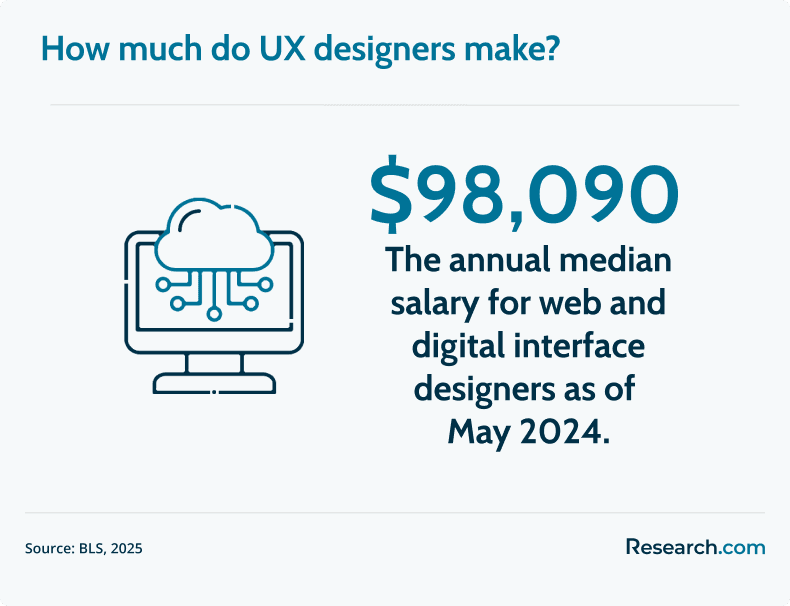
- UX designers earn a median of $98,090, with averages ranging from $81,538 to $126,082, and top roles like UX managers reaching about $171,884 annually.
- Many online UX design programs integrate professional software like Adobe XD, Figma, and Sketch, ensuring students develop the same technical skills expected in the workplace.
What can I expect from an online user experience design degree program?
An online user experience design degree program prepares students to craft digital products that are functional, engaging, and accessible for users. These programs combine creative and technical training using asynchronous lectures, interactive workshops, and project-based assignments. In turn, these enable students to balance coursework with other commitments while developing a polished portfolio.
Core courses often include human-computer interaction, visual design principles, usability testing, and prototyping with industry tools such as Figma, Adobe XD, and Sketch. Many programs also emphasize user research and analytics so students can create designs grounded in user behavior and business needs.
High-quality programs feature faculty with professional experience and capstone projects that reflect real-world workflows. Some degrees also offer internship opportunities or partnerships with employers, helping students gain practical experience and make professional connections before graduation.
Where can I work with an online user experience design degree?
An online UX design degree prepares graduates to work across industries where intuitive, user-centered digital solutions are vital. Graduates can apply their skills in a variety of environments, from global corporations to emerging startups and independent projects.
Below are examples of common career settings where UX designers are in demand:
- Technology and Software Firms: UX teams at major tech companies and startups develop product strategies and design user-friendly interfaces for web and mobile platforms.
- Digital Agencies and Consultancies: Creative and consulting agencies employ UX professionals to provide research, wireframing, and prototyping services for diverse client projects.
- Finance and Insurance: Banks, credit unions, and insurance providers hire UX designers to simplify digital banking, trading, and claims systems.
- Healthcare and Medical Facilities: Hospitals, telehealth platforms, and medical device companies rely on UX expertise to enhance patient portals and clinical dashboards.
- E-commerce and Retail: Online retailers leverage UX research and testing to optimize product discovery and checkout flows.
- Education and EdTech: Digital learning companies and education platforms recruit UX designers to streamline course interfaces and improve learner engagement.
- Government and Public Sector: Local, state, and federal agencies employ UX professionals to modernize public-facing websites and digital services.
- Freelance and Contracting: Independent UX designers work with clients across industries, expanding their experience through project-based work.
- Gaming and Entertainment: Game studios and media companies employ UX/UI specialists to create immersive, interactive user experiences.
- Startups: Small, agile teams at early-stage companies use UX designers to quickly prototype products and iterate based on user testing.
These opportunities show how this degree can support both specialized career paths and roles that evolve with technology, giving graduates flexibility to pursue meaningful and varied work.
How much can I make with an online user experience design degree?
UX designer salaries vary by career stage, role, and location, with graduates of strong programs often earning at or above national averages.
Here is a breakdown of recent salary data from a variety of U.S. sources:
- Median National Salary: Web and digital interface designers, which include many UX roles, have a median annual wage of $98,090, with the lowest 10% earning $47,840 and the highest 10% earning $192,180 (Bureau of Labor Statistics, 2024).
- Average UX Designer: Typical base salary is about $81,538, ranging from $58,000 at the 10th percentile to $116,000 at the 90th percentile (PayScale, 2025).
- National Average by Career Level: Junior UX designers earn about $78,961, mid-level designers average $124,415, senior designers earn roughly $129,828, and UX managers make about $171,884 (CareerFoundry, 2025).
- Overall U.S. Average: UX designers report an average base salary of $126,082, with reported pay between $84,696 and $187,691 (Indeed, 2025).
These figures show that UX designers can expect strong starting salaries and substantial increases with experience, especially in senior and managerial positions or high-demand regions.
- List of Online User Experience Design Degree Programs for 2027 List of Programs
- How long does it take to complete an online user experience design degree? Completion Time
- How do online user experience design degree programs compare to on-campus programs? How do online user experience design degree programs compare to on-campus programs?
- What is the average cost of an online user experience design degree? Average Cost
- What are the financial aid options for students enrolling in online user experience design degree programs? Financial Aid
- What are the prerequisites for enrolling in online user experience design degree programs? Prerequisites
- What courses are typically in online user experience design degree programs? What courses are typically in online user experience design degree programs?
- What types of specializations are available in an online user experience design degree? What types of specializations are available in an online user experience design degree?
- How to choose the best online user experience design degree programs? How to choose the best online user experience design degree programs?
- What career paths are available for online user experience design degree graduates? Career Paths
- What is the job market for online user experience design degree graduates? Job Outlook
- How can creative storytelling complement user experience design? How can creative storytelling complement user experience design?
Best Online User Experience Design Degree Programs for 2026
Choosing an online user experience design degree is not just a question of finding a creative major. It is a decision about cost, portfolio quality, software training, accreditation, career fit, and whether the program will prepare you for real UX work: researching users, designing interfaces, testing prototypes, and improving digital products.
This guide is for prospective undergraduates, career changers, working adults, and creative professionals comparing online UX design bachelor’s programs. You will find a ranked list of programs, side-by-side cost and curriculum details, questions to ask before enrolling, financial aid options, career paths, job-market data, and practical advice for choosing a program that fits your goals.
Quick Answer: Is an Online UX Design Degree Worth It?
An online user experience design degree can be worth it if you want a structured bachelor’s program, need an accredited credential, and want to graduate with a portfolio that demonstrates user research, wireframing, prototyping, usability testing, visual design, and collaboration skills. It is usually a better fit for students who want broad undergraduate training than for experienced designers who only need a short certificate or portfolio refresh.
Before enrolling, confirm that the school is accredited, review the required portfolio or capstone work, compare total tuition rather than only per-credit cost, and check whether the curriculum includes current tools such as Figma, Adobe XD, Sketch, analytics platforms, and accessibility standards.
How We Selected These Online UX Design Programs
Strong online UX design programs combine creative studio work, applied technology, research methods, accessibility, and portfolio development. The programs below were selected using Research.com’s methodology, with attention to curriculum relevance, faculty experience, online delivery, tuition transparency, accreditation, and career preparation.
Program information was reviewed using reputable education data sources, including the Integrated Postsecondary Education Data System (IPEDS), Peterson’s Distance Learning database, the U.S. Department of Education’s College Scorecard, and the National Center for Education Statistics (NCES).
| Rank | School | Online UX-related degree | Cost per credit | Credits | Accreditation |
| 1 | University of Tennessee–Knoxville | BS in Information Sciences with Applied Data Analytics and User Experience | $490 in-state; $565 out-of-state | 120 credits | SACSCOC |
| 2 | Boise State University | BA in Digital Innovation and Design with User Experience track | $350, with no out-of-state fees | 120 credits | NWCCU |
| 3 | Southern New Hampshire University | BA in Graphic Design and Media Arts with User Experience Design concentration | $342 for online undergraduate courses | 120 credits | NECHE |
| 4 | University of Maryland Global Campus | BS in Web and Digital Design with UX/UI-related pathways | $330 in-state; $499 out-of-state; $250 for military students | 120 credits | MSCHE |
| 5 | Utah State University | BS in Human Experience Design and Interaction | $405 | 120 credits | NWCCU |
| 6 | Lesley University | BS in Design for User Experience | $525 | 120 credits | NECHE |
| 7 | Academy of Art University | BFA in Interaction & UI/UX Design | $1,301 per unit, with 3 units/class | 120–128 credits, typically 40–43 units | WSCUC |
| 8 | Arizona State University | BS in User Experience | $692 for Arizona residents, based on Fall 2025 and Spring 2026 rates | 120 credits | HLC |
| 9 | University of Arizona | BA in Design Arts and Practices | $525 | 120 credits | HLC |
| 10 | Franklin University | BS in User Experience and Graphic Design | $398 | 120 credits | HLC |
1. University of Tennessee–Knoxville
University of Tennessee–Knoxville offers a fully online Bachelor of Science in Information Sciences with a concentration in Applied Data Analytics and User Experience. This option is especially relevant for students who want to connect UX decisions with data, usability evidence, accessibility, and information behavior.
The curriculum emphasizes practical projects in areas such as usability testing, data visualization, accessibility, and user-centered problem solving. Students who want UX training with a stronger information science and analytics foundation may find this program a good match.
- Program length: Approximately 48 months for full undergraduate completion
- Tracks or concentrations: Applied Data Analytics and User Experience
- Cost per credit: $490 in-state; $565 out-of-state
- Required credits to graduate: 120 credits
- Accreditation: Southern Association of Colleges and Schools Commission on Colleges (SACSCOC)
2. Boise State University
Boise State University provides a fully online Bachelor of Arts in Digital Innovation and Design with a User Experience track. Its stackable certificate structure can be useful for students who want to build credentials in stages while progressing toward the full degree.
The program begins with Innovation and Design and can extend into UX Design, UX Research, and electives. Coursework is project-centered and includes design activities such as prototyping, usability testing, and information design.
- Program length: Approximately 48 months, with six seven-week terms per year
- Tracks or concentrations: Stackable certificates in Innovation and Design, UX Design, UX Research, plus electives
- Cost per credit: $350, with no out-of-state fees
- Required credits to graduate: 120 credits
- Accreditation: Northwest Commission on Colleges and Universities (NWCCU)
3. Southern New Hampshire University
Southern New Hampshire University offers a fully online Bachelor of Arts in Graphic Design and Media Arts with a concentration in User Experience Design. This program may appeal to students who want UX training rooted in visual communication, digital media, and design production.
Students study areas such as wireframing, prototyping, usability testing, responsive design, and interface planning. The applied coursework is designed to help learners turn class projects into portfolio-ready examples.
- Program length: 48 months
- Tracks or concentrations: Graphic Design and Media Arts with a User Experience Design track
- Cost per credit: $342 for online undergraduate courses
- Required credits to graduate: 120 credits
- Accreditation: New England Commission of Higher Education (NECHE)
4. University of Maryland Global Campus
University of Maryland Global Campus offers a fully online Bachelor of Science in Web and Digital Design with pathways in Web Design, Digital Design, and Augmented and Virtual Reality, including UX/UI-focused coursework. The program is a practical option for students who want digital design training that connects web, visual, and emerging media skills.
Students use professional design tools, complete embedded certificates, and finish with a faculty-supported capstone. This structure can help graduates present a focused body of work to employers.
- Program length: Typically completed in 4 years
- Tracks or concentrations: Web Design, Digital Design, Augmented and Virtual Reality, with UX/UI focus
- Cost per credit: $330 in-state; $499 out-of-state; $250 for military students
- Required credits to graduate: 120 credits
- Accreditation: Middle States Commission on Higher Education (MSCHE)
5. Utah State University
Utah State University delivers a fully online Bachelor of Science in Human Experience Design and Interaction, also known as HEDI. The program is described as the first of its kind in Utah and is built around human-centered design, interaction, product development, multimedia, and culturally responsive design.
Students work with tools such as Adobe XD and Figma while exploring areas that can support UX, product, game, marketing, and technical communication careers.
- Program length: Typically completed in 4 years
- Tracks or concentrations: Game Studies, Multimedia, Marketing, Product Development, Technical Communication, Culturally Responsive Design, or New Venture Management
- Cost per credit: $405
- Required credits to graduate: 120 credits
- Accreditation: Northwest Commission on Colleges and Universities (NWCCU)
6. Lesley University
Lesley University offers a fully online Bachelor of Science in Design for User Experience. The degree combines visual design fundamentals with UX-specific work in wireframing, prototyping, usability testing, interface design, and design communication.
The program has been ranked among the most affordable UX bachelor’s degrees nationally. Its studio projects, startup collaboration opportunities, and faculty guidance can be valuable for students who want a portfolio-oriented online design education.
- Program length: Approximately 48 months, across eight 15-week semesters
- Tracks or concentrations: Core UX design curriculum with design electives and liberal arts integration
- Cost per credit: $525
- Required credits to graduate: 120 credits
- Accreditation: New England Commission of Higher Education (NECHE)
7. Academy of Art University
Academy of Art University offers a fully online Bachelor of Fine Arts in Interaction & UI/UX Design. The curriculum blends interaction design, visual communication, mobile and web design, motion graphics, and design thinking.
Students learn through online studio experiences supported by a custom-built learning management system, peer critique, and instructor feedback. This may be a strong option for learners who want a portfolio-intensive BFA format and a studio-style online environment.
- Program length: 8 semesters, or 48 months
- Tracks or concentrations: Interaction & UI/UX Design
- Cost per credit: $1,301 per unit, with 3 units/class
- Required credits to graduate: 120–128 credits, typically 40–43 units
- Accreditation: WASC Senior College and University Commission (WSCUC)
8. Arizona State University
Arizona State University offers a fully online Bachelor of Science in User Experience. The program combines user research, design, content strategy, and applied project work.
Students use tools such as Adobe XD, Figma, and Qualtrics and complete a capstone project that demonstrates their ability to design user-focused solutions. The 7.5-week course format may appeal to students who prefer shorter academic sessions.
- Program length: Approximately 48 months, with 40 courses delivered in 7.5-week sessions
- Tracks or concentrations: Interdisciplinary focus on user research, content strategy, and experience design
- Cost per credit: $692 for Arizona residents, based on Fall 2025 and Spring 2026 rates
- Required credits to graduate: 120 credits
- Accreditation: Higher Learning Commission (HLC)
9. University of Arizona
University of Arizona provides a fully online Bachelor of Arts in Design Arts and Practices. The program blends design theory, visualization, rapid prototyping, and project-based learning.
The degree has been recognized among the top 3% of online undergraduate degrees. Students study areas such as design history, visual communication, usability testing, and data visualization with faculty expertise across art, design, information studies, and technology.
- Program length: Approximately 48 months for full-time study
- Tracks or concentrations: Interdisciplinary design practice and visualization
- Cost per credit: $525
- Required credits to graduate: 120 credits
- Accreditation: Higher Learning Commission (HLC)
10. Franklin University
Franklin University offers a fully online Bachelor of Science in User Experience and Graphic Design. The program combines UX methods with graphic design principles, which can be useful for students who want to work across interface design, visual design, and product presentation.
The curriculum includes wireframing, prototyping, design thinking, Adobe XD, Figma, and portfolio-building assignments. Franklin’s tuition guarantee and transfer credit options may help students manage cost and completion time.
- Program length: Approximately 48 months for full-time students
- Tracks or concentrations: UX design integrated with graphic design principles
- Cost per credit: $398
- Required credits to graduate: 120 credits
- Accreditation: Higher Learning Commission (HLC)
How Long Does It Take to Complete an Online User Experience Design Degree?
Most online UX design bachelor’s degrees require about 120 credits and are commonly structured for completion in roughly 48 months of full-time study. Some students finish faster by transferring credits, taking heavier course loads, or choosing accelerated formats, while part-time learners may need longer.
| Study format | Typical timeline | Best for | What to confirm before enrolling |
| Traditional full-time online bachelor’s degree | About 48 months | Students starting college or transferring limited credits | Course sequencing, annual terms, and whether major courses are offered every term |
| Part-time online study | Longer than the standard full-time plan | Working adults, caregivers, and students with limited weekly study time | Maximum time-to-degree limits and financial aid enrollment requirements |
| Accelerated or competency-based pathway | Some learners finish in under 19 months | Students with prior college credit, work experience, or strong self-direction | How credits transfer, how mastery is assessed, and whether the format fits your schedule |
If speed is a major factor, compare UX timelines with the fastest online graphic design degree programs, since graphic design and UX programs often share portfolio, visual design, and digital media requirements.
Online UX Design Degree vs. On-Campus Program: Which Is Better?
Online and campus-based UX design degrees can lead to similar academic outcomes when the online program is accredited, project-based, and supported by regular critique from faculty and peers. The better choice depends on how you learn, how much flexibility you need, and whether you want access to campus studios or prefer remote collaboration.
| Factor | Online UX design degree | On-campus UX design degree |
| Schedule | Often more flexible, with asynchronous lessons, online critiques, and virtual collaboration | More fixed class times, studio sessions, and in-person group work |
| Hands-on practice | Uses digital studios, shared design files, recorded feedback, and remote team projects | May provide physical labs, in-person critiques, and campus-based design facilities |
| Networking | Can connect students across regions through online communities, faculty meetings, and career platforms | Offers face-to-face access to classmates, professors, student groups, and local employers |
| Cost considerations | May reduce commuting, relocation, and campus living costs | May involve housing, transportation, parking, and campus fees |
| Best fit | Working adults, remote learners, transfer students, and students who need schedule control | Students who want an immersive campus environment and frequent in-person studio interaction |
Online UX programs usually combine recorded lessons, live critiques, group projects, discussion boards, design-tool collaboration, and portfolio reviews. This mirrors how many design teams now work: asynchronously, across locations, and inside shared digital tools.
Students comparing portfolio-based creative degrees may also want to review the best online digital photography degree programs, especially if they are deciding between UX, media arts, and visual storytelling careers.
What Is the Average Cost of an Online User Experience Design Degree?
The price of an online UX design bachelor’s degree depends on the school, residency rules, private versus public status, transfer credits, technology fees, software costs, and how long it takes to finish. Per-credit tuition is important, but total program cost is the number that matters most.
| Institution type | Estimated annual tuition | Estimated four-year total | Important cost note |
| Public in-state institutions | Around $29,900 per year | Roughly $119,600 for a four-year degree | Usually the lower-cost public option for residents |
| Public out-of-state institutions | About $49,100 per year | Approximately $196,400 for the program | Residency rules can substantially change the final price |
| Private nonprofit colleges | Close to $63,000 per year | About $252,000 across four years | May offer smaller classes, specialized support, or strong career services, but students should verify outcomes |
To estimate your real cost, ask each school for a full cost breakdown that includes tuition, mandatory fees, software subscriptions, hardware expectations, books, portfolio platforms, and graduation fees. Transfer credit policies can also change the total cost substantially.
Students who want to shorten the timeline should compare standard bachelor’s options with fast-track UX design programs online. A faster program is only a good value if it is accredited, manageable, and still gives you enough time to build a competitive portfolio.
UX and adjacent design careers can offer strong earning potential, but no degree can guarantee a specific salary. The graph below compares top UX and UX-related occupations using 50th percentile salary data.
Financial Aid Options for Online UX Design Students
Most students use more than one funding source to pay for an online UX design degree. Start with federal aid, then compare school scholarships, transfer scholarships, employer tuition benefits, military benefits, and design-specific awards.
| Funding source | What it can help cover | What to check |
| Federal student aid | Pell Grants, Direct Subsidized and Unsubsidized Loans, and work-study programs may help with tuition, fees, and living costs | Submit the FAFSA and confirm that your school participates in federal aid programs |
| Adobe Design Circle Scholarships | Adobe awards ten scholarships annually, with up to $25,000 per year and a maximum of $100,000 over four years for students pursuing interaction or UX design | Eligibility, deadlines, renewal requirements, and portfolio or essay expectations |
| AIGA Worldstudio D×D Scholarships | The AIGA Foundation supports undergraduate students in UX, graphic design, and related fields, with attention to diversity in design | Academic level, design discipline, financial need, and application materials |
| Diversify Design Scholarship | Designlab provides monthly tuition awards for UX Academy cohorts | Whether the scholarship applies to a degree, certificate, bootcamp, or separate training program |
| Employer or military benefits | May reduce out-of-pocket tuition for working adults, service members, veterans, or military-connected students | Benefit caps, approved schools, repayment obligations, and required grades |
Financial aid should be evaluated with caution. Loans must be repaid, scholarships may be competitive, and some awards only apply to specific programs or enrollment levels.
Admission Requirements for Online User Experience Design Degree Programs
Online UX design bachelor’s programs usually expect applicants to show college readiness and basic technical preparedness. Selective or studio-focused programs may also ask for creative samples.
- High school diploma or GED: Most undergraduate programs require proof of secondary school completion.
- Transcripts: Schools may request high school and prior college transcripts to evaluate admission and transfer credit.
- Minimum GPA: Many programs use a 2.5–3.0 GPA range, though requirements differ by institution.
- Recommended background: Prior coursework in art, design, computer science, communication, or mathematics may help, even when it is not required.
- Technical readiness: Students generally need a reliable computer, stable internet connection, and the ability to learn design tools such as Adobe XD, Figma, and Sketch.
- Portfolio or work samples: Some programs ask applicants to submit creative work to demonstrate design potential.
If you are deciding between design and interactive media, compare these requirements with an online game development degree, since both fields combine creative thinking, technical skills, project work, and portfolio development.
Common Courses in an Online UX Design Degree
UX design programs usually move from foundations to applied studio work. Students learn how to understand users, structure digital experiences, design interfaces, test prototypes, and communicate design decisions to stakeholders.
| Course area | What students learn | Why it matters for UX careers |
| User research and design thinking | Personas, interviews, journey maps, problem framing, and empathize-ideate-prototype methods | Helps designers base decisions on user needs rather than assumptions |
| Interaction and interface design | Layouts, visual hierarchy, navigation, mobile patterns, and micro-interactions | Builds the core skills needed for web, app, and product design roles |
| Prototyping tools | Figma, Sketch, Adobe XD, wireframes, and interactive prototypes | Allows students to demonstrate ideas clearly and test them before development |
| Visual and information design | Typography, color, iconography, information architecture, and content organization | Improves clarity, usability, and accessibility in digital products |
| Usability testing and analytics | Heuristic evaluation, A/B testing, usability studies, and data interpretation | Teaches students how to measure whether designs actually work |
| Front-end fundamentals | HTML, CSS, responsive design concepts, and collaboration with developers | Helps designers create feasible solutions and communicate with technical teams |
| Capstone and portfolio | Case studies, client-style projects, presentation decks, and final design documentation | Provides evidence employers can review during hiring |
Students who want to combine UX with another discipline may also compare unrelated but flexible online options, such as accelerated online Christian ministry degrees, or add technical depth through the shortest graduate certificate programs in data analytics online.
Popular Specializations in Online User Experience Design Degrees
Specializations help students shape their portfolios around specific job goals. The best choice depends on whether you prefer research, visual interface work, content structure, accessibility, product strategy, or emerging technology.
| Specialization | Focus | Good fit for students who want to become |
| Interaction Design | User flows, interface behavior, motion, feedback patterns, and cross-device interactions | Interaction designers, product designers, UI designers |
| User Research and Testing | Interviews, surveys, usability studies, analytics, and research synthesis | UX researchers, usability analysts, product researchers |
| Information Architecture | Navigation, taxonomy, content hierarchy, labeling, and complex information systems | Information architects, content strategists, UX designers for large websites or platforms |
| Accessibility and Inclusive Design | WCAG principles, assistive technology, inclusive design methods, and accessibility testing | Accessibility specialists, UX designers, design system contributors |
| Immersive and XR Experience Design | AR, VR, 3D prototyping, spatial interfaces, and motion-based interaction | XR designers, immersive experience designers, interaction designers |
Students who already have a design background and are considering graduate-level creative roles can compare specialization options with graphics design master's degree careers.
How to Choose the Best Online User Experience Design Degree Program
The best online UX design degree is the one that fits your budget, schedule, learning style, and career target while providing credible accreditation and strong portfolio preparation. Do not choose a program based only on a ranking or a low advertised tuition rate.
Key Factors to Compare
- Institutional accreditation: Confirm that the school is accredited by a recognized accreditor, such as SACSCOC, NWCCU, NECHE, MSCHE, WSCUC, or HLC.
- Programmatic recognition: For design-heavy programs, look for relevant recognition or alignment with standards from organizations such as the National Association of Schools of Art and Design (NASAD).
- Portfolio quality: Review sample student work if available. A strong program should help you graduate with case studies, not just completed assignments.
- UX research depth: Make sure the curriculum includes interviews, usability testing, journey mapping, analytics, and evidence-based design.
- Tool training: Look for coursework using current design and research tools, including Figma, Adobe XD, Sketch, and usability or analytics platforms.
- Accessibility content: A modern UX program should address inclusive design, WCAG principles, and testing with diverse users.
- Faculty experience: Prioritize programs with instructors who have recent professional design, product, research, or interaction design experience.
- Transfer credit policy: If you have prior college credit, ask for an unofficial transfer review before committing.
- Total cost: Compare tuition, fees, software, hardware, textbooks, and time-to-completion.
- Career support: Ask whether the school provides portfolio reviews, mock interviews, employer networking, internship support, and alumni connections.
Questions to Ask Before You Enroll
- Is the institution accredited, and by which accreditor?
- How many credits will transfer into the degree?
- What UX tools will I use in required courses?
- Will I complete a capstone, internship, or client-style project?
- How many portfolio case studies will I have by graduation?
- Are courses asynchronous, synchronous, or a mix of both?
- How often will I receive critique from faculty or peers?
- What fees are not included in the advertised tuition?
- Does the program publish outcomes such as placement, graduation, or student satisfaction data?
- What career services are available to online students?
If you are comparing UX with another professional field entirely, Research.com also provides guides to programs such as accelerated online MSN PMHNP programs. Use those comparisons to clarify whether your long-term goals are creative, technical, clinical, or service-oriented.
Common Mistakes to Avoid When Choosing an Online UX Degree
| Mistake | Why it can hurt you | Better approach |
| Choosing a program without checking accreditation | It can affect credit transfer, financial aid eligibility, and employer confidence | Verify accreditation through the school and recognized education databases |
| Looking only at per-credit tuition | Fees, software, hardware, and extra semesters can raise the final cost | Calculate total program cost from enrollment to graduation |
| Assuming all UX programs teach research well | Some design programs focus heavily on visuals and lightly on user evidence | Review required courses for usability testing, interviews, analytics, and research synthesis |
| Ignoring portfolio outcomes | Employers often need to see how you think, test, iterate, and explain decisions | Choose a program with capstones, critiques, and case-study development |
| Underestimating time demands | Online does not mean easier; studio projects and group work can be time-intensive | Ask how many hours per week students usually spend on coursework |
| Assuming salary outcomes are guaranteed | Pay depends on experience, location, portfolio quality, industry, and labor-market conditions | Use salary data as a planning tool, not a promise |
Career Paths for Online User Experience Design Degree Graduates
Graduates of online UX design programs can pursue roles in design, research, content, product, consulting, and leadership. Entry-level candidates usually need a strong portfolio, while advanced roles typically require professional experience and evidence of business impact.
| Career path | Main responsibilities | Portfolio evidence employers may expect |
| UX Designer | Creates user flows, wireframes, prototypes, and design solutions based on user needs | Case studies showing research, iteration, design rationale, and usability results |
| UX Researcher | Plans and conducts interviews, surveys, usability tests, and research synthesis | Research plans, findings reports, personas, journey maps, and study recommendations |
| Interaction or Interface Designer | Designs interface behavior, visual hierarchy, interactive states, and user pathways | Interactive prototypes, design systems, screen flows, and annotated decisions |
| Content Designer or UX Writer | Writes interface copy, error messages, onboarding flows, labels, and user guidance | Before-and-after content examples, content strategy documents, and usability improvements |
| Information Architect | Organizes navigation, taxonomies, labeling systems, and content structures | Sitemaps, navigation models, card-sorting results, and information hierarchy examples |
| Product Designer | Combines UX, UI, research, and product strategy across the product lifecycle | End-to-end product case studies with problem definition, prototypes, testing, and outcomes |
| UX Manager or Director | Leads design teams, sets UX strategy, manages priorities, and partners with product and engineering | Leadership examples, design process improvements, team outcomes, and product impact |
| Chief Experience Officer | Guides organization-wide experience strategy across products, services, and customer journeys | Executive-level experience strategy, cross-functional leadership, and measurable business results |
| Freelancer or Consultant | Provides UX research, design, audits, prototyping, and strategy services to clients | Client case studies, proposals, project scopes, testimonials, and measurable improvements |
Students looking for lower-cost ways to enter the field can also compare the UX design degree online options that emphasize affordability.
Job Market Outlook for Online UX Design Degree Graduates
UX design sits at the intersection of technology, design, research, and business. Employers need professionals who can make digital products easier to use, more accessible, and more aligned with customer needs. However, hiring can vary by industry, company size, location, experience level, and portfolio strength.
Employment for web developers and digital designers, a category that includes many UX-related roles, is projected to grow 8% from 2023 to 2033. That compares with a 4% average growth rate across all occupations. This projection represents about 16,500 job openings each year from both new roles and replacement needs.
Across arts and design occupations overall, employers are expected to fill an average of 87,900 openings annually because of turnover and changing industry demand.
User experience designer roles are projected to increase 22.2% over the decade, adding approximately 13,800 new positions. Graphic designers, by comparison, face a slower 2% growth rate, with about 21,100 job openings per year.
If you are still choosing between fields, compare UX labor-market expectations with other flexible online degrees, such as the shortest online bachelor's in political science, to understand how different majors align with your interests and career goals.
The graph below compares projected openings for UX and UX-related occupations over the next decade.
How Creative Storytelling Supports UX Design
Storytelling is useful in UX because digital products are not only visual systems; they are guided experiences. Designers use narrative structure to make onboarding clearer, organize information logically, explain product value, and help users move from confusion to action.
Strong UX storytelling can appear in product flows, user journey maps, microcopy, case studies, service blueprints, and stakeholder presentations. Designers who can explain the user’s problem, show the trade-offs behind a design, and connect evidence to outcomes often communicate more effectively with product managers, engineers, executives, and clients.
Students interested in the writing side of experience design may find it helpful to compare UX with creative writing pathways, including Research.com’s guide on what can you do with a creative writing MFA degree.
Can Additional Creative Study Strengthen a UX Design Career?
Additional creative study can help a UX designer, but only when it supports a clear career goal. Visual arts coursework may strengthen composition and branding. Writing coursework may improve UX copy, content strategy, and storytelling. Data coursework may improve research interpretation. Business coursework may support product strategy or consulting.
A second credential is most useful when it fills a specific gap in your portfolio. For example, students who want advanced creative training can explore options such as the cheapest MFA programs online, but they should weigh the cost and time commitment against more direct alternatives such as certificates, freelance projects, internships, or targeted portfolio work.
What Graduates Say About Online User Experience Design Degree Programs
- : "My online UX program gave me enough flexibility to keep working while I built a portfolio. The most useful assignments were the realistic projects because they prepared me to communicate with clients, defend design choices, and start taking on freelance work. — Allison"
- : "Studying UX online helped me move into a more senior design role without leaving my job. I could apply new methods at work right away, especially in strategy discussions and product planning meetings. — Antoine"
- : "I needed a program that was practical, remote, and manageable during a career change. The online format helped me transition from education into UX strategy, and the portfolio work made that shift much easier to explain to employers. — David"
Key Insights
- An online UX design degree is best for students who want a full accredited bachelor’s credential. If you only need a portfolio update or a narrow skill, a certificate or bootcamp may be faster.
- Portfolio quality matters as much as the degree title. Look for capstones, critiques, usability testing, research projects, and case studies that show your process.
- Most programs require about 120 credits and around 48 months of full-time study. Transfer credits and accelerated formats can shorten the timeline, but only if the pace is realistic.
- Total cost varies widely. Compare tuition, fees, residency rules, software, hardware, and time-to-completion before deciding.
- Accreditation is nonnegotiable. It affects credibility, financial aid, and credit transfer.
- Modern UX programs should teach research, accessibility, prototyping, visual design, analytics, and collaboration. A program focused only on aesthetics may not prepare you for the full UX job market.
- Career outcomes depend on more than the degree. Employers also evaluate your portfolio, communication skills, internship or project experience, industry knowledge, and ability to explain design decisions.
References
- Bureau of Labor Statistics. (2024). Arts and design occupations: Occupational Outlook Handbook. https://www.bls.gov/ooh/arts-and-design/home.htm
- Bureau of Labor Statistics. (2025). Graphic designers: Occupational Outlook Handbook. https://www.bls.gov/ooh/arts-and-design/graphic-designers.htm
- Bureau of Labor Statistics. (2025). Web developers and digital interface designers: Occupational Outlook Handbook, median annual wage. https://www.bls.gov/ooh/computer-and-information-technology/web-developers.htm
- CareerFoundry. (2025). Average UX designer salary overview. https://careerfoundry.com/en/blog/ux-design/how-much-will-i-earn-as-a-ux-designer/
- Designlab. (2025). Scholarships for UX Academy students. https://designlab.com/scholarships/
- Federal Student Aid. (2025). Types of federal student aid: Grants, loans, and work-study. U.S. Department of Education. https://studentaid.gov/understand-aid/types
- Figma. (2025). Figma for Higher Education. https://www.figma.com/education/higher-education/
- Figma Training. (2025). Resources for bootcamps and educators. https://www.figmatraining.com/pages/for-bootcamps-educators
- Indeed. (2025). User experience designer salary data in the United States. https://www.indeed.com/career/user-experience-designer/salaries
- Interaction Design Association. (2024). UX education resources and professional design skills. https://ixda.org/resources
- National Center for Education Statistics. (2024). Distance education in IPEDS. https://nces.ed.gov/ipeds/use-the-data/distance-education-in-ipeds
- Noble Desktop. (2025). Industries that hire UX/UI designers. https://www.nobledesktop.com/classes-near-me/blog/what-industries-hire-ux-ui-designers
- PayScale. (2025). UX designer salary data. https://www.payscale.com/research/US/Job=UX_Designer/Salary
- Springboard. (2024). Student Outcomes Report. https://www.springboard.com/outcomes/
- Teal. (2025). UX designer job titles. https://www.tealhq.com/job-titles/ux-designer
- U.S. Department of Education. (2025). Federal Pell Grants. https://studentaid.gov/understand-aid/types/grants/pell
Other Things You Should Know About Online User Experience Design Degree Programs
The best online UX design degree programs in 2027 offer career support services such as one-on-one mentorship, portfolio reviews, job placement assistance, and access to exclusive UX industry networking events. These programs often partner with top tech companies to enhance job prospects for graduates.
The best 2027 online UX design degree programs provide comprehensive coursework, transferable academic credits, and a deep theoretical foundation that goes beyond the practical skills-focused approach of bootcamps. This academic rigor is often supplemented by opportunities for internships and networking, offering broader career prospects upon graduation.
Yes. Many accredited online UX design degree programs require a portfolio or design sample as part of admission, especially at the bachelor’s and master’s level. Schools may also ask for transcripts, a personal statement, and a minimum GPA, often around 2.5 to 3.0.


