
2027 Best Online Professional Writing Degree Programs

Co-Founder and Chief Data Scientist
Articulating ideas into words is the hallmark of a great writer. But to turn that passion into a profession requires skill, discipline, and strategy. Top writing programs are built to teach exactly that. Today, you don’t need to be on campus to access that level of training; these courses can be completed anywhere where there’s WiFi.
Online professional writing degree programs offer the same rigorous instruction as traditional classrooms, with the added flexibility to fit your schedule. From journalism and technical writing to market research, these programs help sharpen your voice and build your portfolio. Many also include workshops, internships, and peer feedback to simulate real-world experience.
In this guide, we’ve rounded up the best online professional writing programs based on curriculum quality, faculty experience, and career support. Each one is designed to prepare you for the demands of today’s writing landscape: digital, fast-paced, and constantly evolving. If you're ready to turn your writing into a profession, this is a smart place to start.
What are the benefits of getting an online professional writing degree?
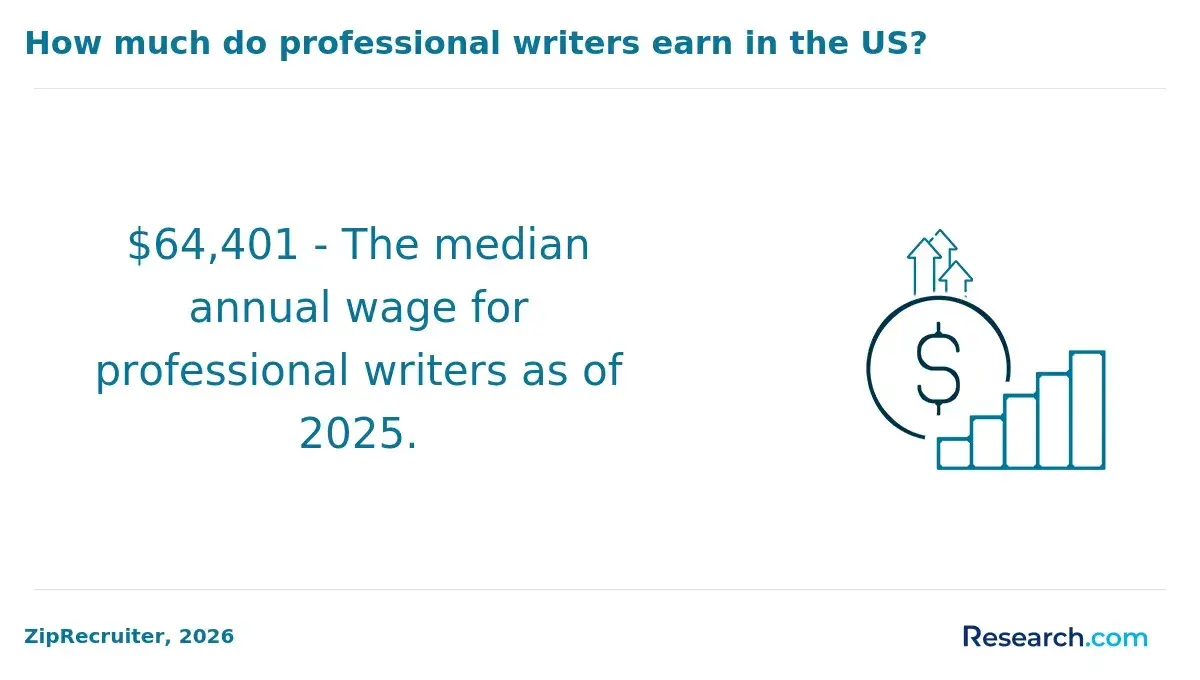
- The median annual salary for professional writers is $64,401, offering strong earning potential across industries (ZipRecruiter, n.d.).
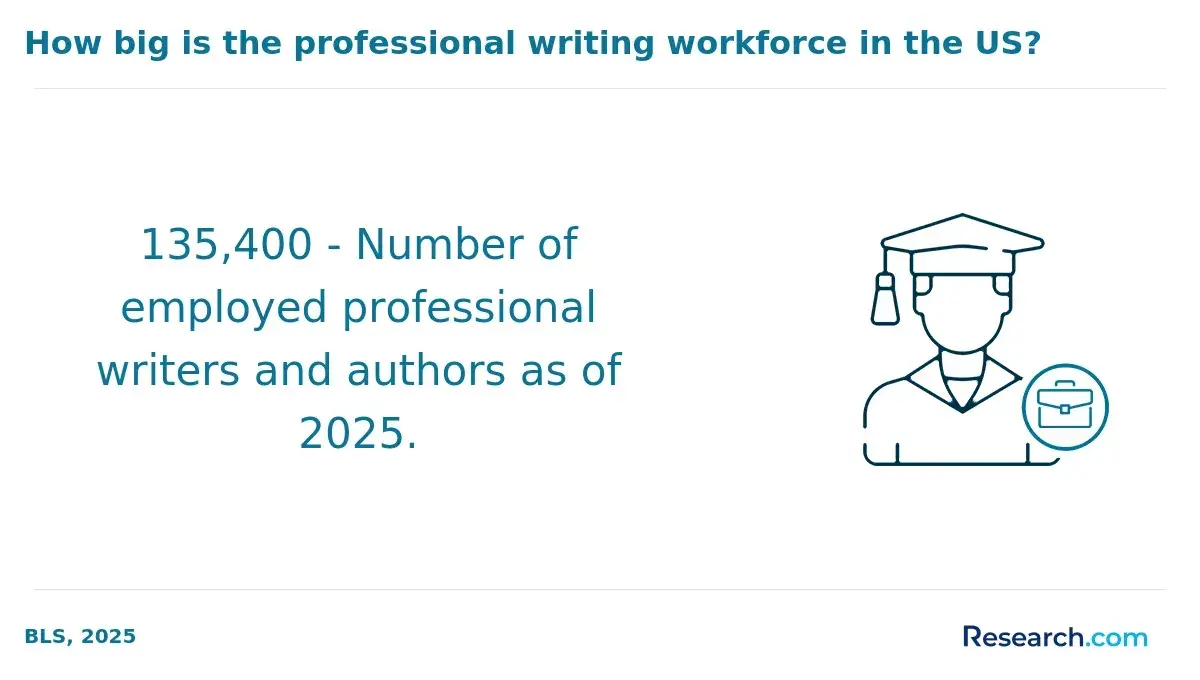
- Employment of professional writers across a myriad of sectors is projected to grow 4% from 2024 to 2034, keeping pace with national job trends (BLS, 2025).
- Online professional writing programs give writers the flexibility to work in their own free and creative environments, away from the constraints of traditional classrooms.
What can I expect from an online professional writing degree?
An online professional writing degree is a melting pot of creative development and practical training, all delivered through a flexible digital format. You’ll engage with experienced faculty, collaborate with peers, and build a portfolio—all from wherever you write best. These programs are designed to help you grow as a writer while fitting into your personal and professional life.
Here’s what you can expect:
- Asynchronous Classes: Access lectures, readings, and assignments on your schedule, giving you the freedom to write when inspiration strikes.
- Virtual Writing Workshops: Receive feedback from peers and professors in online forums that mirror the collaborative process of real-world editorial teams.
- Portfolio Development: Compile and refine a professional writing portfolio with guidance from instructors, tailored to your specific career goals.
- Genre-Specific Electives: Choose from courses in creative nonfiction, technical writing, digital content, or copywriting to specialize in your area of interest.
- Remote Internship Opportunities: Gain industry experience through online internships with publishers, media companies, or content agencies.
Where can I work with an online professional writing degree?
Professional writing degrees can open doors across industries that rely on clear, compelling communication. Whether you prefer creative storytelling or technical precision, your skills are in demand.
Here are a few common career paths for graduates:
- Publishing: Write, edit, or proofread for magazines, book publishers, or literary agencies.
- Marketing and Advertising: Craft content, copy, and brand messaging for digital campaigns and print materials.
- Technical Writing: Create manuals, guides, and documentation for software, healthcare, or engineering firms.
- Journalism and Media: Report, research, and write for news outlets, blogs, or multimedia platforms.
- Corporate Communications: Manage internal messaging, press releases, and executive communications for businesses.
How much can I make with an online professional writing degree?
Earnings in the writing field can vary depending on your experience, niche, and industry. With an online professional writing degree, you’ll be qualified for roles in everything from content creation and publishing to technical writing and corporate communications. Here's a closer look at potential income levels:
- Top Earners – $155,500 per year: Highly experienced writers, often in senior roles or specialized industries like law, tech, or finance, can reach six-figure salaries.
- 75th Percentile – $77,500 per year: Writers with a few years of experience and a solid portfolio typically earn well above the national average.
- Average – $64,401 per year: Most professional writers fall into this range, working in roles like content strategist, copywriter, or editor.
- 25th Percentile – $40,500 per year: Entry-level writers or those in freelance or part-time roles may start here but can increase their earnings with experience and specialization.
- List of the Best Universities for Online Professional Writing Degree Programs for 2027 List of Programs
- How long does it take to complete an online professional writing degree program? Completion Time
- How does an online professional writing degree program compare to an on-campus program? How does an online professional writing degree program compare to an on-campus program?
- What is the average cost of an online professional writing degree program? Average Cost
- What are the financial aid options for students enrolling in an online professional writing degree program? Financial Aid Options
- What are the prerequisites for enrolling in an online professional writing degree program? Enrollment Prerequisites
- What courses are typically in an online professional writing degree program? What courses are typically in an online professional writing degree program?
- What types of specializations are available in online professional writing degree programs? Specializations
- How to choose the best online professional writing degree program? How to choose the best online professional writing degree program?
- What career paths are available for graduates of online professional writing degree programs? Career Paths
- What is the job outlook for graduates with an online professional writing degree program? Job Outlook
- How can an MFA in creative writing enhance my professional writing career? How can an MFA in creative writing enhance my professional writing career?
- Can integrating UX principles enhance my professional writing strategy? Can integrating UX principles enhance my professional writing strategy?
Best Online Professional Writing Degree Programs for 2026
An online professional writing degree can be a practical route into careers that depend on clear, audience-focused communication: digital content, technical documentation, editing, grant writing, marketing, publishing, and business communication. The challenge is that writing programs vary widely. Some emphasize creative storytelling, some focus on rhetoric and academic writing, and others train students for technical, corporate, or digital media roles.
This guide is designed for students comparing online professional writing programs, transfer-friendly writing degrees, and short writing credentials. You will learn which programs stand out, how online writing degrees compare with campus options, what they cost, what courses and specializations to expect, and how to evaluate whether a program fits your career goals. If you are also comparing writing with more technical training, resources such as online CompTIA A+ training bootcamps can help you understand how career-focused online education differs across fields.
Quick Answer: Is an Online Professional Writing Degree Worth Considering?
An online professional writing degree is worth considering if you want structured writing practice, faculty feedback, a portfolio, and a credential that can support careers in content writing, editing, technical communication, marketing communications, publishing, grant writing, or digital media. It is usually strongest for students who can work independently, revise frequently, and use online collaboration tools. It may not be the best fit if you want a highly in-person workshop environment, a guaranteed creative publishing career, or a program that focuses only on one narrow writing style.
| Best fit | When it makes sense | What to check before enrolling |
| Career changers | You need a portfolio and formal training in workplace writing. | Look for courses in technical writing, editing, digital content, and professional communication. |
| Creative writers seeking employable skills | You want to combine storytelling with marketable writing formats. | Check whether the curriculum includes both creative workshops and practical writing courses. |
| Working adults | You need asynchronous or flexible online coursework. | Confirm weekly workload, live meeting requirements, and part-time options. |
| Transfer students | You already have credits and want to finish a bachelor’s degree online. | Ask how many credits transfer and whether writing major courses must be completed at the institution. |
How We Evaluated Online Professional Writing Programs
Choosing a writing degree should not depend on marketing language alone. Research.com’s ranking process considers academic quality, online delivery, affordability, institutional credibility, and student-relevant outcomes. The evaluation uses information from established education data sources, including the IPEDS database, Peterson’s database and its Distance Learning Licensed Data Set, the College Scorecard database, and the National Center for Education Statistics.
Readers should use this list as a starting point, not as the only factor in the decision. Program fit depends on your budget, transfer credits, preferred writing specialty, schedule, and career plans. For a fuller explanation of the ranking process, review our methodology page.
1. Cayuga Community College
Cayuga Community College offers an Associate in Science in Creative and Professional Writing for students who want an affordable starting point before transferring to a bachelor’s program or pursuing entry-level writing-related work. The program focuses on the writing process, genre flexibility, audience awareness, and the use of technology to communicate effectively.
- Program length: 2 years
- Track/concentration: Creative and Professional Writing
- Estimated cost: $2,724 (in-state) and $5,448 (out-of-state) per semester
- Required credits to graduate: 62
- Accreditation: Middle States Commission on Higher Education (MSCHE)
2. Florida International University
Florida International University offers an online Bachelor of Arts in English: Writing and Rhetoric for students who want to study writing as both a practical skill and a rhetorical discipline. Coursework develops argumentation, grammar, editing, multimodal composition, and digital communication skills that can apply to writing, media, business, and related fields.
- Program length: 4 years
- Track/concentration: English Writing and Rhetoric
- Estimated cost per credit: $236 (in-state), $649 (out-of-state)
- Required credits to graduate: 120
- Accreditation: Southern Association of Colleges and Schools Commission on Colleges (SACSCOC)
3. Regent University
Regent University offers an online BA in English Writing that blends literature study with applied writing for business, media, and creative settings. Students study American, British, and world literature while also developing skills in web writing, blogging, scripts, and marketing copy.
- Program length: 4 years
- Tracks/concentrations: English Writing, US and British Literature
- Estimated cost per credit: $395 (full-time), $450 (part-time)
- Required credits to graduate: 120+
- Accreditation: Southern Association of Colleges and Schools Commission on Colleges (SACSCOC)
4. Grand Canyon University
Grand Canyon University offers a BA in Professional Writing for New Media for students interested in writing for digital channels such as social media, blogs, and multimedia platforms. The curriculum combines creative development with technical communication skills for interactive and online formats.
- Program length: 4 years
- Track/concentration: Professional Writing for New Media
- Estimated cost per credit: $485
- Required credits to graduate: 120
- Accreditation: Higher Learning Commission (HLC)
5. Central Washington University
Central Washington University offers an online BA in Professional and Creative Writing for students who want room to explore both workplace writing and literary forms. The curriculum includes fiction, poetry, screenwriting, business writing, technical writing, editing, publishing, peer workshops, and literary analysis.
- Program length: 3 to 4 years
- Track/concentration: Professional and Creative Writing
- Estimated cost per credit: $234 (in-state), $820 (out-of-state)
- Required credits to graduate: 180
- Accreditation: Northwest Commission on Colleges and Universities (NWCCU)
6. University of Colorado - Denver
The University of Colorado - Denver offers an online BA in English: Writing, Rhetoric, and Technology that connects writing fundamentals with digital and technical fluency. Students can choose electives in areas such as multimedia production, science writing, and narrative nonfiction, and may also pursue stackable certificates in specialized areas such as editing or grant writing.
- Program length: 4 years
- Track/concentration: English Writing, Rhetoric, and Technology
- Estimated cost per credit: $465 (in-state), $558 (out-of-state)
- Required credits to graduate: 120
- Accreditation: Higher Learning Commission (HLC)
7. Liberty University
Liberty University offers an online BS in English and Writing for students seeking broad preparation in journalism, education, technical writing, and digital content. The program emphasizes adaptable writing skills that can be used in technology, media, marketing, social platforms, and other communication-driven settings.
- Program length: 3.5-4 years
- Tracks/concentrations: English, Technical, and Creative writing
- Estimated cost: $390 (full-time), $455 (part-time)
- Accreditation: Southern Association of Colleges and Schools Commission on Colleges (SACSCOC)
8. Full Sail University
Full Sail University offers an online BFA in Creative Writing for students who want to write stories for film, games, digital platforms, and other media formats. The program emphasizes genre study, visual storytelling, publishing strategy, collaboration, workshops, and portfolio development.
- Program length: 108 weeks
- Tracks/concentrations: Creative writing and Communication
- Estimated cost: Up to $15,000
- Accreditation: Accrediting Commission of Career Schools and Colleges (ACCSC)
9. Texas Tech University
Texas Tech University offers an online BA in Writing, Design and Technical Communication for students who want applied training in documentation, information design, and professional digital communication. The program connects writing theory with practical projects for industries such as technology, business, healthcare, and other professional sectors.
- Program length: 4 years
- Track/concentration: Writing, Design, and Technical Communication
- Estimated cost per credit: $415-$500
- Required credits to graduate: 120
- Accreditation: Southern Association of Colleges and Schools Commission on Colleges (SACSCOC)
10. Cornell University
Cornell University offers an online Business Writing certificate through eCornell for professionals who want a short, focused credential rather than a full degree. The program emphasizes persuasive writing, presentation writing, audience analysis, clarity, and purpose-driven workplace communication.
- Program length: 2 months
- Track/concentration: Business Writing
- Estimated total cost: $2,520
- Accreditation: Middle States Commission on Higher Education (MSCHE)
How Long Does It Take to Complete an Online Professional Writing Degree?
Most online bachelor’s degrees in professional writing take about 4 years and require 120 credits. This is the standard timeline for full-time students taking courses across 8 semesters. Programs such as those at Florida International University follow this traditional bachelor’s structure.
Some programs offer more flexible pacing for students balancing work, caregiving, or freelance assignments. Liberty University, for example, lists a 3.5-4 year timeline, while Central Washington University lists 3 to 4 years. Part-time enrollment can make weekly workload more manageable, but it may increase the total time to graduation.
Students who want a faster route can compare accelerated online professional writing degree programs. Full Sail University’s online creative writing program, for example, lists a 108-week format, which is about 2 years. Accelerated options can be useful, but they usually require strong time management and a willingness to complete writing, revision, and workshop assignments on a compressed schedule.
| Credential type | Typical timeline based on listed programs | Best for |
| Certificate | 2 months | Professionals who want targeted business writing training without completing a full degree |
| Associate degree | 2 years | Students planning to transfer or build foundational writing skills at lower cost |
| Accelerated bachelor’s format | 108 weeks | Students who can handle intensive coursework and want to finish quickly |
| Traditional bachelor’s degree | 3.5-4 years or 4 years | Students seeking broad training, portfolio development, and a full undergraduate credential |
Online Professional Writing Degree vs. On-Campus Program: Which Format Is Better?
Online and on-campus professional writing programs usually aim for the same outcome: helping students write clearly, revise thoughtfully, understand audiences, and create polished work across formats. In 2024 alone, nearly 3,012 students earned professional writing degrees, reflecting continued interest in writing credentials tied to communication careers.
The better format depends on how you learn. Online programs work well for independent students who want schedule flexibility and experience collaborating through digital platforms. Campus programs may be better for students who want face-to-face workshops, immediate in-person feedback, campus publications, and local literary communities.
| Factor | Online professional writing degree | On-campus professional writing degree |
| Schedule | Often better for working adults, parents, and students with fixed commitments | Better for students who can attend classes at set times on campus |
| Feedback style | Uses discussion boards, file comments, recorded feedback, video meetings, and digital workshops | Uses in-person workshops, office hours, class discussion, and campus writing centers |
| Writing environment | Lets students draft and revise in their own space, often on a more flexible schedule | Provides a dedicated campus setting with peer interaction and faculty access |
| Professional relevance | Mirrors remote writing work, digital publishing, content systems, and online collaboration | Supports campus-based networking, readings, student publications, and in-person mentoring |
| Technology exposure | Often emphasizes online collaboration, digital publishing, and multimedia communication, similar in delivery logic to online CompTIA Cloud+ training bootcamps | May provide physical labs, libraries, print publications, and on-campus media opportunities |
Choose an online writing degree if:
- You need flexibility because of work, family responsibilities, or location.
- You want experience giving and receiving feedback through digital platforms.
- You plan to pursue remote writing, freelance work, content marketing, editing, or digital publishing.
- You are comfortable managing deadlines without frequent in-person reminders.
Choose an on-campus writing degree if:
- You learn best through live discussion and in-person workshop energy.
- You want easier access to campus literary events, student newspapers, writing clubs, or faculty office hours.
- You prefer a structured weekly routine and physical classroom environment.
- You want local networking opportunities tied to a college town or regional media market.
What Is the Average Cost of an Online Professional Writing Degree?
The cost of an online professional writing degree depends on the institution, residency status, enrollment pace, transfer credits, and whether you choose a public, private nonprofit, or career-focused school. Based on the figures provided in the listed programs, full-time students may pay around $390 per credit hour, while part-time students may pay closer to $455. That averages to $422 per credit, or about $12,660 annually.
Public universities are often less expensive for in-state students. The median in-state tuition totaling $7,914 per year can make public programs attractive for students trying to limit borrowing.
Private universities can cost more, with median tuition reaching $34,500 annually. A higher price does not automatically mean better career outcomes, but some private programs may offer specialized faculty, smaller classes, intensive career services, or distinctive creative writing tracks. Always compare total cost, not just tuition.
| Cost factor | Why it matters | Question to ask |
| Per-credit tuition | Most online bachelor’s programs charge by the credit. | Is the quoted rate the same for online, in-state, and out-of-state students? |
| Transfer credits | Accepted credits can reduce both cost and time. | How many prior credits can count toward the writing major and general education requirements? |
| Fees | Technology, distance learning, portfolio, and graduation fees can increase total cost. | What fees are mandatory each term? |
| Course load | Part-time study may be easier to manage but can extend the timeline. | Will part-time enrollment change tuition, aid eligibility, or graduation date? |
| Books and software | Writing programs may require style guides, publishing tools, or design software. | Which tools are included, and which must students buy separately? |
Financial Aid Options for Online Professional Writing Students
Online professional writing students may be eligible for institutional aid, federal aid, state aid, employer tuition assistance, private scholarships, and writing-specific awards. The best approach is to combine broad funding sources with targeted scholarships for writers, editors, journalists, and creative writers.
Students comparing full degrees with shorter options, including short online creative writing programs, should ask each school whether certificate, part-time, and online students qualify for the same aid as campus-based degree students.
| Aid option | Who it may help | Important detail |
| L. Ron Hubbard’s Writers of the Future Contest | New and amateur science fiction and fantasy writers | Quarterly prizes are $1,000, $750, and $500, with a $5,000 grand prize and full rights retained by the author. |
| Bill Walsh Scholarship from ACES: The Society for Editing | College juniors, seniors, and graduate students interested in copy editing | The scholarship recognizes editing skill and commitment to language in news editing; scholarship amount varies. |
| Chronicle of Higher Education Scholarship for Diversity in Media | Students with newsroom experience and interest in reporting on race and identity | The award provides $10,000 in financial support and a summer internship at The Chronicle. |
| Ladies Literary Club Scholarship from Grand Rapids Community Foundation | Michigan residents in select counties majoring in Literary Arts at accredited Michigan colleges or universities | Applicants need a 3.0 GPA; scholarship amount varies. |
| Julie Schoo Scholarship for Journalism Diversity | Students committed to diversity in American journalism | This renewable National Press Club scholarship offers up to $5,000. |
Practical ways to reduce your cost
- Complete the FAFSA if the program is eligible for federal student aid.
- Ask whether online students receive institutional grants or only loans.
- Transfer community college credits when possible, but confirm they apply to the degree requirements.
- Compare total program cost, not only per-credit tuition.
- Look for portfolio-based scholarships, editing awards, journalism scholarships, and writing contests.
- Ask your employer whether tuition assistance applies to communication, writing, or business writing coursework.
Admissions Requirements for Online Professional Writing Degree Programs
Most undergraduate online professional writing programs are designed to be accessible, especially for first-year students, transfer students, and working adults. Admissions requirements vary by school, but students should be prepared to show academic readiness, basic technical skills, and interest in writing-intensive study.
- High school diploma or equivalent: Undergraduate programs generally require proof of secondary education, such as a high school diploma or GED.
- Minimum GPA: Some schools look for a GPA of 2.5 or higher for undergraduate admission, though requirements vary.
- Writing sample or personal statement: Some programs request a short essay or portfolio to evaluate writing ability, motivation, and fit.
- Computer literacy: Students should be able to use learning management systems, word processing tools, shared documents, and file submission platforms.
- Reliable internet access: Online writing courses may include video lectures, virtual workshops, peer review, and frequent digital submissions.
- Transcripts from prior institutions: Transfer students need official transcripts so the school can evaluate completed credits.
- Interest in narrative or professional writing: Programs may value applicants who can explain their interest in storytelling, journalism, technical communication, editing, or workplace writing.
- Comfort with feedback: Workshop-based courses require students to revise and respond constructively to peer and instructor comments.
If your interest is closer to reporting, media writing, or news production, compare professional writing programs with accelerated online bachelor’s in journalism degrees. Journalism programs often place more emphasis on reporting, interviewing, media law, and newsroom practice.
Common Courses in an Online Professional Writing Degree
Professional writing programs teach students to write for specific audiences, goals, formats, and contexts. Strong programs do not treat writing as a single general skill. They train students to adapt voice, structure, research, evidence, tone, and revision strategies for different professional situations.
| Course area | What students usually learn | Career relevance |
| Technical Writing | How to explain complex information through manuals, guides, instructions, and documentation | Useful for technical writer, documentation specialist, UX writer, and product communication roles |
| Editing and Proofreading | Grammar, syntax, style, consistency, fact-checking, and revision processes | Useful for editor, copy editor, content quality specialist, and publishing roles |
| Business and Professional Communication | Emails, memos, proposals, reports, executive summaries, and workplace messaging | Useful in corporate communications, operations, administration, and management support roles |
| Creative Writing | Fiction, nonfiction, poetry, voice, characterization, narrative structure, and workshop revision | Useful for creative media, publishing, screenwriting, games, and branded storytelling |
| Grant and Proposal Writing | Researching funders, organizing arguments, drafting proposals, and aligning projects with requirements | Useful for nonprofit, education, government, and research support roles |
| Writing for Social Media and Marketing | Short-form copy, campaign messaging, brand voice, audience targeting, and platform-specific writing | Useful for social media, content marketing, digital advertising, and communications roles |
| Publication Design and Layout | Document design, typography, hierarchy, layout, and tools such as Adobe InDesign | Useful for publishing, marketing collateral, proposal design, and digital content production |
| AI and Emerging Tools in Writing | How AI tools affect brainstorming, drafting, editing, prompting, and content workflows | Useful for modern content roles that require human judgment and tool-assisted production |
AI is becoming part of writing workflows, but it does not remove the need for human judgment. Writers still need to verify facts, understand audience expectations, maintain voice, organize ideas, and revise for clarity. Students who want deeper technical preparation can compare writing programs with the fastest online artificial intelligence degree programs, especially if they want to combine communication work with AI-related roles.
Specializations in Online Professional Writing Programs
Professional writing is not one career path. It includes business writing, technical communication, content strategy, creative writing, journalism, grant writing, and other specialized forms. Choosing a concentration can help you build a more targeted portfolio and make your job search clearer.
| Specialization | What it focuses on | Best for students who want to |
| Business and Corporate Writing | Internal communications, reports, proposals, presentations, and organizational messaging | Work in companies, nonprofits, healthcare systems, universities, or government offices |
| Science and Medical Writing | Research summaries, public-facing science content, regulatory documents, and STEM communication | Combine scientific interest with writing and translation of complex information |
| Grant and Proposal Writing | Funding proposals, grant applications, needs statements, budgets, and persuasive project narratives | Support nonprofits, schools, agencies, and research organizations |
| Short-Form Content | Social posts, newsletters, ad copy, landing page copy, and concise campaign messaging | Write for fast-moving digital channels; related skills can also be developed through fast online social media marketing degree programs |
| Market Research | Turning customer, market, and product data into readable insights and reports | Work in strategy, product marketing, consumer insights, or research communication |
| Digital Journalism | Reporting, fact-checking, multimedia storytelling, headlines, audience engagement, and digital publishing | Write for digital-first publications, newsletters, local media, or niche news platforms |
The right specialization should match the work samples you want in your portfolio. For example, a future grant writer should graduate with proposal samples, needs statements, and research-based narratives. A future content strategist should have web copy, SEO-informed articles, content briefs, and campaign examples.
How to Choose the Best Online Professional Writing Degree Program
The best online professional writing degree is the one that fits your goals, budget, schedule, and preferred writing niche. A well-known school is not automatically the best choice if its curriculum does not match the type of writing you want to do. Likewise, the lowest tuition may not be the best value if the program lacks portfolio development, faculty feedback, or useful career support.
Key factors to compare
- Accreditation: Confirm that the institution is accredited by a recognized accreditor. Accreditation can affect credit transfer, graduate school admission, and financial aid eligibility.
- Curriculum depth: Look for substantial coursework in writing, editing, rhetoric, technical communication, digital content, or creative writing rather than a generic English curriculum with only a few writing electives.
- Portfolio development: Ask whether students graduate with polished samples for professional use, such as articles, technical documents, proposals, scripts, web copy, or creative work.
- Online format: Determine whether classes are asynchronous, synchronous, or mixed. Choose a structure that fits your weekly availability.
- Faculty experience: Review whether instructors have backgrounds in publishing, digital media, technical communication, editing, creative writing, grant writing, or corporate communication.
- Writing technology: Strong programs expose students to tools used in modern writing workflows, including style guides, content management systems, collaborative editing platforms, and AI-assisted editing tools.
- Peer and mentor feedback: Writing improves through revision. Check whether the program includes workshops, instructor comments, conferences, and structured peer review.
- Career support: Ask about internships, freelance preparation, resume support, alumni networks, writing contests, campus publications, and employer connections.
Writing programs increasingly overlap with digital production, product communication, and software-enabled content work. Students who want a more technical digital pathway may also compare writing programs with related online options such as online mobile app development degree programs.
Questions to ask before enrolling
| Question | Why it matters |
| Is the institution accredited? | Accreditation helps verify academic quality and can affect aid, transfer, and graduate study. |
| How many writing-specific courses are required? | A strong professional writing program should offer more than general literature or composition courses. |
| Will I build a portfolio? | Employers and clients often want samples more than transcripts. |
| Are courses asynchronous or live? | The delivery format determines whether the program will fit your schedule. |
| Can I transfer credits? | Transfer policies can significantly change cost and completion time. |
| What career services are available to online students? | Online students should receive meaningful access to advising, job support, and professional resources. |
| Does the curriculum address AI, SEO, digital publishing, or content strategy? | Many writing jobs now expect familiarity with digital and AI-assisted workflows. |
Career Paths for Online Professional Writing Graduates
An online professional writing degree can support many communication-focused careers, but the best path depends on your portfolio, internships, prior experience, technical knowledge, and chosen specialization. Graduates may work in media, technology, healthcare, higher education, nonprofits, government, publishing, marketing agencies, corporate communications, or freelance settings.
| Career path | What the role does | Skills to build while in school |
| Digital Content Writer | Writes blogs, articles, website copy, guides, and other web content for organizations or publications | Research, SEO, headline writing, content briefs, source evaluation, and revision |
| Corporate Research Analyst | Turns business findings, data, and trends into clear reports, summaries, and presentations | Analytical writing, data interpretation, report structure, and audience-focused communication |
| Social Media Copywriter | Creates concise platform-specific content for Instagram, X, TikTok, LinkedIn, and similar channels | Short-form copy, brand voice, audience targeting, trend awareness, and campaign messaging |
| AI Prompt Designer | Designs and refines prompts to guide AI tools toward useful written outputs | Prompt structure, editing judgment, content evaluation, ethics, and technical fluency |
| Marketing Communications Specialist | Develops messaging for launches, campaigns, announcements, and internal or external communications | Persuasive writing, brand messaging, campaign planning, and stakeholder communication |
| B2B Content Strategist | Plans and creates content for business audiences, including white papers, email campaigns, and LinkedIn posts | Research, content planning, buyer awareness, long-form writing, and analytics literacy |
| Sales Enablement Writer | Creates pitch decks, RFP responses, product sheets, and sales materials aligned with business goals | Persuasion, business writing, product understanding, proposal writing, and collaboration |
Students who want to move toward marketing leadership may eventually consider business training, including short online MBA programs in marketing. However, an MBA is not required for many writing roles; it is usually more relevant for those targeting strategy, management, or senior marketing positions.
Job Outlook for Online Professional Writing Graduates
The writing labor market is changing rather than disappearing. Traditional print publishing has faced pressure, but digital media, content strategy, branded content, technical communication, self-publishing, and AI-supported workflows continue to create opportunities for adaptable writers.
- Employment growth: Employment of writers and authors is projected to grow 4% from 2024 to 2034, which is about as fast as the average for all occupations.
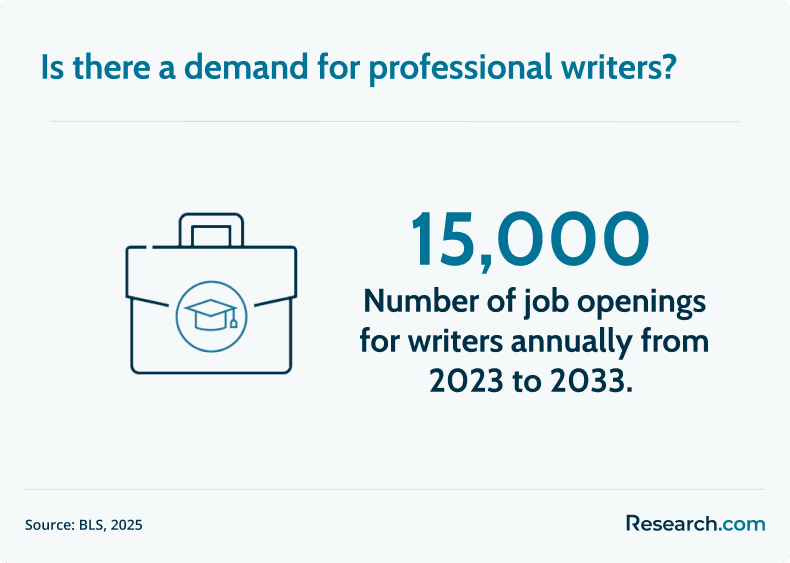
- Annual openings: About 15,100 openings for writers and authors are expected each year, largely because workers retire, change occupations, or leave the labor force.
- Digital shift: As print publishing contracts, more opportunities are tied to websites, newsletters, podcasts, online publications, social platforms, and branded content.
- Self-publishing options: Writers can use platforms such as Amazon Kindle Direct Publishing or Substack to reach readers directly, though audience-building and income are not guaranteed.
- Skill versatility: Writers who understand SEO, editing, UX writing, AI prompting, technical documentation, and content strategy may have broader options. The need to combine communication with technical awareness is similar to the cross-functional skill-building found in online CompTIA CYSA+ training bootcamps.
Students should be realistic: a writing degree alone does not guarantee a job or a publishing career. The strongest candidates usually graduate with a portfolio, internship or freelance experience, evidence of revision skills, and the ability to write for a defined audience.
Can an MFA in Creative Writing Improve a Professional Writing Career?
An MFA in creative writing can strengthen a professional writing career when your goals involve literary publishing, teaching creative writing, narrative craft, screenwriting, editing, or advanced workshop-based development. MFA programs usually emphasize close reading, intensive revision, peer critique, and voice development. They can also help writers build networks in publishing and academia.
However, an MFA is not necessary for most technical writing, content strategy, corporate communication, or marketing writing jobs. For those roles, employers may care more about writing samples, industry knowledge, editing ability, and digital communication skills. If you are considering graduate study, compare the cost and career value carefully and review what you can do with an MFA in creative writing.
Are Online Professional Writing Degree Programs Accredited and Recognized?
Accreditation is one of the most important quality checks for any online degree. It helps indicate that an institution meets recognized academic standards, and it can affect federal financial aid eligibility, transfer credit acceptance, graduate school admission, and employer confidence. Before enrolling, confirm the school’s accreditation status through official sources such as the U.S. Department of Education or the Council for Higher Education Accreditation.
Do not assume every online writing program has the same recognition. Some are full degrees from accredited universities, while others are certificates, continuing education programs, or career-focused credentials. Each can be useful, but they serve different purposes. If you are comparing graduate-level creative writing options with cost in mind, review the most affordable online MFA programs.
How UX Principles Can Strengthen Professional Writing
UX principles can make professional writing clearer, more usable, and more aligned with reader needs. Writers who understand user experience think carefully about structure, navigation, plain language, accessibility, headings, calls to action, and how readers scan digital content. These skills are especially useful for web copy, product documentation, help-center articles, app content, and content strategy.
Students interested in this overlap may want to study content design, UX writing, information architecture, and usability testing. A related pathway is an online UX design degree, which can help writers connect language, design, and user-centered problem solving.
Common Mistakes to Avoid When Choosing an Online Writing Program
| Mistake | Why it can hurt you | Better approach |
| Choosing based only on tuition | The cheapest option may lack portfolio support, strong writing courses, or useful feedback. | Compare total value: cost, curriculum, accreditation, transfer policy, portfolio work, and career support. |
| Ignoring accreditation | Credits may not transfer, and financial aid or graduate school options may be limited. | Verify accreditation before applying. |
| Assuming all writing degrees teach the same skills | A literature-heavy English degree may not provide enough technical, business, or digital writing practice. | Review required courses and sample assignments. |
| Graduating without a portfolio | Writing employers and clients often ask for samples. | Save and revise your strongest work throughout the program. |
| Overlooking online student support | Weak advising or limited access to faculty can make online study harder. | Ask about writing center access, faculty feedback, tutoring, and career services for online students. |
| Assuming salary outcomes are guaranteed | Writing income varies by role, industry, experience, location, and freelance stability. | Use salary data as context, not a promise, and build marketable samples. |
| Avoiding AI tools completely | Many writing workplaces now use AI-assisted brainstorming, editing, or workflow tools. | Learn to use AI responsibly while strengthening original thinking, fact-checking, and editorial judgment. |
What Graduates Say About Online Professional Writing Degrees
- Eugene: "The online format let me keep my full-time job while developing a portfolio I could actually use. I practiced writing for websites, email campaigns, and social platforms from my home in Houston, and I had freelance clients before graduation."
- Veronica: "Studying online forced me to communicate more clearly. I worked with classmates in other time zones, responded to detailed feedback, and met digital deadlines, which is very close to what I now do as a remote content strategist."
- Luis: "I used to treat writing as a personal interest. The program helped me turn it into a career path by covering technical documentation, creative work, and AI-assisted copy. Being able to move through the work at my own pace mattered a lot."
Key Insights
- An online professional writing degree is best for students who want flexible study, writing feedback, and a portfolio for careers in content, editing, technical communication, marketing, publishing, or business writing.
- Most online bachelor’s programs take about 4 years and require 120 credits, but listed options range from a 2-month certificate to a 108-week accelerated bachelor’s format.
- Cost varies significantly. Public programs may be more affordable for in-state students, while private programs may offer specialized tracks or different support structures.
- Accreditation should be verified before enrollment because it can affect financial aid, transfer credits, graduate study, and employer recognition.
- The strongest programs include writing-intensive coursework, revision practice, peer or faculty feedback, digital tools, and portfolio development.
- Career outcomes depend heavily on samples, specialization, experience, and adaptability. A degree helps, but a polished portfolio is often essential.
- AI, UX writing, SEO, and digital publishing are increasingly important. Writers who combine strong editorial judgment with technology awareness are better positioned for modern communication roles.
References:
- American Copy Editors Society. (n.d.). Scholarships. Aceseditors.org. Retrieved 25 July 2025.
- BigFuture. (n.d.). Julie Schoo Scholarship for Journalism Diversity. Bigfuture.collegeboard.org. Retrieved 25 July 2025.
- Chronicle of Higher Education. (n.d.). Chronicle Scholarship: Diversity in Media. Featured.chronicle.com. Retrieved 25 July 2025.
- Data USA. (2025). Professional, Technical, Business, and Scientific Writing. https://datausa.io/profile/cip/professional-technical-business-and-scientific-writing
- U.S. Bureau of Labor Statistics. (2025, September). Writers and Authors. Occupational Outlook Handbook. https://www.bls.gov/ooh/media-and-communication/writers-and-authors.htm
- U.S. Bureau of Labor Statistics. (2025, September). Occupational Projections, 2024–34. https://www.bls.gov/news.release/ecopro.t01.htm
- Full Sail University. (n.d.). Creative writing bachelor’s degree program. Fullsail.edu. Retrieved 25 July 2025.
- University of Colorado Denver. (n.d.). English: Writing, Rhetoric, and Technology BA (Online). Online.ucdenver.edu. Retrieved 25 July 2025.
- University of Houston–Victoria. (n.d.). B.A. in Creative Writing – Degree plan. Uhv.edu. Retrieved 25 July 2025.
- Writers of the Future. (n.d.). Enter the writer contest. Writersofthefuture.com. Retrieved 25 July 2025.
- Zippia. (n.d.). Business writer demographics and statistics. Zippia.com. Retrieved 25 July 2025.
- Zippia. (n.d.). Business writer skills. Zippia.com. Retrieved 25 July 2025.
- ZipRecruiter. (2025). Professional writing salary in the United States. https://www.ziprecruiter.com/Salaries/Professional-Writing-Salary
Other Things You Need to Know About Online Professional Writing Degree Programs
Yes, they are accredited. The Accreditation Council for Collegiate Writing Programs (ACCWP) typically oversees these programs. Accreditation ensures quality and that credits will transfer to other accredited institutions. Always verify specific accreditation with each program before enrolling.
Most programs require a writing sample or portfolio that shows clear grammar, organization, and genre range. Applicants are often asked for 10 to 20 pages of recent work, and some schools request fiction, nonfiction, technical, or professional samples plus a statement of purpose.


