2027 Fastest Online UX Design Bootcamps

Co-Founder and Chief Data Scientist
Choosing an online UX design bootcamp is usually a time-sensitive decision: you want to learn user research, wireframing, prototyping, and portfolio presentation quickly enough to compete for entry-level design roles, but you also need to avoid paying for a program that lacks credible instruction, career support, or useful projects.
UX design, or user experience design, is the practice of improving how people use digital products such as websites, mobile apps, dashboards, patient portals, learning platforms, and checkout systems. A good UX designer studies user behavior, identifies friction, tests ideas, and works with product teams to make digital experiences easier, clearer, and more effective.
This guide explains how the fastest online UX design bootcamps work, what they cost, how long they take, what skills and tools they teach, and how to evaluate whether a bootcamp is worth the investment. It is written for career changers, recent graduates, self-taught designers, and working professionals who want a practical route into UX without committing to a multi-year degree.
Quick answer: Are online UX design bootcamps a fast path into UX?
Yes, online UX design bootcamps can be one of the fastest structured ways to build job-ready UX skills, especially if the program includes mentor feedback, portfolio projects, usability testing practice, and career coaching. The strongest programs do not just teach design software; they help students explain design decisions, document research, test prototypes, and present case studies to employers.
Most students should compare bootcamps by four factors: completion time, total cost, portfolio quality, and career support. A short bootcamp is only valuable if it helps you produce credible work samples and understand the full UX process from research to iteration.
What are the benefits of online UX design bootcamps?
- Faster career preparation: Many UX bootcamps compress practical training into weeks or months instead of years, making them useful for learners who need a quicker route into digital design.
- Industry flexibility: Graduates may pursue UX roles in technology, healthcare, finance, education, retail, government services, and other fields where digital products must be easy to use.
- Portfolio-focused training: Bootcamps usually require students to complete case studies, wireframes, prototypes, user research exercises, and usability tests that can be shown to employers.
- Career support: Many programs include coaching, interview preparation, resume reviews, or employer networks to help students transition from training into job applications.
- Competitive salary potential: Online UX bootcamp graduates typically earn $85,000–$108,000 in entry-level roles, with mid-level and senior salaries often exceeding $110,000 and $114,000, respectively.
What can I expect from online UX design bootcamps?
Online UX design bootcamps are short, structured training programs that teach the practical workflow used by UX and product design teams. Instead of spending most of the curriculum on broad academic theory, bootcamps usually focus on applied assignments: researching users, defining problems, sketching solutions, building prototypes, testing designs, and turning the work into portfolio-ready case studies.
Most programs combine recorded lessons, live workshops, project deadlines, critiques, and mentor sessions. Some are full-time and immersive, while others are part-time or self-paced. The right format depends on how quickly you want to finish, how many hours you can study each week, and whether you need a fixed schedule to stay accountable.
| Bootcamp component | What you do | Why it matters for hiring |
| User research | Conduct interviews, surveys, competitive reviews, or usability observations. | Employers want designers who can explain user needs with evidence, not assumptions. |
| Information architecture | Organize content, navigation, user flows, and task paths. | Strong structure helps users find information and complete tasks efficiently. |
| Wireframing | Create low-fidelity layouts before investing in polished visuals. | Wireframes show how you think through hierarchy, layout, and interaction. |
| Prototyping | Build clickable models of websites, apps, or product features. | Prototypes help teams test ideas before development begins. |
| Usability testing | Observe users completing tasks and revise designs based on feedback. | Testing shows that you can improve designs through iteration. |
| Portfolio development | Turn projects into case studies with process, visuals, decisions, and outcomes. | Your portfolio is often more important than the bootcamp credential itself. |
By graduation, students should understand the UX process well enough to discuss trade-offs, defend design choices, collaborate with developers and product managers, and continue improving through feedback.
Where can I work after completing online UX design bootcamps?
UX skills are used wherever organizations rely on digital products, customer portals, mobile apps, internal software, or online services. Bootcamp graduates often start in junior UX, UI/UX, product design, web design, research assistant, or digital experience roles, depending on their prior background and portfolio strength.
- Technology and software: Product teams use UX designers to improve apps, platforms, dashboards, workflow tools, and enterprise systems.
- E-commerce and retail: Online stores need designers who can improve search, navigation, product pages, carts, and checkout flows.
- Finance and fintech: Banks, payment platforms, investment apps, and insurance companies hire UX talent to simplify complex tasks and build trust.
- Healthcare and medical services: Hospitals, clinics, wellness companies, and telehealth providers need usable patient portals, scheduling tools, and health apps.
- Education and EdTech: Learning platforms and school systems rely on UX design to support students, teachers, administrators, and families.
- Government and public services: Public agencies use UX to improve forms, benefits systems, service portals, and accessibility.
Remote and contract work are common in UX, but early-career designers should be realistic: the first role may require applying broadly, networking consistently, and using freelance or volunteer projects to strengthen a portfolio.
How much can I make after completing online UX design bootcamps?
Salary outcomes vary by location, employer, portfolio quality, prior professional experience, and whether the role is UX design, UI/UX design, product design, or digital interface design. Bootcamps can help you qualify for entry-level roles, but they do not guarantee a specific salary.
| Role or career stage | Reported salary figure | Source context |
| Entry-Level UX Designer | $85,000 to $108,000 | Average starting salary range reported by Glassdoor, 2025; ZipRecruiter, 2025 |
| UI/UX Designer Roles | Around $101,000 | Average salary reported by Glassdoor, 2025 |
| Junior UX Positions | Near $120,000 | Some junior roles in high-demand markets reported by Glassdoor, 2025 |
| Mid-Level UX Designer | Above $110,000 | Common salary level after a few years of experience, PayScale, 2025 |
| Senior UX Designer | $114,000 or more | Average annual salary reported by PayScale, 2025 |
| Digital Interface Designers | $98,090 | Median salary listed by the Bureau of Labor Statistics, 2024 |
The best way to evaluate salary potential is to compare local job postings, required skills, portfolio expectations, and entry-level openings before enrolling. A bootcamp with strong projects and employer-aligned training is more valuable than one that simply promises high-paying outcomes.
- Fastest Online UX Design Bootcamps for 2027
- How long does it take to complete online UX design bootcamps?
- How can I speed up learning online UX design bootcamps?
- What is the average cost of online UX design bootcamps?
- What financial aid options are available for online UX design bootcamps?
- What should I include in my UX bootcamp application?
- How do I evaluate the credibility of an online UX design bootcamp?
- What is the ROI of online UX design bootcamps?
- What challenges might I face during an online UX design bootcamp?
- How do online UX design bootcamps compare to traditional degree programs?
- What does a typical day look like in online UX design bootcamps?
- What UX design tools will I learn in an online bootcamp?
- What are the next steps after finishing online UX design bootcamps?
- What should be included in your UX bootcamp portfolio?
- What is the job market for graduates of online UX design bootcamps?
List of the Fastest Online UX Design Bootcamps for 2027
How do we rank programs?
The fastest online UX design bootcamps were evaluated for speed, structure, affordability, and career relevance. Using Research.com’s methodology, the selection emphasizes program length, specialization options, transparent tuition, and the presence of applied portfolio work. A fast bootcamp should not only be short; it should help students move efficiently from learning to demonstrable design competence.
Program data is based on current, verified sources, including the U.S. Department of Education’s College Scorecard, the National Center for Education Statistics, Peterson’s Distance Learning database, and the Integrated Postsecondary Education Data System.
| Program | Fastest listed pace | Best fit | Cost |
| General Assembly | 12 weeks full-time | Learners who want a live, immersive UX program with career coaching | $16,450 |
| CareerFoundry | 5 months at 30–40 hours/week | Students who want flexible pacing with mentor and career support | From $7,900 |
| Springboard | 9 months at 15–25 hours/week | Career changers who want 1:1 mentorship and a job-focused structure | $7,900–$14,500 |
| BrainStation | 4 weeks foundations or 8 weeks accelerated | Students seeking a short, project-based UX learning experience | $16,500 |
| Designlab | 15 weeks full-time | Learners who want mentor critiques and a structured design portfolio | $7,249–$9,677 |
| Flatiron School | 15 weeks full-time | Students interested in product design with career coaching | $16,900 full-time or $17,900 part-time |
| Google UX Design Professional Certificate | 6 months at 5–10 hours/week | Budget-conscious beginners who want foundational UX training | $39/month, approximately $234 total |
| Ironhack | 9 weeks full-time | Learners who want a fast UX/UI track with project work | $12,500 |
| Nielsen Norman Group | 30 hours plus exams | Professionals who want targeted UX certification rather than a full bootcamp | From $6,000 |
| Interaction Design Foundation | Self-paced, courses typically completed in 3–6 months | Self-directed learners who want low-cost UX course access | $22/month or $264/year |
1. General Assembly
General Assembly offers an online UX Design Immersive built around live instruction, applied assignments, instructor feedback, and career support. The 12-week format is best for students who can commit full time and want a structured transition into UX through repeated project work.
- Program Length: 12 weeks full-time
- Concentrations/Specializations: End-to-end UX design workflow, including wireframing, prototyping, user research, usability testing, and visual interface design
- Total Costs: $16,450
- Accreditation: Licensed by the California Bureau for Private Postsecondary Education, the New York State Education Department, and the Texas Workforce Commission
2. CareerFoundry
CareerFoundry structures its UX Design Program around project milestones, mentor guidance, and career coaching. Its flexible pacing is useful for students who need accountability but cannot attend a full-time immersive bootcamp.
- Program Length: 5 months (30–40 hours/week) or up to 10 months (15–20 hours/week)
- Concentrations/Specializations: UI for UX Designers, Voice User Interface Design, Frontend Development for Designers
- Total Costs: From $7,900 for the complete career change package
- Accreditation: Registered as a private education provider in Germany; not accredited by a U.S. Department of Education-recognized agency
3. Springboard
Springboard offers a remote UI/UX Design Career Track with mentor support, four major portfolio projects, and a job guarantee. It is a strong option for career changers who want guided learning without leaving a job immediately.
- Program Length: 9 months (15–25 hours/week)
- Concentrations/Specializations: End-to-end UX process, user research, wireframing, prototyping, visual interface design
- Total Costs: $7,900–$14,500 depending on payment plan and upfront discounts
- Accreditation: Registered as an educational provider in Delaware
4. BrainStation
BrainStation provides UX training through short, project-centered formats. Students can complete a 4-week foundations course or an 8-week accelerated track while building practical work samples and learning product design concepts.
- Program Length: 4 weeks (foundations) or 8 weeks (accelerated) at 10–15 hours/week
- Concentrations/Specializations: Mobile app design, interaction prototyping, user research, design systems
- Total Costs: $16,500 for either track
- Accreditation: Not accredited by a U.S. Department of Education–recognized agency; registered as a private career college under the Ontario Ministry of Colleges and Universities
5. Designlab
Designlab UX Academy combines structured coursework, hands-on projects, and weekly mentor critiques. It offers both full-time and part-time options, making it suitable for students who want a guided portfolio-building experience.
- Program Length: 15 weeks full-time (40 hours/week) or 30 weeks part-time (20 hours/week)
- Concentrations/Specializations: UX foundations, user research, interaction design, visual interface design, design systems
- Total Costs: $7,249–$9,677 depending on payment plan and financing options
- Accreditation: No accreditation from a U.S. Department of Education–recognized agency
6. Flatiron School
Flatiron School offers a Product Design Bootcamp that teaches UX, UI, design systems, and product strategy through immersive or part-time study. Its capstone and career coaching can help students frame their work for product design roles.
- Program Length: 15 weeks full-time or 40 weeks part-time
- Concentrations/Specializations: User research, interaction design, visual interface design, design systems, product strategy
- Total Costs: $16,900 (full-time) or $17,900 (part-time)
- Accreditation: Licensed by the New York State Education Department
7. Google (Coursera)
The Google UX Design Professional Certificate is a self-paced, beginner-friendly option delivered through seven courses. It is not as intensive as many immersive bootcamps, but its low cost makes it attractive for learners testing the field or building foundational skills.
- Program Length: 6 months at 5–10 hours/week
- Concentrations/Specializations: Foundations of UX design, user research, wireframing, prototyping, high-fidelity visual design, portfolio development
- Total Costs: $39/month subscription on Coursera (approximately $234 total)
- Accreditation: Professional certificate issued by Coursera in partnership with Google
8. Ironhack
Ironhack offers remote UX/UI Design Bootcamp options with full-time and part-time schedules. The curriculum includes pre-work, project-based learning, and career coaching for students seeking a fast transition into applied design.
- Program Length: 9 weeks full-time or 24 weeks part-time
- Concentrations/Specializations: Interaction design, user research, mobile app interfaces, prototyping, and design systems
- Total Costs: $12,500 (estimate based on U.S. remote program)
- Accreditation: Licensed in multiple countries including the U.S. and Spain; not accredited by a U.S. Department of Education–recognized agency
9. Nielsen Norman Group
Nielsen Norman Group UX Certification is better described as an advanced professional credential than a beginner bootcamp. Students complete five online courses and exams, making it useful for professionals who want to validate UX knowledge in areas such as research, usability, and information architecture.
- Program Length: 30 hours of training plus exam sessions completed within 35 days of each course
- Concentrations/Specializations: User research, interaction design, information architecture, usability testing, UX leadership
- Total Costs: From $6,000 for the five-course certification package
- Accreditation: Certificate issued by Nielsen Norman Group
10. Interaction Design Foundation
Interaction Design Foundation gives members access to a large catalog of UX courses and learning paths. It works best for self-motivated learners who want affordable instruction and are comfortable creating their own project schedule.
- Program Length: Self-paced, individual courses typically completed in 3–6 months
- Concentrations/Specializations: User experience fundamentals, interaction design, information architecture, usability testing, visual interface design
- Total Costs: $22/month or $264/year
- Accreditation: Not accredited by a U.S. Department of Education–recognized agency
How long does it take to complete online UX design bootcamps?
Most online UX design bootcamps take several weeks to several months, depending on whether the student studies full time, part time, or at a self-paced speed. Learners coming from adjacent digital roles, including those researching SEO manager career paths, may already understand analytics, content behavior, or user intent, which can make some UX concepts easier to grasp.
| Format | Typical timeline | Weekly commitment | Best for |
| Full-time bootcamp | 8 to 16 weeks | 30–40 hours per week | Students who can pause work or other major obligations and want the shortest path |
| Part-time bootcamp | 4 to 9 months | 10–20 hours per week | Working professionals or caregivers who need a slower but structured pace |
| Self-paced program | 3 to 12 months | Varies by student | Disciplined learners who want flexibility and lower pressure |
| Accelerated path | Varies by provider | Often higher weekly workload | Students with prior design, research, product, or technical experience |
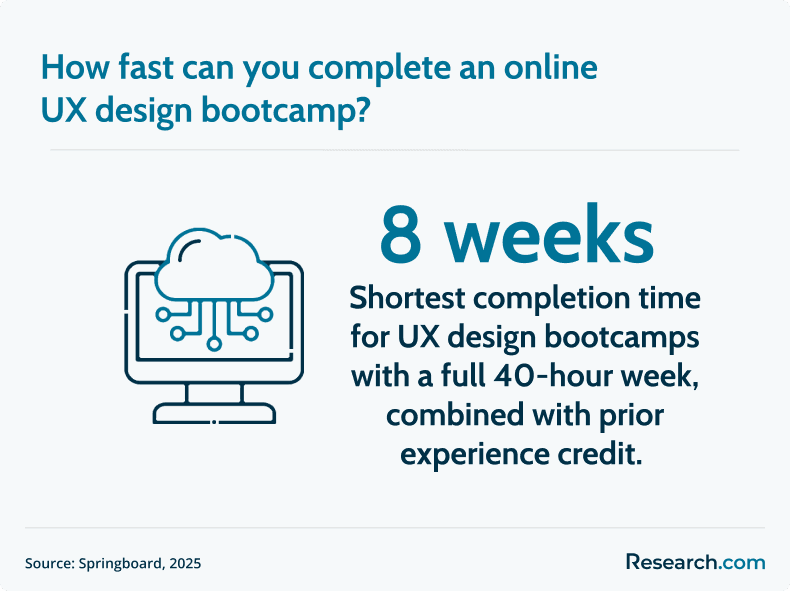
Speed should not be the only deciding factor. A 9-week program may be excellent for someone with prior design experience, while a beginner may need a longer part-time format to produce a portfolio that is strong enough for job applications.
How can I speed up learning online UX design bootcamps?
You can move faster in a UX bootcamp if you treat it like a production schedule, not just a class. Students in any accelerated program, including an accelerated online environmental management master’s program, need weekly milestones, focused work blocks, and rapid feedback loops to stay on track.
- Define your target role early: Decide whether you are aiming for UX designer, UI/UX designer, product designer, UX researcher, or digital designer roles. This helps you prioritize the right projects.
- Plan backward from portfolio deadlines: Break each case study into research, synthesis, wireframes, prototype, testing, revisions, and write-up stages.
- Use feedback before the final version: Ask mentors and peers to review rough work. Late feedback is harder to apply and can slow progress.
- Learn tool shortcuts: Figma, Sketch, Adobe XD, and prototyping workflows become faster when you learn reusable components, styles, and templates.
- Practice outside the curriculum: Redesign a confusing app flow, volunteer for a nonprofit, or run a small usability test with friends or community members.
- Protect deep work time: UX projects require concentration. Schedule 60- to 90-minute sessions for research synthesis, wireframing, or case study writing.
- Document decisions as you work: Do not wait until the end to explain your process. Save screenshots, research notes, iterations, and testing observations throughout the project.
The fastest students are not always the most experienced. They are usually the most consistent, the most willing to revise, and the most disciplined about turning assignments into portfolio evidence.
What is the average cost of online UX design bootcamps?
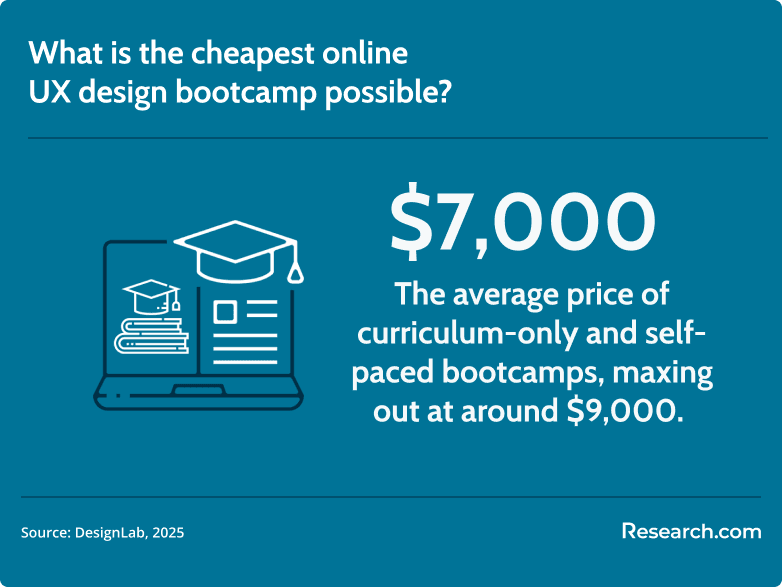
Online UX design bootcamps typically range from $7,000 to $17,000, although lower-cost certificate and self-paced options also exist. As with other accelerated education paths, such as an accelerated online forensic accounting degree, the advertised tuition is only part of the cost. Students should also consider software, time away from work, financing fees, and the quality of career support.
| Bootcamp type | Typical cost range | What usually affects the price | Who should consider it |
| Self-paced or curriculum-only programs | $7,000 to $9,000 | Lower instructor involvement, fewer live sessions, limited career services | Independent learners with strong self-management skills |
| Mentor-guided or career-focused bootcamps | $10,000 to $13,000 | Portfolio reviews, mentor support, job search guidance, structured deadlines | Career changers who need feedback and accountability |
| Full-time or immersive formats | $14,000 to $17,000 | Live instruction, intensive scheduling, career services, higher staff involvement | Students who want the fastest structured route and can study full time |
When comparing tuition, ask what is included. A cheaper program may become less valuable if it offers little portfolio feedback, while a higher-priced program may be worthwhile if it provides stronger mentorship, employer-aligned projects, and realistic job search support. If you are comparing career-switch investments across industries, salary research such as restaurant manager salary information can help frame opportunity cost and long-term earning potential.
Despite high upfront costs, financial aid availability makes UX design an accessible industry, as reflected by the employment numbers shown in the following chart.
What are the financial aid options for students enrolling in online UX design bootcamps?
Many UX bootcamps offer payment options because students may not qualify for the same federal aid available through accredited colleges. Learners comparing bootcamps with degree-based routes, such as an accelerated online emergency management bachelor’s degree, should check aid rules carefully before enrolling.
| Financing option | How it works | What to check before signing |
| Income Share Agreements (ISAs) | You pay little or nothing upfront and repay a portion of income after meeting job and salary conditions. | Salary threshold, repayment cap, payment duration, covered jobs, and what happens if you do not find qualifying work. |
| Monthly installment plans | Tuition is divided across several payments, often over 6 to 12 months. | Whether the plan is interest-free, whether fees apply, and when payments begin. |
| Deferred tuition | Payment is delayed until graduation or employment, depending on program terms. | Eligibility rules, repayment trigger, job definition, and total repayment amount. |
| Private loans | Bootcamp lenders offer fixed-term loans for tuition and sometimes living costs. | Interest rate, origination fees, cosigner requirements, and repayment schedule. |
| Military education benefits | Eligible students may use GI Bill education benefits or other military funding for approved programs. | Whether the specific bootcamp and program format are approved for benefits. |
| Scholarships and grants | Providers or nonprofit groups may offer merit-based or need-based awards. | Application deadlines, award amount, renewal rules, and whether funding reduces tuition or loan balance. |
Before accepting financing, calculate the total amount you will repay, not just the monthly payment. A low upfront cost can become expensive if the repayment terms are unclear.
What should I include in my application to online UX design bootcamps?
Most UX bootcamps do not expect applicants to be professional designers already. They do, however, look for motivation, communication skills, problem-solving ability, and evidence that the applicant can complete a fast-paced program. The process is similar to preparing for a career transition in fields such as recruiting, where understanding the path to becoming an executive recruiter requires connecting past experience to future goals.
- Personal statement: Explain why UX design interests you, what type of work you hope to do, and why this bootcamp format fits your timeline.
- Resume or CV: Highlight transferable skills such as research, writing, customer service, teaching, project management, data analysis, marketing, visual design, or product support.
- Early portfolio samples: If you have design work, include it. If not, a simple redesign exercise or problem-solving project can show how you think.
- Design challenge or assessment: Some programs ask applicants to complete a small task. Focus on explaining your reasoning clearly rather than making the visuals perfect.
- Optional video or interview: Use this to show curiosity, coachability, and realistic expectations about the workload.
- References or recommendations: If requested, choose people who can speak to your reliability, collaboration, and ability to learn quickly.
A strong application does not need to pretend you already know UX. It should show that you understand the commitment, can handle feedback, and have a clear reason for choosing this path.
How do I evaluate the credibility of an online UX design bootcamp?
To judge whether a UX bootcamp is credible, look beyond marketing language and verify the details that affect learning and employment outcomes. Compare the curriculum, instructor background, student work examples, completion expectations, graduate support, refund policy, and any available job outcome disclosures. If you are also considering degree-based tech training, reviewing accelerated online computer science programs can help you understand the trade-off between short skills training and broader academic preparation.
| Question to ask | Why it matters | Red flag |
| Who teaches or mentors students? | UX feedback is only useful if instructors understand current product and design workflows. | No instructor bios, vague “industry expert” claims, or limited access to mentors. |
| What projects will I complete? | Employers evaluate case studies, not just course completion certificates. | Projects are generic, too guided, or not strong enough for a portfolio. |
| How current is the curriculum? | UX tools, accessibility expectations, AI-assisted workflows, and product practices change quickly. | No visible curriculum updates or outdated tool coverage. |
| What career support is included? | Resume help, portfolio reviews, mock interviews, and networking can influence job search success. | Job support is advertised but not clearly defined. |
| Are outcomes transparent? | Employment rates and salary claims should be specific and explain how they were measured. | Guaranteed results, unclear methodology, or no outcome definitions. |
| What are the refund and withdrawal rules? | Fast programs can be intense, and students need to know their financial risk. | Hard-to-find policies or unclear cancellation terms. |
What is the ROI of online UX design bootcamps?
The return on investment of a UX bootcamp depends on tuition, financing costs, lost income during training, job search length, salary after graduation, and whether the portfolio helps you compete for roles. A bootcamp may have strong ROI if it helps you enter a higher-paying field faster than self-study, but it may have poor ROI if you leave without a convincing portfolio or realistic job strategy.
To evaluate value, compare three paths: a bootcamp, self-paced certificate learning, and a degree or degree-completion program. For example, students who want a broader technology credential may also compare UX bootcamps with options such as the most affordable online software engineering degrees. The right choice depends on whether you need a portfolio quickly, a formal degree, a technical foundation, or a lower-cost learning path.
- Choose a bootcamp if: You want structured feedback, a portfolio timeline, and career support in a compressed format.
- Choose self-study if: You are disciplined, have a limited budget, and can create independent projects without external deadlines.
- Choose a degree if: You want broader academic credentials, access to federal aid, or preparation for roles requiring deeper technical, research, or business training.
What challenges might I face during an online UX design bootcamp?
UX bootcamps can be demanding because students must learn concepts, software, critique habits, research methods, and portfolio storytelling at the same time. Similar to students in accelerated professional programs such as a fast online health informatics master’s program, UX bootcamp learners need structure and realistic expectations to avoid burnout.
| Common challenge | Why it happens | Better strategy |
| Underestimating the workload | Students focus on the short timeline but overlook project hours, revisions, and portfolio writing. | Block weekly study time before enrolling and ask the school for sample schedules. |
| Learning tools without learning process | Design software can feel productive even when the user problem is unclear. | Start each project with research, goals, user flows, and assumptions before polishing screens. |
| Taking feedback personally | UX critique is direct because designs must be tested and improved. | Treat critique as evidence for iteration, not as a judgment of talent. |
| Creating shallow case studies | Students show final screens but omit research, trade-offs, and testing decisions. | Document why you made each major design choice and what changed after feedback. |
| Relying only on the bootcamp for jobs | Career support helps, but students still need networking and targeted applications. | Build a job search plan that includes alumni outreach, freelance work, and portfolio reviews. |
How do online UX design bootcamps compare to traditional degree programs?
Online UX bootcamps and traditional degree programs serve different needs. Bootcamps are usually shorter, more practical, and more portfolio-driven. Degree programs are broader, take longer, and may be more useful for students who want academic depth, research experience, access to federal financial aid, or roles that prefer a bachelor’s or master’s credential. This difference is similar to the trade-off students consider when comparing fast professional routes, such as an accelerated online healthcare administration degree, with longer traditional programs.
| Factor | Online UX bootcamp | Traditional degree program |
| Time to complete | Usually weeks to months | Usually several years |
| Main outcome | Portfolio, applied UX skills, career transition support | Academic credential, broader education, major requirements |
| Curriculum focus | User research, wireframes, prototypes, usability testing, case studies | Design theory, research, general education, electives, broader discipline study |
| Cost structure | Often upfront tuition, payment plans, loans, or deferred options | Tuition by credit or term, possible federal aid if eligible |
| Best for | Career changers who need practical work samples quickly | Students seeking a formal credential and wider academic foundation |
| Main limitation | May not carry the same recognition as a degree | Longer timeline and often higher total time commitment |
What does a typical day look like in online UX design bootcamps?
A typical day depends on whether the program is full-time, part-time, or self-paced. Full-time students may treat the bootcamp like a job, while part-time students usually study evenings or weekends. The discipline required is comparable to other accelerated online programs, including an accelerated online sports management master’s program, where progress depends on consistent weekly output.
- Instruction: Students watch recorded lessons or attend live sessions on topics such as user flows, research synthesis, wireframing, prototyping, or usability testing.
- Independent design work: Students apply the lesson to a project, often spending several hours on sketches, flows, screens, or case study documentation.
- Mentor or instructor feedback: Many programs include scheduled critiques or office hours to help students refine design decisions.
- Peer critique: Group reviews help students practice giving and receiving design feedback, which mirrors real product team collaboration.
- Tool practice: Short exercises in Figma, Adobe XD, Sketch, Miro, or other platforms help students build speed and confidence.
- Progress tracking: Students update project notes, revise deadlines, and plan the next step in the case study.
Students with backgrounds in research, teaching, counseling, behavioral science, or a psychology specialty may find UX especially appealing because the work requires empathy, observation, and understanding how people make decisions.
What UX design tools will I learn in an online bootcamp?
Most online UX bootcamps teach tools that support collaborative design, prototyping, research synthesis, and presentation. Tools matter, but they are not the whole skill set. Employers want to see that you can use software to solve user problems, not just create attractive screens.
| Tool | Common use in UX bootcamps | Why students learn it |
| Figma | Wireframes, prototypes, design systems, collaboration, interface mockups | It is widely used for browser-based product design and team feedback. |
| Sketch | UI layouts, components, and visual design work on macOS | It remains useful in design teams with established Sketch-based workflows. |
| Adobe XD | Interactive prototypes, animations, and Creative Cloud integration | It helps students understand screen design and interaction concepts. |
| InVision | Clickable prototypes and stakeholder feedback | It supports review cycles and communication around user flows. |
| Balsamiq | Low-fidelity wireframes | It encourages early thinking about structure before visual polish. |
| Miro | Journey maps, affinity diagrams, workshops, brainstorming | It supports collaborative research synthesis and remote teamwork. |
| Framer or Principle | Motion, micro-interactions, and advanced prototypes | These tools help students explore more realistic interaction behavior. |
If you are comparing occupations, salary research such as math teacher salary information can help you weigh whether learning UX tools and building a design portfolio is worth the career transition effort.
In The State of End-User Experience Management Report, 2024 by Forrester, the usage distribution of UX tools and software is illustrated by the graph below.
What are the next steps after finishing online UX design bootcamps?
Finishing a bootcamp is not the end of the career transition. It is the point where your portfolio, job search strategy, interview skills, and network become the main drivers of progress.
- Refine two or three case studies: Choose your strongest projects and make sure each one clearly explains the problem, research, design decisions, testing, revisions, and final outcome.
- Build a simple portfolio website: Make your work easy to scan. Recruiters and hiring managers should be able to understand your process quickly.
- Practice UX interviews: Prepare for portfolio walkthroughs, behavioral questions, whiteboard-style exercises, critique prompts, and design trade-off discussions.
- Look for experience-building work: Freelance projects, internships, nonprofit work, contract assignments, and startup projects can help you turn bootcamp training into real-world experience.
- Network intentionally: Contact alumni, attend online UX events, join design communities, and ask for portfolio feedback rather than only asking for jobs.
- Continue targeted learning: Short courses in accessibility, analytics, product strategy, research operations, or design systems can help you stand out.
- Consider additional credentials: A credential from Nielsen Norman Group or another reputable provider can support credibility, especially after you have some project experience.
What should be included in your portfolio from online UX design bootcamps?
Your portfolio is the main proof that you can do UX work. A strong bootcamp portfolio usually includes three to five case studies, but quality matters more than quantity. Employers want to see how you think, not just what your final screens look like.
- Project context: Explain the product, user problem, audience, constraints, and your role.
- Research methods: Include interviews, surveys, usability observations, competitive analysis, or secondary research when relevant.
- Key insights: Show how research changed your understanding of the problem.
- User flows and information architecture: Demonstrate how you organized tasks, navigation, and content.
- Wireframes: Show early design exploration before high-fidelity visuals.
- Prototype: Include clickable or high-fidelity screens that illustrate the solution.
- Usability testing: Summarize what you tested, what users struggled with, and what you revised.
- Final design decisions: Explain trade-offs, constraints, and why the final approach made sense.
- Outcomes and metrics: Use results such as increased task success rates, lower error rates, or improved user satisfaction when available.
- Reflection: Describe what you would improve next and what the project taught you.
A polished portfolio should make your design reasoning visible. If a hiring manager cannot understand why you made decisions, the project is not finished, even if the screens look professional.
What is the job market for graduates of online UX design bootcamps?
The UX job market remains competitive but active, especially for candidates who can demonstrate practical design work, strong communication, and comfort with product team collaboration. Bootcamp graduates should expect to compete with degree holders, self-taught designers, experienced career changers, and candidates with internships or freelance experience.
- Web and Digital Interface Designers: These roles are expected to grow by 8% from 2023 to 2033, compared to 4% average growth across all occupations (BLS, 2024).
- Annual Openings: Approximately 16,500 job openings per year are projected for web developers and digital designers, driven by new positions and workforce turnover (BLS, 2024).
- Tech Industry Outlook: Computer and IT occupations overall are projected to generate about 356,700 openings annually through 2033 (BLS, 2024).
- Emerging Technologies: Growth in artificial intelligence and automation is expected to contribute to a 10.5% increase in the broader tech sector (CompTIA, 2024).
AI is changing UX work, but it is not eliminating the need for human-centered design. Designers increasingly use AI-assisted tools for research synthesis, content drafts, prototyping support, and workflow automation. However, employers still need people who can understand user context, evaluate trade-offs, test solutions, communicate with stakeholders, and make ethical design decisions.
For professionals thinking long term, UX can also lead toward product management, design leadership, research operations, service design, or digital strategy. Those exploring executive pathways, including resources on how to become a chief financial officer, may find UX useful as a gateway into product-led organizations where user experience, revenue, and strategy intersect.
The chart below shows job openings for UX designers and other adjacent occupations, projected annually in the next decade.
Common mistakes to avoid when choosing an online UX design bootcamp
| Mistake | Why it can hurt you | Better decision |
| Choosing only the shortest program | A fast timeline is not helpful if you leave without strong case studies. | Prioritize programs with meaningful projects, critique, and portfolio support. |
| Looking only at tuition | Low tuition may mean limited mentorship, weak career support, or fewer portfolio reviews. | Compare total value, including feedback, support, outcomes, and financing costs. |
| Assuming all certificates have equal value | Employers often care more about project quality than the certificate name. | Review alumni portfolios and ask how projects are evaluated. |
| Ignoring accreditation and licensing details | Bootcamps may not be accredited by a U.S. Department of Education-recognized agency. | Verify licensing, accreditation status, refund rules, and whether the credential meets your goals. |
| Believing salary promises | Salary depends on market, experience, location, portfolio, and hiring conditions. | Use multiple salary sources and review current job postings before enrolling. |
| Waiting until graduation to network | Job searches often take time, and relationships can create early opportunities. | Start networking, requesting feedback, and joining UX communities during the program. |
Key Insights
- Fast does not always mean better: The best online UX design bootcamp is the one that helps you build credible case studies, not simply the one with the shortest timeline.
- Your portfolio matters more than the certificate: Employers need to see research, reasoning, iteration, usability testing, and final design decisions.
- Costs vary widely: Many online UX bootcamps fall between $7,000 and $17,000, while some certificate or self-paced options cost much less.
- Career support should be specific: Look for portfolio reviews, interview practice, networking support, and transparent outcome data rather than vague job placement claims.
- UX is used across industries: Technology, healthcare, finance, education, retail, and government agencies all need better digital experiences.
- AI is changing the workflow: Designers who combine UX fundamentals with AI-assisted research, prototyping, accessibility, and product thinking will be better prepared for current roles.
- Before enrolling, ask hard questions: Verify accreditation or licensing status, refund policies, financing terms, instructor qualifications, project expectations, and how graduate outcomes are measured.
References:
- Avocademy. (2025). What will my day-to-day look like when I do a UX bootcamp? Retrieved from https://www.avocademy.com/blogs/the-guac/what-will-my-day-to-day-look-like-when-i-do-a-ux-bootcamp
- BestColleges.com. (2024). Financial aid for coding bootcamps. Retrieved from https://www.bestcolleges.com/bootcamps/payment/financial-aid/
- BrainStation. (2024). Are UX design bootcamps worth it? Retrieved from https://brainstation.io/career-guides/are-ux-design-bootcamps-worth-it
- BrainStation. (2025). Intro Day Online: UX Design Agenda. Retrieved from https://brainstation.io/online/intro-day/ux-design
- BrainStation. (2025). What tools do UX designers use? Retrieved from https://brainstation.io/career-guides/what-tools-do-ux-designers-use
- Bureau of Labor Statistics. (2024). Graphic Designers. Occupational Outlook Handbook. Retrieved from https://www.bls.gov/ooh/arts-and-design/graphic-designers.htm
- Bureau of Labor Statistics. (2024). Software Developers, Quality Assurance Analysts, and Testers. Occupational Outlook Handbook. Retrieved from https://www.bls.gov/ooh/computer-and-information-technology/software-developers.htm
- Bureau of Labor Statistics. (2024). Web Developers and Digital Designers. Occupational Outlook Handbook. Retrieved from https://www.bls.gov/ooh/computer-and-information-technology/web-developers.htm
- CareerFoundry. (2025). A day in the life of a UX designer. Retrieved from https://careerfoundry.com/en/blog/ux-design/a-day-in-the-life-of-a-ux-designer/
- Climb Credit. (2024). How to pay for a UX design bootcamp. Retrieved from https://climbcredit.com/resources/bootcamps/how-to-pay-for-a-ux-design-bootcamp/
- Code Labs Academy. (2025). 10 industries currently hiring UX designers. Retrieved from https://codelabsacademy.com/en/blog/10-industries-currently-hiring-UX-designers/
- CompTIA. (2024). State of the Tech Workforce 2024. Retrieved from https://www.comptia.org/content/research/state-of-the-tech-workforce
- Forrester. (2024). The State of End-User Experience Management, 2024. Retrieved from https://www.forrester.com/report/the-state-of-end-user-experience-management-2024/RES180601
- Glassdoor. (2025). UX designer salary. Retrieved from https://www.glassdoor.com/Salaries/ux-designer-salary-SRCH_KO0,11.htm
- PayScale. (2025). UX Designer Salary. Retrieved from https://www.payscale.com/research/US/Job=UX_Designer/Salary
- ZipRecruiter. (2025). Entry Level UX Designer Salary in the United States. Retrieved from https://www.ziprecruiter.com/Salaries/Entry-Level-Ux-Designer-Salary
Other Things You Should Know About Online UX Design Bootcamps
In 2027, the fastest online UX design bootcamps can be completed in as little as 10 to 12 weeks. These bootcamps focus intensively on essential UX skills, including user research, prototyping, and user testing, to prepare students quickly for the job market.
The primary benefits of enrolling in one of the fastest online UX design bootcamps in 2027 include quick skill acquisition for immediate career transitions, flexibility with online learning, and often reduced costs compared to traditional degrees, while still providing industry-relevant skills.