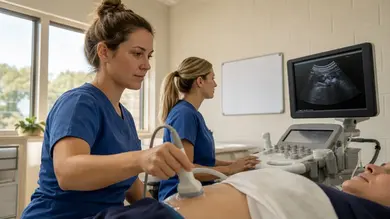
2027 Online Ultrasound Technology Degree Programs for Veterans: GI Bill Benefits, Costs & Top Considerations

Co-Founder and Chief Data Scientist
Choosing an online ultrasound technology program as a veteran is a financial, academic, and career decision at the same time. You need a program that can be completed without unnecessary relocation, accepts the right benefits, prepares you for clinical work, and leads to credentials employers recognize. The challenge is that “online” sonography programs are rarely fully online: most combine remote coursework with required in-person labs or clinical placements.
GI Bill benefits can make this path more affordable, but the value depends on more than tuition coverage. Veterans should compare VA approval, accreditation, clinical placement support, transfer credit policies, housing allowance rules, certification outcomes, and local job demand before enrolling. Nearly 40% of veterans enrolled in such programs use the GI Bill to cover tuition and living costs, yet many still find it difficult to judge total cost and post-graduation return on investment.
This guide explains who qualifies, how military training may transfer, how online ultrasound technology programs work, what GI Bill benefits can cover, what support services to look for, and what veterans can realistically expect in terms of program length, jobs, and salary.
Key Benefits of Online Ultrasound Technology Degree Programs for Veterans
- The GI Bill covers tuition and fees for online ultrasound technology programs at many accredited institutions, helping veterans avoid student debt while advancing their healthcare careers.
- Online ultrasound technology degrees offer scheduling flexibility, allowing veterans to balance studies with family obligations or transitioning military careers.
- Many programs provide dedicated career support for military-connected students, resulting in 85% veteran employment within six months post-graduation in diagnostic medical sonography roles.
Who Qualifies as a Veteran for Online Ultrasound Technology Degree Programs?
Veteran status matters because it affects access to GI Bill benefits, tuition assistance, housing allowances, school-based veteran services, and sometimes priority registration or transfer-credit review. Recent data from the National Center for Education Statistics shows nearly 1.3 million veterans were enrolled in postsecondary education, making benefit eligibility a major issue for colleges and healthcare training programs.
For online ultrasound technology degree programs, veteran eligibility is usually tied to military service history, discharge status, and the specific benefit program being used. Applicants should confirm eligibility with the Department of Veterans Affairs and the school’s veterans certifying official before assuming a program will be covered.
- Active-duty veterans: Former full-time service members from any branch of the U.S. Armed Forces who received an honorable discharge typically qualify for GI Bill benefits that may be used toward eligible ultrasound technology programs.
- Reservists and National Guard members: Those activated for federal service, generally for 90 days or more, may qualify for education benefits depending on the length and type of federal service completed.
- Discharge status: Eligibility commonly requires an honorable or general discharge. Veterans with other discharge types may have limited access and should request a benefits review before applying.
- Dependents and transferred benefits: Spouses, children, and eligible survivors may qualify if GI Bill benefits were transferred or if survivor education provisions apply.
Veterans should also distinguish between being admitted to a college and being eligible to use benefits at a specific program. A school may admit veterans, but the ultrasound technology program must still meet VA approval and academic requirements. Applicants considering other healthcare paths can compare benefit use across programs, including options such as a pharmacy degree.
Do Online Ultrasound Technology Degree Programs Accept Military Training for College Credit?
Some online ultrasound technology degree programs accept military training for college credit, but the amount of credit awarded varies by school, accreditation rules, and program requirements. This can reduce total cost and completion time, especially for veterans with medical, technical, anatomy, patient care, or equipment-related training. According to the Department of Veterans Affairs, about 80% of veteran students utilize credit for prior learning or military training when seeking higher education.
Credit transfer is especially useful for general education courses, electives, computer skills, medical terminology, or foundational healthcare courses. It is less common for schools to waive core sonography labs, clinical hours, or competency-based imaging requirements because these are tied to professional standards and patient safety.
- Joint Services Transcripts: Schools commonly review Joint Services Transcripts (JST) to evaluate military education, occupational experience, and formal training completed during service.
- ACE credit recommendations: Many colleges use American Council on Education (ACE) recommendations to determine whether military coursework is comparable to civilian college courses.
- Competency assessments: Some programs allow veterans to demonstrate existing skills through exams, portfolios, interviews, or practical assessments.
- Institutional policy limits: Colleges may cap the number of credits accepted, require a minimum number of credits in residence, or restrict transfer credit for major-specific ultrasound courses.
- Accreditation requirements: Even when military training is relevant, accredited sonography programs may still require documented clinical competencies completed through the program.
Before enrolling, veterans should request a preliminary transfer-credit evaluation in writing. Ask which credits apply directly to the ultrasound technology degree, which only count as electives, and whether transferred credits affect full-time enrollment status for GI Bill purposes. Service members who want a shorter healthcare pathway may also compare accelerated options such as medical assistant certification programs.

How Do Online Ultrasound Technology Degree Programs Work for Veterans?
Online ultrasound technology programs for veterans usually use a hybrid format. Academic courses may be delivered online, while scanning labs, simulations, and supervised clinical hours must be completed in person. This structure can work well for veterans who need flexibility, but it requires careful planning around clinical placement, work schedules, family obligations, and benefit timelines.
The strongest programs make the clinical expectations clear before admission. Veterans should avoid assuming they can complete an ultrasound technology degree entirely from home unless the school explicitly states how labs and clinical rotations are handled.
- Online coursework: Didactic courses may include anatomy, physiology, patient care, ultrasound physics, imaging procedures, and healthcare ethics. Many programs use asynchronous lessons so students can study outside fixed class times.
- Blended learning: Programs may combine recorded lectures, virtual simulations, case reviews, remote exams, and scheduled in-person labs or clinical experiences.
- Clinical placements: Students typically need supervised hands-on training in approved healthcare settings. Veterans should ask whether the school arranges placements near their home or expects students to find sites independently.
- Academic support: Strong programs offer tutoring, technical support, faculty office hours, and advisors who understand military and veteran student needs.
- GI Bill processing: VA-approved programs can certify enrollment so eligible veterans can apply benefits toward tuition, fees, and other covered costs.
- Veteran resources: Career counseling, peer networks, benefits counseling, and employer connections can help veterans translate military experience into healthcare employment.
A veteran enrolled in an online ultrasound technology degree program described the early adjustment as demanding: “It was tough balancing irregular shifts and study deadlines, but having control over when I completed modules helped a lot.” The same student noted that local clinical placements reduced travel and made the program realistic while continuing civilian responsibilities.
The main takeaway for veterans is to verify logistics before committing. Ask how often campus visits are required, whether evening or weekend clinical hours are possible, what happens if a clinical site falls through, and how enrollment status may affect GI Bill payments.
Are Online Ultrasound Technology Degree Programs for Veterans Accredited?
Accreditation is one of the most important factors in choosing an online ultrasound technology program. Veterans should check both institutional accreditation and programmatic accreditation because each serves a different purpose. Institutional accreditation applies to the college or university. Programmatic accreditation applies to the sonography or allied health program itself.
The U.S. Department of Veterans Affairs requires that schools be approved and accredited to qualify for GI Bill benefits, which cover tuition and housing allowances. However, VA approval alone does not automatically mean an ultrasound technology program has the programmatic accreditation preferred by employers or needed for certain certification pathways.
| Accreditation or Approval Type | What It Means | Why Veterans Should Check It |
| Institutional accreditation | The college or university has met recognized academic and administrative standards. | It can affect federal aid eligibility, transfer credit, graduate study, and employer confidence. |
| Programmatic accreditation | The ultrasound technology program has been reviewed against field-specific education and clinical standards. | Programs accredited by recognized bodies like the Commission on Accreditation of Allied Health Education Programs (CAAHEP) are often preferred for licensure eligibility, certification preparation, and credit transfer. |
| VA approval | The school or program is approved for eligible students to use GI Bill benefits. | Veterans cannot rely on benefits unless the program is approved for VA education funding. |
More than 90% of veterans using the GI Bill attend accredited programs, which shows how central accreditation is to benefit use and education quality. Veterans should confirm accreditation directly through official accreditor databases and ask the school’s veterans certifying official to verify VA approval for the exact program, not just the institution.
Common mistake: enrolling in a program because it is “online,” affordable, or fast without confirming whether it supports clinical training and certification goals. In ultrasound technology, program quality and clinical readiness matter as much as convenience.
How Much Do Online Ultrasound Technology Programs for Veterans Cost?
The cost of an online ultrasound technology program depends on tuition, fees, transfer credits, clinical requirements, supplies, exam costs, and how much GI Bill eligibility the veteran has remaining. The average annual tuition and fees for veterans' postsecondary education hover around $6,500, but ultrasound technology programs can vary widely based on institution type and program design.
Veterans should compare total cost, not just tuition per credit. A lower tuition rate may still lead to higher out-of-pocket costs if the program charges clinical, lab, technology, or testing fees that are not fully covered.
- Tuition per credit: Most programs charge between $300 and $600 per credit hour. Total tuition depends on the number of credits required and how many credits transfer in.
- Total program cost: Beyond tuition, total expenses can exceed $15,000 when mandatory fees, supplies, and certification exams are included.
- Mandatory fees: Technology fees, lab fees, simulation fees, background checks, drug screening, uniforms, health records, and clinical placement costs can add to the published price.
- Housing allowance: Online learners may receive a different Monthly Housing Allowance (MHA) than students attending in person. Veterans should confirm the current rule that applies to their enrollment format and course load.
- Out-of-pocket expenses: Books, equipment, exam fees, travel to clinical sites, parking, childcare, and lost work hours may not be fully covered by military education benefits.
Before selecting a program, veterans should request a written cost breakdown showing tuition, fees, books and supplies, clinical costs, certification exam estimates, and expected GI Bill coverage. Also ask whether the school participates in any military tuition discounts, Yellow Ribbon funding, scholarships, or payment plans.
Veterans comparing online healthcare options with different cost structures may also consider a healthcare administration online degree, especially if they prefer a non-clinical career path.
What GI Bill Benefits Can Be Used for Online Ultrasound Technology Degrees?
Eligible veterans can use GI Bill benefits for approved online ultrasound technology degrees, but coverage depends on the benefit type, length of qualifying service, enrollment status, school approval, and whether the program is public, private, or otherwise subject to annual limits. With approximately 1.3 million veterans utilizing these education benefits recently, understanding the details can prevent expensive enrollment mistakes.
The Post-9/11 GI Bill is the benefit many veterans consider first. It can help cover direct education costs and provide support for living expenses, but online students should pay close attention to how distance learning affects the housing allowance.
- Tuition and fees coverage: The Post-9/11 GI Bill generally pays full in-state tuition at public institutions or up to a maximum amount for private and foreign schools.
- Housing allowance: Online students receive a monthly housing stipend set at roughly half the national average of the Basic Allowance for Housing, reflecting the absence of on-campus residency.
- Book and supplies stipend: Veterans can receive up to $1,000 annually to help pay for textbooks, course materials, and required supplies.
- Eligibility requirements: Access depends on qualifying service length and discharge status, with coverage applicable across undergraduate and selected graduate-level programs.
Veterans should ask the school how it certifies online, hybrid, and in-person credits because enrollment classification can affect benefit payments. A program with at least one qualifying in-person component may be treated differently from a fully online schedule, depending on VA rules and course structure.
One veteran who completed an ultrasound technology degree online said the process felt overwhelming at first, especially while balancing school and family responsibilities. She explained that tuition coverage reduced financial stress and helped her focus on learning. The housing allowance, although lower than for in-person students, helped stabilize her budget while she studied from home. “Using these benefits made earning my degree realistic and gave me confidence to pursue a new career path.”
What Veteran Support Services Are Offered in Online Ultrasound Technology Degree Programs?
Veteran support services can make a major difference in an online ultrasound technology program because students must manage coursework, clinical requirements, benefits paperwork, and the transition into civilian healthcare employment. Research shows that veterans engaged with these dedicated resources experience a 15% higher retention rate compared to those who are not.
The best support services are practical, accessible online, and connected to the specific needs of healthcare training. Veterans should ask whether services are available outside standard business hours and whether the school has staff trained in VA education benefits.
- Academic advising: Advisors help veterans select courses, map degree requirements, understand prerequisites, and avoid taking classes that do not apply to graduation.
- Benefits counseling: Veterans certifying officials and benefits staff help students understand GI Bill use, enrollment certification, housing allowance rules, and remaining entitlement.
- Mental health resources: Counseling and wellness services can support students managing stress, service-related challenges, family responsibilities, or the transition to civilian academic life.
- Career services: Career staff can help veterans translate military experience into healthcare resumes, prepare for interviews, locate clinical employers, and understand certification expectations.
- Peer support: Veteran student groups, online communities, and mentoring networks can reduce isolation and provide practical advice from students who have already navigated the process.
- Clinical placement support: For ultrasound technology programs, this is especially important. Veterans should ask whether the school helps secure approved clinical sites or requires students to arrange them independently.
A strong veteran-friendly program should be able to explain exactly who helps with benefits, who helps with academics, and who helps with clinical placement. If staff give vague answers before enrollment, support may not improve after tuition is paid.
How Long Does It Take to Complete an Online Ultrasound Technology Degree as a Veteran?
Program length depends on the credential level, transfer credit, enrollment status, clinical availability, and whether the student studies full time or part time. For veterans using GI Bill benefits, completion time also affects how much entitlement is used and whether benefits will last through graduation.
Certificate and associate degree programs typically last about 1.5 to 2 years, while bachelor's degree options require closer to 4 years to complete. Veterans with transferable credits may finish sooner, but clinical sequencing can still limit acceleration because sonography skills must be developed and assessed in a supervised setting.
- Enrollment status: Full-time students usually finish faster, while part-time students may need additional terms because of work, family, or military obligations.
- Credit transfer and military training: Prior military experience or previous college coursework may reduce general education or elective requirements.
- Course scheduling flexibility: Asynchronous courses can make study more manageable, but self-paced access does not always mean students can complete clinical requirements faster.
- Program length variation: Certificate and associate degree programs typically last about 1.5 to 2 years, while bachelor's degree options require closer to 4 years to complete.
- GI Bill benefits application: Veterans should align program duration with remaining GI Bill entitlement to avoid funding gaps near the end of the degree.
When comparing timelines, ask for a sample degree plan for both full-time and part-time enrollment. Also ask when clinical rotations begin, how many hours are required, whether summer terms are available, and what happens if a required course is offered only once per year.
Veterans interested in broader affordable healthcare pathways may also compare the cheapest online health science degree options. The right timeline is not always the shortest one; it is the one that can be completed without exhausting benefits, sacrificing clinical quality, or creating unsustainable scheduling pressure.
What Jobs Can Veterans Get With an Online Ultrasound Technology Degree?
Veterans with an online ultrasound technology degree can pursue healthcare roles focused on diagnostic imaging, patient care, and specialized sonography procedures. Employment in this field is expected to grow 14% from 2022 to 2032, adding approximately 77,000 new jobs, which presents strong opportunities for veterans who complete the right training and credentials.
Most employers care less about whether coursework was online and more about accreditation, clinical experience, certification readiness, and hands-on competency. Veterans should choose programs that prepare them for the job setting they want, such as hospitals, outpatient imaging centers, physicians’ offices, or diagnostic laboratories.
- Diagnostic Medical Sonographer: Sonographers use imaging equipment to create internal images that help physicians diagnose and monitor medical conditions. Veterans’ attention to detail, composure under pressure, and ability to follow protocols can be valuable in this role.
- Cardiovascular Technologist: These professionals focus on heart and vascular imaging. Veterans with medical, technical, or emergency-response backgrounds may find this specialty aligned with their military experience.
- Ultrasound Technician: Ultrasound technicians work in hospitals, outpatient centers, and diagnostic labs. The role requires technical accuracy, patient communication, and consistent image-quality standards.
Veterans should also consider specialization. Obstetric, abdominal, vascular, cardiac, and musculoskeletal imaging can involve different work settings, patient populations, schedules, and credential expectations. Before enrolling, review local job postings to see which credentials employers request and whether graduates from the program have access to those pathways.
Affordability still matters, but program fit matters more in clinical healthcare fields. Veterans comparing advanced or alternative healthcare education routes can review resources such as cheapest BSN to DNP programs to understand how cost and career outcomes differ across health professions.
What Salary Can Veterans Earn With an Online Ultrasound Technology Degree?
Salary outcomes for veterans with an online ultrasound technology degree depend on credential level, certification, specialty, employer type, location, and experience. In 2023, the median annual wage for diagnostic medical sonographers was about $75,920, with entry-level positions starting near $56,000 and seasoned professionals earning upwards of $104,000.
GI Bill benefits can improve the financial return by reducing or eliminating tuition debt, but they do not guarantee a specific salary. Veterans should evaluate salary alongside total program cost, time to completion, clinical quality, and certification outcomes.
- Industry: Hospitals, outpatient centers, diagnostic laboratories, and specialty clinics may offer different compensation levels based on patient volume, schedule demands, and complexity of work.
- Role specialization: Areas such as cardiovascular or obstetric sonography can influence pay because specialized skills may be more valuable in certain markets.
- Geographic location: Pay varies by region because of cost of living, healthcare demand, employer competition, and local workforce supply.
- Experience and certification: Additional credentials, strong clinical experience, and proven scanning competency can improve advancement and earning potential.
- Military skills: Discipline, precision, teamwork, and technical aptitude gained during service can help veterans adapt to clinical imaging environments and pursue long-term growth.
Veterans should compare expected earnings with out-of-pocket costs after GI Bill coverage. A program that costs less but lacks strong clinical preparation may not deliver better value than a more structured program with stronger employer connections and certification preparation.
What Graduates Say About Their Online Ultrasound Technology Degree for Veterans
- Aubrey: "Choosing an online ultrasound technology degree was a game-changer for me. The flexibility allowed me to balance family life and study without the stress of commuting, which was crucial during my transition to civilian life. Plus, with average tuition around $15,000, it was a cost-effective way to gain valuable skills that quickly boosted my career prospects in medical imaging."
- Kaya: "After serving, I wanted a program that respected my time and experience. The online format of the ultrasound technology degree offered just that, providing a structured yet self-paced path that eased my shift into a healthcare role. This degree not only made me more marketable but also helped me find meaningful work that values the discipline and precision I honed in the military."
- Nina: "Pursuing an online ultrasound technology degree was a professional investment grounded in practicality. I appreciated knowing the average cost upfront and the ability to study remotely without sacrificing work opportunities. Completing this program significantly advanced my expertise and gave me a competitive edge, affirming that the sacrifice of service translates well into impactful civilian careers."
Other Things You Should Know About Ultrasound Technology Degrees
Veterans should evaluate tuition costs versus GI Bill benefits coverage in 2027 online ultrasound technology programs. Key considerations include the Yellow Ribbon Program's potential assistance, out-of-pocket expenses, and the benefits' duration. Ensure that the program is VA-approved to optimize financial support, and verify that housing allowances meet personal needs.
Yes, if the externship is required for graduation and the school reports it as part of an approved GI Bill program. Veterans should confirm the program is VA-approved, because ultrasound training usually includes 800 to 1,200 supervised clinical hours at an approved site.
Yes, many 2027 online ultrasound technology programs provide specialized pathways for veterans, often featuring targeted coursework and resources. These programs may include military transfer credits and veteran-specific career support to help tailor veterans' education and career transition in the healthcare sector.
References
- Benefits Of Online Ultrasound Technician Schools - Ultrasound Technician News https://ultrasoundtechniciansnews.com/benefits-online-ultrasound-technician-schools/
- Diagnostic Medical Sonography Program | Greenville Technical College https://www.gvltec.edu/academics_learning/health-sciences/diagnostic_medical_sonography/index.html
- Accredited Sonography School | Ultrasound Career Training Program https://www.gurnick.edu/programs/ultrasound-technology/
- 29-2032.00 - Diagnostic Medical Sonographers https://www.onetonline.org/link/summary/29-2032.00
- Diagnostic Medical Sonography | HVCC https://www.hvcc.edu/programs/all/health/diagnostic-medical-sonography-certificate/index.html
- Veterans Use the GI Bill to Attend Diagnostic Healthcare School in Orange County https://mtschool.edu/gi-bill-healthcare-school/
- Online & Campus-Based Programs in CA | Platt College https://plattcollege.edu/campaign/
- Ultrasound Technology | ATI College https://www.ati.edu/ultrasound
- Sonography Program | College of DuPage https://www.cod.edu/academics/programs/sonography/
- USAJOBS connects job seekers with federal jobs across the United States and around the world as the official employment site for the federal government https://www.usajobs.gov/Search/Results/