
2027 Master’s Degree Programs: Types, Costs & Requirements

Co-Founder and Chief Data Scientist
Master’s Degree Programs in 2026: How to Choose the Right Path
A master’s degree can help you qualify for specialized roles, leadership positions, professional licensure pathways, or doctoral study—but it is also a major investment of time, money, and energy. The challenge is not simply choosing between an MBA, MS, MA, MEd, or MSc. The real decision is whether a specific program fits your career goal, budget, schedule, and expected return.
Graduate education continues to attract working adults and career changers. In the past 2 decades, postbaccalaureate enrollment increased by 9%, reaching 3.2 million students, and recent projections point to a 5% increase in full-time enrollment by 2031. That growth makes comparison shopping more important: more programs are available, but quality, cost, accreditation, flexibility, and career outcomes vary widely.
This guide explains the major types of master’s degrees, popular online programs, typical timelines, admission requirements, costs, financial aid options, online-versus-campus trade-offs, ROI considerations, and mistakes to avoid before enrolling.
Quick Answer: Is a Master’s Degree Worth It?
A master’s degree is most likely to be worth it when it is required for your target profession, clearly improves your promotion prospects, helps you move into a higher-paying specialization, or provides access to licensure or advanced credentials. It may not be the best choice if your field values experience, portfolios, certifications, or technical skills more than graduate education.
- Master’s programs often take 1.5 to 2.5 years to finish full time, though part-time students may take up to 6 years.
- Master’s degree holders earn $1,661 per week on average, compared with $1,432 for bachelor’s degree holders.
- During the 2024-25 academic year, full-time graduate students paid an average of $11,950 in tuition and required fees at public postsecondary institutions and $22,430 at private postsecondary institutions.
- In 2025, the BLS projected that occupations typically requiring a master’s degree will average 346,000 job openings each year from 2024 to 2034.
Popular Online Master’s Degree Programs to Compare
The best online master’s program depends on your career goal. Some degrees prepare students for management, some support licensure or clinical practice, and others build technical expertise in fields such as computer science, data science, accounting, or nursing.
1. Online MBA
An online Master of Business Administration is built for students who want broader business knowledge and stronger management skills. Courses usually cover finance, marketing, operations, organizational leadership, analytics, and strategy. An MBA can be useful for professionals seeking promotion, entrepreneurs building a company, or career changers moving into business leadership. Before enrolling, compare concentrations, employer reputation, networking opportunities, and whether the curriculum matches your industry.
2. Online MS in Psychology
An online Master of Science in Psychology focuses on human behavior, research methods, assessment, and applied psychological principles. Depending on the program, students may study clinical psychology, counseling-related topics, industrial-organizational psychology, or research design. This degree can support roles in research, consulting, human services, or organizational development, but students pursuing counseling or therapy careers should verify whether the program meets licensure requirements in their state.
3. Online MS in Computer Science
An online MS in Computer Science is designed for students who want advanced technical training in areas such as artificial intelligence, machine learning, cybersecurity, software engineering, algorithms, and data systems. It can be a strong option for professionals aiming for software engineering, research, data science, or technical leadership roles. Applicants should check prerequisite requirements carefully because some programs expect prior coursework in programming, discrete math, data structures, or related topics.
4. Online Master of Social Work
An online Master of Social Work prepares students for advanced social work practice through coursework in social policy, human behavior, ethics, social justice, assessment, and clinical or community practice. Most MSW programs include supervised field education, so students should confirm placement support in their area before enrolling. Graduates may pursue roles in clinical social work, advocacy, case management, nonprofit leadership, or community services, depending on licensure rules and specialization.
5. Online MA in Counseling
An online MA in Counseling teaches counseling theories, human development, assessment, ethics, multicultural counseling, and therapeutic techniques. Because counseling is commonly regulated by state licensure boards, this is one of the programs where accreditation, supervised hours, practicum requirements, and state approval matter most. Students should not assume an online counseling degree automatically qualifies them for licensure everywhere.
6. Online MA in Communication, Public Relations, and Media Relations
An online communication master’s program helps students develop skills in strategic messaging, media relations, digital communication, audience analysis, crisis communication, and brand reputation management. It can fit professionals pursuing public relations, corporate communication, media consulting, nonprofit communications, or digital strategy roles. Strong programs use case studies, campaign projects, and current media tools rather than relying only on communication theory.
7. Online MA in Accounting
An online MA in Accounting provides graduate-level study in financial accounting, taxation, auditing, forensic accounting, reporting standards, ethics, and data analytics. It can be valuable for students preparing for accounting leadership roles or meeting education requirements for professional credentials. Since CPA requirements vary by state, students should confirm whether the program’s credits align with the rules in the jurisdiction where they plan to practice.
8. Online MS in Nursing
An online MS in Nursing is intended for registered nurses who want to move into advanced clinical practice, education, leadership, administration, or specialized nursing roles. Programs may offer nurse practitioner tracks, nurse educator pathways, leadership concentrations, or other specialties. Students should review clinical placement expectations, state authorization, certification exam alignment, and whether the program supports their intended nursing role.
9. Online Master’s in Speech Pathology
An online master’s in speech pathology prepares students to assess and treat communication and swallowing disorders across different age groups. Coursework is typically combined with clinical experiences, so applicants need to verify local placement options, accreditation, and licensure alignment. Graduates may work in schools, hospitals, clinics, rehabilitation settings, or research environments, depending on credentialing requirements.
10. Online Master of Science in Library and Information Science
An online MS in Library and Information Science focuses on information organization, digital archives, cataloging, information retrieval, library systems, research services, and knowledge management. It can prepare students for roles as librarians, archivists, information specialists, digital asset managers, or records professionals. Students interested in school library positions should check state certification requirements before choosing a program.
11. Online MS in Applied Data Science
An online MS in Applied Data Science trains students to use statistical modeling, machine learning, data visualization, programming, and analytics to solve practical business and research problems. Programs with labs, portfolio projects, and industry datasets tend to be more useful for job searches than programs that are mostly theoretical. Applicants should compare programming prerequisites, software tools, capstone requirements, and career support.
Master’s Degree Decision Guide: Common Program Types
| Degree Type | Best Fit | What to Check Before Applying |
| MA or MS | Students seeking advanced academic, technical, scientific, or professional specialization | Thesis or capstone requirements, prerequisites, faculty expertise, and career outcomes |
| MBA | Professionals pursuing management, entrepreneurship, consulting, or business leadership | Accreditation, concentrations, alumni network, employer recognition, and work-experience expectations |
| MEd | Educators aiming for instructional, administrative, curriculum, or specialist roles | State licensure alignment, endorsement options, fieldwork, and district salary policies |
| MSW | Students pursuing social work practice, advocacy, policy, or clinical pathways | Field placement support, licensure preparation, and program accreditation |
| MFA | Artists, writers, designers, and creative professionals building advanced portfolios | Faculty mentorship, portfolio expectations, studio time, and career networks; compare affordable MFA programs if cost is a concern |
| MPA or MPH | Professionals interested in public administration, policy, nonprofit leadership, public health, or community programs | Internships, applied projects, public-sector partnerships, and specialization options |
- Types of master’s degrees
- How long a master’s degree takes
- Online versus on-campus study
- Average cost of a master’s degree
- Financial aid options
- Admission prerequisites
- How to choose a program
- How to judge online program quality
- How to evaluate ROI
- Whether to pursue a doctorate
- Whether certifications can replace a master’s degree and how this relates to doctoral planning
- Career advancement and salary growth
- Global recognition of online master’s degrees
- Mistakes to avoid
- Employer views of online master’s degrees
- Job market for master’s graduates
- Balancing work and graduate study
- Finding affordable online programs
- Accelerated master’s degrees and earnings
- Easiest online master’s options, with related planning for affordability, work-study balance, and next steps
What Graduates Often Value Most About Their Master’s Degrees
“My graduate program was not only classroom learning. The most useful part was applying new skills to real workplace problems, which helped me handle more complex responsibilities after finishing the degree.” - Tiffany
“The program expanded my knowledge and introduced me to professionals outside my local market. Working with classmates in different places made the experience more practical and globally relevant.” - Jed
“Choosing an online master’s program made graduate school manageable. I avoided commuting and could organize coursework around my job, which helped me stay enrolled and finish.” - Lea
Key Facts to Know Before Enrolling
- Many master’s programs can be completed in 1.5 to 2.5 years by full-time students.
- Business is the largest master’s degree field in the latest NCES data, with 202,300 master’s degrees granted.
- Financial aid may include scholarships, grants, work-study, loans, and employer tuition assistance.
- The job market for master’s degree holders is projected to grow by 11.3%, but outcomes differ by field, employer demand, location, experience, and credential requirements.
- Accreditation, licensure alignment, total cost, and career outcomes matter more than whether a program is simply labeled “online” or “flexible.”
What are the different types of master’s degrees?
Master’s degrees vary by purpose. Some are academic and research-focused, while others are designed for professional advancement, licensure preparation, or business leadership. Understanding the category helps you avoid choosing a degree that sounds impressive but does not match your goal.
- Taught and research master’s degrees: Taught programs rely on structured courses, seminars, exams, projects, and faculty-led instruction. Research degrees emphasize independent investigation and may require a thesis or major research project. Common taught degrees include the Master of Arts and Master of Business Administration, while research-focused options include the Master of Research and Master of Philosophy.
- Academic master’s degrees: These programs deepen knowledge in a discipline. The Master of Arts usually covers humanities, social sciences, communication, and related fields. The Master of Science or MSc commonly applies to science, technology, engineering, health, and quantitative fields. Specialized academic options include the MRes, MPhil, and MLitt.
- Professional master’s degrees: These degrees are built around applied practice. Examples include the Master of Social Work for social work careers, Master of Engineering for engineering practice, Master of Education for educators, and MFA programs for creative professionals.
- Business master’s degrees: The MBA is usually designed for people seeking broader management, leadership, and strategy skills. A Master in Management is often more suitable for recent graduates or early-career professionals who want business training without extensive work experience.
- Public service master’s degrees: The MPA supports public administration, government, nonprofit, and policy careers. The MPH focuses on public health, community health, epidemiology, health policy, and population-level health work.
The chart below shows the top five fields of study for master’s degrees, based on NCES data.
Academic Challenges for Freshmen College Students

How long does it take to complete a master’s degree?
Most master’s programs require 30 to 60 credit hours per semester, and some use a range of 36- to 54-semester credits or the equivalent of 12 to 18 units in college. If you are asking how long does it take to get a masters degree, the typical full-time timeline is about 1.5 to 2.5 years. Part-time students may take up to 6 years, depending on course load, program rules, transfer credits, clinical or fieldwork requirements, and whether the program offers year-round enrollment.
| Enrollment Format | Typical Timeline | Best For |
| Full time | 1.5 to 2.5 years | Students who can prioritize school and finish sooner |
| Part time | Up to 6 years | Working adults, caregivers, and students who need a lighter course load |
| Accelerated | Shorter than traditional formats, depending on program design | Students who can handle intensive coursework and limited breaks |
| Clinical, licensure, or field-based programs | Varies by placement and state requirements | Students in fields such as nursing, counseling, social work, and speech pathology |
How does an online master’s degree compare to an on-campus program?
Online and campus-based master’s programs can both be rigorous. The better option depends on your schedule, learning style, location, need for hands-on training, and how much you value in-person networking.
| Factor | Online Master’s Degree | On-Campus Master’s Degree |
| Schedule | Often better for working adults because coursework may be asynchronous or offered in evening formats | Works well for students who can attend classes at fixed times |
| Location | Can reduce relocation and commuting barriers | May require living near campus or commuting regularly |
| Networking | Uses discussion boards, virtual events, group projects, and online alumni networks | Offers face-to-face interaction, campus events, and local employer connections |
| Cost | May reduce transportation and housing expenses, though tuition varies | May include added housing, commuting, parking, or campus-related costs |
| Hands-on learning | May use simulations, remote projects, local placements, or required residencies | Often provides direct access to labs, studios, clinics, workshops, and campus facilities |
| Best fit | Students needing flexibility and geographic access | Students who prefer structured in-person learning and campus resources |
What is the average cost of a master’s degree?
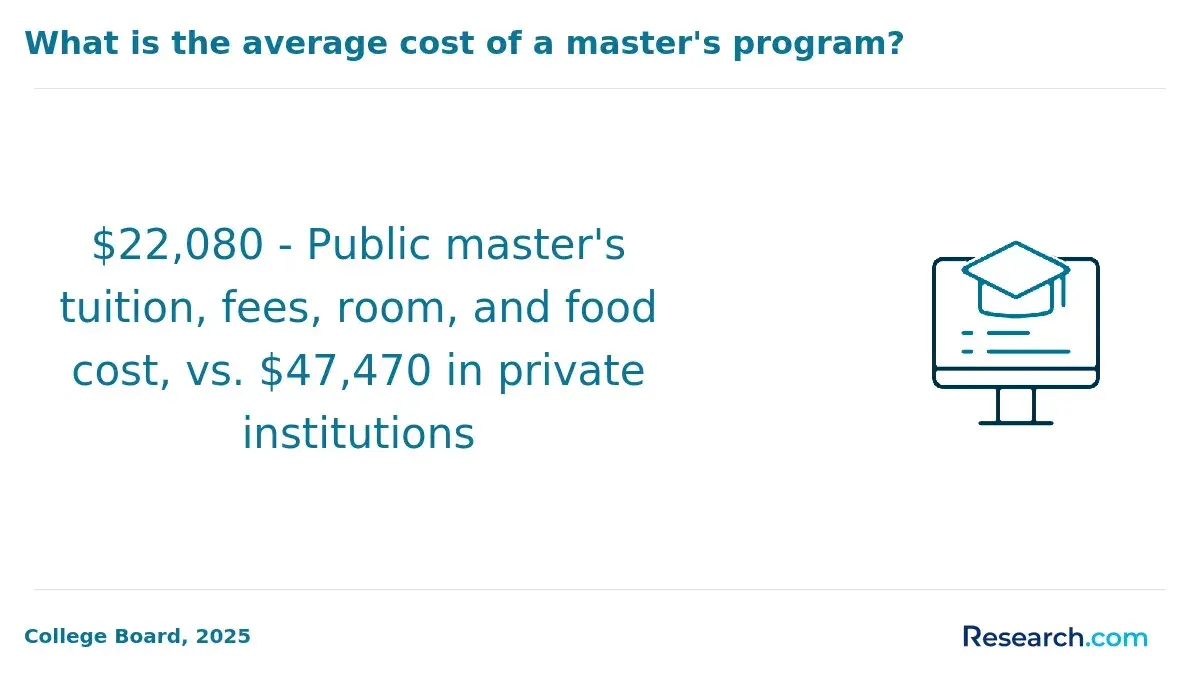
According to NCES, during the 2024-25 academic year, full-time graduate students at private postsecondary institutions paid an average of $22,430 for tuition and required fees. Full-time graduate students at public postsecondary institutions paid an average of $11,950 during the same period. Your actual price may be higher or lower depending on residency status, program length, credit requirements, fees, books, technology costs, travel, clinical placement expenses, and whether the school charges different rates for online students.
Do not compare programs by tuition alone. A program with a lower per-credit price may cost more overall if it requires more credits, has high fees, limits transfer credits, or extends your time to graduation.
What are the financial aid options for students enrolling in a master’s degree program?
Graduate students often combine several funding sources instead of relying on one. Students comparing online education master degree programs, business degrees, nursing programs, or technical master’s degrees should ask each school for a complete aid estimate before applying.
- Scholarships and grants: Universities, foundations, professional associations, and public programs may award funding based on merit, financial need, field of study, identity, service commitments, or career goals. Examples include the Fulbright Scholar Program for graduate study abroad and the Gates Millennium Scholars Program for minority students.
- Federal financial aid: Graduate students may qualify for federal aid options such as Direct PLUS Loans and Federal Work-Study. The Federal Perkins Loan Program helps those with high financial need.
- Employer tuition assistance: Some employers help pay for graduate study, especially when the degree supports the employee’s role. Companies like Google and Starbucks offer tuition assistance programs. Review service obligations, grade requirements, annual caps, and repayment clauses before using this benefit.
- Private loans: Private lenders such as Sallie Mae and Wells Fargo offer graduate loans, but terms, interest rates, repayment options, and borrower protections differ from federal loans. Compare carefully before borrowing.
What are the prerequisites for enrolling in a master’s degree program?
Most master’s programs require a bachelor’s degree, but the details vary by field. Some programs accept applicants from many academic backgrounds, while others expect specific undergraduate coursework, professional experience, licensure, portfolios, or prerequisite credits.
- GPA: Many graduate programs expect a 3.0 GPA, though selective programs may set higher standards. For example, the Wharton University of Pennsylvania's MBA program requires an average GPA of 3.6.
- Official transcripts: Schools use transcripts to review academic preparation, course history, grade trends, and whether prerequisites have been completed.
- Entrance exams: Some programs ask for GRE, GMAT, LSAT, or MAT scores, while others have test-optional or test-free policies. Students seeking flexible admissions can compare schools that do not require GRE requirements.
- Statement of purpose or admission essay: This document should explain why the degree fits your goals, why the program is a good match, and what you bring to the cohort.
- Work experience: MBA and executive-style programs may value or require professional experience, while research or science programs may focus more on academic preparation.
- Research proposal: Research-based programs may require a proposal, writing sample, or evidence of prior research work.
- Recommendation letters: Programs may request up to three letters from professors, supervisors, managers, or professionals who can comment on your readiness for graduate study.
- Language proficiency: Applicants whose first language is not English may need TOEFL, IELTS, SAT, or PTE scores. Some students may be placed into English preparation before full admission.
How to choose the best master’s degree program?
The best master’s program is the one that supports your target outcome at a price and pace you can manage. Use a structured process rather than choosing based on brand name, convenience, or advertising alone.
- Define the outcome first: Identify the job title, promotion, license, doctoral pathway, or skill set you want the degree to support.
- Match the curriculum to that outcome: Review required courses, electives, concentrations, capstones, internships, labs, and clinical placements.
- Verify accreditation: Confirm that the institution and program meet recognized standards. For example, the Accreditation Council for Business Schools and Programs (ACBSP) accredits MBA and business master’s degrees.
- Check licensure alignment: For counseling, nursing, social work, education, speech pathology, and accounting, ask whether the program meets requirements in your state.
- Evaluate faculty qualifications: Look for faculty with relevant research, industry experience, clinical expertise, or professional credentials.
- Calculate total cost: Include tuition, fees, books, travel, residencies, exams, software, background checks, and lost work time.
- Review flexibility: Compare asynchronous courses, evening classes, part-time options, accelerated formats, and leave policies.
- Ask about student support: Look for academic advising, technical support, tutoring, career services, placement help, and alumni connections.
- Study outcomes carefully: Ask for graduation rates, job placement information, licensure pass rates where relevant, and alumni career paths.
- Compare location advantages: For campus programs, consider local employers, practicum sites, research facilities, and networking opportunities.
What ensures the quality and credibility of an online master’s degree program?
Quality starts with recognized accreditation, but it does not end there. A credible online master’s program should have qualified faculty, clear admissions standards, strong student support, transparent costs, well-designed courses, and evidence that graduates achieve relevant outcomes. For regulated professions, it should also meet state authorization and licensure expectations.
Students looking for shorter formats can compare fastest masters degrees, but speed should not replace academic rigor. A fast program is only useful if it still provides the required credits, supervised experiences, and competencies your field expects.
What is the return on investment for a master’s degree?
ROI depends on the relationship between total cost and the career benefit you realistically expect. Consider tuition, fees, interest on loans, time away from work, delayed earnings, exam costs, and the number of years it may take to recover your investment. Then compare those costs with potential salary growth, promotion eligibility, job stability, licensure access, or career mobility.
Programs tied directly to required credentials or high-demand technical skills may show clearer value than broad programs with uncertain outcomes. Some students also evaluate accelerated degree programs because finishing sooner may reduce opportunity cost, though the workload can be intense.
Should I pursue a doctorate after my master’s degree?
A doctorate can make sense if your goal requires advanced research, university teaching, high-level clinical practice, specialized leadership, or independent scholarship. It is usually not necessary if your main goal is a promotion that can be achieved with experience, certifications, or a professional master’s degree.
Before moving from a master’s to a doctorate, compare the additional years of study, research expectations, dissertation or capstone requirements, funding options, faculty fit, and career outcomes. Flexible students may also explore online doctorate programs, especially if they need to continue working while studying.
Are online certifications a viable alternative to obtaining a master’s degree?
Online certifications can be a smart alternative when your target job values specific skills more than a graduate degree. They are often faster, more focused, and less expensive. This can be especially useful in technology, analytics, project management, digital marketing, software tools, and other skill-based fields.
A master’s degree is usually stronger when you need advanced theory, formal academic training, licensure preparation, research experience, or a credential recognized across an entire profession. Many professionals use both: a master’s degree for long-term credibility and targeted credentials for current tools or specialized skills. To compare options, review the best online certifications for jobs.
How do master’s programs contribute to career advancement and salary increases?
A master’s degree can support career growth by giving students deeper expertise, stronger professional networks, applied projects, research training, and leadership preparation. However, the degree itself does not guarantee a raise. The strongest results usually occur when the program aligns with employer demand and the student can show measurable skills.
- Advanced expertise: Graduate coursework can help you qualify for specialized roles that require deeper knowledge than an undergraduate degree provides.
- Leadership preparation: Many programs train students to manage people, budgets, projects, systems, or strategic decisions.
- Professional network: Faculty, classmates, alumni, and field placements can lead to job leads, mentorship, and referrals.
- Credential signaling: Employers may see a relevant master’s degree as evidence of discipline, technical preparation, and commitment to a field.
- Research and analysis skills: Graduate programs often strengthen critical thinking, data interpretation, writing, and evidence-based decision-making.
- Negotiation leverage: A relevant graduate credential may strengthen salary discussions, especially when paired with performance results and market data.
- Career mobility: Some programs help professionals move into new industries, international roles, consulting, management, or doctoral study.
Are online master’s degrees recognized globally?
Online master’s degrees from accredited and reputable institutions are generally evaluated by employers based on the same core factors as campus-based degrees: institutional credibility, program quality, field relevance, accreditation, and graduate skills. International recognition can vary because countries, employers, licensing bodies, and professional associations may apply different rules.
If you plan to work outside the United States, contact employers, credential evaluators, licensing boards, or professional associations in the destination country before enrolling. Students still building their academic pathway may also compare lower-cost undergraduate options such as the most affordable online bachelor's degree.
What pitfalls should you avoid when choosing a master’s degree program?
The biggest mistakes happen when students focus on convenience or prestige without checking whether the program will actually help them reach their goal.
| Common Mistake | Why It Can Hurt You | Better Approach |
| Choosing without verifying accreditation | Employers, licensing boards, and doctoral programs may reject or question the credential | Check institutional and programmatic accreditation before applying |
| Looking only at tuition | Fees, books, residencies, travel, software, and extra credits can change the total cost | Request a full cost estimate for the entire degree |
| Assuming online programs meet licensure rules | State requirements may differ for counseling, nursing, education, social work, accounting, and speech pathology | Ask the program and state board whether the curriculum qualifies you |
| Ignoring transfer credit policies | You may pay for courses you could have transferred or waived | Confirm credit transfer, prior learning, and certification policies in writing |
| Relying only on rankings | A highly ranked program may still be too expensive, too inflexible, or poorly matched to your career | Compare outcomes, curriculum, support, cost, and fit |
| Assuming salary outcomes are guaranteed | Pay depends on industry, region, experience, employer, and performance | Use salary data cautiously and compare outcomes in your specific field |
If you are planning multiple credentials, reviewing pathways such as fast track bachelor degree programs can help you think strategically about time, cost, and progression.
Do employers value online master’s degrees?
Many employers value online master’s degrees when the institution is reputable, the program is accredited, and the graduate can demonstrate relevant skills. The delivery format matters less when the curriculum is rigorous and the degree comes from a recognized school. That said, employer attitudes can vary by industry, role, and local market.
For the strongest employer signal, choose programs with applied projects, internships or fieldwork where relevant, strong faculty, transparent outcomes, and career services. Students comparing broader academic options may also review the best accredited online bachelor's degree programs as part of long-term credential planning.
What is the job market for graduates with a master’s degree?
In 2025, the BLS projected that occupations typically requiring a master's degree will average 346,000 job openings each year from 2024 to 2034. Demand is often strongest in fields where employers need advanced technical knowledge, clinical training, leadership ability, data skills, research capacity, or specialized professional preparation.
Still, job prospects are not equal across all master’s degrees. Programs tied to regulated professions, high-demand technical fields, healthcare, education leadership, analytics, and specialized business functions may lead to different outcomes than broad programs without a clear labor-market connection.
The chart below compares employment growth by typical entry-level education requirement.
How can you balance work and study while pursuing a master’s degree?
Graduate school is manageable for many working adults, but it requires planning before classes begin. The goal is to choose a program structure that fits your real schedule, not your ideal schedule.
- Build a weekly plan: Block time for readings, lectures, assignments, group work, exams, employment, family responsibilities, and rest.
- Choose the right format: Online, evening, weekend, or part-time programs may be better for students who cannot pause their careers.
- Break assignments into stages: Divide larger papers, projects, and exams into smaller weekly tasks so deadlines do not pile up.
- Talk with your employer early: Ask about flexible hours, tuition reimbursement, exam leave, adjusted workloads, or project alignment with coursework.
- Protect your health: Sleep, exercise, social support, and realistic course loads are retention strategies, not luxuries.
Students who need a lighter academic load may compare the easiest masters degree options, but “easy” should mean manageable and well-structured—not low quality.
How to find affordable online master’s degree programs?
An affordable master’s degree is not just the program with the lowest listed tuition. The better measure is total net cost after aid, employer support, transfer credits, fees, and time to completion.
- Start with accredited schools: Affordability is only useful if the credential is recognized by employers, licensing boards, and other institutions.
- Compare total program cost: Multiply credits by cost per credit and add fees, books, software, residencies, exams, and placement costs.
- Ask about scholarships and grants: Contact financial aid offices and departments directly because some awards are program-specific.
- Use employer tuition assistance: If available, confirm annual limits, eligible programs, repayment obligations, and grade requirements.
- Consider public universities: State and public institutions may offer lower rates, especially for residents or online students.
- Review accelerated formats: Faster completion can reduce time-related costs, but only if the pace is realistic for you.
- Transfer eligible credits: Prior graduate courses or approved certifications may shorten your program if the school accepts them.
- Ask about Open Educational Resources: Programs using OER may reduce textbook and material costs.
- Enroll part time if needed: A longer timeline can help students keep working and reduce the need for loans.
- Compare cost per credit and required credits together: A low per-credit price is less meaningful if the program requires more credits than alternatives.
For a focused list of budget-conscious options, compare cheap online masters degree in USA resources alongside accreditation and outcome data.
Can an accelerated master’s degree boost your earnings quickly?
An accelerated master’s degree may help you reach the job market or promotion eligibility sooner, but faster does not automatically mean better. These programs compress coursework, reduce breaks, or use intensive terms, which can be useful for disciplined students with strong time management. They can be risky for students balancing heavy work hours, caregiving, clinical placements, or unfamiliar subject matter.
Before choosing an accelerated option, compare total cost, graduation requirements, employer recognition, career outcomes, and whether the workload allows you to learn deeply enough to use the credential. You can also compare related short career-focused pathways such as the quickest course to make money.
What are the easiest master’s degree programs to complete online?
The easiest online master’s degree is usually the one that matches your background, strengths, and career goals. Programs in education, liberal arts, communication, and business administration may feel more manageable for some students because they often emphasize applied projects, discussion, writing, and professional practice rather than intensive labs or advanced quantitative coursework. However, ease depends on the student, not only the major.
Look for programs with clear course schedules, strong advising, asynchronous classes, no unnecessary thesis requirement, generous transfer policies, and practical capstone options. For additional comparisons, review easy master degrees online.
Current Trends Affecting Master’s Degree Decisions
- Online learning is now mainstream: More students are willing to consider online or hybrid programs, especially when they can continue working.
- Employers are emphasizing applied skills: Projects, portfolios, clinical experience, analytics ability, and communication skills can matter as much as the credential itself.
- AI and automation are changing skill expectations: Programs in business, computer science, communication, education, healthcare, and data-related fields increasingly need to address responsible technology use and digital tools.
- Cost scrutiny is increasing: Students are comparing ROI more carefully because tuition, fees, borrowing, and opportunity costs can be substantial.
- Licensure alignment remains critical: Online programs in regulated fields must be checked against state requirements before enrollment.
Questions to Ask Before You Apply
- Is this degree required, preferred, or optional for my target job?
- Does the program meet licensure or certification requirements in my state?
- What is the full cost after tuition, fees, materials, travel, and financing?
- How many students graduate, and how long do they usually take?
- What jobs do recent graduates get, and what support does the school provide?
- Will I need internships, fieldwork, clinical hours, labs, or campus visits?
- Can I complete the workload while keeping my job and personal responsibilities?
- Does the school accept transfer credits or prior graduate coursework?
- Are courses taught by full-time faculty, adjuncts, industry experts, or a mix?
- What happens if I need to pause enrollment for work, health, or family reasons?
References
- CollegeData. (2025). Transition to College: 13 things students say about it. https://www.collegedata.com/resources/transition-to-college/transition-to-college-survey-results
- Education Dynamics. (2025). Engaging the Modern Learner: Preferences & Behaviors Shaping Higher Ed. https://insights.educationdynamics.com/modern-learner-report-2025.html
- Gatta, M., Kahn, J., Koncz, A. J., Galbraith, A., Patil, S., & Longenberger, A. (2025, November). 2026 Job Outlook. National Association of Colleges and Employers. https://www.naceweb.org/research/reports/job-outlook/2026
- Gulish, A., Morris, C., Cheah, B., & Strohl, J. (2024). Graduate Degrees: Risky and Unequal Paths to the Top. Georgetown University Center on Education and the Workforce. https://cew.georgetown.edu/cew-reports/graduatedegrees
- Walton Family Foundation & Gallup. (2025). Voices of Gen Z Study Year 3 Annual Report. https://www.gallup.com/analytics/651674/gen-z-research.aspx
Key Insights
- Start with the career outcome: A master’s degree is most valuable when it clearly connects to a target role, license, promotion path, or specialized skill set.
- Do not skip accreditation checks: Accreditation and state authorization are especially important for counseling, nursing, social work, education, accounting, and speech pathology.
- Compare total cost, not sticker price: Include fees, materials, travel, credit requirements, time to completion, and loan costs before deciding.
- Online degrees can be credible: Employers are more likely to value an online master’s when the school is reputable, the program is rigorous, and graduates can show practical skills.
- ROI varies by field: Average earnings data can be helpful, but your return depends on industry demand, location, experience, credential requirements, and how well the program supports your goal.
- Faster is not always better: Accelerated and “easy” programs are useful only when they maintain quality and fit your schedule, learning needs, and professional requirements.
- Ask hard questions before applying: Verify licensure alignment, graduate outcomes, placement support, transfer policies, faculty expertise, and full program cost before committing.
Other Things You Should Know About Master’s Degrees
In 2027, the costs for master's degree programs can range widely, from around $20,000 to over $60,000 annually. The cost depends on factors like the field of study, institution type, and location. Tuition rates may vary significantly between public and private institutions.
Most 2027 master's programs require the GRE or GMAT for admission. Some programs may also ask for subject-specific tests, such as the LSAT for law, depending on the discipline. Always check the specific requirements of your chosen program.
Most master’s degree programs require 30 to 60 credit hours for completion. Coursework-heavy programs often fall near 30 credits, while thesis or research programs may require more. Some professional degrees, such as engineering or social work, can exceed 60 credits depending on licensure rules and program structure.


