
2027 Most Affordable Online Marriage and Family Therapy Degree Programs

Co-Founder and Chief Data Scientist
Are you seeking a career in Marriage and Family Therapy (MFT) while trying to keep expenses under control? The rising costs of education can be a significant barrier for aspiring therapists. This article helps solve this problem by guiding you to the most affordable online MFT degree programs. Our experts ensure you receive a quality education that fits your budget.
What are the benefits of getting an online marriage and family therapy degree?
- The degree prepares you for licensure as a Licensed Marriage and Family Therapist (LMFT) or Licensed Professional Counselor (LPC). This credential allows you to work in various settings, including mental health clinics, hospitals, schools, and private practice.
- The average annual salary of a Licensed Marriage and Family Therapist is $45,109.
- Earning an online marriage and family therapy degree offers flexibility and convenience, enabling you to complete your education while working and managing other responsibilities. You can do this without needing to relocate or attend on-campus classes.
What can I expect from an online marriage and family therapy degree program?
An online marriage and family therapy degree program provides comprehensive training to help individuals, couples, and families navigate relationship challenges and improve well-being. The curriculum covers the following:
- Counseling theory
- Assessment
- Diagnosis
- Treatment planning that focuses on systems theory and family dynamics
Students develop critical thinking and research skills essential for effective therapy. The program typically combines online coursework with supervised clinical training, enabling students to apply their knowledge in real-world settings.
Where can I work with an online marriage and family therapy degree program?
Graduates of an online marriage and family therapy degree program have a wide range of career options. Many become school counselors, working closely with administrators to support students' psychological needs and create programs that boost student performance. With their specialized training, they can better identify and address issues affecting students, providing tailored solutions.
They help individuals navigate interpersonal issues, emotional disorders, and negative behavior patterns through counseling and mediation. The online degree's flexibility allows graduates to balance their studies with personal and professional commitments while preparing for these rewarding careers.
How much can I make with an online marriage and family therapy degree program?
The average annual salary of a Licensed Marriage and Family Therapist is $45,109. With the right degree and licensure, marriage and family therapists can find rewarding careers in diverse settings.
According to the U.S. Bureau of Labor Statistics (BLS), the median annual wages for MFTs in the top industries in which they worked in 2023 were as follows:
- State government (excluding education and hospitals): $86,030
- Outpatient care centers: $61,390
- Individual and family services: $50,700
- Offices of other health practitioners: $49,190
- List of Affordable Online Marriage and Family Therapy Degree Programs for 2027 Best Programs
- How long does it take to complete an online marriage and family therapy degree program? Completion Time
- How does an online marriage and family therapy degree program compare to an on-campus program? How does an online marriage and family therapy degree program compare to an on-campus program?
- What is the average cost of an online marriage and family therapy degree program? Average Cost
- What are the financial aid options for students enrolling in an online marriage and family therapy degree program? Financial Aid
- What are the prerequisites for enrolling in an online marriage and family therapy degree program? Requirements
- How has telehealth impacted marriage and family therapy? How has telehealth impacted marriage and family therapy?
- What courses are typically in an online marriage and family therapy degree program? What courses are typically in an online marriage and family therapy degree program?
- What types of specializations are available in an online marriage and family therapy degree program? What types of specializations are available in an online marriage and family therapy degree program?
- How to Choose the Best Online Marriage and Family Therapy Degree Program How to Choose the Best Online Marriage and Family Therapy Degree Program
- How are graduate outcomes evaluated in online MFT programs? How are graduate outcomes evaluated in online MFT programs?
- How can I transition from an online MFT degree to becoming a licensed professional counselor? How can I transition from an online MFT degree to becoming a licensed professional counselor?
- What career paths are available for graduates of an online marriage and family therapy degree program? What career paths are available for graduates of an online marriage and family therapy degree program?
- How can I verify the credibility of an online MFT program? How can I verify the credibility of an online MFT program?
- What are the licensing requirements for MFT programs? What are the licensing requirements for MFT programs?
- What is the job market for graduates with an online marriage and family therapy degree? Job Market
- What challenges can online MFT programs present? What challenges can online MFT programs present?
- What opportunities exist for ongoing professional development after graduation? What opportunities exist for ongoing professional development after graduation?
- What support services are available for online MFT students? What support services are available for online MFT students?
- How can integrating substance abuse counseling training benefit your MFT practice? How can integrating substance abuse counseling training benefit your MFT practice?
- How do licensure pathways differ from an online MFT degree? How do licensure pathways differ from an online MFT degree?
Most Affordable Online Marriage and Family Therapy Degree Programs for 2027
Choosing an online marriage and family therapy degree is not only a tuition decision. It is also a licensure decision, a clinical training decision, and a career-fit decision. Students comparing online MFT programs need to know whether a program is affordable, whether it can lead to licensure in their state, how clinical placements work, and whether the online format will support the kind of therapist they want to become.
This guide is designed for prospective graduate students who want a lower-cost online or hybrid path into marriage and family therapy, counseling, or related behavioral health roles. It explains affordable program options, typical timelines, costs, admissions requirements, licensure considerations, financial aid, telehealth trends, and the practical questions to ask before enrolling.
Quick answer: What is the most important thing to check before choosing an online MFT program?
The most important step is to confirm that the program meets licensure requirements in the state where you plan to practice. A low tuition rate is valuable only if the curriculum, supervised clinical experience, accreditation status, and degree title align with your state board’s requirements for marriage and family therapists or related counseling licenses.
How Research.com ranks affordable online MFT programs
Because graduate therapy programs can represent a major financial commitment, students need rankings built on clear, verifiable information. Research.com evaluates affordable online marriage and family therapy degree programs using current institutional and program data from trusted education databases, including:
- The Integrated Postsecondary Education Data System (IPEDS) database
- Peterson’s database, including the Distance Learning Licensed Data Set
- College Scorecard database
- National Center for Education Statistics
Our review also considers factors that affect student value, including graduation rate, student-faculty ratio, affordability, and program focus. More details about the Research.com ranking process are available on our methodology page.
Affordable online MFT programs at a glance
| Rank | School | Program | Format or notable feature | Credits | Listed cost |
| 1 | Mid-America Christian University | MS in Counseling, Marital, Couples, and Family Counseling/Therapy | One course at a time in six-week sessions | 60 | $38,520 (tuition) |
| 2 | Liberty University | MA in Marriage and Family Therapy | Online coursework with two on-campus intensives | 60 | $565 per credit |
| 3 | Lancaster Bible College | MA in Marriage, Couple & Family Counseling | Hybrid Christian counseling program | 60 | $27,300 (tuition) |
| 4 | Regent University | MA in Marriage, Couple & Family Counseling | Includes residency and licensure-focused preparation | 60+ | $730 per credit |
| 5 | Colorado Christian University | Master’s Degree in Counseling with marriage and family therapy focus | Seven-week blocks with two courses at a time | 69 | $14,948 (tuition) |
| 6 | Amberton University | MA in Marriage and Family Therapy | Campus-based with some online classes | 60 | $300 per credit |
| 7 | Loma Linda University | MS Marital and Family Therapy | Online and campus options with approved in-person practicum | N/A | $24,597 (tuition) |
| 8 | Lamar University | MEd in Counseling and Development - Marriage Couple and Family Counseling Online | Includes a 15-week practicum and a 15-week internship | 60 | $20,520 |
| 9 | University of Massachusetts Global | Online Master’s in Marriage and Family Therapy | Meets licensure requirements in California and 38 other states | 60 | $730 per credit |
| 10 | Kairos University | MA in Marriage and Family Therapy | Cohort model with personal and professional formation | 65 | $4,800 (tuition) |
1. Mid-America Christian University
Mid-America Christian University offers a Master of Science in Counseling with a Marital, Couples, and Family Counseling/Therapy emphasis. The curriculum is built around counseling methods, therapeutic theory, and clinical foundations for students preparing to work with couples and family systems. Courses are taken one at a time in six-week blocks, which can help students manage graduate coursework alongside work or family responsibilities.
- Program length: 27 months
- Tracks/concentrations: N/A
- Cost per credit: $38,520 (tuition)
- Required credits to graduate: 60
- Accreditation: Higher Learning Commission (HLC)
2. Liberty University
Liberty University provides an online MA in Marriage and Family Therapy. Students may be able to transfer up to 50% of the degree, which can reduce both cost and time to completion for eligible applicants. The program is delivered online but includes two required on-campus intensives, plus a 600-hour internship and a 100-hour practicum.
- Program length: 2 years
- Tracks/concentrations: N/A
- Cost per credit: $565
- Required credits to graduate: 60
- Accreditation: Southern Association of Colleges and Schools Commission on Colleges (SACSCOC)
3. Lancaster Bible College
Lancaster Bible College offers a hybrid Master of Arts in Marriage, Couple & Family Counseling. The program is a fit for students seeking graduate counseling education in a Christian academic environment. Graduates may be prepared to sit for the National Counselor Exam as part of the process of becoming licensed Professional Counselors.
- Program length: 3-4 years
- Tracks/concentrations: N/A
- Cost per credit: $27,300 (tuition)
- Required credits to graduate: 60
- Accreditation: Middle States Commission on Higher Education (MSCHE)
4. Regent University
Regent University offers an MA in Marriage, Couple & Family Counseling designed to support preparation for Licensed Marriage and Family Therapist (LMFT) licensure. Applicants must hold an undergraduate degree from an accredited institution and have at least a 3.0 GPA in undergraduate coursework. Students also complete a residency as part of the program.
- Program length: 2 years
- Tracks/concentrations: N/A
- Cost per credit: $730
- Required credits to graduate: 60+
- Accreditation: Council for Accreditation of Counseling and Related Educational Programs (CACREP)
5. Colorado Christian University
Colorado Christian University offers a Master’s Degree in Counseling with a marriage and family therapy focus. Coursework examines interpersonal relationships, human behavior, social influence, mental and emotional disorders, conflict resolution, and family dynamics. Students usually take two courses at a time in seven-week blocks.
- Program length: 2 years
- Tracks/concentrations: Marriage and family therapy
- Cost per credit: $14,948 (tuition)
- Required credits to graduate: 69
- Accreditation: CACREP
6. Amberton University
Amberton University in Garland, Texas offers a Master of Arts in Marriage and Family Therapy. The program can be completed on campus, and some classes are available online. It is intended to prepare students for work in settings such as community organizations, government agencies, and nonprofit service providers.
- Program length: 4 semesters
- Tracks/concentrations: N/A
- Cost per credit: $300
- Required credits to graduate: 60
- Accreditation: SACSCOC
7. Loma Linda University
Loma Linda University offers an MS in Marital and Family Therapy in online and on-campus formats. Courses may combine synchronous and asynchronous learning. Practicum work is completed in person, locally when available, and must receive program approval.
- Program length: 2.5 years
- Tracks/concentrations: N/A
- Cost per credit: $24,597 (tuition)
- Required credits to graduate: N/A
- Accreditation: Commission on Accreditation for Marriage and Family Therapy Education (COAMFTE)
8. Lamar University
Lamar University offers an online Master of Education in Counseling and Development - Marriage Couple and Family Counseling. The program covers cross-cultural competencies, family structures, life-cycle development, intergenerational patterns, and healthy family functioning. Students complete both a 15-week practicum and a 15-week internship.
- Program length: 30 months
- Tracks/concentrations: Marriage, couple, and family counseling
- Cost per credit: $20,520
- Required credits to graduate: 60
- Accreditation: Association for Advancing Quality in Educator Preparation (AAQEP)
9. University of Massachusetts Global
The University of Massachusetts Global offers an online Master’s in Marriage and Family Therapy. The program meets licensure requirements in California and 38 other states. Admission requirements include a minimum GPA of 2.75, an application, an autobiographical essay, and other required materials.
- Program length: 2 years
- Tracks/concentrations: N/A
- Cost per credit: $730
- Required credits to graduate: 60
- Accreditation: WASC Senior College and University Commission (WSCUC)
10. Kairos University
Kairos University offers a Master of Arts in Marriage and Family Therapy. The program uses a cohort model intended to build close working relationships among students and faculty. Its approach emphasizes preparation for MFT practice as well as personal emotional growth.
- Program length: 2.5 - 4 years
- Tracks/concentrations: N/A
- Cost per credit: $4,800 (tuition)
- Required credits to graduate: 65
- Accreditation: COAMFTE
Research.com maintains transparent ranking standards across education and research topics. Students comparing graduate options may also find value in related affordability guides, including our page on online masters in HR, especially if they are still comparing career directions across counseling, business, healthcare, and organizational roles.
How long does an online marriage and family therapy degree take?
Most online Master’s Degree in Marriage and Family Therapy programs take 24 to 36 months, though the exact timeline depends on enrollment pace, clinical requirements, residency obligations, and whether the program uses accelerated terms. Bachelor’s programs generally require 120 to 126 credit hours and usually take full-time students four to five years, while part-time students often need additional time.
| Factor | How it can affect completion time |
| Full-time or part-time enrollment | Full-time study can shorten the timeline, while part-time enrollment may make the workload more manageable for working adults. |
| Synchronous or asynchronous coursework | Live class meetings create more structure; self-paced online work may offer more flexibility but requires stronger time management. |
| Practicum and internship requirements | Clinical placements can extend the timeline if sites are limited, approvals are delayed, or students must complete hours on a fixed schedule. |
| Residencies or intensives | Some online programs require short campus visits, which students must plan for in advance. |
Online vs. on-campus MFT programs: Which format is better?
Online and on-campus MFT programs can lead to similar academic and clinical outcomes when they are properly accredited and aligned with state licensure requirements. The better choice depends on your schedule, learning style, access to clinical sites, and need for in-person faculty and peer interaction.
| Comparison area | Online MFT program | On-campus MFT program |
| Course delivery | Often combines recorded lectures, live sessions, online discussions, and digital assignments. | Typically relies on scheduled classroom meetings and in-person group work. |
| Clinical training | Usually requires local in-person practicum or internship placements approved by the program. | May offer easier access to campus clinics, local agency partnerships, or faculty-supervised sites. |
| Flexibility | Often better for working adults, caregivers, and students who cannot relocate. | Better for students who want a fixed routine and regular face-to-face engagement. |
| Networking | Can include virtual cohorts, online supervision, and remote faculty access. | May provide stronger local professional connections through campus-based clinics and nearby agencies. |
| Best fit | Students who are self-directed and can secure approved clinical placements near home. | Students who prefer in-person learning or want more built-in clinical placement support. |
Accreditation and curriculum
Both online and campus-based MFT programs generally cover family systems theory, couple and family therapy, assessment, diagnosis, ethics, diversity, and evidence-based treatment practices. The key is not the delivery format alone; it is whether the program’s curriculum satisfies the academic standards required for your intended license.
Clinical experience
Marriage and family therapy is a clinical profession, so online students should expect in-person fieldwork. Online programs may allow students to complete supervised training near where they live, but placements typically require approval, documentation, and coordination with qualified supervisors.
Flexibility and accountability
Online learning can make graduate education more accessible, but it does not remove the intensity of clinical training. Students should be prepared for weekly readings, skills practice, supervision, client-facing hours, and state-specific documentation requirements.
How much does an online marriage and family therapy degree cost?
Based on our research, the average cost of an online marriage and family therapy degree program is $52,200. Online MFT master’s programs can range from $23,000 to $86,000 depending on the institution and the student’s residency status.
Online programs are often less expensive than campus-based programs when total tuition and attendance costs are compared. For public four-year colleges, an online degree is $31,165 cheaper than an in-person degree when comparing tuition and attendance costs. At private institutions, the average cost is $60,593 for an online degree compared with $185,252 for an in-person degree.
The chart below presents average per-credit-hour tuition for public and private four-year institutions.
Students interested in broader healthcare leadership careers may also want to compare counseling and therapy programs with the cheapest online Master Degree in Healthcare Administration, especially if they are deciding between direct clinical practice and healthcare management.
Cost factors students often overlook
| Cost item | Why it matters |
| Tuition model | Some schools list per-credit tuition, while others list total tuition. Always calculate the full degree cost. |
| Residency or intensive travel | Online programs with campus visits may require transportation, lodging, meals, and time away from work. |
| Clinical placement costs | Background checks, liability insurance, fingerprinting, and supervision-related expenses may apply. |
| Technology and materials | Online students may need a reliable computer, webcam, secure internet access, textbooks, and software. |
| Licensure expenses | Exam fees, application fees, continuing education, and post-degree supervision costs can add to total career preparation costs. |
Financial aid options for online MFT students
Students in online MFT programs may be able to reduce out-of-pocket costs through federal aid, institutional scholarships, employer benefits, and payment plans. The best strategy is to combine several funding sources rather than relying on one option.
Federal financial aid through FAFSA
Eligible students can start by submitting the Free Application for Federal Student Aid (FAFSA). Completing the FAFSA may provide access to federal student loans, grants, and work-study opportunities depending on student eligibility and institutional participation.
Scholarships
Scholarships may be available from universities, counseling associations, nonprofit organizations, foundations, and community groups. Awards can be based on academic performance, financial need, career goals, demographics, or commitment to serving specific populations.
Fellowships and assistantships
Some graduate programs provide fellowships or assistantships that reduce tuition or provide stipends in exchange for research, teaching, administrative, or clinical support work. Availability is more common in some institutions than others, so students should ask directly.
Employer tuition reimbursement
Students already working in healthcare, behavioral health, education, social services, or nonprofit settings should ask whether their employer offers tuition assistance. Some employers require employees to stay for a set period after receiving reimbursement.
Deferred payment plans
Many schools offer payment plans that divide tuition into smaller installments across a term. These plans do not necessarily reduce total cost, but they can make cash flow easier to manage.
Admissions requirements for online marriage and family therapy programs
Admission requirements differ by school, degree level, and licensure focus. Online master’s programs in marriage and family therapy commonly ask applicants to demonstrate academic readiness, professional maturity, and interest in clinical work with couples, families, and individuals.
- A bachelor’s degree from an accredited institution, often with a minimum GPA of 2.5-2.75
- Official transcripts from all previous undergraduate and graduate coursework
- A professional resume and a letter of intent that explains relevant experience, volunteer work, and career goals
- Three recommendation letters from people who can evaluate the applicant’s readiness for graduate-level MFT study
- Completion of a criminal background check
- For international applicants, proof of English proficiency and transcript evaluation may be required
Who is a strong fit for an online MFT program?
- Students who want to work clinically with couples, families, and relationship systems
- Working adults who need flexible coursework but can still complete in-person clinical hours
- Applicants who are comfortable discussing sensitive personal, relational, and cultural topics
- Students who can manage documentation, supervision requirements, and ethical responsibilities
Who should consider another path?
- Students who want a fully remote degree with no in-person fieldwork
- Applicants who are not ready for supervised client-facing clinical practice
- Students who want school counseling, social work, or professional counseling licensure and have not confirmed whether an MFT degree meets those goals
- Students focused mainly on research or policy rather than therapy practice
How telehealth is changing marriage and family therapy
Telehealth has become an important part of marriage and family therapy because it can reduce barriers related to transportation, geography, scheduling, and physical access. Students planning to enter the field should understand what education is needed to become a marriage and family therapist and how online therapy delivery affects clinical practice.
Many MFT programs now address teletherapy skills, including virtual rapport building, informed consent, crisis planning, confidentiality, technology limitations, and ethical practice across state lines. This matters because online therapy is not simply a video version of an office session. Therapists must know how to manage privacy, risk, documentation, and licensing boundaries in a digital setting.
Telehealth can benefit clients dealing with marital concerns, parenting stress, family conflict, and other mental health challenges. However, practitioners must follow state licensing rules and understand when teletherapy is appropriate, when in-person care is safer, and how to respond if a remote client experiences a crisis.
Common courses in an online marriage and family therapy degree
Online MFT programs usually combine theory, clinical skill development, ethics, diagnosis, research, and supervised practice. Course names vary by institution, but students commonly encounter subjects such as:
- Ethnic and Cultural Diversity in Families. Examines how culture, history, identity, and social context shape family experiences and therapeutic needs.
- Human Development. Studies growth from conception through the lifespan, including personality, emotion, behavior, sexuality, and communication patterns within families.
- Modern Family Relationships and Issues. Reviews family development stages and common stressors such as divorce, financial pressure, substance abuse, and changing household structures.
- Basic Concepts of Systems Therapy. Introduces systemic therapy models and how they are applied when working with couples and families.
- Family Therapy with Children and Adolescents. Focuses on therapeutic methods for children, teens, and their families.
- Assessment, Diagnosis, and Treatment Planning in Family Counseling. Builds clinical assessment, diagnosis, case conceptualization, and treatment planning skills.
- Couple and Marital Counseling. Covers major theories and interventions used in therapy with couples.
- Counseling Children and Adolescents. Explores developmentally appropriate counseling approaches for youth clients.
Specializations available in online MFT programs
Some online MFT programs offer formal concentrations, while others allow students to specialize through electives, practicum settings, certificates, or post-graduate training. Common focus areas include:
- Medical Family Therapy. Prepares students to support individuals and families managing illness, injury, disability, treatment decisions, and healthcare-related stress.
- Child and Adolescent Therapy. Focuses on counseling young clients and families facing trauma, behavioral concerns, developmental challenges, and conflict.
- Couple and Sex Therapy. Provides advanced preparation for working with couples on intimacy, relationship distress, communication, and sexual concerns.
- Substance Abuse Counseling. Helps students understand addiction, recovery, relapse prevention, family impact, and co-occurring behavioral health concerns.
- Diversity and Social Justice. Emphasizes culturally responsive practice, systemic inequities, marginalized communities, and ethical service delivery.
How to choose the best online marriage and family therapy degree program
The best online MFT program is not automatically the cheapest or fastest option. It is the program that fits your licensure goal, budget, schedule, clinical placement needs, and preferred therapeutic approach.
| Question to ask | Why it matters |
| Does the program meet licensure requirements in my state? | State boards control licensure eligibility, and requirements can differ substantially. |
| What accreditation does the institution or program hold? | Accreditation can affect financial aid, transferability, employer recognition, and licensure review. |
| Who helps students find practicum and internship placements? | Clinical placement support can determine whether students graduate on time. |
| Are there required campus visits? | Residencies and intensives add travel costs and scheduling demands. |
| What is the total program cost? | Tuition alone may exclude fees, books, technology, travel, and clinical expenses. |
| What outcomes does the program report? | Licensure exam pass rates, employment information, and graduation data can help evaluate value. |
| How accessible are faculty and advisors? | Online students need clear communication, supervision guidance, and academic support. |
| Does the curriculum match my career goal? | An MFT, counseling, social work, or school counseling pathway may lead to different credentials. |
Common mistakes to avoid
- Choosing by tuition alone. A low-cost program can become expensive if it delays licensure, requires unexpected travel, or provides limited placement support.
- Assuming online means fully remote. MFT programs almost always require in-person clinical practice.
- Ignoring state licensure rules. A program that works for one state may not meet requirements in another.
- Overlooking accreditation language. Institutional accreditation and programmatic accreditation are not the same thing.
- Relying only on rankings. Rankings help narrow the field, but students should still verify costs, curriculum, outcomes, and licensure alignment.
- Forgetting transfer policies. Transfer credits can reduce cost, but limits and approval rules vary by school.
How are graduate outcomes evaluated in online MFT programs?
Graduate outcomes help students judge whether an online MFT program is preparing learners for actual clinical work. Useful indicators include licensure exam pass rates, employment data, alumni satisfaction, graduation rates, supervisor feedback, and evidence of clinical competency. These measures can reveal whether the curriculum, advising, supervision, and placement processes are working as intended.
Students comparing MFT and counseling options should also examine accredited counseling pathways, including resources on counseling degree online accredited programs, because related mental health degrees may have different licensure outcomes and career paths.
How can an online MFT degree lead to professional counseling licensure?
An online MFT degree can build strong clinical skills, but professional counseling licensure is governed by state-specific rules. Students who want to become licensed professional counselors should verify whether their MFT coursework satisfies their state board’s academic requirements or whether additional courses, supervised hours, or exams are needed.
Typical next steps include completing required supervised clinical hours, meeting any remaining coursework standards, passing the appropriate licensure examination, and maintaining continuing education after licensure. Students looking for a broader overview can review Research.com’s guide on how to become a licensed professional counselor.
Career paths with an online marriage and family therapy degree
Graduates of online marriage and family therapy programs may pursue several mental health and human services roles. Exact eligibility depends on licensure, supervised experience, state regulations, and employer requirements.
Marriage and family therapist
Marriage and family therapists work with couples, families, and individuals dealing with relationship problems, emotional distress, communication patterns, behavioral concerns, and mental health conditions. They may work in private practice, mental health clinics, hospitals, social service agencies, and community organizations.
School counselor
Some graduates pursue school-based counseling roles, though requirements vary by state and may require a school counseling-specific credential. Family systems training can help professionals understand how home life, relationships, and developmental factors influence student well-being.
Other counseling and behavioral health roles
Graduates may also work in substance abuse counseling, rehabilitation counseling, mental health support, case management, or related service roles depending on licensure and employer expectations. Settings may include treatment centers, government agencies, nonprofit organizations, and behavioral health facilities.
Private practice
Private practice may appeal to therapists who want independence and scheduling flexibility. However, most states require licensure and at least two years of supervised clinical experience after the master’s program before independent practice is possible.
MFT is not the right path for everyone. Students still comparing affordable healthcare, technical, or management-focused programs may also want to review these related options:
- cheap online associate programs in radiology
- cheap online LPN to RN degrees
- cheap online master's degrees in engineering management for students with a related undergraduate background
- affordable online MBA in information technology for students whose goals are closer to technology leadership than clinical practice
How to verify the credibility of an online MFT program
To confirm that an online MFT program is credible, check both institutional accreditation and any relevant programmatic accreditation. Then compare the curriculum, supervised practice structure, faculty qualifications, licensure disclosures, student outcomes, and clinical placement support.
Students should also contact the licensing board in the state where they plan to practice. Do not rely only on a school’s general statement that a program is “licensure-focused.” Ask whether the program has confirmed eligibility in your state and whether graduates have successfully pursued the license you want.
For comparison, students can review broader counseling affordability resources such as affordable online master's programs in counseling to understand how tuition, curriculum, support, and accreditation differ across related behavioral health degrees.
MFT licensure requirements: What students should know
After earning a qualifying degree, graduates must complete the licensing process before practicing independently as marriage and family therapists. Requirements vary by state, but many states require the following:
- Complete a Master's Degree in MFT or a related field from an accredited program.
- Complete Postgraduate Supervised Clinical Hours: Most states require candidates to complete 2,000-4,000 hours of supervised clinical experience before they can sit for the licensing exam.
- Pass a Licensing Exam: The Examination in Marital and Family Therapy (EMFT) is commonly required for licensure.
- Maintain Continuing Education: After licensure, therapists are usually required to complete continuing education credits to stay current in the field.
Students interested in faith-based counseling should also review accreditation and licensing expectations carefully. A Christian counseling degree may serve different goals than an LMFT-focused program, so prospective students can compare options such as the best masters in Christian counseling degree programs before deciding.
Job market outlook for marriage and family therapy graduates
Employment for marriage and family therapists is expected to grow 15% from 2022 to 2032, which is significantly faster than the average for all occupations.
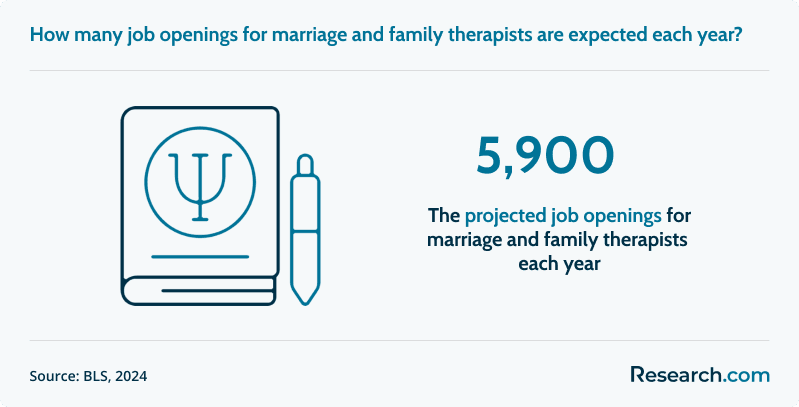
Approximately 5,900 openings for marriage and family therapists are projected each year over the decade. Many openings are expected to come from replacement needs as workers transfer to other occupations or leave the labor force, including retirement.
One major driver is the growing use of integrated care, where teams of professionals address multiple behavioral health needs together. In this model, marriage and family therapists may collaborate with substance abuse counselors, behavioral disorder specialists, mental health counselors, physicians, and social service professionals. Students comparing therapy and counseling paths may also review the most affordable online Masters in Mental Health Counseling to determine which licensure route better matches their goals.
The chart below shows the projected percent change in employment for marriage and family therapists from 2022 to 2032.
Challenges of online MFT programs
Online MFT programs can make graduate education more accessible, but they also require discipline and careful planning. Students must manage coursework, clinical documentation, supervision, technology, and personal responsibilities without the daily structure of a campus environment.
- Limited in-person interaction: Students may need to be proactive about building relationships with faculty, supervisors, and peers.
- Clinical placement complexity: Finding an approved local site can take time, especially in areas with fewer behavioral health providers.
- Technology demands: Reliable internet access, video participation, secure platforms, and digital assignment systems are essential.
- Time management pressure: Online flexibility can become a challenge for students who do not set firm study and clinical schedules.
- Licensure uncertainty: Students who move during or after the program may face different state requirements.
Programs with strong advising, responsive faculty, placement guidance, technical support, and active cohorts can reduce these challenges. Students comparing program structures may want to review options for a masters degree in family counseling online to evaluate how different schools support online learners.
Professional development after an online MFT degree
Graduation is not the end of professional training for marriage and family therapists. Licensed clinicians must often complete continuing education, and many pursue advanced training in areas such as trauma-informed care, adolescent therapy, telehealth, couples therapy, substance abuse treatment, or medical family therapy.
Ongoing development can take the form of workshops, webinars, certificate programs, supervision groups, professional conferences, and advanced clinical training. Students who want a more streamlined route through graduate study can also compare marriage and family therapy master's programs online while still verifying licensure fit and clinical quality.
Support services online MFT students should expect
Strong student support can make a major difference in an online MFT program because students must balance rigorous academics with clinical preparation. Before enrolling, ask whether support services are available to online students on the same terms as campus students.
Academic support
- Tutoring and writing help: Useful for research papers, case conceptualization assignments, and graduate-level writing.
- Academic advising: Helps students plan course sequences, monitor degree progress, and avoid delays.
- Library access: Online students should have digital access to databases, journals, e-books, and research tools.
Career and clinical placement support
- Career counseling: Helps students clarify job goals, prepare for interviews, and understand local employment settings.
- Internship placement assistance: Helps students identify and secure approved practicum and internship sites.
- Resume and portfolio support: Helps students present clinical training, supervision experience, and professional skills clearly.
Technology support
- Technical help desk: Online learners need prompt support for learning platforms, video tools, and software issues.
- Orientation: A strong orientation helps students understand course systems, communication expectations, and digital resources.
Community and networking
- Virtual study groups: Peer groups can help students practice concepts, discuss readings, and stay accountable.
- Alumni networks: Alumni connections can support mentoring, job leads, and professional identity development.
Mental health and wellness
- Counseling services: Some programs offer access to mental health support for students managing stress or personal challenges.
- Wellness resources: Stress management and work-life balance resources are especially relevant in a field that requires emotional presence and ethical self-awareness.
When comparing online programs, students should also verify that the institution is properly accredited. Research.com’s guide to the most accredited online colleges can help students understand why accreditation matters for online learning quality.
How substance abuse counseling training can strengthen MFT practice
Substance use concerns often affect the whole family system, not only the individual client. MFT students who add substance abuse counseling training can better understand addiction patterns, relapse dynamics, family roles, co-occurring conditions, and integrated treatment planning.
This added preparation can be especially useful for therapists working in community agencies, treatment centers, integrated care settings, or private practice. Students interested in a dedicated credential path can compare an affordable bachelor's degree in substance abuse counseling online as a supplemental or alternative route depending on their career goals.
How MFT licensure differs from other mental health licenses
An online MFT degree is one route into clinical mental health practice, but it is not the same as a counseling, social work, or psychology pathway. Each license has its own scope of practice, supervision rules, coursework requirements, exams, and state board expectations.
Before choosing a degree, compare the license you want with the work you hope to do. Students deciding among counseling, clinical social work, and family therapy credentials can review Research.com’s guide to LPC vs LCPC vs LCSW for a clearer comparison of common mental health licensure paths.
What graduates say about earning an online marriage and family therapy degree
- Soriah: "Completing my marriage and family therapy degree online made it possible to keep working and stay present for my family. The flexible schedule helped me stay on track, and the interactive coursework kept the material practical and engaging."
- Alexis: "My online MFT program connected me with classmates and faculty from many different backgrounds. Even though we were learning remotely, the discussions were meaningful and the academic quality remained strong."
- Jamie Lyn: "Studying online gave me the freedom to learn from anywhere while building real therapy skills. The concepts and techniques I learned have been useful in my current work as a therapist."
Key Insights
- Affordability matters, but licensure alignment matters more. Always confirm that an online MFT program meets requirements in the state where you plan to practice.
- Most online Master’s Degree in Marriage and Family Therapy programs take 24 to 36 months, and clinical fieldwork is usually required in person.
- Based on our research, the average cost of an online marriage and family therapy degree program is $52,200, with online MFT master’s programs ranging from $23,000 to $86,000.
- Online learning can be a strong option for working adults, but students should plan early for practicum, internship, supervision, technology, and any required campus intensives.
- Employment for marriage and family therapists is expected to grow 15% from 2022 to 2032, with approximately 5,900 projected openings each year over the decade.
- Telehealth has expanded access to therapy, but it also raises important ethical, privacy, crisis management, and state licensure issues.
- The strongest programs provide clear licensure disclosures, placement support, responsive advising, qualified faculty, and transparent outcome data.
References:
- Bureau of Labor Statistics, U.S. Department of Labor. (2024). Occupational outlook handbook: Marriage and family therapists. U.S. BLS
- Data USA. (n.d.). Marriage and family therapists. Data USA
- Hanson, M. (2023, August 23). Cost of online education vs. traditional education. Education Data Initiative. Education Data
- Salary.com. (2024). Licensed marriage and family therapist salary. Salary.com
Other Things You Should Know About Affordable Online Marriage and Family Therapy Degree Programs
Many online marriage and family therapy programs are not CACREP accredited because CACREP accredits counseling programs, not marriage and family therapy degrees. For licensure, students should instead verify regional accreditation, state approval, and any required MFT curriculum standards set by their state licensing board or the COAMFTE guidelines.
In 2027, students enrolled in affordable online marriage and family therapy degree programs can access federal financial aid, scholarships, and sometimes state-specific grants. It's important to fill out the FAFSA to explore eligibility for these opportunities fully.
Online marriage and family therapy degree programs typically require between 45-60 credit hours for completion. This can vary by institution, but these programs usually include core courses, electives, and practical experience components to prepare students for professional certification and practice.


