
2027 Best Online Master’s in Marriage and Family Counseling

Co-Founder and Chief Data Scientist
Choosing an online master’s in marriage and family counseling is not just a question of convenience. It is a licensure, cost, clinical training, and career decision. The right program can prepare you to work with couples, families, children, and individuals through relational, emotional, behavioral, and mental health challenges. The wrong program may leave you with extra coursework, licensure delays, or clinical placement problems.
This guide is for prospective graduate students comparing online marriage and family therapy programs, counseling master’s degrees with MFT tracks, and related licensure-focused programs. You will learn what these programs include, how long they take, what they cost, how online study compares with campus-based training, what accreditation matters, and how to evaluate whether an online MFT pathway is worth the investment.
Quick answer: Is an online master’s in marriage and family counseling a good path?
An online master’s in marriage and family counseling can be a strong choice if you want a flexible graduate program that prepares you for marriage and family therapist licensure while still allowing you to complete supervised clinical training. These programs typically combine online coursework in family systems, human development, counseling ethics, assessment, and intervention strategies with practicum or internship experiences that must meet state licensing rules.
Major benefits of an online master’s in marriage and family counseling
- Multiple career settings: Graduates may work in private practice, mental health agencies, community organizations, outpatient programs, and other counseling environments.
- Clear occupational pathway: As of May 2023, the average annual income for MFTs was $58,510.
- Licensure-focused preparation: Programs usually cover family systems theory, lifespan development, conflict resolution, treatment planning, ethics, and supervised clinical practice needed for MFT licensure preparation.
What can I expect from an online master’s in marriage and family counseling?
An online master’s in marriage and family counseling prepares students to understand client concerns through a relational and family-systems lens. Instead of focusing only on one person’s symptoms, MFT training examines how relationships, communication patterns, culture, family roles, trauma, conflict, and life transitions affect well-being.
Coursework is usually delivered online, but clinical preparation is not fully virtual in most licensure-focused programs. Students should expect supervised practicum and internship requirements, and these experiences may need to be completed in person at approved sites. Before enrolling, confirm that the program’s curriculum and fieldwork structure match the licensure rules in the state where you plan to practice.
Where can I work with this degree?
Graduates with an online master’s in marriage and family counseling may pursue roles in settings that provide therapy, counseling, behavioral health, family support, or community mental health services. Some eventually open private practices, where they can offer individual, couple, and family therapy. Others work in agencies or outpatient programs where clients may be dealing with trauma, addiction, anxiety, depression, relationship conflict, or co-occurring mental health concerns.
In many clinical environments, MFTs collaborate with psychologists, social workers, licensed professional counselors, physicians, case managers, and substance abuse counselors. That team-based approach is especially important in integrated care settings, where clients may need coordinated support for several concerns at once.
How much can I make with an online master’s in counseling?
In May 2023, the typical yearly salary for MFTs stood at $58,510. The lowest 10% earned under $39,090, while the top 10% earned over $104,710.
Income depends on location, employer, licensure status, experience, client population, and whether a therapist works in an agency, outpatient setting, government role, or private practice. Many MFTs work full time, although part-time schedules are also common. Some therapists offer evening or weekend appointments to meet client scheduling needs.
- Best Online Master’s in Marriage and Family Counseling Programs for 2027
- How long does an online master’s in marriage and family counseling take?
- Online vs. on-campus master’s in counseling: which format is better?
- What does an online master’s in marriage and family counseling cost?
- What financial aid is available for online MFT students?
- What are the admission requirements?
- What courses are included in an online MFT master’s program?
- What specializations and focus areas are available?
- How do you choose the best online MFT program?
- What skills do students develop?
- Are online master’s in marriage and family counseling programs accredited?
- Is an online master’s in marriage and family counseling worth it?
- Why does CACREP accreditation matter?
- How do online programs use digital tools in counseling training?
- How can Christian counseling shape your treatment approach?
- How do online MFT programs address substance abuse issues?
- What should students know about clinical supervision?
- What career paths are available after graduation?
- What is the job market for MFT graduates?
- What challenges should online MFT students expect?
- What are the licensing and certification requirements?
- How do online programs support professional development and networking?
- Are there faster ways to work in mental health than becoming an MFT?
Best Online Master’s in Marriage and Family Counseling Programs for 2027
How Research.com evaluates schools
Research.com rankings are designed to help students compare online master’s in marriage and family counseling programs with more confidence. Graduate school is a major financial and professional commitment, so program comparisons should consider cost, accreditation, structure, clinical preparation, and available public data rather than marketing claims alone.
Our ranking process uses a structured research approach and draws from established education data sources, including:
- The Integrated Postsecondary Education Data System (IPEDS) database
- Peterson's databases, including their Distance Learning Licensed Data Set
- The College Scorecard database
- National Center for Education Statistics (NCES)
1. Touro University Worldwide
Touro University Worldwide offers an online marriage and family therapy program with clinical, non-clinical, and licensed professional clinical counseling (LPCC) options. The clinical and LPCC tracks require 300 hours of practice. Students may enroll on a full-time or part-time basis. Full-time students can complete the non-clinical track in 18 months, the clinical track in two years, and the LPCC track in two and a half years.
- Program Length: 18 to 30 months
- Tracks/concentrations: MFT, LPCC, Non-clinical
- Cost per Credit: $525
- Required Credits to Graduate: 54 to 72
- Accreditation: Board of Behavioral Sciences (BBS), Commission on Accreditation for Marriage and Family Therapy Education (COAMFTE)
2. Abilene Christian University
Abilene Christian University provides an online master’s program for students preparing for MFT careers. The program is designed to help graduates prepare for the national MFT exam and offers specialization options in general practice, child and adolescent therapy, military families, and trauma treatment.
- Program Length: 33 months
- Tracks/concentrations: MFT
- Cost per Credit: $799
- Required Credits to Graduate: 60
- Accreditation: COAMFTE
3. Palo Alto University
Palo Alto University offers an online master of arts in clinical mental health counseling with a focus on marriage, family, and child therapy. The curriculum emphasizes current research, clinical methods, and culturally responsive counseling that can be adapted to different communities and client populations.
- Program Length: 27 months
- Tracks/concentrations: MFT, LPCC
- Cost per Credit: $580
- Required Credits to Graduate: 63
- Accreditation: Council for Accreditation of Counseling & Related Educational Programs (CACREP)
4. University of Holy Cross
The University of Holy Cross offers a 60-credit online master of arts in counseling with a marriage, couple, and family therapy specialization. Students complete online coursework, two four-day residencies, two internships, and a practicum. The clinical components include both direct and indirect client hours.
- Program Length: 24 to 30 months
- Tracks/concentrations: MFT
- Cost per Credit: $735
- Required Credits to Graduate: 60
- Accreditation: CACREP
5. Indiana Wesleyan University-Marion
Indiana Wesleyan University-Marion delivers an online master of arts in counseling with a marriage and family counseling or therapy focus. The program emphasizes interpersonal, holistic, and evidence-based practice. Students must complete at least 300 direct clinical hours, including 100 hours supervised by an AAMFT-approved licensed professional. The program meets Indiana’s academic requirements for MFT licensure.
- Program Length: 24 to 30 months
- Tracks/concentrations: MFT
- Cost per Credit: $602
- Required Credits to Graduate: 60
- Accreditation: COAMFTE
6. Pacific Oaks College
Pacific Oaks College offers a fully online master of arts in MFT for California residents, with specialization options in African American studies, Latin studies, and trauma studies. Students study evidence-based theory, developmental perspectives, and family systems theory while completing supervised fieldwork practicum in schools and community agencies in the Los Angeles and Pasadena areas. The program prepares students for California’s MFT exam.
- Program Length: 30 months
- Tracks/concentrations: African American Family Studies, Latinx Family Studies, Trauma Studies
- Cost per Credit: $1,210
- Required Credits to Graduate: 61
- Accreditation: WASC Senior Colleges and Universities Commission
7. Toccoa Falls College
Toccoa Falls College provides an online master of arts in MFT that blends multicultural counseling preparation with an integrated Christian framework. The program is designed to meet the licensing requirements of the Georgia Composite Board of Professional Counselors, Social Workers, and MFTs.
- Program Length: 30 months
- Tracks/concentrations: MFT
- Cost per Credit: $525
- Required Credits to Graduate: 60
- Accreditation: Southern Association of Colleges and Schools Commission on Colleges (SACSCOC)
8. Syracuse University
Syracuse University offers an online master of arts in MFT that combines theory with clinical practice through a 500-hour clinical practicum. The program prepares graduates to work with couples, families, children, and military families and meets the academic requirements for clinical membership in the AAMFT.
- Program Length: 30 months
- Tracks/concentrations: MFT
- Cost per Credit: $1,139
- Required Credits to Graduate: 60
- Accreditation: COAMFTE
9. Houston Christian University
Houston Christian University offers a master of arts in MFT centered on evidence-based counseling skills from a Christian perspective. Students complete a 700-hour, three-semester practicum. The online program also includes a 16-week intensive with one required week on campus. It meets academic criteria for LMFT licensure or certification in Texas.
- Program Length: 30 months
- Tracks/concentrations: MFT
- Cost per Credit: $600
- Required Credits to Graduate: 60
- Accreditation: SACSCOC
10. National University
Originally offered by Northcentral University before its merger with National University, this fully online master of arts in MFT includes nine specialization options. Students can tailor the degree to align with their academic interests and professional goals. National University is located in San Diego, California.
- Program Length: 33 months
- Tracks/concentrations: Child and Adolescent FT, Couple Therapy, General FT, LGPTQ Couple and FT, Medical FT, Military FT
- Cost per Credit: $913
- Required Credits to Graduate: 45 to 60
- Accreditation: BBS, COAMFTE
Key Findings About Online Master’s in Marriage and Family Counseling Programs
- Most online master’s in marriage and family counseling programs take about two to three years to complete.
- An online master’s in marriage and family counseling program consisting of 60 credits can cost around $31,500.
- Common financial aid options include federal student loans, scholarships, employer assistance programs, university aid, and payment plans.
- In 2023, the primary sector of employment for MFTs was state government.
- The job prospects for MFTs indicate a projected growth of 15% from 2022 to 2032.
How long does it take to complete an online master’s in marriage and family counseling?
Completion time depends on the degree track, enrollment status, clinical requirements, and whether the program includes additional counseling licensure preparation. Full-time students in a non-clinical MFT track may finish in 18 months, while a clinical track may take two years.
Students pursuing an LPCC pathway may need an additional half year, extending full-time completion to two and a half years. Part-time enrollment in online master’s degree programs in counseling usually takes longer, and the exact timeline depends on course load and clinical placement scheduling.
A master’s degree is generally the standard graduate credential for advanced counseling practice in marriage and family therapy. If your goal is to enter the counseling field sooner in a support or adjacent role, compare this route with the fastest way to become a counselor.
| Program pathway | Typical full-time completion time |
| Full-time non-clinical MFT | 18 months |
| Full-time clinical MFT | 24 months |
| Full-time MFT with LPCC | 30 months |
How does an online master’s in counseling compare to an on-campus program?
Online and campus-based master’s programs in counseling can cover similar academic content, but the student experience is different. The best format depends on your schedule, learning style, clinical placement needs, and access to local training sites.
| Factor | Online master’s in counseling | On-campus master’s in counseling |
| Learning format | Coursework is delivered through virtual lectures, discussion boards, video meetings, and online assignments. | Students attend in-person classes, labs, seminars, and faculty meetings on campus. |
| Flexibility | Often better for working adults, parents, and students who cannot relocate. | Works well for students who prefer a fixed schedule and face-to-face instruction. |
| Clinical experience | Students may need to arrange approved practicum and internship placements near their location. | Programs may have established relationships with local clinics, agencies, and counseling centers. |
| Networking | Requires more intentional participation in virtual events, faculty meetings, and online peer groups. | Provides more spontaneous interaction with classmates, faculty, and local professionals. |
| Best fit | Students who need scheduling flexibility and can manage independent learning. | Students who want in-person mentorship and campus-based community. |
What is the average cost of an online master’s in marriage and family counseling?
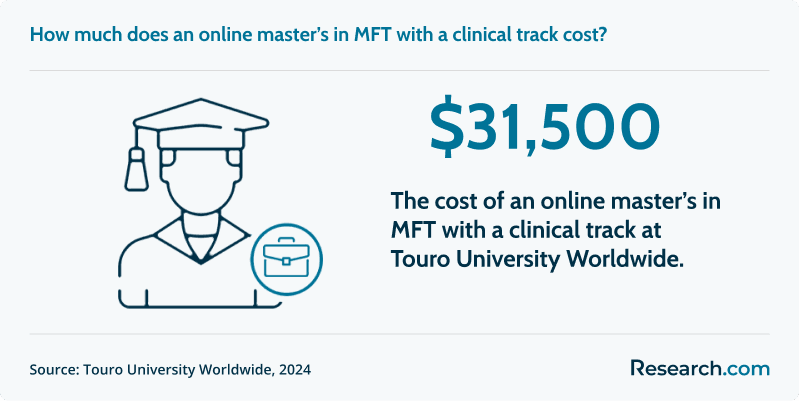
Cost varies by school, credit requirement, residency requirement, technology fees, and program track. For example, the non-clinical MFT track at Touro University Worldwide requiring 54 credits totals $24,350 for the entire program. The clinical track comprising 60 credits amounts to $31,500, while the LPCC track comprising 72 credits totals $37,800.
When comparing programs, look beyond tuition. Ask about practicum fees, residency travel, background checks, technology requirements, exam preparation, graduation fees, and whether additional courses may be needed for licensure in your state. Students searching for lower-cost options can also compare the most affordable online schools with counseling degrees, which are often public universities.
What are the financial aid options for students enrolling in an online master’s in marriage and family counseling?
Graduate counseling students may be able to combine several forms of aid. The best approach is to complete required financial aid applications early, ask each school about program-specific awards, and confirm whether online students qualify for the same funding as campus students.
- Federal Student Loans: Federal loans are a common source of financial aid for graduate students. Graduate students should review loan terms carefully because borrowing costs affect the long-term value of the degree.
- Grants and Scholarships: These awards may be need-based, merit-based, or tied to counseling, behavioral health, service commitments, or demographic eligibility. They do not require repayment.
- Employer Assistance Programs: Some employers help workers pay for graduate education through tuition reimbursement or tuition assistance benefits.
- University Aid: Schools may offer graduate scholarships, assistantships, or departmental awards for counseling students.
- Other Payment Options: Some universities allow students to divide tuition across several terms through payment plans.
What are the prerequisites for enrolling in an online master’s in marriage and family counseling?
Admission requirements differ by institution, but most online MFT and counseling master’s programs look for evidence that applicants are academically prepared, emotionally mature, and suited for clinical training.
- Bachelor's Degree: Applicants generally need a bachelor’s degree from an accredited college or university. A counseling, psychology, sociology, or human services major may help, but it is not always required.
- Transcripts: Schools usually request official transcripts from every college or university attended.
- Minimum GPA: Many programs set a minimum GPA, often in the range of 2.0 to 3.0 on a 4.0 scale.
- Standardized Tests: Some programs may ask for GRE scores, although this requirement is becoming less common in online MFT admissions.
- Statement of Purpose: This essay should explain why you want to study marriage and family counseling, what experiences shaped your goals, and how the program fits your career plan.
- Letters of Recommendation: Programs commonly request one or two recommendations from professors, supervisors, or professionals who can speak to your readiness for graduate study and client-facing work.
- Resume or CV: A resume can highlight counseling-related experience, volunteer work, social service roles, research, or leadership experience.
- Background Check: Programs with clinical training may require a background check before practicum or internship placement.
- Prerequisite Courses: Some schools require undergraduate coursework in psychology, human development, social science, or related areas. If speed and accessibility are major priorities, you may also want to compare this degree with the easiest master degree options.
- Interview: Some admissions committees conduct interviews to evaluate communication skills, professional judgment, motivation, and fit for clinical work.
What courses are typically in an online master’s in marriage and family counseling?
Online MFT programs usually combine counseling theory, relational assessment, clinical skill building, ethics, research, and supervised practice. Course titles vary, but students can expect several recurring content areas.
| Course area | What students learn | Why it matters |
| Human development and family systems | Lifespan development, family roles, family dynamics, and sociocultural influences. | Helps therapists understand how individual concerns connect to relationships and developmental stages. |
| Counseling theories and techniques | Major therapeutic models, including approaches used with individuals, couples, and families. | Builds the clinical foundation needed to select appropriate interventions. |
| Assessment and treatment planning | Interviewing, case conceptualization, diagnosis, goal setting, and documentation. | Prepares students to create structured plans based on client needs. |
| Ethics and professional practice | Confidentiality, boundaries, mandated reporting, informed consent, and cultural competence. | Protects clients and prepares students for professional standards and licensure expectations. |
| Research methods | Research design, evidence evaluation, and application of findings to practice. | Supports evidence-informed decision-making in therapy. |
| Practicum and internship | Supervised work with clients in approved settings. | Connects classroom learning to real clinical responsibilities. |
What types of specializations are available in online master’s in marriage and family counseling programs?
Some online MFT programs offer formal tracks, while others allow students to shape their training through electives, practicum settings, or faculty-supervised projects. Focus areas can help you prepare for specific client populations, but they do not replace state licensure requirements.
- Military and Veteran Families: Students study deployment stress, family separation, combat-related trauma, reintegration, and the needs of military-connected households.
- Trauma and Crisis Intervention: Coursework may cover trauma theory, assessment, crisis response, and evidence-based interventions for individuals and families affected by traumatic events.
- Substance Abuse and Addiction: These electives examine how addiction affects relationships, parenting, conflict, and family stability. Students interested in this area may also compare training options through an online substance abuse counseling degree.
- Child and Adolescent Development: This focus supports work with children, teenagers, caregivers, and families experiencing behavioral, emotional, or developmental challenges.
- LGBTQ+ Issues: Courses may address affirming care, family acceptance, minority stress, identity development, and culturally responsive practice with LGBTQ+ clients and families.
How to choose the best online master’s in marriage and family counseling programs?
The best program is not always the highest-ranked or cheapest option. It is the one that fits your licensure state, budget, schedule, clinical placement needs, and career goals. Before applying, decide whether you prefer the MA vs MS in counseling route and whether you want a general MFT program, an LPCC-aligned option, or a faith-integrated pathway such as an online Christian counseling degree.
- Accreditation: Confirm institutional accreditation and, when relevant, specialized accreditation such as COAMFTE. Accreditation can affect licensure eligibility, employer recognition, and transferability.
- Licensure alignment: Ask whether the curriculum meets academic requirements in the state where you plan to practice. Do not assume an online program is approved in every state.
- Clinical placement support: Find out whether the school helps students secure practicum and internship sites or expects students to locate placements independently.
- Program focus: Review electives, faculty expertise, practicum options, and specialization areas to make sure the program supports your preferred client population.
- Schedule flexibility: Check whether courses are asynchronous, synchronous, cohort-based, self-paced, or tied to specific class meeting times.
- Total cost: Compare tuition, required credits, fees, travel for residencies, books, technology, and potential extra coursework.
- Student support: Look for academic advising, online tutoring, career services, licensure advising, technical support, and mental health resources.
Questions to ask before enrolling
| Question | Why it matters |
| Does this program meet MFT licensure requirements in my state? | State rules vary, and a mismatch can delay licensure. |
| Who is responsible for finding clinical placements? | Placement support can strongly affect your ability to graduate on time. |
| Are there required campus visits or residencies? | Travel can add cost and scheduling complexity. |
| What is the total program cost, not just tuition? | Fees, travel, books, and background checks can increase the real price. |
| Does the program prepare students for the national MFT exam? | Exam preparation is a key step toward licensure. |
What are the key skills and competencies gained in an online master’s in marriage and family counseling program?
A strong online MFT program should develop both clinical judgment and practical counseling skills. Students learn how to listen carefully, assess relational patterns, build treatment plans, manage conflict, document care, and practice ethically with diverse clients.
Communication skills are central. MFT students learn to ask effective questions, create trust, de-escalate tension, and help clients discuss difficult issues in constructive ways. Conflict resolution is also essential because couples and families often enter therapy during periods of high stress, grief, betrayal, trauma, parenting strain, or life transition.
Programs also emphasize cultural competence. Students must understand how race, ethnicity, religion, gender, sexuality, socioeconomic status, immigration background, disability, and community context can shape family life and the counseling relationship.
Clinical training introduces evidence-based and theory-informed approaches such as cognitive-behavioral therapy (CBT), narrative therapy, solution-focused brief therapy, and family systems models. Practicum and internship experiences allow students to apply these methods under supervision before independent practice.
If you want a step-by-step explanation of the full professional pathway, review this guide on how to become a marriage and family therapist.
Are online master’s in marriage and family counseling programs accredited?
Many online master’s in marriage and family counseling programs are accredited, but students must verify each program individually. Accreditation signals that a school or program has been reviewed against established standards for curriculum quality, faculty qualifications, student support, and clinical preparation.
Institutional accreditation matters for financial aid, transfer credit, and general academic recognition. Specialized accreditation, such as CACREP or COAMFTE, may matter for licensure preparation and employer confidence. Because counseling, psychology, and family therapy overlap in some areas but lead to different professional routes, it can also help to understand related disciplines through resources such as sociology vs psychology.
Is the Online Master's in Marriage and Family Counseling Worth the Investment?
An online master’s in marriage and family counseling may be worth it if the program meets your state’s licensure requirements, offers strong clinical placement support, fits your schedule, and leads to the type of counseling role you actually want. It may not be worth the cost if you choose a program without confirming accreditation, licensure alignment, or the total price of attendance.
To evaluate return on investment, compare tuition and likely borrowing against salary expectations, local job availability, licensure timelines, and your willingness to complete supervised clinical hours after graduation. For broader program comparisons, review this guide to a master's in marriage and family therapy online.
What makes CACREP accredited online counseling programs stand out?
CACREP accreditation is a recognized quality marker for counseling programs because it indicates that a curriculum meets established standards for counselor preparation, ethics, assessment, clinical experience, and professional identity. For students considering counseling programs that overlap with marriage, couple, and family therapy, CACREP status can help signal academic rigor and structured clinical preparation.
However, CACREP and COAMFTE are not interchangeable in every licensure context. Students should check their state board’s rules before choosing a program. If affordability is a major concern, compare CACREP accredited online counseling programs to understand cost-effective options.
How do online programs integrate digital tools to enhance counseling training?
Online counseling programs often use video conferencing, virtual classrooms, telehealth demonstrations, simulated case exercises, digital assessments, and online supervision tools. These resources can help students practice interviewing, documentation, crisis response, treatment planning, and ethical decision-making before and during clinical placement.
Digital training is increasingly relevant because many counseling settings use telehealth or hybrid care models. Students should ask whether the program teaches telehealth ethics, privacy standards, documentation practices, and appropriate use of technology. For another perspective on counseling-related career development, see this guide on how to become a spiritual counselor.
How can integrating Christian counseling enhance your treatment approach?
Christian counseling programs may appeal to students who want to integrate faith-informed perspectives with evidence-based counseling practice. In marriage and family therapy, this may include attention to spiritual values, religious community, meaning-making, forgiveness, family roles, and faith-based coping strategies when these are relevant and client-directed.
Faith integration should not replace ethical practice, informed consent, cultural humility, or clinically appropriate treatment. Students interested in this pathway can compare Christian counseling master's programs online to understand how different schools balance theology, counseling theory, and licensure preparation.
How do online MFT programs integrate training for co-occurring substance abuse issues?
Some online MFT programs include coursework or electives on substance abuse, addiction, and co-occurring mental health concerns. This training helps future therapists understand how substance use can affect couple conflict, parenting, boundaries, communication, safety, and family stability.
MFT students interested in addiction-focused work should ask whether the program includes addiction assessment, referral practices, relapse prevention concepts, family-based interventions, and collaboration with substance abuse counselors. For more specialized training information, compare options for a substance abuse counselor degree online.
What measures ensure robust clinical supervision in online MFT programs?
Clinical supervision is one of the most important parts of MFT training. In an online program, supervision quality depends on clear placement approval processes, qualified supervisors, regular feedback, ethical oversight, and documentation that meets licensure requirements.
Prospective students should ask how often supervision occurs, whether supervisors must hold specific credentials, how the school evaluates practicum sites, and what happens if a placement falls through. Online programs may use local agencies, telehealth platforms, case conferences, recorded sessions, and one-on-one supervision to connect academic training with client care. To understand how counseling credentials differ in clinical settings, read What is the difference between an LPC and a LCSW?
What career paths are available for graduates of online master’s in marriage and family counseling programs?
Graduates can pursue several counseling and behavioral health roles, although independent practice usually requires licensure. Your exact options depend on your state, credential, supervised hours, exam completion, and employer requirements.
- Private Practice: Licensed MFTs may provide individual, couple, and family therapy in an independent or group practice setting.
- Mental Health Agencies and Community Centers: MFTs may support clients experiencing anxiety, depression, trauma, relationship concerns, addiction-related stress, or family conflict.
- Hospital Outpatient Programs: Therapists may work with clients receiving treatment for eating disorders, substance abuse, co-occurring disorders, or other behavioral health concerns.
- School Counseling: With additional school counseling preparation, some professionals support students and families dealing with social, emotional, or family-related challenges.
- Employee Assistance Programs (EAPs): MFTs may provide short-term counseling, referrals, and support for employees facing work stress, personal concerns, or family issues.
The following chart illustrates the average yearly incomes of MFTs across the leading industries in which they were employed.
What is the job market for graduates of online master’s in marriage and family counseling programs?
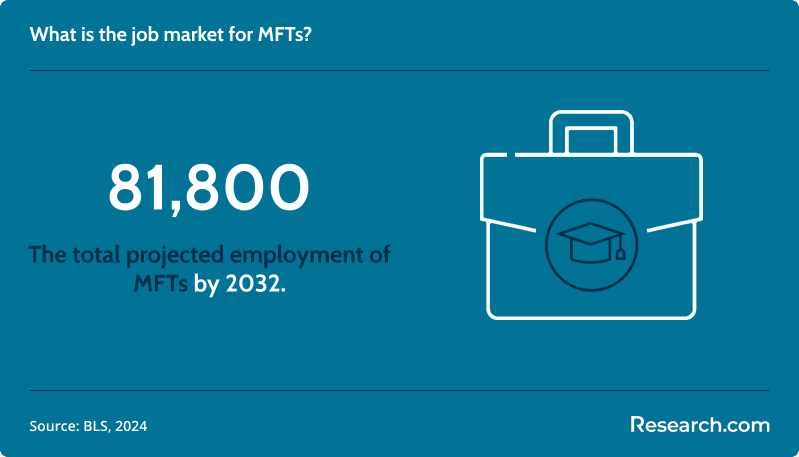
The employment outlook for MFTs suggests a 15% growth from 2022 to 2032, surpassing the average rate for all professions. Projections indicate approximately 5,900 new job openings for MFTs annually, totaling 81,800 by 2032. Much of this demand is anticipated to stem from the need to replace workers transitioning to other fields or retiring from the workforce.
One driver of demand is the use of integrated care models, where multiple professionals coordinate treatment for clients with overlapping behavioral, relational, medical, and substance use concerns. MFTs may be part of these teams alongside substance abuse, behavior disorder, and mental health counselors.
What are the challenges of pursuing an online master’s in marriage and family counseling?
Online MFT programs can be flexible, but they are not easy. Students must manage graduate-level coursework, emotionally demanding material, clinical training, technology requirements, and licensure planning, often while working or caring for family members.
- Finding clinical placements: Online students may need to locate approved practicum and internship sites in their own communities. This can take time, especially in areas with limited counseling agencies.
- Balancing school with work and family: Flexible coursework still requires consistent reading, writing, discussion participation, supervision, and clinical hours.
- Staying connected: Online students may need to make extra effort to build relationships with faculty, supervisors, and classmates.
- Managing technology: Video meetings, telehealth demonstrations, learning platforms, and digital assignments require reliable internet, equipment, and technical confidence.
- Tracking state licensure rules: Licensing requirements vary, and failing to check them early may lead to additional coursework or delays.
Common mistakes to avoid
| Mistake | Better approach |
| Choosing a program based only on tuition. | Compare total cost, licensure fit, clinical support, accreditation, and completion time. |
| Assuming every online program leads to licensure in every state. | Contact the state licensing board and the program’s licensure advisor before enrolling. |
| Ignoring clinical placement expectations. | Ask who finds placements, how sites are approved, and what support is available. |
| Relying only on rankings. | Use rankings as a starting point, then evaluate fit for your goals and location. |
| Assuming salary outcomes are guaranteed. | Review local job postings, employer requirements, licensure timelines, and BLS data. |
What are the licensing and certification requirements for marriage and family therapists?
Licensure is the critical step between earning the degree and practicing independently as a marriage and family therapist. Requirements vary by state, so students should confirm rules with the licensing board in the state where they plan to work.
- Educational Requirements: The first step is completing an accredited graduate program that satisfies state academic requirements. Many online master’s programs are designed for licensure preparation, but students must verify state-specific approval before enrolling.
- Postgraduate Clinical Experience: Graduates must complete supervised clinical experience after or during graduate training. The number of required hours varies by state, but it generally ranges from 2,000 to 4,000 hours.
- Licensing Exam: After meeting education and clinical experience requirements, candidates typically must pass the National Marriage and Family Therapy Exam (NMFT), administered by the Association of Marital & Family Therapy Regulatory Boards (AMFTRB).
- State-specific Requirements: States may require additional coursework, background checks, jurisprudence exams, continuing education, or renewal requirements. Always confirm the exact rules with the state board.
- Post-licensure Opportunities: Licensed therapists may pursue additional training or certifications in areas such as sex therapy, family therapy, trauma treatment, or other specialized areas.
Even when comparing the cheapest online MFT programs, do not sacrifice licensure preparation. A low-cost program that does not meet your state’s requirements may become more expensive if you need extra courses later.
How do online MFT programs foster lifelong professional development and networking?
Strong online MFT programs support students beyond coursework by offering mentorship, alumni connections, career services, licensure guidance, webinars, workshops, and virtual case discussions. These resources can help graduates stay current with ethical standards, clinical approaches, state regulations, and telehealth practices.
Networking also matters for referrals, supervision opportunities, job leads, and private practice growth. Students interested in long-term earnings and advancement can also review career guidance on what therapist makes the most money.
Are there faster paths to becoming a Marriage and Family Therapist (MFT) besides a master's degree?
There is usually no true shortcut to independent MFT practice because licensure typically requires a graduate degree, supervised clinical hours, and an exam. However, there are faster ways to begin working in mental health or behavioral health support roles while deciding whether to pursue full MFT licensure.
Alternative entry points to consider
- Mental Health Technician: This role supports mental health professionals under supervision. A bachelor’s degree may be preferred, but some entry-level positions may consider relevant experience and on-the-job training.
- Fast-Track Master's Programs: Some universities offer accelerated master’s programs that reduce completion time compared with traditional formats.
- Licensure Requirements: Independent MFT practice generally requires licensure. To compare timelines and requirements, review this guide to the fastest way to become a counselor.
Key Insights
- An online master’s in marriage and family counseling can prepare students for MFT licensure, but only if the program aligns with the state where they plan to practice.
- Clinical training is the main difference-maker. Ask early about practicum sites, supervision quality, placement support, and state approval.
- Most programs take two to three years, with full-time timelines ranging from 18 months for some non-clinical tracks to 30 months for some LPCC-aligned routes.
- Cost varies widely. A 60-credit online master’s in marriage and family counseling program can cost around $31,500, but students should also budget for fees, residencies, technology, travel, and licensure-related expenses.
- Accreditation matters for program quality and licensure planning. Review institutional accreditation, CACREP or COAMFTE status when relevant, and state board requirements before applying.
- The career outlook is favorable, with projected MFT job growth of 15% from 2022 to 2032, but salary and job outcomes depend on licensure, location, employer, experience, and practice setting.
- The best program is not necessarily the cheapest or most recognizable. It is the one that fits your licensure state, budget, schedule, clinical placement needs, and preferred client population.
Reference:
- U.S. Bureau of Labor Statistics. (2024). Marriage and Family Therapists: Occupational Outlook Handbook. BLS.
Other Things You Should Know About Online Master’s in Marriage and Family Counseling Programs
Yes. Most programs require a supervised practicum or internship, usually 100 to 300 hours, before graduation. Students also complete direct client-contact hours, and many states later require additional post-degree supervised hours for licensure as a marriage and family therapist.
Admission requirements typically include a bachelor's degree from an accredited institution, letters of recommendation, a personal statement, and sometimes GRE scores. Some programs may also require relevant work experience or prerequisite coursework related to counseling or psychology.


