2027 Best Online Bachelor's in General Studies for Adults Over 30

Co-Founder and Chief Data Scientist
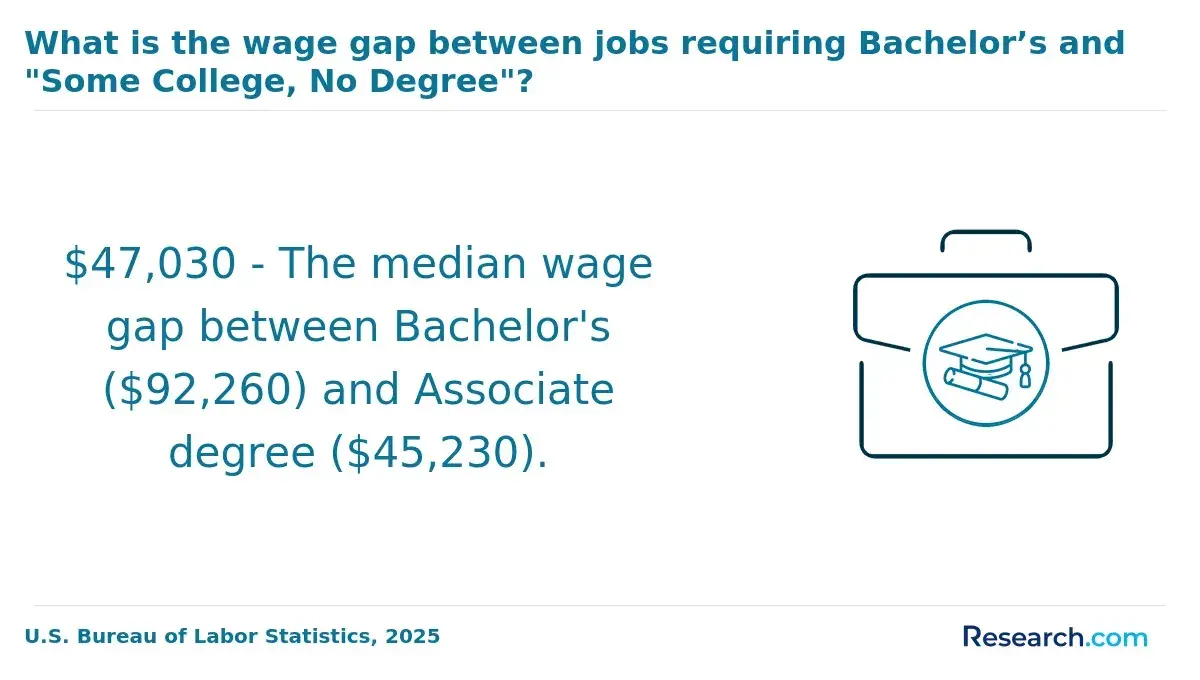
Finishing a bachelor's degree after 30 is often a question of time, transfer credits, and return on investment. A general studies degree can help adults turn prior college, work, military, or professional experience into a flexible path to graduation. The stakes are real: BLS 2024 data shows workers with a bachelor's degree had median weekly earnings of $1,543, compared with $992 for those with some college but no degree. This guide explains how to compare accredited online programs, estimate costs, avoid red flags, and choose a degree that fits your career goals.
Key Things You Should Know
- For adults over 30, the best online general studies bachelor's programs usually accept generous transfer credit, offer asynchronous courses, and let students build concentrations around career goals instead of starting over.
- A standard bachelor's degree requires about 120 credits, but adults with prior college, military training, professional certifications, or portfolio credit may finish much faster if the school has strong credit-for-prior-learning policies.
- Cost varies widely: College Board's 2024 pricing report listed average 2024-25 published tuition and fees at $11,610 for in-state public four-year colleges and $43,350 for private nonprofit four-year colleges, before aid.
What is a general studies bachelor's degree for adults over 30?
A general studies bachelor's degree is an interdisciplinary undergraduate program that lets students combine courses from several fields, such as business, communication, social science, technology, humanities, or public service. For adults over 30, its main advantage is flexibility: the degree is often designed to accept previous college credits and help students finish a credential without losing years to a highly rigid major sequence.
This degree can be a smart fit if you already have credits from multiple schools, changed majors earlier in life, need a bachelor's degree for promotion, or want a broad credential rather than preparation for a licensed profession. It is often grouped with flexible completion options and may appeal to readers comparing easy bachelor degrees, although "easy" should not mean low quality. The better question is whether the program's structure removes unnecessary barriers while still teaching useful skills.
A general studies degree is usually not the best choice if your goal requires a specific major, license, or technical sequence. Nursing, engineering, teacher certification, accounting licensure, and some graduate programs may require designated prerequisites that a broad major may not include unless you plan carefully.
The table below summarizes when a general studies degree is likely to fit and when a more specialized degree may be the better investment.
| Student goal | General studies fit | Why it matters |
| Finish a bachelor's degree after stopping out | Strong fit | Programs often accept varied transfer credits and electives. |
| Qualify for a promotion requiring any bachelor's degree | Strong fit | Many employers screen for degree completion rather than a specific major. |
| Prepare for graduate school | Possible fit | You must confirm prerequisite coursework for the target graduate program. |
| Enter a licensed profession | Weak fit | Licensure paths often require specific accredited majors or clinical requirements. |
| Build a technical portfolio | Possible fit | Choose concentrations, certificates, or electives that produce demonstrable skills. |
Are online general studies programs accredited?
Reputable online general studies programs should be offered by institutionally accredited colleges or universities. Institutional accreditation is the baseline quality check for federal financial aid eligibility, transfer credit recognition, employer acceptance, and graduate school review. The online format itself is not a separate accreditation category; what matters is whether the institution and, when applicable, the program meet recognized standards.
Adults returning to school should verify accreditation before discussing tuition, transfer credits, or enrollment dates. This is especially important because unaccredited schools may advertise fast completion but leave students with credits that employers, graduate schools, or other colleges may not recognize.
Use this short process before applying or paying an application fee:
- Search the school in the U.S. Department of Education's Database of Accredited Postsecondary Institutions and Programs or the accreditor's own directory.
- Confirm that the institution, not just a subunit or partner, is currently accredited.
- Ask whether the online general studies degree appears on the same official transcript as the campus degree.
- Check whether your intended concentration has any additional requirements, especially if you plan to enter graduate school or a regulated field later.
- Avoid schools that pressure you to enroll immediately before providing written accreditation, tuition, and transfer-credit information.
The most common red flag is assuming that "online" automatically means less legitimate. A properly accredited online bachelor's degree from a recognized institution can carry the same academic standing as a campus degree, but the burden is on the student to verify the school before committing.
How do online and campus general studies programs compare?
Online and campus general studies degrees usually cover similar academic requirements, but they serve different student needs. Adults over 30 often compare them based on scheduling, commute time, classroom format, support services, and how easily they can continue working while enrolled.
The table below compares the practical differences that matter most to adult learners. Use it to decide which format best fits your work schedule, learning style, and need for in-person support.
| Factor | Online general studies | Campus general studies |
| Schedule | Often asynchronous or evening-friendly | Class times may be fixed and commute-dependent |
| Best for | Working adults, parents, military learners, rural students | Students who want in-person discussion and campus resources |
| Networking | Built through discussion boards, virtual teams, and career services | Built through campus events, clubs, and face-to-face faculty access |
| Learning style | Requires self-direction and strong time management | Provides more external structure and routine |
| Hidden costs | Technology fees, proctoring fees, home office needs | Transportation, parking, housing, childcare, missed work hours |
Online learning can be the better option if you need to protect work hours and family routines. Campus learning can be better if you benefit from face-to-face accountability or need access to facilities, labs, or local internships. Neither format is automatically easier; the best choice is the one you can sustain through graduation.
A current trend affecting this decision is the growth of hybrid student support. Many online programs now offer virtual tutoring, online library access, remote advising, video office hours, and digital career services. For adults over 30, these services can matter as much as the course format because they reduce the friction of returning to school after a long break.
What courses are in a general studies bachelor's program?
General studies programs vary, but most combine general education, upper-division electives, a concentration or thematic area, and a capstone course. The degree is broad by design, but a strong program should still help you build a coherent academic plan rather than a random collection of credits.
The table below shows common course areas and how they can support career goals. Exact course titles differ by school, so compare catalogs before applying.
| Course area | Common examples | Career value |
| Communication | Professional writing, public speaking, digital communication | Useful for management, client service, training, and operations roles |
| Business and leadership | Management, organizational behavior, project basics | Helpful for supervisors, office managers, and team leads |
| Social science | Psychology, sociology, public policy | Relevant for human services, HR support, nonprofit, and public-sector roles |
| Technology and data literacy | Information systems, spreadsheets, analytics foundations | Supports administrative, analyst, and operations work |
| Capstone | Research project, portfolio, applied problem-solving project | Helps demonstrate integrated skills to employers or graduate programs |
When choosing electives, think backward from your next job rather than forward from the easiest open courses. A general studies degree becomes more valuable when your transcript shows a pattern, such as leadership and communication, business operations, human services, or technology-supported administration.
For adults returning after several years, the most useful course plan often includes these skill-building categories:
- Writing-intensive courses that improve workplace communication, proposals, reports, and documentation.
- Quantitative or data literacy courses that show comfort with spreadsheets, metrics, and evidence-based decisions.
- Leadership or organizational courses that support promotion into supervisory work.
- Applied capstone or portfolio courses that produce work samples you can discuss in interviews.
What admission requirements do adult learners usually need?
Admission requirements for online general studies bachelor's programs are usually more flexible than those for selective first-year campus programs, especially when the program is designed for degree completion. Adults over 30 often apply as transfer students, returning students, veterans, or students with some college but no degree.
Most schools ask for a core set of materials so they can evaluate your academic history and determine transfer credit. Requirements vary, but adult applicants commonly need the following:
- Official transcripts from every college previously attended, even if the credits are old or the grades were uneven.
- A high school transcript or GED record if required by the institution.
- A minimum transfer GPA, which may be flexible at some adult-focused schools.
- A completed application and identity or residency documentation.
- Military transcripts, professional training records, certification documents, or prior-learning materials if you want those experiences evaluated for credit.
Do not assume old credits are worthless. Many institutions review credits from regionally or institutionally accredited colleges regardless of age, although science, technology, and professional courses may have time limits if content changes quickly. Ask for an unofficial transfer estimate before enrolling so you know how many credits remain.
One common mistake is applying only to the school with the fastest admissions process. Fast admission does not always mean fast graduation. The better measure is how many of your previous credits apply to degree requirements, not just how quickly the school accepts you.
How long does an online general studies degree take?
A bachelor's degree usually requires about 120 semester credits. The time to finish depends on how many credits you transfer, how many courses you can take each term, whether the school uses 8-week or 16-week courses, and whether prior learning can reduce remaining requirements.
The table below gives realistic completion scenarios for adults over 30. These are planning ranges, not guarantees, because transfer policies and course availability differ by school.
| Starting point | Typical remaining credits | Possible completion pace |
| No prior college credit | About 120 credits | Roughly 4 years full time or longer part time |
| Associate degree completed | About 45 to 60 credits | Often 18 to 30 months, depending on pace |
| Some college, no degree | Varies widely | Depends on transfer evaluation and remaining upper-division credits |
| Military or professional training | Varies by evaluation | May shorten the timeline if credits apply to requirements |
Acceleration works best when it is based on transfer credit, prior-learning credit, year-round enrollment, and clear course sequencing. It works poorly when students overload their schedule without accounting for work, caregiving, health, or financial pressure.
Before choosing an accelerated path, ask the school these questions:
- How many of my credits apply directly to the degree, not just as extra electives?
- How often are required upper-division courses offered online?
- Can I take courses year-round without losing financial aid eligibility?
- Are there 8-week terms, competency-based options, or portfolio assessments?
- What happens if I need to stop out for one term because of work or family obligations?
If you want a faster route but also need a more career-specific major, compare specialized accelerated programs before defaulting to general studies. For example, students aiming at recreation, athletics, or facility management may want to research an accelerated sports management degree online instead of a broad interdisciplinary plan.
How much does an online general studies bachelor's degree cost?
The cost of an online general studies bachelor's degree depends on tuition, transfer credits, fees, books, technology requirements, and the number of terms you need to finish. Published tuition is only the starting point; the real price is the cost of the credits you still need after transfer and financial aid.
College Board's 2024 report listed the following average published tuition and fees for 2024-25. These figures are useful benchmarks, but online programs may charge different rates than campus programs.
- Public four-year, in-state: $11,610 per year in average published tuition and fees.
- Public four-year, out-of-state: $30,780 per year in average published tuition and fees.
- Private nonprofit four-year: $43,350 per year in average published tuition and fees.
For adults over 30, the biggest cost lever is often not the advertised per-credit rate but the number of accepted credits. A school charging a slightly higher tuition rate may still be cheaper if it accepts more prior coursework toward graduation.
The table below breaks down cost factors that adults should compare before choosing a program. This can help you avoid focusing on tuition alone while missing fees or lost transfer value.
| Cost factor | Why it matters | What to ask |
| Per-credit tuition | Determines the base cost of remaining credits | Is online tuition different for in-state and out-of-state students? |
| Transfer credit acceptance | Can reduce total credits needed | How many credits apply to major, general education, and electives? |
| Fees | May include technology, graduation, proctoring, or course fees | What is the total estimated cost to finish? |
| Books and materials | Can vary by course format | Are open educational resources or inclusive access materials used? |
| Time to completion | Longer enrollment can increase total cost | Can required courses be completed without waiting extra terms? |
| Employer tuition assistance | Can lower out-of-pocket cost | Does the school defer billing until employer reimbursement arrives? |
Federal student aid can help, but adults should borrow carefully. Independent undergraduate students can generally borrow more in federal loans than dependent students, but the lifetime undergraduate federal loan limit still creates a ceiling. If you are comparing broad programs with career-oriented alternatives, also review the cost structure of business degrees online, especially if your goal is management, accounting support, marketing, or operations.
What jobs can you get with a general studies degree?
A general studies degree can support careers where employers value a bachelor's degree, communication ability, problem-solving, leadership potential, and adaptable knowledge. It is less suited to jobs requiring a specific licensed major or technical credential. For adults over 30, the degree often works best as a completion credential layered on top of existing work experience.
The table below lists roles that may align with a general studies background, especially when paired with relevant electives, certificates, work history, or internships. Job titles and requirements vary by employer.
| Career area | Possible roles | How to strengthen your candidacy |
| Business operations | Operations coordinator, office manager, administrative supervisor | Add courses in management, spreadsheets, communication, and project coordination. |
| Human resources | HR assistant, recruiting coordinator, training coordinator | Choose electives in psychology, employment law, organizational behavior, and data tracking. |
| Public service and nonprofit | Program coordinator, case management support, community outreach specialist | Build skills in grant writing, public policy, social services, and stakeholder communication. |
| Sales and client services | Account coordinator, customer success specialist, sales operations associate | Emphasize communication, CRM tools, business writing, and presentation skills. |
| Education support | Academic advisor assistant, student services coordinator, training support specialist | Take courses in adult learning, communication, counseling basics, or administration. |
AI and automation are changing many administrative and coordination roles, but they do not eliminate the need for human judgment, communication, ethics, and cross-functional problem-solving. Adults choosing general studies should intentionally add digital skills, such as spreadsheet analysis, project management software, basic data visualization, and AI-assisted research practices.
Avoid the mistake of listing "general studies" alone as your career strategy. Employers respond better when you translate the degree into a skills story: what you studied, what problems you can solve, what tools you can use, and how your previous work experience connects to the role.
What salary can general studies graduates expect?
Salary outcomes for general studies graduates vary because the degree can lead to many fields rather than one occupation. The most responsible way to think about earnings is to compare likely job families, prior experience, location, and skill concentration instead of assuming the degree alone determines pay.
BLS 2024 education data provides a useful broad benchmark: workers whose highest education was a bachelor's degree had median weekly earnings of $1,543 and an unemployment rate of 2.5%. This does not mean every general studies graduate will earn that amount, but it shows why completing a bachelor's degree can matter for long-term labor market positioning.
The table below shows how salary potential often differs by pathway. Use it as a decision guide rather than a promise of earnings.
| Pathway after graduation | Typical salary influence | Best preparation strategy |
| Promotion with current employer | May improve eligibility for roles that require a bachelor's degree | Align electives with your department's leadership or technical needs. |
| Entry into a new field | May start lower if you lack direct experience | Add internships, certificates, projects, or volunteer work in the target field. |
| Operations or administration | Often depends on industry, software skills, and supervisory experience | Develop spreadsheet, workflow, budgeting, and communication skills. |
| Human services or nonprofit work | Often mission-driven, with pay varying by funding and region | Build case documentation, grant support, and community partnership skills. |
| Graduate school pathway | May improve long-term options if prerequisites are met | Choose courses that satisfy admissions requirements for the intended program. |
For adults over 30, ROI often depends on whether the degree removes a specific barrier. If your employer requires a bachelor's degree for advancement, a general studies program with strong transfer credit may produce a faster return than starting a new specialized major. If you are switching fields, the ROI depends more heavily on internships, certificates, networking, and targeted electives.
How do you choose the best online general studies program?
The best online general studies program is not simply the cheapest, fastest, or highest ranked. It is the accredited program that accepts the most useful transfer credit, fits your weekly schedule, supports your career goal, and provides a clear path to graduation without unnecessary courses.
Use the following steps to compare programs in a practical order:
- Define the outcome first: promotion, degree completion, graduate school preparation, career change, or personal goal.
- Verify institutional accreditation before discussing enrollment.
- Request a written transfer-credit evaluation from each school you are seriously considering.
- Compare total remaining cost, not only per-credit tuition.
- Review the course catalog to see whether electives match your career direction.
- Ask how often required courses are offered online and whether any campus visits are required.
- Check adult learner support, including tutoring, advising, career services, disability services, and stop-out policies.
- Ask for graduate outcomes information, but treat it as context rather than a guarantee.
Many adults also need to decide between broad and specialized degrees. If your goal is general advancement, leadership, or degree completion, general studies may be efficient. If you want a clearer business credential, an online BA business administration may be a stronger match because the curriculum is more directly tied to management, finance, marketing, and organizational roles.
Watch for these common mistakes before you enroll:
- Choosing a school before seeing how many transfer credits actually apply to the degree.
- Assuming all online programs are self-paced when many still have weekly deadlines.
- Ignoring upper-division credit requirements that can extend the time to graduation.
- Picking random electives instead of building a concentration employers can understand.
- Borrowing based on the first year's cost instead of the full cost to finish.
- Assuming a general studies degree meets licensure or graduate prerequisite rules without checking.
A strong final test is simple: after reviewing the degree plan, you should be able to explain why this program, why this concentration, why this cost, and why this timeline. If the school cannot help you answer those questions clearly, keep comparing.
Other Things You Should Know About General Studies
Most online general studies bachelor's programs require 3 to 6 credit hours of college-level math, usually algebra, statistics, or quantitative reasoning. Many schools accept transfer credit or placement scores, and some let adults complete the requirement with an approved math support course.
Many graduate schools accept applicants with a general studies bachelor's degree if the institution is accredited and the applicant meets GPA, prerequisite, test, or experience requirements. The key is checking the specific graduate program early so you can choose undergraduate electives that fill any prerequisite gaps.
Yes, many online bachelor's programs in general studies offer credits for military or professional experience. Schools use Prior Learning Assessments (PLAs) to evaluate your professional or military training and work experience, allowing you to earn credits and reduce the time required to complete your degree.
References
- Navigating the College Application Process as an Adult Learner - ReUp Education https://reupeducation.com/blog/navigating-the-college-application-process-as-an-adult-learner/
- Adult learners: who they are and what they want out of college | EAB https://eab.com/resources/blog/adult-education-blog/adult-learners-who-they-are-what-they-want-college/
- General Studies Degree Jobs: 10 Careers + Salaries (2026) | Extern https://www.extern.com/post/general-studies-degree-jobs-career-guide
- Online Bachelor's Degree: General Studies https://www.umgc.edu/online-degrees/bachelors/general-studies
- A General Studies Degree Is a Launchpad for Career Changers https://www.tuw.edu/gen-ed/general-studies-degree-benefits/
- Streamline Adult Learner Enrollment: Best Practices Guide - Collegis Education https://collegiseducation.com/insights/streamline-adult-learner-enrollment-best-practices-guide/
- Meeting the Needs of Adult Students | Insight Into Academia https://insightintoacademia.com/meeting-the-needs-of-adult-students/