2027 Best 1 Year Online Master's in Education Programs

Co-Founder and Chief Data Scientist
Choosing a one-year online master’s in education is not just a question of speed. Educators usually want a program that can fit around teaching, family responsibilities, licensure requirements, and career goals without sacrificing academic credibility. That decision is more important as online learning continues to expand; the online education market is expected to reach 87.6 million users by 2029, giving students more options but also making program quality harder to judge.
This guide is for teachers, instructional specialists, career changers, and education professionals comparing accelerated online graduate programs. It explains what a one-year online master’s in education can and cannot do, how to compare programs, what costs and financial aid to expect, which specializations are common, and how the degree may affect salary, advancement, doctoral study, and career mobility.
Quick answer: Is a 1-year online master’s in education worth considering?
A one-year online master’s in education can be a strong option for working educators who already know their career direction, can manage an intensive course load, and choose an accredited program aligned with their goals. It may help teachers qualify for salary lane movement, instructional leadership roles, curriculum positions, education technology work, or further doctoral study. However, it is not automatically the best choice for everyone. Students who need initial teacher licensure, extensive fieldwork, slower pacing, or state-specific certification should confirm requirements before enrolling.
| Best fit | Use caution if |
| You already work in education and want faster graduate-level advancement. | You need a program that leads to initial teacher certification or counseling licensure. |
| You can study full time while working or can reduce work hours temporarily. | You prefer extended discussion, slower deadlines, or frequent in-person interaction. |
| You want a focused specialization such as curriculum and instruction, leadership, special education, literacy, or educational technology. | You have not checked whether the program is regionally accredited or recognized by your employer or state agency. |
| You are comparing total cost, employer tuition assistance, and career outcomes before enrolling. | You are choosing only because the program is short, without reviewing workload, practicum expectations, or transfer policies. |
Why educators choose a 1-year online master’s in education
- Career flexibility: A master’s in education can support roles in classroom teaching, curriculum design, school leadership, instructional technology, educational research, school counseling, corporate training, and learning and development.
- Potential salary improvement: Teachers with a master’s degree can expect an estimated total annual pay of $81,670, with an average base salary of $70,548 per year. Actual pay depends on district salary schedules, state rules, role, experience, and credentials.
- Flexible delivery: Online programs can reduce commuting and relocation barriers. Many use asynchronous coursework, which lets students complete assignments outside fixed class times.
- Faster completion: A one-year format can help students return to full professional focus sooner, although the compressed calendar usually requires a heavy weekly workload.
What can I expect from a 1-year online master’s in education degree?
A one-year online master’s in education is an accelerated graduate program that compresses advanced education coursework into a shorter schedule than a traditional two-year pathway. Most programs focus on practical classroom improvement, curriculum design, research-based instruction, educational leadership, assessment, and equity-centered teaching.
Many programs allow students to tailor the degree through concentrations such as:
- Educational technology
- Special education
- Literacy
The format is usually built for working professionals, but “online” does not always mean self-paced. Some courses may have weekly deadlines, live sessions, group projects, practicum requirements, or capstone milestones. Before enrolling, confirm how many hours per week the program expects and whether the schedule fits your teaching calendar.
Where can I work with a 1-year online master’s in education degree?
Graduates can use the degree in schools, districts, colleges, nonprofits, museums, education technology companies, and corporate training departments. The best destination depends on your specialization, licensure status, work history, and local employer requirements.
| Work setting | Possible roles | What the degree helps demonstrate |
| K-12 schools | Teacher leader, special education teacher, literacy specialist, instructional coach, curriculum developer | Advanced instructional planning, assessment skills, differentiated teaching, and classroom leadership |
| School and district administration | School administrator, assistant principal, principal, education administrator | Leadership preparation, policy understanding, staff development, and school improvement planning |
| Student support services | School counselor or related support role, depending on licensure | Knowledge of learner development, academic planning, and student support systems |
| Community and cultural organizations | Educational coordinator at a museum, nonprofit, or community organization | Program design, public learning strategy, and audience-centered instruction |
| Business and industry | Corporate trainer, learning and development specialist, instructional designer | Adult learning knowledge, training design, assessment, and digital learning skills |
How much can I make with a 1-year online master’s in education degree?
Earnings vary widely because a master’s in education can lead to different roles. School principals earn a median annual salary of approximately $120,306, while education administrators make around $56,247 per year. High school teachers earn an average of $67,300 annually, and educational consultants report an average salary of about $111,101 per year.
Graduates who move into workplace training may also find competitive pay. Corporate trainers typically earn between $69,037 and $85,359, with differences by industry, employer size, geography, and experience. A graduate degree may improve marketability, but it does not guarantee a promotion or salary increase; public school pay increases often depend on district contracts and approved credit rules.
- Best 1-Year Online Master’s in Education Programs for 2027
- Can you finish an online master’s in education in 1 year?
- Online vs. on-campus master’s in education: what changes?
- Average cost of a 1-year online master’s in education
- Financial aid options for accelerated online education graduate students
- Admission requirements for a 1-year online master’s in education
- Online student support services to look for
- How to judge return on investment
- Typical courses in a 1-year online master’s in education
- Challenges of accelerated online graduate study
- How accelerated online programs maintain quality
- Common specializations
- How to choose the right 1-year online master’s in education
- Employer views of 1-year online master’s degrees
- Career paths after graduation
- Using the degree as a step toward a doctorate
- Moving from a master’s program to an online EdD
- Alumni networks and professional development
- Interdisciplinary career opportunities
- How the degree may accelerate a teaching career
- How interdisciplinary study can strengthen teaching
- Job market for graduates
- References
Best 1-Year Online Master’s in Education Programs for 2027
How do we rank schools?
Research.com evaluates programs with an emphasis on credibility, affordability, and student-relevant outcomes. The list below was built using reliable U.S. government and education data sources, including the Integrated Postsecondary Education Data System, Peterson’s Distance Learning Licensed Data Set, College Scorecard, and the National Center for Education Statistics. Factors considered include graduation rates, student-faculty ratios, and program focus. Additional details are available on our methodology page.
| School | Program length | Tracks or concentrations | Cost per credit | Credits or courses required | Accreditation |
| California State University, Bakersfield | One year | Curriculum and Instruction | $473 per credit | 30 credits | Western Association of Schools and Colleges (WASC) |
| Heritage University | 11 months | Elementary Education (K-8) – Theory to Practice, Elementary Education HU Residency, Elementary Education HU Accelerate, English/Language Arts (5-12 Credential) | $885 per credit | 40 credits | Northwest Commission on Colleges and Universities (NWCCU) |
| Augustana University | 14-16 months | Instructional Strategies, Reading, Special Populations, STEM, Technology | $490 per credit | 30 credits | Higher Learning Commission (HLC) |
| Southern New Hampshire University | 10 weeks (term length) | Dyslexia & Language-Based Learning Disabilities, Education Leadership, Online Teaching, Reading, Special Education, Technology Integration | $637 per credit | 12 (courses) | New England Commission of Higher Education (NECHE) |
| Northcentral University | Typically require 27 months | Master of Education, Educational Leadership, Master of Science in Instructional Design | $640 per credit | 30-36 credits | Council for the Accreditation of Educator Preparation (CAEP) |
| Arizona State University | 18-24 months | Early Childhood Education, Gifted Education, Global Education, Educating Multilingual Learners, Special Education Endorsement (additional requirements), Other focal areas from partner colleges, such as Data and Society or Social Justice and Human Rights, Elementary Education, Secondary Education | $665 per credit | 30 credits | HLC |
| University of Illinois Urbana-Champaign | As little as 18 months | Curriculum and Instruction, Educational Policy, Organization & Leadership, Early Childhood Education, Special Education, Educational Psychology | $520 per credit | 32 credits | HLC |
| University of Kansas | Less than two calendar years | Education and Social Policy | $595 per credit | 30 credits | CAEP |
| Clemson University | As little as 18 months (Teaching and Learning) | Learning Sciences, Teaching and Learning, Special Education, Educational Leadership | $449 per credit (In-state); $499 per credit (Out-of-state) | 30 credits | CAEP |
| University of Virginia | One year (full time) | Curriculum and Instruction | $622 per credit | 30 credits | Southern Association of Colleges and Schools Commission on Colleges (SACSCOC) |
Program notes to help you compare options
- California State University-Bakersfield: This fully online master’s program is designed for educators who want to strengthen classroom practice while developing leadership-oriented skills in curriculum and instruction.
- Heritage University: This private institution in Toppenish, Washington, offers a Master’s in Teaching pathway designed for students pursuing Washington State teaching credentials, with synchronous and asynchronous elements.
- Augustana University: Founded in 1860, this private Christian institution in Sioux Falls, South Dakota, offers a flexible online master’s program with a learner-designed concentration and elective coursework through continuing education partners before the remaining 21 program credits.
- Southern New Hampshire University: The online Master of Education in Curriculum and Instruction emphasizes culturally responsive, outcome-driven learning design aligned with local, state, and national standards.
- Northcentral University: The education master’s options are structured for professionals seeking leadership, instructional design, or broader education expertise through flexible online study.
- Arizona State University: ASU provides several online education master’s options that allow students to choose courses around two focal areas matching personal and professional goals.
- University of Illinois Urbana-Champaign: UIUC offers online education master’s programs for professionals seeking advancement in multiple education specialties while maintaining work commitments.
- University of Kansas: The M.S.E. in Education and Social Policy focuses on educational leadership and policy studies, especially issues connected to education and social policy.
- Clemson University: Clemson’s College of Education offers online master’s programs intended for educators who want graduate study that fits around professional responsibilities.
- University of Virginia: UVA’s fully online M.Ed. in Curriculum and Instruction is designed for educators working with diverse learners across educational environments.
What graduates say about 1-year online master’s in education programs
-
: "
“Finishing the degree online in one year helped me keep moving professionally while still managing a full-time teaching position and family responsibilities. The asynchronous structure was helpful, but the pace required discipline.” – Sandy
"
-
: "
“The one-year format helped me reduce the time and cost of graduate school while building skills I needed for a school leadership opportunity. Studying from home made the goal more realistic.” – Mel
"
-
: "
“The most useful part of the program was its focus on strategies I could apply immediately. I also learned from classmates in different regions, which broadened my perspective as an educator.” – Iyah
"
Key findings at a glance
- By 2033, jobs requiring a master’s degree are projected to grow by 12.1%, compared with 4.0% growth across all occupations.
- Master’s degree holders earned a median annual salary of $79,840 in 2023. Some education-related paths, including school principals and educational consultants, can reach salaries ranging from $111,000 to $120,000 annually.
- One-year online programs can work well for disciplined students who need flexibility, but the condensed pace requires strong time management and sustained weekly effort.
- Graduates may pursue teaching, administration, curriculum development, counseling-related roles, corporate training, nonprofit education, museum education, and education technology work.
- The average cost of a one-year online master’s program is approximately $17,900. Many programs also waive GRE requirements and offer access to federal aid, state grants, institutional scholarships, or private financing.
- Common high-value specializations include Educational Leadership, Special Education, Curriculum and Instruction, and Educational Technology.
Is it possible to complete an online master’s in education program in 1-year?
Yes. Some online master’s in education programs are designed to be completed in about one year, especially when students enroll full time and take courses in accelerated terms. However, “one-year” usually means a demanding schedule, not a lighter degree.
What makes a one-year program possible?
- Compressed academic calendar: Programs may use shorter terms, often including eight-week courses, so students complete credits faster than in a traditional semester model.
- Full-time enrollment: Students typically take multiple courses during the year and may need summer enrollment to stay on pace.
- Focused specialization: Tracks such as Adult Education, Early Childhood Education, and Instructional Design can help students follow a direct plan without unnecessary electives.
- Streamlined admissions: Some programs do not require the Graduate Record Examination (GRE), which can shorten the application process.
If you are comparing graduate options by workload and accessibility, Research.com also explains the easiest master's degree for teachers, including programs that may offer flexible scheduling, affordability, and career advancement potential.
How does a 1-year online master’s in education program compare to an on-campus program?
The biggest differences are schedule control, pace, networking style, cost structure, and access to in-person resources. Neither format is automatically better; the right choice depends on how you learn, what your employer requires, and whether you need field experiences or licensure-related placements.
| Factor | 1-year online program | On-campus or longer program |
| Schedule | Often more flexible, especially with asynchronous coursework. | Usually follows fixed class meeting times and campus schedules. |
| Pace | Fast and intensive, with limited downtime between terms. | May allow more time for reading, projects, reflection, and fieldwork. |
| Networking | Depends on discussion boards, virtual meetings, cohort design, and faculty access. | Offers more face-to-face interaction with classmates, faculty, and campus groups. |
| Cost considerations | May reduce relocation, commuting, and housing costs. | Can include additional campus-related expenses but may provide direct access to facilities. |
| Best for | Working professionals who can handle independent learning and accelerated deadlines. | Students who want structured interaction, campus resources, or a slower academic rhythm. |
If your main goal is teacher preparation rather than a broader education master’s degree, compare the best online teacher certification programs before applying to a master’s program.
The chart below shows the average tuition per credit hour from public and private four-year institutions.
What is the average cost of a 1-year online master’s in education program?
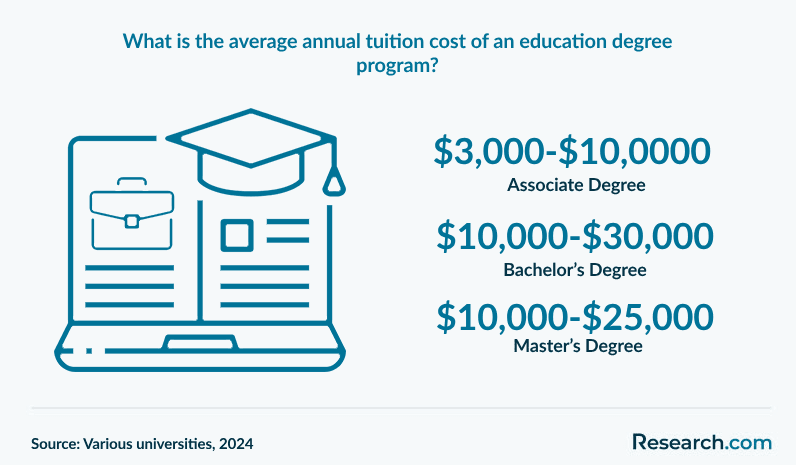
The total cost depends on tuition, required credits, fees, books, technology requirements, practicum expenses, and whether the school charges different rates for in-state and out-of-state students. The average cost of a master's in education program is typically around $17,900. If spread over two years, that equals about $8,950 per year, although a one-year format often concentrates the expense into a shorter payment period.
- Public vs. private tuition: Public institutions charge approximately $8,347 for online master’s programs on average, while private nonprofit colleges average around $12,896.
- Lower-cost options: The most affordable online programs range from $4,000 to $7,000 per year.
- Higher-cost programs: Tuition at private institutions can exceed $26,597 annually.
- Hidden costs: Students should ask about technology fees, graduation fees, background checks, licensing-related testing, practicum travel, and required software.
Students focused on affordability can also review Research.com’s guide to the cheapest online elementary education degree for examples of accredited education pathways with lower tuition.
What are the financial aid options for students enrolling in a 1-year online master’s in education program?
Online graduate students should build a funding plan before enrolling because accelerated programs may require larger payments over a shorter timeline. Common options include federal aid, state programs, institutional awards, scholarships, employer assistance, and private loans.
1. Federal financial aid
Start with the Free Application for Federal Student Aid (FAFSA). Graduate students commonly use federal loans such as Direct Unsubsidized Loans or Grad PLUS Loans when eligible. Pell Grants that provide up to $6,895 without repayment requirements are generally associated with qualifying undergraduate study, so graduate students should verify eligibility rather than assuming Pell funding applies to a master’s program.
2. State financial aid
Some states offer grants, scholarships, or educator-specific incentives for residents. These may require FAFSA completion, employment in a shortage area, service commitments, or enrollment in an approved institution.
3. Institutional aid
Universities may offer scholarships, tuition discounts, assistantships, grants, or graduate education awards. Ask whether online students qualify for the same funding as campus students.
4. Scholarships
External scholarships may reduce borrowing. Examples include the GetEducated.com Distance Learning Scholarship, which awards $1,000 to students with a minimum 3.0 GPA, and the Emerging Voices Scholarship, along with other graduate student awards.
5. Private loans
Private loans can fill funding gaps, but they often have higher interest rates, fewer protections, and less flexible repayment terms than federal options. Compare them carefully and borrow only what you can reasonably repay.
The chart below shows the top five states that award the largest total amount of financial aid to college students.
What are the prerequisites for enrolling in a 1-year online master’s in education program?
Admission requirements differ by school and specialization. Programs connected to licensure, leadership certification, or counseling preparation may have stricter prerequisites than general curriculum and instruction programs.
Common admission requirements
- Bachelor’s degree: Applicants generally need a bachelor’s degree from an accredited institution. Some programs prefer education majors, while others admit candidates from related or unrelated fields. If you still need to finish an undergraduate degree, Research.com’s guide to an accelerated bachelor's degree explains faster bachelor’s pathways.
- Minimum GPA: Many programs expect a GPA between 2.5 and 3.0, often calculated from the last 60 credit hours of undergraduate coursework. Some schools may offer provisional admission.
- Recommendation letters: Applicants are often asked for two to three letters from supervisors, professors, or professional mentors.
- Personal statement: Most programs request a statement describing your teaching philosophy, career goals, and reasons for pursuing graduate study.
- Teaching experience: Some advanced tracks prefer or require classroom experience, especially leadership, literacy, or specialized teaching pathways.
- GRE scores: Many online education master’s programs no longer require the GRE, though policies vary.
- English proficiency: Non-native English speakers may need TOEFL or IELTS scores.
If your long-term interests include counseling or school-based psychological services, compare requirements carefully with programs such as the best NASP accredited online school psychology programs.
What online support services are offered in a 1-year online master’s in education program?
Support services matter more in an accelerated program because students have less time to recover from technical issues, unclear expectations, or academic setbacks. Strong programs usually provide academic advising, faculty office hours, online library access, tutoring, writing support, technical assistance, career services, and student success coaching.
Before enrolling, ask how quickly instructors respond, whether advising is available outside business hours, how group projects are managed online, and whether career support is tailored to education professionals. Students comparing cost and support can also review Research.com’s guide to the cheapest online educational leadership programs.
Is the program’s return on investment worth it?
The return on investment depends on what you pay, how much you borrow, whether your employer rewards graduate credits, and whether the degree qualifies you for the role you want. A one-year program may improve ROI by shortening time in school, but only if the credential is accepted by your employer, district, licensing board, or doctoral program.
| ROI question | Why it matters |
| Will my district or employer recognize this degree for pay advancement? | Some employers require approved institutions, specific credits, or prior approval before salary movement. |
| Does the program support my target role? | A general M.Ed. may not meet requirements for principal licensure, counseling licensure, or special education endorsement. |
| What is the total cost after fees and aid? | Tuition alone can understate the real cost of attendance. |
| How much debt will I carry? | Loan payments can reduce the financial value of any salary increase. |
| Can I keep working while enrolled? | Maintaining income during the program can improve affordability. |
For a broader affordability comparison, see Research.com’s guide to the cheapest online education degree.
What courses are typically in a 1-year online master’s in education program?
Coursework varies by institution, but most programs combine education theory, instructional practice, research, leadership, and applied projects. In a one-year format, these courses move quickly and may require weekly writing, collaboration, or field-based assignments.
| Course area | Examples of topics | Why it matters |
| Educational foundations | Introduction to Education; History and Philosophy of Education; Teaching and Learning Theories | Builds a framework for understanding schooling, learning, and instructional decision-making. |
| Curriculum and instruction | Learning Theories and Instructional Strategies; Curriculum Development and Design | Prepares educators to plan lessons, units, and programs aligned with learning outcomes. |
| Educational research | Research Methods in Education; Data Analysis and Evaluation | Helps students interpret evidence, evaluate programs, and use data responsibly. |
| Specialized practice | Special Education Practices; Educational Technology Integration; Adult Learning Theories | Supports work with specific learner groups, technologies, or training environments. |
| Leadership and policy | Educational Leadership and Administration; Ethical Leadership in Education; Education Policy Analysis | Develops skills for school improvement, decision-making, and organizational leadership. |
| Diversity and inclusion | Educational Equity and Social Justice; Multicultural Education | Strengthens culturally responsive teaching and equitable learning design. |
| Applied learning | Capstone Project or Thesis; Field Experience or Practicum (if required) | Demonstrates mastery through research, practice, or a professional project. |
| Advanced topics | Child Development and Psychology; Instructional Leadership | Deepens understanding of learner development and instructional improvement. |
What challenges might you face in a 1-year online master’s in education program?
The main challenge is intensity. Students may face overlapping deadlines, dense reading loads, group work across time zones, limited breaks, and fast-moving expectations. Online learning also requires comfort with digital platforms, independent communication, and proactive problem-solving.
- Time pressure: Short terms leave little room for missed assignments or delayed feedback.
- Work-life conflict: Teaching full time while completing graduate coursework can be demanding during grading periods, testing seasons, or family obligations.
- Reduced hands-on time: Some accelerated programs may have fewer in-person experiences unless a practicum is required.
- Technology issues: Unstable internet, unfamiliar learning systems, or software requirements can create barriers.
- Licensure uncertainty: Students can mistakenly assume a master’s degree automatically satisfies certification or endorsement rules.
Students interested in other accelerated graduate formats can compare related online options, including masters in library science online.
How do accelerated online programs maintain academic rigor and quality?
High-quality accelerated programs preserve rigor by using structured course sequencing, frequent assessments, faculty engagement, accreditation-aligned outcomes, applied assignments, and clear rubrics. A shorter timeline should not mean fewer expectations; instead, the work is compressed into a more intensive calendar.
Look for evidence of quality in faculty credentials, accreditation, learning outcomes, capstone expectations, student support, and transparent workload estimates. Programs that rely only on prerecorded lectures without meaningful feedback may be less useful than programs that combine flexibility with active faculty guidance. For a comparison of quality considerations in another discipline, Research.com also reviews the best online history degree.
What types of specializations are available in a 1-year online master’s in education program?
Specialization choice should come before school choice. A fast program is only useful if it builds the expertise your next role requires.
| Specialization | Best for | What to verify |
| Curriculum and Instruction | Teachers, instructional coaches, curriculum specialists, and educators improving classroom practice | Whether the program includes assessment, instructional design, and curriculum evaluation |
| Educational Leadership | Educators interested in school administration, department leadership, or district roles | Whether it meets principal or administrator certification requirements in your state |
| Special Education | Teachers supporting learners with disabilities and inclusive classrooms | Whether it leads to an endorsement or only provides advanced knowledge |
| Educational Technology | Instructional designers, online teachers, technology coaches, and training professionals | Whether coursework includes learning management systems, digital accessibility, and evaluation |
| Early Childhood Education | Educators working with young children and early learning systems | Whether state early childhood credential or licensing rules are addressed |
How to choose the best 1-year online master’s in education program
The right program should match your career goal, state requirements, schedule, budget, and learning style. Do not choose only by tuition, ranking, or speed.
1. Confirm accreditation first
Choose an institution with recognized accreditation. For educator preparation, also check whether the program is accredited or recognized by bodies such as the Council for the Accreditation of Educator Preparation (CAEP) or by a relevant regional accreditor. Accreditation affects employer recognition, transferability, financial aid eligibility, and doctoral admissions.
2. Match the program to your goal
A curriculum and instruction degree, a leadership degree, a special education degree, and a teaching credential program are not interchangeable. Ask the admissions office and your state education agency whether the degree supports the credential or role you want.
3. Review the curriculum in detail
Look beyond the program title. Compare course descriptions, practicum requirements, capstone expectations, research components, and specialization depth.
4. Evaluate faculty experience
Faculty with classroom, administrative, research, or instructional design experience can provide more practical guidance. Review faculty bios and ask whether students work directly with full-time faculty or adjunct instructors.
5. Test the fit of the online format
Ask whether courses are asynchronous, synchronous, or blended. Confirm weekly workload, group project expectations, technology requirements, and whether live sessions are recorded.
6. Compare total cost, not just tuition
Include fees, textbooks, software, testing, background checks, practicum travel, and lost income if you need to reduce work hours.
7. Ask the right questions before applying
- Is the program designed for licensed teachers, career changers, or both?
- Does it lead to any certification, endorsement, or licensure?
- Are online students eligible for the same scholarships as campus students?
- What percentage of students finish within the advertised timeline?
- How are field experiences arranged for out-of-state students?
- Will my employer approve this program for salary advancement?
- Can credits transfer into a doctoral program later?
Do employers value a 1-year online master’s in education?
Employers generally focus less on whether a degree was completed online and more on accreditation, relevance, evidence of skill, and whether the program meets role-specific requirements. A one-year online master’s can be respected when it comes from an accredited institution and includes rigorous, job-relevant coursework.
Still, employer policies vary. School districts may have approved provider lists, salary schedule rules, or restrictions on credits earned after a certain date. Private schools, nonprofits, and corporate employers may evaluate the degree based on demonstrated competencies in training, leadership, curriculum, or technology. Students comparing affordable graduate options in other subject areas can also review the cheapest online master's in English.
What career paths are available for graduates of a 1-year online master’s in education program?
Career outcomes depend on prior experience, licensure, specialization, location, and employer requirements. Common paths include teaching advancement, leadership, curriculum work, counseling-related roles, and training positions outside schools.
Classroom teacher
Many graduates remain in the classroom and use the degree to deepen expertise in areas such as special education, STEM, literacy, or early childhood education. An online teaching degree may be more appropriate for students who still need a teaching credential, while a master’s may support advancement for licensed educators.
Educational administrator
Graduates may pursue roles such as assistant principal, principal, school administrator, or district leader. These positions often require specific administrative credentials, so verify state and district rules before choosing a leadership track.
School counselor
School counseling usually has separate licensure and practicum requirements. A master’s in education can support related student services knowledge, but students aiming for counseling licensure should select a qualifying counseling program. For a related career discussion, Research.com answers the question, How much do Christian counselors make?
Curriculum developer
Curriculum specialists, instructional coordinators, and learning designers create, revise, and evaluate instructional materials. This path fits graduates with strong skills in standards alignment, assessment, and instructional design.
Corporate trainer
Educators can move into business training, onboarding, employee development, or instructional design. Adult learning theory, digital learning tools, and assessment skills are especially useful in these roles.
Interdisciplinary education roles
Some graduates apply education expertise in fields such as sustainability education, museum learning, nonprofit programming, or community outreach. For example, Research.com discusses environmental science degree jobs, where education and public communication skills can overlap with environmental learning initiatives.
Writing and teaching can also intersect. For example, postsecondary teaching is discussed as one of the best careers to pursue with a creative writing masters degree.
Can a 1-year online master’s in education propel you toward a doctorate?
Yes, a one-year online master’s in education can be a stepping stone toward doctoral study if it includes research preparation, strong faculty mentorship, and a curriculum aligned with your doctoral interests. Students considering doctoral work should ask whether the program includes a thesis, capstone, research methods course, or opportunities to develop academic writing.
If your goal is doctoral-level leadership, compare EdD requirements early. Research.com’s guide to the shortest EdD program online can help you understand faster doctoral pathways.
How can I transition from a 1-year master’s in education to pursuing an online EdD?
To move from a master’s program into an EdD, choose coursework and projects that connect to your intended doctoral focus, such as instructional leadership, educational equity, policy, technology integration, or organizational change. Keep strong writing samples, build relationships with faculty who can write recommendations, and confirm whether the EdD accepts your master’s credits or requires a specific GPA.
When comparing doctoral options, review curriculum structure, dissertation or capstone requirements, faculty expertise, residency expectations, and tuition. Research.com’s guide to the best EdD programs online can help you compare affordable and reputable options.
How can alumni networks and professional development support boost long-term success?
A strong alumni network can extend the value of the degree after graduation. Look for programs that offer mentoring, professional development workshops, district partnerships, career coaching, leadership seminars, and access to education conferences or job boards.
These connections can help graduates identify openings, prepare for leadership interviews, find doctoral mentors, and stay current with education trends. Some students may also use professional networks to explore online leadership doctoral programs.
How can a 1-year online master’s in education expand interdisciplinary career opportunities?
Education degrees build transferable skills in communication, training, curriculum design, assessment, leadership, and learning technology. Those skills can apply beyond K-12 schools, especially in organizations that need people to explain complex information, train adults, build learning systems, or evaluate program effectiveness.
Graduates may find crossover opportunities in corporate learning, nonprofit education, museum programming, environmental education, library instruction, public outreach, and education technology. For readers exploring library-related options, Research.com explains potential jobs with MLIS.
How can a 1-year online master’s in education fast-track your teaching career?
An accelerated master’s can shorten the time between deciding to pursue graduate education and applying new skills at work. For licensed teachers, the degree may support specialization, salary schedule movement, instructional coaching, department leadership, or preparation for administrative pathways.
However, it is not a shortcut around state licensure rules. If you need initial teacher certification, compare certification-focused pathways first. Research.com’s guide, What is the fastest path to earning a teaching degree?, can help you evaluate how quickly different teacher preparation options may work.
How can interdisciplinary studies, including history, enrich teaching practices?
Interdisciplinary study can make teaching more contextual, culturally aware, and intellectually engaging. History, for example, can help educators design lessons that connect content to social change, civic understanding, primary sources, and critical thinking.
Teachers who want deeper subject knowledge may pair education training with focused disciplinary study. Research.com’s guide to an affordable online master's in history may be useful for educators who want to strengthen content expertise and curriculum design.
What is the job market for graduates with a 1-year online master’s in education?
The job market for master’s-level education professionals is shaped by school staffing needs, leadership openings, public funding, technology adoption, and demand for training beyond traditional classrooms. A graduate degree can improve qualifications, but outcomes depend on specialization and local hiring conditions.
In 2023, about 3.67 million jobs required a master’s degree. That number is projected to grow to 4.11 million by 2033, adding 442,400 jobs over the decade. The 12.1% projected growth rate is higher than the 4.0% growth rate for all occupations. The share of jobs requiring a master’s degree is also projected to increase from 2.2% of total employment in 2023 to 2.4% by 2033.
Master’s degree holders earned a median annual salary of $79,840 in 2023. That is below the median wages for jobs requiring a doctoral or professional degree ($124,550) and bachelor's degree positions ($86,460), but it remains higher than wages associated with lower education levels. Workers with only a high school diploma are projected to experience slower job growth at 2.5% and lower earnings.
Postsecondary teachers, often called college or university professors, teach academic, career, and technical subjects. Among the occupations shown in the chart below, health specialties teachers are projected to have the highest number of average annual job openings and the highest median annual salary.
Common mistakes to avoid before enrolling
| Mistake | Better approach |
| Choosing the fastest program without checking accreditation. | Verify institutional accreditation and, when relevant, education-specific accreditation or state approval. |
| Assuming an M.Ed. automatically leads to licensure. | Confirm certification, endorsement, practicum, and exam requirements with your state agency. |
| Comparing only tuition per credit. | Calculate total cost, including fees, books, technology, travel, and lost income. |
| Ignoring workload. | Ask for weekly time estimates and sample course calendars before committing to a one-year plan. |
| Relying only on rankings. | Use rankings as a starting point, then compare curriculum fit, faculty, support, outcomes, and employer recognition. |
| Overlooking transfer and doctoral pathways. | Ask whether credits can transfer and whether the program prepares students for EdD or PhD admission. |
Key insights
- A one-year online master’s in education is best for motivated students who can handle an intensive schedule and already know how the degree supports their career plan.
- Accreditation and state approval are nonnegotiable, especially for licensure, endorsements, salary advancement, and doctoral study.
- The degree can support careers in teaching, leadership, curriculum design, special education, educational technology, counseling-related work, corporate training, and interdisciplinary education roles.
- Costs vary substantially. The average program cost is approximately $17,900, but students should compare total cost after fees, aid, and borrowing.
- Fast completion can improve ROI, but only when the program is recognized by employers and aligned with the graduate’s target role.
- Before applying, ask about workload, live class requirements, practicum expectations, online support, completion timelines, and whether the program meets your state’s professional requirements.
References:
- Glassdoor. (n.d.). Teacher with master’s degree salary. Retrieved January 22, 2025, from Glassdoor teacher with master’s degree salary data
- Hanson, M. (2024, November 3). Pell Grant statistics. EducationData.org. Retrieved January 22, 2025, from EducationData.org Pell Grant statistics
- Salary.com. (2025). Corporate trainer salary. Retrieved January 22, 2025, from Salary.com corporate trainer salary
- Salary.com. (2025). Education administrator salary. Retrieved January 22, 2025, from Salary.com education administrator salary
- Salary.com. (2025). Educational consultant salary. Retrieved January 22, 2025, from Salary.com educational consultant salary
- Salary.com. (2025). High school teacher salary. Retrieved January 22, 2025, from Salary.com high school teacher salary
- Salary.com. (2025). School principal salary. Retrieved January 22, 2025, from Salary.com school principal salary
- Statista. (2024). Online education - United States. Retrieved January 22, 2025, from Statista online education in the United States
- U.S. Bureau of Labor Statistics. (2024). Occupations that need more education for entry are projected to grow faster than average. Retrieved January 22, 2025, from U.S. Bureau of Labor Statistics education summary
Other Things You Should Know About 1-Year Online Master’s in Education Programs
In 2027, most 1-year online Master's in Education programs require the completion of 30 to 36 credit hours. These programs are designed to be intensive, allowing students to complete all coursework within a year while covering essential education theories and practices.
No. Most 1-year online Master of Education programs accept applicants with a bachelor's degree and do not require a state teaching license for admission. Some concentrations, especially leadership or licensure-track options, may require current certification, teaching experience, or a valid educator license before enrollment.