
2027 Best Online Master’s Degree in Educational Counseling

Co-Founder and Chief Data Scientist
School counselors play a vital role in guiding students through academic, career, and personal challenges, making a Master’s in Educational Counseling a valuable step for those seeking to make a meaningful impact. The U.S. Bureau of Labor Statistics projects 5% job growth until 2032, adding thousands of positions and underscoring the growing demand for qualified counselors.
With this guide, readers can expect to gain insights into the key features of these programs, including their flexible formats, comprehensive curricula, and preparation for licensure and career advancement. We also highlight the importance of choosing a program with appropriate accreditation, such as CACREP, which ensures a high standard of education and often facilitates the licensure process.
What are the benefits of getting a degree in educational counseling?
- With a degree in educational counseling, you can qualify for roles such as school counselor, academic advisor, and career counselor. The training also opens doors for positions in human resources, training and development, and crisis intervention.
- The median annual salary for educational, guidance, and career counselors and advisors in the U.S. is around $65,140 as of 2024. Educational counselors specifically report average salaries ranging between $57,170 and $65,140.
- Earning an educational counseling degree online offers significant flexibility and convenience, making balancing studies with other personal and professional responsibilities possible. Online programs allow you to access coursework from anywhere, often at your own pace, eliminating the need to relocate or commute.
What can I expect from an educational counseling degree?
An educational counseling degree prepares you for a career dedicated to supporting students and clients through their academic and personal development. You can expect a curriculum covering subjects such as human development, counseling theories and techniques, ethical and legal issues, assessment methods, and multicultural counseling.
Practical components often include supervised internships or practicum experiences, giving you hands-on opportunities to work in educational or community settings.
Where can I work with an educational counseling degree?
With an educational counseling degree, you can work in a variety of settings. Most commonly, graduates find positions in public and private K-12 schools as elementary, middle, or high school counselors, where they support students’ academic, career, and social-emotional development.
Opportunities also exist at colleges and universities as academic advisors, admissions counselors, or career services counselors, guiding students through course selection, college transition, and job searches.
How much can I make with an educational counseling degree?
With an educational counseling degree in the United States, you can expect to earn a median annual salary of around $61,710 to $65,140 in 2025. The typical salary range varies depending on experience, location, and work environment: entry-level roles might start near $43,580, while experienced professionals in the top 10% can earn over $105,870 annually.
Salaries differ significantly by state; for example, the median in California is around $94,320, in Massachusetts $78,840, and in Texas $65,660.
- Best Online Master's Degrees in Educational Counseling for 2027 List of Programs
- How long does it take to complete an online master’s degree in educational counseling? Completion Time
- How does an online master’s degree in educational counseling compare to an on-campus program? How does an online master’s degree in educational counseling compare to an on-campus program?
- What is the average cost of an online master’s degree in educational counseling? Average Cost
- What are the financial aid options for students enrolling in an online master’s degree in educational counseling? Financial Aid
- What are the prerequisites for enrolling in an online master’s degree in educational counseling? Requirements
- What courses are typically in an online master’s degree in educational counseling? What courses are typically in an online master’s degree in educational counseling?
- What types of specializations are available in an online master’s degree in educational counseling? What types of specializations are available in an online master’s degree in educational counseling?
- How to choose the best online master’s degree in educational counseling? How to choose the best online master’s degree in educational counseling?
- What career paths are available for graduates of an online master’s degree in educational counseling Career Paths
- What is the job market for graduates with an online master’s degree in educational counseling? Job Market
- What is the return on investment for an online master’s degree in educational counseling? What is the return on investment for an online master’s degree in educational counseling?
- What challenges might students face in an online master’s degree in educational counseling? What challenges might students face in an online master’s degree in educational counseling?
- Can an affordable BCBA online program complement my educational counseling degree? Can an affordable BCBA online program complement my educational counseling degree?
Best Online Master's Degrees in Educational Counseling for 2027
Choosing an online master’s degree in educational counseling is a licensure, cost, and career decision—not just a school selection. The right program can prepare you for school counseling roles, supervised fieldwork, and state credentialing, while the wrong fit may delay licensure or add unnecessary debt. This guide is designed for working educators, career changers, and bachelor’s degree holders who want to compare online school counseling and educational counseling programs with a practical eye toward accreditation, field placement, affordability, and career outcomes.
You will learn which programs are featured, how long online educational counseling master’s programs typically take, what they cost, how online study compares with campus-based training, what admissions requirements to expect, and how to evaluate whether this path fits your goals. If your interests also include education technology, student-support platforms, or digital learning tools, some learners may explore complementary options such as a mobile app development online degree, but counseling licensure requirements should remain the main priority if your goal is to work directly with students.
Quick answer: Is an online master’s in educational counseling worth considering?
An online master’s in educational counseling can be a strong option if you want to become a school counselor, need scheduling flexibility, and can complete required practicum or internship hours in an approved local setting. Most programs in this guide require 48 to 60 credits, take about 18 months to 3 years, and include supervised field experience. Before enrolling, verify accreditation, state licensure alignment, total cost, field placement support, and whether the program prepares you for the credential required where you plan to work.
How Research.com evaluates schools
Accreditation, program quality, cost transparency, and student outcomes matter when comparing counseling degrees because graduates often need state approval before working in schools. Research.com uses a ranking approach built from validated education datasets and institutional information. You can review the full process on our methodology page.
Our school research draws from major postsecondary education sources so prospective students can compare programs using consistent data rather than marketing claims alone.
- Integrated Postsecondary Education Data System (IPEDS database)
- Peterson’s database, including the Distance Learning Licensed Data Set
- College Scorecard database
- National Center for Education Statistics and related NCES education data resources
Featured online master’s programs in educational counseling
| Rank | School and program | Program length | Credits | Cost per credit | Accreditation listed |
| 1 | Fresno Pacific University — Master of Arts in School Counseling | 2 years | 50 credits | $770 | WASC Senior College and University Commission |
| 2 | University of Denver — Master of Arts in School Counseling | 22 months | 60 credits | $770 | Council for Accreditation of Counseling and Related Educational Programs |
| 3 | Bradley University — Master of Arts in Professional School Counseling | 3 years | 60 credits | $1,153 | Council for Accreditation of Counseling and Related Educational Programs |
| 4 | Liberty University — Master of Education (M.Ed.) in School Counseling | 2 years | 60 credits | $580 | Council for Accreditation of Counseling and Related Educational Programs |
| 5 | North Carolina State University — Master of Education (M.Ed.) in School Counseling | 3 years | 60 credits | $547 | Council for Accreditation of Counseling and Related Educational Programs |
| 6 | Campbellsville University — Master of Arts in Education in School Counseling | 18 months | 48 credits | $319 | Council for the Accreditation of Educator Preparation |
| 7 | Seton Hall University — Master of Arts in School Counseling | 2 years | 48 credits | $1,150 | Council for the Accreditation of Educator Preparation |
| 8 | Northwestern University — Master of Arts in Counseling | 18 months | 24 credits | $5,743 | Council for Accreditation of Counseling and Related Educational Programs |
| 9 | Eastern New Mexico University — Master of Education with Emphasis in School Counseling | 2 years | 48 credits | $317 | Higher Learning Commission |
| 10 | Grand Canyon University — Master of Education (M.Ed.) in School Counseling | 2 years | 60 credits | $615 | Higher Learning Commission |
1. Fresno Pacific University Master of Arts in School Counseling
The Master of Arts in School Counseling at Fresno Pacific University is built around 50 units of coursework and 800 hours of supervised field experience in K–12 environments. Students study topics such as Foundations of the School Counseling Profession, Social Emotional Development, Professionalism, Ethics & Legal Mandates, and Program Development & Core Curriculum. Graduates may apply for California’s PPS credential and pursue work as fully credentialed school counselors.
- Program length: 2 years
- Track or concentration: School Counseling
- Cost per credit: $770
- Credits required: 50 credits
- Accreditation: WASC Senior College and University Commission
2. University of Denver Master of Arts in School Counseling
The University of Denver offers an online Master of Arts in School Counseling through the Morgridge College of Education. The program prepares future school counselors to support students across P–12 settings, with attention to academic, career, and social/emotional development. The curriculum emphasizes advocacy, data-informed practice, social awareness, and reducing opportunity gaps for students from varied backgrounds.
- Program length: 22 months
- Track or concentration: School Counseling
- Cost per credit: $770
- Credits required: 60 credits
- Accreditation: Council for Accreditation of Counseling and Related Educational Programs
3. Bradley University Master of Arts in Professional School Counseling
The Bradley University Master of Arts in Professional School Counseling combines online coursework with two short, one-week campus residencies. These residencies are designed for hands-on skill practice and cohort connection. Coursework highlights culturally responsive counseling, leadership in school systems, and practical preparation for addressing academic, developmental, and social-emotional student needs.
- Program length: 3 years
- Track or concentration: School Counseling
- Cost per credit: $1,153
- Credits required: 60 credits
- Accreditation: Council for Accreditation of Counseling and Related Educational Programs
4. Liberty University Master of Education (M.Ed.) in School Counseling
Liberty University offers a Master of Education (M.Ed.) in School Counseling with CACREP and CAEP accreditation. The program prepares students for counseling roles in K-12 settings, including public, private, and Christian schools. Students complete a full-semester practicum and two full-semester internships, allowing them to build supervised experience in their local communities.
- Program length: 2 years
- Track or concentration: School Counseling
- Cost per credit: $580
- Credits required: 60 credits
- Accreditation: Council for Accreditation of Counseling and Related Educational Programs
5. North Carolina State University Master of Education (M.Ed.) in School Counseling
The North Carolina State University (NC State) Master of Education (M.Ed.) in School Counseling centers on multicultural counseling, advocacy, and social justice. The program connects research-based counseling methods with field application, preparing students to contribute to comprehensive school counseling programs and make data-informed decisions in diverse school communities.
- Program length: 3 years
- Track or concentration: School Counseling
- Cost per credit: $547
- Credits required: 60 credits
- Accreditation: Council for Accreditation of Counseling and Related Educational Programs
6. Campbellsville University Master of Arts in Education in School Counseling
The Campbellsville University Master of Arts in Education in School Counseling includes coursework in counseling theories, group counseling, substance abuse, college readiness, crisis intervention, cultural competency, current school counseling issues, and ethical and legal practice. Courses are developed and taught by professional and retired school counselors and administrators, giving students exposure to field-based perspectives.
- Program length: 18 months
- Track or concentration: School Counseling
- Cost per credit: $319
- Credits required: 48 credits
- Accreditation: Council for the Accreditation of Educator Preparation
7. Seton Hall University Master of Arts in School Counseling
Seton Hall University offers a CAEP-accredited Master of Arts in School Counseling that emphasizes equity, inclusion, multicultural competence, and student-centered practice. The program is designed for future counselors who want to address contemporary challenges in schools and serve as advocates for students from diverse communities.
- Program length: 2 years
- Track or concentration: School Counseling
- Cost per credit: $1,150
- Credits required: 48 credits
- Accreditation: Council for the Accreditation of Educator Preparation
8. Northwestern University Master of Arts in Counseling
The Northwestern University Master of Arts in Counseling includes coursework such as Theories of Counseling & Psychotherapy, Psychopathology & DSM-5 Diagnosis, Multicultural Counseling, Assessment & Career Counseling, and Addictions Counseling. Students also complete Practicum and Internship experiences totaling 800 hours, and elective options such as Cognitive Behavioral Therapy are available.
- Program length: 18 months
- Track or concentration: School Counseling
- Cost per credit: $5,743
- Credits required: 24 credits
- Accreditation: Council for Accreditation of Counseling and Related Educational Programs
9. Eastern New Mexico University Master of Education with Emphasis in School Counseling
Eastern New Mexico University offers a Master of Education with Emphasis in School Counseling for working professionals preparing for licensed K–12 school counseling roles. The curriculum covers Foundations of School Counseling; Human Growth & Development; Career Development & Counseling; Mental Health & Community Counseling; and related practicum and internship courses.
- Program length: 2 years
- Track or concentration: School Counseling
- Cost per credit: $317
- Credits required: 48 credits
- Accreditation: Higher Learning Commission
10. Grand Canyon University Master of Education (M.Ed.) in School Counseling
Grand Canyon University offers a Master of Education (M.Ed.) in School Counseling intended to prepare counselors to support students from pre-K through 12th grade. The curriculum includes Theories and Models of Counseling, Ethical and Legal Considerations, School Counseling Program Administration, and College & Career Counseling, along with training in mental health, trauma‑informed practice, and research methods.
- Program length: 2 years
- Track or concentration: School Counseling
- Cost per credit: $615
- Credits required: 60 credits
- Accreditation: Higher Learning Commission
How long does it take to finish an online master’s degree in educational counseling?
Most online master’s programs in educational counseling take about 18 months to 3 years. The exact timeline depends on credit requirements, course sequencing, whether you enroll full time or part time, and how quickly you can complete required fieldwork. Campbellsville University’s program, for example, can be completed in 18 months, while other programs are structured around 2-year or 3-year plans.
Students who want the shortest route should compare accelerated options carefully because speed alone does not guarantee the program will meet state licensure requirements. Research.com’s guide to the fastest online master's degree in educational counseling can help you identify shorter formats, but you should still verify internship hours, state approval, and accreditation.
Many programs require 42 to 60 credit hours and include several hundred hours of supervised practicum or internship experience. A faster program may work well if you can manage a heavy course load and arrange field placement quickly. A part-time schedule may be better if you are teaching, working full time, raising a family, or changing careers gradually.
| Study pace | Typical completion time | Best for | Main trade-off |
| Accelerated | About 18 months | Students who can study intensively and complete fieldwork on schedule | Less flexibility and a heavier workload |
| Full time | About 2 years | Students who want a balanced but direct path to graduation | May still be demanding during practicum and internship terms |
| Part time | About 2 to 3 years | Working adults who need more scheduling room | Longer time before licensure and employment eligibility |
Online vs. on-campus master’s in educational counseling: Which format is better?
An online master’s degree in educational counseling is usually better for students who need location flexibility, want to keep working, or cannot relocate for graduate school. Online programs may include live classes, recorded lectures, discussion boards, virtual simulations, and local practicum or internship placements. The strongest online programs still require substantial supervised practice because counseling is a hands-on profession.
Campus-based programs may be better for students who value face-to-face interaction, immediate faculty feedback, in-person role-play, and easier access to campus counseling labs or school partnerships. The trade-off is that on-campus study can require commuting, relocation, or a less flexible weekly schedule.
The best format depends on how you learn, where you plan to complete fieldwork, and how much structure you need. If you are comparing other education-focused online credentials, you may also want to review options such as the shortest EdS in special education online, especially if your long-term goal is advanced practice in special education rather than school counseling.
| Factor | Online program | On-campus program |
| Schedule flexibility | Usually stronger, especially for working adults | Often tied to fixed class meeting times |
| Field experience | Often completed locally, but placement coordination varies | May use established nearby school partnerships |
| Peer and faculty interaction | Depends on live sessions, advising, and cohort design | More natural in-person interaction |
| Skill practice | May use virtual role-play, residencies, or supervised site work | Often easier to practice counseling skills face to face |
| Best fit | Students who need geographic or work flexibility | Students who want a traditional campus environment |
What does an online master’s degree in educational counseling cost?
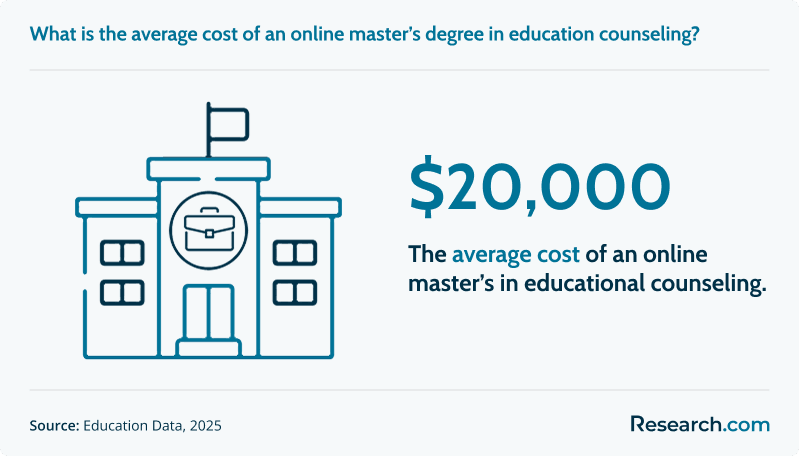
The full cost of an online master’s degree in educational counseling often ranges from about $20,000 to $30,000, but the total can vary widely. The biggest drivers are cost per credit, required credits, public or private institution status, residency rules, technology fees, textbooks, field placement expenses, and whether the program charges additional fees for online delivery.
- Some affordable accredited online counseling programs estimate total tuition around $25,000 to $30,000 when per-credit rates fall between $429 and $492.80.
- Among affordable online master’s in school counseling programs, median tuition is about $9,000 to $11,000 annual tuition, depending on program length, with some degrees totaling close to $20,000 to $25,000 overall.
- Private institutions and highly ranked programs may charge more than $1,000 per credit, which can push total costs above $60,000 to $100,000 in some cases.
A reasonable broad estimate is around $20,000 to $30,000 for the full online master’s in educational counseling, but applicants should calculate their own cost using the school’s official tuition page. Cost comparisons across fields can also be useful; for example, students comparing education and environmental or geography-focused graduate pathways may review the shortest online environmental geography degrees to understand how program length and tuition structures differ.
| Cost factor | Why it matters | Question to ask before enrolling |
| Cost per credit | This is the base tuition unit used by many online programs | Is the listed rate the same for all online students? |
| Required credits | A lower per-credit price may not mean a lower total cost if the program requires more credits | How many credits are required for graduation and licensure preparation? |
| Fees | Technology, clinical, graduation, and course fees can raise the final bill | Can the school provide a full estimated cost of attendance? |
| Field placement expenses | Internship travel, background checks, insurance, or site requirements may add costs | What costs are associated with practicum and internship placements? |
| Transfer credits | Accepted credits may reduce time and cost | Does the program accept graduate transfer credits? |
Financial aid options for online educational counseling master’s students
An online master’s degree in educational counseling can be financed through a mix of federal aid, institutional aid, employer support, and private scholarships. Start with the FAFSA if you plan to use federal student aid, then compare school-specific scholarships and tuition assistance policies before committing to a program.
- Direct Unsubsidized Loans: These graduate loans are not based on financial need, and interest starts accruing right away, including while you are enrolled. Graduate students can typically borrow up to $20,500 per academic year.
- Federal Work-Study (FWS) Program: Eligible students with financial need may qualify for part-time work that helps cover education-related expenses. FAFSA information is used to determine eligibility.
- University-specific scholarships: Many institutions offer graduate scholarships based on merit, need, program enrollment, or a combination of factors. Some schools automatically review admitted students, while others require separate applications.
- Private organizations and foundations: Counseling, education, human services, and community-focused organizations may offer scholarships for graduate students. Use scholarship databases, professional associations, and local foundations to search beyond the university.
- Grants: Grants generally do not need to be repaid and are often need-based. Federal Pell Grants are mainly for undergraduates, but some states and institutions may provide grant aid for graduate students.
- Employer tuition assistance: School districts, education agencies, nonprofits, and related employers may offer reimbursement or tuition support for staff pursuing advanced credentials. Ask human resources whether counseling coursework qualifies.
Some students reduce total costs by comparing program length, transfer credit policies, and related credential options. For example, those considering counseling-adjacent mental health training may also compare the shortest online addiction psychology programs, though these programs may not lead to the same school counseling credential.
Common admissions requirements for an online master’s in educational counseling
Admissions requirements vary by school, but most online master’s programs in educational counseling look for evidence that applicants can handle graduate-level coursework and are prepared for student-facing work. If you are comparing related helping professions, requirements may overlap with areas such as school social worker requirements by state, but counseling and social work licensure paths are not interchangeable.
- Bachelor’s degree from an accredited institution: Most programs require a bachelor’s degree from a regionally accredited college or university.
- Official transcripts: Applicants usually submit transcripts from every postsecondary institution attended, including community colleges and schools where no degree was completed.
- Letters of recommendation: Programs commonly request two or three recommendations from professors, supervisors, employers, or other professionals who can evaluate academic readiness, work ethic, leadership, and fit for counseling.
- Relevant experience: Paid or volunteer experience with children, adolescents, schools, mentoring programs, youth organizations, or human services may strengthen an application, even when it is not mandatory.
Courses typically included in an online master’s in educational counseling
Online educational counseling master’s programs combine counseling theory, school-based practice, ethics, child and adolescent development, career planning, assessment, and supervised fieldwork. Even accelerated online school counseling master's programs must still prepare students for the practical responsibilities of counseling in K-12 settings.
- Counseling Children and Adolescents: Students learn counseling methods for developmental, behavioral, emotional, and family-related concerns affecting younger clients.
- Foundations of School Counseling: This course introduces the history, purpose, and professional role of school counselors, including the ASCA (American School Counselor Association) National Model.
- Developmental Guidance and Counseling: Coursework focuses on designing school counseling programs that support academic, career, and social-emotional growth from elementary through high school.
- Practicum: This first supervised field experience typically includes a minimum of 100 supervised clock hours under CACREP standards and introduces students to direct and indirect counseling service.
- Internship: This more extensive supervised experience requires a minimum of 600 supervised clock hours under CACREP standards and applies counseling skills under site and faculty supervision.
Specializations in online educational counseling master’s programs
Specializations allow students to focus on the populations, school levels, or counseling functions most relevant to their goals. Some students also pursue post-master’s or add-on credentials through the top online programs for graduate certificate in counseling, especially when they want targeted training beyond a general school counseling curriculum.
- General School Counseling: This is the most common route for students preparing to serve K-12 populations. It includes academic planning, career guidance, social-emotional support, crisis response, group counseling, and collaboration with families and teachers.
- Elementary School Counseling: This focus is designed for students who want to work with younger children. Coursework may emphasize early intervention, play-based techniques, social skill development, and family-school collaboration.
- College and Career Readiness/Advising: This area is especially useful for future middle school and high school counselors. Topics may include career assessment, college admissions, financial aid guidance, workforce pathways, vocational options, and military pathways.
How to choose the best online master’s degree in educational counseling
The best online master’s in educational counseling is the one that matches your state credential requirements, budget, schedule, field placement needs, and career goal. A well-known school is not automatically the best choice if it does not prepare you for licensure where you plan to work.
- Confirm accreditation first. Many states require or strongly prefer graduates from CACREP-accredited programs for school counselor licensure. Accreditation can also affect license portability if you later move.
- Check state licensure alignment. Requirements for school counselors vary by state, including coursework, exam, practicum, internship, and credential rules. Ask the program directly whether it meets requirements in your state.
- Review the curriculum. Look for counseling theories, ethics, assessment, multicultural counseling, group counseling, career development, crisis intervention, consultation, and school counseling program design.
- Evaluate field placement support. Ask whether the school helps secure practicum and internship sites or expects you to find your own placement.
- Calculate total cost, not just tuition. Include fees, books, travel, background checks, technology costs, and any required residencies.
- Ask about online course delivery. Determine whether classes are synchronous, asynchronous, or blended, and whether live attendance is required.
- Compare graduation and support services. Strong advising, faculty access, licensure guidance, and career services can make a significant difference in an online program.
| If your priority is... | Look for... | Be cautious about... |
| Fast completion | 18 months or other accelerated formats | Programs that move quickly but provide limited field placement support |
| Licensure readiness | CACREP accreditation and state-specific advising | Assuming one state’s approval applies everywhere |
| Lower cost | Public universities, lower per-credit tuition, aid, and employer support | Ignoring fees, residency costs, and required credit totals |
| Working while enrolled | Asynchronous courses or flexible live class schedules | Underestimating practicum and internship time commitments |
| Hands-on training | Residencies, simulations, strong supervision, and local school partnerships | Programs with unclear site-supervisor expectations |
Common mistakes to avoid when choosing an online counseling program
- Choosing a program before checking licensure rules: School counseling credentials are state-regulated. Always verify requirements before applying.
- Focusing only on per-credit tuition: A program with a lower credit price may still cost more if it requires more credits or additional fees.
- Assuming online means fully remote: Counseling programs usually require supervised in-person fieldwork, even when coursework is online.
- Overlooking accreditation type: Institutional accreditation and specialized accreditation serve different purposes. Both may matter.
- Waiting too long to plan field placement: Securing a practicum or internship site can take time, especially in areas with limited school partnerships.
- Relying only on rankings: Rankings can help narrow the field, but your state requirements, budget, schedule, and career goals should drive the final decision.
Career paths for graduates of an online master’s degree in educational counseling
An online master’s degree in educational counseling most directly prepares graduates for school counselor or guidance counselor roles in K-12 schools. Depending on curriculum, accreditation, supervision, and state licensing rules, graduates may also pursue counseling, advising, student support, or human services roles in other settings.
The skills gained in counseling programs—communication, assessment, case planning, ethical decision-making, crisis response, and student advocacy—can transfer to adjacent support roles. If you are comparing student-support careers with healthcare support careers, it may help to review guides such as what are the benefits of being a medical assistant, but medical assisting and counseling require different training and credentials.
- School Counselor (K-12): Supports students with academic progress, social-emotional development, career exploration, and school success in public or private schools.
- Clinical Mental Health Counselor: Provides counseling in agencies, clinics, healthcare organizations, nonprofits, or private settings, but this path requires appropriate licensure.
- College or University Counselor or Advisor: Helps college students with academic planning, personal challenges, and career decisions.
- Career Counselor: Guides students or adults through career exploration, employment planning, job-search preparation, and professional development.
- Rehabilitation Counselor: Assists people with disabilities as they work toward personal, educational, and employment goals.
- Substance Abuse/Addiction Counselor: Works in prevention, intervention, treatment, or recovery services for individuals affected by substance use disorders.
- Student Affairs Professional: Works in student services, leadership development, residence life, advising, or community-based education programs.
Job market outlook for educational counseling graduates
The job market for graduates with an online master’s degree in educational counseling is supported by ongoing demand for academic advising, career planning, and mental health-related student support. According to the U.S. Bureau of Labor Statistics, employment for school and career counselors is projected to grow around 4% from 2023 to 2033, which is roughly as fast as the average for all occupations.
Graduates may find opportunities in K-12 schools, colleges and universities, mental health agencies, nonprofit organizations, and private practice, depending on licensure and specialization. Demand can vary by location, school funding, student population needs, and state hiring requirements.
Reported earnings differ by role and setting. School counselors earned an average of about $65,000 annually in 2024, while clinical mental health counselors earn around $59,000. If you are comparing counseling careers with healthcare support roles, Research.com also covers topics such as the highest paying medical assistant jobs, where job growth rates range from 16% to 19% for some roles.
Salary outcomes are not guaranteed. Your earnings and job prospects will depend on geographic location, employer type, licensure status, specialization, experience, and whether you work in a school, community agency, higher education, or another setting.
What is the return on investment for an online master’s degree in educational counseling?
ROI depends on how much you pay, how long it takes to graduate, whether the program leads to the credential you need, and what jobs become available after licensure. A lower-cost program with strong licensure alignment and effective field placement support may offer better value than a prestigious but expensive program that does not match your state requirements.
When estimating ROI, compare total tuition, fees, borrowing costs, lost income if you reduce work hours, and expected career mobility. Also consider non-financial value, such as the ability to work in schools, support student well-being, or move into advising and counseling-related leadership roles. Students still comparing broader psychology pathways may review a cheap psychology degree online to understand lower-cost alternatives, but those programs may not prepare graduates for school counselor licensure.
Challenges students may face in an online master’s degree in educational counseling
Online counseling students need strong time management because coursework, live sessions, readings, group projects, and fieldwork can overlap with full-time employment or family responsibilities. Some students also find that virtual learning requires more self-direction than campus-based study.
Field placement can be another challenge. While many online programs allow students to complete practicum and internship hours locally, some provide more placement assistance than others. Applicants should ask how sites are approved, who supervises fieldwork, and what happens if a placement falls through.
Technology can also affect the learning experience. Live virtual classes, recorded demonstrations, teleconferencing, and collaborative tools require reliable internet access and comfort with online communication. Students comparing lower-cost graduate programs in related fields may also find it useful to review the cheapest forensic psychology masters online before deciding which path best fits their professional goals.
Can an affordable BCBA online program complement an educational counseling degree?
An affordable BCBA online program may complement an educational counseling background if your work involves behavior intervention, special education collaboration, or support for students with complex behavioral needs. However, BCBA preparation and school counseling preparation lead to different professional functions and credentialing expectations.
If you want to add behavior analysis expertise to a counseling or education background, compare curriculum, supervision requirements, certification rules, and total cost before enrolling. Research.com’s guide to an affordable BCBA online program can help you evaluate whether behavior analysis training fits your long-term role in schools or student support services.
What graduates say about online master’s programs in educational counseling
- Susie: "The online format helped me move into school counseling without leaving my job. I learned how developmental guidance and crisis intervention work in real school settings, and the flexible schedule made it possible to study when I could focus. The program strengthened both my counseling skills and my confidence working with students from different backgrounds."
- Abe: "I was unsure whether an online counseling program would feel connected, but the live virtual classes and accessible faculty made the experience much more personal than I expected. Completing my practicum at a local school helped me apply what I was learning right away, and I felt ready to pursue certification after graduation."
- Zelda: "Earning my master’s online gave me a realistic way to keep working while preparing for a counseling career. The coursework was demanding, but the flexibility let me build practical skills, advocate for students more effectively, and move toward a new professional path without giving up my income."
Key Insights
- An online master’s in educational counseling is best for students who need flexibility but can still complete supervised school-based fieldwork.
- Most programs take about 18 months to 3 years and commonly require 48 to 60 credits.
- Accreditation and state licensure alignment are more important than convenience, speed, or school name recognition.
- Total cost varies widely, so compare fees, required credits, field placement expenses, and financial aid—not just tuition per credit.
- Online and campus programs can both prepare students well, but online learners must be proactive about field placement, advising, and time management.
- The most direct career path is K-12 school counseling, though graduates may also pursue advising, career counseling, student affairs, and related human services roles depending on licensure and training.
- Before enrolling, ask whether the program meets requirements in the state where you plan to work and what support is available for practicum, internship, and credentialing.
References:
- American College Health Association. (2024). NCHA IIIb Fall 2024 Reference Group Executive Summary. https://www.acha.org/wp-content/uploads/NCHA-IIIb_FALL_2024_REFERENCE_GROUP_EXECUTIVE_SUMMARY.pdf. Retrieved 29 June 2025
- Bureau of Labor Statistics. (2024). School and career counselors and advisors. U.S. Department of Labor. https://www.bls.gov/ooh/community-and-social-service/school-and-career-counselors.htm. Retrieved 29 June 2025
- College Counseling Center Mental Health Trends (CCMH). (n.d.). Diagnostic prevalence and trends in college counseling. Penn State University. https://ccmh.psu.edu/index.php?option=com_dailyplanetblog&view=entry&category=new-findings&id=59:diagnostic-prevalence-and-trends-in-college-counseling. Retrieved 29 June 2025.
- Zippia. (n.d.). Educational counselor education. https://www.zippia.com/education-counselor-jobs/education/. Retrieved 29 June 2025.
- ZipRecruiter. (n.d.). Educational Counselor Salary. https://www.ziprecruiter.com/Salaries/Educational-Counselor-Salary. Retrieved 29 June 2025.
Other Things Know About the Best Online Master's Degree in Educational Counseling Programs
Yes, students typically need a reliable computer with high-speed internet, a webcam, and a microphone for online educational counseling programs in 2027. Specific software like video conferencing platforms and digital learning management systems may also be required by the program.
Most online educational counseling master’s programs require a practicum plus an internship. A common standard is 100 to 300 supervised field hours, often completed in a K–12 school or college counseling setting under an approved site supervisor and faculty oversight.


