
2027 Best Online Master’s in Teaching Degree Programs

Co-Founder and Chief Data Scientist
Choosing an online Master’s in Teaching is usually a career decision, not just an academic one. You may be trying to qualify for initial licensure, move into a higher-paying teaching role, specialize in areas such as special education or ESL, or prepare for leadership work in curriculum, training, or administration. The challenge is that online programs vary widely in cost, licensure outcomes, fieldwork requirements, accreditation, pacing, and employer value.
This guide explains what an online Master’s in Teaching can offer, how it compares with campus-based study, what it may cost, which careers it can support, and how to evaluate programs before enrolling. It is designed for current teachers, career changers, paraprofessionals, education professionals, and working adults who need a practical way to compare online teaching master’s programs without overlooking licensure, accreditation, or return on investment.
Quick answer: Is an online Master’s in Teaching worth it?
An online Master’s in Teaching can be worth it if it helps you meet a specific goal: earning a teaching credential, moving into a specialization, qualifying for district salary advancement, or preparing for education leadership roles. It is most valuable when the program is accredited, accepted by your state licensing agency, affordable enough for your expected salary path, and flexible enough to complete while working.
- By 2025, the estimated total number of elementary and secondary teachers in public and private schools is expected to reach 3,688.
- Depending on the teaching role, reported earnings in this field can range from $38,640 to $106,690 or more.
- Online study can make graduate education more manageable for working educators because many programs offer flexible scheduling, asynchronous coursework, and specialization options.
What is an online Master’s in Teaching?
An online Master’s in Teaching is a graduate program focused on classroom instruction, curriculum design, student assessment, learning theory, and practical teaching skills. Some programs are built for licensed teachers who want advanced training, while others are designed for career changers who need a pathway to initial teacher certification.
The degree may be called a Master of Arts in Teaching (MAT), Master of Science in Teaching (MST), Master of Education (MEd), or a related title. The name matters less than the program’s purpose. Before applying, confirm whether the program leads to licensure, supports an added endorsement, or is intended mainly for professional development.
What can you expect in an online Master’s in Teaching program?
Most online teaching master’s programs combine graduate-level coursework with applied assignments. If the program leads to licensure, expect supervised fieldwork, clinical practice, student teaching, or an internship in an approved school setting. Fully online coursework does not always mean fully remote completion.
- Graduate classes commonly cover instructional planning, advanced teaching strategies, curriculum design, assessment, and classroom management.
- Many programs require students to analyze education data, conduct applied research, and evaluate current trends in learning and instruction.
- Assignments often ask students to connect theory to real classrooms through lesson plans, case studies, reflective projects, and field-based work.
- Digital literacy is usually part of the curriculum because teachers increasingly use learning management systems, online assessment tools, and classroom technology.
- Students typically interact with faculty and classmates through discussion boards, live sessions, virtual group projects, and online conferences.
- Well-designed online programs are expected to meet the same academic standards as comparable campus programs at the same institution.
Where can you work with an online Master’s in Teaching?
A Master’s in Teaching can support roles inside and outside the classroom, but your options depend on your license, state requirements, specialization, experience, and the type of school or organization hiring.
| Work setting | Possible roles | When this path makes sense |
| K-12 public or private schools | Classroom teacher, lead teacher, department chair, specialist teacher | Best for educators who want direct student impact and may need licensure or endorsements. |
| Higher education | Instructor, student support professional, academic services role, research support role | Useful for those interested in postsecondary teaching, advising, or academic administration. |
| School and district administration | Instructional coordinator, assistant principal, principal, curriculum leader | Appropriate for experienced educators who want to influence instruction beyond one classroom. |
| Education organizations and nonprofits | Educational consultant, policy analyst, curriculum specialist, program manager | Good fit for educators who want to work on systems, programs, policy, or training. |
| Corporate learning and development | Training specialist, instructional designer, training and development manager | Strong option for teachers who want to apply instructional skills in adult learning environments. |
How much can you make with an online Master’s in Teaching?
Teaching salaries vary by state, district, school type, grade level, union contract, years of experience, and credentials. A master’s degree can improve earning potential in some districts, but it does not guarantee a specific salary. Based on reports from the U.S. Bureau of Labor Statistics, the following income figures show the range of education roles connected to teaching and school leadership:
- Elementary Teachers: $68,000
- Middle School Teachers: $67,790
- Secondary School Teachers: $69,480
- Postsecondary Teachers: $64,990$108,860
- Career/Technical Education Teachers: $65,50067,680
- Special Education Teachers: $68,58074,310
- Adult Education and English as a Second Language Instructors: $63,130
- K to Secondary Education Administrators: $106,690
- Postsecondary Education Administrators: $115,180
Use these figures as broad reference points, not promises. Before enrolling, check your local salary schedule, ask whether a master’s degree changes your pay lane, and compare the total program cost with the likely earnings benefit.
- 2026 list of the best online Master’s in Teaching programs
- How long does an online Master’s in Teaching take?
- Online vs. on-campus Master’s in Teaching programs
- Average cost of an online Master’s in Teaching
- Financial aid for online Master’s in Teaching students
- Admissions requirements and prerequisites
- Typical courses in a Master’s in Teaching program
- Common specializations
- How to choose the right program
- Career paths after graduation
- Job market for Master’s in Teaching graduates
- Child development and teaching strategy
- When to consider an online doctorate of education
- Digital tools in online teaching programs
- Early childhood education outcomes
- Career advancement beyond classroom teaching
- Complementary credentials for educators
- Using child development research in teaching
- Skills educators need to stay competitive
- Career opportunities with an online doctorate in education
- How to make online teaching master’s programs more accessible
- Accreditation and quality benchmarks
- Balancing work, life, and graduate study
2026 List of the Best Online Master’s Degrees in Teaching
How Research.com ranks schools
Because graduate school is a major investment, the ranking below was developed using Research.com’s established methodology. The evaluation considered data from the Integrated Postsecondary Education Data System (IPEDS), Peterson’s database including its Distance Learning Licensed Data Set, College Scorecard, and the National Center for Education Statistics (NCES). Students should use the ranking as a starting point, then verify licensure fit, cost, field placement requirements, and accreditation for their own state and career goal.
| School | Program focus | Length | Cost | Credits | Accreditation listed |
| Johns Hopkins University | Educational Studies for Teach For America and TNTP members or alumni | 2 to 5 years (part-time) | $875 per credit | 39 | Middle States Commission on Higher Education; Maryland State Department of Education (MSDE) |
| University of Southern California | Single and Multi-Subject Teaching | 1 to 1.5 years (full-time); 17 months to 3 years (part-time) | $2,137 (average) per credit | 28 | Council for the Accreditation of Educator Preparation (CAEP) |
| University of North Carolina at Charlotte | Elementary Education, Foreign Language Education, Middle and Secondary Education, Special Education (K-12), English as a Second Language | 2 years or less depending on the program | $241 to $1,026 per credit depending on residence | 30+ depending on concentration | Southern Association of Colleges and Schools Commission on Colleges (SACSCOC) |
| Fordham University | Early Childhood Education, Early Childhood Special Education, Childhood Education, Childhood Special Education, Childhood and Early Childhood Education | 2 years | $1,560 per credit | 25 to 36 depending on concentration | Higher Learning Commission (HLC) of the Middle States Association |
| NHL Stenden University of Applied Sciences | New Developments for Teaching and Learning in International Schools; International Educational Leadership and Change | 2 years | €2,209 (EU students); €7,385 (non-EU students) per year | 60 European credits | Dutch-Flemish Accreditation Organisation |
| Western Governors University | English, Elementary; Mathematics; Science; Special Education | 2 years | $3,975 per 6-month term | 24-30 | CAEP; Association for Advancing Quality in Educator Preparation (AAQEP) |
| University of Maryland Global Campus | Secondary Education | 2 years | $524 (in-state); $659 (out-of-state) per credit | 36 | AAQEP; Maryland Higher Education Commission |
| Seattle Pacific University | Elementary Math and Science | 2 years | $670/$735 per credit | 56-66 | Northwest Commission on Colleges and Universities (NWCCU) |
| University of Arizona Global Campus | Curriculum and Instruction, Early Childhood Education, Higher Education, Special Education | 2 years | $149.23(resident); $1,794 (non-resident) per credit | 24 | CAEP |
| Louisiana State University | Higher Education Administration | 2 years | $459 per credit | 36 | SACSCOC |
1. Johns Hopkins University
Johns Hopkins University offers a fully online, asynchronous Master of Science in Education Educational Studies (Teach For America and TNTP) for Teach For America Corps members and alumni. The program is designed for educators who want evidence-based instruction, mentorship, elective flexibility, and access to a professional network while continuing to work. Courses include Teaching for Transformation, Classroom Management, Effective Practices in Teaching and Learning, and Seminar in Transformational Leadership and Teaching.
- Program Length: 2 to 5 years (part-time)
- Tracks/concentrations: Educational Studies
- Cost per Credit: $875
- Required Credits to Graduate: 39
- Accreditation: Middle States Commission on Higher Education; Maryland State Department of Education (MSDE)
2. University of Southern California
The University of Southern California’s online Master of Arts in Teaching combines rigorous online coursework with classroom experience. The program is structured for students preparing to teach diverse learners and includes routes connected to single-subject and multi-subject teaching. Graduates are prepared to sit for the California teaching credential exam and pursue the California Education Specialist Credential.
- Program Length: 1 to 1.5 years (full-time); 17 months to 3 years (part-time)
- Tracks/concentrations: Single and Multi-Subject Teaching
- Cost per Credit: $2,137 (average)
- Required Credits to Graduate: 28
- Accreditation: Council for the Accreditation of Educator Preparation (CAEP)
3. University of North Carolina at Charlotte
The University of North Carolina at Charlotte offers several online graduate education and teaching programs for certified teachers, residency instructors, and career changers. Concentrations span early childhood, linguistics, foreign language education, special education, and other fields. Program length depends on the selected pathway and required courses.
- Program Length: 2 years or less (depending on the program)
- Tracks/concentrations: Elementary Education (Phase II); Foreign Language Education; Middle and Secondary Education; Special Education (K-12); English as a Second Language
- Cost per Credit: $241 to $1,026 (depending on the residence)
- Required Credits to Graduate: 30+ (depending on concentration)
- Accreditation: Southern Association of Colleges and Schools Commission on Colleges (SACSCOC)
4. Fordham University
Fordham University’s fully online Master of Science in Teaching is designed for students seeking teacher certification. The curriculum emphasizes modern teaching practices, student development, and individualized learning. Students select from five concentrations related to early childhood, childhood, and special education.
- Program Length: 2 years
- Tracks/concentrations: Early Childhood Education; Early Childhood Special Education; Childhood Education; Childhood Special Education; Childhood and Early Childhood Education
- Cost per Credit: $1,560
- Required Credits to Graduate: 25 to 36 (depending on concentration)
- Accreditation: Higher Learning Commission (HLC) of the Middle States Association
5. NHL Stenden University of Applied Sciences
NHL Stenden University of Applied Sciences offers the Master’s Learning & Innovation special track in International Teacher Education for international educators. The program blends online modules with three weeks of intensive summer study in Leeuwarden, the Netherlands. Students collaborate with peers worldwide and connect assignments to challenges from their own teaching and professional settings.
- Program Length: 2 years
- Tracks/concentrations: New Developments for Teaching and Learning in International Schools; International Educational Leadership and Change
- Cost per year: €2,209 (EU students); €7,385 (non-EU students)
- Required Credits to Graduate: 60 European credits
- Accreditation: Dutch-Flemish Accreditation Organisation
6. Western Governors University
Western Governors University offers a competency-based MAT for students preparing for licensure and for learners without a bachelor’s degree in education. Depending on the specialization, students complete 19 to 26 courses. Unlicensed students also complete preclinical experiences and student teaching to build classroom readiness.
- Program Length: 2 years
- Tracks/Concentrations: English, Elementary; Mathematics; Science; Special Education
- Cost per 6-month Term: $3,975
- Required Credits to Graduate: 24-30
- Accreditation: CAEP; Association for Advancing Quality in Educator Preparation (AAQEP)
7. University of Maryland Global Campus
The University of Maryland Global Campus offers a MAT focused on secondary education licensure in a specific subject. Coursework covers teaching and learning foundations, reading and literacy, subject methods, and assessment. Students complete an approximately 18-week full-time, on-site field experience with a mentor teacher, and an accelerated pathway is available.
- Program Length: 2 years
- Tracks/Concentrations: Secondary Education
- Cost per Credit: $524 (in-state); $659 (out-of-state)
- Required Credits to Graduate: 36
- Accreditation: AAQEP; Maryland Higher Education Commission
8. Seattle Pacific University
Seattle Pacific University delivers a cohort-based online MAT that includes coursework in equitable teaching, reading instruction, learning psychology, and subject methods. Students complete a 70-day internship beginning mid-winter. The part-time program can support eligibility for the Washington Residency Teacher Certificate, and accelerated options include the Accelerated Master in Teaching Mathematics and Science (AMTMS) and Accelerated Master of Arts in Teaching (AMAT).
- Program Length: 2 years
- Tracks/Concentrations: Elementary Math and Science
- Cost per Credit: $670/$735
- Required Credits to Graduate: 56-66
- Accreditation: Northwest Commission on Colleges and Universities (NWCCU)
9. University of Arizona Global Campus
The University of Arizona Global Campus offers an MA in Education built around six-week accelerated courses. Concentrations include curriculum and instruction, early childhood education, higher education, and special education. Students study instructional methods, curriculum design, assessment, pedagogical theory, communication, and academic writing, and complete education research and a capstone project during the first year.
- Program Length: 2 years
- Tracks/Concentrations: Curriculum and Instruction; Early Childhood Education; Higher Education; Special Education
- Cost per Credit: $149.23(resident); $1,794 (non-resident)
- Required Credits to Graduate: 24
- Accreditation: CAEP
10. Louisiana State University
Louisiana State University offers an online Master of Arts in Education with a concentration in Higher Education Administration. The program is intended for students who want leadership roles in postsecondary education. Topics include enrollment management, admissions, fundraising, marketing, educational technology, student and academic affairs, diversity and inclusion management, and corporate partnerships. Class size is reported as 20 to 25 individuals.
- Program Length: 2 years
- Tracks/Concentrations: Higher Education Administration
- Cost per Credit: $459
- Required Credits to Graduate: 36
- Accreditation: SACSCOC
Key findings for prospective students
- The average costs of graduate studies were $29,931 for private nonprofit schools, $14,161 for private for-profit institutions, and $12,596 for public universities.
- Some online colleges, around 22.3%, charge more fees than their traditional counterparts.
- 37.3% of teachers in public and private elementary and secondary schools had 10 to 20 years of teaching experience.
- Educators with a master’s degree usually earn around $66,960, but teachers with a doctorate earn 6% more.
- The job outlook of teachers across levels in the U.S. is quite slow, at 1% from 2022 to 2032, due to various reasons such as low wages, high education costs, inequitable funding practices, and poor working conditions.
How long does it take to complete an online Master’s in Teaching program?
An online master’s degree in education commonly takes about two years. The exact timeline depends on the number of credits, whether the program includes student teaching or an internship, and whether you enroll full time, part time, or in an accelerated format. Some programs allow students to finish in one year, while part-time programs may take longer.
| Enrollment format | Typical fit | Main trade-off |
| Full-time | Students who can reduce work hours or focus heavily on graduate study | Faster completion, but heavier weekly workload |
| Part-time | Working teachers, parents, and career changers with limited study time | More manageable schedule, but longer time to graduation |
| Accelerated | Students with strong time management and clear career urgency | Shorter timeline, but less room for schedule disruptions |
| Licensure-track | Students who need supervised practice for certification | Field placements can extend or complicate the timeline |
Before committing, ask whether field placements can be completed near your home, how many weekly hours are expected, and whether summer terms are required. These details often determine whether the program is realistic for working adults.
How does an online Master’s in Teaching compare to an on-campus program?
Online and campus-based teaching master’s programs can cover similar academic content, but the learning experience is different. The better choice depends on your schedule, location, learning style, need for face-to-face interaction, and fieldwork requirements.
| Factor | Online Master’s in Teaching | On-campus Master’s in Teaching |
| Flexibility | Often better for working adults because coursework may be asynchronous or scheduled outside school hours | Less flexible because classes usually follow set meeting times |
| Learning format | Uses virtual classrooms, online discussions, collaborative platforms, and digital assignments | Relies more on in-person classes, campus activities, and direct classroom discussion |
| Networking | Can include live sessions, virtual seminars, cohort groups, and online conferences | Offers easier face-to-face networking with faculty and classmates |
| Access to resources | Depends on online advising, digital libraries, tech support, and virtual career services | Provides direct access to campus offices, libraries, events, and facilities |
| Best for | Students who need location independence and schedule control | Students who prefer in-person structure and campus community |
Online programs often use asynchronous learning, which lets students complete lectures and assignments around work schedules. However, licensure programs may still require in-person student teaching or supervised placements. Employers generally focus more on accreditation, licensure, experience, and demonstrated teaching skill than on whether coursework was online. For that reason, choosing from accredited online teaching degree programs is essential.
What is the average cost of an online Master’s in Teaching program?
The average costs of tuition and fees for a graduate degree in the U.S. during the 20212022 school year were $29,931 for private nonprofit schools, $14,161 for private for-profit institutions, and $12,596 for public universities, according to data from the NCES (2023a). Master of education programs costing about $52,000 in many institutions (Hanson, 2022) have pushed many educators to compare online options carefully.
Online students may save on commuting, relocation, housing, campus meals, parking, and some physical materials. Still, online is not automatically cheaper. Some schools charge technology fees, distance-learning fees, digital resource fees, or higher online tuition. Some online colleges, around 22.3%, charge more fees than their traditional counterparts.
| Cost factor | Why it matters | Question to ask |
| Tuition per credit or term | This is usually the largest direct cost. | Is tuition charged per credit, per course, per term, or as a flat program rate? |
| Required credits | A lower per-credit price may not mean a cheaper program if more credits are required. | How many credits are required to graduate? |
| Online and technology fees | These can narrow or eliminate expected online savings. | Are online students charged additional fees? |
| Field placement costs | Student teaching can affect transportation, work hours, and childcare needs. | Will I need to reduce work hours for fieldwork? |
| Licensure expenses | Exams, background checks, and applications can add costs. | Which certification costs are not included in tuition? |
| Transfer credit policy | Accepted graduate credits can reduce total cost and time. | Does the program accept transfer credits or prior graduate coursework? |
The most useful comparison is total cost to completion, not advertised tuition. Include fees, books, travel, exam costs, fieldwork expenses, and the income you may lose if student teaching requires time away from work.
What are the financial aid options for students enrolling in an online Master’s in Teaching program?
Online Master’s in Teaching students may be eligible for several types of aid, but eligibility depends on the school, enrollment status, program type, and federal rules. Start by confirming that the institution participates in federal student aid and that the program itself qualifies.
- Federal student loans: Many graduate students use federal loans to finance part of their degree, but borrowing should be tied to a realistic repayment plan.
- Loan forgiveness programs: Educators who teach in high-need schools or subjects may qualify for certain forgiveness options if they meet all service and program rules.
- TEACH Grant: The Teacher Education Assistance for College and Higher Education (TEACH) Grant may help eligible students who commit to qualifying teaching service.
- Graduate assistantships: Some programs offer assistantships, tuition waivers, or stipends in exchange for teaching, research, or faculty support work.
- Institutional scholarships: Colleges may provide scholarships for graduate education students, licensed teachers, or candidates in shortage areas.
- Employer or district support: Some school districts reimburse tuition or offer professional development funding for approved graduate coursework.
Scholarships and grants for aspiring or current educators may include the following:
- Edwyna Wheadon Postgraduate Training Scholarship For postgraduate students training to improve teaching skills.
- Nancy Larson Foundation For graduate students pursuing an elementary education major.
- National Academy of Education/Spencer Dissertation Fellowship For graduate students whose dissertations focus on improving education practice.
- The School Superintendents Association (AASA) Educational Administration Scholarships For graduate students in school administration who intend to become school superintendents.
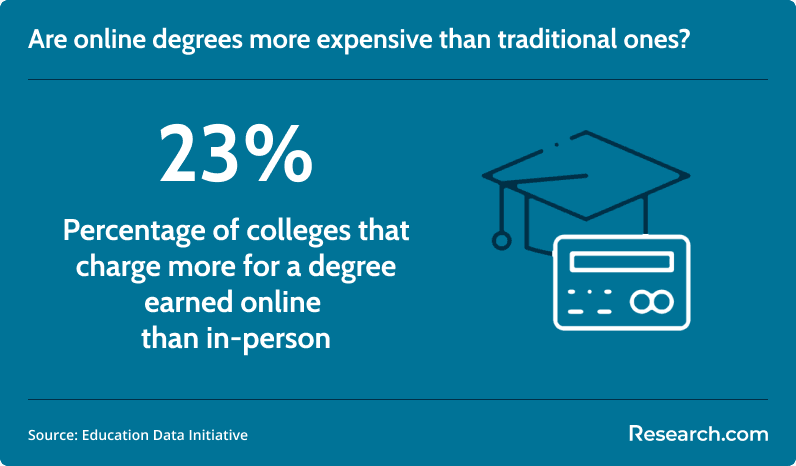
Do not assume online study automatically reduces borrowing. Because 23% of colleges charge more for online degrees than traditional degrees, request a full cost sheet and ask the financial aid office to estimate your aid package before enrolling.
What are the prerequisites for enrolling in an online Master’s in Teaching program?
Admissions requirements differ by university and by whether the program is for licensed teachers, career changers, or future administrators. Most online Master’s in Teaching programs ask for a combination of academic records, professional materials, and evidence that you are prepared for graduate-level education work.
- Bachelor’s degree in teaching/similar field
- Official transcripts
- Minimum 2.5 GPA
- Updated resume or CV
- Prior work in the field of education (if applicable)
- Statement of purpose or personal essay
- Letters of recommendation
- GRE/GMAT scores (if applicable)
Some schools waive GRE/GMAT requirements, while others require an interview, proof of English language proficiency for international applicants, or documentation of teaching experience. If you do not have an education background, the school may require prerequisite coursework in learning theory, classroom management, or subject-area content such as Math, Biology, or English.
Applicants should also be prepared to show communication skill, critical thinking, professionalism, and commitment to student development. For licensure-track programs, verify whether your undergraduate coursework satisfies subject-area requirements before assuming you can begin clinical practice.
What courses are typically in an online Master’s in Teaching program?
Coursework in a Master’s in Teaching is designed to strengthen instructional skill, deepen understanding of student learning, and prepare educators to evaluate and improve classroom practice. Programs differ, but the following subjects are common.
| Course area | What students learn |
| Curriculum Development | How to design coherent curriculum, build lesson plans, and align learning goals with instruction. |
| Educational Psychology | How motivation, cognition, emotion, and development influence student learning. |
| Instructional Technology | How digital platforms, classroom technology, and online tools can support teaching and assessment. |
| Classroom Management | How to create structured, inclusive learning environments using effective teaching methods and strategies. |
| Assessment and Evaluation | How to measure student progress, interpret results, and adjust instruction. |
| Educational Research | How to read, conduct, and apply research to education problems. |
| Professional Development | How educators continue improving practice, credentials, and leadership capacity over time. |
From 2020 to 2021, 37.3% of teachers in public and private elementary and secondary schools had 10 to 20 years of teaching experience, while 29.1% had three to nine years of experience, according to the NCES (2023b). Graduate coursework is often built to help both experienced teachers and newer educators respond to increasingly complex classroom demands.
What types of specializations are available in online Master’s in Teaching programs?
Specializations help students align the degree with a specific role, student population, subject area, or leadership goal. The best concentration is the one that matches your license requirements and your intended career path.
| Specialization | Focus | Best for |
| Educational Administration | Organizational leadership, school policy, instructional leadership, and management | Teachers preparing for leadership or administrative pathways |
| Technology Integration | Educational technology tools, digital literacy, online instruction, and eLearning methods | Educators who want to lead digital learning or instructional technology initiatives |
| Curriculum and Instruction | Curriculum design, instructional planning, assessment, and program evaluation | Teachers interested in curriculum leadership or instructional coaching |
| Subject-Specific Specializations | Advanced pedagogy in fields such as Mathematics, Science, English, or Social Studies | Educators seeking content-area expertise or endorsements |
| Special Education | Inclusive instruction, individualized supports, disability services, and behavior management | Teachers interested in high-need special education roles |
| Literacy and Reading Instruction | Reading comprehension, literacy development, intervention, and cross-content reading strategies | Educators focused on literacy improvement and reading support |
A specialization can also shape future doctoral study. Students planning to continue into online doctorate degrees in education may use their master’s concentration to develop research interests and identify problems they want to investigate at the doctoral level.
In a study by the NCES (2023c), teachers with a doctorate earned, on average, 36% more than those with a bachelor’s degree, 6% more than those with a master’s degree, and 1% more than those with an education specialist degree or certificate. This does not mean every teacher should pursue a doctorate, but it does show why some educators use a master’s degree as one step in a longer advancement plan.
How to choose the best online Master’s in Teaching program
The best online Master’s in Teaching is not simply the highest-ranked or cheapest program. It is the program that meets your licensure needs, fits your schedule, has credible accreditation, supports your field placement requirements, and makes financial sense. Use rankings as one input, not the entire decision.
- Verify accreditation. For teacher preparation, check institutional accreditation and programmatic recognition such as CAEP when applicable. Accreditation supports transferability, financial aid eligibility, employer confidence, and licensing review.
- Confirm state licensure alignment. If you need certification, ask whether the program is approved for your state or whether additional exams, coursework, or placements are required.
- Evaluate flexibility honestly. A program advertised as online may still require synchronous classes, fieldwork, campus visits, or scheduled practicums. Review the calendar before applying.
- Compare total cost, not only tuition. Include fees, books, testing, travel, field placement expenses, and the cost of reducing work hours if required.
- Review teaching methods. Strong online programs use varied instructional strategies, applied projects, feedback-rich assignments, and relevant education technology rather than passive lectures alone.
- Check student support. Ask about advising, placement coordination, technical support, library access, tutoring, career services, and mental health resources.
- Assess networking value. Cohorts, mentorship, professional associations, alumni access, and school partnerships can matter when applying for jobs or leadership roles.
- Understand the online learning model. If you are new to online learning, review how discussions, exams, group projects, and faculty access work before enrolling.
| Common mistake | Why it can hurt you | Better approach |
| Choosing a program without checking licensure rules | You may graduate without meeting your state’s certification requirements. | Contact your state licensing agency and the program’s licensure office before applying. |
| Looking only at tuition | Fees, fieldwork, exams, and lost work time can change the real cost. | Calculate total cost to completion. |
| Assuming online means self-paced | Many programs have deadlines, live sessions, and cohort schedules. | Ask for a sample weekly schedule. |
| Ignoring field placement logistics | Student teaching can be difficult to arrange if the school has limited local partnerships. | Ask who secures placements and where past students completed them. |
| Relying only on rankings | A ranked program may not fit your state, budget, or career goal. | Use rankings alongside accreditation, cost, licensure, and outcomes data. |
What career paths are available for graduates of online Master’s in Teaching programs?
Graduates can continue in classroom teaching or move into specialized instructional, counseling, curriculum, administrative, or training roles. Some positions require additional licenses, certifications, or experience beyond the master’s degree.
| Career path | Reported income | Notes |
| Educational, Guidance, and Career Counselors and Advisors | $64,200 | May require counseling credentials depending on role and state. |
| Librarian/Media Collection Specialist | $64,770 | May require library/media specialist certification or a related degree. |
| Instructional Coordinators | $73,080 | Often suited for experienced teachers with curriculum expertise. |
| Curriculum Designer | $80,604 | Common in schools, publishers, online learning companies, and training teams. |
| Educational Content Writer | $84,151 | Useful for educators with strong writing and subject-matter expertise. |
| School Psychologist | $87,550 | Typically requires specialized graduate preparation and credentialing. |
| Other Education Administrators | $99,820 | May require leadership experience or administrative certification. |
| Educational Consultant | $109,001 | Experience, specialization, and client base strongly affect earnings. |
| Training and Development Managers | $132,100 | Often found in corporate, nonprofit, government, and workforce education settings. |
Students interested in learning, behavior, assessment, and student support may also explore careers in educational psychology. Those careers may require additional training beyond a teaching master’s, so check credential requirements early.
What is the job market for graduates with an online Master’s in Teaching?
The education job market is mixed. According to several BLS data, K to secondary teachers and administrators have a job outlook of only 1% from 2022 to 2032, while instructional coordinators are expected to see a 2% employment change. Postsecondary education administrators are projected to grow by 4%, and postsecondary teachers by 8%.
At the same time, shortages exist in specific areas. The U.S. Department of Education (2023) cited teacher shortages in special education and related services, STEM education, career and technical education, English as a second language, heritage languages or languages of origin, foreign languages, and bilingual education programs. This means specialization can matter as much as the degree itself.
Global demand is also part of the broader context. UNESCO reported that the world needs 44 million more teachers by 2030 to meet universal demands in primary and secondary education (UNESCO, 2023). For U.S. students, however, job prospects still depend heavily on local hiring conditions, state funding, certification area, and school district needs.
How does a Master’s in Teaching enhance child development strategies?
A Master’s in Teaching can deepen an educator’s understanding of how children learn, regulate emotions, build language, develop social skills, and respond to classroom environments. Programs that include developmental psychology and evidence-based intervention training help teachers design instruction that is more age-appropriate, inclusive, and responsive to student needs.
This background can also support work in child development careers, especially when paired with relevant field experience, licensure, or specialized credentials.
When is it the right time to pursue an online doctorate of education after a Master’s in Teaching?
An online doctorate of education may make sense after you have a clear leadership, research, policy, or systems-level goal. A doctorate is usually not necessary for classroom advancement alone, but it can be useful for educators aiming to become senior administrators, district leaders, faculty members, policy specialists, or high-level consultants.
Consider an online doctorate of education when you have identified the problem you want to solve, understand the time commitment, and can connect the degree to a realistic professional outcome.
How are emerging digital tools integrated into online Master’s in Teaching programs?
Online teaching master’s programs increasingly use digital platforms to model modern instruction. Students may work with virtual simulations, learning management systems, digital collaboration tools, data dashboards, and multimedia assessment methods. The goal is not simply to use technology, but to understand when it improves learning and when it distracts from instruction.
Educators who become interested in broader digital leadership may later explore programs such as an online PhD leadership pathway, especially if they want to guide institutional change or educational technology strategy.
What are the practical career outcomes in early childhood education?
Educators with advanced teaching preparation can pursue early childhood roles involving curriculum design, program leadership, child development support, family engagement, and early learning assessment. These careers are strongest for students who choose coursework tied to developmental milestones, early literacy, inclusive practice, and program management.
If early childhood is your target field, compare your options with state credential requirements and review pathways connected to what jobs can you get with early childhood education.
How does a Master’s in Teaching support career advancement beyond traditional classroom roles?
A Master’s in Teaching can help educators move into roles that influence instruction, training, curriculum, and policy beyond a single classroom. The transition is usually strongest when the degree is paired with teaching experience, leadership responsibilities, and a specialization.
- Instructional Coordinator: Develops curriculum, supports teaching standards, reviews instructional materials, and helps educators improve classroom practice.
- Educational Consultant: Advises schools, nonprofits, and education companies on curriculum, training, resources, and instructional improvement.
- Corporate Trainer or Learning and Development Specialist: Designs adult learning programs, workshops, webinars, and training materials for employees.
- Education Policy Analyst: Studies education systems, funding, teacher preparation, assessment, and regulation to recommend improvements.
- Higher Education Administrator: Works in academic advising, admissions, student services, program management, or institutional support.
- Education Content Developer: Creates lesson plans, assessments, digital learning materials, and instructional resources for publishers or online platforms.
Could complementary credentials enhance an education career?
Additional credentials can strengthen a teaching master’s when they fill a specific skill gap. For example, library science, educational technology, data analytics, instructional design, reading intervention, or special education credentials may help educators qualify for more specialized roles.
For teachers interested in research, information literacy, and school media roles, comparing options such as a cheap MLIS degree online may be useful. The key is to avoid collecting credentials without a plan; each added program should connect to a role, endorsement, or advancement goal.
How does integrating child development research enhance teaching effectiveness?
Child development research helps teachers match instruction to students’ cognitive, emotional, social, and language development. In practice, this can improve lesson design, classroom routines, behavior support, differentiated instruction, and early intervention.
Teachers who want deeper preparation in this area can compare child development masters programs with teaching-focused master’s programs to decide whether they need a pedagogy-centered degree, a development-centered degree, or a combination of both.
What skills do educators need to stay competitive with a Master’s in Teaching?
A master’s degree is most valuable when it produces skills employers can see in practice. Competitive educators often need more than subject knowledge; they need evidence that they can improve learning outcomes, use data, adapt instruction, and lead change.
- Curriculum development: Designing standards-aligned lessons, units, and learning sequences.
- Instructional design: Creating effective learning experiences for in-person, hybrid, and online environments.
- Assessment literacy: Using formative and summative data to adjust instruction.
- Technology integration: Selecting tools that improve access, engagement, feedback, and collaboration.
- Differentiated instruction: Supporting students with different readiness levels, language backgrounds, and learning needs.
- Communication: Working effectively with students, families, administrators, and colleagues.
- Leadership: Coaching peers, leading initiatives, managing projects, and contributing to school improvement.
Teachers who want a less complex or more streamlined graduate route can compare options described in masters degree for teachers, while still checking accreditation and licensure alignment.
What career opportunities are available with an online doctorate in education?
An online doctorate in education can prepare experienced educators for leadership roles in school districts, colleges, policy organizations, nonprofits, and consulting. Possible roles include school superintendent, district administrator, university professor, educational consultant, policy analyst, curriculum leader, and instructional design executive.
For students who want to control doctoral costs, comparing the cheapest online EdD programs can be a practical next step. A doctorate should be tied to a long-term leadership or research goal rather than pursued only for title or prestige.
How to make online Master’s in Teaching programs more accessible
Accessibility depends on more than whether courses are online. Working adults also need manageable pacing, predictable schedules, affordable tuition, responsive advising, accessible technology, and clear field placement support.
- Look for asynchronous options. Programs with flexible course access are often easier for full-time teachers and parents.
- Ask about multiple start dates. Several entry points can help students begin when their work schedule allows.
- Compare aid and employer support. Scholarships, grants, loan options, and district tuition assistance can reduce out-of-pocket cost.
- Review technology requirements. Make sure your internet access, devices, and software meet program expectations.
- Check support services. Strong online programs provide advising, virtual libraries, discussion forums, tutoring, and technical help.
- Consider streamlined pathways carefully. Programs described as the easiest teaching degree may be attractive, but they still need to meet your licensing and career requirements.
What role do accreditation and quality benchmarks play in online Master’s in Teaching programs?
Accreditation is one of the most important filters when comparing online teaching master’s programs. It signals that an institution or program has been reviewed against recognized standards. For students, accreditation can affect financial aid eligibility, transfer credit, employer recognition, and licensure review.
Quality benchmarks should also include faculty qualifications, student teaching support, graduate outcomes, licensure exam preparation, online learning design, and student services. Looking at quality standards across related fields, such as the top online library science masters degree, can help students understand how accreditation and outcomes data function across professional graduate programs.
Balancing work, life, and education in an online Master’s in Teaching program
Online graduate study is manageable for many working educators, but it requires planning. The flexibility is real, yet deadlines, group projects, practicum hours, and student teaching can still create pressure. Build a plan before the first term starts.
- Choose a program built for working adults. Look for asynchronous courses, part-time options, clear calendars, and support for nontraditional students.
- Create a weekly study schedule. Block time for reading, assignments, discussions, fieldwork, and recovery.
- Use technology deliberately. Digital calendars, task apps, cloud storage, and collaboration tools can reduce missed deadlines.
- Talk with your support system. Family, employers, colleagues, and mentors can help with schedule flexibility, childcare, encouragement, or practical support.
- Use program resources early. Academic advising, peer groups, technical support, and mental health services are most useful before problems become urgent.
- Set realistic pacing. Taking fewer courses or extending the timeline may be better than overloading yourself and risking burnout.
If flexibility and affordability are top priorities, compare programs designed for working students, including options listed among the best online college for working adults.
Questions to ask before enrolling
- Does this program lead to initial licensure, an added endorsement, professional development, or leadership preparation?
- Is the program accepted by the licensing agency in the state where I plan to teach?
- How are field placements arranged, and can they be completed near me?
- What is the total cost to graduate, including fees, books, exams, and placement-related expenses?
- How many hours per week do successful students typically spend on coursework?
- Are classes asynchronous, synchronous, or a mix of both?
- What student support services are available to online learners?
- What are the graduation, licensure exam, and job placement outcomes?
- Will my district or employer recognize the degree for salary advancement?
- Can I transfer credits or receive credit for prior graduate coursework?
Key Insights
- An online Master’s in Teaching is most valuable when it matches a clear goal: licensure, specialization, salary advancement, or leadership preparation.
- Online does not always mean cheaper or fully remote. Compare total cost, required fieldwork, technology fees, and time away from work.
- Accreditation and state licensure alignment are nonnegotiable for students who want to teach in public schools or qualify for endorsements.
- Specializations matter. Areas such as special education, STEM education, ESL, bilingual education, and career and technical education may align with documented shortage needs.
- Salary outcomes are not guaranteed. Use local district pay schedules and employer policies to judge whether the degree is likely to pay off.
- Rankings can help you build a shortlist, but the final decision should be based on licensure fit, affordability, placement support, flexibility, and career outcomes.
References:
- Hanson, M. (2022, December 29). Average cost of a master’s degree. Education Data Initiative. https://educationdata.org/average-cost-of-a-masters-degree
- National Center for Education Statistics. (2023a, May). Average and percentiles of graduate tuition and required fees in degree-granting postsecondary institutions, by control of institution: Academic year 1989-90 through 2021-22. Digest of Education Statistics. https://nces.ed.gov/programs/digest/d22/tables/dt22_330.50.asp
- National Center for Education Statistics. (2023b, May). Number, highest degree, and years of teaching experience of teachers in public and private elementary and secondary schools, by selected teacher characteristics: Selected school years, 1999-2000 through 2020-21. Digest of Education Statistics. https://nces.ed.gov/programs/digest/d22/tables/dt22_209.20.asp
- National Center for Education Statistics. (2023c, May). Characteristics of public school teachers. Condition of Education. https://nces.ed.gov/programs/coe/indicator/clr/public-school-teachers
- U.S. Department of Education. (2023, November). Raise the bar policy brief: Eliminating educator shortages through increasing educator diversity and addressing high-need shortage areas. https://www.ed.gov/raisethebar/Eliminating-Educator-Shortages-through-Increasing-Educator-Diversity
Other Things You Should Know About Online Master’s Degrees in Teaching
Master's in Teaching programs prioritize equipping students with effective classroom management skills and fostering inclusive, positive, and conducive learning environments:
- The curriculum includes coursework on classroom management techniques and strategies.
- Practical experiences, such as student teaching placements, offer hands-on opportunities to implement classroom management strategies.
- Mentorship and guidance from experienced educators provide support in developing effective classroom management approaches.
- Resources, such as workshops, seminars, and online materials enhance students' understanding and implementation of classroom management principles.
Online Master's in Teaching programs in 2027 use various strategies to remain aligned with modern educational practices. These include integrating newer technologies in their curriculum, maintaining partnerships with schools for real-world insights, and continually updating course content to reflect new pedagogical research and trends in education.
US master's in teaching programs offer extensive classroom experience and student teaching opportunities to prepare future educators for successful careers. These programs typically include a combination of practicum experiences and full-time student teaching placements. During practicum, students spend a set number of hours each week in a classroom setting, observing experienced teachers, assisting with instruction, and gradually taking on more teaching responsibilities. This initial experience helps students gain confidence and develop practical skills.
In the student teaching phase, which often occurs in the final semester, students engage in a full-time teaching internship. This involves planning and delivering lessons, managing a classroom, assessing student learning, and adapting instructional strategies to meet diverse learning needs. Throughout this period, student teachers receive ongoing support and feedback from both their cooperating teachers and university supervisors, ensuring they refine their teaching techniques and strategies. These hands-on experiences are crucial for building the competencies needed to excel in the teaching profession and meet state certification requirements.


