
2027 Best Accelerated Online MSW Programs: Fast Track MSW Degree

Co-Founder and Chief Data Scientist
Social workers are in short supply in the U.S. although they perform the most crucial functions in helping save individuals and their communities by acting as the bridge to healthcare knowledge and access. This field is much in demand and recession-proof, making it an attractive career path.
To help students find the best, most affordable online Master’s in Social Work degrees in the U.S., I analyzed public data from different institutions. Based on my findings and my years of experience in academic counseling and career planning, I have listed the 10 best options for such degrees, highlighting important information for each program.
What are the benefits of getting a Master’s in Social Work?
- You can use a Master’s in Social Work degree in various fields, like counseling and social work, and be employed in many job sectors.
- Online programs help you save money on on-campus fees, room and board, and transportation.
- With a Master’s in Social Work, you can make a median salary of $61,330 per year.
What can I expect from a Master’s in Social Work degree?
An MSW program is less a sequence of academic milestones and more a tightly synchronized system of coursework, field education, and supervision operating simultaneously. In accelerated online formats in particular, this structure compresses what would normally be separated stages into overlapping weekly demands. Our analysis of accelerated MSW program models shows that the defining challenge is not content complexity, but the sustained coordination required to manage multiple learning environments simultaneously.
Parallel demands, not linear learning
Students typically move through theory, applied assignments, and practicum responsibilities in overlapping cycles. Concepts introduced in coursework are often expected to be applied immediately in field settings, with supervision reinforcing both simultaneously. This creates a constant feedback loop between academic expectations and clinical application, leaving limited separation between “learning” and “doing.”
Fieldwork as a structural constraint
Practicum placements function as fixed obligations within the weekly schedule rather than flexible components. Even when coursework is asynchronous, field hours are anchored to agency schedules, which introduces non-negotiable time blocks into an otherwise flexible program. Our review of program structures indicates that this mismatch—flexible academics paired with inflexible placements—is one of the most common pressure points students encounter.
Where expectations diverge from reality
Students often anticipate flexibility as the primary feature of online MSW study, but in practice, flexibility is largely administrative rather than temporal. The workload itself remains consistent and is intensified by overlapping responsibilities rather than being redistributed over longer timelines. The result is a program experience defined more by rhythm management than by traditional academic pacing, where success depends on sustaining continuity across coursework, placement, and supervision without interruption.
Where can I work with a Master’s in Social Work degree?
An MSW opens access to a wide range of roles, but career outcomes are shaped less by the degree title and more by how far you progress along the licensure pathway and which practice track you commit to. In practice, the same MSW can lead to very different labor-market positions depending on whether you move toward clinical licensure, remain in community-based practice, or shift into systems-level work.
Clinical track: access is broad, independence is delayed
Roles such as Clinical Social Worker or Marriage and Family Therapist are among the most structured pathways, but they are not immediately independent after graduation. In most cases, graduates enter supervised roles in which client interaction is permitted, but clinical autonomy is limited until post-degree licensure requirements (often leading to LCSW status) are completed. This creates a staged career progression where responsibility increases gradually rather than immediately at graduation.
Community and systems roles: earlier entry, uneven ceilings
Positions like Child Welfare Specialist, case coordination roles, and substance use counseling are often accessible sooner, but advancement depends heavily on agency structure and funding models. Our analysis of early-career MSW placements across multiple program pathways shows that mobility in these roles is less standardized, with promotion timelines varying significantly by sector and location.
Cross-sector reality: flexibility is real, but inconsistent
MSW holders work across healthcare systems, schools, government agencies, nonprofits, and private organizations. However, hiring expectations are rarely uniform. Many postings shift between “MSW required” and “MSW preferred with experience,” making early positioning and field exposure as important as the degree itself.
You can also explore clinical psychology online programs to understand adjacent behavioral health pathways.
How much I can make with a Master’s in Social Work degree?
Earnings in social work are less a fixed outcome of holding an MSW and more a reflection of how quickly a graduate clears specific structural thresholds in licensure, setting, and reimbursement access. In our analysis of MSW program pathways across institutions, income differences rarely come from the degree itself, but from how practice environments convert clinical work into billable services and how quickly graduates move into independently reimbursable roles.
Licensure as the real income threshold
The most consequential divider is not specialization, but the licensure stage. Entry-level master’s graduates working under supervision often sit in roles where income is effectively capped by institutional pay bands. The shift toward independent clinical practice, typically associated with advanced licensure, changes the economics entirely because it unlocks insurance billing capacity and private-pay flexibility. Our investigation shows students frequently underestimate how long this transition takes, especially when supervised hours are constrained by site availability rather than motivation.
Where higher earnings actually emerge
Higher income potential tends to cluster in settings where billing power or specialized demand is concentrated: private practice networks, hospital systems with high reimbursement rates, and niche forensic or consulting roles. However, these pathways are not interchangeable. A specialization alone does not increase earnings unless it aligns with a setting that can monetize it at higher reimbursement rates or lower caseload volume.
For example, interdisciplinary fields such as forensic practice often depend on court-linked demand and case scarcity, which can elevate value per assignment rather than salary stability. This is why some students explore adjacent pathways, like what can you do with a forensic psychology degree when planning specialization alignment.
Ultimately, MSW income behaves like a tiered system: institutional stability at the base, licensure-driven expansion in the middle, and selective high-earning niches at the top.
- What should I consider when selecting an online MSW program? What should I consider when selecting an online MSW program?
- Are accelerated online MSW programs right for you? Are accelerated online MSW programs right for you?
- How do online clinical MSW programs prepare you for advanced practice? How do online clinical MSW programs prepare you for advanced practice?
- Should I pursue a Doctorate in Social Work (DSW) to further advance my career? Should I pursue a Doctorate in Social Work (DSW) to further advance my career?
2026 Best Accelerated Online MSW Programs
Choosing an accelerated online Master of Social Work program is a high-stakes decision. The right MSW can help you move toward clinical practice, school social work, healthcare social work, nonprofit leadership, policy work, or community advocacy faster than a traditional pathway. The wrong program can leave you with scheduling conflicts, field placement problems, unexpected costs, or licensure barriers.
This guide is for students comparing accelerated online MSW programs, especially those who want a shorter route to graduation without giving up CSWE accreditation, supervised field education, or career preparation. You will learn how accelerated online MSW programs work, how long they take, what they cost, which schools appear in this ranking, how online and campus formats compare, and what questions to ask before enrolling.
Quick Answer: What Is an Accelerated Online MSW Program?
An accelerated online MSW is a Master of Social Work program that compresses graduate social work coursework and field education into a shorter schedule than a standard MSW track. Some programs are built for students with a recent Bachelor of Social Work and offer advanced standing; others allow non-BSW graduates to study full time through an intensive online format. The most important factor is CSWE accreditation, because it is commonly tied to social work licensure eligibility and employer recognition.
| Best fit | What to verify before enrolling |
| Students with a BSW who qualify for advanced standing | Whether the program accepts your BSW, GPA, graduation year, and field education background |
| Working adults who need online coursework | Whether classes are asynchronous, live, part-time, full-time, or fixed-schedule |
| Future clinical social workers | Whether the curriculum, field placements, and state licensure pathway support clinical practice |
| Students focused on affordability | Total tuition, fees, travel for fieldwork, unpaid practicum time, and financial aid options |
How We Ranked These Accelerated Online MSW Programs
An MSW is a major academic, professional, and financial investment. Our ranking is designed to help readers compare programs using transparent information rather than marketing claims alone.
This list of accelerated online MSW programs is based on research and data analysis conducted by our team using the Research.com ranking methodology.
The ranking draws from the following sources:
- IPEDS database
- Peterson’s database, including the Distance Learning Licensed Data Set
- College Scorecard database
- National Center for Education Statistics
Best Accelerated Online MSW Programs for 2026
The programs below offer online MSW options with accelerated, advanced standing, intensive, or flexible completion pathways. Always confirm current tuition, field placement rules, state authorization, and licensure alignment directly with the university before applying.
| Rank | School | Program length | Credits | Accreditation |
| 1 | Syracuse University | 5 years | 60 credits / plus 2 separate internships, foundation level and concentration level | Council on Social Work Education (CSWE) |
| 2 | Simmons University | 16 months | 65 credits / 1,000+ Practicum Hours | Council on Social Work Education (CSWE) |
| 3 | Baylor University | Standard: 2 years; advanced: 9 consecutive months of accelerated (full-time) track study | Standard Program 58 semester hours + two internships; Advanced Standing 30 credit hours | Council on Social Work Education (CSWE) |
| 4 | California State University at Chico | One-year program, two-year program, 3-year program | Various | Council on Social Work Education (CSWE) |
| 5 | University of Denver | 18 to 27 months | Online MSW: 81 credits; Online Advanced-Standing MSW: 54 credits | Council on Social Work Education (CSWE) |
| 6 | University of Southern California | 4 or 7 semesters | Traditional Program: 48 units; Advanced Standing: 24 units | Council on Social Work Education (CSWE) |
| 7 | Boston University | 6-9 semesters | not available | Council on Social Work Education (CSWE) |
| 8 | Case Western Reserve University | 6-9 semesters | 60 Credits for Traditional; 39 credits Advanced Standing | Council on Social Work Education (CSWE) |
| 9 | Fordham University | 16 months | Traditional: 62 credits; Advanced standing: 31 credits | Council on Social Work Education (CSWE) |
| 10 | Cleveland State University | 1 year and 7 months to 2 years | 60 credit hours + 900 field practicum hours | Council on Social Work Education (CSWE) |
1. Syracuse University
Syracuse University’s School of Social Work at Falk College offers an online MSW that combines digital coursework with in-person field placements. The program is structured around social justice, direct service, advocacy, and community impact. Students complete foundation and concentration-level internships while choosing between clinical and integrated practice options.
- Program length: 5 years
- Tracks/concentrations: Advanced Clinical Practice (ACP), Advanced Integrated Practice (AIP, Military Culture & Mental Health Practice focus area
- Tuition cost per credit: reduced rate of $1,111 per credit hour
- Required credits to graduate: 60 credits / plus 2 separate internships, foundation level and concentration level
- Accreditation: Council on Social Work Education (CSWE)
2. Simmons University
Simmons University offers an accelerated online MSW designed for full-time students who can manage a demanding 16-month schedule. The program includes the same curriculum and practicum expectations as longer formats, including two clinical placements and 1,000+ practicum hours.
- Program length: 16 months
- Tracks/concentrations: Trauma Practice, Mental Health Practice
- Total tuition cost: Traditional $74,620; Advanced Standing $39,032
- Required credits to graduate: 65 credits / 1,000+ Practicum Hours
- Accreditation: Council on Social Work Education (CSWE)
3. Baylor University
Baylor University’s Diana R. Garland School of Social Work offers MSW pathways online and residentially. The program emphasizes ethical practice, service, research-informed learning, and social justice. Students can pursue clinical or community-oriented preparation with concentration options connected to leadership, trauma-informed care, and diversity-focused practice.
- Program length: Standard: 2 years; advanced: 9 consecutive months of accelerated (full-time) track study
- Tracks/concentrations: Clinical Practice Specialization: Micro/Mezzo Social Work, MSW Concentrations: Organizational Leadership Concentration, Trauma-Informed Practice Concentration, Diversity, Equity & Inclusion Concentration
- Tuition cost per credit: MSW-Standard $825; MSW-Advanced Standing $825
- Required credits to graduate: Standard Program 58 semester hours + two internships; Advanced Standing 30 credit hours
- Accreditation: Council on Social Work Education (CSWE)
4. California State University at Chico
California State University at Chico’s College of Behavioral & Social Sciences offers MSW options for different student backgrounds and timelines, including a one-year accelerated option for recent BSW graduates, a two-year program, and a three-year online format. Field practicum is required, and students complete a thesis, project, or case review.
- Program length: One-year program, two-year program, 3-year program
- Tracks/concentrations: Various
- Tuition cost: $$4,751 per semester; Non-resident fees additional $396 per unit
- Required credits to graduate: Various
- Accreditation: Council on Social Work Education (CSWE)
5. University of Denver
The University of Denver’s Graduate School of Social Work offers the MSW@Denver online program for both advanced-standing students and those entering without a BSW. The curriculum centers on social justice and anti-oppressive practice, with pathways in Mental Health and Trauma or Health, Equity and Wellness. Field internships are arranged in students’ communities.
- Program length: 18 to 27 months
- Tracks/concentrations: Mental Health and Trauma; Health, Equity and Wellness
- Tuition cost total program cost: Online MSW $94,284; Online Advanced-Standing MSW $62,856
- Required credits to graduate: Online MSW: 81 credits; Online Advanced-Standing MSW: 54 credits
- Accreditation: Council on Social Work Education (CSWE)
6. University of Southern California
The University of Southern California’s Suzanne Dworak-Peck School of Social Work offers an online MSW with full-time and part-time options. Students complete online courses and field placements while selecting from practice-focused tracks, including mental health, children and families, school settings, military populations, and social change.
- Program length: 4 or 7 semesters
- Tracks/concentrations: Adult Mental Health and Wellness; Children, Youth and Families; Social Change and Innovation; School and Educational Settings; Military Populations and Settings
- Program total tuition cost: 4 Semester ISW MSW Program: $89,754; 7 Semester ISW MSW Program: $89,754
- Required credits to graduate: Traditional Program: 48 units; Advanced Standing: 24 units
- Accreditation: Council on Social Work Education (CSWE)
7. Boston University
Boston University’s School of Social Work offers a part-time online MSW with Clinical Practice and Macro Practice options. Students complete sequential online courses, weekly live classroom sessions, and field internships close to their area when possible. The curriculum includes attention to ethics, diversity, populations at risk, and social and economic justice.
- Program length: 6-9 semesters
- Tracks/concentrations: Various
- Tuition cost: $38,596 per year
- Required credits to graduate: not available
- Accreditation: Council on Social Work Education (CSWE)
8. Case Western Reserve University
Case Western Reserve University’s Jack, Joseph and Morton Mandel School of Applied Social Sciences offers an online MSW for students who want live online learning, field education, and consistent academic support. The program includes three study paths, including clinical and macro-oriented options, and prepares students to connect direct practice with broader social change.
- Program length: 6-9 semesters
- Tracks/concentrations: Children, Youth and Families; Mental Health with Adults; Community Practice for Social Change
- Tuition cost: $1,650 per credit hour
- Required credits to graduate: 60 Credits for Traditional; 39 credits Advanced Standing
- Accreditation: Council on Social Work Education (CSWE)
9. Fordham University
Fordham University offers online MSW pathways for advanced-standing students with a recent BSW and traditional students from other academic backgrounds. The program emphasizes social justice, evidence-based practice, and preparation for varied professional roles. Full-time students may finish in as few as 16 months, while part-time students can pursue a longer schedule.
- Program length: 16 months
- Tracks/concentrations: Various
- Tuition cost program fee: Various
- Required credits to graduate: Traditional: 62 credits; Advanced standing: 31 credits
- Accreditation: Council on Social Work Education (CSWE)
10. Cleveland State University
Cleveland State University offers an online MSW with asynchronous coursework and field placement support. Students may focus on Clinical practice or Advanced Generalist practice, with opportunities to add certificates. The curriculum includes policy practice, advocacy, ethics, and applied field learning.
- Program length: 1 year and 7 months to 2 years
- Tracks/concentrations: Clinical practice; Advanced Generalist practice
- Tuition cost program fee: $615.25 per credit (for both in-state and out-of-state tuition) + fees
- Required credits to graduate: 60 credit hours + 900 field practicum hours
- Accreditation: Council on Social Work Education (CSWE)
What Online MSW Students Say About the Experience
- : "The online MSW format changed what was possible for me. I could keep working while completing a demanding graduate program, but the flexibility did not make the degree easy. It required discipline, planning, and consistent engagement. — Ron"
- : "The strongest part of my online MSW was the discussion environment. Even though we were not on campus together, the live conversations and group work helped me learn from classmates with very different professional and personal backgrounds. — Pete"
- : "I chose an online MSW because I needed structure without relocating. The coursework was rigorous, and the field placement helped connect theory to practice. It gave me stronger skills and a clearer sense of purpose. — Johanna"
Key Findings
- CSWE accreditation should be treated as a non-negotiable requirement for most students pursuing professional social work licensure.
- Accelerated programs can shorten time to graduation, but they do not automatically shorten the full path to independent clinical licensure.
- Advanced standing is usually the fastest route, but it is generally limited to students with a BSW who meet program-specific requirements.
- Field education is the main scheduling challenge in online MSW programs because practicum hours usually happen in person, even when coursework is online.
- Total cost should include tuition, fees, reduced work hours, travel to field sites, books, technology, and licensure-related expenses.
How Long Does It Take to Complete a Master’s in Social Work?
MSW completion time depends on the student’s undergraduate background, enrollment intensity, advanced-standing eligibility, practicum schedule, and program structure. Always confirm the current plan of study with the school, because timelines can change by cohort and track.
| Pathway | Typical completion time | Who it usually serves |
| Traditional MSW | Two to three years | Students with a bachelor’s degree outside social work or students who do not qualify for advanced standing |
| Full-time non-BSW pathway | Four full-time semesters | Students without a BSW completing foundation and advanced coursework |
| Advanced standing pathway | Two full-time semesters | Students with a BSW who meet full advanced-standing criteria |
| Part-time pathway | Up to four years | Students balancing graduate study with work, caregiving, or other responsibilities |
| Accelerated advanced standing | 12 to 15 months | Qualified BSW graduates who can handle a compressed schedule |
Online MSW vs. On-Campus MSW: Which Format Makes More Sense?
Online and campus MSW programs can both prepare students for social work practice when they are properly accredited and include supervised field education. The difference is not the legitimacy of the degree; it is the learning format, schedule, networking environment, and field placement process.
| Factor | Online MSW | On-campus MSW |
| Schedule flexibility | Often better for working adults, caregivers, and students who cannot relocate | Usually more structured around campus class times |
| Class interaction | May include asynchronous work, live sessions, discussion boards, and virtual groups | Offers face-to-face classroom interaction and easier informal networking |
| Field education | Typically completed in person at approved local or regional sites | Often coordinated through campus relationships and nearby agencies |
| Cost considerations | May reduce relocation, commuting, and housing costs | May provide easier access to campus services, assistantships, and local agency networks |
| Best for | Students who need location flexibility and can manage independent learning | Students who prefer in-person mentoring, campus resources, and a fixed routine |
What Is the Average Cost of a Master’s in Social Work Program?
MSW tuition varies widely by institution type, residency status, credit requirements, and program format. The figures below are average estimates; students should request a full cost breakdown from each school before applying.
- In-state public colleges: $12,000 – $18,000
- Out-of-state private colleges: $30,000 – $45,000
A sample of higher out-of-state tuition costs shows that the top three in 2025 are the University of Southern California (USC) at $67,680, Columbia University at $64,000, and New York University (NYU) at $60,287.
How to Lower the Cost of an Online MSW
Financial aid can make an MSW more manageable, but borrowing decisions should be made carefully because graduate debt can affect your budget for years. Students comparing tuition-sensitive options can also review affordable accredited online MSW programs and compare them against accelerated formats.
- Federal Student Aid: Complete the FAFSA to determine eligibility for federal loans, grants, and work-study options where available.
- Scholarships and Grants: Look for school-based, nonprofit, professional association, and community scholarships that do not require repayment.
- Private Loans: Compare interest rates, repayment terms, and borrower protections before using bank or credit union loans.
- Loan Forgiveness Programs: Review programs tied to public service, high-need communities, or qualifying employers before choosing a job after graduation.
- School-Based Aid: Ask each program about graduate scholarships, tuition discounts, assistantships, and need-based aid.
- State-Based Aid: Check whether your state offers grants or scholarships for residents pursuing social work or behavioral health careers.
- Independently Owned Scholarships: Search foundations, employers, professional groups, and local organizations with social service scholarship funds.
Students exploring related fields should compare the MSW against other helping-profession degrees. For example, a forensic psychology degree pathway may appeal to students interested in behavioral health, justice systems, and assessment-focused work.
Admission Requirements for Online MSW Programs
Admissions requirements differ by school, but most MSW programs expect applicants to show academic readiness, service commitment, and communication skills. Advanced-standing applicants usually face additional criteria related to their BSW coursework and field experience.
Educational Requirements
- Bachelor’s degree from an accredited institution, with a BSW or related field often preferred
- Minimum GPA that varies by program, typically 2.5-3.5 or higher
Application Materials
- Official transcripts from every post-secondary institution attended
- Statement of purpose explaining your background, motivation, values, and career goals
- Two or three recommendation letters from academic, professional, or service-related references
- Resume or CV showing relevant employment, volunteer work, internships, or community experience
- Standardized test scores, such as the GRE, for some programs, although this is becoming less common
- Related work or volunteer experience, which many programs prefer even when it is not mandatory
- Admissions interview for some finalists or competitive tracks
Additional Requirements for International Students
- English proficiency tests such as IELTS or TOEFL, where required
- Possible GRE/GMAT requirements depending on the institution
- Student visa documentation and international transcript evaluation
Common Courses in a Master’s in Social Work Program
Course titles differ by institution, but accredited MSW programs generally include human behavior, social policy, ethics, research, practice methods, and field education. Students aiming for clinical licensure should pay close attention to clinical assessment, intervention, diagnosis-related, and supervised practice requirements in their state.
- Advanced Social Work Practice: Builds higher-level practice skills for individuals, families, groups, organizations, or communities.
- Ethics in Social Work: Examines ethical standards, legal responsibilities, boundaries, confidentiality, and professional decision-making.
- Field Education: Places students in supervised practice settings where they apply classroom learning.
- Human Behavior in the Social Environment: Studies how social, cultural, economic, and developmental contexts shape behavior.
- Human Behavior and the Social Environment: Covers individual and group development within social systems.
- Interventions in Clinical Social Work: Introduces clinical techniques used with clients, families, and groups.
- Poverty and Inequality: Explores structural causes of poverty, inequality, and social exclusion.
- Psychopathology: Reviews mental disorders through a social work lens; students seeking psychology-focused clinical training may also compare online PsyD programs.
- Research Methods in Social Work: Teaches students how to evaluate evidence and use research in practice.
- Social Welfare Policy: Reviews policy history, current systems, and the effect of policy on social problems.
- Social Welfare Policy and Services: Covers how social services are structured, funded, and evaluated.
- Social Work Research: Develops skills in data analysis, research design, and applying findings to practice.
MSW Specializations: Which One Fits Your Career Goal?
MSW specializations vary widely. Some programs offer formal concentrations, while others allow electives, certificates, or field placements to shape a student’s focus. Before choosing a specialization, compare the career outcome, licensure relevance, field placement availability, and local job market.
Direct Practice Specializations
- Clinical Social Work: Focuses on counseling, therapy, assessment, and treatment with individuals, families, and groups; additional licensure is often required.
- School Social Work: Supports students facing academic, behavioral, social, emotional, family, or attendance-related challenges.
- Medical Social Work: Helps patients and families manage illness, care coordination, discharge planning, and healthcare system navigation.
- Mental Health and Substance Abuse Social Work: Serves people dealing with behavioral health, addiction, recovery, crisis, or co-occurring concerns.
- Child, Family, and School Social Work: Works with children and families affected by poverty, neglect, trauma, disability, school issues, or family instability.
Community, Policy, and Macro Practice Specializations
- Community Organizer: Builds community power, organizes campaigns, and supports residents working toward social change.
- Policy Analyst: Researches social problems and develops policy recommendations for agencies, nonprofits, or government offices.
- Social Justice Advocate: Works to reduce inequity and expand access to rights, services, and opportunity.
- Research Associate: Supports studies that evaluate programs, identify needs, and inform social policy.
- Nonprofit Program Manager: Oversees service programs, staff, budgets, reporting, and community partnerships.
Interdisciplinary and Emerging Areas
- Human Resources: Applies social work skills to employee wellness, conflict resolution, accommodations, and organizational culture.
- Public Health: Connects social services, health promotion, prevention, and access to care.
- International Social Work: Supports communities and agencies dealing with migration, crisis, poverty, and development issues across borders.
- Military Social Work: Serves service members, veterans, and families navigating deployment, trauma, transition, and benefits systems.
- Corporate Social Responsibility: Helps organizations design ethical, community-centered, and socially responsible practices.
Students with a strong interest in performance, wellbeing, teams, and mental health may also compare related options such as sports psychology degree programs before deciding whether an MSW is the best fit.
How to Choose the Best Master’s in Social Work Program
There is no universal “best” MSW program. A strong choice is the one that fits your licensure goal, learning style, finances, location, and field placement needs. Use rankings as a starting point, not as the final decision.
| Selection factor | Why it matters | Question to ask |
| CSWE accreditation | Accreditation is often tied to licensure eligibility and employer trust | Is the specific online MSW pathway CSWE-accredited? |
| Licensure alignment | Requirements vary by state and practice level | Does this program meet educational requirements in the state where I plan to practice? |
| Field placement support | Practicum quality affects skill development, networking, and graduation timing | Who finds placements, and what happens if a local site is unavailable? |
| Program pace | Accelerated formats can be difficult to combine with full-time work | How many hours per week should I expect for coursework and fieldwork? |
| Total cost | Tuition alone does not show the full financial burden | What is the full cost including fees, travel, books, technology, and lost work time? |
| Specialization | Your track should match your intended role | Does the program offer clinical, school, healthcare, macro, or community practice preparation? |
| Student support | Online students need advising, technology help, writing support, and career services | What support is available after regular business hours? |
What Should I Consider When Selecting an Online MSW Program?
Start with accreditation, then move to licensure fit, field placement logistics, and total cost. CSWE accreditation should be verified before you invest time in an application because it can affect licensure, financial aid, and employment options.
Next, study the delivery format. Some online MSW programs use asynchronous coursework; others require live weekly classes, fixed meeting times, campus visits, or intensive field schedules. If you plan to work while enrolled, ask whether students in the accelerated track commonly maintain employment and how many practicum hours they complete each week.
Cost should be evaluated beyond tuition. Compare required credits, program fees, technology costs, field placement travel, loan interest, and the income you may lose if you reduce work hours. Students prioritizing cost should compare affordable online MSW options with accelerated programs to see which route produces the better overall fit.
Finally, examine field education closely. A program can be online, but social work field experience is usually local and in person. Ask whether the school identifies placements, whether you can propose a site, whether evening or weekend placements exist, and whether your placement can support your intended specialization.
What Challenges Should I Expect in an Accelerated Online MSW Program?
The hardest part of an accelerated online MSW is usually not a single difficult course. It is the overlap between graduate coursework, field placement hours, supervision, readings, assignments, and competency evaluations. Students researching broader institutional patterns can compare related programs through Research.com’s social sciences and humanities rankings, but each MSW program’s calendar should be reviewed individually.
- Coursework and fieldwork overlap: Accelerated students often complete practicum hours while taking demanding classes, which leaves less time to absorb feedback and build confidence.
- Compressed evaluation cycles: Papers, skills demonstrations, exams, supervision notes, and practicum assessments may cluster in the same week.
- Limited recovery time: Shorter terms can reduce the time available for reflection, self-care, and adjustment after emotionally demanding field experiences.
- Coordination problems: Faculty deadlines, agency schedules, supervisor availability, and online class requirements may not align neatly.
- Work-life pressure: Students who work full time may need to reduce hours, change shifts, or plan financially for unpaid practicum commitments.
Is an Online MSW a Smart Investment?
An online MSW can be a strong investment when it leads to the role, licensure pathway, and professional mobility you want. It is less attractive if the cost is high, the field placement structure is weak, or the program does not align with your state’s licensure requirements.
ROI Depends on Licensure Timing
For clinical social work, the degree is only one step. Graduates may still need supervised post-degree hours, exams, and state approval before practicing independently. An accelerated degree can shorten school time, but it may not reduce every licensure step.
Unpaid Fieldwork Changes the Financial Picture
Field education can limit paid work hours. In an accelerated program, that pressure may be more intense because practicum hours and coursework happen in a tighter window.
Career Direction Affects Long-Term Value
Clinical roles, healthcare positions, school social work, nonprofit leadership, public policy, and community practice can lead to very different salary ranges and advancement patterns. Students interested in behavioral and interdisciplinary practice may also compare online master’s in applied behavior analysis programs as a complementary or alternative route.
Are Accelerated Online MSW Programs Right for You?
Accelerated MSW online programs are best for students who can handle a fast academic pace, complete fieldwork on schedule, and stay organized without frequent in-person campus structure. They are especially useful for advanced-standing students who want to move quickly into professional practice.
| You may be a good fit if... | You may want a slower option if... |
| You already have a BSW and qualify for advanced standing | You are new to social work and want more time to build foundations |
| You can make room for practicum hours during the week | You cannot reduce work hours or rearrange caregiving responsibilities |
| You are comfortable with online learning and self-directed study | You learn best through daily in-person contact and campus routines |
| You have a clear career goal, such as clinical practice or school social work | You are still deciding between social work, psychology, counseling, or law-related paths |
For a focused comparison of fast-track options, review Research.com’s guide to accelerated MSW online programs.
How Do Online Clinical MSW Programs Prepare Students for Advanced Practice?
Online clinical MSW programs typically combine clinical theory, assessment, intervention methods, ethics, supervised field experience, and preparation for post-graduate licensure steps. Strong programs help students connect evidence-based practice with real client needs through simulations, case analysis, supervision, and field placement feedback.
If your goal is clinical licensure, compare curriculum and field placement requirements carefully. Research.com’s guide to LCSW master’s programs can help you evaluate clinical-focused pathways.
How Is Social Work Different From Other Helping Professions?
Social work combines direct support for individuals and families with attention to systems, policy, resources, and community conditions. Psychology and counseling often focus more narrowly on assessment, diagnosis, and therapy, while social work also emphasizes case management, advocacy, social services, and structural barriers affecting clients.
Students deciding between these fields can read Research.com’s comparison, what is the difference between psychology and social work?, before choosing a graduate pathway.
Career Paths for MSW Graduates
An MSW can lead to direct-service, clinical, administrative, policy, research, and advocacy roles. The best path depends on your specialization, licensure status, field placements, location, and prior experience.
| Career path | Typical focus |
| Child, Family, and School Social Worker | Supports children and families dealing with abuse, neglect, poverty, school problems, or family stress |
| Clinical Social Worker | Provides counseling and therapy, often requiring additional licensure |
| Community Organizer | Builds community capacity and advocates for social change |
| Corporate Social Responsibility | Helps organizations align operations with community and ethical priorities |
| Human Resources | Supports employee wellbeing, workplace programs, and organizational health |
| International Social Work | Works with communities and individuals facing global or cross-border challenges |
| Medical Social Worker | Helps patients and families navigate healthcare systems and illness-related stress |
| Mental Health and Substance Abuse Social Worker | Supports clients dealing with mental health, addiction, recovery, and crisis needs |
| Military Social Work | Serves military personnel, veterans, and families |
| Nonprofit Program Manager | Leads social service programs, staff, partnerships, and reporting |
| Policy Analyst | Researches and develops policy responses to social problems |
| Public Health | Connects health promotion, equity, prevention, and community services |
| Research Associate | Conducts research that informs practice, policy, and program design |
| School Social Worker | Addresses student wellbeing, family needs, and school-based barriers |
| Social Justice Advocate | Works to reduce systemic inequality and improve access to resources |
Students more interested in justice systems than social service practice may also compare forensic psychology and criminal justice-related degree options.
Job Market and Salary Outlook for MSW Graduates
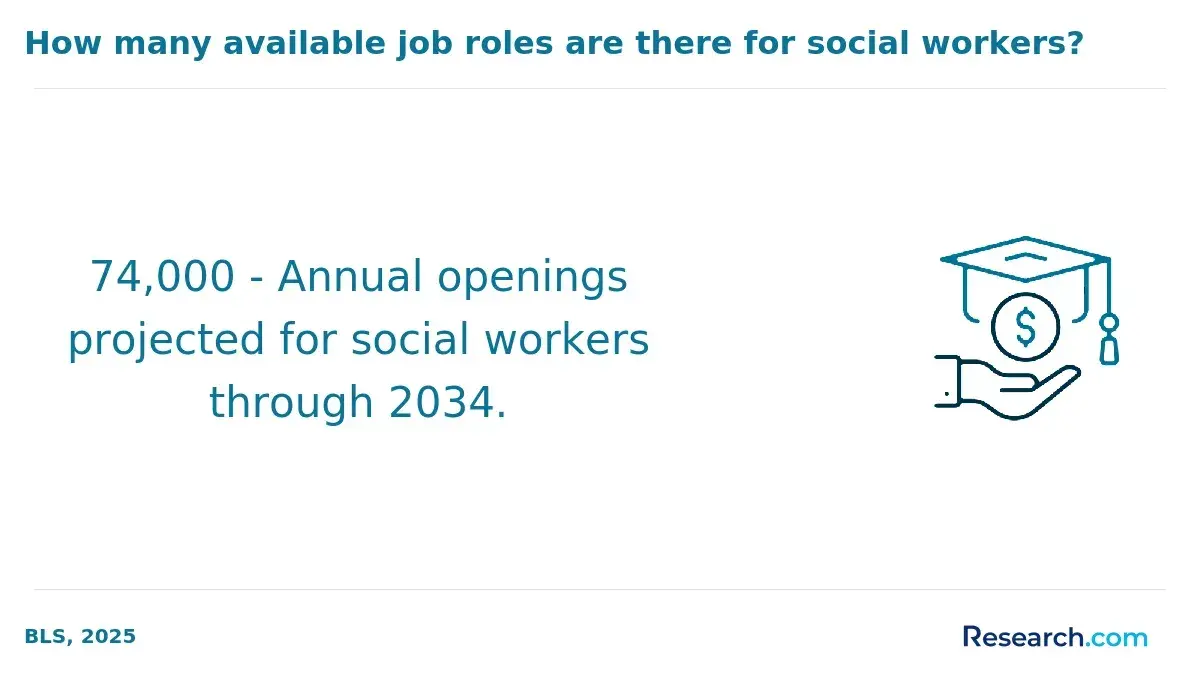
The job market for MSW graduates is shaped by demand for mental health services, healthcare coordination, substance use treatment, school-based support, aging services, and social justice advocacy. Entry-level roles exist for bachelor’s degree holders, but the MSW is often preferred or required for clinical, supervisory, and advanced practice positions.
- Growth Rate: The U.S. Bureau of Labor Statistics (BLS) and 2025 industry analyses project an 8% to 10% growth in overall social work employment through 2033, which remains significantly faster than the average for all occupations.
- The clinical advantage: Licensed clinical social workers (LCSWs) are in strong demand as healthcare systems continue integrating behavioral health into primary care.
- Global competition: Some foreign medical graduates transition into clinical social work or mental health consultancy roles to apply diagnostic and healthcare knowledge in the U.S. market.
Salary and Earnings
Social work compensation varies by license, specialization, employer, geography, and experience. While the median salary for all social workers is approximately $61,330, MSW graduates with advanced licensure or specialized practice experience may qualify for higher-paying roles.
Average Salaries by Title and Role
| Role | Average salary |
| Licensed Master Social Worker (LMSW) | $62,500 – $71,000 |
| Mental Health Therapist | $72,400 |
| Psychotherapist (Private Practice) | $82,000 – $115,000 |
| Clinical Forensic Specialist | $108,500+ |
Location can strongly affect earnings. MSW graduates in metropolitan hubs like New York, San Francisco, and Chicago report salaries 20-30% higher than the national average, although higher living costs may reduce the practical advantage.
Demand Drivers
- Aging population: More older adults create continued need for elder care and geriatric social work.
- Mental health awareness: Greater recognition of behavioral health needs increases demand for trained social workers.
- Substance abuse: Addiction treatment and recovery services continue to require qualified professionals.
- Social justice: Advocacy, policy, and community development roles remain important across public and nonprofit sectors.
Career Challenges to Consider
- Competition: Desirable jobs, especially in specific cities or specialties, may attract many applicants.
- Salary pressure: Some social work roles pay less than other graduate-level careers with comparable education requirements.
- Emotional demands: Social work can involve crisis, trauma, burnout risk, and secondary stress, making self-care and supervision essential.
How Do MSW Graduates Impact Communities and Individuals?
MSW graduates support people facing mental health concerns, poverty, addiction, family crisis, disability, housing insecurity, discrimination, illness, and other complex challenges. Their work may involve counseling, resource navigation, case management, crisis intervention, program development, policy advocacy, and research.
The value of social work is both individual and systemic. Social workers help clients access services while also identifying patterns that require policy change, better funding, stronger community programs, or institutional reform.
How Can MSW Graduates Maximize Earning Potential?
MSW graduates can improve earning potential by pursuing appropriate licensure, choosing high-demand specialties, gaining supervised clinical experience, developing leadership skills, and comparing compensation data before accepting offers. Specialized training, internships, mentorship, and professional networking can also support advancement into clinical, supervisory, program management, or policy roles.
Use current salary benchmarks, such as Research.com’s guide to master of social work jobs and salary, when negotiating pay or evaluating job offers.
If you are still deciding whether the degree fits your goals, review Research.com’s guide on whether a degree in social work is worth it.
Other Educational Programs for Students Interested in Social Justice and Law
Social work is not the only route into advocacy, community service, or justice-oriented work. Students who want to support legal access, public interest law, immigration services, victim advocacy, or nonprofit legal programs may also compare paralegal education. Research.com’s guide to ABA-approved paralegal programs can help students explore law-adjacent alternatives.
Why Is Accreditation Important for MSW Programs?
Accreditation is one of the most important checks when choosing an MSW. The Council on Social Work Education evaluates whether programs meet professional standards for social work education, including curriculum and field education expectations. Students comparing online options should review Research.com’s guide to CSWE-accredited online MSW programs.
- Educational quality: CSWE accreditation signals that the program meets recognized academic and professional standards.
- Licensure eligibility: Many states require graduation from a CSWE-accredited program for social work licensure.
- Employer recognition: Employers often prefer or require degrees from accredited social work programs.
- Financial aid access: Many federal aid options require enrollment in an accredited institution or program.
- Professional networks: Accredited programs often maintain agency partnerships, internship channels, alumni networks, and professional development opportunities.
Should I Pursue a Doctorate in Social Work After an MSW?
A Doctorate in Social Work can make sense for MSW graduates who want senior leadership, advanced practice innovation, policy influence, university teaching, or administrative roles. It is not required for most entry-level or standard clinical social work careers, so the decision should depend on your long-term goal and expected return on investment.
If doctoral study fits your career plan, compare cost, format, dissertation or capstone expectations, and professional outcomes. Research.com’s guide to affordable DSW online programs can help you evaluate the next step.
Common Mistakes to Avoid When Choosing an Accelerated Online MSW
| Mistake | Better approach |
| Choosing a program before checking CSWE accreditation | Verify accreditation for the exact program and pathway before applying |
| Looking only at tuition per credit | Compare total tuition, fees, number of credits, fieldwork costs, and lost income |
| Assuming online means fully remote | Confirm all field placement, residency, campus visit, and live class requirements |
| Ignoring state licensure rules | Contact your state board before enrolling, especially if you plan to move |
| Underestimating practicum time | Ask how many weekly field hours students complete and whether evening or weekend placements are available |
| Relying only on rankings | Use rankings alongside accreditation, outcomes, placement support, cost, and fit |
| Assuming salaries are guaranteed | Research local wages by role, license level, employer type, and experience |
Practical Steps Before You Apply
- Confirm your career goal. Decide whether you are aiming for clinical practice, school social work, healthcare, community organizing, policy, nonprofit leadership, or another path.
- Check accreditation. Verify CSWE accreditation and make sure it applies to the online pathway you plan to enter.
- Review state licensure rules. Contact the licensing board in the state where you plan to practice.
- Compare total program cost. Include tuition, fees, practicum travel, books, technology, and income changes.
- Ask about field placement support. Find out whether the school secures placements or expects students to locate sites.
- Evaluate pace honestly. Accelerated programs require sustained focus; ask whether your work and family schedule can realistically support the load.
- Request outcomes information. Ask about graduation rates, licensure exam support, employment support, and common student placements.
- Talk to current students or alumni. Ask about workload, faculty access, field placement quality, and career services.
Key Insights
- An accelerated online MSW can shorten the time to graduation, but field education and post-graduate licensure steps still require careful planning.
- CSWE accreditation is the first filter. Do not evaluate cost, speed, or prestige until accreditation and licensure alignment are clear.
- Advanced standing is usually the fastest MSW route, but it is typically limited to qualified BSW graduates.
- Online coursework does not eliminate in-person requirements. Practicum placements remain central to MSW training.
- The best program is not always the fastest or most famous. It is the one that fits your state licensure goal, schedule, specialization, budget, and field placement needs.
- Before enrolling, ask direct questions about practicum logistics, total cost, support services, and whether students can realistically work while completing the program.
References
- Bennett, L., Morrison, T., & Zhao, X. (2025). Evolution of social work competencies in integrated health systems: A longitudinal analysis. The Journal of Health and Social Care Systems, 14(2), 112–134. https://doi.org/10.1016/j.jhscs.2025.01.008
- College Board (2025). Trends in college pricing and student aid 2025. https://research.collegeboard.org/media/pdf/Trends-in-College-Pricing-and-Student-Aid-2025-final_1.pdf
- Columbia School of Social Work (2025). Cost of attendance: Residential campus 2025-2026. Columbia University. https://socialwork.columbia.edu/content/cost-attendance-residential-campus-2025-2026
- Education Data Initiative (2025, October 14). Average cost of community college [2025]: Tuition + fees. https://educationdata.org/average-cost-of-community-college
- National Center for Education Statistics (2024). Projections of education statistics to 2030 (Section 2: Elementary and secondary teachers). U.S. Department of Education, Institute of Education Sciences. https://nces.ed.gov/programs/PES/section-2.asp
- NYU Silver School of Social Work (2025). MSW tuition & fees 2025-2026. New York University. https://socialwork.nyu.edu/prospective-students/paying-for-your-education/msw/tuition-and-fees.html
- OnlineMSWPrograms.com. (2024). Most Expensive MSW Programs. https://onlinemswprograms.com/most-expensive-msw-programs/
- Penn Student Registration & Financial Services (2025). School of Social Policy and Practice costs 2025-2026. University of Pennsylvania. https://srfs.upenn.edu/costs-budgeting/SP2
- University of Chicago. (2025). Tuition and fees 2025-26: Crown Family School of Social Work, Policy, and Practice. https://bursar.uchicago.edu/tuition-and-fees/tuition-and-fees-2025-26/tuition-and-fees-2025-26-crown-family-school-of-social-work
- U.S. Bureau of Labor Statistics. (2025). Occupational outlook handbook: Social workers. https://www.bls.gov/ooh/community-and-social-service/social-workers.htm
- USC Suzanne Dworak-Peck School of Social Work. (2025). Tuition & fees 2025-2026. University of Southern California. https://dworakpeck.usc.edu/admissions/tuition-and-financial-aid/tuition-fees
- Zippia. (2026). Social worker job outlook and growth in the US [2026]. https://www.zippia.com/social-worker-jobs/trends/
Other Things You Should Know About Master’s in Social Work
Scholarships are indeed available for 2027 accelerated online MSW programs, often provided by universities, professional organizations, or social work foundations. Eligibility criteria vary, with some programs emphasizing academic achievement, financial need, or commitment to the social work field.
In 2027, internships play a critical role in accelerated online MSW programs, providing real-world experience and networking opportunities critical for successful social work careers. These programs often include required field placements to ensure students gain hands-on skills alongside their academic studies.


