
2027 Highest Paying Psychology Careers: Job Overview, Salary, and Outlook

Co-Founder and Chief Data Scientist
A note from Imed Bouchrika, PhD, career planning expert:
High-paying psychology careers usually require more than an interest in human behavior. They demand careful planning around graduate education, supervised experience, licensure, specialization, and where you choose to work. In psychology and healthcare career planning, I have seen students underestimate how different the pathways are for roles such as psychiatrist, clinical psychologist, industrial-organizational psychologist, and school psychologist. The payoff can be strong, but the training timeline and licensing rules are not the same for every career.
Recent data shows that employment of psychologists is expected to grow by 6% from 2024 to 2034, faster than the average for all occupations. As of 2024, the median annual wage for psychologists is $94,310, while the highest 10 percent earn more than $157,330. This guide explains which psychology careers tend to pay the most, what education and licenses they require, where the best opportunities are, and how to decide whether a high-paying psychology path fits your goals.
Quick Answer: What are the highest-paying psychology careers?
The highest-paying path connected to psychology is typically psychiatry, with an estimated annual salary of $239,514, because psychiatrists are medical doctors who can diagnose mental health conditions and prescribe medication. Among non-physician psychology careers, high-paying options include industrial-organizational psychologist, neuropsychologist, engineering psychologist, military psychologist, clinical psychologist, counseling psychologist, school psychologist, sports and performance psychologist, and forensic psychologist. Most of these roles require a graduate degree, supervised field experience, and, for clinical work, state licensure.
Key Takeaways
- Psychologist employment is projected to grow 6% from 2024 to 2034, which is faster than the average for all occupations.
- The median psychologist salary is approximately $94,310, and the top 10 percent earn more than $157,330.
- Major psychologist employers include self-employed workers at 28%, elementary and secondary schools at 27%, ambulatory healthcare services at 21%, and government sectors at 8%.
- The highest salaries often require advanced credentials, such as an MD or DO for psychiatrists, a Ph.D. or Psy.D. for many licensed psychologists, or a specialist degree for school psychology.
- Online psychology degrees can support career advancement when they are accredited and include the fieldwork, practicum, internship, or residency experiences required for the target role.
- Highest-paying psychology careers
- Degrees required for high-paying psychology jobs
- Private practice vs. institutional employment
- Recognition of online psychology degrees
- Licensing requirements for top psychology careers
- Certifications that may improve earning potential
- Sectors with lucrative psychology opportunities
- Employment outlook for psychologists
- Highest-paying states for psychologists
- How location affects psychology salariesState salary comparison
- Career progression in psychology
- Building a psychology career without a traditional degree
- Common work settings for high-earning psychologists
- Technology trends affecting psychology careersWork setting considerations
- Challenges in high-paying psychology careers
- How mentorship supports psychology career growth
- Work-life balance strategies for high-paying psychology careers
- Strategic decisions for reaching a six-figure therapy salary
- Online education and high-paying psychology careers
- Benefits beyond salary
- Whether advanced education is worth the investment
- How forensic psychology programs can strengthen your career
- What drives job satisfaction in psychologyWork-life fitKey insights
Highest Paying Psychology Careers
For 2026 career planning, the best-paying psychology careers are usually those that combine advanced education, regulated practice authority, specialized expertise, and high demand. A bachelor’s degree in psychology can open the door to entry-level behavioral health, research, human services, and business roles, but the highest-paying paths typically require graduate or medical training. If you are still comparing options, it can help to review broader psychology career paths before committing to a specialty.
The salaries below use figures reported by the Bureau of Labor Statistics and other reputable salary or job sites such as Payscale, ZipRecruiter, and Salary.com. Actual earnings vary by location, employer, license status, specialty, years of experience, and whether you work for an organization or build a private practice.
| Rank | Career | Estimated Annual Salary | Typical Advanced Preparation |
| 1 | Psychiatrist | $239,514 | Medical degree, psychiatry residency, medical license |
| 2 | Industrial-Organizational Psychologist | $135,688 | Master’s or doctoral degree in industrial-organizational psychology |
| 3 | Neuropsychologist | $122,928 | Doctoral degree, postdoctoral fellowship, state license |
| 4 | Engineering Psychologist | $92,813 | Graduate training in engineering psychology, human factors, or a related field |
| 5 | Military Psychologist | $92,813 | Graduate clinical or counseling psychology training, licensure, military requirements when applicable |
| 6 | Clinical Psychologist | $91,872 | Doctoral degree, internship, supervised experience, state license |
| 7 | Counseling Psychologist | $89,359 | Graduate degree, supervised clinical experience, state license |
| 8 | School Psychologist | $81,500 | Master’s or specialist degree, school internship, state certification or licensure |
| 9 | Sports and Performance Psychologist | $79,575 | Graduate degree, applied performance experience, optional certification |
| 10 | Forensic Psychologist | $78,869 | Graduate or doctoral training, forensic experience, licensure for clinical practice |
1. Psychiatrist
Estimated Annual Salary: $239,514
Psychiatrists are physicians who specialize in mental health. Unlike most psychologists, they complete medical school and can prescribe medication. Their work may include diagnosing psychiatric disorders, managing medication, delivering psychotherapy, coordinating with other healthcare providers, and treating complex conditions such as depression, anxiety, bipolar disorder, schizophrenia, substance use disorders, and trauma-related conditions.
Typical requirements
- Complete a bachelor’s degree in a relevant area, such as psychology, biology, or pre-med.
- Earn an MD or DO degree from medical school.
- Complete a four-year psychiatry residency focused on diagnosis, treatment planning, medication management, and patient care.
- Obtain a medical license in the state where you plan to practice.
- Consider board certification through the American Board of Psychiatry and Neurology to strengthen professional credibility.
2. Industrial-Organizational Psychologist
Estimated Annual Salary: $135,688
Industrial-organizational psychologists apply psychological science to workplace problems. They may help employers improve hiring systems, leadership development, employee training, team performance, assessment design, organizational culture, workplace safety, and employee engagement. This path is a strong fit for people who like psychology but prefer business, consulting, analytics, or human resources over clinical practice.
Typical requirements
- Earn a bachelor’s degree in psychology or a related field.
- Complete a master’s or doctoral degree in industrial-organizational psychology.
- Build experience through internships, research, human resources roles, consulting projects, or organizational assessment work.
- Consider professional involvement or credentials through the Society for Industrial and Organizational Psychology (SIOP).
- Keep current with workplace analytics, organizational research, labor trends, and assessment ethics.
3. Neuropsychologist
Estimated Annual Salary: $122,928
Neuropsychologists study and assess the relationship between the brain and behavior. They often evaluate people with traumatic brain injuries, neurological disorders, dementia, stroke, epilepsy, developmental conditions, or cognitive changes. Their work may include detailed testing, diagnosis support, rehabilitation planning, consultation with physicians, and research into brain-behavior relationships.
Typical requirements
- Complete a bachelor’s degree in psychology, neuroscience, or a related field.
- Earn a Ph.D. or Psy.D. in clinical neuropsychology or a closely related discipline.
- Complete a postdoctoral neuropsychology fellowship, typically two years, with advanced clinical and research training.
- Obtain a state psychology license.
- Consider board certification in Clinical Neuropsychology through the American Board of Professional Psychology.
4. Engineering Psychologist
Estimated Annual Salary: $92,813
Engineering psychologists focus on how people interact with technology, machines, tools, systems, and built environments. Their work is especially relevant in human-computer interaction, product design, safety engineering, ergonomics, usability testing, transportation systems, manufacturing, and technology development. This can be a strong psychology path for people who enjoy research, design, and applied problem-solving.
Typical requirements
- Earn a bachelor’s degree in psychology, human factors engineering, or a related field.
- Complete a master’s or doctoral degree in engineering psychology, human factors, ergonomics, or a similar area.
- Gain applied experience through internships, usability labs, research projects, or design teams.
- Consider Board Certification in Professional Ergonomics (BCPE) if it fits your work focus.
- Continue learning about user experience research, emerging technology, safety standards, and behavioral science methods.
5. Military Psychologist
Estimated Annual Salary: $92,813
Military psychologists support service members, veterans, and military families. Their work can include counseling, psychological evaluation, crisis response, resilience training, trauma treatment, performance support, and policy or program development. Some roles are based in military hospitals or clinics, while others may involve deployment-related responsibilities or work with veteran populations.
Typical requirements
- Complete a bachelor’s degree in psychology or a related field.
- Earn a master’s or doctoral degree in clinical or counseling psychology, ideally with military, trauma, or veteran-focused preparation.
- Obtain a state license to practice psychology.
- Complete military training if serving as an active-duty psychologist.
- Meet security clearance, physical, and medical standards when required by the role.
- Gain experience in military, veteran healthcare, trauma, or crisis-response settings.
6. Clinical Psychologist
Estimated Annual Salary: $91,872
Clinical psychologists assess, diagnose, and treat mental, emotional, and behavioral disorders. They may provide psychotherapy, conduct psychological testing, design treatment plans, and collaborate with physicians, social workers, counselors, and other healthcare providers. Demand for clinical psychology careers is tied to the need for mental health services in private practices, hospitals, community clinics, schools, and integrated healthcare settings.
Typical requirements
- Complete a bachelor’s degree in psychology or a related field.
- Earn a doctoral degree in clinical psychology, such as a Ph.D. or Psy.D.
- Complete a doctoral internship, typically one year, in an approved clinical setting.
- Meet state licensing requirements, including passing the Examination for Professional Practice in Psychology (EPPP).
- Complete postdoctoral supervised experience if required by the state.
- Consider board certification through the American Board of Professional Psychology for specialized recognition.
7. Counseling Psychologist
Estimated Annual Salary: $89,359
Counseling psychologists help people manage emotional concerns, life transitions, relationship issues, career decisions, educational stress, and mental health challenges. Compared with some clinical psychology roles, counseling psychology may place more emphasis on adjustment, development, strengths, and wellness, though many counseling psychologists also treat diagnosable mental health conditions.
Typical requirements
- Earn a bachelor’s degree in psychology or a related field.
- Complete a master’s or doctoral degree in counseling psychology; some students compare online counseling graduate programs for flexibility.
- Complete supervised clinical training through practica, internships, or post-graduate experience.
- Obtain the state license required for your intended scope of practice.
- Continue professional development in evidence-based counseling approaches, ethics, and specialty areas.
8. School Psychologist
Estimated Annual Salary: $81,500
School psychologists work in educational environments to support student learning, behavior, mental health, disability evaluation, crisis response, and family-school collaboration. They often help create intervention plans, conduct assessments, consult with teachers, support special education processes, and promote healthy school climates. Students interested in child and adolescent development may compare programs through resources on the best colleges for child psychology majors.
Typical requirements
- Complete a bachelor’s degree in psychology, education, child development, or a related field.
- Earn a master’s or specialist degree, such as an Ed.S., in school psychology.
- Complete an internship or supervised school-based field experience.
- Obtain the state certification or license required for school psychology practice, which may include the Praxis School Psychologist examination.
- Stay current with educational law, disability services, assessment practices, and student mental health trends.
9. Sports and Performance Psychologist
Estimated Annual Salary: $79,575
Sports and performance psychologists help athletes, performers, teams, and high-pressure professionals improve mental focus, motivation, confidence, stress management, recovery, and performance consistency. Some work with college athletic departments, professional teams, private clients, or performers outside traditional sports. If this specialty interests you, compare the training path and sports psychology salary expectations before choosing a program.
Typical requirements
- Complete a bachelor’s degree in psychology or a related field.
- Earn a master’s or doctoral degree in sports psychology or a closely related discipline.
- Gain supervised experience with athletes, teams, performers, or performance organizations.
- Consider certification through the Association for Applied Sport Psychology (AASP).
- Continue learning about performance science, motivation, injury recovery, and mental skills training.
10. Forensic Psychologist
Estimated Annual Salary: $78,869
Forensic psychologists apply psychological knowledge to legal and criminal justice questions. Their work may include competency evaluations, risk assessments, child custody evaluations, expert testimony, offender rehabilitation, police consultation, and research related to legal decision-making. This field requires strong writing, ethical judgment, courtroom communication, and familiarity with legal standards.
Typical requirements
- Complete a bachelor’s degree in psychology or a related field.
- Earn a master’s and/or doctoral degree in forensic psychology, clinical psychology with forensic training, or a related area.
- Complete supervised experience in legal, correctional, forensic, or clinical settings.
- Obtain state licensure when providing clinical psychological services.
- Consider certification through the American Board of Forensic Psychology for specialized professional recognition.
The chart below compares estimated annual salaries for several high-paying psychology careers in U.S. dollars. Psychiatry stands out because it follows the physician training pathway, while other high-earning psychology roles usually depend on graduate specialization, licensure, and employer demand.
Here’s What Graduates Have to Say About Their Psychology Degrees
-
: "
“My psychology degree changed the way I understand people, communication, and mental health. The training shaped how I approach clients in my counseling work and gave me a stronger framework for interpreting behavior.” Emily
"
-
: "
“Choosing an online psychology program gave me the flexibility to keep working while studying. The online discussions and peer support helped me develop the independence and adaptability I now use in my career.” Alex
"
-
: "
“Psychology pushed me to think more critically and listen more carefully. Those skills have been valuable in human resources, where understanding motivation, conflict, and workplace behavior matters every day.” Jordan
"
Key Findings
- Overall employment of psychologists is projected to grow by 6% from 2024 to 2034, faster than the average growth rate for all occupations.
- Approximately 12,800 job openings for psychologists are anticipated each year over the next decade, mainly because workers retire or move into other occupations.
- Demand for clinical and counseling psychologists is expected to rise as schools, hospitals, mental health centers, and social service agencies need psychological services.
- In May 2024, the median annual wage for psychologists was $94,310, while the highest 10 percent earned more than $157,330.
- The largest employers of psychologists include self-employed workers at 28%, elementary and secondary schools at 27%, ambulatory healthcare services at 21%, and government sectors at 8%.
- Counseling psychologists often build independent practices, which can make psychology a realistic entrepreneurial path for licensed professionals.
What degrees are required for high-paying jobs in psychology?
The degree you need depends on whether the job is medical, clinical, school-based, business-focused, or research-oriented. The highest-paying careers usually require one of three routes: medical school for psychiatry, a doctoral psychology degree for licensed psychologist roles, or a master’s/specialist degree for selected applied roles such as industrial-organizational psychology or school psychology.
| Career Goal | Minimum Common Graduate Path | Licensure or Credential Issue to Check |
| Psychiatrist | Bachelor’s degree, MD or DO degree, four-year psychiatry residency | State medical license and optional board certification |
| Clinical Psychologist | Ph.D. or Psy.D. in clinical psychology | State psychology license, EPPP, internship, and supervised experience |
| Neuropsychologist | Doctoral degree in clinical neuropsychology or related discipline | State license and typically postdoctoral neuropsychology fellowship |
| Industrial-Organizational Psychologist | Master’s or doctoral degree in industrial-organizational psychology | Licensure may not be required for all roles, but employer expectations vary |
| School Psychologist | Master’s or specialist degree, such as an Ed.S. | State school psychology certification or licensure |
| Forensic Psychologist | Master’s and/or doctoral degree in forensic or clinical psychology | State license if practicing clinically; forensic credentials may help |
Students comparing regional options, such as psychology master’s programs in Texas, should look beyond program title. Check accreditation, practicum access, faculty expertise, state licensure alignment, transfer policies, and whether the degree supports the exact career you want. A master’s degree may be enough for some applied roles, but many high-paying clinical specialties require a doctorate.
What are the pros and cons of private practice vs. institutional employment?
Many licensed psychologists eventually choose between working for an institution and building a private practice. Neither option is automatically better. The right choice depends on your tolerance for business risk, need for benefits, desired autonomy, client population, and long-term income goals.
| Factor | Private Practice | Institutional Employment |
| Income structure | Potentially higher earnings if you can attract and retain clients, manage rates, and control overhead | More predictable salary, often with employer-provided benefits |
| Autonomy | High control over schedule, services, client mix, and treatment approach | Less control because policies, caseloads, and procedures are set by the organization |
| Business responsibilities | Requires billing, marketing, compliance, records, insurance management, and administrative systems | Administrative burden may be lower because the organization provides infrastructure |
| Professional support | Can feel isolating unless you intentionally build referral and consultation networks | More access to teams, supervisors, colleagues, and institutional resources |
| Risk level | Income can fluctuate with referrals, cancellations, insurance changes, and market competition | More stability, but advancement and salary growth may be limited by budgets or job classifications |
When private practice may make sense
- You want more control over your schedule, niche, and client population.
- You are comfortable managing business operations or hiring help for billing and administration.
- You have a strong referral network or a specialty that supports private-pay or high-demand services.
When institutional employment may make sense
- You value salary stability, health insurance, retirement benefits, and paid time off.
- You want to work within a multidisciplinary team.
- You prefer focusing primarily on clinical, school, research, or organizational work instead of running a business.
In career advising, I often see early-career psychologists benefit from institutional experience before moving into private practice. It allows them to build clinical judgment, professional contacts, supervision experience, and a clearer sense of the client population they want to serve.
Are online psychology degrees recognized in high-paying fields?
Yes, online psychology degrees can be recognized in high-paying fields when the institution and program meet the standards required by employers, licensing boards, and graduate schools. Accreditation is the first checkpoint. If the online program is accredited, 76% of academic leaders and 89% of executives believe online degrees are comparable to on-campus degrees. Degrees from institutions with a brick-and-mortar presence are also favored, with a 42% higher favorability rate than those from online-only universities.
However, online coursework alone is not enough for many top-paying psychology roles. Clinical, counseling, school, neuropsychology, and psychiatry pathways require in-person components such as practica, internships, supervised experience, residencies, or fellowships. Psychiatrists, for example, must complete a four-year residency training program. Before enrolling, confirm that the program supports the licensing or certification requirements in the state where you plan to work.
Questions to ask before choosing an online psychology program
- Is the institution regionally accredited or otherwise appropriately accredited for my career goal?
- Does the program meet state licensure requirements where I plan to practice?
- Are practicum, internship, residency, or supervised field placements included or supported?
- Will credits transfer into a doctoral program if I decide to continue?
- Do employers or licensing boards in my specialty accept this degree format?
What type of licensing is required for high-paying psychology careers?
Licensure is non-negotiable for most clinical and healthcare psychology work. Requirements vary by state and role, so students should check licensing board rules before choosing a program. A degree that is acceptable in one state or specialty may not automatically qualify you elsewhere.
- Psychiatrists: Must hold a medical license after completing an MD or DO degree and residency. Board certification through the American Board of Psychiatry and Neurology may strengthen career options.
- Clinical psychologists: Usually need a doctoral degree, supervised experience, and a passing score on the Examination for Professional Practice in Psychology (EPPP).
- Neuropsychologists and counseling psychologists: Typically need a Ph.D. or Psy.D., relevant supervised training, and a state psychology license.
- School psychologists: Usually need state certification or licensure, often tied to a master’s or specialist degree and an exam such as the Praxis School Psychologist examination.
- Industrial-organizational psychologists: May not need licensure for some organizational roles, but requirements can change if services are represented as psychological practice.
- Forensic psychologists: Often need state psychology licensure for clinical evaluations and may pursue additional certification through the American Board of Forensic Psychology.
The safest approach is to start with the end requirement. Identify your target state, target job title, and licensing board rules before selecting a degree.
Are there specific certifications that lead to higher salaries in psychology?
Certifications do not guarantee a higher salary, but they can improve credibility in specialized markets, help with referrals, support promotion, or strengthen negotiations. Their value depends on the employer, specialty, and whether the credential signals skills that are scarce or difficult to verify.
| Credential or Certification | Who It May Help | Why It Matters |
| Board Certification in Psychiatry | Psychiatrists | Shows advanced specialization through the American Board of Psychiatry and Neurology |
| Society for Industrial and Organizational Psychology (SIOP) involvement or certification-related recognition | Industrial-organizational psychologists | Can support visibility in consulting, research, and organizational roles |
| Board Certification in Clinical Neuropsychology | Neuropsychologists | Signals advanced competence through the American Board of Professional Psychology |
| Board Certification in Professional Ergonomics (BCPE) | Engineering psychologists and human factors specialists | Demonstrates expertise in ergonomics and human factors practice |
| Association for Applied Sport Psychology (AASP) certification | Sports and performance psychologists | Helps validate applied sport and performance psychology skills |
| American Board of Forensic Psychology (ABFP) | Forensic psychologists | Can strengthen credibility in legal and forensic settings |
Which sectors are offering the most lucrative opportunities in psychology?
Psychology salaries vary sharply by sector. Healthcare settings, government roles, schools, research organizations, and private practices can all offer strong opportunities, but the highest-paying sector for one specialty may not be the best option for another.
Annual mean wage by selected sector
| Psychology Career Category | Selected High-Paying Sectors and Annual Mean Wage |
| Psychiatrists | Offices of Physicians: $273,440; General Medical and Surgical Hospitals: $207,600; Psychiatric and Substance Abuse Hospitals: $276,570; Outpatient Care Centers: $253,000; State Government: $231,510 |
| School Psychologists | Elementary and Secondary Schools: $87,320; Educational Support Services: $103,000; Colleges, Universities, and Professional Schools: $80,560; Local Government: $87,550; Offices of Other Health Practitioners: $97,400 |
| Industrial-Organizational Psychologists | Scientific Research and Development Services: $122,100; Colleges, Universities, and Professional Schools: $111,050; State and Local Government: $79,970 |
| Clinical and Counseling Psychologists | Offices of Other Health Practitioners: $111,750; Outpatient Care Centers: $106,410; Offices of Physicians: $108,440; Individual and Family Services: $91,510; General Medical and Surgical Hospitals: $98,550 |
| All Other Psychologists | Federal Executive Branch: $104,870; Offices of Other Health Practitioners: $80,590; General Medical and Surgical Hospitals: $95,810; Colleges, Universities, and Professional Schools: $71,830; Offices of Physicians: $105,810 |
The main takeaway is that “highest paying” is not tied to one employer type. Psychiatrists may find strong earnings in medical and psychiatric settings, clinical psychologists may do well in healthcare practices and outpatient care, and industrial-organizational psychologists may find higher-paying opportunities in research, consulting, or business environments.
What is the employment outlook for psychologists in the next 10 years?
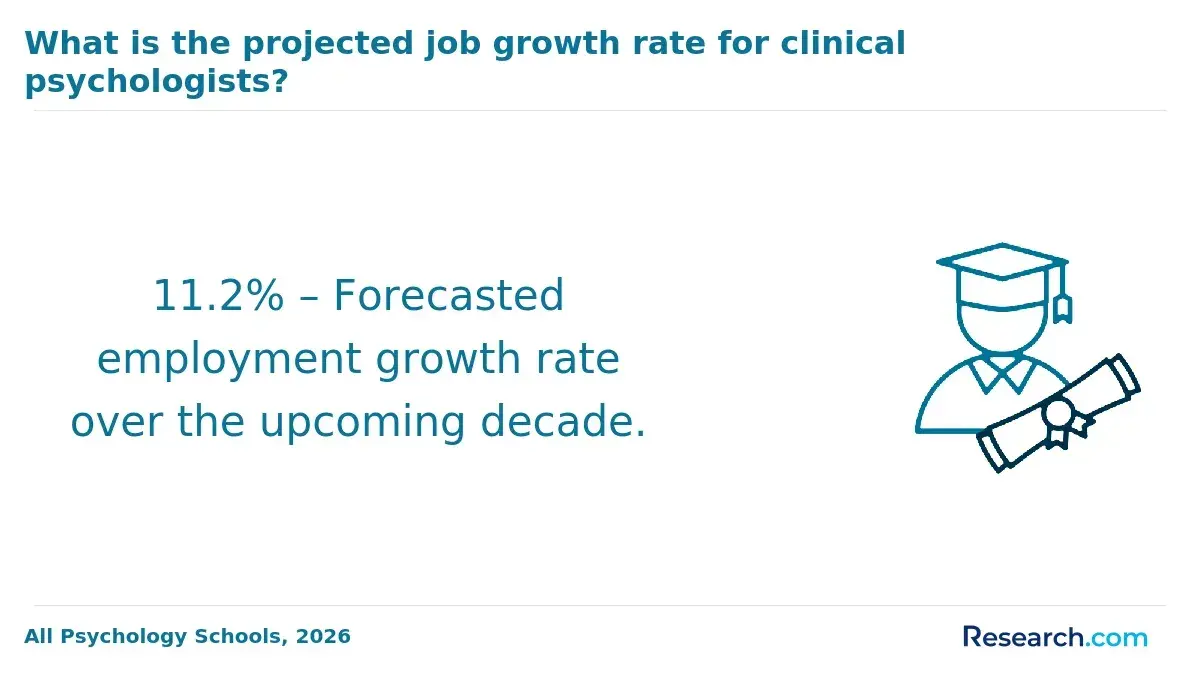
The employment outlook for psychologists is positive, with overall employment projected to grow by 6% from 2024 to 2034. This growth is expected to be especially relevant in clinical, counseling, and school psychology because of demand for services in schools, hospitals, mental health centers, and social service agencies. About 12,900 job openings for psychologists are expected annually, largely because workers retire or move into other occupations.
Psychiatry, which is the highest-paying career in this guide, also shows strong demand. For psychiatrists, the projected job growth rate is 7% through 2032, according to the BLS. Zippia reports an 18% increase in psychiatrist salaries over the last five years. With approximately 55,400 new jobs projected over the next decade, psychiatry is likely to remain a competitive and well-compensated mental health career path.
What are the highest-paying states for psychologists?
State-level salaries differ by specialty. These differences can reflect demand, cost of living, public funding, healthcare infrastructure, school budgets, availability of specialists, and local labor competition.
| Career Category | Highest-Paying States Listed |
| Psychiatrists | New Mexico: $390,140; North Dakota: $311,950; Connecticut: $308,690 |
| School Psychologists | California: $106,890; Colorado: $104,810; District of Columbia: $102,850 |
| Industrial-Organizational Psychologists | California: $125,270; Ohio: $108,320; Oregon: $99,780 |
| Clinical and Counseling Psychologists | New Jersey: $164,110; Oregon: $134,830; New York: $128,520 |
| All Other Psychologists | Nevada: $120,220; California: $116,420; Oregon: $115,680 |
Do not choose a state based on salary alone. A higher wage may come with higher housing costs, heavier caseloads, more competition, or stricter licensing processes. Compare take-home pay, cost of living, professional opportunities, supervision access, and long-term career mobility.
How does geographic location influence earning potential in high-paying psychology careers?
Location affects psychology income in several ways. States and metropolitan areas with larger healthcare systems, more universities, higher insurance reimbursement, stronger school budgets, or major corporate employers may support higher salaries for certain specialties. Areas with high demand and limited provider supply may also create opportunities, even if base salaries are not the highest nationally.
Licensing rules are another location-specific factor. If you plan to move, practice across state lines, or provide telehealth services, check whether your license, supervised hours, and degree meet the requirements in the new state. This is especially important for clinical, counseling, school, and forensic psychology roles.
Students who want to enter the field more quickly sometimes compare accelerated options such as a fast track psychology degree. Speed can be useful, but it should never come at the expense of accreditation, licensure eligibility, clinical placement quality, or graduate school readiness.
What are the career progression opportunities in psychology?
Psychology careers often progress through a sequence: foundational education, supervised experience, licensure or certification, specialization, and leadership or independent practice. The exact path depends on whether you are pursuing clinical practice, school psychology, research, organizational consulting, medicine, or legal work.
| Career Stage | Typical Roles or Milestones | What to Focus On |
| Early exposure | Research assistant, behavioral health technician, case aide, psychology intern | Build experience, confirm your specialty interest, develop references |
| Graduate training | Master’s student, doctoral student, practicum trainee, intern | Choose accredited programs, secure supervised fieldwork, develop a specialty |
| Licensure or certification | Licensed psychologist, certified school psychologist, medical resident for psychiatry | Complete exams, supervised hours, and state requirements |
| Specialization | Neuropsychologist, forensic psychologist, sports psychologist, I-O consultant | Pursue fellowships, board certification, niche experience, and professional networks |
| Senior practice | Clinic director, senior clinician, consultant, private practice owner, faculty member | Develop leadership, supervision, business, teaching, or research expertise |
Advancement is not only about years of experience. It also depends on choosing a high-demand niche, documenting outcomes, building referral relationships, and staying aligned with licensing and ethical standards.
Can you build a successful psychology career without a traditional degree?
You can work in psychology-adjacent or behavioral health support roles without becoming a licensed psychologist, but you generally cannot practice independently as a psychologist without the required degree and license. Alternative routes may include peer support, behavioral technician work, case management support, coaching in non-clinical settings, human services roles, or certified counseling-related pathways depending on state law.
If your goal is to provide therapy, diagnose mental health conditions, or use protected professional titles, check your state’s rules before investing in a nontraditional pathway. For a deeper look at alternative routes, review this guide on how to become a counselor without a degree.
What are typical work settings for high-earning psychologists?
Work setting influences income, schedule, client population, stress level, autonomy, and advancement. The same specialty can feel very different in a hospital, school, government agency, corporation, private practice, or court-related role.
- Psychiatrists: Often work in private practices, hospitals, outpatient care centers, psychiatric hospitals, and government settings.
- Industrial-organizational psychologists: Commonly work in corporations, consulting firms, government agencies, research organizations, and human resources or talent departments.
- Neuropsychologists: Often work in hospitals, rehabilitation centers, clinics, academic medical centers, and private practices.
- Engineering psychologists: May work in technology, automotive, aviation, manufacturing, usability research, ergonomics, or product design environments.
- Military psychologists: Work on bases, in military hospitals, in veteran-related care settings, and sometimes in deployment-related environments.
- Clinical psychologists: Work in private practices, hospitals, mental health clinics, integrated healthcare settings, and community health centers.
- Counseling psychologists: Work in universities, private clinics, counseling centers, schools, and community organizations.
- School psychologists: Primarily work in elementary and secondary schools, district offices, and educational support services.
- Sports and performance psychologists: Work with athletic teams, universities, performers, private clients, and performance organizations.
- Forensic psychologists: Work in courts, correctional facilities, law enforcement agencies, forensic hospitals, and private evaluation practices.
How do emerging technological trends influence high-paying psychology careers?
Technology is changing how psychologists assess, treat, document, and communicate with clients and organizations. Telehealth platforms can expand access to care, digital assessments can support measurement-based practice, and secure client management systems can improve scheduling and documentation. In some specialties, virtual reality, remote monitoring, and AI-powered analytics are becoming more relevant to assessment, training, and intervention design.
These tools also create new responsibilities. Psychologists must understand privacy, informed consent, data security, telehealth regulations, accessibility, and the limits of automated tools. Professionals who want to update their training may compare flexible graduate options, including the fastest masters in psychology, but should verify whether the program supports their licensing or career goals.
What challenges might you encounter in high-paying psychology careers?
High salaries often come with higher responsibility. Psychologists in advanced roles may face emotionally demanding cases, documentation pressure, ethical complexity, liability exposure, continuing education requirements, and the need to maintain licensure. Private practice owners must also manage billing, marketing, compliance, cash flow, and client acquisition.
Specialization can increase income, but it can also narrow the job market. For example, neuropsychology, forensic psychology, and military psychology may require specific training settings, supervision, or credentials. Some professionals pursue advanced options such as an online doctorate of psychology, but any doctoral program should be evaluated carefully for accreditation, licensure alignment, supervised training access, and career outcomes.
Common mistakes to avoid
- Choosing a psychology program without checking accreditation and state licensure rules.
- Assuming an online degree automatically qualifies you for clinical practice.
- Comparing salaries without considering cost of living, debt, benefits, and unpaid training time.
- Waiting too long to build supervised experience in your intended specialty.
- Relying only on rankings instead of reviewing placement outcomes, faculty expertise, and licensing exam support.
- Entering private practice without understanding insurance billing, legal compliance, marketing, and emergency protocols.
How Does Mentorship Enhance Success in High-Paying Psychology Careers?
Mentorship can shorten the learning curve in competitive psychology specialties. A strong mentor can help you choose the right graduate program, understand licensing steps, identify reputable practicum sites, prepare for board certification, avoid ethical pitfalls, and build a professional network. Mentors can also give realistic feedback about whether your goals match the demands of a specialty.
Mentorship is especially useful when comparing specialized credentials or adjacent fields. For example, students interested in behavior analysis may evaluate options such as the most affordable online BCBA degree programs while discussing whether that path aligns with psychology, education, autism services, or behavioral consulting goals.
What are the best strategies for balancing work-life in high paying psychology careers?
Psychology work can be deeply meaningful, but it can also be emotionally draining. High-paying roles may involve complex clients, leadership demands, legal risk, business pressure, or irregular schedules. Work-life balance should be planned as part of your career strategy, not treated as an afterthought.
- Set firm boundaries: Decide when you are available for clients, documentation, crisis calls, and administrative work.
- Protect recovery time: Schedule exercise, rest, family time, hobbies, and personal therapy or consultation when needed.
- Use systems: Calendars, electronic records, billing tools, and templates can reduce administrative overload.
- Delegate when possible: Private practice owners may benefit from billing, scheduling, bookkeeping, or virtual assistant support.
- Build peer consultation: Regular professional consultation can reduce isolation and improve decision-making.
- Be selective with continuing education: Choose training that supports your actual specialty and career goals instead of chasing every credential.
Can Strategic Career Decisions Propel You to a Six-Figure Therapy Salary?
Reaching a six-figure therapy income usually requires intentional positioning. Factors that may help include licensure, specialization, strong referral sources, experience with high-demand populations, efficient scheduling, ethical marketing, and careful decisions about insurance, private pay, group practice, or institutional leadership roles. Salary is never guaranteed, but strategy matters.
Therapists considering this goal should evaluate specialty demand, local competition, reimbursement rates, business expenses, and burnout risk. For a closer look at income strategy in therapy, see this guide on can a therapist earn $100k a year.
Can online education prepare you for a high-paying psychology career?
Online education can prepare students for parts of a high-paying psychology career, especially the academic coursework, research methods, theory, and some professional skills. It is often most useful for students who need flexibility because of work, caregiving, military service, or location. However, high-paying licensed roles still require supervised practice, internships, residencies, or field placements that cannot be replaced by coursework alone.
Students interested in therapy specializations may compare options such as online MFT degrees. Before enrolling, confirm accreditation, practicum placement support, state licensing alignment, faculty qualifications, and graduate outcomes.
What are the benefits of high-paying psychology careers beyond salary?
Income matters, but it is not the only reason people pursue advanced psychology careers. Many of the most satisfying benefits are tied to autonomy, expertise, impact, and career flexibility.
- Meaningful impact: Psychologists can improve mental health, learning, workplace performance, legal decision-making, and quality of life.
- Career stability: Specialized skills can support long-term employability, especially in healthcare, schools, government, and forensic settings. Students interested in legal applications can review the job outlook for forensic psychologist roles.
- Multiple career formats: Psychologists may work in employment, consulting, academia, government, telehealth, private practice, or hybrid roles.
- Professional autonomy: Licensed and experienced psychologists often have room to shape their specialty, schedule, and client population.
- Leadership opportunities: Advanced psychologists can supervise trainees, direct programs, consult with organizations, conduct research, and influence policy.
Is Advanced Education a Worthwhile Investment for High-Paying Psychology Careers?
Advanced education can be worth the investment when it leads to licensure eligibility, a clear specialty, stronger employment prospects, and income growth that justifies the cost and time. It can be a poor investment if the program is not accredited, does not meet state requirements, offers weak field placement support, or prepares students for a job market they have not researched.
Before enrolling, compare tuition, fees, living costs, lost income during training, debt, licensing requirements, and realistic salary ranges. Resources on the average cost of psychology master's degree can help you understand the financial commitment before you apply.
ROI questions to ask before committing
- What license, certification, or job title will this degree qualify me for?
- What percentage of graduates complete the program, obtain supervised placements, and become licensed?
- How much debt would I need, and what monthly payment could I manage?
- Can I work while studying, or will the program require full-time unpaid training?
- Is there a lower-cost route that leads to the same professional outcome?
How Can Specialized Forensic Psychology Programs Boost Your Career?
Forensic psychology is a specialized field where general psychology knowledge is not enough. Professionals need to understand assessment, ethics, report writing, legal standards, courtroom communication, correctional systems, risk evaluation, and the boundaries between clinical opinion and legal decision-making.
Specialized training can make candidates more competitive for legal, correctional, evaluation, and consulting roles. If this field fits your goals, compare curriculum, supervised forensic placements, faculty experience, and cost. Affordable options such as affordable forensic psychology master's programs may help reduce debt while building a targeted skill set.
What contributes to job satisfaction in high-paying psychology careers?
Job satisfaction in psychology often comes from seeing real change. Psychiatrists may help stabilize severe symptoms, clinical psychologists may support recovery, school psychologists may improve a child’s learning environment, and industrial-organizational psychologists may make workplaces more effective and humane. The sense of practical impact is a major reason many professionals stay in the field.
Fit also matters. A person who enjoys business strategy may thrive in industrial-organizational psychology but feel drained in a therapy-heavy role. Someone who values direct client relationships may prefer clinical or counseling work. Others may find purpose in research, forensic evaluation, school systems, or performance psychology.
Autonomy, supportive colleagues, manageable caseloads, ethical alignment, and opportunities to specialize also affect satisfaction. Private practice can offer independence, but it can also bring business pressure. Institutional jobs may provide structure and benefits, but they may limit schedule control. The best path is the one that aligns your values, skills, lifestyle, and tolerance for risk.
If you are considering graduate study but are not sure which direction it can support, review what can you do with a masters in psychology? before choosing a program.
Key Insights
- Psychiatry is the highest-paying career on this list, but it requires the longest medical pathway: an MD or DO, a four-year residency, and a medical license.
- Among non-physician psychology careers, strong earning potential is often found in industrial-organizational psychology, neuropsychology, engineering psychology, military psychology, and licensed clinical specialties.
- A bachelor’s degree alone is rarely enough for the highest-paying psychology careers. Most require a master’s, specialist, doctoral, or medical degree.
- Licensure should guide your school choice. Always verify accreditation, supervised experience requirements, exam requirements, and state rules before enrolling.
- Online psychology degrees can be respected when they are accredited and paired with required in-person training, but they do not remove practicum, internship, residency, or licensing obligations.
- Location matters. State salaries vary widely, but high pay should be weighed against cost of living, licensing rules, competition, benefits, and career growth.
- Private practice can increase autonomy and income potential, but it adds business risk. Institutional employment usually offers more stability and support.
- The best high-paying psychology career is not simply the one with the largest salary. It is the path that matches your training capacity, preferred work setting, ethical responsibilities, lifestyle needs, and long-term professional goals.
References:
- BLS. (2023a). Clinical and Counseling Psychologists. Bureau of Labor Statistics.
- BLS. (2023b). Industrial-Organizational Psychologists. Bureau of Labor Statistics.
- BLS. (2023c). Physicians and Surgeons: Occupational Outlook Handbook:: U.S. Bureau of Labor Statistics. Bureau of Labor Statistics.
- BLS. (2023d). Psychiatrists. Bureau of Labor Statistics.
- BLS. (2023e). Psychologists, All Other. Bureau of Labor Statistics.
- BLS. (2023f). Psychologists: Occupational Outlook Handbook:: U.S. Bureau of Labor Statistics. Bureau of Labor Statistics.
- BLS. (2023g). School Psychologists. Bureau of Labor Statistics.
Other Things You Should Know About Psychology Careers
Clinical, counseling, and school psychologists must hold a state license to practice independently in 2027. Most states require a doctoral degree, supervised internship hours, a passing score on the Examination for Professional Practice in Psychology (EPPP), and periodic continuing education for renewal.
Industrial-organizational psychologists are projected to have significant demand growth in 2027. This field focuses on workplace behavior and productivity, with growing needs in business environments for analytics and human resources management. Demand is driven by companies seeking to enhance worker productivity and retention.


