Oral Exams Are Back: A 2026 Student's Guide to Defending Your Work When AI Can't Take the Test For You

Co-Founder and Chief Data Scientist
The assignment looked flawless. Twelve pages, clean citations, an argument that flowed as if a professional editor had smoothed every sentence. Then the professor leaned in and asked one small question: can you explain your second point in your own words? What followed was silence. A long, uncomfortable, sweaty silence.
That scene is now repeating itself in lecture halls and seminar rooms across the country, and it is quietly rewriting the rules of how you will be graded in 2026. A growing number of professors have stopped trusting the take-home essay and the at-home problem set, because a chatbot can finish either one in seconds. Their solution is a method older than the printing press: the oral exam.
At Cornell University, biomedical engineering professor Chris Schaffer requires his students to sit across from an instructor for what he calls an oral defense. There is no laptop, no chatbot, no notes, and in some cases not even a pen or paper. As he told Fortune, you will not be able to AI your way through an oral exam.
If that sounds intimidating, it should not. An oral exam is not a trap. It is an invitation to show that you actually own what you turned in. This guide breaks down why oral assessments are surging back, what the research reveals about the skills students are unknowingly losing, and a concrete, repeatable system for walking into any oral defense and sounding like the author rather than a tourist.

Why oral exams are back, and why now
The return of the oral exam is not a quirky experiment at one school. It is a national shift. At Cornell, Schaffer asks students to sign up for 20-minute sessions of Socratic-style questioning after they submit written problem sets. With 70 students in the class, he and his teaching assistants now grade only the oral defenses, not the written work, which he describes as a way of incentivizing students to do the work or at least understand it well enough to explain it.
This transition mirrors a broader trend toward standards-based grading systems in higher education, where educators assess a student's actual mastery of specific skills and competencies rather than simply compiling numerical averages from homework sheets.
Elsewhere on the same campus, a religious studies professor holds 30-minute final conversations in place of a final exam, and an engineering instructor runs four-minute mock interviews with every student in a 180-person class.
Other institutions are moving in the same direction. At New York University, more faculty are requiring office hours, assigning presentations, and cold-calling students during class. Clay Shirky, NYU's vice provost for AI and technology in education, summarized the motivation simply: instructors want to look their students in the eye and ask whether they truly know the material. At the University of California, San Diego, engineering professor Huihui Qi launched a three-year study during the pandemic on how to scale oral exams, and universities have since invited her to run faculty workshops.
Perhaps the most striking comment comes from the University of Pennsylvania, as reported by WHYY. Emily Hammer, an associate professor of Middle Eastern Languages and Cultures, now pairs oral exams with written papers. She is careful to explain that this is not mainly about catching cheaters. We are doing this because students are actually losing skills, losing cognitive capacity and creativity, she said. Her colleague Bruce Lenthall, who directs Penn's Center for Teaching and Learning, calls it part of a massive shift toward in-person assessments.
The pressure behind all of this is the sheer scale of AI use. According to the Lumina Foundation and Gallup 2026 State of Higher Education study, more than half of U.S. college students, around 57 percent, now use artificial intelligence in their coursework at least weekly, and roughly one in five use it daily. When that many students can generate polished work on demand, a perfect document tells a professor almost nothing about what is inside the student's head. The oral exam closes that gap.
What the research says about outsourcing your thinking
The fear that professors like Hammer describe is not just a hunch. In 2025, researchers at the MIT Media Lab published a study with a blunt title: Your Brain on ChatGPT. They asked 54 participants to write essays across four sessions spanning about four months, splitting them into three groups: one used a large language model such as ChatGPT, one used a traditional search engine, and one used no tools at all. Throughout, the team recorded brain activity with EEG headsets to measure cognitive engagement.
The results were sobering. Brain connectivity scaled down in step with how much external help people leaned on. The brain-only group lit up the strongest, widest neural networks, the search group landed in the middle, and the AI group showed the weakest coupling of all, with reductions of up to 55 percent compared with the brain-only writers. The most memorable finding, though, was about memory itself. When asked to quote a single sentence from the essay they had finished only minutes earlier, 83 percent of the AI group could not do it. Among the writers who used no tools, only 11 percent struggled with the same task.
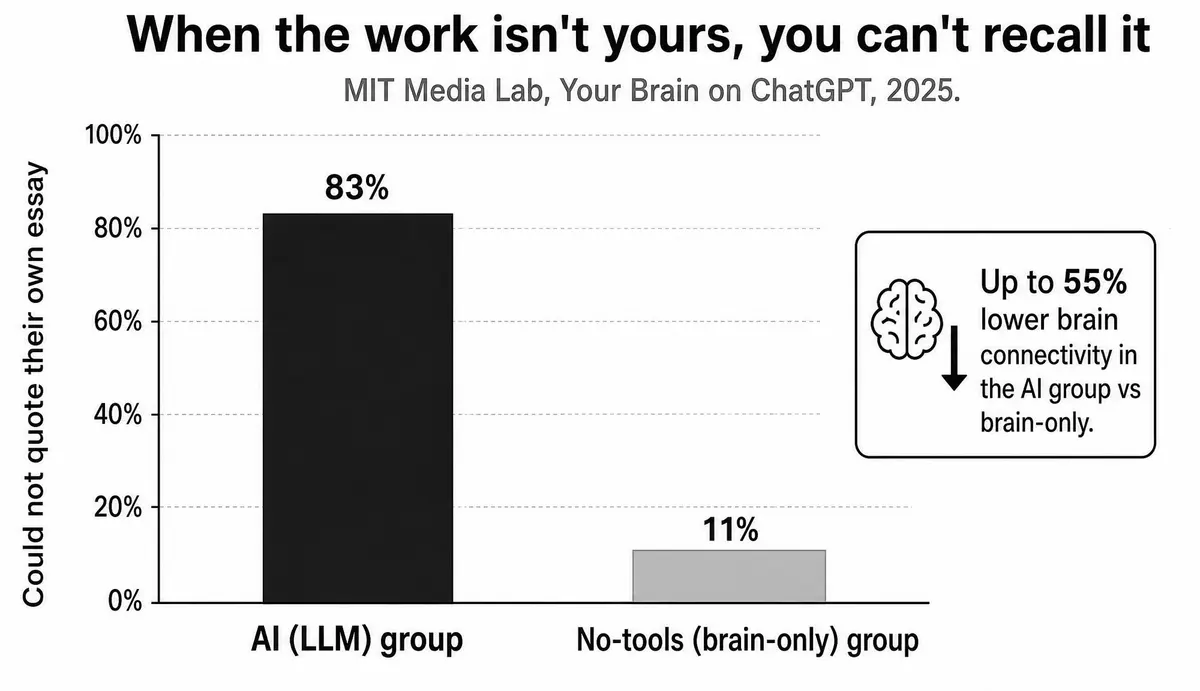
It gets worse for habitual users. When the AI group was later asked to write with no tools at all, they still showed weaker neural connectivity than people who had never used AI, a lingering effect the authors call cognitive debt. In plain terms, leaning on the machine to produce your work appears to leave you less able to produce it yourself later.
A fair word of caution: the MIT paper is a preprint that has not yet completed peer review, and the sample is small, so the precise numbers deserve humility rather than panic. But the direction of the finding lines up exactly with what instructors are seeing in person. Students hand in writing they cannot explain, quote, or defend, because, on some level, it was never truly theirs.
The accountability gap that oral exams expose
Here is the core principle every student should understand. A take-home assignment measures a document. An oral exam measures you. AI can manufacture a flawless artifact, but it cannot install comprehension in your brain. The moment a professor asks a follow-up question that is not in the original prompt, the difference between owning the material and renting it becomes obvious within seconds.
This is why Socratic questioning is so effective. The instructor does not need an AI detector or a plagiarism scanner. They simply ask why, then ask why again, then ask what you would change if one assumption were different. This shift represents a broader evolutionary phase in how universities manage writing, highlighting a major pivot in the future of academic integrity tools away from simple 'detect-and-punish' software and toward deeper process evaluation. Genuine understanding bends and adapts under that pressure. Borrowed understanding snaps.
Consider what that looks like in practice. Defending an essay you did not really write is a lot like giving a guided tour of a house you have only ever seen on Zillow. You can confidently announce that it has hardwood floors and wonderful natural light. But the second the professor asks which room is your favorite and why, you are just a person sweating in a hallway, gesturing vaguely and insisting that all of the rooms are, structurally, very sound.
Learn it so well you could teach it
The good news is that defending your work is a learnable skill, and it starts long before exam day. According to Eugene Kashuk, CEO and lead ELA and math tutor at Brighterly, a K12 tutoring platform, the students who freeze in oral exams are usually the ones who studied by re-reading rather than retrieving.
Just close the book and record yourself on camera explaining the material. If you can explain everything in simple terms, like for a 12-year old - you are good. Otherwise - your knowledge is still weak and you are highly likely to remember the shape and image of information instead of actually understanding it. Also, imagine that you are being asked the question about the material under a different angle. Try to imagine that you are explaining the answer to a real person exactly under that angle. This is the best possible method to defend your knowledge during the oral exam.
That advice maps onto a technique researchers call active recall. Instead of highlighting and rereading, you force your brain to pull information out from memory, which is precisely the muscle an oral exam tests. Pair it with the teach-back method, sometimes called the Feynman technique, and you build the exact capability the format rewards: explaining a concept simply, in your own voice, on demand. For a deeper walk-through of both habits, see our complete study-skills guide.
The formats you will face
Oral assessment is not one thing. Knowing which version you are walking into changes how you prepare. The table below maps the most common formats now appearing on U.S. campuses, drawn from the real examples above, along with what each one is really testing and how to get ready.
| Format | Where you will see it | What it really tests | How to prepare |
| Oral defense (Socratic question and answer after a submission) | Cornell biomedical engineering | Whether you can justify your own reasoning under follow-up questions | Run the why, why, why drill on every claim you submitted |
| Final conversation (extended discussion replacing the final) | Cornell religious studies | Depth and the connections between ideas across the whole course | Build a mental map linking the major themes, then practice synthesis |
| Cold-calling during class | NYU and many seminar courses | On-the-spot recall and the ability to think while speaking | Do the reading actively and predict the questions before class |
| Class presentation | NYU and most disciplines | Structured explanation and command of an audience | Lead with your conclusion, rehearse out loud, and prepare for the question and answer |
| AI-agent oral exam (a voice bot interviews you) | NYU Stern, AI product management | Whether you, and not your group or your tools, did the work | Know every part of group projects and practice speaking to a prompt-driven interviewer |
A preparation system that actually works
Cramming does not survive contact with a follow-up question. What works is a short, repeating loop you run in the days before your defense. The flowchart below lays it out, and the steps underneath explain each stage.
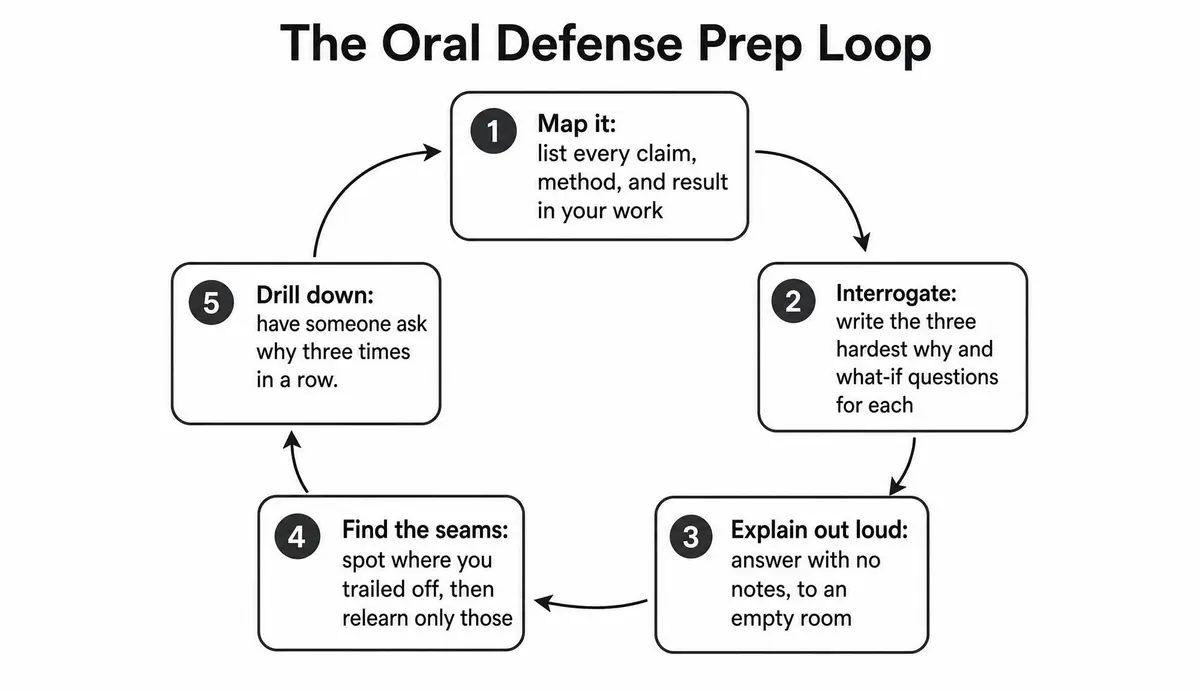
- Map the territory. List every major claim, method, and result in your submitted work. For each one, write a single sentence answering what it is and why it is there.
- Interrogate yourself. For each claim, generate the three hardest follow-up questions a skeptical professor could ask, focusing on why and what-if.
- Explain out loud. Without notes, talk through each answer to an empty room, a roommate, or a voice recorder, and listen for the spots where you trail off.
- Find the seams. The places where you went quiet are your weak points. Relearn only those, then explain them again from scratch.
- Rehearse the drill-down. Have a friend ask why three times in a row on a single point. If you can stay calm and keep reasoning, you are ready.
Treat your defense like a pitch, not a quiz
Knowing the material is necessary but not sufficient. Delivery decides whether your knowledge actually lands. Tanya Slyvkin, a pitch deck expert and CEO at WhitePage, a professional presentation design agency, spends his days helping founders defend ideas to skeptical investors, which is not so different from defending a thesis to a skeptical professor.
An investor does not fund the slide. They fund the founder who can answer the question after the slide. An oral exam is identical. Open with a clear, one-sentence version of your main point, then support it, because a grader who knows where you are going will follow you anywhere. And when a question surprises you, do not bluff. Say what you know, name the edge of what you know, and explain how you would find the rest. Professors and investors both reward honest, structured thinking far more than a confident answer that collapses on the second question.
The takeaway is to give your defense a spine. Lead with your conclusion, walk through your strongest evidence, and frame everything around the question the listener actually cares about, which is usually a simple so what. Structure is not decoration. It is what keeps you steady when the questions get hard.
See it in action
If you have never watched an oral exam unfold, it helps to see the format before you face it. The short report below follows Cornell's Chris Schaffer and other instructors as they explain why they are trading take-home work for face-to-face questioning.
What to do when your mind goes blank
Even well-prepared students freeze, and instructors know it. Carolyn Aslan, who leads Cornell's oral exam training, recommends that professors clarify the format in advance and open with gentle questions, precisely so nerves do not sink an otherwise capable student. You can use that same logic to your advantage.
If you blank, narrate your thinking instead of going silent. Saying let me reason through this out loud buys time and, more importantly, shows the grader your process, which is most of what they are grading. If you genuinely do not know, the strongest move is not invention but honesty paired with a plan: state what you do know, identify exactly what you are missing, and describe how you would figure it out. That answer demonstrates the one thing AI cannot fake, which is a mind at work.
For anxiety, rehearse out loud until speaking the material feels routine. Familiarity is the antidote to panic. The student who has already explained their argument ten times to an empty room is far harder to rattle than the one who only ever read it silently.
AI is still your friend, if you use it in the right order
None of this means you should swear off AI. The same MIT research points to a smarter path. Participants who started with their own thinking and then brought in AI, the group the researchers labeled Brain-to-LLM, showed stronger neural engagement and better recall than those who let the tool lead. The order matters. Think first, draft your own raw ideas, wrestle with the problem, and only then use AI to pressure-test, challenge, or refine what is already yours.
When you approach using AI in your academic writing as a method for structuring and editing rather than generating, you protect your cognitive development."
Used that way, a chatbot becomes a sparring partner rather than a ghostwriter. Ask it to quiz you. Ask it to play the skeptical professor and drill into your weakest claim. Ask it where your argument is thin. That is AI in service of your learning instead of in place of it, and it happens to be one of the best oral-exam preparation tools ever invented, as long as you remain the one doing the thinking.
Oral exams are back because a polished document no longer proves anything on its own. What still cannot be faked is a person who understands their own work well enough to defend it, adapt it, and explain it to someone looking them in the eye. Build that understanding on purpose, rehearse it out loud, and structure your delivery like a pitch, and the oral exam stops being a threat. It becomes the one assessment where being genuinely good at something is, at last, the whole point.