Interview With Accounting Experts: Answering Student’s Questions About Accounting Trends

Co-Founder and Chief Data Scientist
Delving into the latest trends in accounting education, I noticed a significant shift—bachelor's degree completions in accounting dropped by 7.8% from 2021 to 2022, following a steady decline of 1-3% per year since 2015 (AICPA & CIMA, 2023). Similarly, master's degree completions have also decreased. These statistics raise important questions about the future of accounting education and the profession.
As a career-planning expert, I find students planning accounting degrees often overwhelmed by uncertainties that can discourage them from venturing into this field. Technological advancements, essential skills, and evolving industry trends can make the landscape seem daunting.
To address these concerns, I and my team at Research.com consulted accounting experts. This article shares their insights on students' pressing questions about pursuing an accounting degree and building a career in the field. They also offer valuable advice on exploring specializations and career opportunities, guiding students toward becoming proficient accountants and versatile professionals across various industries.
Experts We Interviewed:
- Dr. Yaw M. Mensah: Professor of Accounting and Interim Vice Dean for Strategic Partnerships, Rutgers Business School
- Paul A. Griffin, PhD: Emeritus Distinguished Professor of Management, University of California, Davis
- Dr. John G. Wermert: Associate Professor of Accounting and prior Director of the Master of Accountancy program, Middle Tennessee State University
- Daniel Szpiro, PhD: Professor of Practice, Samuel Curtis Johnson Graduate School of Management, Cornell University
- What are the most critical skills accounting students should develop to succeed in today’s job market?
- What emerging trends in accounting should students be aware of for their careers?
- How is technology transforming the field of accounting, and what specific tools or software should students become proficient in?
- How do internships and practical experiences benefit accounting students, and how can they maximize these opportunities?
- What advice helps accounting students transition from academia to the professional world?
- What books, courses, or resources would you recommend to students who are passionate about accounting?
- How can integrating legal studies enhance an accounting career?
- How can accounting students finance their education affordably?
- Can short term certificate programs accelerate career growth in accounting?
- Can accelerated online accounting programs fast-track my career?
- What are the different types of accounting degree programs available?
- What is the ROI of an accounting degree?
- Should I Pursue an Online Doctorate to Bolster My Accounting Career?
- What are the job prospects for accounting graduates?
- Are online accounting degrees respected by employers?
- Is an Affordable Online Associate Degree a Strategic Stepping Stone in Accounting?
What are the most critical skills accounting students should develop to succeed in today’s job market?
In today's fast-changing job market, accounting students need to consistently enhance their skill set to achieve professional success. To gain deeper insights into these essential competencies, accounting experts Dr. Wermert and Dr. Mensah discuss the critical importance of fundamental skills, such as strong analytical abilities, critical thinking, and communication capabilities as key factors to thrive in the accounting field.
We also have Professor Griffin who opens the discussion about the topic by saying that students must "focus on high-level knowledge questions not solvable by AI." It underscores the role of AI in most disciplines today.
- Dr. Mensah: First and foremost, an accounting student must acquire a thorough knowledge of the subject matter and be able to apply the knowledge of concepts learned in school. Both critical and strategic thinking, along with strong analytical skills, are also very desirable. Additional skills needed are strong communication ability, attention to detail, and great time management. Finally, the ability to work in teams, strong organizational skills, and leadership qualities are needed as the student progresses in the chosen career.
- Dr. Wermert: To succeed in the accounting profession, students need to develop analytical and critical thinking skills as well as communication skills. Analytical and critical thinking skills help accountants break down complex problems, use data and logic to evaluate alternatives, and apply professional judgment to arrive at a conclusion. Good communication skills are essential for accountants to clearly explain their analyses to others, especially those who do not have a technical accounting background.
Professor Szpiro, on the other hand, highlights the accounting skills that can be applied in a management context outside the finance department:
- Professor Szpiro: It is more likely that non-financial managers would need to apply the skills we include in the domain of managerial account in their roles than financial accounting (i.e., the preparation of financial statements). For example, operating managers are regularly asked to control costs.... Accountants can help, but the ultimate responsibility for managing costs does not lie with the accountants.
The experts' perspectives on the critical skills aspiring accounting professionals should cultivate are reinforced by the 2023 job outlook report from the National Association of Colleges and Employers (NACE). This report shows that over 50% of employers find analytical and communication skills to be highly attractive attributes on a candidate's resume. These skills rank just behind problem-solving and being team-oriented, which are the top attributes sought by employers.
What emerging trends in accounting should students be aware of for their careers?
As the accounting field evolves rapidly, staying informed about emerging trends is crucial for students aiming to build rewarding careers. These trends reflect the latest advancements in technology and industry practices, highlighting the shifting demands and expectations within the profession. According to Professor Griffin, some of these advancements include developing "technology for emissions accounting, mapping, management, and disclosure." One significant trend, however, is adopting artificial intelligence (AI) technology, which 71% of accounting professionals worldwide believe will significantly transform the industry (Karbon, 2024).
- Dr. Mensah: The most obvious trends in the profession are the widespread and increasing adoption of Artificial Intelligence, greater awareness of cybersecurity issues, and the increasing importance of robotic process automation. Separately, an emerging practice involves greater client awareness and [a] tendency towards insistence on value-based pricing. This means that the accounting profession will need to think of the value they deliver to clients, instead of just billing them on the basis of hours worked.
Meanwhile, in his interview, Dr. Wermert highlighted the trend affecting the supply of accounting professionals—the critical shortage of students entering the field. The number of accounting graduates, both at the bachelor's and master's levels, has declined significantly from 78,518 in the 2017-18 academic year to 65,305 in 2021-22 (AICPA & CIMA, 2023). While this decline poses challenges for the accounting industry, Dr. Wermert pointed out that it can create exceptional opportunities for current accounting graduates. With increased competition for top talent, employers strive to connect with students early and enhance workplace environments to attract and retain accounting professionals.
- Dr. Wermert: Another change I’m seeing is that many employers are more considerate of employees’ work-life balance…. Accordingly, firms are working harder…to make the traditional busy season a little less burdensome, and firms may offer more “comp time” or paid time off during less busy times of the year. Finally, I will mention that I believe changes are coming related to the certification process for CPAs. Generally, a person must currently earn 150 credit hours of college credit to become a CPA, which means students must obtain approximately 30 hours of additional credits beyond a typical bachelor’s degree. In the past, many students pursued a master’s degree (e.g., MAcc or MBA) to obtain those credit hours.
Dr. Wermert also mentioned that the American Institute of CPAs (AICPA) is working on ways to make it easier for students to obtain the necessary 30 credit hours. In 2023, AICPA, in partnership with the National Association of State Boards of Accountancy (NASBA), initiated a project called the Experience Learn and Earn (ELE) program to help students meet the 150 credit hours required for CPA licensure.
The ELE program combines valuable online academic coursework with practical work experience. Through this program, students can earn up to 30 educational credit hours via asynchronous courses provided by our partners while working at a CPA firm. Tulane University piloted this program, with the first cohort of student associates starting classes in January 2024 (AICPA & CIMA, 2023).
How is technology transforming the field of accounting, and what specific tools or software should students become proficient in?
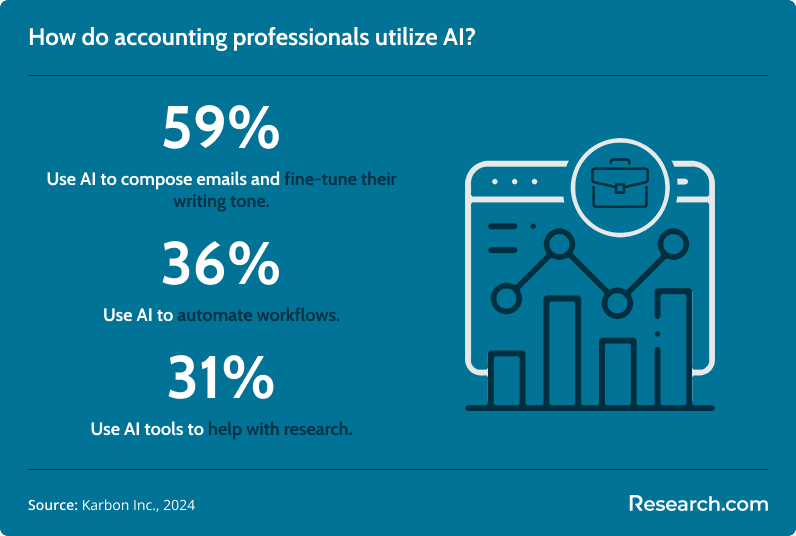
Technology is revolutionizing the field of accounting, significantly altering how tasks are performed and the skills professionals need. Currently, accounting professionals primarily use AI to enhance their written communication, particularly through AI-assisted emails. Approximately 36% of accountants leverage AI to automate workflows, freeing up time for more complex, value-adding activities (Karbon, 2024). Professor Mensah shares the same perspective in his interview.
- Dr. Mensah: The rapid penetration of artificial intelligence in accounting practice means that the structured, rather repetitive audit tasks that entry-level accountants previously performed will be automated, thus clearing the way for more complex and analytical work. Machine learning algorithms identify patterns and anomalies in large, complex data sets that might signal errors or fraud…. Among specific software tools are the relatively old ones like Excel, SAP, and Tableau. The newer software becoming of increasing importance are DataSnipper, Microsoft Power BI, and Alteryx. One might also include document processing software like Acrobat Pro and DocuSign. Software programming languages like Python and Java might be useful to learn, although AI may eventually displace the need for direct basic programming.
For his part, Professor Griffin emphasizes that AI is likely to replace many jobs. He suggests that the profession should focus on developing its own software rather than relying on external solutions. Dr. Wermert, on the other hand, highlights the importance of viewing AI as a tool to be mastered, enabling accounting professionals to use it to their advantage.
- Dr. Wermert: Accountants need to learn new technologies as they become available, and those new technologies become new tools in their toolbox. AI is the newest technology, and the profession is currently grappling with how to use it most effectively…. In addition to essential MS Office tools, I recommend students master PowerBI, Tableau, Alteryx, and Python, and many universities offer analytics classes that allow students to learn these tools. However, the technology tools that students need change over time, and to some extent, it is important for students to develop “technological agility,” being able to adapt and learn new technology tools in an ever-changing business environment.
Dr. Wermert also addresses students' concerns about the impact of new technologies on job prospects in the accounting profession. He acknowledges that technologies such as AI and robotic process automation may eliminate some jobs, particularly low-level, repetitive roles like those of accounting clerks or bookkeepers. However, he asserts that higher-level accounting positions, which require advanced analytical and communication skills, will remain essential.
According to Dr. Wermert, while automation can handle routine tasks, skilled accountants will always be needed to perform complex analyses and provide strategic insights. This perspective is further supported by a 2024 survey on the use of AI in accounting, which reveals that accounting professionals not only leverage AI to automate workflows, but nearly 60% of them also use AI to enhance their written communication (Karbon, 2024).
How do internships and practical experiences benefit accounting students, and how can they maximize these opportunities?
Internships and practical experiences play a crucial role in the development of accounting students, offering numerous benefits that extend beyond the classroom. In the United States, interns constitute 1% to 4% of the workforce, depending on the time of year (Lindner, 2024). While accounting internships, in particular, offer the highest average hourly wage among all fields at a little more than $25/hour in 2021, its value goes far beyond the financial aspect (Lindner, 2024).
- Dr. Mensah: Internships provide students the opportunity to acquire direct hands-on experience. During internships, students can further develop critical soft skills like communication, teamwork, problem-solving on the fly, critical thinking, and general professional business conduct and etiquette. They should also attempt to identify more experienced professionals in their workplace to serve as their mentors.
- Dr. Wermert: I encourage all accounting students to complete at least one internship, and our students at MTSU will often complete two or more internships before they graduate…. Many firms use internships as a recruiting tool, and internships often lead to full-time employment offers. Students get to see an employer close-up for several months. They will see the company’s culture and how the employer treats their employees. This is important information to know before accepting a full-time offer. However, the internship also allows the employer to evaluate the student’s skills and see if they are a good fit.
Professor Griffin agrees that internships are "extremely important" and "should be essential to graduation." Internships significantly enhance job prospects for accounting students by providing a direct pathway to full-time employment. According to the 2023 NACE internship report, employers planned to increase intern hiring by 9.1% for the 2022-23 academic year compared to the previous year. Additionally, nearly two-thirds of surveyed employers anticipated offering their 2022-23 interns a hybrid work experience, combining both in-person and virtual environments (NACE, 2023).
Additionally, a survey by Cartus Corporation among various industry representatives revealed that 62% of employers planned to implement in-person internships in 2023. When it comes to benefits, salary remained the top offering for interns in 2023 (Cartus, 2023).
What advice helps accounting students transition from academia to the professional world?
Professor Griffin encourages accounting graduates to apply scientific methods to solve real-world problems. Transitioning from academia to the professional world, however, can be challenging for students as the behaviors expected in these environments can differ significantly. According to NACE’s 2024 job outlook report, 91% of professionals believe professionalism is paramount, yet only 50% of graduates are proficient in this area (NACE, 2023). Accounting experts Dr. Mensah and Dr. Wermert emphasize the importance of bridging this gap.
- Dr. Mensah: During the transition from academia to the professional world, students should apply the skills they learned during their internships. They should participate in new employee orientation and onboarding activities offered by their employers. They should seek to enhance their soft skills including communication (both oral and written), professional business presentations, and networking. But above all else, they should be hard-working and avoid any display of arrogance, a failing that may particularly afflict students graduating from highly ranked and exclusive schools.
- Dr. Wermert: I often think students believe they can act like a student in college, and they will be magically transformed into professionals once they walk through the doors of their first employer. That’s just not the way it works. Students need to begin honing the skills and behaviors of a professional while in college. This includes many things, such as developing a good work ethic, being dependable, having a professional appearance, using professional language, exhibiting a positive attitude, managing time effectively, behaving ethically, and respecting others.
Although these behaviors can be learned while still in college or during internships, some employers recognize the need for additional training. To address this issue, they incorporate business etiquette and workplace expectations into their training for new hires. According to Cartus (2023), 41% of employers currently include this training in their onboarding programs. This proactive approach not only helps new graduates transition more smoothly into professional roles but also highlights the growing awareness among employers of the importance of equipping new employees with the skills needed for success in a professional environment.
What books, courses, or resources would you recommend to students who are passionate about accounting?
Accounting, along with finance, is considered one of the most challenging majors to master. According to a 2023 survey by the Center for Audit Quality (CAQ), only 62% of accounting graduates felt confident enough in their understanding to teach introductory courses in the subject. Fortunately, a wealth of learning resources is available to help accounting students overcome these challenges and succeed in their studies, and here are some of the recommendations of our accounting experts:
- Dr. Mensah: Apart from the standard textbooks they acquired during their general accounting and business education, students should begin to broaden their professional outlook by reading the business press and also listening to business and economic podcasts. This may include some news publications like The Wall Street Journal, The Economist, [and] Financial Times, and listening to business-focused outlets like Bloomberg Radio/TV, CNBC, and the like. Reading accounting-focused publications like the Journal of Accountancy and Accounting Horizons will help keep their accounting knowledge fresh.
- Dr. Wermert: Students must realize that their learning will not end after college. They must become life-long learners, and one of my favorite resources for learning new things is LinkedIn Learning. This website requires a subscription, but many students can get free access through their university (if their university has a license that applies to students). Even if you must pay out-of-pocket, it’s well worth the cost. Linked-In Learning has courses on a wide array of topics, but I especially like it for learning new technology tools.
Professor Mensah also highlights the importance of continuous learning to stay competitive and relevant in an ever-evolving job market. This involves pursuing further education, such as a graduate degree in accounting or an MBA, as well as taking technology courses and obtaining advanced certifications. These educational endeavors, whether short-term or semester-long, help ensure that career paths remain open and adaptable.
Meanwhile, in his interview, Professor Szpiro delves into the importance of integrating real-world business scenarios into accounting courses to make the material more relevant to all business students.
- Professor Szpiro: It is helpful that public companies publish their financial reports for all to read. In class, we can look at a firm’s decisions and press releases and then look at that firm’s financial statements and see how organizational strategy, acquisitions, divestments, and other managerial decisions make their way into the financial reports.
The expanded roles of accounting professionals now require a broader understanding of various business issues. Obtaining industry-recognized certifications enhances professionals' expertise in critical areas and demonstrates a commitment to their careers. These certifications can also lead to financial benefits. According to Robert Half International's Salary Guide, a property accountant's salary can increase by more than 37% when they possess rare qualifications in addition to skills and industry experience (Robert Half, 2024). Beyond financial rewards, staying current with industry trends and obtaining advanced certifications contribute to long-term job satisfaction and career value.
How can integrating legal studies enhance an accounting career?
Combining legal studies with accounting expertise equips professionals with a broader perspective on regulatory compliance, risk management, and corporate governance. An interdisciplinary approach can help bridge the gap between financial analysis and legal considerations, enhancing strategic decision-making. This integration fosters clear communication between technical and legal teams in today's complex business environment, thereby improving overall operational efficiency. Professionals who augment their technical background with legal insights may find themselves better positioned to navigate regulatory challenges and capitalize on emerging market opportunities, thereby delivering greater value to employers and clients—for example, by pursuing an online master of legal studies to deepen their understanding of legal frameworks.
How can accounting students finance their education affordably?
Accounting students have several options to mitigate tuition expenses and support their academic journey. Many institutions provide merit-based scholarships, need-based grants, and federal student aid that can significantly reduce out-of-pocket costs. Work-study programs, employer tuition reimbursement, and accelerated online formats also offer viable alternatives to traditional classroom settings. For example, exploring online schools for adults can help students identify flexible, cost-effective programs that maintain rigorous academic standards. Proactive financial planning and early consultation with academic advisors further enhance the ability to secure affordable pathways in accounting education.
Can short term certificate programs accelerate career growth in accounting?
Recent market shifts underscore the potential of expedited educational models to bridge skill gaps and offer updated technical proficiencies. Focused certificate courses provide targeted training in emerging areas such as advanced tax regulation, forensic accounting, or specialized financial software. These programs offer an agile and cost-effective alternative that complements traditional degrees by delivering practical skills in a condensed format. For individuals looking for rapid career advancement and immediate application of new competencies, exploring short term certificate programs can serve as a strategic investment in their professional journey.
Can accelerated online accounting programs fast-track my career?
Accelerated online accounting programs condense comprehensive accounting curricula into focused, intensive formats designed to build both core competencies and specialized skills in a shorter timeframe. These programs integrate innovative learning methods—such as simulation-based exercises and industry-relevant case studies—that prepare students for immediate real-world challenges. For professionals looking to rapidly transition or advance their careers, such programs offer a streamlined education pathway without sacrificing academic rigor. Options like the degree in 6 months online empower candidates to address evolving industry demands and enhance their competitive standing in today’s dynamic job market.
What are the different types of accounting degree programs available?
In his interview, Professor Szpiro explained the importance of accounting in a general management program and how it serves as a foundation for broader business studies.
- Professor Szpiro: Financial accounting is universally a core course found in the foundation of business programs at all levels (e.g., undergraduate business majors and minors; MBA; EMBA). The role of financial accounting in this core is to provide any analysis of the financial condition and financial performance of an organization with the necessary tools and vocabulary. An oft repeated description of financial accounting is that it is “the language of business.” There is certainly some truth to that. For those studying business and making business decisions, the use of the financial metrics and framework provided by financial accounting is indispensable for making informed decisions.
Building on this foundation, various accounting programs cater to different educational and career needs. These programs vary in depth and scope, allowing individuals to choose the one that best fits their career goals and educational background. Here are the main types:
- Associate Degree in Accounting: This is typically a two-year program that covers foundational accounting principles, bookkeeping, and basic business concepts, making it the fastest degree to get for students who want to venture into the accounting field. This program prepares students for entry-level positions such as bookkeepers or accounting clerks.
- Bachelor's Degree in Accounting: This four-year program provides comprehensive education in accounting principles, financial reporting, auditing, taxation, and business law. It prepares students for a wide range of accounting positions and is often required for advanced certifications.
- Master's Degree in Accounting (MAcc or MSA): A master's degree in accounting is an advanced degree typically requiring one to two years of study beyond the bachelor's degree. It focuses on deeper accounting knowledge, including advanced financial accounting, auditing, and tax. This program prepares students for higher-level positions and is often pursued by those seeking CPA certification. Before enrolling, students usually consider the cost of online masters degree in accounting as well as its traditional counterpart.
- MBA with a Concentration in Accounting: A Master of Business Administration with a Concentration in Accounting combines broader business education with specialized accounting training. Typically a two-year program, it is suitable for those seeking leadership or managerial roles in accounting or finance. MBA is also considered one of the cheapest online masters programs, making it more financially accessible to accounting graduates who want to pursue a master’s degree.
- Doctorate in Accounting (Ph.D. or DBA): This focuses on academic research and advanced theoretical knowledge. It prepares graduates for careers in academia, research, and high-level consultancy.
Aside from the degree programs, accounting also has professional certifications, such as the following:
- Certified Public Accountant (CPA): Widely recognized certification requiring passing a rigorous exam and meeting experience requirements. CPAs are qualified to perform auditing and attestation services.
- Certified Management Accountant (CMA): Focuses on management accounting and financial management skills. Requires passing an exam and relevant work experience.
- Certified Internal Auditor (CIA): Specializes in internal auditing. Requires passing an exam and relevant work experience.
- Certified Fraud Examiner (CFE): Focuses on uncovering and preventing fraud and corruption within organizations. Requires passing an exam and relevant work experience.
- Chartered Financial Analyst (CFA): Focuses on investment management. Requires passing three levels of exams and relevant work experience.
- Enrolled Agent (EA): Specializes in taxation. Requires passing an IRS exam and meeting continuing education requirements.
- Diplomas and Certificates in Accounting: If you are looking for certifications that pay well, diplomas and certificates in accounting are some of the ideal options. These are shorter programs focused on specific areas of accounting, such as bookkeeping, payroll accounting, or tax preparation, making them suitable for those seeking to quickly gain skills for specific accounting tasks.
Among the various certifications available, the CPA license is the most sought-after, with 82% of accounting majors considering it extremely valuable or very valuable for their career goals (CAQ, 2023). However, only about 60% of these students feel confident in their ability to pass the CPA licensure exam. This discrepancy suggests a need for enhanced preparatory resources and support to help students feel more equipped to achieve this important professional milestone.
What is the ROI of an accounting degree?
An accounting degree offers a robust return on investment by combining competitive starting salaries with substantial long‐term growth potential. Evaluating tuition costs, financial aid opportunities, and projected earnings can help prospective students make informed decisions about their educational investments. Strategic pathways—such as pursuing advanced certifications or exploring flexible options like doctoral degrees online—can further boost career prospects and salary trajectories. A thorough ROI assessment considers both the quantitative benefits of increased earning power and qualitative factors, including enhanced professional status and job security over a lifetime.
Should I Pursue an Online Doctorate to Bolster My Accounting Career?
Obtaining an online doctoral degree in accounting is emerging as a strategic asset for professionals aiming to lead in a competitive market. Advanced programs offer rigorous curricula designed to deepen expertise in complex financial frameworks and enhance decision-making capabilities—a benefit that can translate into higher credibility and leadership opportunities. Choosing a fast-track pathway, such as the shortest doctorate program, may provide a practical balance between academic advancement and career progression, positioning graduates to contribute significantly to innovative financial strategies and research-driven insights.
What are the job prospects for accounting graduates?
The job prospects for accounting graduates are highly promising. According to the U.S. Bureau of Labor Statistics, accountants and auditors held approximately 1.5 million jobs in 2022, with 23% of these positions in accounting services. Additionally, a solid understanding of accounting principles benefits future managers, even if they don't plan to pursue a career in accounting. Professor Szpiro elaborates on this point:
- Professor Szpiro: Most managers are not financial managers, yet all managers— especially the more senior managers—have financial responsibilities.... Responsible decision-makers have to understand the financial considerations of their analyses and decisions. It makes a great deal of sense for non-financial managers to depend on the skills and analytical insights of their colleagues who are accountants and financial managers. Nonetheless, the non-financial managers have to understand the financial information and ask demanding questions of accountants.
Professor Szpiro delves into common misconceptions about accounting encountered among non-accounting students. He notes that one prevalent misunderstanding among non-financial managers and newcomers to accounting is the difference between measuring cash flows and measuring profit. Another common misconception is the belief that a public company's market price and market capitalization are reflected on its balance sheet, causing confusion between a company's market value and book value. However, these misconceptions can be effectively addressed and clarified as non-accounting students navigate the fundamentals and complex aspects of accounting as they prepare themselves to be accounting professionals.
With the demand for accounting professionals being on the rise, accounting services employers are projected to increase their hires by 37.5% for the academic year 2023-24 (NACE, 2023). This significant growth reflects the expanding role of accountants in various sectors, driven by the increasing complexity of financial regulations and the need for businesses to maintain transparent and accurate financial records. Graduates entering the field can expect diverse opportunities in public accounting firms, corporate finance departments, government agencies, and non-profit organizations, which are also the biggest employers of accountants and auditors in 2022,
Are online accounting degrees respected by employers?
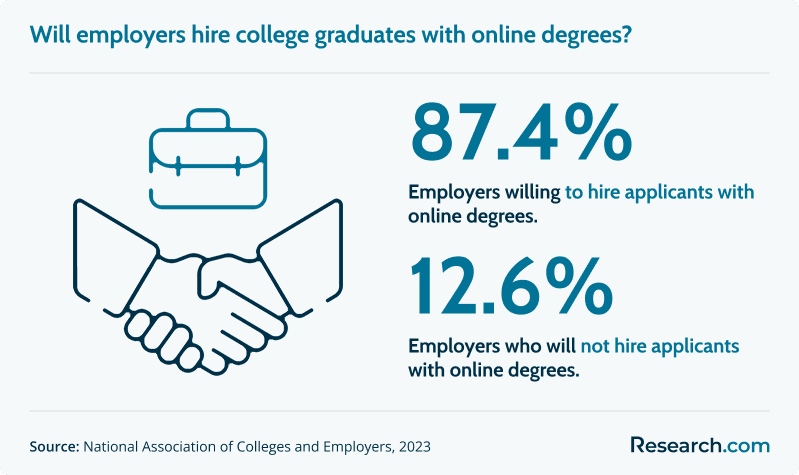
Online accounting degrees are respected by employers. Data shows that among employers who track the modality of their new hires' degrees, 87.4% have hired new college graduates with online degrees (NACE, 2023). Furthermore, there is no difference in starting salary, with 100% of these employers paying new hires with online degrees the same as those who earned their degrees traditionally.
Furthermore, the role of accounting in business education has evolved over the years, and Professor Szpiro shares what changes he foresees in the future.
- Professor Szpiro: The role of accounting in business education has not changed significantly over the years but the content of the accounting education has evolved as the economy has shifted. For example, the integration of the world economy has led to a convergence of the evolution of U.S. and international financial reporting standards. The demand for more transparent disclosure has led to the evolution of accounting for various long-term liabilities such as leases. So, while accounting remains a cornerstone of the foundational courses in all business programs, the content of these accounting courses has evolved over time to adapt and respond to the contemporary needs of investors and managers.
When it comes to online accounting degrees, the acceptance reflects a growing recognition of the quality and rigor of online programs, including the cheapest online accounting degree programs. As long as the program is accredited and provides a comprehensive education, employers value the skills and knowledge that graduates bring, regardless of how they obtained their degrees. Additionally, online degrees often demonstrate a candidate’s ability to manage time effectively and work independently, traits that are highly valued in the accounting profession. Therefore, students pursuing online accounting degrees can be confident that their qualifications will be respected and valued in the job market.
Navigating Change and Opportunity in the Field of Accounting
The accounting field has gone through significant changes and will continue to do so, presenting both challenges and opportunities for students and professionals alike. As we have explored through expert insights and current trends, the demand for accounting expertise remains strong despite recent declines in degree completions, making it one of the best degrees to get in college. This underscores the importance of continuous learning, professional certification, and adaptability to new technologies and industry practices.
The shift towards online education and the increasing recognition of online degrees by employers further highlight the flexibility and accessibility of accounting programs today. Students equipped with essential skills, such as analytical thinking and effective communication, alongside specialized knowledge and certifications, are well-positioned to thrive in diverse roles within the accounting profession. As the accounting landscape continues to change, those who remain informed and adaptable will undoubtedly find success and fulfillment in their careers.
Is an Affordable Online Associate Degree a Strategic Stepping Stone in Accounting?
For students seeking an economical entry into the accounting field, an affordable online associate degree can provide a cost-effective foundation without compromising academic rigor. This pathway allows learners to acquire essential accounting principles and practical skills in a flexible format, easing the transition into advanced studies or entry-level positions. With curricula reflecting current industry practices and the integration of technology-driven tools, these programs can position graduates to quickly adapt to the evolving market demands. Students interested in this option can explore opportunities by reviewing the cheap online associates degree programs to make an informed decision about maximizing their return on educational investment.
More Information About the Experts We Interviewed
Dr. Yaw M. Mensah

Yaw M. Mensah is a professor and Interim Vice Dean for Strategic Partnerships at Rutgers Business School, specializing in accounting and information systems. He holds an MBA in Accounting and Finance from Columbia University and a Ph.D. in Accounting from the University of Illinois. His teaching and research focus on managerial and financial accounting, particularly in efficiency evaluation, non-profit financial reporting, and capital markets.
Professor Paul A. Griffin, PhD


Dr. John G. Wermert is an Associate Professor in the Department of Accounting and previously served as the Program Director for the Master of Accountancy program at Middle Tennessee State University. He received his Ph.D. from Indiana University and became an expert in the areas of external auditing and financial accounting. Dr. Wermert's research interests include the role of hindsight bias in auditor evaluation and the valuation of goodwill on company balance sheets.
Professor Daniel Szpiro, PhD

Professor Daniel Szpiro is a Professor of Practice at Cornell University, where he teaches courses in both financial and managerial accounting. An award-winning teacher and expert in financial management, Professor Szpiro brings a wealth of experience to his role. He holds a PhD in Business Administration from the University of Western Ontario, and he is also a seasoned leader in executive and adult education, dedicated to fostering a deep understanding of accounting principles among his students.
References:
- AICPA & CIMA. (2023). 2023 Trends: A report on accounting education, the CPA exam, and public accounting firms’ hiring of recent graduates. Retrieved July 16, 2024, from the Association of International Certified Professional Accountants.
- Burke, J. A., & Polimeni, R. S. (2023, December 1). The accounting profession is in crisis. Retrieved July 16, 2024, from The CPA Journal.
- CAQ. (2023, July). Increasing diversity in the accounting profession pipeline: Challenges and opportunities. Retrieved July 17, 2024, from The Center for Audit Quality.
- Cartus. (2023, February 15). Cartus 2023 internship and co-op program pulse survey report. Retrieved July 17, 2024, from Cartus.com.
- Karbon. (2024). The state of AI in accounting report 2024: Emerging trends, challenges, & opportunities. Retrieved July 17, 2024, from Karbon Inc.
- Lindner, J. (2024, June 18). World metrics report 2024: Internship statistics. Retrieved July 17, 2024, from WorldMetrics.org.
- NACE. (2022, October). Job outlook 2023. Retrieved July 17, 2024, from National Association of Colleges and Employers.
- NACE. (2023, November). Job outlook 2024. Retrieved July 17, 2024, from National Association of Colleges and Employers.
- Robert Half. (2024). Finance and accounting salaries and hiring trends: 2024 salary guide. Retrieved July 17, 2024, from RobertHalf.com.
- U.S. BLS. (2024, April 17). Occupational outlook handbook: Accountants and auditors. Retrieved July 17, 2024, from U.S. Bureau of Labor Statistics.