Interview with Engineering Experts: Answering Students’ Questions About Engineering Trends

Co-Founder and Chief Data Scientist
Engineers earn top pay, making an average of $131,370 per year and a median annual wage of $91,420. But do students consider pursuing engineering degrees because of the earning potential alone? As a career planning advisor with over 10 years of experience, what I know for sure is that the pay is commensurate with the role engineers play. They are, after all, our world's silent shapers.
Engineering is a dynamic field and it is evolving in an age marked by rapid technological advancements and ever-changing industry demands. For students pursuing a career in engineering, understanding and appreciating insights from seasoned experts is more crucial than ever. This is especially true given the 3% decline in the number of engineering degrees awarded from 2021 to 2022.
I have interviewed engineering experts to share their perspectives and to highlight emerging trends and cutting-edge technologies. The interviews also underscore the importance of balancing rigorous theoretical coursework with practical, hands-on experiences, as well as offer valuable guidance on selecting areas of specialization that align with future opportunities and personal interests.
Experts We Interviewed
- Jasna Jankovic, Ph.D.: Associate Professor of Materials Science and Engineering, University of Connecticut
- John Kenneth Schueller, Ph.D.: Professor of Mechanical & Aerospace Engineering, University of Florida
- Bohdan W. Oppenheim, Ph.D.: Professor Emeritus of Healthcare Systems Engineering, Loyola Marymount University
- Joseph C. Reichenberger PE, BCEE: Professor of Civil and Environmental Engineering, Loyola Marymount University
- What are the most essential skills for a successful career in engineering?
- How should students approach selecting their areas of specialization or focus within computer science?
- How can engineering students effectively balance theoretical coursework with practical, hands-on experience?
- What emerging trends and technologies should engineering students be aware of to stay ahead in the field?
- What books, courses, or resources would you recommend to students who are passionate about engineering?
- What advice would you give to engineering students about preparing for the transition from academia to the professional world?
- How can I find affordable engineering education options?
- What career paths are available for graduates of engineering programs?
- What are the prerequisites for enrolling in an engineering program?
- What is the job outlook for engineering graduates?
- Could an online associate's degree be a strategic stepping stone for an engineering career?
- Can online master's degree programs accelerate your engineering career?
- What professional certifications can enhance your engineering career?
- Are online graduate degrees respected?
- Can certificate programs provide a competitive edge in engineering careers?
- How can networking and mentorship opportunities shape an engineering career?
What are the most essential skills for a successful career in engineering?
A successful engineering career hinges on a unique blend of skills. One can be an engineer with a mind full of groundbreaking ideas, but if they are unable to translate these ideas into a tangible design, explain these ideas to a team, or adapt these to new technologies, then these ideas won't materialize. In the real world of engineering, brilliance is just one piece of the puzzle. Beyond technical knowledge, a successful engineer needs a well-rounded skillset to bridge the gap between theory and reality.
- Dr. Schueller: A strong and broad mastery of the fundamentals. Whatever your field of study is, you will all do the same thing—whatever the boss tells you to do. So have a broad background such that you can be successful no matter the task you are given. Corporate bigwigs being interviewed or coming to campus will say people skills are most important. Yes, that is true at their level and somewhat true [at] every level. But since you will not be making billion-dollar decisions in your first job, you need to have technical competence at [entry-level] positions to be successful in the tasks you are assigned.
- Prof. Reichenberger: Ethics. In school, academic honesty; collaboration is [okay] as long as it is a discussion of theory and approach, not direct copying. Ethics also applies to citing work properly and being sure to not plagiarize other [people's] ideas. In professional practice, [e]thics means practice only in your area(s) of competence. Communication—oral and written communication. This applies to letter writing through calculations. Reports and letters must be clear and organized. In a report, I always tell the students, “[T]ell a story.” What is behind or driving the report; provide background for some not familiar with the project details. Then describe what you did, provide some conclusions, and then recommendations. And most importantly, cite your sources. Too many engineers grab images, tables, etc. from Google and just use [them]. These images and tables etc. have sources. In calculations, the engineer must adequately describe the methods and equations used; answers must have the correct units and the appropriate precision. When putting a table together on a spreadsheet, make sure there are units at the column headings, etc. Annotate your spreadsheets so you and anyone else can pick it up 6 months later and know exactly what was done without much time wasted. Computer software has allowed us to be more efficient; but just because you get an output, don’t accept it; review it, “does it pass the smell test?”
Dr. Jankovic thinks that "communication skills and people skills" are crucial. She points out that "[Y]ou can learn all the engineering concepts and be a great engineer, but you need those soft skills to communicate your ideas, to translate your knowledge, to collaborate, etc."
Prof. Reichenberger also places importance on attention to detail. He relates that when he taught a class called Civil Engineering Design, Practice and Ethics, where one of the topics is “Engineering Failures,” he presented details of recent or relatively recent failures, such as the Kansas City Hyatt Hotel Walkway Collapse and the Interstate Highway Bridge Collapse in Minneapolis. He notes that these projects didn’t fail because someone designed a major structural element incorrectly, but were instead "due to minor details or changes that on the surface looked ok but had major flaws due to lack of application of basic statics. In the Minneapolis Bridge, one of the contributing factors was inadequate gusset plates. Again, it’s just a detail, which does not get the same level of scrutiny as other elements."
Desire to continue to learn is also essential, according to Prof. Reichenberger. "Our fields are changing dramatically. When I started out in civil engineering, I used a slide rule to do calculations. We had rotating dial phones. We did hand drafting. Look where we are today: phones that are more powerful than the computers of the 60s, AutoCAD, Civil3D. Now we are embarking on AI. At the University level, we only teach the students to learn. Yes, we teach subjects that prepare you for the profession, but what we teach, in the time permitted, only scratches the surface. I have been practicing over 60 years, and I still learn new things and new technologies and new ways of doing things. One must maintain competency or face being phased out."
Dr. Oppenheim sees the relevance of "[b]asic sciences, laboratories, design in teams, and systems thinking."
According to Data USA, engineering majors require many skills, but leading the list are reading comprehension and complex problem-solving. Also important on the skills value chart are critical thinking, mathematics, judgment and decision-making, writing, speaking, active listening, active learning, monitoring, time management, coordination, and social perceptiveness.
The chart below shows these important skills in engineering ranked by LV value—without the revealed comparative advantage (RCA). Value is the absolute rating of a particular skill, while RCA refers to how much greater or lesser that skill's rating is than the average.
How should students approach selecting their areas of specialization or focus within computer science?
Choosing a specialization, whether in computer science or any field of engineering, can be daunting. Computer science, for one, branches out into a number of exciting specializations like artificial intelligence, cybersecurity, software engineering, data science, computer graphics, networking, and web development. Engineering has a wide range of specializations, too. There's civil engineering, mechanical engineering, electrical engineering, chemical engineering, computer engineering, aerospace engineering, biomedical engineering, and industrial engineering, among others.
It goes without saying that for students to pick the right specialization, they will need to explore what sparks their curiosity and identify their natural strengths and areas for development.
- Dr. Jankovic: I am not in computer science but in materials science and engineering. However, it does not matter—this is applicable to any field. The students should try to explore areas that interest them. They could take some internships, or do some research at university. Also, they should talk to people [who] work in those areas to better understand what their job is about. They can have mentors to guide them in their decisions or share their experiences. Another way of making a choice is by reading articles in the areas that interest them—if they get excited and keep reading, this is probably the right choice.
- Dr. Schueller: The standard career requirements apply: what someone will pay you for, what you are good at, what you enjoy. Try to find a "real world" position that will allow you to find out what types of work meet those conditions for you.
- Prof. Reichenberger: In civil engineering, ABET and the American Society of Civil Engineers (ASCE) discipline requirements require that our students are proficient in at least 4 of the major subdisciplines of civil engineering. I am not sure about the other disciplines, but civil engineering requirements are prescriptive. Our program provides an entry-level course in four disciplines (structure, geotechnical, water resources, geomatics, environmental, for example) at the sophomore/junior level. Students then select a “track” based on their choosing and then take electives in the ”track.” Even so, when students are working, they will very likely change their focus or discipline, perhaps several times throughout their career. I tell students not to stress over the discipline. Choose one, study hard, get a job, and see how you like it. You can always move to another company or agency with a different focus. If a student joins an agency with an introductory rotational program, this is even better. Civil Engineering and other engineering graduates can do many things outside of engineering, e.g., law school (patent, construction, environmental law); business (MBA), teaching at the high school level, public service, medicine, etc.
Engineering is one of the highest paying degrees. But how much you earn would still depend on your specialization, your location, your industry, your employer, and the length of your experience. If you choose an engineering specialization based on its earning potential, you can take a look at this chart. It shows the average annual salary per engineering industry. Leading the list is engineering management, with an average annual wage of $172,290. This is followed by computer hardware engineers, who earn an average of $147,770 per year. Third are software engineers, who earn an average annual salary of $138,110.
| Engineer Specialization | Mean Annual Salary |
| Engineering Management | $172,290 |
| Computer Engineer, IT Engineer (Computer Hardware Engineers) | $147,770 |
| Computer Engineer, IT Engineer (Software Developers) | $138,110 |
| Aerospace Engineer | $134,330 |
| Chemical Engineer | $122,910 |
| Electrical Engineer | $117,680 |
| Materials Science and Engineer | $110,430 |
| Biomedical Engineer | $106,700 |
| Mechanical Engineer | $105,220 |
| Civil Engineer | $101,160 |
| Mechatronics Engineer, Robotics Engineer | $93,375 |
| Industrial Engineer, Manufacturing Engineer | $76,726 |
| Geospatial Engineering |
How can engineering students effectively balance theoretical coursework with practical, hands-on experience?
Striking a balance between theoretical coursework and practical experience is a constant challenge for engineering students, but it's an essential element for success in the field. For one, theoretical knowledge forms the bedrock of engineering and it equips you with the fundamental principles and scientific understanding necessary to approach problems. However, it is practical experience that helps you apply this knowledge to real-world scenarios. By building things, tinkering in labs, or working on projects, you gain a deeper understanding of how theoretical concepts translate into practical solutions.
Moreover, engineering is all about solving problems. While theoretical coursework teaches you the "what" and "why" behind engineering principles, hands-on experience allows you to hone your "how" skills. Through hands-on projects and real-world challenges, you develop critical thinking, creativity, and the ability to translate theoretical knowledge into practical solutions. There's also a sense of accomplishment and satisfaction that comes from taking theoretical knowledge and using it to design, build, and test something tangible. This hands-on experience fosters confidence in your abilities as an engineer and motivates you to tackle even more complex challenges.
For Dr. Jankovic, "[i]nternships are a great place to start." With internships, "[t]hey will learn how to apply those theoretical concepts in real life." In addition to the hands-on experience, "[t]hey can also do research in university labs."
- Dr. Schueller: At the undergraduate level, the curriculum is mostly fixed, so this is not a very valid question. At the undergraduate level, look for diverse theoretical electives to diversify your technical background. At the graduate level, you have flexibility and most coursework tends to be very theoretical, so look for the most practical courses.
- Prof. Reichenberger: The best way is to get an internship starting as early as possible, typically after sophomore year. This will get the student exposed to work in one of the subdisciplines or focus areas. Then the next summer find another internship with a different focus area. Some engineering programs have structured “co-op” programs which is an excellent way to explore the profession. We have a civil engineering alumni support group that puts on mixers with students at the start of the school year where students get to break the ice and meet professionals and learn about their careers and companies. They also provide a mentor matched with a student to provide guidance, review resumes, and provide mock interviews. This is all outside of the curriculum.
While theoretical knowledge is the cornerstone of engineering education, it's the hands-on application that bridges the gap to real-world challenges. Practical training equips students with the technical skills needed in the field, from operating machinery to designing prototypes.
Dr. Oppenheim opines that "[t]he present balance appears correct." However, would-be engineers should not lose sight of "more team-based design and systems approaches."
This exposure builds confidence and refines expertise. But the benefits extend beyond technical prowess. Practical training fosters essential soft skills like teamwork, communication, and time management—all honed through real-world projects. By collaborating with colleagues and tackling deadlines, students develop the well-rounded skillset employers value, including adaptability, leadership, and the ability to effectively communicate ideas.
What emerging trends and technologies should engineering students be aware of to stay ahead in the field?
The engineering landscape is constantly evolving, so it is important for students to be aware of some of the most exciting emerging trends and technologies: from artificial intelligence to sustainable materials, these advancements are poised to revolutionize various industries, and understanding them will equip future engineers with the knowledge and skills to not only adapt but also lead the charge in innovation.
With the explosion of AI, Dr. Jankovic points out that "AI, ML, and quantum computing" will be always in the conversation. Dr. Jankovic also includes "clean energy, nanomaterials, [and] functional materials" as emerging trends that should prove critical to aspiring engineers.
- Dr. Schueller: Look at digital or printed magazines in your fields and industries of interest to see what the current hot topics are. Generally, identifying the trends and technologies is not difficult. But what is "hot" now when you are a student may not be "hot" when you are in your work career. Again, a strong, diverse fundamental background will serve you well.
- Prof. Reichenberger: This is hard to predict. Engineering is constantly changing. When I was an undergraduate, there were no air quality or air pollution control courses, certainly no toxic site remediation courses. All this came about through environmental regulation. Civil engineering, and I suppose other disciplines, are driven to some degree by regulations, e.g., electric vehicles, self-driving vehicles; and the industries that support these. Engineers need to stay on top of what is going on in their profession to prepare themselves for this. A lot can be gained by reading the literature [about] what research areas are developing.
These emerging developments all point to overlapping interests. Dr. Oppenheim sees "integration across interdisciplinary elements" as the necessary result of such trends.
AI and machine learning indeed continue to reshape engineering and drive innovation across various industries. However, there are also other trends like wireless power transfer (WPT), which is a technology that transmits electrical energy without the need for a physical wire connection. Experts actively research WPT technologies, which [are] growing at an exponential rate. The WPT market is projected to grow at a compound annual growth rate of 28% from 2023 to 2029.
Then there are the advancements in engineering solutions for solar, wind, and tidal energy, which rapidly propel us towards a future of more sustainable energy. As climate change awareness grows and people all over the world aim to lessen their use of fossil fuels, renewable energy sources become increasingly prevalent. A remarkable 83% of all power capacity produced in 2022 was produced by renewables. It is no wonder why renewable energy is a growing trend in the engineering industry.
What books, courses, or resources would you recommend to students who are passionate about engineering?
It is important for engineering students to fuel their passion and curiosity and to refine their skills with the help of resources—from captivating books to stimulating courses and engaging online platforms. Whether you are a tinkering beginner or a tech-savvy pro, the right resources will ignite your engineering journey and propel you toward an exceptional career.
- Dr. Schueller: Students would learn best by taking courses in their areas of interest. Do not just do the minimum or worry about GPA. Find the courses which will be useful to you. Students should also try to get free subscriptions to technical or trade magazines in their fields of interest. There are no "must-have" books. I like To Engineer is Human by Henry Petroski to learn about failure and persistence and The Culture Map by Erin Meyer to learn about multinational work, but there are others [that] may be as good or better.
- Prof. Reichenberger: Students need to maintain relationships with alumni. That is why alumni support groups for students should be developed for all programs. Many of our faculty maintain relationships with agencies and companies and can provide introductions, ... career guidance, and internship opportunities. The student chapters of the various professional technical societies can bring in speakers (recent alumni) to talk about their discipline and careers and open up lines of communication.
"There are a lot of cool shows to watch," Dr. Jankovic adds. In particular, “How it’s made?“ “Mythbusters” “Mighty Machines,” stand out, even “Khan Academy.” Most engineers already develop an interest in mathematics and science from an early age. They pursue science and math courses in school, as well as participate in summer camps, science fairs, and other related activities. There are also high schools that offer a pre-engineering curriculum to prepare their students for an engineering major in college. Dr. Jankovic also points out that "Coursera has a lot of cool engineering courses."
Once these students reach college, it is important to attend an engineering program in an institution accredited by accrediting bodies like the Accreditation Board for Engineering and Technology, Inc. Nationally accredited online universities and programs—as well as on-campus ones—ensure that students receive an education that follows guidelines and standards required to obtain an engineering job and license.
What advice would you give to engineering students about preparing for the transition from academia to the professional world?
Transitioning from the academic world to the professional world is not easy. This is especially true when competition can be stiff in certain engineering industries and in certain locations. After all, in 2022 alone, a total of 192,474 engineering degrees were awarded in the country. And even if this represents a 3% decline from the previous year, this means that graduates would need to put their best foot forward to find employment.
So what should graduates do for them to easily transition from having that student mindset to joining the workforce?
- Dr. Jankovic: I always tell to students: make good connections, leave a great track record, and stay in touch. As fresh graduates, there is a lot to learn. Be open to more learning, [and] be curious and enthusiastic. Take any opportunity to get more experience. A good idea is to find a mentor. And practice those soft skills.
- Dr. Schueller: The practice of engineering varies extremely widely. If possible when given an assignment, ask to see a successful related project and learn from the success at the local environment. How was it done? What sort of reporting on it was good? Also, your colleagues and supervisors are busy. They may forget about you. It is your responsibility to get guidance and decisions from them. Bad results by you because you didn't understand the situation or you made wrong decisions will reflect poorly on you. However, do not be a pest. Move forward with your work without needing constant guidance or supervision. Yes, that is a hard balance to achieve. Observing and following the local culture may help. While studying engineering your time is perceived as not being so valuable. But when you are an engineer, your time costs your employer money. Being productive and efficient is important. So try not to waste time or do things in a slow manner.
- Prof. Reichenberger: I have a topic lecture in the Civil Engineering Design, Practice and Ethics Course referenced previously, called “Your First Job.” I describe what it’s like to work in the profession from the aspect of working in the construction industry, working for a public agency, working for a private engineering company, etc. This is based on my 30 years of experience in public and private engineering practice before I came on full-time as a faculty member. I describe the advantages and disadvantages of each of the types of work environments. But the best advice is to get internships. In engineering, ... internships pay reasonably well, and students should take advantage of these opportunities.
Transitioning from academia to the professional world can be challenging due to shifting priorities. A good approach could be to "seek opportunities that will give you the best growth, learning, and experience. Do not focus on money yet," according to Dr. Oppenheim. Academia often prioritizes theoretical knowledge and in-depth research. The professional world, however, focuses on applying knowledge to solve practical problems and achieve specific goals within deadlines and budgets. Then there’s [the] skill gap. While academics excel in research and analysis, the professional world demands a broader skill set. Communication, teamwork, time management, and project management skills might not be as emphasized in academia, but these are crucial for professional success.
There’s also work culture change. Universities, especially affordable online colleges, can have a more independent and flexible work environment, but professional settings typically have a more structured hierarchy, defined work hours, and potentially a faster pace. Another factor is limited practical experience. Academic programs may not provide ample opportunities for real-world project work or client interaction. This lack of practical experience can make it difficult to adapt to the demands of professional engineering projects. And then there’s that thing about different expectations. Professors may provide detailed feedback and guidance, while professional settings might expect greater independence and initiative from employees. This can be a significant adjustment for new graduates.
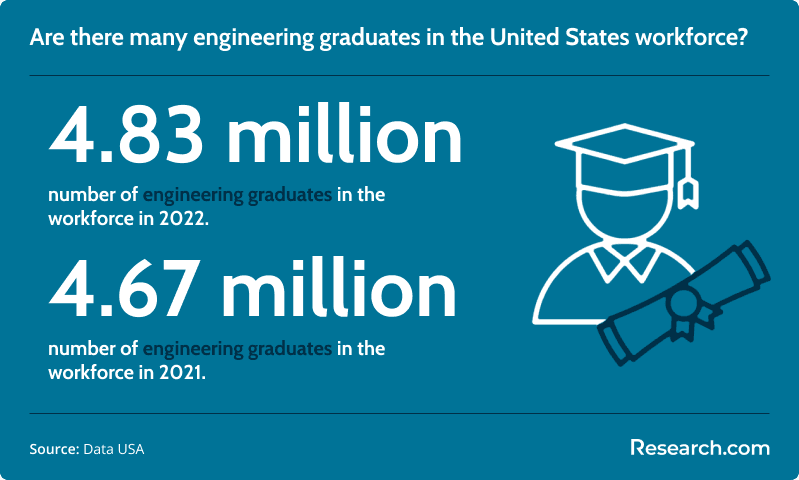
Despite all these challenges, it’s worth noting that the number of engineering graduates in the workforce has been growing at a rate of 3.48%, from 4.67 million in 2021 to 4.83 million in 2022. This means that despite universities and colleges producing thousands of graduates each year, there will always be a place for a new breed of engineers in companies across various industries.
How can I find affordable engineering education options?
Evaluating program costs alongside educational quality is essential for engineering students. Consider factors such as tuition fees, accreditation status, and financial aid opportunities when comparing options. Researching both traditional and online formats can reveal cost-effective solutions without compromising professional standards. For instance, exploring accredited programs like the cheapest online construction management degree can provide a viable pathway toward a rigorous and affordable education.
What career paths are available for graduates of engineering programs?
Your career choices largely depend on the engineering specialization you choose. These specializations include:
- Aerospace Engineering. Aerospace engineering jobs focus on designing better airplanes. An aerospace engineer can also take on technical supervisory roles, lead an engineer and technician team, or be offered executive or managerial positions.
- Chemical Engineering. Chemical engineering jobs create chemical processes and products, such as gasoline, plastics, cement, and more. Chemical engineers can become college professors, researchers, or managers.
- Civil Engineering. Civil engineers design streets, establishments, bridges, airports, and almost everything people see and use outside. Civil engineers who earn graduate degrees can become managers.
- Industrial Engineering. What do industrial engineers do? Industrial engineers develop and improve systems that integrate workers, machine, and materials to provide services.
- Mechanical Engineering. Graduates can also pursue a mechanical engineering career and become involved in product development, manufacturing, and testing for various industries, including energy and power, construction, and medical device manufacturing.
- Biomedical Engineering. This multidisciplinary STEM field combines biology and engineering principles to help inventors, researchers, and innovators design and create medical equipment and systems, such as machines for diagnosing medical problems, artificial organs, surgical robots, and advanced prosthetics. Biomedical engineering is also referred to as Bioengineering, BioMed, or BME.
- Computer Engineering. Computer engineering is an engineering discipline that involves the designing, prototyping, developing, and operating computer systems. It blends computer science and electrical engineering. At its core, the discipline concentrates on computers, digital hardware devices, and the software that controls them.
- Software Engineering. Software engineering, even the cheapest software engineering degree, deals with specifying, designing, building, implementing, testing, and maintaining software systems. It emphasizes the soup-to-nuts software development process while applying systematic practice to ensure products are reliable and safe. It combines electrical and mechanical engineering principles with the fundamentals of computer science to develop new software products.
- Materials Science and Engineering. Materials Science and Engineering combines engineering, physics, and chemistry principles to understand the scientific fundamentals, structure, and properties of materials for real-world applications. The end goal for materials science engineers is to solve real-world problems associated with nanotechnology, biotechnology, information technology, energy, manufacturing, and other major engineering disciplines.
The federal executive branch is the highest engineer employer in the US, as shown in the chart.
What are the prerequisites for enrolling in an engineering program?
Some of the basic requirements for enrolling in an engineering degree program include:
- General College Admission Requirements. Generally, schools will ask applicants to complete an application and take admission tests such as the SAT or ACT. Sometimes, applicants will be asked to earn high scores and finish specific high school programs.
- Coursework. High school English, mathematics, and sciences will help you prepare for the degree. Standings in courses, such as biological and physical sciences, chemistry, and biology also help form a strong foundation for future engineering courses.
- Other Requirements. Other engineering degree prerequisites may include recommendation letters, personal essays, and other school-specific requirements.
- Skill Requirements. In addition to having outstanding math and science skills, students must exhibit hard skills. These include problem-solving, critical thinking, teamwork, and communication skills. Even the cheapest engineering degree would require these skills.
What is the job outlook for engineering graduates?
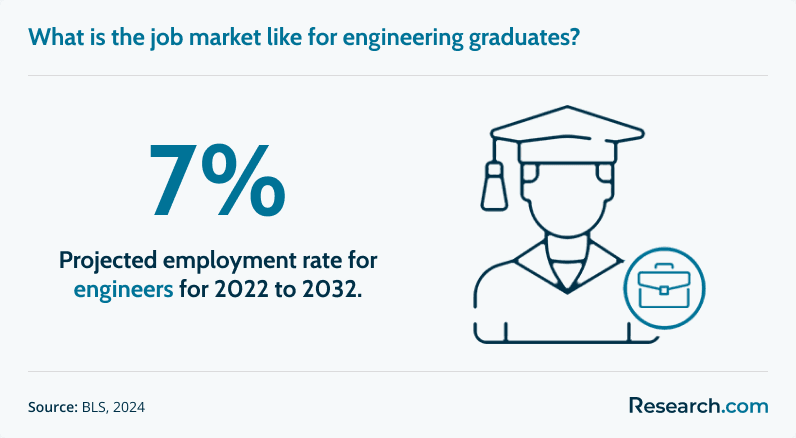
The job outlook for engineers is favorable. According to the United States Bureau of Labor Statistics, the employment of engineers in general is projected to grow 7% from 2022 to 2032. This is faster than the average employment growth rate for all occupations, which is 3%.
About 188,000 openings for architecture and engineering jobs are projected each year, on average, for the 10-year period. Many of those openings are expected to result from the need to replace engineers who transfer to different occupations or exit the labor force, such as to retire.
Could an online associate's degree be a strategic stepping stone for an engineering career?
An online associate's degree can provide an accessible, cost-effective introduction to technical fundamentals and hands-on learning opportunities, serving as a valuable bridge to more advanced engineering studies. This pathway may enable students to build essential skills, gain early exposure to practical applications, and explore various engineering disciplines before committing to a four-year program. Leveraging programs from reputable institutions can help aspiring engineers test the waters of the field while managing educational costs effectively. For more detailed program options and cost comparisons, consider visiting online schools for associate's degree.
How do you carve out a successful career as an engineer?
The world of engineering is a vast and ever-evolving landscape, brimming with opportunities to solve problems, create groundbreaking solutions, and shape the future. Earning your engineering degree is just the first step. By fostering a love for continuous learning, cultivating a well-rounded skillset, and embracing the challenges and rewards of the profession, you can embark on a fulfilling and impactful career path.
Aspiring engineers—even those with a cheap online engineering degree—must also prioritize staying abreast of technological advancements and evolving methodologies. Engaging with mentors, seeking internships, and participating in hands-on projects are crucial steps that provide real-world insights and enhance problem-solving skills. By embracing both theoretical knowledge and practical applications, students can develop a comprehensive skill set that is highly valued in the engineering field.
Can online master's degree programs accelerate your engineering career?
Online master’s degree programs in engineering offer professionals the opportunity to stay current with emerging technologies and industry best practices without disrupting their work-life balance. They foster continuous learning through flexible course structures, enabling engineers to update their technical and management skills while fulfilling professional responsibilities. Accredited online programs are increasingly recognized for their rigor and relevance, often integrating hands-on projects and real-world case studies that complement traditional classroom instruction. For those exploring pathways that combine convenience with career advancement, consider exploring easy master degree programs online as a strategic option.
What professional certifications can enhance your engineering career?
Gaining professional certifications not only validates your expertise but also distinguishes you in a competitive market. Pursue licensure such as the Fundamentals of Engineering (FE) and the Professional Engineering (PE) exams to solidify your credibility and open avenues to advanced roles. Specialized certifications in areas like project management or emerging technological fields can further align your qualifications with industry demands. These credentials complement an academic background from top college majors and demonstrate a commitment to continuous professional development.
Are online graduate degrees respected?
Employers increasingly recognize that accredited online graduate programs offer a rigorous education equivalent to traditional formats. Online programs now align closely with industry standards and demonstrate measurable outcomes in technical proficiency, critical thinking, and problem-solving. This acceptance is supported by partnerships with leading companies and a focus on practical, project-based learning, all of which reinforce the value of these degrees in competitive job markets. Recent analyses indicate that candidates from accredited online settings are evaluated on skill and experience, similar to their on-campus counterparts, suggesting that in today’s evolving educational landscape, are online graduate degrees respected.
Can certificate programs provide a competitive edge in engineering careers?
Targeted certificate programs have emerged as a practical option for engineers seeking to enhance specialized skills without pursuing a full degree. These programs address evolving industry needs by offering concise, relevant training that can expedite entry into specialized roles. In many cases, employers value focused expertise that complements academic credentials and demonstrates a commitment to continual professional development. For further insights into alternatives that can lead directly to jobs that only require a certificate, consider how these credentials can serve as a strategic investment in your career advancement.
How can networking and mentorship opportunities shape an engineering career?
Networking and mentorship offer engineers a pathway to industry insights and career acceleration by opening doors to collaborative projects, leadership development, and strategic advice that extends beyond technical skills. Engaging with experienced professionals and joining industry associations can provide access to exclusive resources, innovative methodologies, and real-world problem solving that sharpen decision-making and adaptability. Furthermore, leveraging such connections can inform choices about accelerated academic options, like the quickest college degree, to align formal education with career advancement goals. Cross-industry networking also encourages the sharing of best practices and emerging trends, ensuring that engineers remain competitive and prepared for evolving market demands.
More Information About the Experts We Interviewed
Jasna Jankovic, Ph.D.

Dr. Jasna Jankovic is an associate professor of Materials Science and Engineering at the University of Connecticut. Her research interests revolve around the development and application of advanced imaging and spectroscopy techniques, 3D material design and imaging, fuel cells, advanced nanomaterials for clean energy, electrospinning for clean energy applications, templating nature designs for application in clean energy, and industrial collaborations.
John Kenneth Schueller, Ph.D.

Prof. John K. Schueller received his Ph.D. from Purdue University in 1983. He is a generalist with some concentration in manufacturing and in off-highway vehicles and equipment. Prof. Schueller is the former Chair Editor-in-Chief of Computers and Electronics in Agriculture and serves on the Management Committee of the Club of Bologna. His awards, including the McCormick-Case, Kishida, Magoon, Pinckney, Teetor, and Vasey, have primarily been for his work in high-speed machining of metal alloys, precision agriculture, international activities, and teaching. He has previously been employed by Gilson Brothers Company, Purdue University, Texas A&M University, Caterpillar, Universiti Putra Malaysia, Hochschule für Technik und Wirtschaft Dresden, and Kyoto University.
Bohdan W. Oppenheim, Ph.D.

Dr. Bohdan W. Oppenheim is Professor Emeritus of Systems Engineering and founder of the Healthcare Systems Engineering Master's program at Loyola Marymount University. In addition, he holds the title of Adjunct Professor of Healthcare at the Kaiser Permanente Bernard J. Tyson School of Medicine in Pasadena, California. At LMU, Dr. Oppenheim served as Founder and Director of the Healthcare Systems Engineering program from 2013 - 2022. In this role, he created the curriculum and established affiliations with nearly every major healthcare organization in the greater Los Angeles area. He advised on over 100 major capstone projects with these and other organizations.
Professor Joseph C. Reichenberger, PE, BCEE

Professor Joseph Reichenberger has over 50 years of professional engineering experience in public and private practice in water, wastewater and recycled water systems, water and wastewater treatment, odor control, and treatment facility hydraulics. He is a registered professional engineer in CA, NV, AZ, NM, and HI and a Certified T5 Water Treatment Facility Operator in CA. He is a Board Certified Environmental Engineer, a Fellow of the American Society of Civil Engineers, life member of the American Water Works Association and the Water Environment Federation Association and member of Tau Beta Pi and Chi Epsilon engineering honor societies. Professor Reichenberger teaches classes in water and wastewater treatment systems, water resources, water quality management, sustainability, and the senior capstone design class at Loyola Marymount University.
References:
- University Heights, Newark, New Jersey. (2024, February 13). The Future of Engineering: 4 Emerging Technologies and Trends. NJIT.
- Data USA. (2022). Engineering. Data USA.
- Michigan Tech. (2024). 2024 Engineering Salary Statistics. MTU.
- United States Bureau of Labor Statistics. (2024, April 17). Architecture and Engineering Occupations. BLS.
- Library of Congress. (n.d.) Students: What Engineers Do. Library of Congress.