2027 Most Affordable Online Associate Degrees

Co-Founder and Chief Data Scientist
Choosing an affordable online associate degree is usually a cost, time, and career decision all at once. You may be trying to qualify for an entry-level job, transfer into a bachelor’s program later, change fields without taking on large debt, or complete a credential while working. The right program can help, but the wrong one can cost more than expected, fail to transfer, or leave you unprepared for licensing or employment requirements.
This guide explains how online associate degrees work, what they cost, which fields are commonly available, how to compare schools, and what career outcomes to consider before enrolling. It also includes a ranked list of affordable online associate degree options, practical selection criteria, common mistakes to avoid, and key questions to ask admissions and financial aid offices.
Quick Answer: Are Online Associate Degrees Worth It?
An online associate degree can be worth it if the school is accredited, the total cost is manageable, the credits transfer toward your next goal, and the program matches a real career path. Most online associate degree programs require 60 to 90 credits and often take one to two years of full-time study. Associate degree holders earn an average salary of $41,327, though earnings vary widely by occupation, location, employer, and experience.
- Best for: working adults, transfer students, career changers, military students, and learners seeking a lower-cost first college credential.
- Use caution if: your field requires state licensure, clinical hours, lab work, supervised teaching, or in-person training.
- Most important checks: accreditation, total program cost, transfer agreements, student support, career placement help, and technology requirements.
What Is an Online Associate Degree?
An online associate degree is an undergraduate credential typically offered by community colleges, technical colleges, and some universities. It usually combines general education courses with major-specific classes. Depending on the program, it may prepare students for entry-level employment, transfer to a bachelor’s degree, or both.
| Associate Degree Type | Best Fit | Typical Goal |
| Associate of Arts (A.A.) | Students interested in liberal arts, education, humanities, social sciences, or transfer pathways | Transfer to a bachelor’s program |
| Associate of Science (A.S.) | Students pursuing science, technology, business, health, or technical fields | Transfer or entry-level employment, depending on the major |
| Associate of Applied Science (A.A.S.) | Students seeking job-focused training in a specific career area | Enter the workforce sooner, though some credits may transfer |
Affordable Quick Online Associate Degrees With High Acceptance Rates
The programs below represent common online associate degree fields that can lead to entry-level roles, transfer opportunities, or further education. Before enrolling, confirm whether the program is fully online, whether it requires in-person labs or clinicals, and whether it meets requirements in your state.
1. Business Administration
An online associate degree in business administration introduces students to core business functions such as management, finance, marketing, operations, and organizational behavior. It can be a practical option for students who want broad career flexibility or plan to continue into a bachelor’s degree in business.
2. Accounting
An online associate degree in accounting focuses on financial reporting, bookkeeping, budgeting, taxation basics, auditing concepts, and business software. Graduates may pursue support roles in businesses, accounting offices, nonprofit organizations, or government settings, while students seeking higher-level accounting roles often continue into a bachelor’s program.
3. Medical Billing & Coding
A medical billing and coding associate program teaches students how healthcare records, insurance claims, medical terminology, health information systems, and coding standards work together. This path can suit detail-oriented students who want to work in healthcare administration rather than direct patient care. Students should check whether certification preparation is included and whether employers in their area prefer specific credentials.
4. Healthcare Administration
An associate degree in healthcare administration covers the business side of healthcare, including healthcare policy, finance, compliance, records, and law. It can support entry-level administrative roles in clinics, hospitals, insurance organizations, and healthcare offices. Students who want management roles may eventually need a bachelor’s degree or additional experience.
5. Computer Science
An online associate degree in computer science usually includes programming, databases, computer networks, systems analysis, and problem-solving. It may help students prepare for IT support, junior development, or cybersecurity-related roles, but job readiness often depends on the student’s portfolio, technical certifications, internships, and hands-on projects.
6. Education
An online associate degree in education introduces teaching methods, child development, curriculum planning, classroom support, and learning theory. It may prepare graduates for roles such as teacher assistant or childcare worker, but students who want to become licensed classroom teachers usually need to continue into a bachelor’s degree and meet state licensure requirements.
7. Associate's Degree: Nursing (ADN/RN)
An Associate's Degree in Nursing (ADN/RN) prepares students for registered nursing pathways through courses such as Pharmacology and Patient Care Management. Because nursing requires clinical training and licensure, students should verify whether the online format includes required in-person clinical placements and whether the program prepares graduates for RN requirements in their state.
8. Psychology
An associate degree in psychology explores human behavior, cognition, emotion, mental health, development, research methods, and social interaction. It can be useful for students interested in human services, healthcare support, human resources, or transfer into a bachelor’s program. Most counseling, clinical, and psychology careers require graduate education, so this degree is usually an early step rather than a final credential.
9. Online AS in Culinary & Pastry
An online Associate of Science in Culinary & Pastry may cover pastry decoration, international cuisine, culinary nutrition, food safety, kitchen operations, and the business side of food service. Students should look closely at whether the program includes hands-on kitchen requirements, externships, or in-person practical experiences, since culinary skills are highly practice-based.
10. Online AS in Criminal Justice
An Online Associate of Science in Criminal Justice examines criminal behavior, legal systems, investigations, corrections, and security administration. Courses such as Criminal Investigations and Security Administration can support entry-level roles in security, corrections, or related public safety settings. Requirements for law enforcement roles vary by agency and location.
11. Finance
An online associate degree in finance introduces financial markets, investment principles, risk management, financial analysis, banking, and corporate finance. It can help students pursue support roles in financial services or continue toward a bachelor’s degree for broader career mobility.
What Can You Expect From an Online Associate Degree Program?
Online associate degree programs typically deliver classes through a learning management system, where students watch lectures, submit assignments, take quizzes, join discussion boards, and communicate with instructors. Some courses are asynchronous, meaning you can complete weekly work on your own schedule. Others are synchronous and require attendance at set times.
Many programs use videos, simulations, virtual labs, digital textbooks, discussion forums, group projects, and online office hours. However, not every online associate degree is fully remote. Nursing, medical assisting, culinary, education, science, and some technical programs may require labs, clinicals, practicums, testing centers, or supervised field experiences.
Where Can You Work With an Online Associate Degree?
Employment options depend heavily on your major, local labor market, prior experience, certifications, and whether the program is designed for transfer or immediate employment. Common sectors for associate degree graduates include:
- Healthcare
- Business
- Information Technology
- Education
- Criminal Justice
- Legal Studies
- Human Services
How Much Can You Make With an Online Associate Degree?
Average earnings vary by occupation, employer, region, experience level, and credentials. The average salary for associate degree holders is $41,327. The following salary examples show how different job titles can vary even when an associate degree may be relevant.
| Role | Average Salary |
| Medical Assistants | $40,464 |
| Pharmacy Technicians | $39,200 |
| Customer Service Representatives | $38,442 |
| Teacher Assistants | $30,600 |
| Corrections Officer | $50,234 |
| Preschool Teachers | $39,030 |
| Hotel Front Desk Clerks | $30,999 |
| Community Health Workers | $80,683 |
- Best online associate degree programs
- How long online associate degrees take
- Online versus on-campus associate degrees
- Average online associate degree cost
- Financial aid options
- Admissions requirements
- Typical courses
- Common specializations
- Challenges in online associate programs
- Trends affecting online associate degrees
- Moving from an associate degree toward doctoral study
- How to choose the right program
- Career paths
- Job market outlook
- How to improve ROI
- Tools for succeeding online
List of the Best Online Associate Degree Programs
How We Ranked Schools
To help readers compare programs more efficiently, our research team reviewed schools using our ranking methodology. We also referenced publicly available education data sources to support the ranking process:
Rankings are useful starting points, not final decisions. Always confirm current tuition, fees, program format, transfer policies, and accreditation directly with the school before applying.
1. Southern New Hampshire University
Southern New Hampshire University provides several online associate degree options in areas such as business, criminal justice, liberal arts, and technology. SNHU is designed for transfer-minded students as well as learners seeking a flexible online format. Courses are asynchronous, and students can access online coursework 24/7. Some students may complete an associate degree in as little as two years.
- Program Length: Two Years
- Tracks/concentrations: business, criminal justice, liberal arts, and technology
- Cost per credit: $320
- Required Credits to Graduate: 60
- Accreditation: New England Commission of Higher Education (NECHE)
2. Purdue University Global
Purdue University Global offers online associate degree programs, including A.S. and A.A.S. options, with concentration choices in several fields. The university uses multiple start dates, which can help students plan around work and personal responsibilities. Purdue Global lists 13 associate degree programs, including an associate of science in nursing, an associate of applied science in human services, and an associate of applied science in accounting. Service members and veterans may also explore the PME2Degree program for military transfer credit.
- Program Length: One to two years
- Tracks/concentrations: business, criminal justice, education, human services, and more.
- Cost per credit: $371
- Required Credits to Graduate: 90
- Accreditation: Higher Learning Commission (HLC)
3. Eastern Gateway Community College
Eastern Gateway Community College offers associate degree programs online, on campus, and in hybrid formats. Main areas include health, public service, engineering, information technology, and business. Students should note that not every concentration is available online. Examples include an associate of applied science in criminal science, an associate degree in nursing, and an associate of applied business in accounting.
- Program Length: Two Years
- Tracks/concentrations: health, public safety, information technology, business, and education.
- Cost per credit: $167 (online in-state), $275 (online out-of-state).
- Required Credits to Graduate: 60 to 90
- Accreditation: HLC
4. Southern Arkansas University Tech
Southern Arkansas University Tech offers an online associate of arts in general studies built around general education coursework. This option may fit students who want to start college, complete core classes, and keep transfer options open before choosing a bachelor’s degree path. Coursework includes subjects such as psychology, English, history, and math.
- Program Length: Two Years
- Tracks/concentrations: N/A
- Cost per credit: $186
- Required Credits to Graduate: at least 60
- Accreditation: HLC
5. Panola College
Panola College offers an online associate of the arts in teaching for students interested in education. The AAT is built as a transfer-oriented academic program and may also support roles in early education settings or positions that require an associate degree. Students can choose between two AAT degree plans: special education (AAT) and grades six to 12.
- Program Length: Two Years
- Tracks/concentrations: special education
- Cost per credit: $125
- Required Credits to Graduate: 60
- Accreditation: Southern Association of Colleges and Schools Commission on Colleges (SACSCOC)
6. Roane State Community College
Roane State Community College provides online associate degrees and certificate programs, including associate of arts, associate of science, and associate of applied science options. Many programs include concentrations and transfer pathways for students planning to continue at a university. RSCC also offers student life opportunities such as athletics, clubs, theater, and intramurals.
- Program Length: One to two years
- Tracks/concentrations: criminal justice, history, pre-law, pre-nursing, business, and more.
- Cost per credit: $246 (online in-state), $796 (online out-of-state).
- Required Credits to Graduate: 63
- Accreditation: SACSOC
7. CUNY Kingsborough Community College
CUNY Kingsborough Community College offers online A.A.S., A.S., and A.A. associate degrees along with on-campus programs. Students can choose among 11 fully online associate degrees in fields such as accounting, human services, and business administration. The college offers over 50 academic programs, including nursing, business, and liberal arts, and graduates may choose to continue into a bachelor’s program at the same institution.
- Program Length: Two Years
- Tracks/concentrations: accounting, criminal justice, tourism and hospitality, business administration, and more.
- Cost per credit: $285
- Required Credits to Graduate: at least 60
- Accreditation: Middle States Commission on Higher Education (MSCHE)
8. Lone Star College
Lone Star College offers multiple online associate degree programs for students seeking transfer credits, workforce preparation, or prerequisite coursework. Options include associate of arts degrees, associate of science degrees, fast-tracked programs, and certificates for students who want to enter the workforce sooner. LSC also offers individual online courses that may satisfy prerequisites for other degrees.
- Program Length: One to Two Years
- Tracks/concentrations: computer science, sociology, speech communication, business, digital technology, health sciences, teaching, and more.
- Cost per credit: $103 (online in-state), $231 (online out-of-state).
- Required Credits to Graduate: 60
- Accreditation: SACSCOC
9. Eastern Wyoming College
Eastern Wyoming College offers online associate degree programs for students who can manage independent coursework. Distance courses use Canvas and are completed within set time frames. Delivery may include synchronous or asynchronous requirements. Students should also plan for required access keys, textbooks, and study guides.
- Program Length: Two Years
- Tracks/concentrations: business administration, criminal justice, elementary education, and more.
- Cost per credit: $315
- Required Credits to Graduate: at least 60
- Accreditation: HLC
10. God's Bible School and College
God's Bible School and College offers a hybrid associate degree in medical assisting for students preparing for future healthcare study and medical assisting pathways. The college partners with Christ College for healthcare training. GBSC also offers associate degree programs and a general studies option that lets students shape coursework around their interests and career goals.
- Program Length: Two Years
- Tracks/concentrations: bible and theology, elementary education, music ministry, general business, and more.
- Cost per year: $6,500
- Required Credits to Graduate: 60
- Accreditation: HLC
At-a-Glance Program Comparison
| School | Program Length | Cost Information | Credits | Accreditation |
| Southern New Hampshire University | Two Years | $320 per credit | 60 | NECHE |
| Purdue University Global | One to two years | $371 per credit | 90 | HLC |
| Eastern Gateway Community College | Two Years | $167 online in-state; $275 online out-of-state | 60 to 90 | HLC |
| Southern Arkansas University Tech | Two Years | $186 per credit | at least 60 | HLC |
| Panola College | Two Years | $125 per credit | 60 | SACSCOC |
| Roane State Community College | One to two years | $246 online in-state; $796 online out-of-state | 63 | SACSOC |
| CUNY Kingsborough Community College | Two Years | $285 per credit | at least 60 | MSCHE |
| Lone Star College | One to Two Years | $103 online in-state; $231 online out-of-state | 60 | SACSCOC |
| Eastern Wyoming College | Two Years | $315 per credit | at least 60 | HLC |
| God's Bible School and College | Two Years | $6,500 per year | 60 | HLC |
How Long Does It Take to Complete an Online Associate Degree Program?
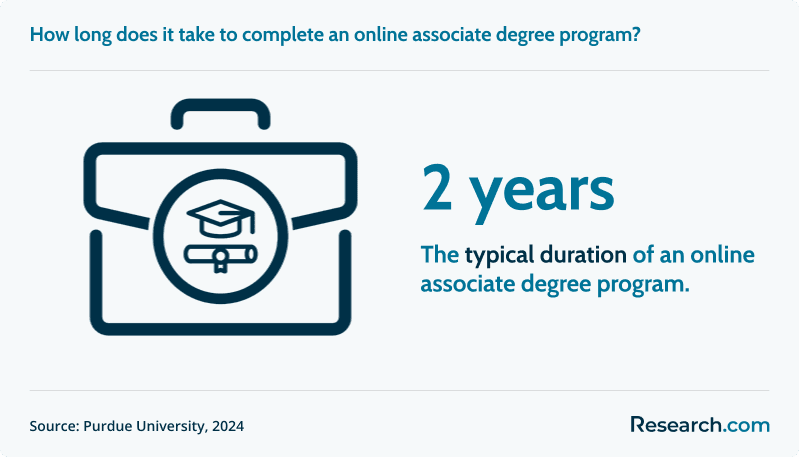
Most online associate degree programs require 60 to 90 credit hours. Full-time students often finish in one to two years, while part-time students may need longer. The timeline depends on the program structure, course availability, major requirements, transfer credits, and whether the student takes accelerated terms.
Online associate degrees are often included among the most affordable online degrees because they can be completed before a bachelor’s degree and may be offered by lower-cost community colleges. Still, faster is not always better. Students in healthcare, nursing, education, culinary, and technical fields should make sure accelerated pacing does not interfere with required labs, practicums, or certification preparation.
How Does an Online Associate Degree Program Compare to an On-Campus Program?
The main difference is flexibility. Online programs let students complete coursework from home and may offer asynchronous classes, which can be helpful for working adults and caregivers. On-campus programs provide more face-to-face interaction, structured schedules, physical labs, campus resources, and immediate access to faculty and classmates.
| Factor | Online Associate Degree | On-Campus Associate Degree |
| Schedule | Often more flexible; may include asynchronous coursework | Requires attendance at specific times and locations |
| Learning style | Best for self-directed students with strong time management | Best for students who prefer routine and in-person instruction |
| Support | Virtual advising, tutoring, library access, and tech help may be available | In-person offices, labs, study groups, and campus services are easier to access |
| Hands-on requirements | May still require labs, clinicals, fieldwork, or proctored exams | Hands-on work is usually integrated into campus facilities |
| Best fit | Working adults, distance learners, military students, and students needing schedule control | Students who want campus life, direct supervision, and more structure |
What Is the Average Cost of an Online Associate Degree Program?
Costs vary by school, residency status, credit requirements, fees, books, technology, and whether the program requires in-person components. For example, an online associate degree from SNHU can cost around $19,200, while online associate programs from EGCC can cost around $16,500. RSCC provides a clear example of residency differences: about $15,500 for in-state students and $50,150 for out-of-state students.
When comparing affordability, do not look only at tuition per credit. Add mandatory fees, textbooks, software, lab kits, exam fees, background checks, clinical travel, graduation fees, and the cost of any required equipment.
What Financial Aid Options Are Available for Online Associate Degree Students?
Online associate degree students may qualify for several forms of financial aid, depending on enrollment status, school eligibility, financial need, and personal circumstances.
- Federal Student Aid: Eligible students can apply for Pell Grants, Federal Supplemental Educational Opportunity Grants (FSEOG), and Federal Work-Study (FWS). The first step is completing the Free Application for Federal Student Aid (FAFSA).
- Scholarships: Colleges may offer scholarships based on academic achievement, financial need, major, background, or enrollment status. Students can also search for awards from organizations, foundations, employers, and community groups.
- Grants: State and institutional grants may be available in addition to federal grants. Grants usually do not need to be repaid and are often based on financial need.
- Military Benefits: Active-duty service members, veterans, and eligible dependents may qualify for military tuition assistance, GI Bill benefits, or other education benefits. Students can also compare the best online colleges for military learners when evaluating support services and credit for training.
What Are the Prerequisites for Enrolling in an Online Associate Degree Program?
Admission requirements vary by institution and major. Open-admission community colleges may have fewer barriers, while selective healthcare or technical programs may require additional steps.
- High school diploma or equivalent: Most programs require a high school diploma or GED certificate.
- Minimum GPA: Some schools or competitive programs may set GPA requirements.
- Standardized test scores: SAT or ACT scores are not always required, but some institutions may request them.
- English proficiency: International students may need to show English proficiency through exams such as the TOEFL or IELTS.
- Prerequisite coursework: Some majors may require prior math, science, English, or technical coursework before admission or before upper-level program courses.
What Courses Are Typically Included in an Online Associate Degree Program?
Coursework depends on the degree type and major, but most programs blend general education, major requirements, and electives. Students planning to transfer should make sure their general education credits align with the bachelor’s program they want later.
- Introduction to the field: These courses explain basic concepts, terminology, and professional practices. For example, students exploring careers in data science may begin with introductory computing, statistics, or analytics coursework.
- General education courses: Common requirements include English composition, math, natural sciences, social sciences, humanities, and communication.
- Core major courses: These classes focus on the student’s subject area. A business administration major, for example, may take accounting, marketing, management, and business ethics.
- Electives: Electives let students explore related interests or customize their degree around career and transfer goals.
- Practical experience or internship: Some programs include internships, practicums, clinicals, labs, or capstone projects. Hands-on requirements are also common in some undergraduate and graduate pathways, including RN-to-MSN bridge programs and education programs.
What Specializations Are Available in Online Associate Degree Programs?
Specializations help students focus their coursework on a career field or transfer pathway. Availability varies by school and program format.
- Business Administration: Possible focus areas include marketing, accounting, entrepreneurship, or management.
- Information Technology: Students may study cybersecurity, network administration, web development, or database management.
- Healthcare: Common options include medical assisting, healthcare administration, billing and coding, or healthcare informatics.
- Criminal Justice: Students may focus on law enforcement, corrections, criminal investigations, or homeland security.
- Early Childhood Education: Coursework may include child development, curriculum design, classroom management, or special education. Students who want teacher licensure may later consider a bachelor’s in elementary education online or another state-approved teacher preparation route.
In 2021, one million associate degrees were conferred. The most common majors were general studies and humanities, with 400,400 graduates; health professions, with 181,000 graduates; and business, with 116,100 graduates. Other fields included engineering technologies with 48,700 graduates, homeland security and law enforcement with 35,000 graduates, and information sciences with 34,200 graduates.
What Challenges Might You Face in an Online Associate Degree Program?
Online learning can be convenient, but it is not automatically easier. Students often struggle with isolation, procrastination, technology problems, unclear expectations, and balancing school with work or family. Programs with labs, clinicals, or practicums can also create scheduling challenges if in-person experiences are required.
| Common Challenge | Why It Matters | Better Approach |
| Weak time management | Online courses may have weekly deadlines but fewer reminders | Use a weekly study calendar and schedule fixed work blocks |
| Assuming “online” means “self-paced” | Many online classes still follow term schedules and deadlines | Ask whether courses are asynchronous, synchronous, accelerated, or self-paced |
| Feeling disconnected | Lack of peer contact can reduce motivation | Use discussion boards, online tutoring, advisor meetings, and student groups |
| Technical problems | Missed assignments or exams can affect grades | Confirm device, internet, webcam, software, and proctoring requirements before classes start |
| Unclear transfer plans | Credits may not apply to a future bachelor’s degree | Review articulation agreements and ask for written transfer guidance |
If you plan to continue your education after an associate degree, reviewing transfer-friendly options such as the easiest bachelors to get can help you understand how credits might support the next step.
What Emerging Trends Are Shaping Online Associate Degree Programs?
Online associate degrees are being shaped by employer demand for practical skills, growth in digital course delivery, wider use of virtual collaboration tools, and increased attention to transfer pathways. Some institutions are adding adaptive learning tools, simulations, online labs, and industry-aligned coursework to make remote learning more interactive.
Students should still evaluate these features carefully. Technology can improve access, but program quality depends on course design, instructor engagement, academic support, accreditation, and career relevance. Learners who plan to continue beyond an associate and bachelor’s degree may also compare future options such as the quickest masters degree when mapping long-term academic goals.
How Can You Transition From an Online Associate Degree to a Doctoral Program?
An associate degree does not lead directly into a doctoral program. The usual path is associate degree, bachelor’s degree, and then, depending on the field, a master’s degree or direct doctoral admission. The value of the associate degree is that it may provide lower-cost transferable credits and help students build the academic foundation needed for later study.
Before enrolling, ask whether the school has articulation agreements with four-year institutions and whether credits apply to your intended bachelor’s major. If your long-term goal is education leadership or another doctoral pathway, you can later compare options such as the shortest EdD program, but only after confirming the required bachelor’s and graduate prerequisites.
How Do You Choose the Best Online Associate Degree Program?
The best online associate degree is not always the cheapest or fastest. It is the program that matches your career goal, transfer plan, budget, schedule, and learning needs.
- Check accreditation first: Make sure the institution is accredited by a recognized accrediting agency. This affects credit transfer, employer recognition, and financial aid eligibility.
- Match the degree type to your goal: Choose A.A. or A.S. pathways if transfer is the priority. Consider A.A.S. programs if workforce preparation is the main goal.
- Compare total cost, not just tuition: Include fees, books, software, exams, labs, travel, supplies, and lost work time.
- Review transfer policies: Ask which credits transfer, where they transfer, and whether the agreement is guaranteed in writing.
- Confirm format details: Ask whether courses are asynchronous, synchronous, hybrid, accelerated, or self-paced.
- Evaluate support services: Look for online advising, tutoring, writing help, library access, career counseling, disability services, and technical support.
- Review faculty and career alignment: Faculty experience, employer connections, internships, and certification preparation can matter as much as the course list.
Questions to Ask Before Enrolling
- Is the institution accredited, and by which accrediting body?
- Is the program fully online, or are there campus visits, labs, clinicals, practicums, or proctored exams?
- What is the total estimated cost through graduation?
- Can I use federal financial aid for this program?
- How many credits can I transfer in?
- Which bachelor’s programs accept these credits?
- Does the program prepare me for any required certification or licensure?
- What support is available for online students?
- What happens if I need to pause enrollment?
- Are courses available every term, or could limited scheduling delay graduation?
Common Mistakes to Avoid When Choosing an Online Associate Degree
- Choosing based only on tuition: A low per-credit rate can become expensive if fees, books, or nontransferable credits add up.
- Ignoring accreditation: Non-accredited programs can create problems with transfer, financial aid, and employer recognition.
- Assuming all online programs are fully remote: Healthcare, nursing, culinary, education, and technical programs may require in-person training.
- Not checking state requirements: Licensure and certification rules can differ by state, especially in nursing, education, and healthcare.
- Overlooking transfer fit: Credits that count toward an associate degree may not always count toward your intended bachelor’s major.
- Relying only on rankings: Rankings can narrow your search, but your best choice depends on cost, location, transfer goals, support, and schedule.
- Assuming salary outcomes are guaranteed: Degree level matters, but earnings also depend on occupation, region, experience, employer, and additional credentials.
What Career Paths Are Available for Online Associate Degree Graduates?
Career options depend on the student’s major and whether the program is designed for direct employment or transfer. Common pathways include:
- Healthcare: Medical assistant, pharmacy technician, medical billing and coding specialist, or dental assistant.
- Information Technology: Computer support specialist, network support role, web development support, or cybersecurity technician.
- Business: Administrative assistant, customer service representative, office manager, or sales associate. Students who later want advanced business roles may compare cheap MBA programs after completing a bachelor’s degree.
- Education: Teacher assistant, childcare worker, or early childhood education support role.
- Criminal Justice: Security guard, correctional officer, private investigator, or police officer, depending on agency requirements.
- Liberal Arts: Transfer to a four-year college or entry-level roles in administration, social services, communications, or related fields.
What Is the Job Market for Graduates With Online Associate Degrees?
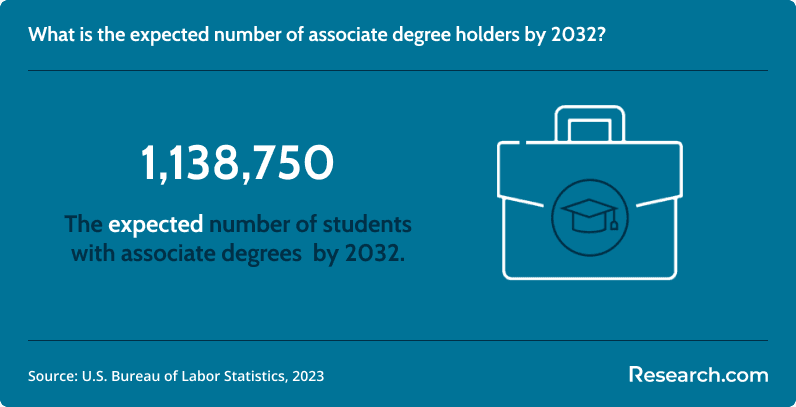
The job market for online associate degree graduates varies by major, industry, location, and work experience. Fields such as healthcare, business, technology, and education commonly employ associate degree graduates in entry-level or support roles. The number of students expected to graduate with an associate degree is projected to reach 1,138,750 by 2032.
Employers generally care more about the school’s accreditation, the relevance of the program, the applicant’s skills, and work experience than whether the coursework was completed online. Graduates can improve competitiveness by building a portfolio, completing internships, earning industry certifications where relevant, and using career services before graduation.
How Can You Maximize the Return on Investment of an Online Associate Degree?
To improve ROI, compare the total cost of attendance against realistic career and transfer outcomes. The lowest-cost program is not always the best value if credits do not transfer, career support is weak, or the program does not prepare students for required credentials.
- Start with the end goal: Decide whether you want immediate employment, transfer to a bachelor’s degree, or both.
- Choose transferable credits: If you plan to continue, prioritize schools with clear articulation agreements.
- Use financial aid wisely: Complete the FAFSA, compare grants and scholarships, and borrow only what you need.
- Look for employer tuition support: Some employers help pay for job-related education.
- Build experience while enrolled: Internships, part-time work, volunteer experience, and projects can strengthen your resume.
- Consider high-value fields carefully: Programs listed among 2-year online degrees that pay well can help you compare affordability with earning potential, but salary outcomes are never guaranteed.
What Tools and Resources Help Students Succeed in an Online Associate Degree Program?
Successful online students need more than motivation. They also need dependable technology, organized schedules, and regular use of academic support services.
- Learning Management System: Most programs use Canvas, Blackboard, Moodle, or a similar platform for lectures, assignments, grades, and discussions.
- Reliable technology: Students typically need a dependable computer, stable internet, updated software, and access to tools such as Microsoft Office, Google Workspace, Zoom, or Microsoft Teams.
- Online libraries and databases: Digital libraries, e-books, JSTOR, ProQuest, and other academic databases can support research and writing assignments.
- Time management tools: Google Calendar, Trello, Notion, or similar tools can help students track deadlines and study blocks.
- Academic support: Tutoring, writing centers, academic advising, and research help can prevent small problems from becoming course failures.
- Virtual networking: LinkedIn, school forums, class discussion boards, and student groups can help online learners build connections with classmates, instructors, and industry contacts.
Resources
- Eastern Gateway Community College. (2024). Tuition. https://catalog.egcc.edu/content.php?catoid=3&navoid=149
- National Center for Education Statistics. (2022). Fast Facts: Most Popular Majors. https://nces.ed.gov/fastfacts/display.asp?id=37
- Purdue University. (2024). ASSOCIATE'S DEGREE PROGRAMS (AS AND AAS). https://www.purdueglobal.edu/degree-programs/associates-degrees
- Roane State Community College. (2024). Tuition and Fee Listing. https://www.roanestate.edu/?9185-Tuition-and-Fee-Listing
- Salary.com. (2023). Medical Assistant - Certified Salary. https://www.salary.com/research/salary/benchmark/medical-assistant-certified-salary
- Southern New Hampshire University. (2024). Associate Degrees. https://www.snhu.edu/online-degrees/associate
- Statista. (2022). Number of Associate's degree recipients in the United States from 1969/70 to 2031/32. https://www.statista.com/statistics/238249/associate-degree-recipients-in-the-us
- ZipRecruiter. (2024). Associate Degree Salary. https://www.ziprecruiter.com/Salaries/Associate-Degree-Salary#Yearly
Key Insights
- An online associate degree can be a strong low-cost starting point if the school is accredited and the credits support your career or transfer plan.
- Most programs require 60 to 90 credits and commonly take one to two years for full-time students, though part-time and clinical-heavy programs may take longer.
- Do not compare schools by tuition alone. Total cost should include fees, books, software, equipment, exams, travel, and any in-person requirements.
- Associate degree holders earn an average salary of $41,327, but occupation choice has a major impact on earnings.
- Fields such as healthcare, business, technology, education, criminal justice, legal studies, and human services commonly offer associate-level pathways.
- Transfer planning is essential. Ask for written confirmation of which credits will apply to a bachelor’s degree before enrolling.
- Online does not always mean fully remote. Nursing, education, culinary, healthcare, and technical programs may require clinicals, labs, practicums, or supervised fieldwork.
- The best program is the one that fits your schedule, budget, accreditation needs, career goal, and next academic step—not simply the one with the fastest timeline or lowest advertised price.
Other things you should know about online associate degree programs
In 2027, among the most affordable online options for associate degrees are Brigham Young University – Idaho, Georgia Highlands College, and Great Basin College. These institutions offer competitive tuition rates, making higher education accessible to a broad range of students.
The average duration to complete an affordable online associate degree in 2027 is typically two years for full-time students. Part-time students may take longer, depending on their course load. The programs usually require the completion of about 60 credit hours.
Many do, especially in math, science, business, and general education courses. Schools may use online proctoring services such as Respondus Monitor or ProctorU, or require a local testing center. The course syllabus usually lists exam rules, ID requirements, and any allowed materials.
Federal Pell Grants, state-specific scholarships, and school-based financial aid programs can help fund affordable online associate degrees in 2027. Students should check eligibility criteria and apply through FAFSA (Free Application for Federal Student Aid) for access to federal funds.