
2027 Easiest DNP Programs

Co-Founder and Chief Data Scientist
Pursuing a DNP for your career or interests can be overwhelming, especially with many available program options. As someone who's been guiding students through career planning for over a decade, I understand the importance of finding the right fit. That's why I've delved into credible sources to compile a comprehensive list of the ten easiest DNP programs for 2024.
With the number of students enrolled in DNP programs rising, standing at 41,021 according to data published in 2023, it's crucial to navigate these choices wisely. My expertise in career planning has enabled me to sift through the information and present you with a guide tailored to simplify your decision-making process. By reading this article, you'll gain valuable insights into the easiest DNP programs available, empowering you to take the next step toward advancing your education and career goals.
What are the benefits of getting a DNP?
- DNP graduates can pursue various nursing roles in clinical settings and leadership positions, such as Nurse Practitioners (NPs) or nurse executives.
- Studying for a DNP online provides flexibility and convenience, allowing students to balance their education with other responsibilities.
- Completing a DNP program typically takes around three to four years for full-time students.
What can I expect from a DNP?
DNP programs cover essential courses like advanced nursing practice, leadership, healthcare policy, and evidence-based practice. These courses give you the skills you need for various nursing roles in clinical settings and leadership positions. To graduate, you must complete coursework, clock in clinical practicum hours, and wrap up with a final DNP project or capstone. These elements help you blend theory with real-world practice so you're ready to tackle the challenges of modern healthcare.
Average tuition for DNP programs can vary depending on where you study and how the program is set up. On average, you might shell out $10,000 to $40,000 per year in tuition fees. As for timing, most DNP programs take full-time students about three to four years to finish. If you're going part-time, it could stretch to five years or more.
Where can I work with a DNP?
According to recent data, the most significant chunk of DNP graduates end up as Nurse Practitioners (NPs), making up about 33%. After that, about 25% of grads become nurse executives. With a DNP, you could land jobs in academia, research, healthcare administration, or even policy-making. Your career path might lead to hospitals, clinics, universities, government agencies, or private practices.
Data published by the BLS in 2023 identified the following as the industries with the highest levels of employment for NPs:
- Offices of Physicians
- General Medical and Surgical Hospitals
- Outpatient Care Centers
- Offices of Other Health Practitioners
- Home Health Care Services
How much can I make with a DNP?
On average, a DNP graduate in the US pulls in around $117,859 annually, according to 2024 data. Now, if you're eyeing an NP role, the average salary bumps up to $126,260 a year. Remember that your salary can vary based on location, experience, specialization, and employer. Generally, though, having a DNP opens doors to higher-paying positions compared to those with lower-level nursing degrees. Plus, as the demand for healthcare professionals grows, so does the potential for competitive compensation.
- 10 Easiest DNP Programs for 2027 Best Programs
- How long does it take to complete a DNP program? Completion Time
- How does an online DNP compare to an on-campus program? How does an online DNP compare to an on-campus program?
- What is the average cost of DNP programs? Average Cost
- What are the financial aid options for students enrolling in a DNP program? Financial Aid
- What are the prerequisites for enrolling in DNP programs? Requirements
- What courses are typically in a DNP program? What courses are typically in a DNP program?
- What skills will I gain from a DNP program? What skills will I gain from a DNP program?
- What types of specializations are available in DNP programs? What types of specializations are available in DNP programs?
- How to choose the best DNP program? How to choose the best DNP program?
- What career paths are available for graduates of DNP programs? Career Paths
- What is the job market for graduates with a DNP? Job Market
- What technology skills and tools do I need for DNP programs? What technology skills and tools do I need for DNP programs?
- Are the easiest DNP programs just as good as regular DNP programs? Are the easiest DNP programs just as good as regular DNP programs?
- How can non-nursing professionals begin an accelerated pathway to advanced practice? How can non-nursing professionals begin an accelerated pathway to advanced practice?
- What funding options exist for accelerated DNP programs? What funding options exist for accelerated DNP programs?
10 Easiest DNP Programs for 2027
Choosing a Doctor of Nursing Practice program is rarely about finding a program that is academically “easy.” A DNP is a terminal nursing practice degree, so every legitimate program requires advanced coursework, clinical practice, evidence-based projects, and strong professional judgment. For most nurses, the real search is for a DNP program that is easier to manage: clearer admissions, flexible online or hybrid delivery, reasonable credit requirements, affordable tuition, useful concentrations, and accreditation that supports certification or career advancement.
This guide is designed for registered nurses comparing DNP pathways, including BSN-to-DNP, MSN-to-DNP, post-master’s APRN, nurse executive, FNP, PMHNP, and other advanced practice options. You will learn which programs may be more accessible, how long they take, what they cost, how online and campus formats compare, what admissions requirements to expect, and how to avoid choosing a program that looks convenient but does not support your licensing, certification, or career goals.
Quick Answer: What Makes a DNP Program “Easier”?
The easiest DNP programs are usually accredited programs with flexible formats, transparent admissions requirements, manageable credit loads, online or hybrid coursework, local clinical placement options, and clear tracks for nurses entering with either a BSN or MSN. “Easy” should not mean low quality. The safest choice is a CCNE- or ACEN-accredited program that fits your schedule, finances, state licensure needs, and intended role.
| What to Look For | Why It Matters | What to Verify Before Applying |
| Accreditation | Accreditation helps confirm that the program meets recognized nursing education standards. | Check CCNE, ACEN, or institutional accreditation status before enrolling. |
| Entry pathway | BSN-to-DNP programs usually take longer than MSN-to-DNP programs. | Confirm whether the program accepts your current nursing degree and license. |
| Clinical placement support | Even online DNP programs include practicum or project requirements. | Ask whether the school finds placements or expects students to secure them. |
| Specialization | Your track affects certification, clinical hours, coursework, and career options. | Match the track to your intended APRN, leadership, education, or policy role. |
| Total cost | Per-credit tuition does not show the full price of a degree. | Compare tuition, fees, travel, campus intensives, books, and lost work time. |
How We Ranked These Schools
Because DNP decisions affect licensing, certification, career mobility, and cost, this ranking emphasizes practical factors that matter to working nurses. Research.com uses data from sources such as the IPEDS database, Peterson's database, the College Scorecard database, and the National Center for Education Statistics. These sources help compare schools using transparent institutional and program data. For more detail about the evaluation process, review the Research.com methodology page.
Ranked List: 10 Easiest DNP Programs to Consider
The programs below may be easier for many nurses to complete because they offer flexible delivery, multiple tracks, online coursework, shorter post-master’s options, or clear credit structures. Always confirm current admissions rules, clinical placement policies, state authorization, and certification eligibility with the school before applying.
1. Southeastern Louisiana University
Southeastern Louisiana University offers DNP pathways for nurses seeking advanced practice, psychiatric-mental health, family practice, and nurse executive leadership preparation. The program emphasizes clinical scholarship, prevention-focused care, informatics, evidence-based practice, and quality improvement. Graduates who complete the appropriate track meet educational requirements for national certification exams and may pursue APRN licensure in Louisiana.
- Tracks/Concentrations: Post-MSN DNP, Psychiatric Mental Health Nurse Practitioner (PMHNP), BSN to DNP FNP (Family Nurse Practitioner), BSN to DNP Nurse Executive Leadership, BSN to DNP PMHNP
- Required Credits to Graduate: 39-70, depending on track/concentration
- Cost: $2,685.90 for 6 credits for in-state students, $5,805.90 for out-of-state students
- Accreditation: Commission on Collegiate Nursing Education (CCNE)
2. Delta State University
Delta State University provides an online DNP option for registered nurses entering with a bachelor’s or master’s degree. The curriculum is designed to prepare nurses for FNP national certification and state APRN licensure while strengthening leadership, practice innovation, care delivery, and health policy skills.
- Tracks/Concentrations: BSN/Post-Master’s to DNP, FNP to DNP
- Required Credits to Graduate: 31-65, depending on track/concentration
- Cost: $469 per credit hour
- Accreditation: CCNE
3. University of Southern Mississippi
The University of Southern Mississippi offers a DNP program focused on advanced practice, leadership, and improved healthcare outcomes for diverse populations. Students study topics such as leadership, ethics, healthcare law, policy, economics, management, and human resources. The program also includes a DNP project with a healthcare leadership focus and benefits from partnerships with healthcare facilities for clinical practice and research opportunities.
- Tracks/Concentrations: N/A
- Required Credits to Graduate: 34
- Cost: $529 per credit hour
- Accreditation: CCNE
4. Old Dominion University
Old Dominion University offers an accredited post-MSN DNP for advanced practice nurses, including nurse practitioners, nurse midwives, clinical nurse specialists, and nurse anesthetists. The program is built for clinicians who want to improve systems of care, lead teams, support underserved populations, and address access and disparity issues through advanced nursing practice.
- Tracks/Concentrations: N/A
- Required Credits to Graduate: 36
- Cost: $620 per credit hour for in-state students, $642 for out-of-state students
- Accreditation: CCNE
5. University of Kentucky
The University of Kentucky offers an online DNP for nurses preparing for advanced practice and leadership roles. Most coursework is online, but students attend in-person immersion blocks twice each semester on the Lexington campus. These sessions include orientation, networking, and program-related activities. The curriculum prepares graduates to provide advanced clinical care, apply evidence to practice, and analyze health policy at multiple levels.
- Tracks/Concentrations: Post-BSN track, Post-MSN track
- Required Credits to Graduate: 36-77, depending on your track
- Cost: $981 per credit hour
- Accreditation: CCNE
6. Keiser University
Keiser University offers a DNP program for APRNs preparing for roles in patient care, policy, education, research, and healthcare leadership. The curriculum follows AACN guidelines and focuses on integrating nursing theory, scientific evidence, cultural competence, and leadership skills to improve care delivery and healthcare management.
- Tracks/Concentrations: N/A
- Required Credits to Graduate: 36
- Cost: $31,712
- Accreditation: Southern Association of Colleges and Schools Commission on Colleges (SACSCOC)
7. University of St. Thomas
The University of St. Thomas offers DNP pathways for nurses with either a bachelor’s or master’s degree. Students may study full time or part time and choose a patient population or leadership focus. The program culminates in a supervised DNP Project and is designed for nurses who want to translate research into practice and lead improvements across healthcare organizations.
- Tracks/Concentrations: DNP in Transformational Leadership, DNP PMHNP
- Required Credits to Graduate: 34-73, depending on your track
- Cost: $500 per credit hour
- Accreditation: SACSCOC, CCNE
8. Felician University
Felician University offers an online DNP for working nurses who want advanced leadership, clinical decision-making, and policy skills. The program can be completed in just over two years and includes two on-campus intensives. Students complete work tied to clinical practice change, healthcare delivery, interprofessional collaboration, patient-centered care, policy, and nursing leadership.
- Tracks/Concentrations: APRN Direct Care, Executive Leadership
- Required Credits to Graduate: 36
- Cost: $1,145 per credit hour
- Accreditation: CCNE
9. University of New Mexico
The University of New Mexico offers a 2-year and 9-month post-baccalaureate DNP pathway. The program develops advanced clinical, leadership, and healthcare systems skills, with attention to rural and underserved communities. Students choose from six advanced nursing concentrations and complete coursework and clinical education centered on evidence-based practice, health equity, inclusivity, and justice.
- Tracks/Concentrations: Adult-Gerontology Acute Care Nurse Practitioner (AGAC-NP), FNP, Nurse-Midwifery, Nursing Administrative Leadership, Pediatric Nurse Practitioner – Primary Care (PNP-PC), PMHNP
- Required Credits to Graduate: 63-71, depending on your track
- Cost: $625.18 per credit hour for in-state students, $1,394.88 for out-of-state students
- Accreditation: CCNE
10. Carlow University
Carlow University offers an interactive online DNP that can be completed in as few as 15 months. The program includes synchronous online classes, faculty support, clinical practice hours, and a scholarly project focused on practice improvement. Its curriculum reflects the service-oriented values of the Sisters of Mercy and is built for nurses who want leadership preparation without leaving the workforce.
- Tracks/Concentrations: N/A
- Required Credits to Graduate: 34
- Cost: $950 per credit hour
- Accreditation: CCNE
Program Comparison at a Glance
| School | Best Fit | Required Credits | Listed Cost | Accreditation |
| Southeastern Louisiana University | Nurses comparing multiple BSN-to-DNP and post-MSN tracks | 39-70, depending on track/concentration | $2,685.90 for 6 credits for in-state students, $5,805.90 for out-of-state students | CCNE |
| Delta State University | Online FNP-focused students entering with a BSN or master’s degree | 31-65, depending on track/concentration | $469 per credit hour | CCNE |
| University of Southern Mississippi | Students seeking a 34-credit DNP with leadership and practice focus | 34 | $529 per credit hour | CCNE |
| Old Dominion University | Post-MSN advanced practice nurses serving vulnerable populations | 36 | $620 per credit hour for in-state students, $642 for out-of-state students | CCNE |
| University of Kentucky | Nurses who want online coursework with required campus immersions | 36-77, depending on your track | $981 per credit hour | CCNE |
| Keiser University | APRNs interested in leadership, education, research, and policy roles | 36 | $31,712 | SACSCOC |
| University of St. Thomas | Students seeking leadership or PMHNP pathways with full-time or part-time options | 34-73, depending on your track | $500 per credit hour | SACSCOC, CCNE |
| Felician University | Working nurses who want online study with two on-campus intensives | 36 | $1,145 per credit hour | CCNE |
| University of New Mexico | Post-baccalaureate students interested in rural, underserved, or specialty practice | 63-71, depending on your track | $625.18 per credit hour for in-state students, $1,394.88 for out-of-state students | CCNE |
| Carlow University | Nurses seeking a short online DNP option with synchronous classes | 34 | $950 per credit hour | CCNE |
Key Findings
- A shorter DNP is not automatically easier. A 34- or 36-credit post-master’s program may move quickly and require strong time management.
- BSN-to-DNP pathways usually require more credits than post-MSN options because they combine advanced practice preparation with doctoral-level work.
- Accreditation is the first filter. A flexible program is not worth the risk if it does not support certification, licensure, or employer expectations.
- Online DNP programs still require clinical work, project implementation, faculty interaction, and sometimes campus intensives.
- The lowest tuition rate may not be the lowest total cost once fees, travel, clinical placement expenses, and reduced work hours are included.
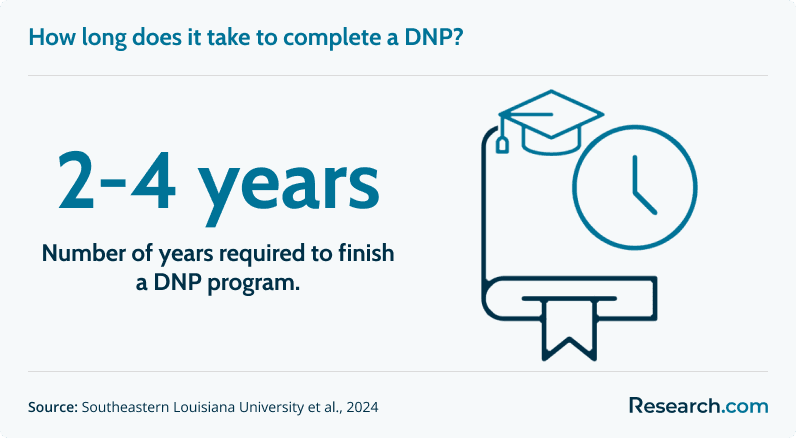
How Long Does It Take to Complete a DNP Program?
DNP completion time usually ranges from about two to four years, depending on your starting degree, enrollment pace, specialization, and clinical requirements. Nurses entering with a bachelor’s degree commonly need around three to four years because the pathway includes advanced practice preparation and doctoral coursework. Nurses who already hold a master’s degree may finish in two to three years. Part-time study can lengthen the timeline, while accelerated options may allow completion in as few as 15 to 18 months.
| Starting Point | Typical Timeline | Why It Takes That Long |
| BSN-to-DNP | Around three to four years | Includes graduate-level advanced practice coursework, clinical requirements, and doctoral project work. |
| MSN-to-DNP | Two to three years | Builds on prior graduate nursing education and usually requires fewer credits. |
| Accelerated DNP | As few as 15 to 18 months | Designed for faster completion, often with an intensive schedule and limited breaks. |
| Part-time DNP | Longer than full-time study | Allows working nurses to spread coursework and project requirements over more terms. |
How Does an Online DNP Compare to an On-Campus Program?
An online DNP is usually better for working nurses who need schedule flexibility, while an on-campus program may be better for students who prefer in-person structure, direct faculty access, and campus-based clinical connections. Currently, 42% of DNP students chose a blend of both, with more than half of the program delivered online.
| Factor | Online DNP | On-Campus DNP |
| Flexibility | Often easier to fit around work, family, and shift schedules. | Usually follows a more fixed class schedule. |
| Faculty and peer interaction | Relies on video meetings, discussion boards, email, and virtual advising. | Offers more frequent face-to-face conversations and immediate classroom feedback. |
| Networking | May connect nurses from multiple states and healthcare systems. | Can build deeper local relationships with faculty, classmates, and clinical partners. |
| Technology expectations | Requires comfort with digital platforms, online testing, virtual collaboration, and electronic submissions. | May use technology but relies more heavily on in-person classes and campus resources. |
| Learning style | Works best for self-directed students with strong time management. A nursing degree online can be convenient, but it requires discipline. | Works well for students who benefit from scheduled class meetings and campus routines. |
| Clinical requirements | May allow clinical hours near your home, depending on approval and placement rules. | May use established partnerships with local healthcare organizations. |
| Cost considerations | Can reduce commuting and housing expenses, though tuition may be similar. | May include parking, campus fees, commuting, housing, or relocation costs. |
| Accreditation | Must meet the same program quality expectations as campus-based options. | Must meet the same accreditation standards as online programs. |
What Is the Average Cost of DNP Programs?
DNP programs commonly cost between $500 and $1,200 per credit. Online DNP tuition often ranges from $500 to $900 per credit, and students may save on commuting, campus housing, and some location-based expenses. On-campus DNP tuition often ranges from $800 to $1,200 per credit, with possible additional costs such as lab fees, parking, and campus facility charges. Residency status can also change the total price; in-state tuition may be much lower than out-of-state tuition at public universities.
When comparing schools, do not stop at the per-credit rate. Ask for a full cost estimate that includes tuition, mandatory fees, course materials, travel for intensives, background checks, health requirements, clinical documentation, graduation fees, and any lost income from reduced work hours.
What Financial Aid Options Are Available for DNP Students?
DNP students may use several forms of aid, including federal loans, scholarships, grants, employer support, loan forgiveness, private loans, work-study, and military education benefits. Availability depends on the school, your enrollment status, your employer, and your eligibility.
- Federal Student Loans: Graduate nursing students often use federal loans because they may offer borrower protections and repayment options. The Direct Unsubsidized Loan allows graduate students to borrow up to $20,500 annually.
- Scholarships: Nursing schools, hospitals, foundations, and professional organizations may offer awards for DNP students. Some are based on merit, financial need, specialty area, community service, or underrepresented populations.
- Grants: Grants do not have to be repaid and may support students pursuing nursing roles in shortage areas or underserved communities.
- Employer Tuition Assistance: Hospitals and health systems may provide tuition reimbursement or education benefits for nurses pursuing advanced degrees.
- Loan Forgiveness Programs: Nurses employed in qualifying public service jobs may consider the Public Service Loan Forgiveness (PSLF) program, depending on loan type, employer eligibility, and repayment history.
- Private Loans: Banks and credit unions may offer graduate student loans, but rates, fees, and repayment terms vary. Compare them carefully with federal loan options.
- Work-Study Programs: Some universities offer part-time work opportunities connected to nursing departments, research, or healthcare settings.
- Military Benefits: Eligible service members and veterans may use benefits such as the Post-9/11 GI Bill, which can help cover tuition and fees, housing, and books.
The chart below lists the top-paying states for nurse practitioners.
What Are the Prerequisites for Enrolling in DNP Programs?
Most DNP programs require prior nursing education, an active RN license, clinical experience, a strong academic record, recommendations, and a goal statement. Exact requirements vary by track. APRN-focused programs may have additional certification, prerequisite, or state licensure requirements.
- Bachelor’s or Master’s Degree in Nursing: Applicants usually need a BSN or MSN from an accredited nursing program. Nurses who started with an associate degree can use pathways such as affordable online RN-to-BSN programs or the easiest online RN to BSN programs to prepare for graduate study.
- Active RN License: DNP applicants must hold a current registered nurse license and must meet state-specific practice requirements.
- Clinical Experience: Many programs expect one to two years of nursing experience, especially for advanced practice tracks.
- GPA Requirements: Programs often require a minimum GPA around 3.0 on a 4.0 scale.
- Letters of Recommendation: Schools may request academic or professional references who can evaluate your readiness for doctoral nursing study.
- Personal Statement or Essay: Applicants usually explain their clinical background, career goals, leadership interests, and reasons for pursuing the DNP.
- GRE Scores: Some programs still request GRE scores, although this requirement is becoming less common.
- Prerequisite Coursework: Schools may require prior coursework in statistics, research methods, health assessment, or related areas.
- Interview: Some admissions committees use interviews to assess professionalism, communication skills, and program fit.
Many nurses begin with an Associate Degree in Nursing and later upgrade their education to improve career options and earning potential. Comparing ADN salary with advanced nursing compensation can help students understand why some nurses pursue graduate degrees and specializations, especially when roles such as CRNA may earn around $240k/year.
What Courses Are Typically Included in a DNP Program?
DNP coursework combines advanced clinical knowledge, leadership, evidence-based practice, systems improvement, health policy, informatics, and a final DNP project. Course titles vary by school and specialization, but many programs include the following areas.
- Advanced Pathophysiology: Students study complex disease processes and the physiologic changes behind acute and chronic conditions.
- Advanced Pharmacology: This course covers medication classes, mechanisms of action, therapeutic uses, adverse effects, and prescribing considerations for advanced practice.
- Healthcare Policy and Advocacy: Students examine how policies are created, implemented, and evaluated and how nurses can advocate for quality, access, and equity. Nurses interested in population health may also compare this focus with the cheapest online MPH degree.
- Evidence-Based Practice: Students learn to evaluate research, assess evidence quality, and apply findings to clinical or organizational problems.
- Leadership in Nursing: Coursework may address team leadership, conflict management, strategic planning, ethics, and organizational decision-making.
- Quality Improvement and Patient Safety: Students learn to measure performance, identify root causes, reduce risk, and implement practice improvements.
- Health Informatics: This area covers electronic health records, data analytics, telehealth, and technology-supported care delivery. It involves more advanced healthcare systems thinking than what students usually find in the cheapest medical billing and coding program.
- DNP Project: The DNP project requires students to identify a practice problem, design an intervention, implement or evaluate a solution, and present outcomes under faculty guidance.
What Skills Will I Gain From a DNP Program?
A DNP program builds advanced nursing capabilities that apply to direct patient care, leadership, policy, quality improvement, informatics, and systems change. The most valuable skills depend on your concentration, but most graduates develop the following competencies.
- Advanced Clinical Judgment: Students strengthen assessment, diagnostic reasoning, treatment planning, and care coordination skills for complex patient needs.
- Leadership and Management: DNP coursework prepares nurses to lead teams, manage resources, evaluate workflows, and guide organizational change.
- Evidence Translation: Graduates learn how to move research findings into practice rather than stopping at literature review.
- Policy and Advocacy: Students develop the ability to analyze policy, identify barriers to care, and advocate for patients, communities, and the nursing profession.
- Quality Improvement and Safety: DNP students learn structured methods for improving outcomes, reducing errors, and evaluating healthcare systems.
- Data and Informatics Literacy: Programs increasingly expect nurses to interpret data, use digital tools, and support technology-enabled practice improvement.
What Types of Specializations Are Available in DNP Programs?
DNP specializations allow nurses to align doctoral study with a specific clinical population, advanced practice certification, leadership function, or education role. The right choice depends on the patients you want to serve, the work setting you prefer, and the credential you need after graduation.
| Specialization | Common Focus | Best For |
| Family Nurse Practitioner (FNP) | Primary care for individuals and families across the lifespan | Nurses who want broad outpatient or community-based primary care roles. Cost-conscious students may compare the cheapest FNP program online. |
| Psychiatric-Mental Health Nurse Practitioner (PMHNP) | Mental health assessment, diagnosis, therapy, and medication management | Nurses interested in behavioral health, psychiatric care, and mental wellness. |
| Nurse Anesthetist (CRNA) | Anesthesia administration, airway management, and perioperative care | Experienced critical care nurses seeking anesthesia practice. |
| Nurse Executive Leadership | Healthcare administration, strategy, quality, finance, and operations | Nurses aiming for executive, director, or systems leadership roles. |
| Nurse Educator | Teaching, curriculum design, student evaluation, and clinical instruction | Nurses who want academic, staff development, or clinical education roles. |
| Adult-Gerontology Nurse Practitioner (AGNP) | Care for adult and older adult patients across care settings | Nurses focused on chronic disease, aging, acute care, or primary care for adults. |
| Pediatric Nurse Practitioner (PNP) | Primary or acute care for infants, children, and adolescents | Nurses who want to specialize in pediatric assessment, treatment, and family education. |
| Women’s Health Nurse Practitioner (WHNP) | Reproductive, gynecologic, preventive, and lifespan women’s health services | Nurses interested in women’s health, family planning, and reproductive care. |
The chart below illustrates the current employment role of DNP students, as reported by the AACN in 2023.
How to Choose the Best DNP Program
The best DNP program is the one that fits your license, specialization, schedule, budget, clinical placement needs, and long-term career plan. Use the steps below to compare options before you apply.
- Confirm accreditation first. Look for recognized nursing accreditation such as CCNE or the Accreditation Commission for Education in Nursing (ACEN). Accreditation can affect certification eligibility, transferability, employer acceptance, and licensure preparation.
- Match the pathway to your starting point. A BSN-to-DNP is different from a post-MSN DNP. Do not compare timelines or prices without checking which entry route each school is quoting.
- Check whether the specialization supports your intended credential. If you want APRN certification, make sure the curriculum, clinical hours, and population focus align with certification requirements.
- Ask detailed clinical placement questions. Find out who secures sites, whether out-of-state placements are allowed, what documentation is required, and what happens if a site falls through.
- Review faculty expertise. Faculty experience matters most when it overlaps with your specialty, project interests, population focus, or leadership goals.
- Compare format and schedule honestly. Online, hybrid, full-time, and part-time options all have trade-offs. A flexible program can still be demanding if courses are accelerated.
- Calculate total cost, not just tuition. Include fees, travel, intensives, textbooks, software, clinical compliance costs, and potential income changes.
- Look for student support. Strong advising, writing support, project mentoring, library access, clinical coordination, and technology help can make a demanding program more manageable.
Questions to Ask Before Enrolling
| Question | Why It Matters |
| Is the DNP program accredited for my intended track? | Accreditation affects quality assurance and may affect certification or employer recognition. |
| Will this program meet requirements in my state? | Licensure and clinical authorization rules can differ by state. |
| Who is responsible for finding clinical sites? | Clinical placement problems can delay graduation. |
| Are there campus visits or intensives? | Travel requirements can add cost and scheduling pressure. |
| What is the total program cost? | Fees and travel can significantly change affordability. |
| How is the DNP project supported? | Strong project mentoring can reduce delays and improve outcomes. |
Common Mistakes to Avoid
- Choosing only by speed. The shortest program may not be best if it lacks your specialization, clinical support, or state authorization.
- Ignoring accreditation. A convenient DNP can become a poor investment if it does not meet professional standards.
- Comparing per-credit tuition instead of total cost. A low rate may be offset by more credits, fees, travel, or reduced work hours.
- Assuming online means no in-person obligations. Many online or hybrid DNP programs include practicums, campus intensives, interviews, or project presentations.
- Relying only on rankings. Rankings can narrow your list, but your license, specialty, state, employer, and clinical access should drive the final decision.
- Waiting too long to plan clinical placements. Competitive sites may require early outreach, contracts, onboarding, background checks, immunizations, and documentation.
How Does a DNP Differ From an MSN?
A DNP is a practice doctorate designed for nurses who want advanced clinical authority, systems leadership, evidence translation, policy influence, and quality improvement responsibilities. An MSN is a graduate nursing degree that often prepares nurses for specialized practice, education, management, or advanced clinical roles without the same doctoral-level emphasis on organizational change and practice scholarship. Comparing the types of MSN degrees can help you decide whether a master’s degree is enough for your goals or whether the DNP better matches your long-term plans.
| Degree | Main Purpose | Common Best Fit |
| MSN | Graduate preparation for advanced clinical, education, administration, or specialty nursing roles | Nurses who need a master’s-level credential for a defined practice or leadership role |
| DNP | Doctoral preparation for advanced practice, systems improvement, policy, and evidence-based leadership | Nurses seeking terminal practice preparation or high-level clinical and organizational leadership |
Can Online BSN-to-DNP Programs Accelerate Your Pathway to Advanced Practice?
Online BSN-to-DNP programs combine graduate-level advanced practice preparation with doctoral nursing coursework. They can shorten the overall path for nurses who already know they want a terminal practice degree, but they also require a major time commitment because students complete advanced clinical training, doctoral coursework, and project requirements in one pathway. If you want to compare flexible options, review online BSN to DNP programs and confirm that each program supports your intended certification and state licensure needs.
What Red Flags Should I Watch for in DNP Programs?
Be cautious with programs that make admissions, cost, accreditation, clinical placement, or outcomes difficult to verify. A legitimate DNP program should clearly explain its curriculum, faculty qualifications, practicum expectations, project process, tuition, fees, state authorization, and accreditation. If you are still deciding how to move from RN preparation into graduate nursing, compare structured bridge options such as RN to MSN primary care nurse practitioner pathways as part of your planning.
- Accreditation status is unclear, expired, or hard to confirm.
- The school cannot explain whether the program meets requirements in your state.
- Clinical placement responsibilities are vague.
- Tuition and fees are not transparent.
- The curriculum does not clearly align with your intended role.
- Student support, faculty access, and project mentoring appear limited.
How Does the Cost of a DNP Program Compare to Other Nursing Pathways?
A DNP usually costs more than entry-level nursing education because it is an advanced graduate or doctoral pathway with specialized faculty, clinical requirements, and project supervision. The potential value depends on your current credentials, target role, specialty, employer, location, and debt level. Comparing a doctoral pathway with earlier nursing education costs, such as LPN program cost, can help you understand how each step fits into a long-term education and career plan.
What Challenges Might You Face During a DNP Program?
DNP students often balance demanding coursework, clinical or practicum hours, doctoral project deadlines, employment, family responsibilities, and technology-heavy learning environments. The most common challenges include managing time, securing clinical sites, narrowing a feasible DNP project, collecting usable data, and sustaining momentum through multiple terms. Nurses who want a narrower post-master’s route before committing to a doctorate may also compare post MSN FNP certificate programs online.
What Career Paths Are Available for DNP Graduates?
DNP graduates can work in direct advanced practice, healthcare leadership, education, research translation, policy, consulting, entrepreneurship, public health, and community health. Your options depend heavily on your specialization, certification, state license, and prior nursing experience.
- Advanced Practice Nursing: Graduates may work as nurse practitioners, nurse anesthetists, nurse midwives, or clinical nurse specialists. Because DNP salary by state varies, location can affect compensation and work-life balance.
- Nursing Leadership and Administration: DNP-prepared nurses may become nurse executives, directors of nursing, clinical leaders, or healthcare administrators.
- Nursing Education: Graduates may teach in academic or clinical settings, develop curricula, mentor nurses, or support staff development.
- Healthcare Research Translation: DNP graduates often focus on applying research to practice rather than conducting traditional academic research alone.
- Policy and Advocacy: Some DNP-prepared nurses work on healthcare policy, regulation, advocacy, access, and systems improvement.
- Clinical Consultation and Entrepreneurship: Graduates may consult for healthcare organizations, build programs, or launch practice-related ventures. A cheap online MBA may be useful for nurses pursuing business-focused leadership or entrepreneurship.
- Public Health and Community Health: DNP graduates may design initiatives focused on health equity, prevention, population health, and community partnerships.
What Is the Job Market for Graduates With a DNP?
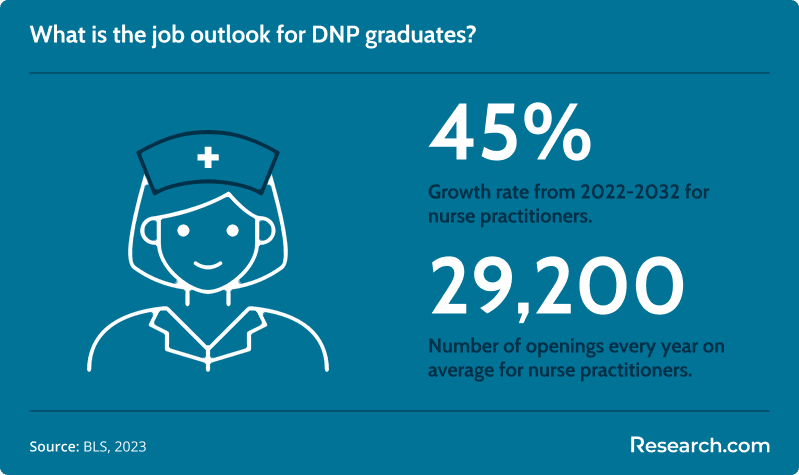
The number of jobs for nurse practitioners is expected to grow by 45% from 2022 to 2032, which is much faster than average. This demand supports strong career potential for nurses in advanced practice roles, though specific opportunities depend on certification, specialty, state scope of practice, employer demand, and clinical experience. DNP graduates may also pursue leadership, education, policy, and quality improvement roles beyond traditional nurse practitioner positions.
What Technology Skills and Tools Do I Need for DNP Programs?
DNP students, especially online students, need enough technology fluency to participate in virtual courses, collaborate with teams, manage clinical documentation, analyze evidence, and complete a scholarly project. These skills also matter in modern healthcare environments where telehealth, informatics, electronic records, and data-supported quality improvement are increasingly embedded in practice.
- Learning Management Systems: Students should be comfortable using platforms such as Blackboard or Canvas to access lectures, submit assignments, join discussions, and communicate with faculty.
- Telehealth Tools: Advanced practice nurses may benefit from familiarity with telemedicine workflows, virtual patient communication, and remote care platforms.
- Data Management and Analysis: DNP projects often require students to organize data, track outcomes, and interpret quality improvement results.
- Electronic Health Records: Comfort with EHR navigation and documentation supports clinical practice, informatics work, and project implementation.
- Virtual Collaboration: Online programs often use video conferencing, shared documents, digital presentations, and group project tools.
If budget is a major concern, compare flexible and lower-cost options through most affordable online DNP programs.
Are the Easiest DNP Programs Just as Good as Traditional DNP Programs?
An easier DNP program can be just as credible as a traditional program if it is properly accredited, academically rigorous, transparent about clinical requirements, and aligned with your professional goals. The difference is usually format and structure, not professional standards. A flexible online or accelerated DNP may reduce commuting time or shorten the calendar, but it should not eliminate the core expectations of doctoral nursing practice.
The most important quality marker is accreditation. Accredited programs must meet recognized standards for curriculum, faculty, clinical learning, outcomes, and continuous improvement. For APRN students, accreditation and state alignment are especially important because certification and licensure may depend on completing an appropriate program.
Clinical experience is another critical factor. Even the most flexible DNP should include meaningful practicum, project, or practice-based learning. If a program is vague about clinical expectations, site approval, preceptor requirements, or project support, ask more questions before enrolling.
Students just beginning the nursing pathway may first consider accelerated LPN programs, which can lead to entry-level nursing preparation before later academic progression into RN, BSN, MSN, or DNP pathways.
How Can You Accelerate Your Path to a DNP?
You can shorten the path to a DNP by choosing the right entry route, transferring eligible credits, studying full time, selecting an accelerated or year-round format, and planning clinical requirements early. Speed should not come at the expense of accreditation, certification eligibility, clinical quality, or your ability to keep working safely.
- Choose an accelerated pathway when appropriate. BSN-to-DNP programs combine advanced practice and doctoral work, while MSN-to-DNP options may be shorter for nurses who already completed graduate coursework. You can compare options such as the shortest MSN to DNP program.
- Consider online or hybrid delivery. These formats may reduce commuting and make it easier to keep working, although clinical and project requirements still apply.
- Transfer prior graduate credits if allowed. Ask whether previous MSN or post-master’s coursework can reduce your required credits.
- Clarify clinical hour policies. Some programs may recognize prior experience differently, but you must verify requirements with the school and relevant certifying bodies.
- Enroll full time if you can manage it. Full-time study can shorten the calendar, but it may be difficult for nurses working demanding shifts.
- Use employer support. Tuition reimbursement, schedule flexibility, or clinical site access from your employer can make an accelerated program more realistic.
- Look for year-round enrollment. Multiple start dates or rolling admissions can help you begin sooner instead of waiting for a traditional academic cycle.
How Can Non-Nursing Professionals Begin an Accelerated Pathway to Advanced Practice?
Non-nursing professionals cannot move directly into a DNP without first becoming nurses and meeting RN licensure requirements. A common first step is an accelerated BSN designed for students who already hold a non-nursing bachelor’s degree. These programs build clinical nursing competence and can prepare graduates for RN licensure and later graduate nursing study. Cost-conscious career changers can compare the cheapest accelerated BSN programs for non nurses as an entry point into the profession.
What Funding Options Exist for Accelerated DNP Programs?
Accelerated DNP programs may require careful financial planning because tuition is compressed into a shorter period and students may have less flexibility to work. Compare school scholarships, nursing grants, federal loans, employer tuition reimbursement, military benefits, payment plans, and specialty-specific aid. If you are earlier in your nursing journey, it can also help to compare funding options for the easiest accelerated nursing programs to get into before committing to a long-term graduate pathway.
Current Trends Affecting DNP Students
- Online and hybrid learning are now common. Many working nurses choose formats that reduce travel while still requiring practicum, project work, and faculty engagement.
- Technology skills matter more. Telehealth, informatics, electronic records, and data analysis are increasingly relevant to advanced nursing practice and DNP projects.
- Employers continue to value advanced practice capacity. The projected 45% growth for nurse practitioner jobs from 2022 to 2032 reflects strong demand, though hiring varies by specialty and location.
- Clinical placement planning is a major decision factor. As online enrollment grows, students should verify how schools support placements before enrolling.
- Cost and ROI scrutiny are increasing. Nurses are comparing tuition, debt, salary potential, employer reimbursement, and program length more carefully before choosing a doctorate.
Key Insights
- The “easiest” DNP program is not the least rigorous program. It is the accredited program that best fits your background, schedule, state, specialty, clinical access, and budget.
- Start with accreditation, state authorization, and certification alignment before comparing tuition or program length.
- BSN-to-DNP programs usually take longer and require more credits than MSN-to-DNP pathways, but they may be efficient for nurses who know they want doctoral preparation.
- Online DNP programs can be flexible, but they still require clinical practice, project work, technology skills, and sometimes campus intensives.
- Ask specific questions about clinical placement support, DNP project mentoring, total cost, and graduation timeline before applying.
- A lower tuition rate does not always mean a lower total cost. Fees, travel, clinical compliance, and lost work time can change the real price.
- DNP graduates may pursue advanced practice, leadership, education, policy, consulting, and population health roles, but outcomes depend on specialization, certification, experience, and location.
References:
- American Association of Colleges of Nursing (AACN). (2023a). Fact Sheet: The Doctor of Nursing Practice. AACN.
- American Association of Colleges of Nursing (AACN). (2023b). The State of Doctor of Nursing Practice Education in 2022. AACN.
- Bureau of Labor Statistics (BLS). (2023a). A look at nurse practitioners for National Nurse Practitioner Week. TED: The Economics Daily. BLS.
- Bureau of Labor Statistics (BLS). (2023b). 29-1171 Nurse Practitioners. Occupational Employment and Wages, May 2023. BLS.
- Bureau of Labor Statistics (BLS). (2023c). Nurse Anesthetists, Nurse Midwives, and Nurse Practitioners. Occupational Outlook Handbook. BLS.
- ZipRecruiter. (2024). DNP Salary. ZipRecruiter.
Other Things You Should Know About the Easiest DNP Programs
BSN-to-DNP bridge programs let registered nurses enter directly after a BSN and usually combine master’s-level coursework with doctoral study. Most require an active RN license, a BSN from an accredited school, and roughly 1,000 clinical hours by graduation under AACN-aligned standards.
The easiest DNP programs in 2027 typically require a minimum of 500 clinical practice hours. Programs may vary, but these hours help bridge academic learning with practical experience and are essential for completion and certification.


