2027 AI Bachelor's Degrees for Community College Graduates

Co-Founder and Chief Data Scientist
For community college graduates, the main question is not whether artificial intelligence is a strong career field. It is whether an AI bachelor's program will accept enough prior credit, fit around work, and lead to credible career options without adding unnecessary time or debt. Students with associate degrees, especially those whose earlier coursework was not in computer science, need to understand transfer rules before choosing a program.
This guide explains how AI bachelor's completion pathways work for transfer students, what accreditation to verify, which credits are most likely to apply, and what math, programming, and admissions requirements to expect. It also compares online and on-campus formats, outlines likely time and cost considerations, and reviews career, salary, and certification options for graduates entering artificial intelligence roles.
Key Things You Should Know
- In 2026, over 150 community colleges nationwide offer transferable ai bachelor's degree pathways, addressing workforce demand with a 35% projected growth in ai-related jobs through 2030.
- These degree programs often integrate practical skills and foundational ai theory, enabling community college graduates to advance without starting a bachelor's from scratch.
- Financial aid and articulation agreements reduce costs by up to 40%, making ai bachelor's degrees more accessible to diverse, cost-conscious students entering competitive fields.
What is an AI bachelor's degree completion program for community college graduates?
An AI bachelor's degree completion program is designed for students who have already earned an associate degree or completed substantial community college coursework and want to finish a bachelor's degree focused on artificial intelligence. Instead of starting over as a first-year student, eligible learners apply transfer credits toward general education, lower-division math, programming, and science requirements.
These programs are especially useful for working adults and transfer students who need a structured route into AI without repeating courses they have already completed. Many are offered through online AI bachelor's degree programs for transfer students, though some universities also provide hybrid or campus-based completion options.
The value of a completion program depends on how efficiently it converts prior learning into progress toward the bachelor's degree. Many community college students intend to earn a bachelor's degree, but only a fraction complete it within six years. Clear transfer pathways, accurate degree audits, and early advising can reduce the risk of lost credits and delayed graduation.
Common features include:
- Transfer-focused admissions: Programs may accept completed associate degrees, block-transfer general education credits, or course-by-course evaluations.
- Applied AI curriculum: Students typically study machine learning, data analysis, programming, algorithms, and AI system design.
- Programming preparation: Python is common, and some programs also require SQL, Java, or other tools used in data and software roles.
- Experiential learning: Capstones, internships, simulations, or project portfolios can help students demonstrate applied AI skills to employers.
- Flexible scheduling: Online, evening, or part-time formats may help students continue working while completing upper-division coursework.
Program design varies widely. One university may place AI inside a computer science major, while another may offer AI as a standalone bachelor's degree, data science concentration, robotics track, or machine learning specialization. Students should compare the actual courses, not just the program title.
For most community college graduates, an AI bachelor's completion pathway can take 2 to 3 years beyond associate studies, depending on transfer credits, prerequisites, enrollment intensity, and whether missing math or programming courses must be completed first. Students seeking a shorter technology pathway may also want to compare options in this fast track computer science degree resource.
Which accreditation should AI bachelor's programs have for transfer students?
Transfer students should prioritize AI bachelor's programs offered by institutions accredited by agencies recognized by the U.S. Department of Education or the Council for Higher Education Accreditation (CHEA). Accreditation matters because it affects credit transfer, financial aid eligibility, graduate school recognition, and employer confidence in the degree.
For most bachelor's students, institutional accreditation is the baseline requirement. Regional accreditation agencies such as the Higher Learning Commission (HLC), Middle States Commission on Higher Education (MSCHE), and New England Commission on Higher Education (NECHE) are common examples. National or technology-related accreditations may add value in some cases, but they do not replace the need to verify institutional accreditation.
Transfer students should also check whether the receiving university has articulation agreements with their community college. These agreements can identify which courses transfer, which requirements are satisfied, and whether an associate degree meets lower-division general education requirements. Without a clear agreement, credits may still transfer, but they may apply only as electives rather than toward the AI major.
What to verify before applying
- Current accreditation status: Confirm the school is currently accredited, not relying on outdated marketing language.
- Recent warnings or probation: If an institution has accreditation concerns, ask how that could affect students, financial aid, and transferability.
- Program location: Determine whether AI is a standalone major, a computer science concentration, or a data science track.
- Transfer credit policy: Review limits on community college credits, age limits for technical courses, and grade requirements.
- Employer and graduate school recognition: A properly accredited bachelor's degree is usually more portable for future study and career mobility.
Many of the best accredited AI bachelor programs for transfer admissions are housed at public or private universities with clear transfer procedures and published degree maps for associate degree holders. Students comparing related engineering or technology fields can also review alternatives such as an online mechanical engineering bachelor degree.
How do associate degree credits transfer into an AI bachelor's program?
Associate degree credits transfer into an AI bachelor's program through either a formal articulation agreement or an individual course evaluation. General education courses such as English, humanities, social science, math, and natural sciences are often easier to apply toward a bachelor's degree than specialized AI or computer science courses. In many cases, transfer credits may cover 30 to 60 of the 120 credits required for a bachelor's degree.
The harder question is not whether credits transfer, but how they apply. A course may be accepted by the university but still count as an elective instead of satisfying an AI major requirement. This distinction can add semesters to a degree plan.
Credits that often transfer more smoothly
- College composition and communication courses
- General education humanities and social science courses
- Calculus, statistics, and natural science courses that match university requirements
- Introductory programming courses using languages accepted by the destination program
- Computer science fundamentals, when syllabi align with university expectations
Credits that require closer review
- Community college AI courses that do not match upper-division university content
- Technical courses completed many years before transfer
- Programming courses taught in a language not used by the bachelor's program
- Courses without labs, projects, or required mathematical depth
- Career or applied technology courses that may not meet academic major requirements
For example, a community college course titled “Introduction to Artificial Intelligence” may not automatically replace a university AI course if the syllabus lacks comparable machine learning, math, programming, or lab components. The same issue can apply to data analytics, robotics, or database courses.
Credit loss is a common transfer risk. Reports show transfer students lost a median of 13 credits, with about one in five losing 30 or more credits. In an AI pathway, that can mean extra prerequisite work before students can begin upper-division machine learning or advanced programming courses.
To reduce the risk, students should request a preliminary degree audit before enrolling, collect syllabi for technical courses, ask whether an associate degree transfers as a block, and confirm whether accepted credits satisfy general education, major, prerequisite, or elective requirements. Cost planning should also account for credits that do not apply. For related planning, see this guide to online engineering degree cost.
What admission requirements apply to AI bachelor's programs after community college?
AI bachelor's programs for community college transfer students usually focus on college performance, completed prerequisites, and readiness for upper-division technical coursework. Standardized tests are typically less important for transfer applicants. For Fall 2024 applicants, about 80% of U.S. bachelor's-degree-granting institutions are test-optional or test-free.
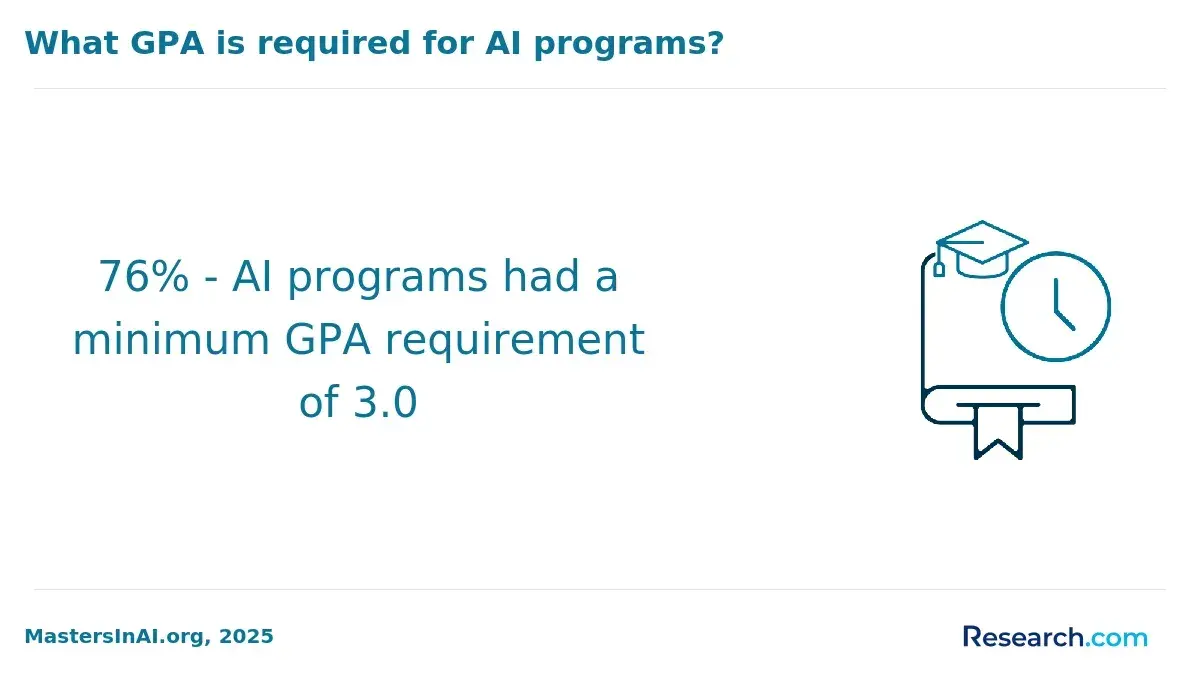
Many programs expect official college transcripts and a cumulative GPA between 2.5 and 3.0. More selective AI, computer science, or data science programs may review grades in math and programming courses especially closely because those classes predict readiness for machine learning, algorithms, and data-intensive coursework.
Common transfer admission requirements
- Completed college credits: Applicants may need an associate degree or a minimum number of transferable credits.
- Minimum GPA: A cumulative GPA between 2.5 and 3.0 is commonly expected, though requirements vary by institution.
- Official transcripts: Schools usually require transcripts from every college attended.
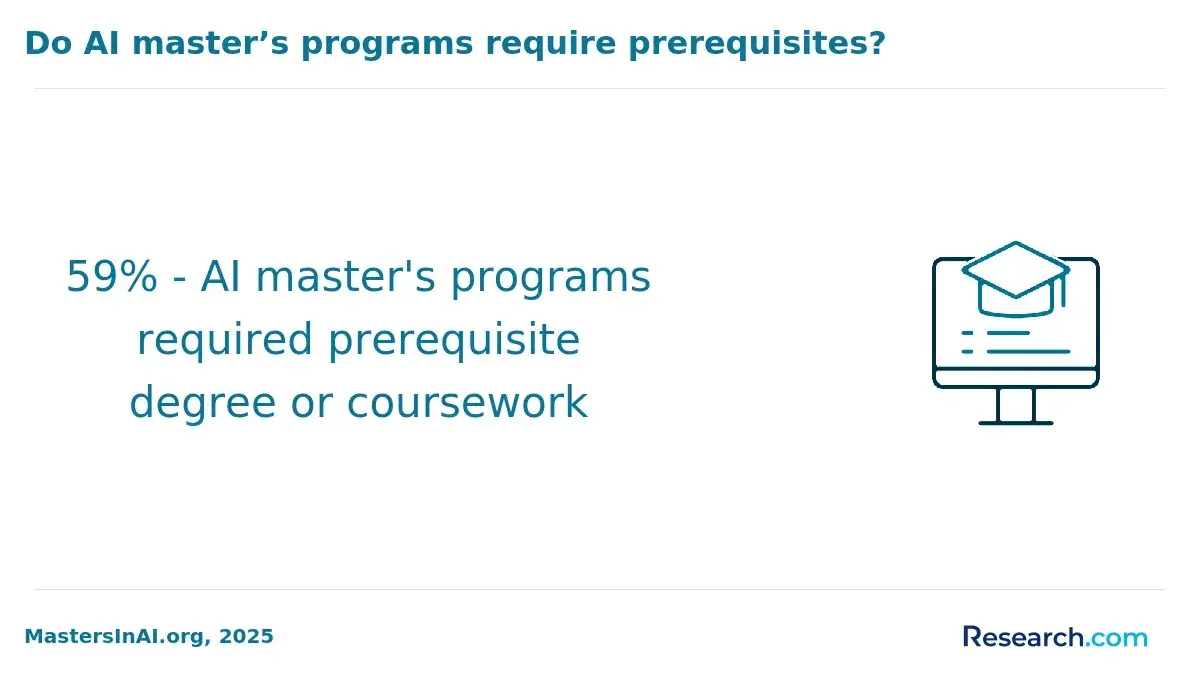
- Prerequisite coursework: Calculus, linear algebra, programming fundamentals, and data structures may be required or strongly recommended.
- Personal statement: Some programs ask students to explain their academic preparation, career goals, and interest in AI.
- Recommendations or placement review: Less common, but helpful when students need to show technical aptitude or readiness after a nontraditional path.
Transfer deadlines can differ from first-year deadlines, and some competitive programs fill seats early. Students should check whether admission to the university is separate from admission to the AI major. Being accepted to the institution does not always guarantee entry into a selective computer science or AI program.
Some schools offer guaranteed admission pathways for students who complete specified community college programs with required GPAs. Others require placement exams, bridge courses, or prerequisite completion before students can begin upper-division AI classes. Students comparing adjacent technology fields may also want to review affordable cybersecurity programs.
What AI coursework and math prerequisites should transfer students expect?
Transfer students should expect an AI bachelor's degree to combine computer science, mathematics, data analysis, and applied AI coursework. Students who completed a general associate degree may need additional bridge courses before they can start upper-division AI classes, especially if they have not taken calculus, programming, or data structures.
Core AI coursework typically includes machine learning, data mining, natural language processing, robotics, algorithms, data management, and model evaluation. Programming skills, especially in Python and SQL, are important because these languages are widely used in AI, analytics, and machine learning workflows. Job market demand continues to emphasize these skills along with machine learning expertise (Lightcast, 2024).
Math prerequisites to check early
- Calculus: Often required for understanding optimization, modeling, and continuous functions.
- Linear algebra: Essential for vectors, matrices, neural networks, and many machine learning methods.
- Discrete mathematics: Important for logic, algorithms, graph theory, and computer science foundations.
- Probability and statistics: Needed for inference, model evaluation, uncertainty, and data-driven decision-making.
- Multivariable calculus: Required in some programs, especially those with more theoretical or engineering-oriented AI coursework.
Computer science preparation to expect
- Programming fundamentals
- Object-oriented programming or software development
- Data structures and algorithms
- Databases and SQL
- Computer systems or architecture, depending on the program
Students should compare completed community college courses with the bachelor's degree plan before applying. Missing discrete math, linear algebra, calculus I and II, statistics, or data structures can delay access to upper-division AI courses. In some cases, taking these courses before transfer is cheaper and faster; in other cases, the university may prefer students to complete them after enrollment.
Bridge programs can help students with unrelated associate degrees or limited technical backgrounds. These may add time, but they can prevent students from entering advanced AI courses without the math and coding foundation needed to succeed.
How do online and on-campus AI bachelor's programs compare for working adults?
Online AI bachelor's programs are often the better fit for working adults because they reduce commuting, offer more scheduling flexibility, and may allow students to complete coursework around full-time employment. Over half of online undergraduates work full time, compared to less than one-fifth of on-campus students. For community college graduates who cannot pause their careers, modality can determine whether the degree is realistic.
Online programs may use asynchronous lectures, cloud-based coding environments, virtual labs, discussion boards, and remote project teams. The best online AI programs still require rigorous math, programming, and project work; flexibility does not mean lighter coursework.
On-campus programs can be stronger for students who want in-person faculty access, physical labs, campus recruiting, research assistantships, and face-to-face peer networks. They may also be better for students who learn best with structured class times. The trade-off is that daytime classes and commuting can make full-time work difficult.
| Factor | Online AI bachelor's programs | On-campus AI bachelor's programs |
| Schedule | Often better for full-time workers and students with family obligations | Often better for students who can attend scheduled classes |
| Lab access | Usually virtual, cloud-based, or software-driven | May include physical labs, research facilities, and in-person equipment |
| Networking | Requires intentional participation in online events, projects, and advising | More natural access to campus events, clubs, and faculty interactions |
| Learning style | Best for self-directed students with strong time management | Best for students who prefer direct structure and immediate interaction |
| Work compatibility | Typically stronger for adults maintaining employment | Can be challenging if required courses are offered during business hours |
Before choosing a format, students should ask whether technical support, tutoring, library access, career services, internship support, and faculty office hours are available to online learners. They should also confirm whether exams are proctored, whether group projects require live meeting times, and whether any campus visits are required.
How long does an AI bachelor's take after an associate degree, and what does it cost?
After an associate degree, an AI bachelor's program usually takes 2 to 3 years, depending on how many credits transfer, whether prerequisites are complete, and whether the student enrolls full time or part time. Students with strong preparation in math and computer science may move directly into upper-division coursework. Students from unrelated associate programs may need additional bridge or prerequisite courses.
Cost depends heavily on institution type, residency status, transfer credit acceptance, and enrollment pace. Tuition at public four-year in-state institutions averages $11,610 yearly, making a two-year completion program cost about $23,220 for tuition and fees alone. Books, software, equipment, supplies, transportation, and living expenses can add to the total cost. Private or out-of-state options may cost more.
The most expensive transfer mistake is assuming all associate degree credits will apply to the major. A program that appears affordable can become costlier if technical credits transfer only as electives or if students must repeat prerequisites. A written degree audit before enrollment is one of the most important cost-control tools.
Ways to reduce time and cost
- Confirm articulation agreements before transferring.
- Request a course-by-course transfer evaluation before committing.
- Choose programs with dedicated AI bachelor's completion tracks when available.
- Complete lower-cost prerequisites at community college only if the receiving university confirms they will apply.
- Ask whether online students pay different tuition or fees.
- Plan course sequencing carefully so prerequisites do not delay upper-division AI classes.
- Apply early for financial aid and scholarships aimed at STEM or AI disciplines.
Part-time study can make the degree more manageable for working adults, but it often extends the timeline and delays entry into higher-paying roles. Full-time study may finish faster but can reduce work income. Students should compare both scenarios before enrolling.
What careers can you get with an AI bachelor's after community college?
An AI bachelor's degree completed after community college can prepare graduates for entry-level and early-career roles in software, data, automation, and applied machine learning. The strongest candidates graduate with both a degree and a portfolio of projects that shows they can clean data, write code, train models, evaluate results, and communicate technical decisions.
Common roles include software developer, machine learning engineer, data scientist, AI analyst, automation specialist, business intelligence developer, quality assurance analyst, and AI testing specialist. Some research-heavy roles may prefer graduate education, but bachelor's graduates can still build experience through applied engineering, analytics, and product-focused work.
According to the U.S. Bureau of Labor Statistics, software developer jobs are expected to grow by 377,500 from 2023 to 2033, with about 38,000 openings annually. Many software roles now involve AI-enabled products, automation, recommendation systems, analytics tools, or data-driven applications.
Career paths to consider
- Software developer: Builds applications, platforms, and features that may integrate AI tools or machine learning models.
- Machine learning engineer: Develops, tests, deploys, and improves models used for prediction, classification, recognition, or automation.
- Data scientist: Uses statistics, programming, and modeling to extract insights and support decisions.
- AI analyst: Evaluates AI tools, monitors outputs, documents performance, and helps organizations use AI responsibly.
- Automation specialist: Designs AI-supported workflows for business, manufacturing, logistics, or operations.
- AI research assistant: Supports academic, commercial, or lab-based AI projects through coding, experimentation, and data preparation.
- AI testing or quality assurance specialist: Tests AI-enabled systems for accuracy, reliability, bias, and usability.
Employers often look for Python, Java, SQL, linear algebra, statistics, model evaluation, and familiarity with frameworks such as TensorFlow and PyTorch. Communication also matters. AI professionals frequently work with software engineers, product managers, business teams, legal teams, and domain specialists.
What salary ranges can AI bachelor's graduates expect in common roles?
AI bachelor's graduates can qualify for several well-paid technology roles, but salary depends on job title, location, industry, experience, portfolio quality, and whether the role is truly AI-focused or more broadly related to software and data. Entry-level candidates should be cautious about comparing themselves to senior AI engineers or research scientists with graduate degrees and extensive experience.
According to data from the U.S. Bureau of Labor Statistics, computer and information research scientists earned a median annual salary of $145,080. These roles often involve designing new algorithms, conducting experiments, and applying advanced machine learning methods. Some positions may prefer or require graduate study, especially in research-intensive settings.
Software developers working with artificial intelligence earned a median salary of $130,160. Pay can vary by specialization, with machine learning engineering, AI application development, and cloud-based AI deployment influencing compensation. Entry-level salaries can start near $90,000, while senior positions may exceed $160,000.
Other roles available to AI bachelor's graduates include data scientist, AI analyst, and business intelligence developer, typically offering salaries ranging from $80,000 to $140,000 based on experience and location.
How students can improve earning potential
- Build a project portfolio using real datasets, documented code, and clear explanations of model performance.
- Complete internships, capstones, or applied research projects before graduation.
- Develop cloud skills because many AI systems are deployed on cloud platforms.
- Learn how to explain technical results to nontechnical stakeholders.
- Target industries where AI is actively used, such as healthcare, finance, logistics, education technology, and software.
Total compensation may include bonuses, stock options, and benefits. Certifications can help, but they are strongest when paired with a bachelor's degree, applied projects, and demonstrable programming ability.
Which AI certifications should students pursue during or after a bachelor's?
AI certifications can strengthen a student's resume when they validate practical skills employers use in production environments. They should not replace a degree, portfolio, internship, or strong coursework, but they can help students signal cloud, machine learning, and framework competency.
Useful certifications to consider during or after an AI bachelor's include:
- AWS Certified Solutions Architect - Associate: Useful for students interested in designing and deploying scalable systems on AWS infrastructure, including environments that support AI workloads.
- Google Professional Machine Learning Engineer: Focuses on building, deploying, and maintaining machine learning models in production settings.
- Microsoft Certified: Azure AI Engineer Associate: Validates skills in creating AI applications using Azure cloud services.
- TensorFlow Developer Certificate: Demonstrates ability to develop AI models using the TensorFlow framework.
- Certified Artificial Intelligence Practitioner (CAIP): Covers foundational AI concepts, applied workflows, and automation-oriented knowledge.
Students should choose certifications based on career goals. Those interested in AI infrastructure, cloud deployment, or systems architecture may benefit from AWS or Azure credentials. Students focused on model building may prefer TensorFlow or Google machine learning credentials. Students seeking a broader AI foundation may consider CAIP.
One or two relevant, industry-recognized certifications are usually more valuable than collecting many unrelated credentials. The best sequence is to complete core coursework first, build projects, then use certifications to validate specific tools or platforms that match target job postings.
Other Things You Should Know About Artificial Intelligence
No prior work experience is required for community college graduates to enroll in a 2027 AI bachelor's degree program. Instead, prerequisites typically include completed coursework in foundational subjects like mathematics and computer science from the community college level.
Prerequisites usually include a strong foundation in mathematics (calculus and linear algebra), basic programming skills, and completion of general education credits. Community college students should ensure they complete any transfer agreements or specific course requirements of the four-year institution offering the AI bachelor's program.
Yes. Most AI bachelor’s programs require prior coursework in college algebra, calculus, statistics, and introductory programming before transfer. Many also expect a 2.5 to 3.0 GPA and completed general education credits, such as English composition and basic science, before junior-level admission.
References
- Your Roadmap to Earning the Best AI Certifications https://www.usaii.org/ai-insights/your-roadmap-to-earning-the-best-ai-certifications
- 16 Artificial Intelligence Career Paths https://www.calmu.edu/news/artificial-intelligence-career-paths
- Transfer your Credits from an Associate’s to Bachelor’s Degree | Latest News and Information About Online Degree Programs https://www.sheffieldstateuniversity.com/blog/transfer-your-credits-from-an-associates-to-bachelors-degree/
- Prepare for the Future of Tech with a Bachelor’s in AI | UMGC https://www.umgc.edu/blog/umgc-bachelors-degree-artificial-intelligence
- Online Degree vs. Traditional: Choosing the Right Path https://beal.edu/online-degree-vs-traditional/
- Best AI Bachelor's Degrees - AIDegreeProgams.org https://aidegreeprograms.org/rankings/best-ai-bachelor-degrees/
- Top 10 AI certifications and courses for 2025 https://www.techtarget.com/whatis/feature/10-top-artificial-intelligence-certifications-and-courses
- Ultimate Guide: How to Choose the Right AI Training Course to Boost Your Career - ONLC https://www.onlc.com/blog/how-to-choose-ai-training-courses/
- Artificial Intelligence BEng (Hons) at Ulster University 2026/27 entry - Full-time Undergraduate Study https://www.ulster.ac.uk/courses/202627/artificial-intelligence-41372