2027 Artificial Intelligence Degree Programs With Open Enrollment

Co-Founder and Chief Data Scientist
Many professionals with undergraduate degrees outside STEM face barriers when attempting to enter the artificial intelligence field due to rigid program schedules and competitive enrollment. This challenge limits access to timely reskilling opportunities needed for career transitions.
Flexible, accredited programs with open enrollment can remove these obstacles, allowing learners to start their education without long wait times or restrictive prerequisites. This article will explore current artificial intelligence degree programs offering open enrollment, focusing on how they accommodate diverse backgrounds and support efficient career pivots into this fast-growing industry.
Key Things You Should Know
- In 2026, open enrollment AI degree programs offer flexible, accessible education options with 40% of U.S. institutions providing fully online or hybrid AI courses for working professionals.
- Curricula emphasize practical skills in machine learning, natural language processing, and ethical AI, responding to industry demand projected to grow 35% through 2030.
- Graduates of open enrollment AI programs report a median starting salary of $95,000, highlighting strong career prospects amid accelerating AI adoption across multiple sectors.
What are open-enrollment artificial intelligence degree programs in the U.S.?
Open enrollment artificial intelligence degree programs in the U.S. provide accessible artificial intelligence degree courses across the United States by removing traditional admission barriers like high GPA or test score requirements. These programs cater to diverse learners such as working professionals, career changers, and recent graduates, allowing flexible start dates and pacing. Many institutions offer fully online, hybrid, or on-campus options to accommodate different learning preferences.
Degree options include bachelor's, master's, and certificate programs focusing on AI fundamentals, machine learning, data science, and robotics. These programs often exist within computer science or engineering departments at community colleges, regional public universities, and some private institutions that offer rolling admissions and asynchronous courses.
There are over 3,000 U.S. higher education institutions accredited by agencies recognized by the Council for Higher Education Accreditation (CHEA), supporting program quality and credit transferability. Prospective students should verify accreditation status to ensure credibility. It is also crucial to evaluate curriculum relevance, faculty expertise, technology resources, and career support services.
Those interested can learn more about 'What is applied AI engineering?' to understand career pathways linked to these degrees and make informed decisions about their educational goals.
Which accredited colleges offer open-enrollment AI degrees online or on campus?
Several accredited colleges offer open enrollment artificial intelligence degree programs, both online and on campus. Institutions like Arizona State University, the University of Texas at Austin, and Northeastern University have developed bachelor's and master's programs that often eliminate traditional barriers such as standardized test requirements. Over 80% of U.S. colleges now follow test-optional admissions policies for first-time undergraduates.
These open-enrollment artificial intelligence degree programs commonly allow applicants to enroll without extensive prerequisites, beneficial for working professionals or those changing careers. For instance, Southern New Hampshire University offers an online bachelor's in computer science with an AI specialization that admits students based on prior academic performance instead of standardized tests.
Master's programs at schools like Georgia Tech and DePaul University also provide flexible options with minimal or no GRE requirements. These curricula emphasize core topics such as machine learning, data science, and ethics, tailored for practical industry applications.
Key admission features across these programs include:
- Test-optional or test-free admissions for most applicants
- Open enrollment policies with rolling or late application options
- Online and hybrid formats to support varied schedules
- Core AI courses accessible without advanced computing degrees
Prospective students should confirm accreditation and detailed enrollment policies directly with institutions. Many students also explore related fields like online mechanical engineering degrees to complement AI knowledge and career options.
How do I verify accreditation for an open-enrollment AI program?
Checking accreditation is critical when considering an open-enrollment artificial intelligence degree program to ensure it meets recognized educational standards. Verify that the institution is accredited by agencies recognized by the U.S. Department of Education or the Council for Higher Education Accreditation (CHEA). These agencies assess colleges to confirm quality education and academic integrity.
Use reliable resources like the official CHEA website or the U.S. Department of Education's Database of Accredited Postsecondary Institutions and Programs to search for the institution's accreditation status. Beware of programs advertising open enrollment without clear accreditation, as some may have institutional accreditation but lack program-specific approval in computing or engineering, which can impact credit transfers and employer recognition.
To find accredited online artificial intelligence courses in the United States, contact the program's admissions office for documentation and ask if specialized accreditors like ABET have evaluated the curriculum, ensuring it meets industry standards. Typical bachelor's degree programs in AI follow standard durations. According to NCES data, the median time to a bachelor's degree at U.S. 4-year institutions is about 52 months. This benchmark helps assess program pacing and legitimacy.
For students exploring affordable options, consider researching the cheapest online industrial engineering degree programs, which may overlap with AI and engineering pathways. Confirm that any chosen program's accreditation is current to avoid complications with credit transfer, financial aid, or employment credibility.
What admission requirements are typical for open-enrollment AI bachelor's and master's programs?
Admission criteria for open enrollment AI degree programs vary but generally focus on accessibility and foundational skills. For bachelor's programs, applicants usually need a high school diploma or equivalent, with many schools waiving standardized tests like the SAT or ACT. Some require prerequisite math or programming courses either before admission or early in the curriculum. This approach supports diverse educational backgrounds and encourages wider participation.
Master's programs often require a bachelor's degree from an accredited institution but frequently accept graduates from related fields such as computer science, engineering, or mathematics without insisting on extensive prior AI coursework. Applicants might need to show proficiency in programming languages like Python or Java and mathematical areas such as linear algebra and statistics.
Many schools prioritize application materials over high-stakes exams. These include personal statements about AI career goals, relevant work experience, or portfolios of coding projects. Conditional acceptance with foundational modules is sometimes offered to ensure readiness. Such flexibility meets the demand for adaptable professionals skilled in fast-evolving AI tools.
Employers value candidates who combine technical expertise with adaptability. Notably, 66% of global organizations reported routine use of generative AI in at least one business area, a jump from 33% the prior year (McKinsey, The State of AI 2024). Prospective students can explore affordability and program options through resources like the master of data science online.
What courses and skills are covered in AI degree program curricula?
AI degree programs offer a comprehensive curriculum designed to equip students with both technical knowledge and hands-on skills. Core subjects typically include machine learning, deep learning, natural language processing, and computer vision. Hands-on experience with programming languages like Python and R, along with frameworks such as TensorFlow or PyTorch, is essential for effectively developing AI models.
Foundational courses in data science and statistics focus on data preprocessing, analysis, and visualization, while studies in algorithms, optimization, and probability. Many programs integrate systems design and software engineering tailored to AI applications. Ethics and policy courses address responsible AI use, fairness, and bias mitigation.
Students often engage in practical projects, internships, or capstone assignments, gaining real-world experience critical for career readiness. Specialized tracks in areas like robotics, reinforcement learning, or AI for healthcare cater to diverse career paths. Knowledge of AI cloud services and edge computing prepares graduates for evolving industry trends.
Complementary expertise in databases, cybersecurity, and human-computer interaction fosters well-rounded professionals. According to Coursera's 2024 Industry Skills Report, 78% of learners who earned industry certifications alongside their degrees found these credentials boosted their career prospects, underscoring the value of certifications in this fast-changing field.
How long do open-enrollment AI degree programs take to complete?
Open-enrollment artificial intelligence degree programs typically range from 12 to 24 months, influenced by factors like study level, format, and pace. Certificate and professional diploma programs often last about one year, designed for working professionals who want to upskill quickly. Many online master's degrees in artificial intelligence with open enrollment offer completion timelines between 18 and 24 months.
Students enrolled part-time generally take closer to 24 months, while full-time learners tend to finish within 12 to 18 months. Some institutions provide self-paced options, allowing students to adjust based on their schedules. Notable examples include Purdue University and Stanford, which have adopted models suited for diverse student needs.
- Program length depends on part-time vs. full-time enrollment, prior experience, and curriculum intensity
- Capstone projects and practical assignments may extend completion time
- 65% of students in non-traditional formats finish within two years, according to the National Center for Education Statistics
Prospective students should evaluate course workload and alignment with career goals to set realistic expectations. Flexible open-enrollment programs enable many to advance their skills effectively while managing professional and personal commitments.
What do open-enrollment AI degrees cost, and what financial aid is available?
Costs for open-enrollment artificial intelligence degree programs vary significantly by institution, credit hours, and program level, generally ranging from $10,000 to over $40,000. Online bachelor's degrees often fall between $15,000 and $25,000, while some master's programs at private universities may exceed $35,000. Public universities tend to offer lower tuition for in-state students, typically between $10,000 and $20,000.
A range of financial aid options can reduce total costs, including federal grants, loans, and scholarships. Completing the Free Application for Federal Student Aid (FAFSA) is crucial to accessing Pell Grants and subsidized loans. Many programs also provide merit-based scholarships for STEM and artificial intelligence fields, sometimes covering 25% to 50% of tuition. Employer tuition reimbursement programs serve as an important support for working professionals pursuing these degrees part-time.
According to a National Center for Education Statistics report, nearly 60% of online STEM students received financial aid, highlighting its broad availability. Prospective students should research specific program deadlines and requirements, as many grants require early applications. Additionally, military education benefits like the GI Bill apply to numerous open-enrollment schools offering artificial intelligence degrees.
- Tuition ranges from $10,000 to $40,000 based on program and institution.
- Federal aid includes Pell Grants and subsidized loans through FAFSA.
- Merit scholarships for STEM/artificial intelligence may cover 25-50% of tuition.
- Employer tuition reimbursement supports many working students.
- Military benefits apply to several online artificial intelligence programs.
What careers can you pursue with an AI degree, and what do employers expect?
An AI degree can lead to diverse career paths across technology, data science, software engineering, research, and business intelligence. Graduates frequently become machine learning engineers, data scientists, AI research scientists, robotics engineers, or AI product managers. Employers prioritize professionals skilled in designing, implementing, and optimizing AI algorithms in industries such as healthcare, finance, automotive, and cybersecurity.
Beyond coding, strong foundations in mathematics, statistics, and data analysis are essential for developing and evaluating models. Proficiency in programming languages like Python and R, and frameworks like TensorFlow or PyTorch, is commonly required. Practical experience deploying AI systems, knowledge of ethical AI practices, and collaboration within multidisciplinary teams also enhance employability.
- Certifications and project portfolios showcasing applied AI skills, including natural language processing or computer vision projects, can set candidates apart.
- Employers value problem solvers who translate business challenges into AI solutions, emphasizing domain-specific knowledge.
- Staying current with technological advances and regulations on data privacy is crucial for career longevity.
The U.S. Bureau of Labor Statistics projects a 22% growth in employment for computer and information research scientists, many specialized in AI, through 2032. This rapid expansion reflects the growing demand for AI expertise in innovation-driven sectors.
What salary ranges can AI graduates expect in common U.S. job roles?
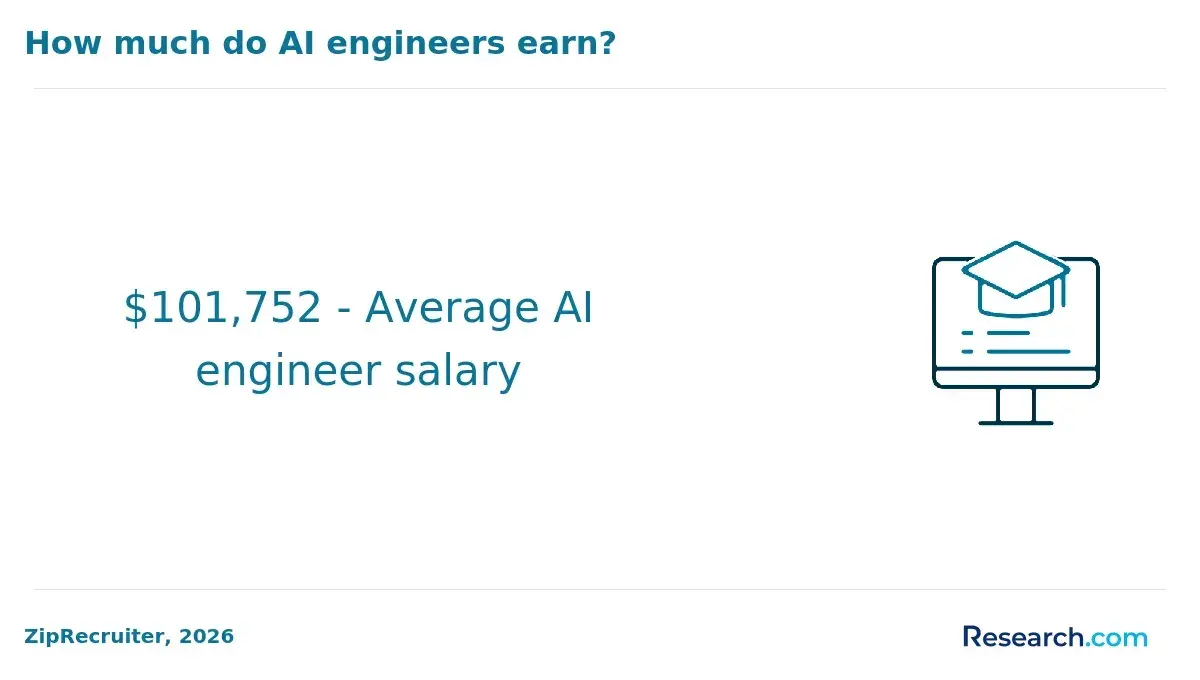
AI professionals in the U.S. enjoy competitive salaries that reflect strong industry demand and specialized skills. Entry-level AI engineers start with annual salaries ranging from $85,000 to $110,000, often requiring expertise in machine learning algorithms, Python programming, and data management. Data scientists with AI skills typically earn between $95,000 and $130,000.
More experienced AI researchers, especially in advanced labs or technology companies, command higher salaries, from $120,000 up to $180,000 or more. These roles focus on developing novel AI models, conducting experiments, and publishing findings. Machine learning engineers typically earn between $100,000 and $150,000, with bonuses tied to successful projects or product launches.
Management positions such as AI project managers or directors of AI strategy often offer salaries exceeding $140,000. Location plays a major role; tech hubs like San Francisco and New York usually provide pay that is 10-20% above the national average. The U.S. Bureau of Labor Statistics and industry surveys report a median salary of $112,000 for AI-related jobs.
Credentials like advanced degrees or certifications improve prospects for leadership roles and higher pay. Key skills to develop include neural networks, natural language processing, and ethical AI frameworks to maximize career potential.
- Entry-level AI engineers: $85,000-$110,000
- Data scientists with AI expertise: $95,000-$130,000
- Experienced AI researchers: $120,000-$180,000+
- Machine learning engineers: $100,000-$150,000
- AI project managers/directors: $140,000+
Which AI certifications complement a degree and improve job readiness?
AI certifications that complement a degree enhance job readiness by blending theoretical knowledge with practical skills sought by employers. Credentials like the Certified Artificial Intelligence Practitioner (CAIP) and Microsoft Certified: Azure AI Engineer Associate provide specialized expertise in AI development, deployment, and ethical concerns. These certifications typically emphasize hands-on experience with neural networks, machine learning frameworks, and cloud-based AI solutions.
Professional certifications from notable organizations, including Google's Professional Machine Learning Engineer and IBM AI Engineering Professional Certificate, focus on project-based learning. This approach builds candidates' abilities to design efficient AI systems and integrate them into business processes-key skills for roles in data science or AI research and development.
Additional data-related certifications, such as Certified Data Scientist, sharpen skills in data wrangling and statistical analysis, crucial for many AI projects. According to the O'Reilly AI Report 2025, 79% of AI professionals confirm that expertise spanning AI and data science enhances career prospects.
For career changers and working professionals, online platforms like Coursera and edX offer flexible certification paths aligned with current AI technologies and industry standards. Selecting certifications tailored to specific jobs and demands optimizes career advancement and readiness for workplace challenges.
Other Things You Should Know About Artificial Intelligence
Open enrollment AI degree programs in 2027 generally require a high school diploma or equivalent. Some programs might also recommend proficiency in mathematics or computer science, though formal prerequisites in these subjects are often not mandatory due to the open nature of the enrollment.
Many open-enrollment AI degree programs use rolling admissions, so applications stay open until each start term fills. Common deadlines are 2 to 6 weeks before classes begin, and some schools allow same-term review if documents are submitted on time.
Yes, many AI degree programs with open enrollment in 2027 offer online classes. These programs provide flexible learning options and use platforms like Blackboard or Moodle. Check each institution's offerings as the availability and format can vary significantly.
Graduates can pursue careers as AI engineers, data scientists, machine learning specialists, or roles in AI ethics. For those interested in ethical applications, a responsible AI governance master’s further broadens opportunities in regulatory and policy-making domains.
References
- ABET Accreditation and Artificial Intelligence - ABET https://www.abet.org/accreditation/ai-policy/
- MS in AI in USA: Eligibility, Costs, and Top Universities https://futurense.com/blog/ms-in-ai-in-usa
- Top Career Paths Utilising AI: A Guide for Aspiring Professionals https://regent.ac.za/blog/top-career-paths-utilising-ai-a-guide-for-aspiring-professionals
- AI Course Duration: How Long Does It Take to Become AI-Ready? https://rcm.ac.in/ai-course-duration-how-long-does-it-take-to-become-ai-ready/
- Guidance on the Responsible Use of Artificial Intelligence (AI) in Accredited Continuing Education (CE) - ACCME https://accme.org/resource/guidance-on-ai/
- Top 15 paid AI certifications to boost your resume | Uxcel https://uxcel.com/blog/top-paid-ai-certifications
- AI Programs and Courses | DeVry University https://www.devry.edu/online-programs/area-of-study/artificial-intelligence.html
- Best Online AI Degrees: 2025 Rankings & Program Directory - MastersInAI.org https://www.mastersinai.org/degrees/online-artificial-intelligence-degrees/
- Pardon Our Interruption https://www.aiuniv.edu/degrees