2027 AI Degree Enrollment Report by Degree Level

Co-Founder and Chief Data Scientist
Many professionals with undergraduate degrees outside STEM face uncertainty when exploring pathways into artificial intelligence careers. Traditional programs often require extensive prior knowledge or full-time commitment, making career pivoting especially challenging. Understanding enrollment trends by degree level can clarify which academic routes offer the best balance of flexibility, accessibility, and credibility. This report analyzes enrollment patterns in artificial intelligence degrees across undergraduate, master's, and doctoral levels. It aims to guide prospective students in selecting the most suitable degree option aligned with their career goals and personal circumstances, helping them make informed decisions for successful entry into the field.
Key Things You Should Know
- In 2026, AI degree enrollment in the U.S. surged by 18% from 2024, with graduate programs accounting for 62% of total enrollees, reflecting growing demand for advanced specialization.
- Undergraduate AI programs expanded rapidly, showing a 14% increase in new student registrations and diversification across public and private institutions nationwide.
- Women represented 35% of AI enrollments in 2026, marking a gradual but notable rise towards gender balance in AI-related degree fields.
What are the main artificial intelligence degree levels available in the United States?
The ai degree programs in the United States range from undergraduate certificates to doctoral degrees, providing various pathways for students and professionals. Bachelor's degrees commonly cover computer science, data science, or focused AI tracks, with courses in machine learning, robotics, and algorithms, often integrating mathematics and cognitive science.
Graduate studies deepen expertise with master's degrees in artificial intelligence, machine learning, and related fields, emphasizing practical projects and specializations like natural language processing or computer vision. Graduate certificates offer a flexible way for working professionals to enhance skills without a full degree commitment.
Doctoral programs focus on original research and advanced theory, preparing candidates for academic or innovative roles within the AI sector. Collaboration and publication of research are key components of these programs. Between 2016 and 2023, completions in AI programs increased almost tenfold, reflecting strong demand as about 4,000 students enrolled in AI/ML degrees and certificates in 2023 alone.
Students should align their choices with career ambitions: entry-level technical roles generally require a bachelor's degree, while advanced research or leadership roles may need a master's or PhD. Certificates are ideal for faster, targeted skill upgrades. For more detailed insights about career possibilities with artificial intelligence education, prospective learners can explore the AI degree options currently available.
Considering the artificial intelligence degree levels offered in US universities helps students select the program that best fits their professional goals and educational needs.
How many students are enrolling in artificial intelligence degrees at each level today?
Enrollment in artificial intelligence degrees in the U.S. has surged, especially at the bachelor's level, reflecting strong student interest. According to recent AI degree enrollment numbers by education level in the US, the availability of standalone or concentration AI programs increased from 90 in 2024 to 193 in 2026, a growth of over 114% in two years. This expansion provides more opportunities for students to pursue foundational AI education across diverse institutions, including liberal arts colleges, public universities, and private tech schools.
Students in bachelor's programs encounter broad curricula integrating machine learning, data science, and robotics, preparing them for roles such as AI software developers, data analysts, and research assistants. Graduate-level enrollment in AI shows continued growth but at a steadier pace. Master's degrees, AI specializations within computer science, and professional certificates attract working professionals aiming to upskill, while doctoral programs remain competitive and focus heavily on research and innovation.
For those analyzing student enrollment trends for artificial intelligence programs across degree levels, it's important to match educational choices with career goals. Bachelor's degrees offer quicker workforce entry, while graduate studies provide specialization and stronger research opportunities. As demand grows, candidates may also explore affordable options such as the cheapest online mechanical engineering degree programs that sometimes include AI-related coursework to complement their studies.
How do online and campus-based artificial intelligence degree programs compare?
Online versus campus artificial intelligence degree enrollment trends reflect expanding options tailored to diverse student needs. Online AI programs often provide greater accessibility and flexibility, favoring working professionals or those unable to relocate. These programs typically feature asynchronous learning and courses that may not be locally offered. In contrast, campus-based artificial intelligence degree programs emphasize immersive, on-site experiences, such as face-to-face networking, hands-on lab work, and collaboration with faculty and peers.
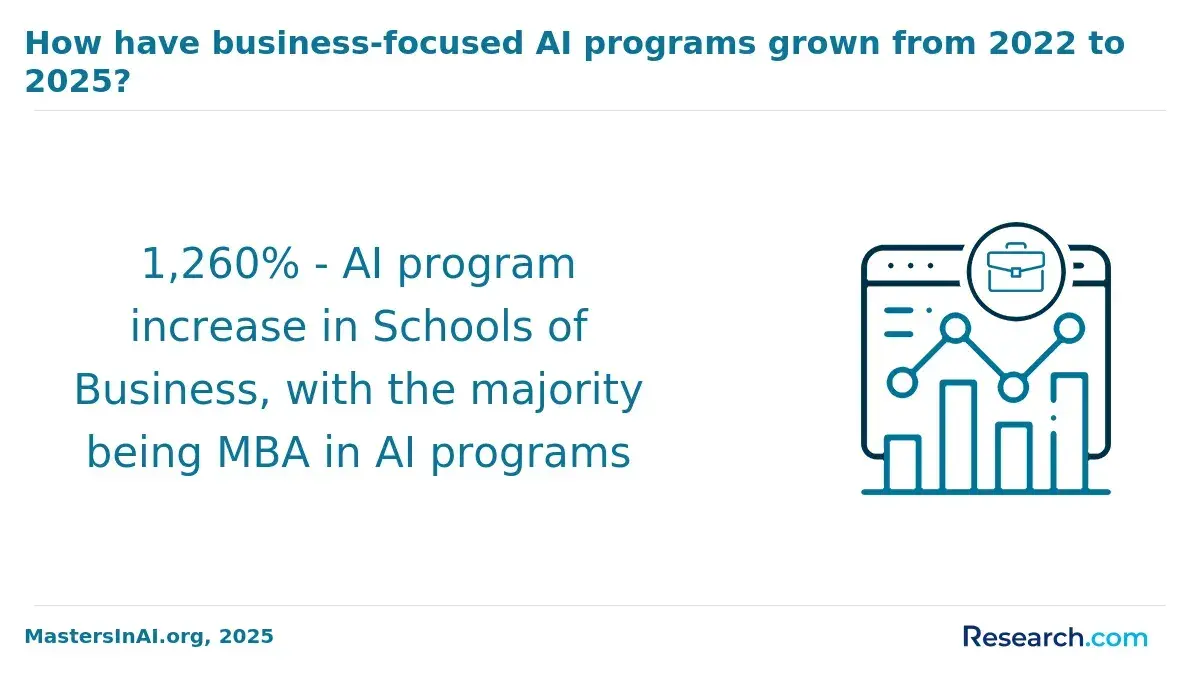
The number of Master's-level AI programs in the U.S. rose sharply from 116 to 310 between 2022 and 2026, driven by demand in both online and campus settings. Many new programs are online or hybrid, offering varied scheduling to suit different learning styles and career goals. Campus programs often provide stronger internship and research opportunities at universities with established AI research centers, while online degrees may incorporate virtual internships or project-based work aligned with industry needs.
For prospective students weighing options:
- Those prioritizing flexibility and fast workforce entry may consider online degrees.
- Campus programs are better suited for students seeking direct mentorship and hands-on experience.
- Hybrid models combine features of both, appealing to varied preferences and schedules.
This comparison of online and on-campus artificial intelligence degree programs highlights important factors influencing choice. Students may also explore an accelerated cyber security program for related career pathways.
What admission requirements do U.S. colleges set for artificial intelligence degrees?
Admission requirements for artificial intelligence degrees in U.S. colleges vary by degree level, reflecting the increasing complexity from undergraduate to doctoral studies. Undergraduate applicants typically need a high school diploma or equivalent with strong math and science backgrounds. Standardized tests like the SAT or ACT are often required, though many schools have adopted test-optional policies. Additional components usually include letters of recommendation, personal statements, and evidence of programming skills or related extracurricular activities.
Graduate admission criteria for AI programs in the United States generally require a bachelor's degree in computer science, engineering, mathematics, or a related field. Coursework prerequisites often include calculus, linear algebra, probability, statistics, and introductory programming. Master's programs usually expect a competitive GPA above 3.0 on a 4.0 scale and may require GRE scores, though some schools waive this. Applicants need to submit letters of recommendation, statements of purpose, and occasionally portfolios or research experience.
Doctoral programs demand even more rigorous standards centered on research potential. Candidates must hold a master's or a bachelor's degree with outstanding academic records and demonstrate expertise in core AI topics. Admissions committees look for significant research experience, strong faculty recommendations, and a clear research proposal aligned with faculty interests. This is consistent with data showing a 33% rise in AI-related PhD conferrals since 2011, contrasting with about 120% growth in bachelor's and master's degrees. Prospective students should also explore complementary fields, such as cybersecurity courses online, to broaden their skills and career prospects.
What courses and skills are typically taught in artificial intelligence degree programs?
AI degree programs blend foundational theories with practical skills and advanced topics essential for a successful career. Core courses typically cover machine learning, data structures and algorithms, computer vision, natural language processing, robotics, and AI ethics. Students gain hands-on experience with programming languages like Python and R, along with frameworks such as TensorFlow and PyTorch, emphasizing model development, data analysis, and automation.
The growth in master's and graduate certificate completions in AI is notable, with an average annual increase of 28% from 2016 to 2021. Enrollment reached 3,721 students last academic year, rising 48% since 2018-2019 (Gray DI, "Welcome to AI: The Academic Program"). This surge highlights the demand for skills in neural networks, reinforcement learning, and AI-driven data analytics.
Beyond technical knowledge, programs emphasize ethical considerations, bias mitigation, and the societal impact of AI, critical for responsible development. Many courses include applied projects, research methodologies, and partnerships with industry to ready students for real-world work environments.
Skills mastered include:
- Programming and software development for AI applications
- Mathematical foundations such as linear algebra, statistics, and probability
- Model building and evaluation techniques
- Data acquisition, cleaning, and visualization
- Implementing AI solutions in fields like healthcare, finance, and autonomous systems
Prospective students should choose programs balancing theory, practical labs, and current AI tools. Specialized tracks or electives in deep learning, AI ethics, or human-computer interaction help align education with career goals.
How long do artificial intelligence degrees take and what do they cost by level?
A bachelor's degree in artificial intelligence typically requires four years of full-time study, combining computer science, mathematics, and AI-specific courses. Tuition for public in-state universities averages around $10,000 annually, while private colleges can exceed $35,000, leading to total costs between $40,000 and $140,000.
Master's programs take one to two years, focusing on advanced theory, machine learning, and application. Tuition varies widely: public universities charge $15,000 to $30,000 per year, and private schools range from $30,000 to $50,000 annually.
Doctoral degrees usually last four to six years, including research and dissertation work. Though tuition can be $20,000 to $50,000 per year, many doctoral students receive funding or assistantships that reduce costs significantly.
Since 2017, English-language AI-related programs worldwide have tripled, offering increased specialization and flexibility. Prospective students should consider career goals and finances carefully. Entry-level AI roles often need a bachelor's degree, while research or academic careers may require a master's or doctorate.
Which U.S. colleges and universities offer accredited artificial intelligence degree programs?
Several top U.S. universities offer accredited artificial intelligence degree programs across undergraduate, master's, and doctoral levels. Institutions such as Carnegie Mellon University, Stanford University, Massachusetts Institute of Technology (MIT), and University of California, Berkeley provide specialized AI degrees or concentrations within computer science or engineering departments. These programs emphasize foundational AI knowledge, machine learning, robotics, and ethics in AI deployment.
Undergraduate students can pursue AI tracks within computer science bachelor's programs at schools like Georgia Institute of Technology and University of Washington, which also offer research opportunities. Master's programs featuring AI specializations are available at Columbia University and University of Texas at Austin, combining rigorous theory with applied projects in data science and natural language processing.
Doctoral programs focused on AI research are offered at universities including University of Michigan and University of Illinois Urbana-Champaign. These PhD studies prioritize advanced research, innovation, and interdisciplinary collaboration, reflecting a 33% growth in AI-related doctorate conferrals since 2011, according to Georgetown CSET's "Leading the Charge."
Prospective students should verify institutional accreditation through bodies like ABET or regional commissions and seek programs with strong industry ties to improve internship and career opportunities.
Enrollment in AI degrees has grown approximately 5% annually since 2010, leading to a 120% increase in undergraduate and master's conferrals in 2023 compared to 2011.
What careers can you pursue with different levels of artificial intelligence degrees?
Career opportunities in artificial intelligence vary widely depending on the degree level, reflecting differences in expertise and technical skills. Bachelor's graduates often work as AI software developers, data analysts, or machine learning engineers, focusing on applying AI models and maintaining systems across industries like healthcare, finance, and technology. Those with a master's degree usually qualify for specialized roles such as AI research scientists, robotics engineers, and natural language processing (NLP) specialists, who develop advanced algorithms and optimize AI architectures for autonomous systems and conversational AI.
Doctoral graduates generally pursue leadership and research careers, becoming principal scientists, AI strategists, or university professors. They lead initiatives in areas like deep learning, computer vision, and AI ethics, making significant contributions to both academia and industry at leading technology firms and research institutes.
Employment growth in AI careers is strong. According to a Validated Insights report on "The Demand for AI Education 1.0," AI and machine learning developers and engineers are projected to see a 40% compound annual growth rate (CAGR), nearly 100 times faster than average job growth. Broader AI/ML practitioner roles are expected to grow at a 12.6% CAGR, showing sustained demand across all degree levels.
Students should align their career goals to degree scope:
- Bachelor's degrees target entry-level technical roles
- Master's degrees lead to applied research and development
- Doctoral degrees pave the way for innovation leadership and specialized academic or industry positions
What are salary expectations and earning potential for artificial intelligence graduates?
Graduates in artificial intelligence enjoy strong salary prospects due to high demand and limited specialized programs. Entry-level salaries for bachelor's degree holders typically range from $85,000 to $110,000 annually, varying by location and industry. Those with master's degrees often start between $115,000 and $140,000, with significant growth potential as skills develop.
Only about 1% of U.S. higher education institutions offer a master's degree in AI, and 2.5% provide bachelor's degrees in AI, according to MastersinAI.org and Programs.com. This scarcity drives demand for graduates in technology, finance, healthcare, and government sectors, where AI expertise is highly valued.
Mid-career professionals with advanced degrees or specialized skills like machine learning engineering or natural language processing may exceed $180,000 annually. Contract and consulting roles can offer even higher pay but require demonstrated project success and a strong portfolio.
Programming languages (e.g., Python), frameworks (like TensorFlow), and cloud platform knowledge enhance employability. AI graduates without formal degrees but robust portfolios can also find competitive opportunities, though with less predictable career paths.
Investing in AI education at reputable institutions is a strategic move to increase employment options and salary potential in this rapidly evolving field.
What is the long-term job outlook and industry demand for artificial intelligence professionals?
The job outlook for artificial intelligence professionals is highly promising, with employment growth projected at over 15% through 2030 by the U.S. Bureau of Labor Statistics. This expansion outpaces the average growth for all occupations and is driven by increased AI adoption across healthcare, finance, automotive, and manufacturing sectors. These industries rely on AI for automation, data analysis, and innovation, creating demand for skilled specialists.
Key industry drivers include:
- Healthcare's use of AI in diagnostics, personalized treatments, and drug discovery, increasing demand for experts with domain knowledge.
- Financial services leveraging AI for fraud detection, risk assessment, and algorithmic trading, needing professionals versed in AI and regulatory compliance.
- Transportation and defense sectors developing autonomous systems requiring engineers who build safety-critical AI models.
- Technology companies advancing AI research, creating roles from AI ethics to data engineering.
The U.S. South stands out, hosting 38.4% of all AI degree programs, highlighting regional disparities that affect talent supply and employer access. Prospective students should consider geographical flexibility and networking within active AI clusters to boost career prospects.
Graduates benefit from blending AI skills with sector-specific knowledge and maintaining continuous learning to keep pace with fast-evolving AI tools and frameworks. For detailed insights into accredited AI programs and career pathways, consult trusted educational resources specialized in AI education and career development.
Other Things You Should Know About Artificial Intelligence
In 2027, AI students often focus their research on machine learning, natural language processing, computer vision, and robotics. They also explore emerging areas such as ethical AI and AI for social good, reflecting current global challenges and innovations.
Most artificial intelligence degree programs recommend or require some background in programming, typically in languages such as Python, Java, or C++. However, introductory courses are often available for beginners to build foundational coding skills alongside AI topics.
Interdisciplinary skills such as statistics, data science, ethics, and domain-specific knowledge strengthen artificial intelligence studies by enabling students to apply AI tools effectively in varied contexts. This broad skill set improves problem-solving capabilities and supports innovation across multiple industries.
Ethics is a critical component of artificial intelligence education, with many programs integrating coursework focused on responsible AI use, fairness, bias mitigation, privacy, and societal impacts. This emphasis ensures graduates understand the broader consequences of AI technologies.
In 2027, there's a noticeable trend towards increased enrollments in part-time AI degree programs, driven by the flexibility they offer working professionals. This aligns with the rise in healthcare AI master’s programs online, catering to those seeking specialized education without leaving their jobs.
References
- AI job market insights: Growth and challenges https://www.eitdeeptechtalent.eu/news-and-events/news-archive/ai-job-market-insights-growth-and-challenges/
- Here’s How an AI Degree Stacks Up Against Other Options https://www.aidegree.org/blog/comparison-table
- Artificial Intelligence Degree Career Outcomes: Jobs, Salaries & Growth https://hakia.com/degrees/artificial-intelligence/career-outcomes/
- How Long Does It Take to Learn AI Completely? https://blog.nobledesktop.com/learn/ai/how-long-do-ai-courses-take
- Degree Programs in Artificial Intelligence | ComputerScience.org https://www.computerscience.org/degrees/artificial-intelligence/
- AI Degrees in the United States: A Guide for International Students - Indian Student Abroad https://studyingabroad.co.in/ai-degrees-in-the-united-states-a-guide-for-international-students
- Report: 93% of Students Believe Gen AI Training Belongs in Degree Programs -- Campus Technology https://campustechnology.com/articles/2025/05/21/report-93-of-students-believe-gen-ai-training-belongs-in-degree-programs.aspx
- AI pricing: how much does AI cost in 2025? | Future Processing https://www.future-processing.com/blog/ai-pricing-is-ai-expensive/
- Online Bachelor’s Degree: Artificial Intelligence https://www.umgc.edu/online-degrees/bachelors/artificial-intelligence-ai
- 16 Artificial Intelligence Career Paths https://www.calmu.edu/news/artificial-intelligence-career-paths