2027 Cheapest Doctorate Degrees in Artificial Intelligence

Co-Founder and Chief Data Scientist
Many professionals with unrelated undergraduate degrees face steep financial and time barriers when seeking a doctorate in artificial intelligence. High tuition costs and rigid program schedules often prevent promising candidates from advancing their careers in this rapidly evolving field. Identifying affordable, flexible options becomes essential for those aiming to transition smoothly into AI research or industry roles.
This article explores the most cost-effective doctorate degrees in artificial intelligence, highlighting accredited programs that offer practical pathways for career pivoters. The goal is to empower readers with clear insights to make informed decisions about pursuing advanced AI education despite budget and time constraints.
Key Things You Should Know
- Cheapest doctorate degrees in artificial intelligence often involve applied or interdisciplinary programs rather than pure AI titles, allowing universities to offer lower tuition while still covering core topics such as machine learning, data science, and advanced analytics.
- Program affordability is frequently influenced by funding opportunities and delivery format, as online or hybrid doctoral programs and those offering assistantships, scholarships, or employer sponsorships can significantly reduce total educational costs.
- Lower-cost AI doctorate programs typically maintain rigorous research and dissertation requirements, meaning students should evaluate program accreditation, faculty expertise, and career outcomes alongside tuition when comparing options.
What are the cheapest accredited AI doctorate programs in the United States?
The cheapest accredited doctorate programs in artificial intelligence in the United States are generally found at public research universities offering in-state tuition rates. Public universities averaged $12,596 for in-state graduate tuition and fees, significantly lower than the $29,931 charged by private nonprofit institutions.
This gap makes public schools the most affordable option for AI doctoral education.
Examples of affordable PhD degrees in artificial intelligence offered by US universities include:
- University of Florida - PhD in Computer & Information Science and Engineering with AI specialization
- University of Texas at Austin - PhD in Computer Science emphasizing machine learning and AI
- Ohio State University - PhD in Computer Science and Engineering with AI research focus
These programs provide rigorous AI research opportunities with tuition typically under $15,000 annually for in-state students. Out-of-state students may pay higher fees but can explore residency options to reduce costs.
Private institutions such as Carnegie Mellon University usually charge over $30,000 per year, which can be prohibitive without substantial scholarships or assistantships.
Funding through research assistantships and fellowships can lower net costs. Interdisciplinary doctorate programs that combine AI with fields like data science or robotics may also offer more affordable pathways.
Students should carefully compare tuition, fees, and financial aid to access cost-effective accredited AI doctorate education. For those interested in an accelerated path, consider exploring an accelerated bachelor's degree computer science online as a foundation.
How much does an AI doctorate cost, including tuition, fees, and funding?
Doctorate programs in artificial intelligence vary widely in cost, with tuition at U.S. universities ranging from $10,000 to over $50,000 per year. However, the actual out-of-pocket expenses are often much lower because most AI doctoral programs offer funding packages that cover tuition and provide a stipend.
Funding options for artificial intelligence doctoral programs commonly include teaching assistantships, research assistantships, or fellowships. These typically cover full tuition and provide a living stipend, which had a median annual value of $24,000 according to Nature's survey.
Stipends are intended to offset living expenses but can differ significantly depending on location and institution.
Students should confirm funding guarantees, especially at private universities, which may have less predictable support and higher fees. Public universities often provide more stable funding but may charge out-of-state tuition for non-residents, raising costs.
Additional fees for registration, health insurance, and services usually add $1,000-$3,000 per year and may be covered in funding packages.
Prospective students need to consider that successful funding often requires satisfactory academic progress and is typically limited to five or six years. Unfunded years can lead to expenses exceeding $100,000 in tuition and fees.
Part-time or online AI doctorate options may reduce some costs but often have limited funding opportunities, so interested learners might compare options such as mechanical engineering degrees online for alternative paths.
Which accreditations should an AI doctoral program have in the United States?
In the United States, accredited doctorate programs in artificial intelligence must hold regional accreditation to ensure high educational standards and access to federal financial aid. Six accrediting bodies, including the Middle States Commission on Higher Education (MSCHE) and the Western Association of Schools and Colleges (WASC), oversee this process, confirming that institutions meet rigorous academic criteria.
Regional accreditation for AI doctoral degrees in America is crucial, but students should also verify programmatic accreditation from organizations like ABET (Accreditation Board for Engineering and Technology), which affirms the quality of technical programs and curriculum relevance to industry standards.
Many AI doctorate programs have interdisciplinary attributes and may align with specialized organizations such as the Computing Research Association or the Association for the Advancement of Artificial Intelligence, though these do not replace the need for established accreditation.
With thousands of postsecondary institutions offering federally recognized degrees, confirming accreditation protects your educational investment and eligibility for aid. It's essential to check the U.S. Department of Education's Database of Accredited Postsecondary Institutions and Programs before enrolling to avoid unrecognized or ineligible programs.
Students exploring AI doctoral paths should ensure their coursework and research align with industry needs. Additionally, for those interested in cost-effective options, consider institutions offering data science degrees, which can complement AI expertise.
Can you earn a low-cost AI doctorate online, and how do formats compare?
You can pursue an affordable online doctorate in artificial intelligence programs by carefully comparing available options. Online formats eliminate relocation and commuting costs, making them more economical than traditional paths. Public universities often provide lower tuition rates, while some private schools offer competitive pricing or flexible payment plans.
Financial aid policies for distance learners may vary, so it's important to check eligibility before enrolling.
Two main formats are common: fully online and hybrid. Fully online programs suit professionals needing flexibility, while hybrid formats blend remote study with periodic campus visits, potentially increasing expenses due to travel. When comparing online and traditional artificial intelligence doctorate formats, consider interaction levels, research resources, and residency requirements.
Cohort size and faculty expertise impact mentorship quality and networking opportunities, crucial to doctoral success.
Doctoral curricula typically focus on research, data analytics, and machine learning theory. Accreditation and program rigor should match on-campus standards to ensure value. Remote research resources and collaboration tools also differ; verify their adequacy for your project needs.
For related fields, reviewing options among cyber security schools online may provide insights into affordable online delivery models.
- Public universities generally offer the most affordable tuition for AI doctorates.
- Private institutions may have competitive pricing or payment flexibility.
- Financial aid availability for distance learners can vary widely.
- Hybrid approaches can add travel and lodging expenses.
- Evaluate online research support to ensure it meets your academic goals.
What admission requirements are typical for AI doctoral programs?
Admission into AI doctoral programs requires a strong background in quantitative and computational disciplines. Applicants typically hold a master's or bachelor's degree in computer science, engineering, mathematics, or related STEM fields. Programs expect proficiency in programming, algorithms, linear algebra, probability, and statistics.
Research experience, demonstrated through published papers or significant projects, is commonly necessary to show readiness for advanced doctoral research.
Academic transcripts with a GPA above 3.0 on a 4.0 scale are usually required. Letters of recommendation from faculty or industry experts familiar with the applicant's research potential play a critical role. Additionally, a personal statement or research proposal detailing the candidate's AI interests and goals is standard.
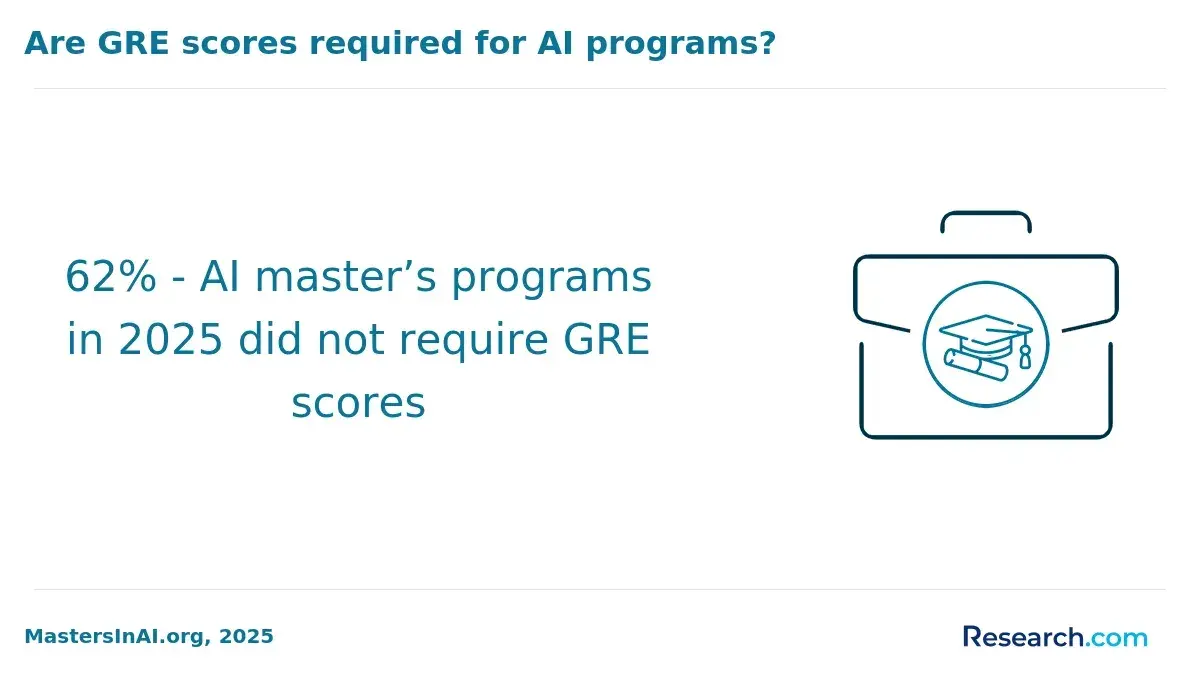
Standardized tests like the GRE are becoming optional or waived in many programs. The 2024 CGS Graduate Admissions Survey found 81% of STEM graduate admissions leaders favor applicants with strong quantitative skills even without GRE scores.
This shift emphasizes demonstrated abilities over test results.
Some programs also include coding interviews or portfolio reviews showcasing machine learning or AI projects. International students must prove English proficiency through exams such as TOEFL or IELTS. Demonstrating alignment with faculty research areas can significantly enhance admission chances.
How long does an AI doctorate take, and what affects time to degree?
The typical duration of a doctorate in artificial intelligence ranges from 4 to 7 years, with the median time-to-degree for U.S. research doctorates in computer and information sciences about 5.8 years. Multiple factors affect this timeframe, including:
- Research complexity: Projects vary widely; developing new algorithms may take less time than robotics or applied data-intensive research.
- Funding and resources: Steady financial support and access to cutting-edge computing often accelerate progress, while funding gaps can cause delays.
- Program structure: Some programs require extensive coursework and exams before research begins, while others provide accelerated paths for experienced candidates.
- Advisor and group dynamics: Faculty mentorship styles and lab environments influence completion speed through collaborative opportunities or administrative coordination.
- Personal circumstances: Part-time study, teaching duties, or external jobs commonly extend the duration beyond average.
Selecting a program that aligns with specific research interests and clarifying timelines for coursework, exams, and dissertation milestones upfront can help reduce delays. Focused research and strong institutional support may enable finishing in under 5 years.
What courses and research areas are common in AI doctoral curricula?
Doctorate programs in artificial intelligence involve advanced study and research in areas like machine learning, natural language processing, computer vision, robotics, and data mining. Students gain expertise in algorithms, statistical models, and neural networks, building on strong foundations in mathematics such as linear algebra, probability, and optimization techniques vital for AI development.
Typical course topics include:
- Deep learning architectures and applications
- Reinforcement learning and decision-making systems
- Ethical and social implications of AI technology
- Human-computer interaction and cognitive systems
- AI system scalability and real-time processing
Research efforts often target enhancing algorithmic efficiency, pioneering new learning paradigms, or applying AI in specialized sectors like healthcare or autonomous vehicles. Challenges such as model interpretability, robustness against adversarial attacks, and bias reduction are common focal points.
Prospective students should carefully assess programs for faculty expertise and research facilities aligned with their interests. Collaboration with active AI labs and access to substantial computing resources are essential for successful experimentation.
According to LinkedIn's Jobs on the Rise, AI and machine learning specialists remain in high demand globally, underscoring career opportunities for graduates adept in both theoretical underpinnings and practical AI applications.
What is the difference between a PhD and a professional doctorate in AI?
The primary difference between a PhD and a professional doctorate in artificial intelligence lies in their focus and intended career paths. A PhD centers on original research that contributes new knowledge or theories to the field, typically culminating in a dissertation with novel insights.
This path prepares graduates for academia, research institutions, or advanced R&D roles in technology companies.
In contrast, a professional doctorate emphasizes applying established AI knowledge to solve real-world problems, often targeting leadership roles in industry, policy, or consultancy. These programs are generally shorter and designed for working professionals seeking expertise in AI implementation and strategy without focusing on groundbreaking research.
Examples of PhD research include creating new machine learning algorithms or advancing AI theories. Professional doctorate curricula often address optimizing AI systems in sectors such as healthcare or finance, with an emphasis on project management and applied AI ethics.
Consider your career goals when choosing between these paths: pursue a PhD to become a scholar or lead innovative AI research, or opt for a professional doctorate to enhance applied skills for executive roles.
- PhD: Research-intensive, academic and R&D focused
- Professional doctorate: Practice-oriented, industry leadership focused
- Only 1.4% of U.S. research doctorates awarded were professional doctorates, underscoring their specialized role
What jobs can you get with an AI doctorate in industry or academia?
Professionals with a doctorate in artificial intelligence find diverse career paths in both industry and academia, driven by rising demand for advanced expertise. Industry roles include research scientists, machine learning engineers, AI architects, and data scientists who develop novel algorithms, improve natural language processing, and design autonomous systems.
For example, an AI research scientist might focus on creating efficient deep learning methods for healthcare diagnostics.
Academic careers typically involve professorships, postdoctoral research, and AI lab leadership. These positions emphasize original research, publishing peer-reviewed work, and mentoring graduate students.
Universities and research institutions value doctorate-level experts to drive AI innovation and lead advanced coursework.
Employment opportunities span sectors like finance, healthcare, robotics, and tech startups. An AI architect may design scalable AI platforms enhancing customer experiences for multinational companies, while academic roles focus on foundational research and theory development.
Practical interdisciplinary experience, including skills in computer vision, robotics, or AI ethics, adds value. The U.S. computer and information technology sector alone reported 545,000 job openings, many requiring specialized AI knowledge.
Balancing research funding, publishing, and applied innovation is key for those entering these fields, with a strong emphasis on integrating theoretical foundations and real-world problem-solving.
What salary and job outlook can AI doctorate graduates expect?
Graduates with a doctorate in artificial intelligence tend to earn competitive salaries reflecting their advanced expertise in machine learning, robotics, natural language processing, and data analytics. The U.S. Bureau of Labor Statistics notes the median annual wage for computer and information research scientists at $145,080, but doctorate-level AI experts commonly earn more due to their specialized skills.
Demand for AI professionals with doctoral qualifications is accelerating across multiple sectors, including technology, healthcare, finance, automotive, and government research. Career paths include roles such as AI engineer, research scientist, senior data scientist, or university professor.
Salary ranges vary based on location, experience, and industry:
- In tech hubs like Silicon Valley or New York City, annual salaries often exceed $170,000.
- Academics and government lab researchers typically earn between $100,000 and $140,000, benefiting from job stability and research funding.
- AI experts in finance and healthcare generally see salaries from $150,000 to $180,000.
The job outlook remains favorable with a projected 19% growth rate for computer and information research scientists through 2032, outperforming many other fields. Continuous skill development in emerging AI subfields is essential for career advancement.
Other Things You Should Know About Artificial Intelligence
Most programs require IELTS or TOEFL iBT scores. A common minimum is IELTS 6.5 overall with no band below 6.0, or TOEFL iBT 90 or higher. Some universities waive the test for applicants whose prior degree was taught in English, with official proof.
The minimum GPA requirement for affordable AI doctorate programs in 2027 typically ranges from 3.0 to 3.5. It's crucial to check specific university admissions criteria, as requirements can vary between institutions offering low-cost doctoral programs in artificial intelligence.
Financial aid options for affordable AI doctorate programs in 2027 include government scholarships, grants from tech organizations, and university-specific assistantships. Eligibility often requires maintaining a certain GPA or demonstrating financial need. Check specific program websites for detailed criteria and deadlines.
References
- University of the Cumberlands’ Ph.D. in Information Technology Ranked No. 6 Nationally for Best Online AI Doctorate by Learn.org https://www.ucumberlands.edu/news/university-cumberlands-phd-information-technology-ranked-no-6-nationally-best-online-ai-doctorate
- Recent PhD Topics in Artificial Intelligence -PhD Assistance https://www.phdassistance.com/blog/recent-phd-topics-in-artificial-intelligence/
- Difference between Professional Doctorate and PhD https://www.ebu.ac/articles/6-Difference-between-Professional-Doctorate-and-PhD-article.php
- My Journey to PhD Admission in Artificial Intelligence | Towards Data Science https://towardsdatascience.com/my-journey-to-phd-admission-in-artificial-intelligence-35593adb923f/
- Cost to Study Artificial Intelligence in 2026 https://checkmateittech.com/cost-to-study-artificial-intelligence-usa/
- How long is a PhD program: Duration and key factors https://vinuni.edu.vn/how-long-is-a-phd-program/
- Most Affordable Online Master's in AI for 2026 https://aidegreeprograms.org/rankings/affordable-online-ai-masters/
- Top Universities Offering a PhD in AI (2025 Guide) https://aiashes.com/phd-in-ai/
- Online PhD in Artificial Intelligence | Signum Magnum College https://smceducation.com/online-doctoral-programs/phd-in-ai/
- How long should a PhD take today - Swiss School of Business Research https://ssbr-edu.ch/how-long-should-a-phd-take-today/