2027 AI Master's Degrees in Texas: Best Options

Co-Founder and Chief Data Scientist
Choosing an AI master’s degree in Texas is a high-stakes decision because the right program can help you move into machine learning, data science, automation, robotics, or AI product work, while the wrong fit can cost time and money without improving your job prospects. For applicants without a traditional computer science background, the main questions are usually practical: Which programs are accredited? What prerequisites are expected? Can you study online while working? How much will it cost? And will the degree lead to stronger career outcomes?
This guide explains the AI master’s degree landscape in Texas for 2026, with attention to accredited options, admissions expectations, online versus campus formats, coursework, cost, timelines, salaries, job demand, and credentials that can strengthen your profile. It is designed for working professionals, recent graduates, and career changers who want a clearer way to compare programs before applying.
Key Things You Should Know
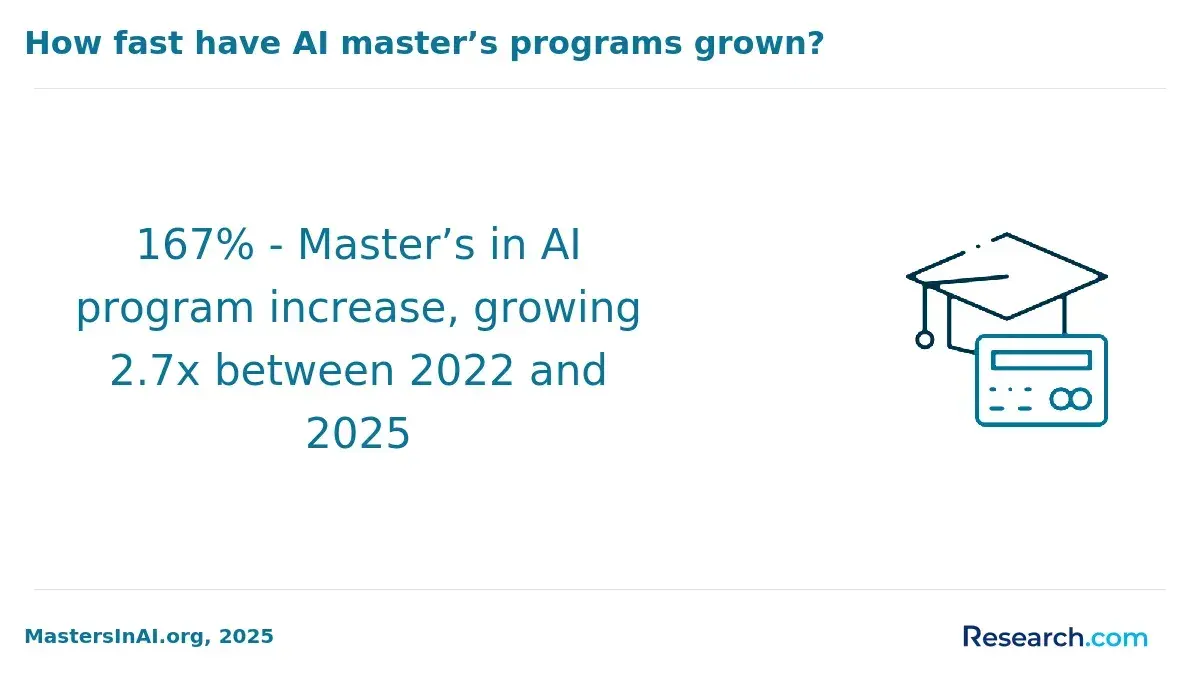
- Texas offers diverse AI master's programs emphasizing machine learning, data science, and robotics, with enrollment growth exceeding 18% since 2024 due to rising industry demand.
- Graduates from Texas AI programs report starting salaries averaging $95,000, reflecting strong local tech sector growth and corporate partnerships with universities.
- Leading Texas universities integrate hands-on research, internships, and interdisciplinary coursework, preparing students effectively for evolving AI careers in healthcare, finance, and autonomous systems.
Which universities in Texas offer accredited master's degrees in artificial intelligence?
Texas offers several accredited graduate pathways for students who want advanced training in artificial intelligence. Some programs carry an explicit AI focus, while others are computer science, engineering, or data science degrees that allow students to build an AI-centered curriculum through electives, research, labs, and capstone work.
The University of Texas at Austin offers a Master of Science in Computer Science with AI specialization tracks that combine theoretical foundations with applied machine learning and intelligent systems coursework. Texas A&M University provides an accredited MS in Computer Science with AI-focused classes and significant research opportunities. Southern Methodist University offers a Master of Science in Data Science and Engineering, a program that emphasizes AI methods used in analytics, modeling, and large-scale data systems.
Rice University includes AI concentration areas within its Master of Computer Science and Electrical Engineering programs, with topics such as machine learning, natural language processing, and robotics. The University of Houston offers a master’s program in computer science with electives in AI algorithms, supporting both practical skill development and preparation for research-oriented roles.
For students comparing the best accredited master’s programs in artificial intelligence in Texas, the degree title should not be the only filter. A computer science or engineering master’s program with strong AI faculty, modern electives, and applied projects may be a better fit than a narrowly branded AI degree with limited course depth.
The U.S. Bureau of Labor Statistics projects 15% growth in computer and information technology jobs from 2023 to 2033, which helps explain why AI-related graduate programs have become more competitive. Applicants should verify institutional accreditation through regional accrediting bodies and, when relevant, look for ABET-recognized engineering or computing programs. Accreditation matters because it can affect employer recognition, transferability of credits, eligibility for some financial aid, and the credibility of the degree.
Working professionals who need a faster or more flexible route may also compare online computer science pathways, including a one year computer science degree, but they should confirm whether the curriculum includes enough advanced AI, machine learning, and systems coursework for their career goals.
What to check before shortlisting a Texas AI master’s program
- Accreditation: Confirm regional accreditation and review any program-level accreditation when applicable.
- AI depth: Look beyond one or two electives. Strong programs usually include machine learning, deep learning, data systems, NLP, computer vision, AI ethics, and applied projects.
- Faculty expertise: Review faculty publications, labs, grants, and industry collaborations in AI-related areas.
- Research and lab access: This is especially important for students considering doctoral study or research scientist roles.
- Industry connections: Internships, capstones with employers, career fairs, and alumni networks can materially affect job outcomes.
- Admissions fit: Students without a computer science degree should check whether the program offers bridge courses or expects prerequisites before admission.
What are the typical admission requirements and prerequisites for AI master's programs in Texas?
Most AI master’s programs in Texas expect applicants to show strong quantitative, programming, and analytical preparation. A bachelor’s degree in computer science, engineering, mathematics, statistics, or a closely related field is the most common background, although some programs consider applicants from other disciplines if they have completed the necessary prerequisites.
A minimum GPA of 3.0 on a 4.0 scale is commonly expected. Applicants usually submit official transcripts, letters of recommendation, a resume or CV, and a statement of purpose explaining their academic preparation, professional goals, and interest in artificial intelligence. Strong statements do more than express enthusiasm; they connect prior coursework, projects, research, or work experience to the program’s AI curriculum.
Common prerequisite areas
- Algorithms and data structures
- Linear algebra
- Probability and statistics
- Calculus or discrete mathematics, depending on the program
- Programming in Python, Java, or C++
- Foundational computer science concepts, including operating systems or databases for some programs
- Introductory machine learning for more selective or advanced tracks
The GRE remains relevant at some institutions, even as other schools have adopted test-optional or test-flexible policies. Data from the Graduate Record Examinations Board indicates that admitted students to related graduate programs average a quantitative reasoning GRE score of 163 out of 170. Applicants with weaker test scores should strengthen the rest of the application with evidence of programming ability, research experience, publications, professional software development, machine learning projects, or data science work.
International applicants typically need TOEFL or IELTS scores to demonstrate English proficiency. They may also need credential evaluations, translated transcripts, or proof of funding depending on the university’s graduate admissions process.
Career changers should pay close attention to how each school handles prerequisite gaps. Some programs require all foundational coursework before admission. Others admit students conditionally or offer bridge courses after enrollment. The second route can be useful, but it may increase time to completion and total cost.
How to make an application stronger
- Build a portfolio with machine learning, data analysis, or AI engineering projects.
- Use GitHub or a similar platform to show clean code, documentation, and reproducible results.
- Ask recommenders who can evaluate your quantitative ability, technical work, research potential, or professional reliability.
- Explain any nontraditional background clearly and show how you have prepared for graduate-level AI coursework.
- Match your statement of purpose to specific faculty, labs, courses, or career outcomes at the university.
Applicants comparing data-focused alternatives can also review the data science master US ranking to understand affordable options outside a traditional AI or computer science degree structure.
How do online and campus-based AI master's degrees in Texas differ in format, flexibility, and outcomes?
Online and campus-based AI master’s degrees in Texas can lead to similar academic credentials, but the student experience is different. Online programs typically prioritize flexibility, while campus programs usually provide more direct access to labs, faculty, research groups, and in-person networking. The better choice depends on your schedule, learning style, career goals, and need for hands-on research access.
Online programs may use asynchronous lectures, scheduled live sessions, virtual labs, discussion boards, remote group projects, and online exams. This format works well for working professionals, military students, parents, and applicants who cannot relocate. A 2024 Online Learning Consortium study found that 73% of online STEM graduate students reported greater flexibility balancing work and education compared to campus-based peers.
Campus-based programs require physical attendance for lectures, seminars, labs, office hours, and research meetings. They are often a stronger fit for students who want frequent faculty interaction, funded research roles, access to specialized equipment, or deeper participation in university life.
| Factor | Online AI master’s degree | Campus-based AI master’s degree |
| Schedule | Often more flexible, with part-time or asynchronous options | Usually follows fixed semester schedules and in-person meeting times |
| Location | Can reduce or eliminate relocation and commuting | May require living near campus or commuting regularly |
| Networking | Depends heavily on virtual events, group work, and proactive outreach | Often stronger for in-person networking, labs, and student organizations |
| Research access | May include virtual labs or remote research, but availability varies | Usually better access to labs, faculty projects, and on-site research teams |
| Best fit | Working professionals and students who need schedule flexibility | Students seeking research depth, campus resources, or immersive study |
Graduation rates are close, with 85% for online and 83% for campus students, according to the Online Learning Consortium, 2024. That similarity suggests that format alone does not determine success. Student support, course design, faculty engagement, advising, and career services often matter more than whether classes are online or in person.
Campus-based programs may still have an advantage for students targeting research-heavy positions, doctoral study, or roles that benefit from close faculty mentorship. Online programs are increasingly narrowing that gap through virtual labs, remote internships, cloud-based computing environments, and employer-sponsored projects.
Cost can also differ. Online students may save on commuting or relocation, but tuition and fees vary by university. Students exploring lower-cost technical pathways can compare options such as the cheapest online computer engineering degree, while checking whether the curriculum supports AI-specific goals.
Before choosing a format, ask each program how online and campus students differ in access to faculty, research opportunities, career services, internships, computing resources, and alumni networks. If the diploma does not distinguish the format, employers are more likely to focus on your skills, projects, internships, and ability to explain technical work.
What core coursework and specializations are covered in Texas AI master's degree programs?
Texas AI master’s programs typically combine advanced computer science, applied mathematics, data systems, and responsible AI practice. The strongest curricula do not treat AI as a single course; they build from algorithms, statistics, and programming into machine learning, deep learning, natural language processing, computer vision, and deployment.
Common core coursework
- Machine learning: Supervised, unsupervised, and reinforcement learning methods used to build predictive and adaptive systems.
- Data mining and large-scale analytics: Techniques for extracting patterns from structured and unstructured data.
- Computer vision: Image recognition, object detection, visual classification, and neural network models for visual data.
- Natural language processing: Language modeling, sentiment analysis, text classification, conversational AI, and speech-related applications.
- Deep learning: Neural network architectures, convolutional networks, recurrent models, and modern training methods.
- AI ethics: Bias, transparency, privacy, accountability, explainability, and the social impact of automated decision-making.
- AI systems design: Building, testing, and deploying AI applications in production-oriented environments.
Students often work with Python and AI frameworks such as TensorFlow and PyTorch. They also develop mathematical modeling and statistical skills needed to evaluate models, interpret results, and avoid common technical mistakes such as overfitting, data leakage, poor validation design, and biased training data.
Specializations vary by university, but many Texas programs emphasize machine learning engineering. LinkedIn’s 2024 Jobs Report reported a 74% annual increase in job postings for this role, making it a practical concentration for students who want industry-facing AI development work.
Common specialization areas
- Machine learning engineering: Model development, scalable pipelines, deployment, and performance monitoring.
- Deep learning: Neural network architectures for image, speech, language, and prediction problems.
- Natural language processing: Conversational AI, language modeling, search, summarization, and text analytics.
- Robotics: Perception, planning, control systems, and autonomous systems.
- Healthcare informatics: AI applications in clinical data, diagnostics, patient risk modeling, and health systems analytics.
- Cybersecurity: AI for threat detection, anomaly detection, security analytics, and automated response systems.
Capstone projects, thesis options, and applied research are especially important because employers want proof that graduates can move beyond coursework. A strong capstone should show problem definition, data preparation, model selection, validation, deployment considerations, and ethical risk assessment.
Students who want a broader analytics foundation may also compare MS data science online programs. Data science degrees can be a good alternative when the goal is analytics, modeling, and business decision support rather than AI research or advanced AI engineering.
How long does it take to complete an AI master's degree in Texas, and what is the typical cost?
An AI master’s degree in Texas generally takes 1.5 to 2 years of full-time study. Part-time students commonly need 3 years or more, depending on course load, prerequisite needs, work schedule, and whether the program includes a thesis, capstone, or internship requirement.
Most programs require 30 to 36 credit hours, including core AI courses, electives, and a culminating experience such as a capstone project or thesis. The University of Texas at Austin offers a 1.5-year full-time master’s track, while Texas A&M provides both full- and part-time enrollment options.
Tuition varies significantly by institution type and residency status. According to NAGAP data, average total tuition for a master’s in computer science or AI at Texas public universities ranges from $30,000 to $50,000. Private schools often charge between $60,000 and $90,000 for the full program, excluding fees, books, and living expenses.
Cost factors students often overlook
- Fees: Technology, distance learning, lab, student services, and graduation fees can raise the final cost.
- Prerequisite or bridge courses: Students without a computer science background may need additional coursework before or during the degree.
- Course load: Part-time study may help with cash flow but can extend the timeline and increase certain recurring fees.
- Living expenses: Campus students may need to budget for housing, transportation, parking, and relocation.
- Computing needs: Some students need upgraded hardware, cloud computing credits, or paid software tools.
- Opportunity cost: Full-time study can reduce earnings if students cut work hours or leave the workforce temporarily.
Financial aid may include federal student loans, scholarships, graduate assistantships, employer tuition reimbursement, fellowships, and tuition discounts. Assistantships can be especially valuable because they may provide stipends, tuition support, research experience, and closer faculty mentorship, but they are competitive and more common in campus-based or research-oriented programs.
When estimating return on investment, compare total program cost with likely career outcomes, not just the tuition sticker price. A lower-cost program can be the better financial choice if it offers strong AI coursework, credible faculty, applied projects, and employer connections. A more expensive program may be worth considering if it provides exceptional research access, internships, alumni reach, or placement into high-paying AI roles.
What are the career outcomes and job titles for graduates of Texas AI master's programs?
Graduates of Texas AI master’s programs commonly move into technical roles that require machine learning, programming, statistics, and applied data skills. The most frequent outcomes include AI engineer, machine learning engineer, and data scientist. These roles account for 68% of employed graduates within six months, reflecting the close connection between graduate AI coursework and employer demand.
Other job titles include data analyst, AI researcher, software engineer with AI specialization, machine learning operations engineer, computer vision engineer, NLP engineer, robotics engineer, and AI product-focused technical roles. The right title depends on the student’s specialization, prior work experience, internship record, portfolio, and comfort with production systems.
Common career paths
- AI engineer: Builds intelligent applications, integrates models into software systems, and works with data and engineering teams.
- Machine learning engineer: Designs, trains, validates, deploys, and monitors machine learning models.
- Data scientist: Uses statistical modeling, machine learning, and data analysis to support decisions and predictions.
- AI researcher: Develops or evaluates new algorithms, often in research labs, advanced industry groups, or academic settings.
- Software engineer with AI specialization: Builds software products that use AI features, recommendation systems, automation, or predictive tools.
- Data analyst: Applies analytics and modeling to business, healthcare, finance, operations, or policy questions.
Texas employers in Austin, Dallas, Houston, and other growing tech markets hire AI talent across technology, healthcare, finance, energy, manufacturing, logistics, and consulting. Austin and Dallas are particularly active for technology and AI-enabled product development, while Houston offers opportunities connected to healthcare, energy, engineering, and industrial systems.
With a 92% employment rate within six months, graduates of Texas AI master’s programs show strong practical readiness for advanced roles. Still, a degree alone is rarely enough for the most competitive openings. Employers usually want evidence that candidates can work with real data, write production-quality code, evaluate models responsibly, communicate results, and collaborate with technical and nontechnical teams.
How students can improve employability before graduation
- Complete a capstone or thesis that solves a real-world problem and can be discussed in interviews.
- Build a portfolio with documented AI, machine learning, NLP, computer vision, or data engineering projects.
- Seek internships, research assistantships, or employer-sponsored projects.
- Learn cloud deployment, MLOps, data pipelines, and model monitoring if targeting engineering roles.
- Develop knowledge of ethical AI implementation, privacy requirements, and responsible data use.
- Use university career centers, alumni networks, faculty referrals, and local tech events for targeted networking.
What is the average salary for AI master's degree holders in Texas compared to national averages?
AI master’s degree holders in Texas earn an average annual salary of $142,000, about 12% higher than the national average of $126,500, according to Glassdoor’s 2024 Salary Report. This premium reflects the state’s expanding AI-related industries, large corporate presence, and growing technology hubs.
Salary outcomes vary by city, employer, specialization, and experience level. Graduates working in Austin, Dallas, and Houston often benefit from strong demand in healthcare technology, finance, energy, autonomous systems, enterprise software, and AI-enabled products. AI professionals at startups or established firms in Austin often earn salaries exceeding $145,000, while smaller Texas markets may offer compensation closer to the state average.
Students should also consider total compensation, not only base salary. Some Texas employers provide signing bonuses, relocation packages, annual bonuses, stock options, or equity compensation. These benefits can materially change the financial value of an offer, especially in startup or large technology environments.
National salary averages combine high-paying technology markets with lower-paying regions, which helps explain the gap between Texas and the national figure. Graduates who move into leadership, architecture, or research-focused AI roles in Texas may see salaries surpassing $160,000 annually.
What affects AI salary after graduation?
- Technical specialization: Machine learning engineering, MLOps, computer vision, and NLP can command different pay levels.
- Prior experience: A master’s degree paired with software engineering, analytics, or domain expertise is often more valuable than the degree alone.
- Portfolio and projects: Employers pay for demonstrated ability to build, deploy, and explain AI systems.
- Industry: Finance, healthcare technology, enterprise software, energy, and autonomous systems may offer different compensation structures.
- Location: Austin, Dallas, Houston, and smaller Texas markets can differ significantly in salary and cost of living.
- Role scope: Research, leadership, infrastructure, and product ownership may increase compensation compared with entry-level applied roles.
Glassdoor, 2024, is a useful salary reference, but students should compare multiple sources, review job postings by title and city, and ask programs for recent graduate outcomes when estimating return on investment.
What is the job outlook and demand for AI professionals in Texas over the next five years?
The job outlook for AI professionals in Texas is strong. Projections by the Texas Workforce Commission and Economic Modeling Specialists indicate that Texas will add 18,500 AI and machine learning specialist roles by 2029, representing a 31% growth rate and ranking second among all U.S. states.
Demand is being driven by technology, healthcare, finance, energy, manufacturing, logistics, cybersecurity, and public-sector modernization. Employers are using AI to improve prediction, automation, fraud detection, customer service, medical decision support, energy optimization, robotics, and operational efficiency.
Common in-demand roles include data scientist, machine learning engineer, AI research specialist, AI product manager, computer vision engineer, NLP specialist, and AI-focused software engineer. Employers often look for candidates with practical experience in natural language processing, computer vision, AI algorithm development, model deployment, data engineering, and responsible AI governance.
The strongest candidates will be those who can connect AI methods to business or technical outcomes. For example, building a model is only one part of the job. Employers also need professionals who can assess data quality, explain model behavior, monitor performance, reduce bias, manage privacy concerns, and work with stakeholders who may not have technical backgrounds.
How students can prepare for Texas AI demand
- Choose programs with applied projects, internships, research labs, or industry-sponsored capstones.
- Develop skills in cloud platforms, MLOps, data pipelines, and model deployment.
- Build domain knowledge in industries that are active in Texas, such as healthcare, finance, energy, manufacturing, and enterprise technology.
- Stay current with AI tools while maintaining strong fundamentals in algorithms, statistics, and software engineering.
- Use local networks in Austin, Dallas, Houston, and other Texas tech markets to find internships and early-career roles.
For prospective students, the key takeaway is that Texas has both demand and variety. AI jobs are not limited to large technology companies. Opportunities also exist in startups, hospitals, banks, energy firms, consulting groups, government contractors, and industrial companies that are adopting AI systems.
Are there industry certifications or professional credentials that complement an AI master's degree from Texas schools?
Yes. Industry certifications can complement an AI master’s degree by proving hands-on proficiency with platforms, deployment tools, and applied workflows that may not be fully covered in graduate coursework. They are most valuable when they match the student’s target role rather than being collected at random.
Cloud credentials are especially relevant because many AI systems are built, trained, deployed, and monitored on cloud infrastructure. Certifications from AWS, Google Cloud, and Microsoft Azure stand out. An Indeed Hiring Lab analysis found that job postings listing these credentials offer 18-22% higher salaries on average, and 64% of mid-to-senior AI roles prefer candidates with at least one cloud platform certification.
Certifications that pair well with an AI master’s degree
- AWS Certified Machine Learning - Specialty: Useful for students targeting machine learning engineering, AI deployment, or cloud-based model development.
- Google Professional Machine Learning Engineer: Relevant for building, managing, and productionizing ML models in Google Cloud environments.
- Azure AI Engineer Associate: Helpful for students pursuing AI roles in Microsoft Azure-based enterprise environments.
- Certified Data Scientist (CDS): Can support roles that emphasize analytics, modeling, and applied data science.
- IEEE or Association for Computing Machinery (ACM) certificates: Useful for strengthening professional knowledge, ethics, and continuing education.
- CompTIA Security+: Valuable for AI roles intersecting with cybersecurity, data protection, and secure systems.
- DevOps credentials: Helpful for MLOps, AI infrastructure, and roles that require model deployment and automation pipelines.
Students interested in data engineering, MLOps, AI infrastructure, or enterprise AI deployment should prioritize cloud and DevOps credentials. Students focused on research or advanced algorithm development may benefit more from publications, thesis work, research assistantships, or specialized coursework than from entry-level certifications.
Some Texas institutions align AI and data science coursework with industry-recognized platforms, making it easier to prepare for certifications while completing the degree. The best strategy is to choose one credential that supports your target job title, complete applied projects using that platform, and be ready to explain the work in interviews.
How should prospective students evaluate and compare the quality and reputation of AI master's programs in Texas?
Prospective students should compare AI master’s programs in Texas using evidence, not reputation alone. A well-known university can be valuable, but the best program is the one that fits your background, budget, schedule, and career target while offering rigorous AI coursework and credible employment outcomes.
Employer recognition is one useful signal. QS World University Rankings reports that 40% of graduate program reputation scores are based on how well employers rate graduates’ practical skills. Texas schools top employer ratings among Fortune 500 companies for industry readiness, reflecting strong alignment with market expectations.
Key factors to compare
- Accreditation: Confirm that the institution is properly accredited and that any relevant program-level accreditation is clear.
- Curriculum relevance: Look for machine learning, NLP, computer vision, deep learning, data systems, explainable AI, and AI ethics.
- Faculty expertise: Review faculty research, publications, lab activity, patents, grants, and industry collaborations.
- Hands-on learning: Prioritize programs with capstones, internships, research projects, labs, or employer-sponsored work.
- Career outcomes: Ask for graduate employment rates, common job titles, salary data, internship placement, and employer partners.
- Alumni network: Strong alumni ties can help with referrals, mentoring, and job searches in Texas tech markets.
- Format and flexibility: Compare online, hybrid, and campus options based on your work schedule and need for research access.
- Total cost: Include tuition, fees, books, technology, living expenses, and any prerequisite coursework.
- Student support: Advising, tutoring, career coaching, technical support, and faculty availability can affect completion and job readiness.
Students should also examine whether a program is research-oriented, industry-oriented, or balanced. A thesis-heavy program may be ideal for students aiming for doctoral study or research roles. A capstone-based or professionally oriented program may be better for students who want to move quickly into AI engineering, data science, or product roles.
Before applying, contact admissions staff, attend information sessions, review course catalogs, speak with current students if possible, and ask specific questions about AI electives, course availability, faculty access, internship support, and career placement. A reputable program should be able to explain how its curriculum prepares students for current AI roles, not just advertise broad technology outcomes.
The strongest choice will combine credible accreditation, rigorous technical training, practical AI experience, employer recognition, manageable cost, and a format you can realistically complete.
Other Things You Should Know About Artificial Intelligence
Prerequisite courses often include linear algebra, probability, statistics, and basic programming. Some programs may also require courses in data structures or machine learning to ensure foundational knowledge before starting the master's curriculum.
Many Texas universities offering AI master's degrees provide research opportunities in collaboration with faculty, often focusing on machine learning, natural language processing, or robotics. Internships are also commonly available, especially through partnerships with tech companies and startups in major cities like Austin and Dallas, allowing students to gain practical experience.
Admission to AI master's programs in Texas typically requires GRE scores. Some universities might waive the GRE requirement based on undergraduate GPA or work experience. Specific test score thresholds vary by institution, so check individual program requirements for 2027.
Texas AI master’s programs should hold regional accreditation from the Southern Association of Colleges and Schools Commission on Colleges, or SACSCOC. Program quality may also be strengthened by college-level recognition in computer science or engineering. Accreditation affects federal aid eligibility, credit transfer, and employer recognition.
References
- 59 AI Job Statistics: Future of U.S. Jobs | National University https://www.nu.edu/blog/ai-job-statistics/
- Texas Job Market Outlook 2026: Which Industries Will Grow the Fastest https://burnettspecialists.com/blog/texas-job-market-outlook-2026-which-industries-will-grow-the-fastest/
- Master's Degree in Artificial Intelligence | UT San Antonio https://future.utsa.edu/programs/master/artificial-intelligence/
- AI Jobs Growth https://www.aimaps.ai/texas.php
- Affordable AI Master’s Degree for Working Adults https://amberton.edu/2025/09/22/ai-masters-working-professionals/
- America Isn’t Ready for What AI Will Do to Jobs https://www.theatlantic.com/magazine/2026/03/ai-economy-labor-market-transformation/685731/
- Master of Science (M.S.) Major in Artificial Intelligence https://mycatalog.txstate.edu/graduate/science-engineering/computer/computerscience-artificial-intelligence-ms/
- Data Science & AI Careers After Master’s Degree | Job Scope & Growth https://www.mywestford.com/blog/top-career-opportunities-after-earning-a-masters-in-data-science-and-artificial-intelligence/
- Artificial Intelligence Certificate Programs - MastersInAI.org https://www.mastersinai.org/degrees/ai-certificate-programs/
- AI Master’s Programs in Texas - AIDegreePrograms.org https://aidegreeprograms.org/ai-masters/texas/