2027 Where AI Degree Programs Are Growing the Fastest

Co-Founder and Chief Data Scientist
Many professionals with degrees unrelated to artificial intelligence face uncertainty when seeking to enter the AI field. Traditional programs often require extensive prior knowledge, limiting access for those looking to pivot their careers. This challenge creates barriers for motivated individuals aiming to leverage AI's growing industry demand without starting from scratch. Understanding where AI degree programs are expanding fastest can help these prospective students identify flexible, accredited options that match their needs. This article examines geographical and institutional growth trends in AI education, guiding readers toward the best opportunities for successful career transitions into this rapidly evolving field.
Key Things You Should Know
- Enrollment in AI degree programs grew by over 35% nationally from 2024 to 2025, with significant expansion in states like California, Texas, and Massachusetts.
- Universities are increasingly partnering with tech companies to offer specialized AI tracks, enhancing hands-on learning and job placement opportunities.
- Demand for AI skills in sectors beyond tech, including healthcare and finance, drives program growth, aligning education with evolving labor market needs.
Where are artificial intelligence degree programs expanding most rapidly across the United States?
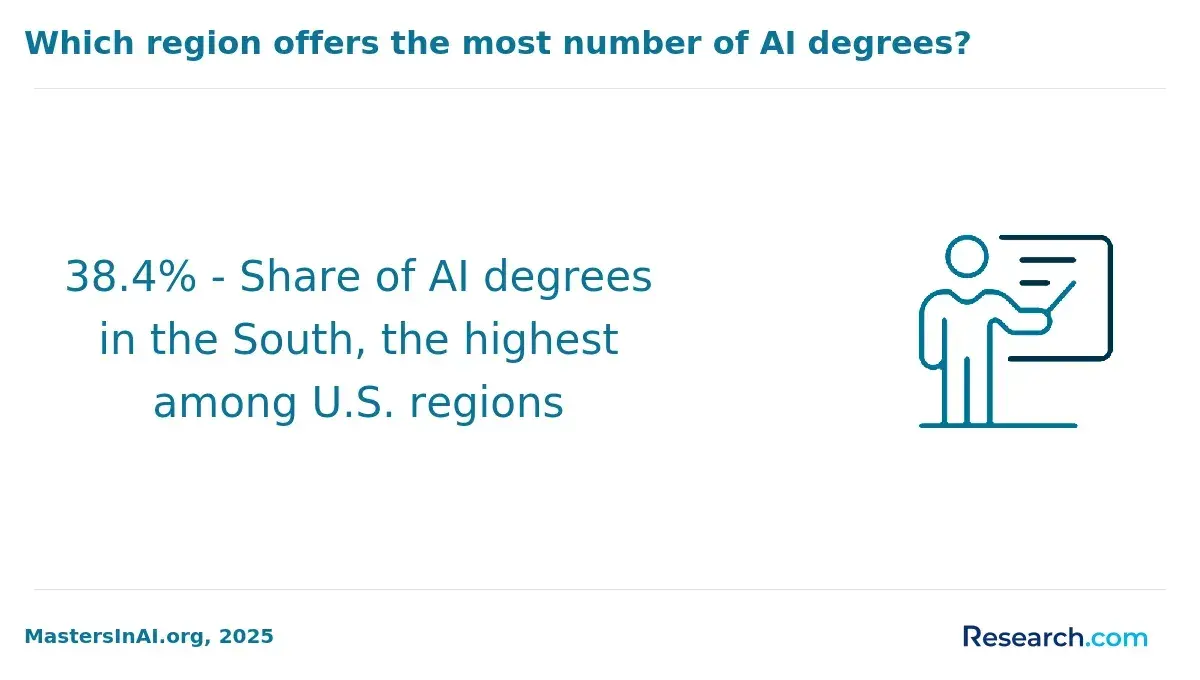
Artificial intelligence degree programs are growing fastest in states with strong tech sectors and research universities. California leads this expansion, driven by Silicon Valley's demand for AI talent, with schools like Stanford and UC Berkeley offering new standalone AI bachelor's degrees. Texas is another key region, with UT Austin and Texas A&M broadening AI curricula to support the booming industries in Austin and Houston.
Midwestern states such as Michigan and Ohio also see rapid growth in artificial intelligence degree programs, reflecting the region's emphasis on automotive and manufacturing technology. The University of Michigan and Ohio State University provide comprehensive AI courses prioritizing practical applications relevant to Industry 4.0.
The southeastern U.S., including Georgia and North Carolina, is quickly adopting AI-specific degrees. Georgia Tech and UNC Chapel Hill focus on AI in healthcare and cybersecurity, highlighting regional industry strengths. These programs offer diverse paths for students aiming to specialize in areas aligned with local job markets.
The national rise in AI bachelor's majors is striking. The 2025 AI Degree Report by MastersinAI.org shows standalone AI majors surged 114.4% in one year, from 90 programs in 2024 to 193 in 2025. This rapid growth reflects how institutions across states respond to growing student and employer demand for formal AI education.
Students planning careers in this field should consider regions where programs match local job markets to improve internship and employment prospects. Exploring what is applied AI engineering can help clarify pathways for those interested in this expanding sector.
Which types of colleges and universities are adding new AI majors and concentrations?
Public universities, private research institutions, and liberal arts colleges across North America are expanding AI majors and concentrations, reflecting varied approaches to integrating artificial intelligence into higher education. While large public research universities in tech hubs like California and Massachusetts initially led this growth, the expansion now reaches beyond these centers, demonstrating how universities expanding artificial intelligence programs in North America are diversifying.
As of April 2026, there are 62 standalone AI majors available at U.S. universities, with an additional dozen schools planning to offer AI majors later in the year. Many of these new programs are appearing outside traditional tech centers, indicating rapid regional expansion reported by Northeastern University's Center for Inclusive Computing in The New York Times.
Regional public universities add AI programs emphasizing local industry demands and workforce needs, often providing specialized tracks such as AI in healthcare, agriculture, or manufacturing. Private research universities focus on interdisciplinary AI curricula combining computer science with fields like statistics, ethics, and cognitive science to prepare students for both technical and policy roles. Liberal arts colleges typically offer AI minors or concentrations integrated with broader data science or computer science departments, with a focus on responsible AI and critical thinking.
Community colleges and technical institutes are also partnering with four-year universities to create transfer pathways into bachelor's AI programs. Prospective students can find affordable, locally relevant options at regional public universities, while private research schools provide cutting-edge resources and interdisciplinary opportunities. Those seeking affordable paths may explore the list of cheapest engineering colleges for related options.
How can you verify that an artificial intelligence degree program is properly accredited?
To verify an artificial intelligence degree program accreditation in the US, start by confirming recognition from accrediting agencies approved by the U.S. Department of Education (USDE) or the Council for Higher Education Accreditation (CHEA). These accreditations indicate the program meets essential academic and operational standards, influencing credit transferability, federal aid eligibility, and employer acceptance. Regional accreditors like the Middle States Commission on Higher Education or the Western Association of Schools and Colleges commonly oversee respected AI degrees.
When you want to know how to verify regional accreditation for artificial intelligence degrees, carefully check official databases, such as the USDE's Database of Accredited Postsecondary Institutions and Programs. Some artificial intelligence programs may also hold program-specific accreditation from ABET, which is recognized for quality in computing and engineering education. Make sure the accreditation applies specifically to the AI degree, not just the institution.
Accreditation can be institutional, covering the whole school, or programmatic, which validates specific departments or degrees. While both types matter, programmatic accreditation often provides stronger assurance of curriculum quality and relevance to the AI field. Also, consider how long the program has maintained accreditation, as newer AI degrees, including many recently launched master's programs, might still be under review.
For related educational paths, explore affordable options like a cyber security degree, which sometimes align with AI in technology fields.
What are the main differences between online and campus-based AI degree programs?
Online and campus-based artificial intelligence degrees in North America differ mainly in delivery style, student interaction, and resource access. Online programs provide flexibility, allowing students to balance studies with work or personal commitments, making them ideal for professionals pursuing career changes or skill upgrades without relocation. Campus offerings, meanwhile, grant hands-on experience through laboratory access, face-to-face mentorship, and in-person collaboration.
The curriculum across both formats covers core topics like machine learning, neural networks, data ethics, and AI applications, though campus programs usually emphasize more extensive lab sessions and live project work. In contrast, online students engage through virtual labs and simulations. Student engagement also varies: campus-based learners benefit from spontaneous discussions and direct peer support, while online students rely heavily on forums, scheduled video meetings, and digital collaboration platforms. This approach requires stronger self-discipline and time management.
Costs typically differ as well. Online degrees often come with lower tuition and eliminate relocation or commuting expenses, offering financial accessibility. Campus programs may have higher fees but provide richer immersive experiences and access to advanced facilities. For those exploring related fields, accredited cybersecurity courses online can complement AI education.
The benefits of campus vs online artificial intelligence degree programs in the United States reflect diverse student priorities: accessibility, hands-on training, and networking. According to MIT registrar data highlighted by The College Fix, enrollment in MIT's Artificial Intelligence and Decision Making major surged from 37 students in 2022-23 to 328 in 2025-26, an almost 8.9x increase in three academic years, underscoring the growing interest in AI education nationwide.
- differences between online and campus-based artificial intelligence degrees in North America
- benefits of campus vs online artificial intelligence degree programs in the United States
What degrees and prerequisites do you need to start a career in artificial intelligence?
A strong foundation in computer science, mathematics, and data analysis is essential for building a career in artificial intelligence. Common undergraduate degrees include computer science, data science, software engineering, and electrical engineering. Many professionals deepen their expertise with advanced degrees such as master's or PhDs focusing on machine learning, robotics, or cognitive computing.
Proficiency in programming languages like Python, Java, or C++ is critical, along with a solid understanding of linear algebra, calculus, probability, and statistics. Knowledge of algorithms, data structures, and software development principles is also necessary. Practical skills with machine learning frameworks like TensorFlow or PyTorch, as well as concepts in neural networks, natural language processing, and computer vision, prepare candidates for AI roles.
Problem-solving and critical thinking abilities are cultivated through rigorous coursework and projects emphasizing logical reasoning and algorithmic thinking. For those transitioning into AI or seeking faster routes, bootcamps and certificate programs focused on generative AI tools offer valuable alternatives.
The demand for generative AI skills is growing rapidly, with job postings rising by 323% year-over-year, according to Leapscholar's 2026 US AI Degree Boom report. Hands-on experience through internships, research, and open source contributions significantly enhances employability in this competitive field.
What core courses and technical skills do AI bachelor's and master's programs teach?
AI bachelor's and master's programs combine theoretical knowledge with practical skills to equip students for evolving technology roles. Core subjects include machine learning, data structures, algorithms, computer vision, natural language processing, and robotics. These areas build the foundation for designing systems that learn from data, interpret images, understand languages, and control intelligent agents.
Students develop strong technical abilities, mainly working with programming languages such as Python, R, and Java. Mastery of frameworks like TensorFlow, PyTorch, and Keras is essential for training and deploying AI models. Programs also cover statistical analysis, data mining, and cloud computing, preparing graduates to handle large datasets and scalable AI environments effectively.
Advanced coursework often focuses on reinforcement learning, ethical AI, AI system architecture, and human-computer interaction. Hands-on projects with real-world datasets foster problem-solving and collaborative skills. Practical training includes model evaluation, hyperparameter tuning, and deployment pipelines-key for workforce readiness.
A joint study by Stanford University and the World Bank, summarized by Investopedia, reports average salaries above $135,000 for professionals in AI-related roles who build and manage AI systems. These workers have seen the fastest salary growth among technical occupations since 2022, highlighting the value of acquiring these technical skills.
How long do AI degree programs typically take, and what do they cost to complete?
AI degree programs generally take two to four years, depending on the degree type. A bachelor's degree in AI or related fields like computer science with an AI focus typically requires about four years, while accelerated tracks or transfer credits can shorten this to roughly three years. Master's degrees usually take one to two years but may extend up to three for part-time or online students. Doctoral programs vary widely, often demanding four to six years of research and coursework.
Tuition costs differ by institution and program format. Public in-state tuition commonly ranges from $10,000 to $30,000 annually, whereas out-of-state and private universities may charge over $40,000 per year. Graduate programs tend to be more expensive, with master's degrees averaging between $20,000 and $50,000 total. Flexible options like online and part-time studies might reduce upfront costs but lengthen completion timelines.
Enrollment in ai programs has surged, reflecting a strong workforce demand for ai skills. Stanford HAI's 2026 AI Index, cited by AcademicJobs, shows ai enrollment rising by approximately 45% annually over five years, while broader computer science enrollment declined 11% between 2024 and 2025. This trend has pushed universities to expand ai offerings and diversify pricing and program models.
Additional expenses can include specialized software, hardware, and potential internships or research projects vital to many ai degrees. Prospective students should carefully plan for these to understand the total cost of their education.
What entry-level and advanced job roles can you pursue with an AI degree?
An AI degree unlocks diverse career opportunities ranging from entry-level roles to advanced positions across multiple industries. Entry-level jobs often include AI software engineer, machine learning analyst, data scientist, and AI research assistant. These roles focus on building, testing, and refining AI models, data preprocessing, and developing algorithms. For example, machine learning analysts may train predictive systems or enhance natural language processing applications to improve user experience.
Advanced careers demand greater expertise and can include AI research scientist, senior data engineer, AI architect, and AI product manager. These professionals lead complex projects, design scalable AI infrastructure, and align AI strategies with organizational goals. An AI architect, for instance, ensures seamless system integration and efficient AI deployment.
The adoption of AI education is growing rapidly: by 2025, 304 U.S. colleges and universities offered AI-related degrees. Among these, 53% provided standalone AI programs, while 47% offered AI concentrations or tracks, according to the 2025 AI Degree Report by MastersinAI.org. This expansion prepares a skilled workforce for challenges ranging from autonomous systems to advanced analytics.
Students should build foundational skills in programming, statistics, and relevant domains. Experience with AI frameworks such as TensorFlow or PyTorch is often essential. Strong abilities in data interpretation and communication remain key, especially for leadership or interdisciplinary roles.
What salary ranges and earning potential can AI graduates expect in today's market?
AI professionals' earnings vary significantly by experience, location, and role. Entry-level AI graduates generally start with salaries between $80,000 and $110,000 annually. Those in mid-career, with 3 to 5 years of experience, often see salaries ranging from $120,000 to $160,000. Senior specialists like machine learning engineers and data scientists can earn more than $180,000, with top salaries exceeding $250,000 in tech hubs.
Specialized roles such as AI research scientists and product managers may command higher pay due to their expertise and strategic impact. Industries like finance, healthcare, and autonomous vehicles offer elevated compensation compared to academia or government positions. Freelancers and consultants in this field can earn hourly rates from $75 to over $200, reflecting skill and reputation.
Education investments also play a role in career prospects. For example, the University of Washington-Seattle charges $11,524 per year for its AI-focused program and boasts a 97% graduation rate. According to Hakia's 2026 Best Online Artificial Intelligence Degree Programs, this represents a strong return on investment given the high earning potential post-graduation.
Job seekers should evaluate salary benchmarks by region and specialization, such as natural language processing or computer vision. Prior internships and continuous skill development remain crucial to staying competitive in AI careers.
How is employer demand and long-term job outlook evolving for AI professionals?
The demand for AI professionals in the U.S. is growing rapidly across various industries. Employers increasingly seek candidates with both technical expertise in machine learning and data science and domain knowledge in fields like business strategy, healthcare, and finance. Job growth projections for AI roles outpace most other tech sectors, reflecting a strong long-term outlook.
Business schools have responded by expanding AI MBA programs with specialized tracks, growing by 1,260% since 2022 according to Leapscholar's 2026 US AI Degree Boom report. This surge reflects a shift toward hiring professionals who blend AI technical skills with management capabilities to lead AI initiatives.
Practical experience plays a critical role in employment prospects. Internships, project portfolios, and AI-focused certifications significantly boost a candidate's attractiveness. Roles in demand include AI product managers, AI ethics officers, and AI consultants, demonstrating a mix of technical and strategic opportunities.
Sectors such as retail, automotive, and government continue to integrate AI, driving sustained job creation. Candidates should develop skills in explainable AI, reinforcement learning, and AI governance while staying current with ongoing advancements to remain competitive.
Other Things You Should Know About Artificial Intelligence
The most important programming languages for artificial intelligence include Python, R, and Java. Python is particularly favored for its extensive libraries, such as TensorFlow and PyTorch, which support machine learning and deep learning. R is often used for statistical analysis, while Java is appreciated for building large-scale AI applications.
In 2027, the expansion of AI degree programs geographically is influenced by the increasing demand for AI skills in various industries, government incentives for educational institutions focusing on technology, and the global push for digital transformation. Countries investing heavily in tech infrastructure and education are leading this growth.
Students in AI degree programs can engage in research projects spanning machine learning, natural language processing, computer vision, and robotics. Many institutions partner with industry leaders and government labs to provide hands-on experiences. Such research opportunities help students apply theoretical knowledge and contribute to advances in the field.
Interdisciplinary collaboration is often emphasized in artificial intelligence programs to integrate diverse perspectives from fields like computer science, mathematics, cognitive science, and ethics. This approach fosters innovation by combining technical skills with insights into human behavior and societal needs. Many programs encourage teamwork across departments through joint projects and seminars.
References
- Key Skills Gained from a Bachelor of Science in Artificial Intelligence https://tetr.com/blog/key-skills-gained-from-a-bachelor-of-science-in-artificial-intelligence
- 16 Artificial Intelligence Career Paths https://www.calmu.edu/news/artificial-intelligence-career-paths
- What are the requirements to start a career in Artificial Intelligence https://www.edureka.co/community/31635/what-are-requirements-start-career-artificial-intelligence
- Who Accredits Artificial Intelligence (AI) Degree Programs? - AI Degrees Online https://aidegreesonline.com/accreditation/who-accredits-ai-degree-programs/
- Future of AI in College Education | University of Phoenix https://www.phoenix.edu/articles/online-college/ai-in-online-college-education.html
- The Impact of AI on Job Roles, Workforce, and Employment: What You Need to Know | Innopharma Education https://www.innopharmaeducation.com/blog/the-impact-of-ai-on-job-roles-workforce-and-employment-what-you-need-to-know
- Online vs Campus-Based Courses: Key Differences 2026 https://amityonline.com/blog/online-vs-campus-based-courses-what-are-the-differences
- AI Job Boom: 12 Entry-Level Roles You Can Get Without a CS Degree https://www.tryapt.ai/blog/ai-job-boom-12-entry-level-roles-you-can-get-without-cs-degree
- Generative AI Salary in India: Trends You Need to Know https://socialprachar.com/blog/generative-ai-salary-in-india-trends-you-need-to-know
- Growth of Degrees & Other Credentials in Artificial Intelligence | Learn & Work Ecosystem Library https://learnworkecosystemlibrary.com/topics/growth-of-postsecondary-degrees-in-artificial-intelligence/