2027 AI Bachelor's Degree Programs That Include Real Client Projects

Co-Founder and Chief Data Scientist
Many individuals with degrees outside of computer science face challenges breaking into the AI industry without hands-on experience. Employers increasingly value candidates who have collaborated on real client projects and demonstrated practical skills. Traditional degree programs often lack this essential exposure, leaving students underprepared for today's job market.
Navigating which bachelor's programs offer genuine, project-based learning can be overwhelming yet crucial for career pivoters seeking flexibility and accreditation. This article highlights programs that integrate real client work, helping readers identify paths that build both foundational knowledge and practical experience necessary to enter the competitive AI field confidently.
Key Things You Should Know
- Bachelor's degree programs in Artificial Intelligence increasingly require real client projects, enhancing practical skills and improving graduate employability, with over 70% of programs adopting this approach by 2025.
- Such hands-on projects help students gain experience in real-world problem solving, bridging academic theory with industry demands in sectors like healthcare, finance, and technology.
- Programs integrating real client work report a 35% higher job placement rate within six months post-graduation compared to those focused solely on theoretical study.
What are AI bachelor's programs with real client projects or industry capstones?
AI bachelor's degree programs with real client projects merge practical experience and academic learning to meet employer demands for hands-on education. According to AAC&U, 76% of employers want students to apply classroom knowledge in real-world settings, while 78% insist on such experience as a core college requirement. These undergraduate artificial intelligence programs featuring industry capstones often involve students developing machine learning models for healthcare, optimization algorithms for logistics companies, or natural language processing tools for startups.
Industry capstones typically last one or two semesters and require student teams to produce functional solutions aligned with specific client goals. This experience enhances skills in problem definition, teamwork, and communication-key competencies for AI careers. Variations among programs include local partnerships, global remote collaborations, and internships paired with capstone projects, all offering continuous mentorship and industry feedback.
When evaluating AI bachelor's degree programs with real client projects, prospective students should consider how projects are sourced and assessed, the balance between client-led versus faculty-led efforts, and the presence of formal mentors from industry. These factors contribute to graduate readiness and competitiveness in evolving job markets. For those seeking accelerated options, exploring the fastest computer science degree pathways can provide valuable insight for a streamlined educational journey.
Which accredited U.S. colleges offer AI bachelor's degrees with client-sponsored projects?
Several accredited U.S. colleges offer bachelor's degrees in artificial intelligence that incorporate client-sponsored projects, providing students with valuable real-world experience. Northeastern University, for example, integrates industry partnerships within its Bachelor of Science in Artificial Intelligence program, collaborating with companies like IBM and Amazon. Carnegie Mellon University's Bachelor of Science in Artificial Intelligence includes capstone projects funded and guided by external clients to tackle practical AI challenges.
Georgia Tech provides a Bachelor of Science in Computer Science with an AI specialization, embedding sponsored projects through partnerships with tech firms and government agencies. The University of Southern California's Viterbi School of Engineering offers an AI-focused degree requiring team projects with real clients, honing skills in machine learning deployment and data analytics. These represent some of the best U.S. universities for AI bachelor's programs with real-world client experience.
According to IPEDS (NCES) Degree Completions data, over 100,000 bachelor's degrees were awarded in Computer and Information Sciences and Support Services, the main pipeline for AI and machine learning talent. This output highlights the abundance of CS-related programs, yet those with client-sponsored projects offer distinct advantages for skill development.
Prospective students should verify accreditation via ABET or regional bodies and ensure projects involve genuine external sponsors rather than classroom simulations. For those exploring STEM fields, resources like mechanical engineering programs online offer insights into affordable, accredited options alongside AI pathways.
How do online AI bachelor's programs provide real client projects?
Online ai bachelor's degrees with client projects often involve structured partnerships with industry organizations, nonprofits, and startups. These collaborations enable students to address real business challenges through capstone courses or specialized practicum modules. For example, a student might develop a machine learning model to optimize inventory management for a retail client or create a natural language processing tool to enhance customer support.
Many ai bachelor programs offering real-world client experience use virtual collaboration platforms that connect students, faculty mentors, and clients. This setup reflects contemporary workplace environments and prepares students for professional roles by maintaining clear alignment of project goals with client expectations. Some programs embed these projects across multiple semesters, exposing students to diverse industry problems and practical applications.
Cengage/Harvard Business Publishing Education's "Future of Undergraduate Business Education" survey found 85% of employers prefer hiring graduates who completed applied, real-world projects, highlighting the career advantage for those engaged in this hands-on learning. Students should seek programs with:
- Clear project deliverables tied to authentic business objectives
- Regular feedback loops involving client representatives
- Access to various industry sectors relevant to ai applications
- Assessment focused on practical impact and innovation of outcomes
These components foster experiential learning beyond theory, resulting in graduates with portfolios validated by external stakeholders. This advantage can also influence decisions related to online engineering degree cost, making applied ai programs a competitive choice in the job market.
What coursework and project deliverables are typical in client-based AI programs?
Client-based artificial intelligence coursework in bachelor's degree programs focuses on practical deliverables that mirror real-world project requirements in AI bachelor programs. Students develop Python-based machine learning pipelines, create interactive notebooks for data exploration, and build APIs to integrate AI services into applications. Projects often involve deploying scalable services on cloud platforms and iterating based on client feedback to enhance model accuracy and performance.
Hands-on experiences prioritize tasks such as:
- Designing end-to-end ML workflows using libraries like scikit-learn, TensorFlow, or PyTorch
- Preparing detailed reports and visualizations to communicate insights to non-technical stakeholders
- Writing clean, maintainable code compliant with client standards and version control
- Collaborating in teams to simulate professional data science environments
According to GitHub Octoverse (2024), Python remains the most widely used programming language by contributors, supporting why programs emphasize Python-based tools. This ensures students produce industry-relevant artifacts such as ML pipelines, Jupyter notebooks, RESTful APIs, and containerized deployment scripts.
Typical client challenges include predictive analytics, natural language processing, and computer vision. Projects require data gathering and preprocessing, model tuning, and automated testing to ensure robust solutions. Clear documentation and client-facing presentations are crucial to reflect workplace communication standards.
Graduates complete their studies with concrete portfolios demonstrating solutions to authentic problems, aligning with hiring managers' expectations for immediate contribution in AI roles. Prospective students may also explore cyber security degrees to complement their technical skillsets.
What admissions requirements and prerequisites do AI bachelor's programs usually require?
Admission to AI bachelor's degree programs typically demands a solid foundation in mathematics and computer science. High school coursework should include algebra, geometry, and precalculus, with many programs preferring or requiring calculus. This focus reflects data from the College Board SAT Suite, which shows math readiness as a significant challenge compared to reading and writing.
Applicants are also expected to demonstrate proficiency in programming languages like Python or Java, either through courses or practical experience. Some programs require SAT or ACT scores, though test-optional policies are increasingly common; when scores are submitted, the math section often weighs more heavily.
Common prerequisites include:
- Algebra II or higher math, typically through precalculus or calculus
- Introductory computer science or programming classes
- Statistics or probability, which is beneficial but sometimes optional
Institutions may evaluate applicants through problem-solving tests, personal statements, interviews, or demonstrated project work in coding or AI. Completing foundational AI or data science courses during high school or community college can strengthen eligibility.
Transfer or nontraditional students usually need credit or placement proof of introductory college-level math and programming. Meeting these requirements prepares students to engage with complex topics such as machine learning algorithms and AI project development from the start.
How long do AI bachelor's programs take, and what do they cost?
AI bachelor's degree programs generally take four years of full-time study, aligning with typical undergraduate timelines. Some institutions offer accelerated three-year tracks or extend programs to five years for part-time learners. Many programs incorporate real client projects in later stages, giving students valuable hands-on experience essential for career readiness in AI.
Tuition costs vary widely depending on school and residency status. According to College Board's "Trends in College Pricing" (2024), annual in-state tuition and fees at public four-year universities average about $11,610, while out-of-state students pay closer to $30,780. Private universities tend to be pricier, often charging between $40,000 and $60,000 per year.
Additional expenses to keep in mind include technology fees, materials, and living costs. Scholarships, grants, and cooperative education programs featuring paid client projects can help offset these costs.
Many universities now embed real-world client collaborations directly into AI curricula, such as capstone projects or internships with industry partners. This practical approach supports skill development while earning academic credits.
Students should consult admissions advisors to confirm program length, tuition details, and opportunities for client-based learning. Careful planning helps align educational choices with financial and career goals.
How can students verify accreditation and avoid low-quality AI programs?
Students seeking credible AI bachelor's programs should verify accreditation through the U.S. Department of Education's Database of Accredited Postsecondary Institutions and Programs (DAPIP). This official source lists federally recognized schools, making it the safest way to confirm a program's legitimacy. It is important to ensure the institution and its ai degree are accredited by agencies recognized by the Council for Higher Education Accreditation (CHEA) or the Department of Education.
Beware of diploma mills and unaccredited schools, which have led to increased complaints reported by the FTC. These fraudulent entities often attract students with low tuition and easy credentials but lack educational value. Accreditation verification helps protect students from falling victim to such scams.
Additional steps students can take include:
- Contacting academic advisors or program administrators for official accreditation proof and program approvals.
- Checking if the program offers real client projects or industry partnerships to confirm applied and rigorous curriculum standards.
- Consulting state higher education agencies to verify the institution's license to grant degrees within that state.
- Reviewing graduate outcomes and employer recognition to evaluate program credibility in the job market.
Using these verification methods reduces the risk of enrolling in low-quality AI programs and helps ensure degrees are recognized by employers and other educational institutions.
What AI job roles can graduates pursue after completing real client projects?
Graduates from AI bachelor's degree programs that include real client projects develop skills that open doors to diverse roles beyond traditional data scientist positions. These roles include machine learning engineer, AI software developer, AI product manager, business analyst with AI specialization, and AI research analyst. Hands-on experience with client projects enhances practical abilities in software engineering, product development, and analytical problem-solving applicable across many industries.
Labor market analytics from Lightcast highlight strong growth in job postings requiring skills in machine learning and generative AI for roles such as software engineers, analysts, and product managers. This trend underscores the importance of applied project experience across multiple job titles.
- Machine Learning Engineer: designing and improving algorithms using real-world client data.
- AI Software Developer: building AI-driven features within business applications based on project specifications.
- AI Product Manager: managing product life cycles while collaborating with cross-functional teams on client solutions.
- Business Analyst with AI Focus: converting client requirements into technical plans and assessing AI models' effectiveness.
- AI Research Analyst: researching innovative AI methods tailored to client challenges and performance goals.
When interviewing, graduates should emphasize their direct contributions to client goals and adaptability to real-world constraints. Employers value candidates who translate AI theory into actionable business solutions, making practical experience a key differentiator in competitive AI-related fields.
What salaries can AI bachelor's graduates expect in entry-level roles?
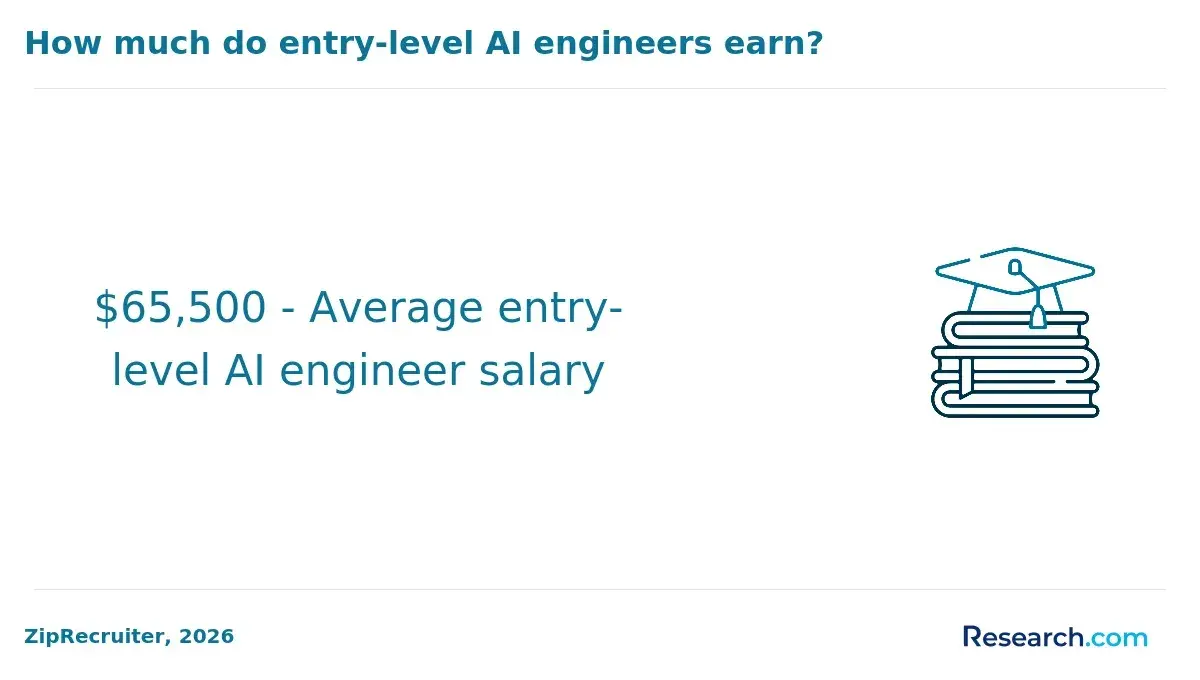
Entry-level graduates holding a bachelor's degree with a focus on artificial intelligence generally start with salaries comparable to related computer science fields. Based on data from NACE, the average starting salary for computer and information sciences bachelor's graduates is about $76,000. This serves as a useful benchmark for AI-related roles, especially for those who have practical experience such as real client projects or integrated machine learning components during their studies.
Several factors influence salary ranges, including geographic location, employer industry, and job function. For example:
- Graduates in AI research or development roles within tech hubs like San Francisco or New York may earn starting salaries between $80,000 and $95,000.
- Roles applying AI solutions in healthcare, finance, or manufacturing often start from $70,000 to $85,000, varying by company size.
- Smaller companies and startups might provide lower initial pay but often offer equity or faster career growth opportunities.
Including real client projects in a bachelor's portfolio enhances employability and salary potential, as employers value demonstrated problem-solving skills applied to business challenges.
Certifications or internships in data science or software engineering complement AI skills and can boost starting offers. Titles such as machine learning engineer, data scientist, or AI analyst typically align with or surpass the stated average starting salary.
Graduates who combine strong technical skills with hands-on, client-driven projects position themselves well for competitive salaries and early career growth.
What is the job outlook and demand for AI bachelor's graduates in the U.S.?
The demand for AI bachelor's graduates in the U.S. is expanding rapidly, with the U.S. Bureau of Labor Statistics projecting a 36% growth in employment for data scientists between 2024 and 2034. This growth surpasses that of most occupations, reflecting strong interest from industries like technology, healthcare, finance, automotive, and government.
Graduates often find roles such as data scientist, machine learning engineer, AI analyst, and robotics specialist. Programs that include hands-on client projects help students demonstrate practical skills in AI model development and complex data handling, boosting their employability.
Key factors fueling this growth include innovation in automation, big data expansion, and demand for AI-powered decision-making tools. Employers value candidates who combine technical expertise with business insight, especially those proficient in Python and familiar with cloud platforms. Soft skills like communication and teamwork are also important.
Ethical considerations continue to shape the use of AI, making knowledge in this area crucial for responsible system integration. While competition exists, the job market remains favorable for those with both academic and real-world experience.
- The strongest job growth is in data science and machine learning roles
- Industries hiring include technology, healthcare, finance, automotive, and government
- Hands-on projects improve practical AI skills and employability
- Proficiency in Python, cloud platforms, and soft skills are essential
- Understanding AI ethics is increasingly important
Other Things You Should Know About Artificial Intelligence
Students pursuing an AI bachelor's degree should have strong foundations in mathematics, particularly in linear algebra, calculus, and statistics. Programming skills in languages like Python or Java are crucial, along with a good understanding of algorithms and data structures. Critical thinking and problem-solving abilities are also important for designing and implementing AI models effectively.
Ethics has become a fundamental part of AI education due to concerns about bias, privacy, and accountability in AI systems. Bachelor's programs often include courses addressing ethical theories, responsible AI development, and legal considerations. This ensures graduates are aware of the societal implications of AI technology and adhere to ethical standards.
Many programs update their curricula regularly by collaborating with industry partners and incorporating the latest research findings. They often use practical projects and internships to expose students to current tools, frameworks, and AI applications. Continuous revision ensures that graduates are prepared for emerging technologies and trends in the AI field.
Real client projects in 2027 AI bachelor's programs enhance employability by providing hands-on experience, problem-solving skills, and industry connections. This practical exposure makes graduates attractive to employers seeking candidates who can immediately contribute. Those interested in further studies can explore best AI master’s programs for non-technical students.
References
- Online AI Training with Real Projects for Career Switchers: A Practical Roadmap https://www.h2kinfosys.com/blog/online-ai-training-with-real-projects-for-career-switchers-a-practical-roadmap/
- Project Deliverables: What They Are & How to Create Them https://galorath.com/project/deliverables/
- What kind of job could I find after finishing this master? https://www.tue.nl/en/education/what-kind-of-job-could-i-find-after-finishing-this-master
- AI Has Eliminated Entry-Level Jobs but These Graduate Careers Are Still Flourishing https://finance.yahoo.com/news/ai-eliminated-entry-level-jobs-110000765.html
- Accreditation and AI: Ensuring Quality in an Era of Smart Learning https://www.qahe.org/article/accreditation-and-ai-ensuring-quality-in-an-era-of-smart-learning/
- Best AI Bachelor's Degrees - AIDegreeProgams.org https://aidegreeprograms.org/rankings/best-ai-bachelor-degrees/
- What Are the Top AI Degree Programs for Undergraduate Students? https://tetr.com/blog/what-are-the-top-ai-degree-programs-for-undergraduate-students
- Rewiring the Job Market, Part Two: What AI Means for Careers That Require a Bachelor’s Degree https://heartlandforward.org/pulse/rewiring-the-job-market-part-two/
- How To Avoid AI Detection As A Student - Top 10 Strategies https://gptzero.me/news/how-to-avoid-ai-detection-as-a-student/