2027 Deep Learning Courses in AI Degree Programs Explained

Co-Founder and Chief Data Scientist
Many professionals with non-technical backgrounds face significant challenges transitioning into careers in artificial intelligence due to the complexity of deep learning concepts and limited access to structured education. Navigating diverse AI degree programs offering deep learning courses can be overwhelming without clear guidance on curriculum relevance, flexibility, and accreditation. Understanding which graduate programs provide a practical and accessible path is critical for those aiming to enter the AI field effectively.
This article breaks down the top 2027 deep learning courses within AI degree programs, helping readers identify suitable options to upskill and pivot confidently into AI careers.
Key Things You Should Know
- In 2026, deep learning courses are integral to AI degree programs, with over 70% of U.S. institutions including specialized curricula to meet rising demand for AI professionals.
- Programs emphasize practical skills, featuring hands-on projects using frameworks like TensorFlow and PyTorch, responding to a 40% growth in AI-related job postings since 2024.
- Interdisciplinary approaches combining data science, ethics, and computer vision are increasingly standard, reflecting industry calls for well-rounded AI experts in global markets.
What are deep learning courses and how do they fit into AI degree programs?
Deep learning courses cover advanced machine learning techniques using multilayer neural networks to analyze complex data. These classes play a vital role in many AI degree programs since deep learning is at the core of numerous modern AI applications. Typically, undergraduate and graduate curricula begin with foundational topics like algorithms and calculus before progressing to specialized subjects such as convolutional and recurrent neural networks, model optimization, and large-scale data handling. This deep learning course overview in AI degree programs ensures students gain skills needed to design and deploy effective models.
Students gain hands-on experience with popular frameworks like TensorFlow and PyTorch, building projects in image recognition, natural language processing, and autonomous systems. Practical assignments might include medical image classification or chatbot development, reflecting real-world AI challenges. The role of deep learning classes within artificial intelligence studies grows as deep learning is expected to represent 37% of AI deployments by 2025, according to Statista. Programs frequently combine deep learning with data science and software engineering, addressing issues such as overfitting, data bias, and resource management.
For those evaluating AI education paths, choosing programs with strong deep learning components is key to career readiness. Without this training, graduates risk falling behind in the competitive AI field. Understanding how these specialized courses fit in helps prospective students align their studies with industry needs and technological advances. To explore further, see what jobs can you get with an AI degree.
Which accredited universities offer deep learning courses as part of their AI degree programs?
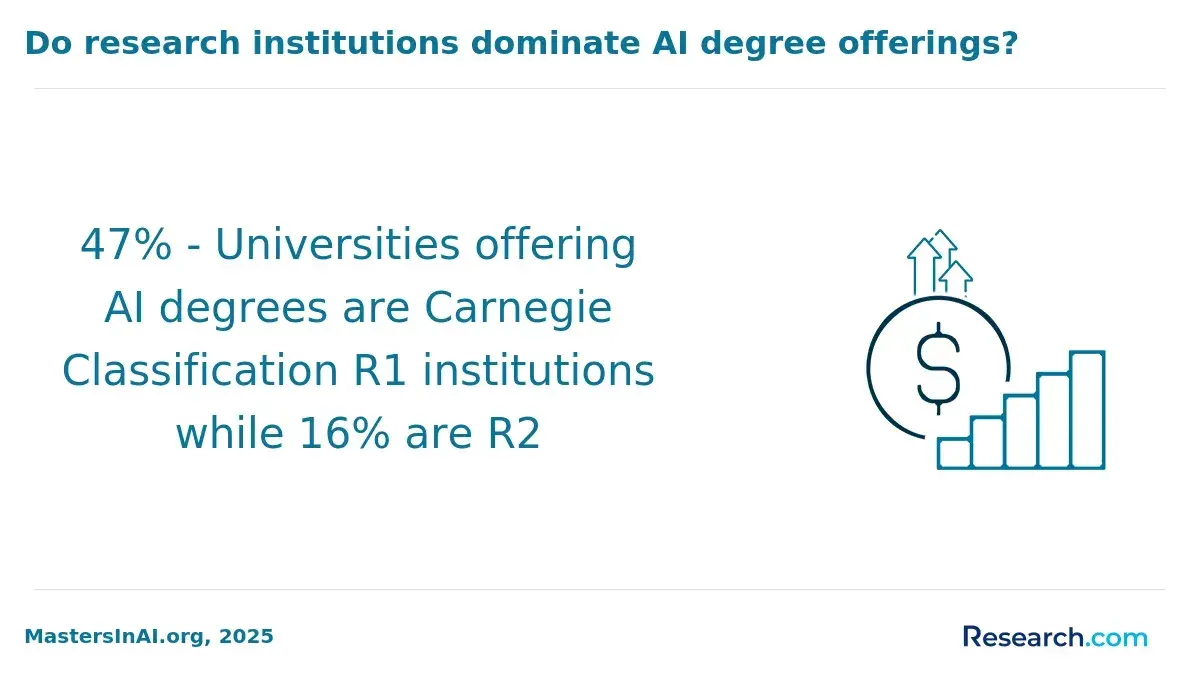
Over 300 universities worldwide offer AI degree programs featuring deep learning classes as a key component, with many accredited universities leading this educational trend. In the United States, top institutions such as Stanford University, Massachusetts Institute of Technology (MIT), Carnegie Mellon University, and the University of California, Berkeley integrate deep learning into their curricula through specialized courses like "Deep Learning for AI," "Neural Networks and Representation Learning," and "Advanced Machine Learning," available at both undergraduate and graduate levels.
Stanford's program focuses on hands-on projects using frameworks such as TensorFlow and PyTorch. MIT's Computer Science and Artificial Intelligence Laboratory (CSAIL) combines theory with practical experience, while Carnegie Mellon emphasizes an interdisciplinary approach blending robotics, vision, and deep learning research. Berkeley incorporates deep learning modules throughout its Electrical Engineering and Computer Sciences courses.
Many mid-tier and public universities expand access to accredited programs offering deep learning tracks, including the University of Michigan, Georgia Institute of Technology, and University of Washington. These schools align courses with industry needs, covering topics like convolutional neural networks and natural language processing. Working professionals often benefit from flexible schedules or online formats.
Students should verify program accreditation by recognized bodies such as ABET and review syllabi for current deep learning content-key factors when exploring accredited universities offering deep learning courses in artificial intelligence degree programs. Evaluating faculty expertise and lab facilities helps ensure alignment with evolving AI industry standards, as these programs update their content annually. For those also interested in engineering fields, consider exploring online mechanical engineering degrees for additional career opportunities.
What is the typical curriculum and core coursework in deep learning courses within AI degrees?
Deep learning courses within AI degree programs focus on a typical curriculum for deep learning courses in AI degree programs that covers foundational and advanced neural network concepts. Core coursework in deep learning within artificial intelligence degrees includes architectures like convolutional neural networks (CNNs), recurrent neural networks (RNNs), and transformers, balancing theoretical knowledge with hands-on projects. Students learn to design and optimize models using frameworks such as TensorFlow and PyTorch. A large majority of AI programs integrate these topics, reflecting their importance in the field.
The curriculum often starts with machine learning basics and moves into specialized topics like unsupervised learning, generative adversarial networks (GANs), and reinforcement learning. Assignments and case studies typically explore real-world applications, including image recognition and natural language processing. Emphasis is also placed on techniques such as backpropagation, gradient descent, and regularization.
Students also face problem-solving challenges like hyperparameter tuning, dataset management, and interpretability. Electives might include scalable distributed training and ethical AI design. Graduates gain skills suitable for AI research or industry roles, supported by strong math foundations. Those seeking affordable options can explore the engineering degree online programs to complement AI studies.
Are deep learning courses available in online, hybrid, and campus-based AI degree formats?
Deep learning courses in online AI degree programs have grown significantly, with a 156% enrollment increase from 2022 to 2024. These courses make up 42% of online AI curricula, allowing those unable to attend campus classes to gain advanced deep learning skills. For learners seeking a mix of flexibility and in-person experience, hybrid and campus-based AI degree deep learning classes offer a balanced approach. Campus programs remain valued for immersive learning and hands-on lab access, while hybrid degrees combine online study with essential on-site workshops or labs, serving working professionals and students with varied schedules.
Students should consider their career goals, preferred learning environment, and resources when choosing among these delivery formats. Online programs provide broad accessibility and scalability, campus-based formats emphasize structured peer and faculty interaction, and hybrids deliver a flexible blend. Accredited institutions update their deep learning content regularly to keep pace with evolving techniques and tools.
For those interested in specialized education pathways, visiting resources on affordable degrees like the online master in data science can help explore options aligned with current industry demands and educational trends.
What are the admission requirements and prerequisites for enrolling in deep learning courses?
Enrollment in deep learning courses within AI degree programs usually requires a strong background in programming and mathematics. Proficiency in languages like Python or Java is essential, as coursework involves significant coding and algorithm development. A firm grasp of linear algebra, calculus, and probability is necessary to understand neural networks and optimization methods.
Applicants must often complete prerequisite courses such as Introduction to Programming, Linear Algebra, and sometimes Probability and Statistics. Specific classes like "Data Structures" and "Matrix Theory" are commonly required. Work experience or certifications in machine learning or AI fundamentals can improve admission prospects, especially in professional or part-time tracks. Some schools evaluate mathematical skills through placement tests.
Students with these prerequisites have 73% higher completion rates in deep learning courses, according to a study published in the Journal of Educational Data Mining. Applicants without this foundation should consider preparatory courses or online modules to fill knowledge gaps before applying. Checking individual program requirements on university websites is critical, as expectations vary between institutions.
How long do AI degree programs with deep learning specializations take to complete, and what do they cost?
AI master's programs with deep learning specializations generally require between 1.5 and 2 years for full-time students. Part-time or online options can extend up to 3 years to accommodate working professionals. Coursework blends foundational machine learning with advanced topics such as neural networks, computer vision, and natural language processing.
Tuition costs vary widely, averaging from $45,000 to $60,000 for a master's degree focused on deep learning. Public universities may offer lower in-state rates, while private institutions tend to be more expensive. These costs typically cover tuition and fees but exclude living expenses.
Evaluating return on investment is essential. The 2024 Graduate Programs Report by U.S. News & World Report notes that graduates see an average ROI of 156% within five years, reflecting strong demand across industries like healthcare, autonomous vehicles, and finance.
Hands-on experience with real-world datasets and frameworks such as TensorFlow and PyTorch significantly boosts job prospects. Prospective students should prioritize programs offering comprehensive practical training alongside theoretical knowledge.
Flexible program formats, including part-time schedules and accelerated tracks, can help working professionals balance education with career goals. Carefully considering program length, costs, and learning formats ensures better alignment with individual career objectives.
What professional certifications or credentials complement deep learning courses in AI degree programs?
Professional certifications enhance AI degree programs by validating hands-on skills that employers seek. Key credentials include the TensorFlow Developer Certificate, which demonstrates expertise in designing, training, and deploying machine learning models using TensorFlow. The PyTorch Certification shows proficiency in neural network programming and managing dynamic computation graphs, skills crucial for advanced research and industry applications.
Additional certifications like the Microsoft Certified: Azure AI Engineer Associate and the Google Cloud Professional Machine Learning Engineer strengthen cloud-based AI deployment capabilities. These certifications bridge gaps between academic knowledge and real-world applications, particularly in scaling and maintaining AI systems.
Combining an AI degree with industry certifications can increase earning potential by up to 31% compared to holding degrees alone, according to recent industry data. This highlights the value employers place on both theoretical background and practical expertise.
Certifications also support career advancement, with specialized tracks for research focusing on deep learning and model optimization, while product development paths emphasize deployment and system maintenance. Staying current through certifications ensures professionals remain competitive in a rapidly evolving AI landscape.
What career roles and job titles do graduates with deep learning expertise typically pursue?
Graduates skilled in deep learning frequently take on roles such as machine learning engineer, data scientist, AI researcher, and computer vision engineer. These positions focus on designing and deploying deep learning models that drive applications like natural language processing and autonomous systems. Job titles often include Deep Learning Engineer, AI Specialist, Research Scientist, and Neural Network Architect, reflecting their role in managing complex datasets and optimizing predictive algorithms.
Demand for machine learning engineers with deep learning expertise surged 74% year-over-year between 2023 and 2024, according to LinkedIn's 2024 Jobs Report. This growth highlights industry needs for proficiency in frameworks like TensorFlow and PyTorch and experience handling large-scale data processing.
Beyond engineering roles, opportunities exist as AI product managers or consultants, applying deep learning knowledge to align technology solutions with business objectives. In healthcare, developers create diagnostic tools using convolutional neural networks; in finance, they build fraud detection algorithms leveraging recurrent neural networks. This diversity showcases the wide applicability of their expertise.
For academic or research-focused careers, positions as research scientists or faculty members involved in advancing deep learning theory and applications remain popular. Publishing in peer-reviewed conferences such as NeurIPS or ICML enhances prospects.
Graduates should highlight practical deep learning experience, familiarity with cloud AI services, and contributions to open-source projects to improve employability in this competitive field.
What is the job outlook and salary potential for AI professionals with deep learning skills?
AI professionals with deep learning expertise command strong salaries and increasing opportunities. According to the U.S. Bureau of Labor Statistics and Glassdoor's 2024 Salary Report, specialists in AI and machine learning earn an average of $165,000, a 22% increase compared to 2022. Entry-level roles typically range from $110,000 to $130,000 annually, while experienced professionals working with architectures like convolutional neural networks (CNNs) or transformers often surpass $180,000 in senior roles.
These experts work across sectors including healthcare, finance, automotive, and technology, developing AI applications such as medical imaging analysis, fraud detection, autonomous vehicle systems, and natural language processing tools. The demand for deep learning talent fuels job growth expected to exceed 30% through 2030, significantly faster than average.
Employers value skills in designing and optimizing deep neural networks, integrating AI with big data, and deploying models on edge devices. Certifications and advanced degrees enhance prospects and access to higher compensation. Because the field evolves rapidly, ongoing education and practical project experience are crucial for career advancement and maximizing salary potential.
How should prospective students evaluate and compare AI programs based on deep learning course quality and instructor expertise?
When choosing AI degree programs, focus on the quality of deep learning courses and the expertise of instructors. Faculty actively engaged in deep learning research greatly impact graduate success. A study by the National Association of Graduate and Professional Students (NAGPS) showed graduates from programs with publishing deep learning faculty found jobs 2.3 weeks faster and earned starting salaries 18% higher than those from programs without such faculty.
Review faculty profiles to confirm recent peer-reviewed publications in top AI venues like NeurIPS or ICML. Instructors involved in current research tend to offer courses with the latest content on advanced architectures, optimization methods, and emerging applications. Programs lacking active faculty often use outdated materials, reducing exposure to modern tools such as TensorFlow or PyTorch.
Look for courses featuring practical projects with real-world datasets, hands-on programming, reinforcement learning, or generative models. Course content aligned with industry trends improves job readiness. Smaller class sizes encourage interaction and personalized mentorship, while opportunities for research assistantships or internships with faculty deepen learning.
Also compare published graduate employment data, including job placement rates and salary ranges, to assess program value. Transparent alumni outcomes and employer partnerships indicate stronger career prospects in deep learning specialization.
Other Things You Should Know About Artificial Intelligence
In 2027, emerging trends in deep learning education include an increased focus on ethical AI development, integration of real-time data processing, more courses on comprehensive neural network architectures, and collaborative projects that blend AI with fields like biotechnology and environmental science. These trends aim to enhance both technical competence and interdisciplinary collaboration.
AI degree programs typically focus on programming languages such as Python and R due to their extensive libraries and frameworks for machine learning and deep learning. Other languages like Java, C++, and MATLAB may also be covered, supporting various aspects of AI development from algorithm implementation to performance optimization.
Hands-on experience is essential in AI education, allowing students to apply theoretical knowledge to real-world problems. Many courses include projects, labs, and internships where students work with datasets, build neural networks, and use AI frameworks such as TensorFlow or PyTorch. This practical approach enhances skill development and industry readiness.
Yes, interdisciplinary skills are highly valued in AI programs. Students often gain foundational knowledge in mathematics, statistics, and domain-specific areas like healthcare or finance. Combining technical expertise with problem-solving and communication skills prepares graduates to collaborate across different fields and address complex challenges using AI.
References
- The 7 Best Deep Learning Certifications for 2025 https://www.projectpro.io/article/deep-learning-certifications/1030
- Best Colleges to Study Artificial Intelligence https://www.collegeadvisor.com/resources/study-artificial-intelligence/
- Best AI Certifications to Boost Your Career in 2026 – Dataquest https://www.dataquest.io/blog/best-ai-certifications/
- What Are Deep Learning Jobs? Understanding Roles and Responsibilities - Techneeds https://www.techneeds.com/2024/12/05/what-are-deep-learning-jobs-understanding-roles-and-responsibilities/
- NVIDIA Deep Learning Institute https://www.nvidia.com/en-us/training/
- Unlocking Career Opportunities with Deep Learning Courses - High-Demand Landscape of Deep Learning and Artificial Intelligence Roles https://skilldux.com/blogs/high-demand-on-deep-learning-and-artificial-intelligence-courses
- How Long Does It Take to Complete an AI Course https://www.epw.com/blog/courses/how-long-is-ai-course
- Career Paths in Machine Learning: From Entry-Level Roles to Leadership and Beyond https://machinelearningjobs.co.uk/career-advice/career-paths-in-machine-learning-from-entry-level-roles-to-leadership-and-beyond
- Courses https://www.deeplearning.ai/courses/
- Deep Learning Specialization https://learn.deeplearning.ai/specializations/deep-learning/information