2027 Cost of Online vs On-Campus AI Degrees

Co-Founder and Chief Data Scientist
Choosing between an online and on-campus AI degree poses a significant dilemma for career switchers, balancing cost, time, and quality. Many prospective students struggle to estimate total expenses, including tuition, fees, and living costs, making it difficult to gauge the true financial impact. Without clear cost comparisons, candidates risk incurring unexpected debt or missing out on affordable, flexible options. This article breaks down the typical costs associated with both formats. It aims to help readers make informed decisions tailored to their budget constraints and professional goals in the growing AI industry.
Key Things You Should Know
- In 2026, average tuition for on-campus AI degrees in the U.S. ranges from $30,000 to $60,000 annually, while online programs typically cost 20%-40% less, offering significant savings.
- Online AI degrees provide greater flexibility for working professionals, with many programs allowing self-paced study and asynchronous learning compared to fixed campus schedules.
- Graduates from both online and on-campus AI programs report similar employment rates around 85%-90%, though on-campus students may access more extensive networking opportunities.
What are the key differences in total cost between online and on-campus AI degrees?
The primary cost difference between online and on-campus artificial intelligence degrees lies in tuition rates. For the 2025-26 academic year, the average tuition per credit hour is $509 for online bachelor's programs, compared to $791 for on-campus courses. This means online programs cost about 64.3% of the tuition of similar on-campus degrees, according to EducationData.org. Such regional tuition and fees for artificial intelligence programs vary but generally follow this trend.
Additional expenses also affect total costs. On-campus students often incur housing, meal plans, campus fees, and transportation costs, which can significantly increase expenses. Online students avoid many of these but may face technology fees or charges for proctored exams, usually lower than living expenses.
Program length and credit requirements tend to be consistent for both formats. For example, a 120-credit bachelor's degree might cost around $61,080 online versus $94,920 on campus, excluding living expenses and other fees. Financial aid availability can differ, with some institutions offering fewer scholarships to online learners than to on-campus students.
Working professionals may appreciate the flexibility of online options despite possible cost differences. Prospective students can also explore resources such as the data science master program ranking for guidance on affordable pathways in related fields.
How do tuition and fees for online AI programs compare to traditional campus-based programs?
Tuition and fees for online artificial intelligence degrees are significantly more affordable than those for campus-based options. According to Hakia, online AI master's programs typically cost between $15,000 and $40,000, while comparable on-campus programs range from $80,000 to $220,000. This cost comparison of campus-based versus online AI programs highlights substantial savings primarily due to no expenses related to campus facilities, housing, and some administrative fees.
Online formats also benefit from economies of scale, often enrolling larger student cohorts that reduce per-student costs. Prospective students should be aware that some online programs may add modest technology or proctoring fees, but these are usually less than the costs of commuting and living on campus.
On-campus programs tend to offer more direct access to resources such as labs and networking environments, which some students value despite higher tuition. However, the flexibility of online programs allows many students to work while studying, which helps offset expenses.
Those weighing the value of a campus experience must consider paying 2 to 5 times the tuition versus earning similar credentials online. Career-focused students seeking affordable and flexible options may find excellent choices by exploring online masters in AI.
What financial aid, scholarships, and employer tuition benefits are available for AI degrees?
Financial aid options for AI degrees online and on-campus play a crucial role in making education accessible. Federal and state aid programs, such as Pell Grants and Federal Supplemental Educational Opportunity Grants (FSEOG), support many qualifying undergraduates and some graduate students in accredited AI programs. Several institutions also provide need-based aid targeted to AI or computer science fields for students with financial need.
Scholarships and employer tuition benefits for AI students have become more prevalent. Merit-based scholarships are offered by universities like Georgia Tech, whose Online Master of Science in Computer Science (OMSCS) program features a total tuition as low as $8,950. Professional groups, including the Association for Computing Machinery (ACM), and AI-focused foundations grant awards based on academic merit, research potential, or support for underrepresented groups.
Employer tuition assistance often covers partial or full costs for working professionals aiming to advance in AI. Many tech companies offer tuition reimbursement, sometimes up to $5,250 annually, to retain and upskill employees. Prospective students are encouraged to check with their HR departments about eligibility and program coverage. In addition to these financial supports, approximately 30 of the most affordable online master's in AI programs in the U.S. cost under $20,000 total, reducing financial barriers for many learners.
For those exploring related fields or combined options, an accelerated cyber security degree online can be another pathway with competitive tuition and financial aid availability.
How do accreditation and program quality differ between online and on-campus AI degrees?
Accreditation differences between online and on-campus artificial intelligence programs generally do not affect the fundamental academic standards, as both formats typically hold regional or national accreditation. However, top-tier on-campus degrees often have added specialized accreditations, such as ABET or recognition from leading AI research centers, providing a stronger reputational benefit. These distinctions contribute to a notable comparison of program quality for online versus on-campus artificial intelligence degrees.
On-campus AI students gain direct access to hands-on labs, team projects, and real-time mentorship from faculty, which are vital for mastering complex algorithm development and machine learning techniques. Online programs, while increasingly mirroring on-campus curricula, sometimes face challenges delivering similar immersive experiences, though some have adopted virtual labs and collaborative tools to address these gaps.
Cost differences also influence decisions; living expenses add significantly to the total cost of on-campus AI degrees. According to EducationData.org, on-campus students typically spend $744 more annually on room and board than the average American's full-year living expenses. This financial factor contrasts with online degrees, which largely eliminate such costs.
Students should carefully verify accreditation status, faculty expertise, and hands-on research opportunities when choosing between formats. Those weighing these factors may also consider pathways like a data science PhD online to balance quality and flexibility in advanced AI education.
What is typically included in the curriculum of an AI bachelor's or master's degree?
A bachelor's or master's degree in artificial intelligence typically covers key topics in computer science, mathematics, and specialized AI fields. Students learn programming languages like Python and Java, alongside data structures, algorithms, and statistics. Math courses focus heavily on linear algebra, calculus, probability, and discrete math, all crucial for grasping machine learning concepts.
Advanced subjects often include machine learning, deep learning, natural language processing, computer vision, robotics, and ethical aspects of AI. Courses in data mining, neural networks, and AI system design build practical skills. Most programs incorporate hands-on projects and capstone work to prepare students for real-world challenges.
Master's programs usually emphasize research, offering classes in AI theory, reinforcement learning, and optimization. They may also cover cloud computing and big data technologies to manage large-scale AI applications.
Program content varies by school. Some combine AI with interdisciplinary studies such as cognitive science, business intelligence, or cybersecurity. Others offer electives focused on AI's role in healthcare, autonomous systems, or finance.
According to Hakia, 87% of employers view online and on-campus AI degrees as equivalent for technical roles when the credentials are accredited. This highlights the importance of choosing rigorous and accredited programs that balance theory and practical experience, matching what recruiters seek in candidates.
How long do online AI degree programs usually take compared to on-campus programs?
Online AI degree programs generally require 18 to 24 months to complete, similar to traditional on-campus timelines. However, they offer more flexibility in pacing, allowing students to accelerate or decelerate coursework based on personal and professional commitments. On-campus students usually follow a fixed semester schedule with limited deviation.
Enrollment options include part-time and full-time tracks. Part-time online students often take one or two courses per semester, extending their studies to three or more years, while full-time students typically finish in about two years. This flexibility is particularly beneficial for working professionals balancing education and careers.
Course load influences program length: on-campus students usually enroll in 12 to 15 credits per semester, while online learners might choose a lighter 6 to 9-credit load to better manage work or family responsibilities. Some programs include in-person requirements like residencies or lab work, which can add to time spent on campus but are less common in purely online degrees.
Tuition for online programs may be higher, as exemplified by Penn State World Campus charging $1,089 per credit or $13,062 per semester for 12+ credits. This cost reflects ongoing investment in quality online instruction despite flexible formats.
Students should evaluate their pacing preferences, financial resources, and program specifics to select the best fit for their career goals and lifestyle.
What admissions requirements do U.S. colleges set for online versus on-campus AI degrees?
U.S. colleges require similar admissions criteria for online and on-campus Artificial Intelligence degree programs, typically expecting a bachelor's degree in computer science, engineering, mathematics, or a related field. Most programs look for a competitive GPA, often 3.0 or higher, and proficiency in areas such as programming, calculus, and statistics.
Online AI programs prioritize flexibility and may value professional experience in AI, data science, or software development more heavily. They often waive or reduce standardized test requirements like the GRE for applicants with relevant work experience. In contrast, on-campus programs usually enforce stricter GRE score requirements and academic letters of recommendation.
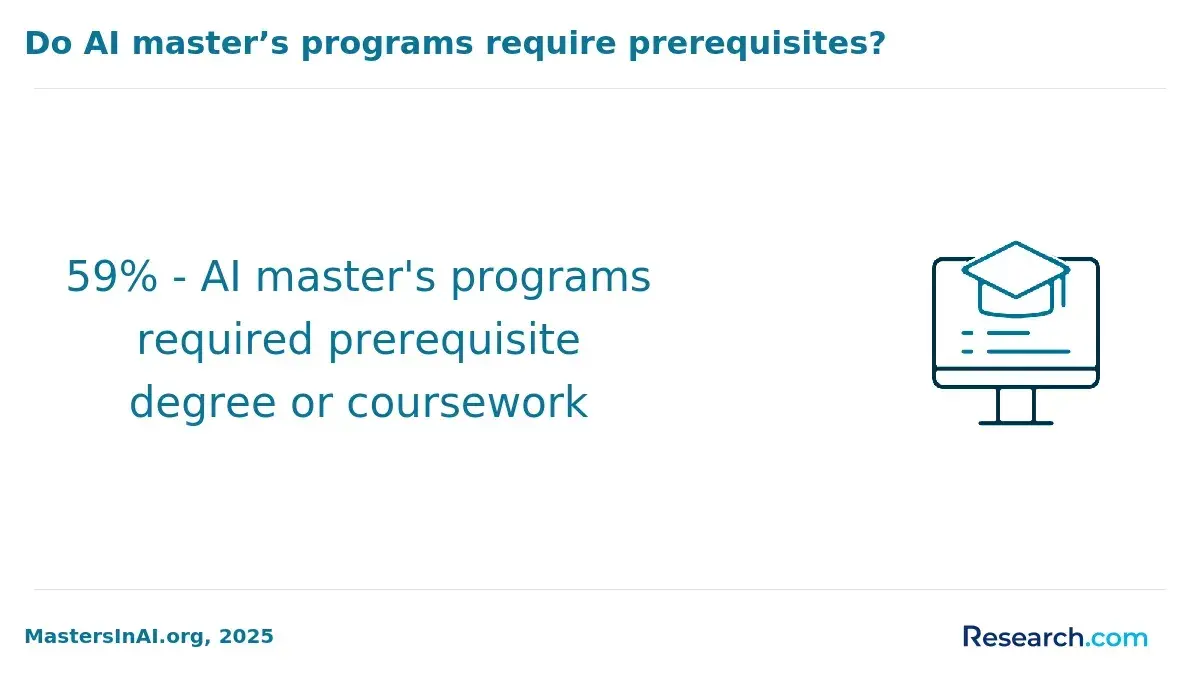
Both formats require prerequisite coursework, with online options sometimes offering remedial or bridge courses. Interviews or personal statements focusing on motivation and career goals are standard. International applicants must meet English proficiency tests such as TOEFL or IELTS.
Tuition costs vary significantly, with online master's programs ranging from $13,428 to $98,970 and averaging $44,107, according to TechGuide. On-campus programs tend to be pricier due to additional fees and campus resources.
Applicants should assess how their academic background, experience, and test scores align with each format to improve their prospects for admission and career success.
What AI career paths, job roles, and industries can graduates pursue?
Graduates of AI degree programs have access to a wide range of career paths that leverage their advanced technical and problem-solving skills. Popular roles include machine learning engineer, data scientist, AI research scientist, and AI software developer. These positions focus on creating algorithms, building predictive models, and implementing AI solutions across industries.
Beyond technical roles, graduates often pursue careers as AI product managers or AI consultants, where strategic, interdisciplinary knowledge-blending AI with business expertise is essential.
Industries hiring AI talent are diverse, including technology, healthcare, finance, automotive, retail, and government. For instance, healthcare applies AI in medical imaging and diagnostics, finance uses it for fraud detection and algorithmic trading, automotive firms develop autonomous vehicles, and retail enhances personalized marketing and inventory management using AI.
Cost considerations play a significant role in education choices. At Northeastern University, for example, graduate tuition is approximately $54,332 on-campus versus $30,500 fully online, reflecting a near 44% tuition reduction for online students. This cost difference can influence students seeking affordable programs without compromising career prospects.
Students should evaluate roles requiring specialized expertise in areas like natural language processing or computer vision against broader AI skills. Continuous learning and strong portfolio development remain critical across all career paths.
What salary ranges and earning potential can AI degree graduates expect?
Graduates holding artificial intelligence degrees can expect starting salaries between $85,000 and $110,000 annually, influenced by factors such as location, institution, and job role. Mid-career professionals often earn from $120,000 to $160,000, while experts with extensive experience in research, development, or management may see salaries exceed $180,000. The U.S. Bureau of Labor Statistics reports that AI-related occupations rank among the fastest-growing and highest-paying in technology.
The mode of degree delivery-whether online or on-campus-has minimal direct effect on earning potential. Employers value practical skills, certifications, and hands-on experience more than the education format. Graduates from reputable online programs with solid project portfolios can compete effectively for jobs alongside on-campus peers.
Tuition costs, however, differ significantly: online undergraduate programs average $12,216 per year, while on-campus programs average $18,981, resulting in an annual saving of $6,765. These savings can improve overall return on investment by reducing debt and allowing for quicker career advancement or additional certification opportunities.
Common career paths for AI graduates include machine learning engineer, data scientist, and AI software developer. Continuing education and certifications in emerging AI tools can further increase earning potential. Students should weigh tuition savings against potential on-campus networking benefits when choosing their educational path.
How can students choose a reputable, cost-effective AI program that fits their goals?
Students seeking reputable, cost-effective artificial intelligence programs should carefully compare tuition, curriculum, faculty expertise, and accreditation. For example, Georgia Tech's online AI program costs approximately $9,000 total, while a similar on-campus AI master's degree may exceed $60,000, creating a more than sixfold price difference. Cost is an important factor, but it should be weighed alongside quality indicators.
Important steps to evaluate programs include:
- Verifying accreditation from recognized bodies such as ABET or regional accreditors to ensure academic quality.
- Reviewing course offerings to confirm coverage of essential AI topics like machine learning, neural networks, and data ethics.
- Researching faculty credentials and active involvement in AI research to assess program rigor.
- Considering program flexibility, as online formats often provide affordable options and accommodate working students effectively.
- Evaluating career services and industry partnerships for practical experience and job placement support.
Programs like Georgia Tech's online AI degree illustrate affordability balanced with academic esteem. In contrast, more expensive on-campus options may offer unique benefits such as hands-on lab access or networking opportunities, but prospective students should verify these advantages justify the added costs. Aligning program choice with personal learning preferences and career goals helps maximize engagement and opportunity within the AI workforce.
Other Things You Should Know About Artificial Intelligence
Several scholarships are available for AI degrees in 2027, including the AI Academic Excellence Award and the Innovative AI Scholarship. Eligibility typically requires a minimum GPA and demonstration of leadership or innovation in the field. Applications must be submitted by January 31, 2027.
In 2027, tuition costs for AI degrees vary significantly between public and private institutions. Public universities often offer more affordable tuition rates due to state funding, while private institutions generally charge higher fees. Students should consider these cost differences along with available financial aid options when choosing a program.
Many online AI degrees charge separate technology or distance-learning fees, usually about $20 to $75 per credit hour or $100 to $500 per term. Some programs also add proctoring fees for required exams, often $15 to $50 each, plus software access charges for AI tools.
The cost differences between online and on-campus AI degrees in 2027 are driven by factors such as campus facility usage, technology requirements, and administrative expenses. Online programs often save on physical infrastructure while incurring higher costs in digital platforms and educational technology.
References
- Most Affordable Online Master's in AI for 2025 https://www.mastersinai.org/degrees/affordable-online-masters-in-ai/
- AI Salaries - How Much AI Jobs Pay https://www.tractionkeys.com/post/ai-salaries---how-much-ai-jobs-pay
- Companies That Pay for Your Degree | ComputerScience.org https://www.computerscience.org/resources/companies-that-pay-for-college/
- University Degree vs AI Bootcamp: Which is Best Career Path? https://agilefever.com/university-degree-vs-ai-bootcamp-which-is-best/
- Best Master's In AI Programs 2026 https://programs.com/programs/ai-masters-degree/
- Study AI Degrees https://mbzuai.ac.ae/study/
- Top 10 Careers in Artificial Intelligence and Machine Learning https://apollouniversity.edu.in/blog/building-a-high-flying-career-in-artificial-intelligence-and-machine-learning/
- Guide to Getting an Online Artificial Intelligence Degree | OnlineColleges.Net https://www.onlinecolleges.net/degrees/artificial-intelligence/
- What do you learn in a bachelor's in artificial intelligence? | edX https://www.edx.org/resources/what-do-you-learn-in-a-bachelors-in-artificial-intelligence
- Choosing the Best AI Tools for Education: What Every Educator Should Know | Zartis https://www.zartis.com/choosing-the-best-ai-tools-for-education-what-every-educator-should-know/