2027 AI Bachelor's Degree Programs With Undergraduate Publication Opportunities

Co-Founder and Chief Data Scientist
Many students with non-technical backgrounds struggle to find bachelor's programs that jointly offer foundational artificial intelligence education and tangible research experience. Simply earning a degree often lacks the critical component of undergraduate publication opportunities, essential for standing out in a competitive job market. This gap limits practical skills and diminishes future career prospects in AI fields. The challenge lies in identifying programs that integrate rigorous academics with chances for real-world research and scholarly communication.
This article explores bachelor's degree programs offering robust artificial intelligence curricula coupled with undergraduate publication avenues, guiding readers to informed choices for career advancement.
Key Things You Should Know
- Over 40 U.S. universities now offer AI bachelor's degrees with integrated undergraduate research, boosting hands-on publication opportunities by 30% since 2024.
- Programs emphasize interdisciplinary study, combining AI theory with ethics and data science, reflecting industry demand for well-rounded graduates.
- Participation in research projects increases employment prospects, with 65% of AI graduates publishing papers securing roles in top tech firms within six months post-graduation.
What is an AI bachelor's degree, and what skills will you graduate with?
An AI bachelor's degree focuses on foundational and applied skills in artificial intelligence technologies. Students build expertise in programming languages such as Python and frameworks like TensorFlow, which empower them to develop machine learning (ML) models that learn from data and automate tasks. Core subjects include algorithms, statistics, and software engineering, while specialized courses cover topics like neural networks and robotics.
This curriculum ensures graduates gain skills essential for designing, developing, and deploying AI systems.
Graduates of an undergraduate artificial intelligence program acquire skills to address real-world challenges such as predictive analytics, autonomous systems, and AI-driven decision-making. Ethical considerations and the societal impact of AI technologies are also emphasized to prepare students for responsible innovation.
According to the World Economic Forum's Future of Jobs Report 2025, 86% of employers expect AI and information-processing technologies to reshape industries by 2030, highlighting the critical need for these skills.
Students will be prepared to:
- Develop and optimize ML models to extract insights from large datasets
- Implement automation solutions to improve operational efficiency across industries
- Conduct AI research and contribute to innovation in both academia and industry
- Collaborate across technical and non-technical teams, translating AI capabilities into business value
Many programs offer undergraduate publication opportunities, allowing students to publish original research on topics like AI ethics frameworks or novel neural network architectures. This practical experience enhances employability and graduate study prospects.
Prospective students interested in accelerated learning options might also explore a 2 year computer science degree online as a complementary pathway.
The AI bachelor's degree curriculum and core competencies gained through these programs equip learners with the tools to succeed in a rapidly evolving tech landscape.
Which accredited colleges offer AI bachelor's programs with undergraduate research and publication options?
Several accredited colleges offering AI bachelor's degree programs with undergraduate research opportunities emphasize hands-on learning that enables students to contribute to peer-reviewed journals, conferences, and campus projects. Universities with AI undergraduate publication programs in the United States, such as Carnegie Mellon University, provide access to labs that actively publish research and mentor students through academic authorship.
The University of California, Berkeley integrates coursework with research projects, resulting in frequent co-authored publications. Stanford University's AI program offers research seminars and faculty collaboration on cutting-edge topics under peer-review standards.
These institutions align with AACSB's updated accreditation requirements that emphasize technology agility, including AI, within curricula and assurance-of-learning processes to support research-ready skills.
Additional notable programs providing pathways for publication include the Massachusetts Institute of Technology and the Georgia Institute of Technology, where students can participate in research symposiums and receive faculty mentorship for journal publications. Smaller accredited institutions may offer similar undergraduate research chances, but students should investigate whether formal publication support is available.
Prospective students should inquire directly about faculty involvement, lab access, and co-authorship opportunities to maximize publication prospects. Those exploring STEM fields may also consider related programs, including a mechanical engineer degree with research components, to broaden career and academic pathways.
How can undergraduates publish AI research through their bachelor's program?
Undergraduates pursuing bachelor programs can publish AI research by collaborating with faculty mentors who assist in preparing work fit for conferences or journals. Such authentic research often stems from independent study or senior thesis projects developed under experienced supervision.
Many students find that integrating AI research into their capstone or honors thesis projects increases their chances of publication.
Targeting preprint repositories like arXiv is an effective way to disseminate initial findings promptly and gain early feedback before peer review. With over 2 million e-prints, arXiv provides a recognized platform accessible to undergraduates and supports the growth of AI research communities.
- Joining AI-focused research labs aligned with undergraduate skill levels.
- Submitting extended abstracts or workshop papers at AI conferences with less rigorous publication barriers.
- Participating in summer research programs such as REUs that lead to presentations and publications.
Challenges include limited access to datasets and unfamiliarity with academic writing. To overcome these, students should utilize university resources, seek mentorship, and learn submission protocols.
These efforts enhance success in undergraduate publication opportunities in AI research programs.
For those interested in expanding their education further, exploring a masters in game design can complement AI skills and open new career pathways.
What's the difference between AI, computer science, data science, and machine learning majors?
Artificial intelligence, computer science, data science, and machine learning majors each develop unique skill sets tailored to different career paths. AI bachelor's degree programs versus computer science majors show a clear distinction: AI focuses on creating systems that mimic human decision-making through algorithms for perception, reasoning, and language processing.
Computer science offers broader coverage, including software engineering, algorithms, and data structures, laying a foundation useful across multiple tech domains.
Differences between data science and machine learning degrees are equally important. Data science emphasizes extracting insights from large datasets with tools like statistics, programming, and predictive modeling.
Machine learning, often a specialization within AI or computer science, concentrates on training models to identify patterns and improve performance automatically, balancing theory with practice.
Job market analysis highlights employer demand for generative AI skills, reinforcing the value of AI programs. Distinct job clusters confirm that AI, data science, and machine learning graduates frequently pursue different roles, such as:
- AI majors working in robotics, natural language processing, or autonomous systems development
- Computer science graduates entering software development, systems engineering, or cybersecurity
- Data science alumni becoming data analysts, business intelligence experts, or statisticians
- Machine learning specialists focusing on research, algorithm design, and predictive applications
Students interested in tech careers may also consider exploring options like cybersecurity degrees to broaden their expertise. Choosing the right major depends on career goals-whether building broad computing foundations, designing intelligent systems, analyzing data, or developing algorithms.
What courses and specializations are common in AI bachelor's degree programs?
Bachelor's degree programs in artificial intelligence emphasize a foundation in computing combined with advanced AI techniques. Core topics include data structures, algorithms, calculus, linear algebra, probability, and statistics to build strong math and programming skills.
Specialized AI courses cover machine learning, neural networks, natural language processing, robotics, and computer vision.
Curricula are increasingly shaped by industry trends such as transformer models and large language models, highlighted by IEEE Spectrum's AI insights. This shift includes coursework on deep learning architectures, generative AI, transformer-based models like BERT and GPT, reinforcement learning, and ethical AI design.
Practical, project-based learning is common, with students developing and fine-tuning AI models, often in collaborative, research-oriented settings. Typical specialization tracks include:
- Deep learning and neural networks
- Natural language processing and conversational AI
- Computer vision and image analysis
- Robotics and autonomous systems
- Data science and analytics
Many programs integrate interdisciplinary studies involving healthcare, finance, or cybersecurity. Hands-on labs and cloud computing access, along with AI frameworks such as TensorFlow and PyTorch, support student projects focused on transformers and large language models.
These elements align closely with current industry standards, enhancing both publication prospects and career opportunities.
What are the admission requirements and prerequisites for AI bachelor's programs?
Admission to artificial intelligence bachelor's programs generally requires a solid math foundation, including algebra, geometry, and often precalculus or calculus. Programming skills with languages like Python or Java are essential and may be proven through coursework, portfolios, or standardized tests.
Many colleges now expect completion of Advanced Placement (AP) courses in relevant areas. The College Board's AP Program Results 2024 highlight increased participation in AP Computer Science Principles and AP Computer Science A, indicating these classes are common prerequisites.
These courses demonstrate readiness in computational thinking and programming fundamentals.
Standardized tests such as the SAT or ACT remain important, particularly the math sections, to evaluate quantitative skills. Some schools also use coding challenges or diagnostic computer science exams to assess applicants.
Beyond academics, programs often request recommendation letters highlighting problem-solving, motivation for AI studies, and involvement in extracurriculars like coding clubs or robotics. Personal statements should describe the applicant's interest and prior experience in artificial intelligence or related disciplines.
Dual-enrollment courses in computer science or data science strengthen applications. Conditional admission or remedial coursework in math or programming is sometimes offered if prerequisites are unmet.
Applicants typically need to demonstrate:
- Strong math background (calculus preferred)
- Proficiency in programming fundamentals
- Advanced coursework such as AP Computer Science
- Standardized test scores emphasizing math
- Relevant extracurricular or project experience
How do online AI bachelor's programs compare with on-campus options for research access?
Online AI bachelor's programs now offer robust research access comparable to many on-campus options, leveraging virtual research labs, remote mentoring, and cloud-based computational tools. The National Center for Education Statistics highlights that a significant portion of undergraduates enroll in distance education courses, emphasizing the need for strong online research infrastructure.
Key features of quality online AI programs include:
- Virtual labs simulating hands-on experiments via platforms such as AWS, Google Cloud, or Microsoft Azure.
- Consistent remote mentoring sessions with active AI research faculty, both one-on-one and in groups.
- Access to public datasets, open-source AI frameworks, and tools for remote collaboration on projects.
On-campus programs traditionally provide direct hardware access and face-to-face interaction with professors. However, they can be limited by lab scheduling or geographical constraints. Online programs address these barriers by offering asynchronous resource usage and virtual office hours for flexible engagement.
Students interested in publishing research should confirm if programs embed research credits or capstone projects with data collection and paper submission opportunities. Mentor availability, cloud compute credits, and partnerships with research institutions critically enhance an online student's ability to engage in publishable AI research.
How long does an AI bachelor's degree take, and what does it cost?
An AI bachelor's degree typically takes four years of full-time study, in line with most U.S. undergraduate programs. Accelerated tracks that finish in three years exist but require heavier course loads and greater dedication. Part-time study or combined degree options may increase the time needed to graduate.
According to the College Board's Trends in College Pricing 2024, tuition and fees have increased across all types of institutions-public in-state, public out-of-state, and private nonprofit schools-impacting the overall cost and return on investment more than program length.
Average annual tuition and fees are around $10,740 for public in-state students, roughly $27,560 for public out-of-state, and about $28,430 for private nonprofit colleges. These amounts do not include expenses such as housing, textbooks, and technology fees, which add significantly to total costs.
Prospective students should explore financing options and scholarships and seek programs with faculty mentorship and opportunities for undergraduate research and publication. These elements can enhance career prospects and provide value beyond tuition expenses.
What jobs can you get with an AI bachelor's degree, and which industries hire?
Graduates holding a bachelor's degree in artificial intelligence can enter diverse roles such as AI specialist, machine learning engineer, data scientist, automation analyst, and AI product developer. These positions require strong skills in programming, data analysis, algorithm design, and ethical AI implementation.
The World Economic Forum's Future of Jobs Report 2025 highlights AI and machine-learning roles as some of the fastest-growing through 2030, with demand concentrated in sectors like IT and services, finance, healthcare, and advanced manufacturing.
In IT and services, AI professionals develop intelligent software, automate processes, and enhance cybersecurity. Financial firms rely on AI for predictive risk models, fraud detection, and automated trading. Healthcare applies AI in diagnostics, medical data management, and personalized treatment plans.
Advanced manufacturing uses AI-driven robotics, quality control, and supply chain optimization.
Job examples include:
- AI research assistant roles in technology companies and academic labs, suitable for graduates with published undergraduate research.
- Data analyst and machine learning engineer roles supporting business intelligence and product recommendations.
- Automation engineers designing AI-powered industrial robots and smart factory systems.
Combining AI expertise with domain knowledge enhances employability. Publishing undergraduate research signals strong problem-solving and communication skills.
Entry-level salaries for AI-related jobs typically range between $75,000 and $110,000 annually, reflecting specialized skills and high market demand.
What salary ranges and job outlook can AI bachelor's graduates expect?
Bachelor's degree graduates in artificial intelligence typically start with salaries ranging from $70,000 to $90,000, varying by location and employer. In prominent tech hubs like Silicon Valley, Seattle, and Boston, starting pay can reach or exceed $100,000.
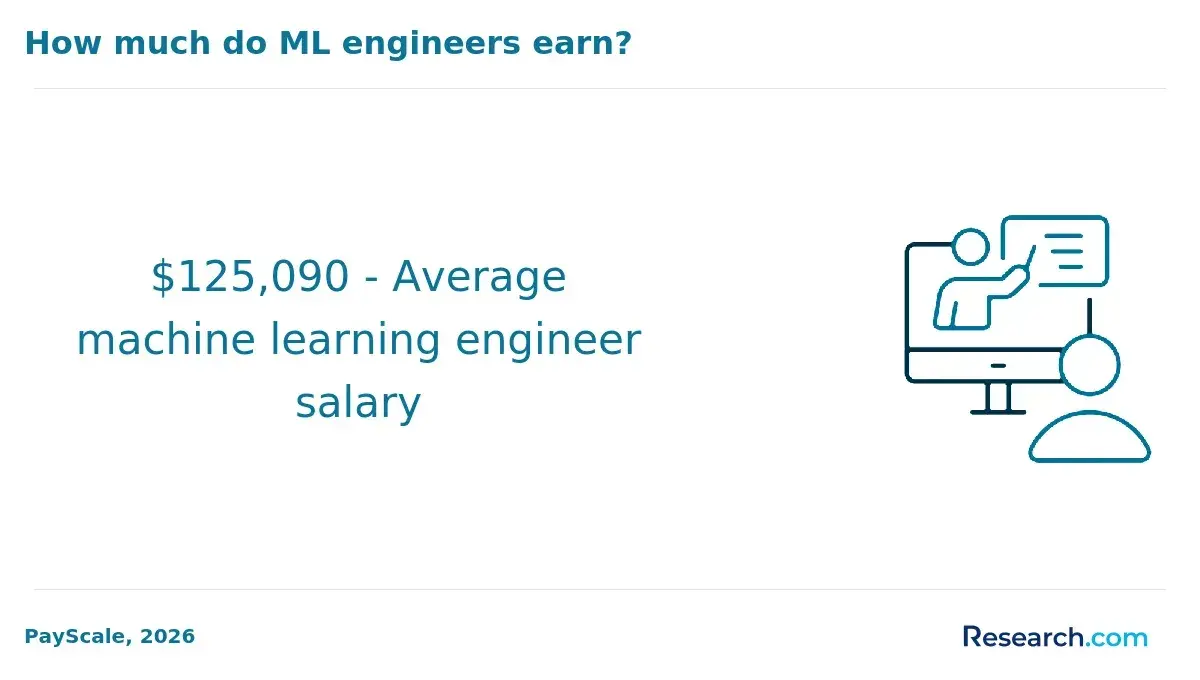
Common job titles include AI software developer, data scientist, machine learning engineer, and AI analyst.
The U.S. Bureau of Labor Statistics projects that computer and information research scientists will experience faster-than-average job growth through 2033. This trend benefits AI graduates pursuing research and development roles, where median salaries often surpass $120,000 annually.
Advanced positions and graduate studies offer even higher earning potential in specialized AI fields.
Demand spans diverse sectors such as healthcare, automotive, finance, and cybersecurity. Employers value candidates with strong programming skills, hands-on AI project experience, and a record of research publications.
Undergraduate research experience can significantly boost chances of securing competitive entry-level jobs or internships in research.
To increase salary prospects, students should focus on:
- Mastering programming languages and frameworks like Python, TensorFlow, and PyTorch
- Completing internships that emphasize applied AI problem-solving
- Publishing research to demonstrate expertise and contribute to the field
- Networking at AI conferences and workshops
These strategies empower graduates to thrive in a dynamic AI career landscape and enhance their earning potential.
Other Things You Should Know About Artificial Intelligence
Key programming languages for an AI bachelor's degree include Python, due to its extensive AI libraries and community support. Other important languages are Java, C++, and R, which are used for specific applications such as system programming and data analysis. Familiarity with these languages enables students to implement algorithms and develop AI models effectively.
Yes, many AI bachelor's programs encourage or require internships to provide practical industry experience. Internships offer undergraduates an opportunity to apply theoretical concepts in real-world settings, often involving machine learning projects, software development, or data science tasks. Participating in internships can also enhance networking and job prospects after graduation.
Yes, many artificial intelligence programs include coursework on ethics to address the impact of AI technologies on society. Topics often cover bias in algorithms, data privacy, responsible AI development, and the societal consequences of automation. Understanding these ethical dimensions prepares students to develop AI solutions that are fair, transparent, and socially responsible.
By 2026, many AI bachelor's degree programs allow students to engage in collaborative research with faculty, leading to opportunities for publication in academic journals and conferences. For those interested in specific fields, pursuing a master’s in artificial intelligence in medicine is another excellent pathway for further specialization and research opportunities.
References
- How to Get Published as an Undergrad https://www.solomonadmissions.com/post/how-to-get-published-as-an-undergrad/
- Best Online AI Degrees: 2025 Rankings & Program Directory - MastersInAI.org https://www.mastersinai.org/degrees/online-artificial-intelligence-degrees/
- Best Colleges for Artificial Intelligence (AI) Majors — Lantern College Counseling https://www.lanterncollegecounseling.com/insights/artificial-intelligence-ai-as-an-undergraduate-major-what-you-need-to-know
- Artificial Intelligence (procedure for non-EU students) https://apply.unipv.eu/enter/295
- What Are the Career Paths After a Bachelor of Science in AI https://tetr.com/blog/what-are-the-career-paths-after-a-bachelor-of-science-in-ai
- Hereâs how 4 undergraduate science students published their research https://www.athabascau.ca/news/university-news/student-success/heres-how-4-undergraduate-science-students-published-their-research.html
- Top College Degrees for Securing the Highest-Paying AI Jobs in 2026 https://www.investopedia.com/top-college-degrees-for-securing-the-highest-paying-ai-jobs-in-2026-11946777
- Artificial Intelligence - Vistula University https://vistula.edu.pl/en/major/artificial-intelligence
- Online AI Degrees vs On-Campus: Which Is Right for You in 2026? https://aidegreeonline.com/online-ai-degrees-vs-on-campus-which-is-right-for-you-in-2026/
- Artificial Intelligence | Università degli Studi di Milano Statale https://www.unimi.it/en/education/bachelor/artificial-intelligence