2027 AI Master's Programs With Multiple Start Dates

Co-Founder and Chief Data Scientist
Many prospective graduate students and working professionals face scheduling conflicts when applying to AI master's programs. Traditional cohort start dates can delay career pivots and prolong time to completion. This rigidity complicates efforts for those balancing jobs, family, or other commitments alongside education. Additionally, applicants from unrelated undergraduate backgrounds require accessible programs that accommodate varied timelines and learning paces.
Programs offering multiple start dates provide crucial flexibility for timely enrollment and efficient skill acquisition. This article examines 2027 AI master's programs with multiple intake options, aiming to guide readers toward accredited, adaptable pathways to enter the AI workforce without delay.
Key Things You Should Know
- AI master's programs offering multiple start dates increase accessibility, accommodating diverse student schedules and enabling enrollment three to four times annually, benefiting working professionals and international students.
- In 2025, over 40% of U.S. universities providing AI graduate degrees now include flexible start options paired with hybrid or online coursework for enhanced learning flexibility.
- Programs with rolling admissions or quarterly intakes respond to rapid industry growth-AI job postings grew by 30% in 2024-allowing graduates to enter the workforce faster and stay current.
Which AI master's programs offer multiple start dates throughout the year?
Multiple AI master's degree programs in the US now offer flexible enrollment options to meet diverse student needs. According to the National Association for College Admission Counseling, 67% of graduate STEM programs had introduced multiple start dates by 2024. This reflects a clear trend toward accommodating non-traditional academic calendars and enhances accessibility for working professionals and others with complex schedules.
Examples include Northeastern University's MS in Artificial Intelligence with spring, summer, and fall start dates. Carnegie Mellon University's Heinz College provides rolling admissions with quarterly entry points for AI-related master's programs. Institutions like Georgia Tech and the University of Illinois Urbana-Champaign also offer two to four start dates annually, often with part-time or online formats. Such programs allow students to blend studies with employment or family duties.
The availability of multiple start dates for ai master's programs in the US makes it easier for students managing tuition support from employers or visa limitations. Early and mid-year admissions can better align with financial planning and legal requirements. Students interested in more flexible options might also consider exploring an accelerated bachelor's degree computer science online to complement their AI education.
Prospective learners should always verify specific start dates and deadlines through official program websites, as these can change. Programs with modular course formats often run intensive sessions, permitting enrollment in a semester or two rather than a full academic year, providing even greater flexibility.
What are the admission requirements for accredited AI master's degree programs?
Admission requirements for accredited AI master's degrees in the US generally include a bachelor's degree in computer science, engineering, mathematics, or a related STEM field. Programs typically seek applicants with strong quantitative skills and foundational knowledge in programming, algorithms, and statistics. Official transcripts confirming academic performance are essential for evaluation.
Standardized test scores, particularly GRE results, continue to play a significant role. According to the GRE Board in 2024, 78% of leading AI and computer science master's programs require GRE scores, while 22% offer optional submission. Applicants aiming for highly selective programs should plan to submit GRE scores to remain competitive. Some schools may waive this requirement based on prior graduate coursework or relevant professional experience.
Letters of recommendation, usually two or three, are important to assess technical skills and research potential. Strong endorsements from professors or industry supervisors familiar with the candidate's work in AI, machine learning, or data science carry considerable weight. Personal statements focused on career goals and research interests are mandatory components of the application.
Proof of English proficiency via TOEFL or IELTS is commonly required for international students. Practical experience such as internships or published research can strengthen applications but is not always mandatory. Some institutions may also request a detailed resume or CV.
For requirements for enrolling in accredited AI master's programs in North America, applicants without a traditional STEM background might need prerequisite coursework before or during the program. Additionally, prospective students should consider factors like program affordability; for example, estimating expenses can be aided by resources such as mechanical engineering degree online cost listings, which offer insight into related STEM program costs.
How do online and campus-based AI master's programs compare in curriculum and delivery?
Online and campus-based AI master's curriculum differences mainly lie in their delivery methods and student experience, though core content remains consistent. Both cover key areas like machine learning algorithms, neural networks, and data ethics, ensuring graduates have strong technical skills. Campus programs often provide more hands-on lab sessions and face-to-face collaboration, benefiting those who prefer in-person networking and direct faculty interaction.
Delivery methods in AI master's programs vary notably. Online formats focus on flexibility, using video lectures, interactive coding tools, and discussion forums. These programs cater especially well to working professionals and international students by offering multiple start dates and asynchronous courses. According to U.S. News & World Report's 2025 Graduate School Survey, online AI and computer science master's enrollments have surged 34% over three years, now making up 41% of graduate STEM students.
While top online programs often replicate campus syllabi, they substitute traditional labs with virtual simulations or at-home projects. Students must weigh their learning preferences: online programs require strong self-discipline and tech comfort, whereas campus experiences offer structured schedules and potentially stronger local industry ties through internships. Career goals also influence this choice.
Prospective students exploring advanced education in technology fields might also consider related options like a game development degree online, which shares some foundational technical skills and flexible delivery elements with online AI degrees.
What is the typical cost and duration of an AI master's degree in 2027?
The cost and duration of an AI master's degree in the United States vary widely depending on institution type. Private universities typically charge between $40,000 and $120,000 in total tuition for full-time programs, while public universities offer more affordable options ranging from $15,000 to $45,000. These average tuition fees and program length for AI master's degrees exclude additional expenses like fees, books, and living costs, which may significantly raise the total financial commitment.
Most programs last one to two years full-time, with typical durations of 18 to 24 months. Accelerated tracks can allow completion in as little as 12 months. Part-time and online options often extend the timeframe to three or four years, catering to working professionals or those balancing other responsibilities. Considering program flexibility, including multiple annual start dates, can help align enrollment with personal schedules.
Choosing between public and private institutions often involves balancing cost against faculty expertise, research facilities, and industry connections. Public universities appeal to budget-conscious applicants, while private schools may offer specialized AI tracks with higher tuition but enhanced networking opportunities. Prospective students should explore financial aid, scholarships, and employer tuition assistance to reduce costs.
For those interested in flexible learning options, resources about online masters data science programs provide valuable insights. Thorough evaluation of all factors ensures informed decisions about pursuing an AI master's degree.
What career roles and job titles do AI master's graduates pursue after graduation?
Graduates of AI master's programs frequently step into roles such as Machine Learning Engineers, AI Research Scientists, and Data Scientists. According to LinkedIn's 2024 Jobs Report, 28% pursue careers as Machine Learning Engineers, where they develop and deploy machine learning models that address challenges across industries like technology, finance, healthcare, and automotive. Proficiency in programming and experience with frameworks such as TensorFlow or PyTorch are essential.
Approximately 19% become AI Research Scientists, focusing on creating new algorithms and advancing fields such as machine learning, computer vision, and natural language processing. These roles, often found in research labs, tech firms, and academic settings, demand strong mathematics and programming skills.
Data Scientists account for 18% of AI master's graduates, analyzing complex datasets to provide actionable business insights through predictive modeling. Their work often correlates with titles like Data Analyst, Business Intelligence Specialist, or Quantitative Analyst, combining statistical methods with AI expertise.
Other career paths for graduates include AI Product Manager, AI Consultant, and Robotics Engineer, where AI knowledge helps guide product strategy or develop autonomous systems. Tailoring job searches and regularly updating technical skills are important for success.
What is the job outlook and salary potential for AI master's degree holders?
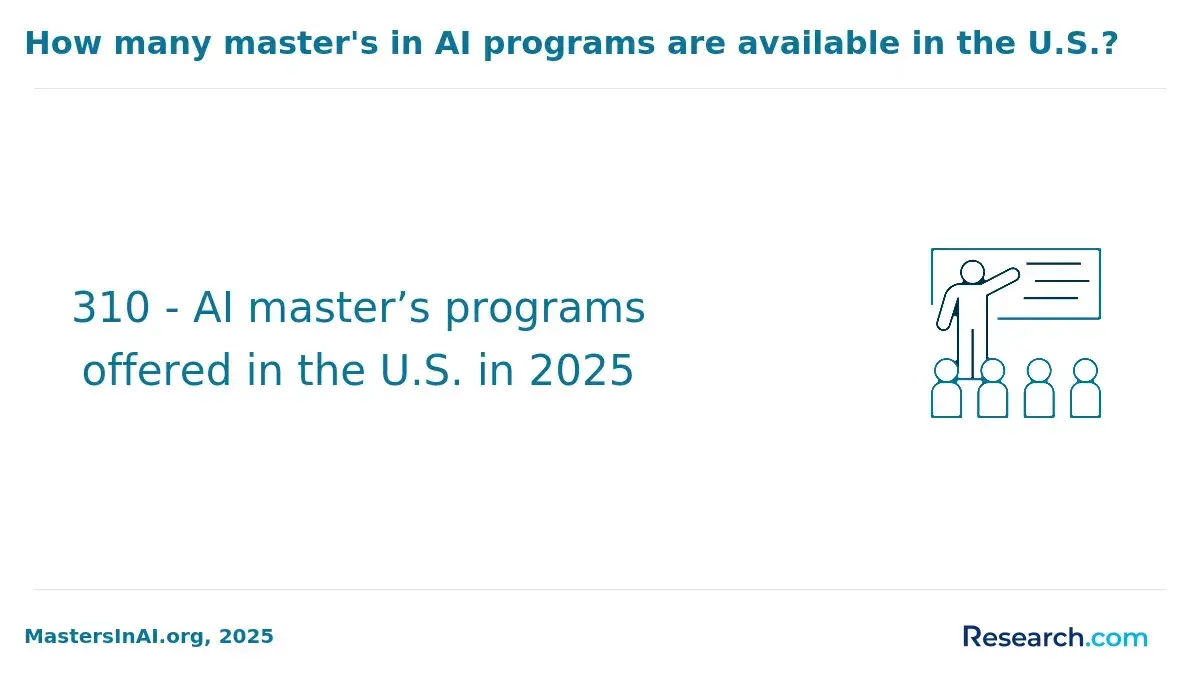
Job growth for AI master's degree holders is projected at 35% from 2023 to 2033, far exceeding the average growth for all jobs, according to the U.S. Bureau of Labor Statistics. This surge reflects the expanding use of AI in sectors like healthcare, finance, automotive, and technology. Graduates find diverse roles available, ranging from data scientists to robotics engineers and AI research scientists.
Starting salaries for these positions typically begin around $90,000 annually, with seasoned professionals earning upwards of $150,000. In major tech hubs such as San Francisco and New York, senior AI engineers often receive compensation exceeding $200,000. Expertise in areas like natural language processing, computer vision, or reinforcement learning boosts earning potential further.
Professionals with an AI master's degree also enjoy considerable career mobility. Employers value interdisciplinary skills, opening pathways in product development, consulting, and AI ethics. For those currently in tech or data roles, this degree frequently leads to promotions and higher pay. Factors like location, industry, and ongoing skill development are key to maximizing both job satisfaction and salary growth.
The strong combination of rapid job expansion and competitive salaries makes pursuing an AI master's degree a strategic investment for those seeking long-term career success in this evolving field.
What core coursework and specializations are included in AI master's programs?
Master's programs in artificial intelligence consistently focus on core subjects such as machine learning, data science, natural language processing, and computer vision. Advanced coursework typically includes algorithms, neural networks, and statistical modeling. A 2024 analysis by the Association of Graduate Schools in Association of American Universities found that 89% of accredited AI master's programs require machine learning ethics and responsible AI coursework, highlighting the importance of ethical considerations and bias mitigation in AI development.
Specializations are diverse, ranging from robotics and deep learning to reinforcement learning and applications in healthcare or finance. For instance, robotics students concentrate on sensor integration and autonomous systems, while finance-focused students explore predictive analytics. Electives often cover AI governance, privacy laws, and human-computer interaction to support careers in policy or applied AI roles.
Evaluating programs involves assessing specialization options and admissions flexibility, as many schools offer multiple start dates yearly. Practical experience through capstone projects or research is vital, often tailored to specialization areas, to develop industry-ready skills. Hands-on exposure to real-world datasets and cloud AI platforms is a common feature for career transition success.
How do you evaluate accreditation and program reputation when choosing an AI master's program?
Accreditation and program reputation play a vital role in choosing a master's program in artificial intelligence. Programs with ABET accreditation or similar recognition specific to computer science and AI disciplines show significantly higher employer satisfaction, boosting your employability and career growth. Regional accreditation by bodies such as the Higher Learning Commission or WASC ensures overall educational quality and eligibility for financial aid.
Look for programs endorsed by professional organizations like IEEE or ACM, which signify strong AI research and teaching standards. Reviewing faculty credentials, including their research output and industry engagement, can reveal valuable networking and learning opportunities, especially when programs actively contribute to national AI initiatives.
Alumni employment rates, partnerships with tech companies, and testimonials highlight the practical benefits of programs, such as internships and job placements. Be cautious of programs that lack clear accreditation information or provide limited faculty and career support details. Contact program offices to clarify these issues.
Prioritize programs that regularly update their curriculum reflecting AI's rapid evolution and offer dedicated career services tailored to the field. This ensures relevant skill development aligned with industry demands and increases your chances of success in the AI job market.
Are there professional certifications or licensing requirements after completing an AI master's degree?
Completing a master's degree in artificial intelligence usually does not require professional certifications or licensing for general employment. However, many careers in this field demand additional credentials to verify expertise or meet industry standards. According to the International Association of Continuing Education and Training (IACET) 2024 report, about 31% of AI master's graduates pursue professional certifications within two years, especially in cloud platforms like AWS, Azure, and Google Cloud, along with specialized AI tools such as TensorFlow and PyTorch.
Specific sectors, including AI ethics, cybersecurity, and data privacy, may require credentials like Certified Information Systems Security Professional (CISSP) or Certified Ethical Emerging Technologist (CEET). Additionally, AI professionals working in healthcare or finance might need regulatory licensing or compliance certifications relevant to those industries, such as qualifications related to FDA regulations for AI-driven medical devices.
Employers increasingly value certifications that demonstrate hands-on skills in AI deployment, model optimization, and cloud integration. Certifications from recognized providers, like Google's Professional Machine Learning Engineer or Microsoft Certified: Azure AI Engineer Associate, can boost job prospects and salary potential. Graduates should carefully evaluate job requirements and industry trends before investing in further certifications.
Although no universal AI license exists, continuing education and professional certifications complement a master's degree by confirming applied competencies. Staying current with evolving frameworks is essential to remain competitive in this fast-changing technology sector.
How do part-time and flexible AI master's programs accommodate working professionals?
Part-time and flexible master's programs in artificial intelligence are designed to fit professionals' busy schedules through asynchronous coursework, allowing students to access lectures, complete assignments, and take exams on their own time. This flexibility is critical since over half of part-time AI students maintain full-time jobs while studying, according to a recent survey by The Chronicle of Higher Education. Recorded lectures, online discussion boards, and adaptable deadlines remove fixed class schedules, enabling learners to effectively balance work and academic responsibilities.
Multiple start dates throughout the year further enhance accessibility, letting students enroll in fall, spring, or summer terms based on individual needs. Some programs use modular formats with intensive course sessions, accommodating those who prefer focused study periods without semester-long commitments. Support services tailored to part-time learners, including dedicated academic advisors and virtual tutoring, help navigate course planning around work demands. Employers often support these studies with tuition assistance linked to flexible academic calendars.
Students should note that managing work and study requires strong self-discipline as workloads can be demanding. Selecting programs with clear pacing policies and responsive faculty can ease these challenges. These flexible AI master's programs provide a valuable pathway for working professionals aiming to advance their careers without interrupting their employment.
Other Things You Should Know About Artificial Intelligence
In 2027, many AI master's programs with multiple start dates offer scholarship options such as merit-based scholarships and need-based financial aid. Prospective students should consult individual program websites for specific details on available scholarships and application procedures as these can vary by institution.
Many AI master's programs offer flexibility that allows students to switch or customize specializations, especially early in the program. However, switching specializations may depend on course availability and advisor approval, and it can affect the time needed to graduate. Prospective students should review program policies before enrollment.
Practical experience is often incorporated through hands-on projects, internships, or capstone courses. Many programs collaborate with industry partners to provide real-world datasets and challenges. This approach helps students apply theory to practice, building skills that are immediately relevant to AI careers.
Yes, many AI programs encourage interdisciplinary learning by offering electives or joint courses with fields such as robotics, data science, cognitive science, or ethics. This integration enriches students' understanding of AI's applications and implications across various domains. Interdisciplinary work helps prepare graduates for diverse AI roles in industry and research.
References
- How to Choose the Right AI Courses and Certifications for Your IT Career https://www.cloudinstitute.io/cloud-computing/how-to-choose-the-right-ai-courses-and-certifications/
- What You'll Learn in an AI MS Program | University of Bridgeport https://www.bridgeport.edu/news/masters-in-artificial-intelligence-program-curriculum/
- What’s the Difference Between Online vs. On-Campus Digital Marketing Master’s Programs? | Digital Marketing Institute https://digitalmarketinginstitute.com/blog/whats-the-difference-between-online-vs-on-campus-digital-marketing-masters-programs
- Master Programme in Applied AI | Luleå University of Technology https://www.ltu.se/en/education/programme/tmdia-master-programme-in-applied-ai
- Affordable AI Master’s Degree for Working Adults https://amberton.edu/2025/09/22/ai-masters-working-professionals/
- AI Program Rankings on AIDegreePrograms.org https://aidegreeprograms.org/rankings/
- Artificial Intelligence (AI) https://ai-master.org/requirements
- What is the difference between online and campus-based programs in a Master in Curriculum and Instruction? - Top Masters in Education https://www.topmastersineducation.com/online-vs-campus-based-programs-in-master-in-curriculum-and-instruction/
- Elms College Launches Master’s Program in Data Analytics & AI Starting Fall 2026 https://www.elms.edu/new-masters-program-in-data-analytics-ai/
- Microsoft Certified: AI Business Professional - Certifications https://learn.microsoft.com/en-us/credentials/certifications/ai-business-professional/