2027 Artificial Intelligence Degree Programs Best for Product and Strategy Careers

Co-Founder and Chief Data Scientist
Many professionals with degrees outside of tech face challenges in transitioning into product management or strategy roles within the AI sector. Without a relevant academic background, understanding technical concepts and industry applications can be difficult. This gap often limits opportunities in organizations pushing for innovation powered by artificial intelligence. Identifying degree programs that balance technical skills with business acumen is essential for career pivots.
This article explores the best artificial intelligence degree programs designed to equip students for product and strategy careers, focusing on flexible, accredited options suitable for those aiming to enter this rapidly evolving field.
Key Things You Should Know
- Product and strategy careers increasingly demand expertise in artificial intelligence, with 62% of AI graduates securing roles in these fields within six months post-graduation as of 2025.
- Top degree programs emphasize interdisciplinary skills combining AI fundamentals with business strategy, analytics, and user-centered design to prepare graduates for leadership roles.
- Universities offering hands-on AI labs and industry partnerships show higher employment rates, reflecting the growing importance of practical experience alongside theoretical knowledge.
What is an artificial intelligence degree for product and strategy careers?
An artificial intelligence degree tailored for product management careers equips students with essential technical and managerial expertise to integrate AI solutions into business strategy and product innovation. These interdisciplinary programs blend AI fundamentals-such as machine learning, data analysis, and algorithm design-with coursework in product management, digital transformation, and strategic business roles.
Typical curricula emphasize:
- Data-driven decision-making and predictive analytics
- AI's impact on market dynamics and competitive advantage
- Ethical considerations and AI governance frameworks
- Cross-functional collaboration between engineering, design, and leadership teams
Students engage in practical projects simulating real-world challenges, like optimizing user engagement through AI features or deploying scalable AI systems aligned with business goals. For professionals, these degrees clarify AI's role beyond engineering, focusing on strategy formulation and product lifecycle management with AI capabilities.
The strong rise in global private AI investment, reaching $252 billion according to Stanford HAI (AI Index 2025), underscores AI's central role in strategic planning. Graduates are well-positioned to translate this momentum into actionable strategies and market-leading AI products.
Prospective students should consider program balance between technical depth and business acumen, industry ties, and applied learning. Exploring ai graduate programs can offer valuable insights into these options, especially for those pursuing artificial intelligence education for strategic business roles.
Which AI degrees best prepare you for product management and strategy roles?
Degree programs integrating artificial intelligence with business strategy and product management best prepare candidates for strategy roles. These AI degree programs for product management careers combine fields like data analytics, business administration, or technology management to build critical skills. The World Economic Forum's Future of Jobs Report 2025 highlights "AI and Big Data" as the fastest-growing skill area through 2030, underscoring a high demand for candidates fluent in both AI technology and decision-making.
Typical examples include interdisciplinary degrees such as:
- Master's in Artificial Intelligence and Business Analytics
- Bachelor's in Computer Science with a concentration in AI and Product Management
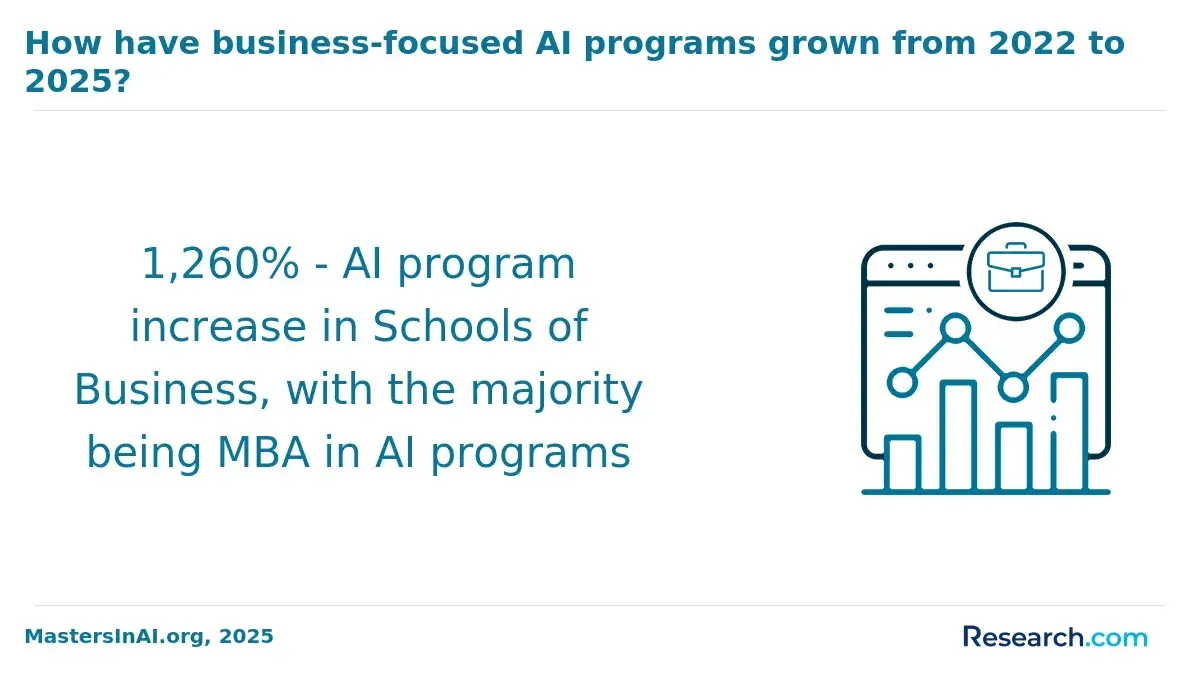
- MBA programs featuring AI strategy and data-driven decision-making coursework
- Master's in Technology Management focusing on AI innovation
These programs focus on turning AI model results into actionable business strategies, product roadmaps, and optimized operations. They develop expertise in AI algorithms, data interpretation, customer analysis, and agile development methods. Students learn to connect technical teams with leadership, a key asset in product and strategy roles.
Students should seek out curricula rich in case studies and real-world projects that emphasize AI ethics and market impact, enhancing responsible innovation on product challenges. Adding certificates or minors in product management alongside AI degrees can further boost career prospects.
Employers look for candidates who can apply AI in strategic ways-shaping AI-enabled product visions, using AI to analyze competition, and managing AI-driven innovation pipelines. To get started on a related technical path, consider exploring an online mechanical engineering degree as a solid foundation for understanding AI systems within product development and strategy roles.
What careers can you get with an AI degree in product and strategy?
Graduates with a degree in artificial intelligence have diverse ai career opportunities in product management and strategy roles that capitalize on their technical knowledge and analytical skills. Prominent positions include product managers specializing in AI-driven products who set features and roadmaps informed by AI capabilities and market demands. Strategy analysts assess competitive landscapes, forecast trends, and create plans to leverage AI technologies effectively. Management analysts, with a projected growth of 11% from 2023 to 2033 according to the U.S. Bureau of Labor Statistics, use AI insights to optimize business processes and improve decision-making.
Other top product strategy jobs with an artificial intelligence degree include AI product strategists who combine technical and business expertise to foster innovation, data product managers handling AI-generated data insights, and strategic consultants advising on AI adoption and digital transformation. AI program managers ensure AI product development aligns with organizational goals, while roles in user experience strategy focus on meeting customer and ethical standards for AI tools.
Practical experience in AI project management and business strategy is highly valued. Certifications in product management or agile methodologies enhance job prospects, as does understanding AI deployment regulations to address compliance and risk. For those exploring education paths, consider programs like the cheapest online masters in artificial intelligence to balance quality and affordability.
How do you choose an accredited AI program with strong career outcomes?
Choosing accredited artificial intelligence degree programs with proven career outcomes involves careful evaluation beyond prestige. Confirm accreditation from recognized agencies like ABET or regional bodies to ensure curriculum quality and eligibility for federal aid. Additionally, prioritize programs that transparently publish graduate employment and salary outcomes, reflecting accountability and enabling assessment of potential returns.
The Georgetown University Center on Education and the Workforce reports a median lifetime net ROI of $583,000 for master's degrees, underscoring the value of selecting programs demonstrating similar results. Strong AI degrees often offer internships, capstone projects, or partnerships with industry leaders, enhancing practical skills and boosting job placement.
Top artificial intelligence programs for product management and strategy careers balance foundational topics such as machine learning and algorithms with applied courses in product development and strategic decision-making. Concentrations or certificates in AI product strategy further support targeted career paths.
Consider flexible program delivery options-online, hybrid, or in-person-and the availability of career services, including resume workshops and networking events. Robust alumni networks and mentorship opportunities often correlate with better employment outcomes.
For those interested in affordable and flexible study options, many turn to online data science masters, which often align closely with artificial intelligence coursework and career objectives.
What curriculum and coursework matter most for AI product and strategy jobs?
Critical coursework for AI product and strategy roles centers on foundational models, evaluation, deployment, and business integration. Mastery of modern large language models (LLMs) is essential as the industry evolves rapidly. According to Stanford HAI's AI Index 2025, 149 new foundation models were introduced recently-a fivefold increase from the previous data-highlighting the need for hands-on experience with LLM architecture, fine-tuning, and prompt engineering.
Key subjects include:
- Machine learning theory with a focus on natural language processing (NLP) and generative AI applications.
- Model evaluation metrics that address accuracy, bias, ethics, and robustness in real-world scenarios.
- Deployment techniques, including APIs, cloud infrastructure, and monitoring for scalable AI models.
- Data strategy and governance to ensure privacy, quality, and regulatory compliance.
- AI product management skills that translate technology into market needs and user-friendly designs.
- Cross-disciplinary studies in ethics, law, and AI policy for responsible decision-making.
Practical training with frameworks like TensorFlow, PyTorch, and Hugging Face tools is vital. Students benefit from project-based learning that covers the entire AI product lifecycle-from data collection to deployment and iteration. Strategy courses emphasize competitive analysis and monetization tactics aligned with industry needs, equipping graduates to lead AI initiatives effectively.
What are the admission requirements and prerequisites for AI degree programs?
Admission to artificial intelligence degree programs usually requires a bachelor's degree in computer science, mathematics, engineering, or a closely related technical field. Some programs consider applicants with substantial professional experience in programming or data analysis without a traditional degree. A minimum GPA around 3.0 on a 4.0 scale is commonly expected.
Strong Python programming skills are essential, reflecting its popularity highlighted in the Stack Overflow Developer Survey 2024, where 45.7% of respondents reported extensive use. Foundational knowledge in linear algebra, calculus, probability, and statistics is typically required, sometimes verified through coursework or standardized tests.
Graduate programs often ask for prior experience with machine learning, data structures, and algorithms. International applicants must prove English proficiency via tests such as TOEFL or IELTS if their previous education wasn't in English. Application materials generally include a statement of purpose and letters of recommendation; GRE scores are less frequently required.
Applicants should check if a program emphasizes theory or applied skills, as some seek demonstrated AI framework experience or relevant projects. Working professionals may find part-time or online options with more flexible prerequisites but still needing evidence of technical ability.
How long do AI degree programs take, and what do they cost?
Master's degree programs in artificial intelligence typically span 1 to 2 years and are the most common pathway into product management and strategy roles. Some schools offer accelerated or part-time formats, extending the duration to 3 years or more for working professionals. Doctoral programs can take 4 to 6 years but are less frequent for those focused purely on product or strategy careers.
Tuition costs vary significantly based on the institution type. Public in-state universities average around $10,000 per year for graduate tuition and fees, while private nonprofit schools charge about $31,000 annually, according to the College Board's report on Trends in College Pricing and Student Aid. These amounts exclude costs like books, fees, and living expenses, which can add several thousand dollars yearly.
For cost-conscious students eyeing AI-related product and strategy careers, public in-state programs offer considerable savings. Additionally, some online AI degrees or certificate bootcamps come under $10,000 total but may not provide as comprehensive a curriculum. Employers often offer tuition assistance, especially for part-time learners continuing professional development.
When choosing a program, consider the balance between length, cost, curriculum relevance, and industry connections. Shorter, affordable degrees with strong ties to technology companies tend to provide better returns on investment for AI product development and strategy careers.
How do online AI degrees compare with on-campus programs for credibility?
Online AI degrees from accredited institutions have earned notable recognition, matching the rigor and outcomes of traditional on-campus programs. The GMAC Prospective Students Survey 2024 reveals that 52% of candidates prefer hybrid or fully online formats, highlighting growing acceptance when strong accreditation and career results are demonstrated.
Key aspects contributing to program credibility include accreditation by recognized bodies such as ABET or AACSB, faculty expertise, and curricula aligned with current industry demands. Employers, especially in product and strategy roles, prioritize skills and project experience, which well-designed online programs deliver through labs, group projects, and capstone assignments.
Prospective students should evaluate networking opportunities and real-time support, which differ between programs. Hybrid formats often enhance peer interaction and faculty engagement via occasional campus residencies, strengthening professional connections.
Before enrolling, verify the program's incorporation of hands-on AI tools and strategic frameworks essential for product and strategy careers. Transparency in graduate employment rates and industry partnerships also indicates practical value.
Consider reviewing employer feedback and alumni success to address concerns about online credential perception. These factors together help ensure the online AI degree supports both learning and career advancement effectively.
What certifications complement an AI degree for product and strategy careers?
Certifications play a crucial role in validating specialized skills for careers involving artificial intelligence product development and strategy. According to Skillsoft's IT Skills and Salary Report 2024, 79% of IT leaders highlight certifications as essential credentials, especially in cloud computing, machine learning, and product management fields.
Key certifications that boost expertise include:
- Certified Scrum Product Owner (CSPO) - Enhances agile product management skills, aligning AI solutions with business goals.
- Google Professional Machine Learning Engineer - Confirms ability to design and implement machine learning models, vital for AI strategists assessing technical impacts.
- AWS Certified Machine Learning - Specialty - Emphasizes deploying ML workloads on cloud platforms, providing insight into scalable AI architecture.
- Certified Product Manager (CPM) from Pragmatic Institute - Focuses on product lifecycle and customer-centric strategies critical for AI-driven products.
- Data Science Council of America (DASCA) Certifications - Broad credentials in data science and analytics support strategic AI decision-making involving data interpretation and deployment.
Professionals often combine cloud certifications (AWS, Azure, or Google Cloud) with product management credentials, bridging technical knowledge and strategic insight. Such certifications enhance the ability to transform AI capabilities into market-ready products and strong business roadmaps. Choosing the right certification depends on career focus, whether it's algorithmic skills, cloud infrastructure, or leadership in product strategy.
What salary and job outlook can AI product and strategy graduates expect?
Graduates specializing in artificial intelligence product and strategy roles can anticipate strong salary prospects and significant job growth. According to the U.S. Bureau of Labor Statistics (May 2024), the median annual wage for product managers is $127,000, which sets a solid benchmark for AI-enabled product development and strategic management careers.
Demand for AI product managers and strategic analysts is fueled by companies integrating AI to enhance decision-making and innovate offerings. Salaries vary based on industry, company size, and location, with major tech hubs like San Francisco and New York offering 15%-25% higher pay due to living costs and competition.
Higher wages are often found in finance, healthcare, and consumer electronics sectors where AI adoption is strong. Entry-level positions typically start around $85,000-$95,000 but offer rapid advancement with experience.
Key ways to boost employability and salary include gaining expertise in AI ethics, data governance, and machine learning pipelines, alongside certifications in project management and data science. Networking within AI communities and continuous learning further supports career growth in this competitive field.
Other Things You Should Know About Artificial Intelligence
Success in artificial intelligence degree programs requires strong analytical and problem-solving skills. Proficiency in programming languages like Python and knowledge of mathematics, especially linear algebra, calculus, and statistics, are crucial. Additionally, effective communication is important for collaborating on interdisciplinary projects in product and strategy roles.
Experience with data is vital in artificial intelligence education, as AI fundamentally depends on data collection, processing, and analysis. Students should be comfortable working with large datasets, data cleaning, and using tools for data visualization. Practical experience through projects or internships strengthens a graduate's ability to apply AI techniques in real-world product and strategy contexts.
Many artificial intelligence degree programs offer interdisciplinary opportunities that combine AI with fields like business, psychology, or design. These opportunities are especially relevant for careers in product management and strategy, where understanding user behavior and market dynamics is essential. Interdisciplinary coursework can enhance a student's ability to develop AI solutions that meet complex organizational needs.
Graduates can pursue roles such as AI product manager, strategy consultant, or business intelligence analyst. These programs typically equip students with skills in data analytics, machine learning, and strategic planning, making them ideal for leadership positions. Additional exploration in areas like artificial intelligence governance master’s can open specific governance roles.
References
- The Sound of Silence: When a Lack of Customer Feedback Derails Your Strategy https://scaledagile.com/blog/ai-certifications-product-managers/
- 16 Artificial Intelligence Career Paths https://www.calmu.edu/news/artificial-intelligence-career-paths
- AI Product Management Skills & Roles: What You Need to Succeed https://voltagecontrol.com/articles/ai-product-management-skills-roles-what-you-need-to-succeed/
- Ultimate Guide: How to Choose the Right AI Training Course to Boost Your Career - ONLC https://www.onlc.com/blog/how-to-choose-ai-training-courses/
- AI Product Managers Are the PMs That Matter in 2025 https://productschool.com/blog/artificial-intelligence/guide-ai-product-manager
- AI Product Manager: Role, Salary, Skills & Career Path Guide https://www.simpliaxis.com/resources/ai-product-manager-guide
- Your Roadmap to Earning the Best AI Certifications https://www.usaii.org/ai-insights/your-roadmap-to-earning-the-best-ai-certifications
- What is an AI Product Manager? - Data Science PM https://www.datascience-pm.com/ai-product-manager/
- Masters Artificial Intelligence https://www.udacity.com/masters-artificial-intelligence
- B.Sc. in Artificial Intelligence https://www.studyinpoland.pl/en/programme