2027 AI Bachelor's Degrees With Summer Start Options

Co-Founder and Chief Data Scientist
Many professionals with degrees outside STEM fields face challenges when trying to enter the artificial intelligence industry. Traditional academic calendars and limited start dates can delay critical career shifts. This rigidity restricts timely access to education that matches fast-evolving technology demands. Those seeking accelerated paths may find few options that align with their schedules, especially if planning a summer start to minimize downtime.
This article examines available bachelor's degree programs in artificial intelligence that offer summer enrollment, providing flexible, accredited routes for career changers and working individuals eager to pivot efficiently into this competitive field.
Key Things You Should Know
- Many U.S. universities now offer AI bachelor's degrees with summer start options to accommodate diverse student schedules and accelerate time to degree completion.
- Enrollment in AI-related undergraduate programs increased by over 20% from 2023 to 2025, reflecting higher demand for skills in emerging technologies.
- Curricula integrate hands-on projects and interdisciplinary courses, emphasizing practical AI applications alongside foundational computer science and ethics.
What is an AI bachelor's degree, and what skills does it teach?
An ai bachelor's degree programs curriculum and skills overview typically covers foundational computing skills such as programming in Python and Java, essential for building ai models. Core concepts include machine learning algorithms, data structures, neural networks, natural language processing, robotics, and computer vision. Students develop the ability to design, implement, and evaluate ai systems in practical, real-world contexts.
Key competencies learned in ai bachelor's degrees in the United States emphasize analytical and mathematical abilities with coursework in linear algebra, calculus, probability, and statistics to support ai model optimization. Students gain skills in developing machine learning models using supervised, unsupervised, and reinforcement learning techniques, data preprocessing for handling large datasets, understanding ethical implications and bias, AI tools for automation and decision-making, and software engineering principles.
- Developing machine learning models using supervised, unsupervised, and reinforcement learning techniques
- Data preprocessing and handling large datasets
- Understanding ethical implications and bias in AI systems
- Application of AI tools for automation and decision-making
- Software engineering principles and collaborative project development
According to LinkedIn's Future of Work Report 2024, AI literacy is the fastest-growing skill in the U.S., highlighting strong demand for graduates with ai expertise. Programs with summer starts offer flexible academic timelines and faster entry into an expanding job market. Prospective students should seek programs that include hands-on projects or internships, as practical experience greatly enhances employability. For insights on artificial intelligence degree jobs, online resources can provide valuable information about career pathways and opportunities.
Which universities offer AI bachelor's degrees with summer start dates?
Several U.S. universities now offer ai bachelor's degree programs starting in summer semesters, providing flexibility for students with diverse enrollment needs. Northeastern University offers a Bachelor of Science in Artificial Intelligence that welcomes both freshman and transfer students in summer, allowing faster entry into specialized coursework.
Stevens Institute of Technology's AI bachelor's program also supports summer enrollment, catering to students with strong STEM backgrounds who prefer to start core AI classes without waiting for fall. DePaul University's Bachelor of Science in Computer Science includes an artificial intelligence concentration with a summer start option to help students accelerate their studies and career goals.
This trend is supported by Common App's 2024 deadline update, which indicates that 1,075 colleges permit first-year applications after May 1, allowing for late-cycle or summer-start applications nationwide. These pathways expand access for those who missed early deadlines or are shifting career focus.
Students interested in summer start AI degrees should evaluate program curricula, transfer policies, and internship opportunities, as accelerated cohorts might have distinct requirements. Confirming current deadlines with each institution is essential since summer start availability can vary annually.
For those exploring flexible options, it's helpful to consider programs offering an affordable data science degree as part of their AI studies. This combination can improve career readiness while managing educational costs effectively.
Are summer-start AI bachelor's programs available online, on campus, or hybrid?
Summer start artificial intelligence bachelor's programs are offered in online, on campus, and hybrid formats to meet diverse student needs. Online and hybrid ai bachelor's degrees with summer enrollment provide flexible options for students balancing work, family, or remote locations. The National Center for Education Statistics reports that nearly half of U.S. undergraduates took at least one distance course recently, reflecting the growing popularity of online learning.
Online summer-start programs offer asynchronous and live sessions, enabling students to study fully remotely without relocation. Campus-based summer start artificial intelligence bachelor's programs are ideal for those seeking hands-on lab work and direct interaction with professors and peers through accelerated courses.
Hybrid models blend online coursework with on-site labs, supporting working professionals needing flexible schedules alongside in-person mentoring. Students choosing between formats should consider factors such as commuting feasibility, learning preferences, and access to AI research facilities.
For those interested in cost-effective options, exploring the cheapest online engineering degree programs can help align financial planning with academic goals. The availability of summer starts across multiple delivery methods enables students to begin AI bachelor's degree studies in 2027 with minimal delays while fitting their personal priorities.
How do accreditation and program quality affect AI bachelor's degree value?
Accredited bachelor's degrees in artificial intelligence carry significant value because accreditation ensures programs meet rigorous academic standards, employ qualified faculty, and allocate sufficient resources. Degrees from accredited institutions are more widely recognized by employers and graduate schools, offering better chances for AI research roles and advanced studies. In contrast, non-accredited programs may limit both career and educational opportunities.
Data from the U.S. Department of Education reveal thousands of programs with poor Gainful Employment debt-to-earnings outcomes, underscoring the impact of program quality on artificial intelligence degree value. Programs that lack strong industry ties or up-to-date curricula often leave graduates with debt they struggle to repay due to inadequate job prospects.
When evaluating AI programs, students should consider:
- Accreditation status confirmed by agencies like ABET or regional accreditors
- Graduate employment rates and starting salaries relevant to artificial intelligence fields
- Curriculum depth, including courses in AI ethics, machine learning, data science, and hands-on projects
- Availability of internships and partnerships with AI firms for practical experience
- Faculty expertise aligned with current AI research and industry trends
Prospective students are advised to focus on accredited programs with transparent outcomes to reduce financial and career risks. Those interested in related fields might also explore options such as a cybersecurity masters online, which can complement AI skills in growing technology sectors.
What courses and specializations are common in AI bachelor's curricula?
AI bachelor's degree programs generally cover core courses like machine learning, data structures, algorithms, and programming languages such as Python and Java. Mathematics plays a crucial role, with a strong focus on linear algebra, calculus, statistics, and probability to support algorithmic understanding. Specialization options often include computer vision, natural language processing (NLP), and deep learning-identified by the Stanford HAI AI Index Report 2025 as the most common subjects in higher education.
Additional specializations might span robotics, reinforcement learning, human-computer interaction, and ethical AI, blending technical expertise with real-world considerations. For instance, students in computer vision explore image recognition and object detection, while those in NLP study language modeling and sentiment analysis.
Practical projects and labs reinforce theoretical knowledge, preparing students for challenges such as bias mitigation and scalable model deployment. Many programs also incorporate discussions on societal impact, data privacy, and fairness to foster responsible AI practices.
Academic institutions differ in how they structure these courses, with some making them core requirements and others offering them as electives, providing flexibility aligned with student interests and career goals. Emerging fields like autonomous systems and biomedical AI are gaining elective popularity.
The Stanford HAI AI Index Report 2025 highlights a 20% increase in diverse AI courses since 2023, reflecting stronger curriculum development and richer specialization choices at universities nationwide.
What are typical admissions requirements for AI bachelor's programs?
Admissions for AI bachelor's programs rely on a comprehensive review of academic achievements, skills, and potential rather than solely on standardized test scores. More than 80% of U.S. undergraduates attended schools that did not require ACT or SAT scores recently, reflecting a widespread adoption of test-optional policies in AI education.
Typical admissions materials include:
- Official high school transcripts demonstrating strong math skills in algebra, calculus, or statistics
- Foundational science coursework, such as physics or computer science
- Letters of recommendation from instructors or professionals familiar with analytical or coding abilities
- Personal statements highlighting interest and motivation in artificial intelligence and technology fields
- Proof of programming proficiency via portfolios, coursework, or certifications
Although test scores may be submitted, many programs treat them as optional and less critical. Highly selective institutions sometimes require interviews or problem-solving assessments. Applicants with professional experience or non-traditional backgrounds should emphasize relevant work or completed online courses in AI, machine learning, or data science.
International students need to meet English proficiency requirements through TOEFL or IELTS scores along with academic qualifications. Early contact with admissions offices is recommended to clarify specific prerequisites or programming skill expectations before applying.
How long do AI bachelor's programs take, and can summer reduce time?
Bachelor's degrees in artificial intelligence usually take four years of full-time study, covering core subjects like computer science, mathematics, and specialized AI areas such as machine learning and robotics. Some programs offer accelerated options, enabling completion in around three years by taking heavier course loads or testing out of prerequisites.
Enrolling in summer classes can significantly shorten program length. Summer courses provide additional credits beyond the traditional fall and spring semesters, potentially reducing graduation time by several months. This option suits students aiming to enter the workforce earlier or those balancing internships and part-time jobs.
Program structures vary widely. Taking one or two summer courses annually might cut the degree to about 3.5 years, while continuous summer enrollment could allow finishing in roughly three years. However, students should carefully assess workload challenges to avoid academic burnout.
Data from the National Student Clearinghouse Research Center's 2024 report shows that students maintaining continuous enrollment, including summer terms, achieve higher completion rates compared to those with enrollment gaps. This supports using summer study as a strategic approach for timely degree completion.
It's important for students to review program policies on summer courses, credit transfer, and financial aid eligibility. Early consultation with academic advisors helps create a tailored plan that leverages summer enrollment effectively without causing financial strain or burnout.
What does an AI bachelor's degree cost, and what financial aid is available?
For students pursuing a bachelor's degree in artificial intelligence at public four-year colleges, the average published in-state tuition and fees hover around $11,610 annually. Many pay significantly less thanks to grant aid that lowers the net price. Private institutions and out-of-state tuition can increase costs to $30,000 or more, depending on the school's prestige and resources.
Financial aid options play a critical role in managing education expenses. Federal Pell Grants offer awards up to $7,395 for eligible low-income students, while the Federal Supplemental Educational Opportunity Grant (FSEOG) targets those with exceptional financial need. Completing the Free Application for Federal Student Aid (FAFSA) is essential to access these benefits.
- Institutional scholarships and merit-based awards often focus on STEM and AI fields, covering anything from partial to full tuition.
- Work-study programs enable students to earn income while gaining relevant experience.
- Private scholarships from major tech companies like NVIDIA and Google help reduce financial burdens further.
Additional support may include state aid, tuition waivers to encourage local enrollment, and education benefits via the GI Bill for veterans and military affiliates. Prospective students should use pricing calculators and consult financial aid offices early to maximize available funding for artificial intelligence programs.
What jobs can you get with an AI bachelor's degree?
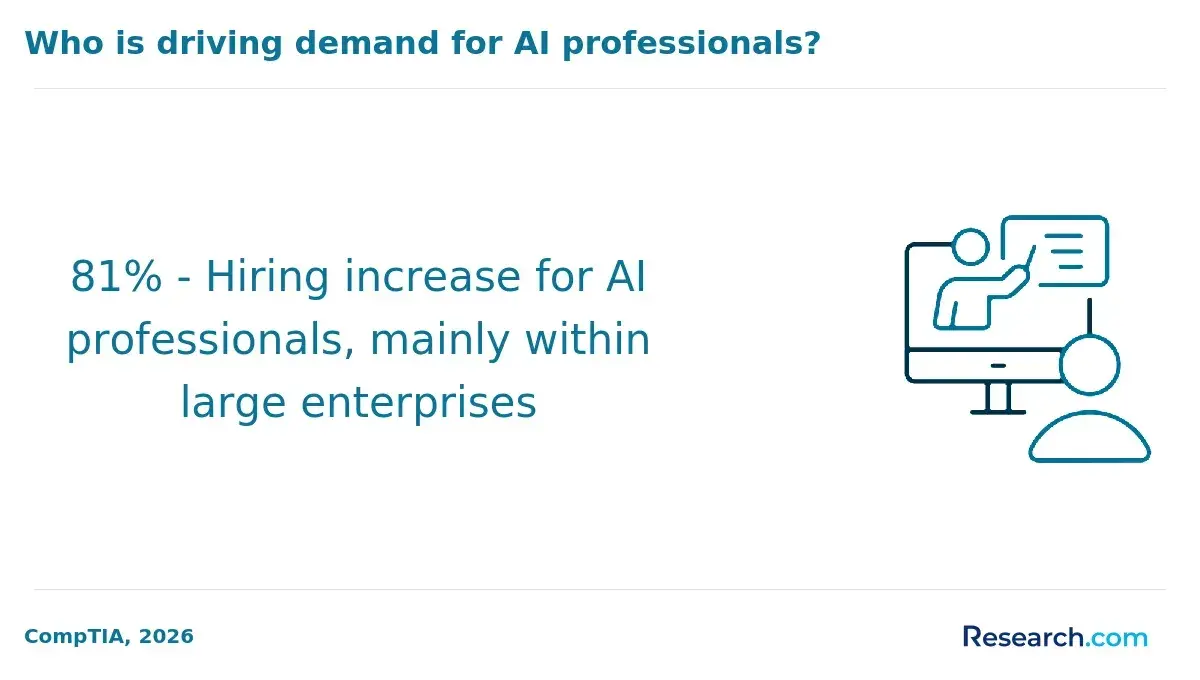
An AI bachelor's degree opens doors to diverse careers beyond traditional software engineering, including AI research scientist, machine learning engineer, data analyst, and AI software developer. These roles focus on building algorithms, designing neural networks, and developing intelligent systems across many industries. U.S. job postings seeking generative-AI skills have surged and now span sectors like marketing, finance, human resources, and sales, showing wide business applications for graduates.
Emerging career pathways include:
- Marketing analysts using AI to enhance campaigns and customer targeting.
- Financial analysts applying AI for risk assessment and fraud detection.
- HR specialists leveraging AI-driven recruitment and workforce analytics.
- Sales professionals utilizing AI for predictive lead scoring and customer insights.
Graduates should align roles with their supplemental skills-such as communication for AI consulting or mathematics for deep learning engineering. Proficiency in Python, R, or SQL, plus familiarity with AI platforms and frameworks, boosts employability. Companies increasingly demand AI talent able to integrate generative models into traditional workflows across varied sectors.
Positive job growth supports these trends, with the U.S. Bureau of Labor Statistics projecting a 19% increase in computer and information research scientist roles, including AI experts, between 2022 and 2032. Building a strong portfolio or gaining internships can help graduates meet employer expectations in this fast-evolving field.
What salary and job outlook can AI bachelor's graduates expect?
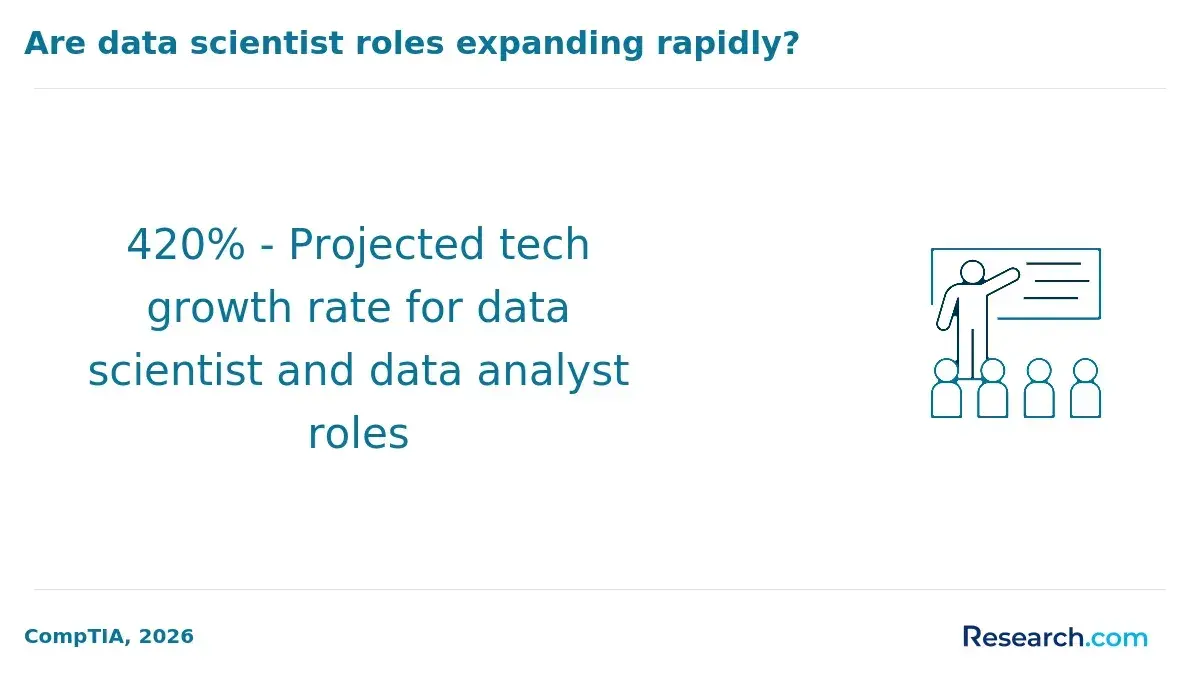
Employment for data scientists, a prominent role for graduates with a bachelor's degree in artificial intelligence, is projected to grow 35% from 2022 to 2032 according to the U.S. Bureau of Labor Statistics (Occupational Outlook Handbook). This surge, much faster than average for all careers, is driven by demand in technology, healthcare, finance, and government sectors.
The median annual salary for data scientists was $108,020 in 2023, with starting salaries typically ranging from $70,000 to $90,000 depending on location and experience. Those specializing in machine learning, natural language processing, or robotics tend to earn more and advance more quickly.
Career paths for AI bachelor's holders include machine learning engineer, AI analyst, software developer, and research assistant. Employers highly value both technical skills and hands-on experience gained through internships or projects.
Salary differences often reflect regional and industry variations, with metropolitan technology sectors offering the highest pay compared to academia or smaller firms. Complementary skills in data analytics or cloud computing can broaden opportunities.
Continuous education through certifications, workshops, or graduate degrees is essential to remain competitive in this fast-evolving field, ensuring robust job prospects and growth in earning potential.
Other Things You Should Know About Artificial Intelligence
Yes, most AI bachelor's degree programs incorporate internships, capstone projects, or hands-on labs to provide practical experience. These opportunities help students apply theoretical knowledge to real-world problems and improve their job readiness. Summer terms can be ideal times to complete such experiences.
AI bachelor's programs typically include foundational courses in computer science, mathematics, and AI theory that prepare students for advanced study. Graduates are often well-prepared to pursue master's or doctoral degrees in Artificial Intelligence or related fields. Summer start options can enable continuous study without long breaks, benefiting academic momentum.
AI bachelor's degrees focus on technologies like machine learning frameworks, neural networks, natural language processing, and robotics. Common programming languages taught include Python, Java, and R, as these are widely used in AI development. Understanding these tools is critical for building effective AI solutions in research or industry.
Starting an AI bachelor's degree in the summer of 2027 allows students to graduate earlier, potentially joining the workforce sooner. This timing can also offer a less competitive entry period. For those interested in further education, exploring a master’s in AI and fintech may be a future option.
References
- Best Online AI Degrees: 2025 Rankings & Program Directory - MastersInAI.org https://www.mastersinai.org/degrees/online-artificial-intelligence-degrees/
- What do you learn in a bachelor's in artificial intelligence? | edX https://www.edx.org/resources/what-do-you-learn-in-a-bachelors-in-artificial-intelligence
- MH Cognition https://mhcognition.com/blogs/core-ai-ml-subjects-bsc-cs
- B.Sc. in Artificial Intelligence https://www.studyinpoland.pl/en/programme
- Summer School on Artificial Intelligence (AI), Ethics and Human Rights, Hybrid Format: Rome (Italy) and online | ReliefWeb https://reliefweb.int/training/4198939/summer-school-artificial-intelligence-ai-ethics-and-human-rights-hybrid-format-rome-italy-and-online
- AI use in accreditation can help, but we still need humans https://www.universityworldnews.com/post.php
- Best AI Bachelor's Degrees - AIDegreeProgams.org https://aidegreeprograms.org/rankings/best-ai-bachelor-degrees/
- Generative AI can accelerate study time | IU News https://www.iu.de/news/en/generative-ai-can-accelerate-study-time-iu-research-shows/
- Accreditation and AI: Ensuring Quality in an Era of Smart Learning https://www.qahe.org/article/accreditation-and-ai-ensuring-quality-in-an-era-of-smart-learning/
- Rewiring the Job Market, Part Two: What AI Means for Careers That Require a Bachelor’s Degree https://heartlandforward.org/pulse/rewiring-the-job-market-part-two/