2027 BS in Business Administration Transfer Planning: General Education Credits Versus Credits in the Business Major
Audited and Verified:
Our Editorial and Data Verification Process
Research.com uses government datasets, official education statistics and primary institutional information to support its career and degree guides. Our review process checks factual accuracy, occupational definitions, source dates and the requirements associated with the credentials discussed.
How This Article Was Fact-Checked
Our editorial team verifies salary estimates, employment projections, education requirements and program information against original data providers and official organizations. Salary figures are checked against the relevant occupational definitions and reporting periods. Information about licensure, accreditation and required in-person training is reviewed separately.
Fact-checked and verified on:

Co-Founder and Chief Data Scientist
A college may accept your previous coursework without applying it to the business courses you need to graduate. That distinction matters when you are deciding where to transfer, what to take next, and whether an advertised completion timeline is realistic. This guide is for students entering or returning to a BS in Business Administration, especially those bringing credits from another major or an associate degree. You'll learn how general education and business credits are evaluated, what to request from a school, and how to compare programs by requirements remaining rather than credits accepted.
Key Things You Should Know
- Accepted transfer credits and credits that satisfy degree requirements are different totals; compare the remaining requirements on each school's degree audit.
- A course such as accounting or statistics may transfer as general education, a business requirement, or an elective, depending on its approved equivalency and the program's rules.
- Use the receiving school's written evaluation, current catalog, course schedule, and cost estimate before relying on a completion date or expected savings.
How Do General Education Credits Differ From Business Major Credits?
General education credits fulfill broad requirements such as writing, mathematics, natural sciences, or humanities. Business major credits fulfill requirements specific to the BS in Business Administration, such as accounting, finance, marketing, management, or a business capstone. A course can be accepted for transfer yet satisfy neither category if it arrives as an elective.
The categories below show why the placement of a credit matters more than its appearance on a transcript.
| Audit category | What it satisfies | Transfer-planning consequence |
| General education | Broad degree requirements | May clear a graduation requirement without advancing the business core |
| Business core or prerequisite | Required business coursework or preparation for it | Can remove a required course or open access to a later one |
| Concentration | Requirements for an officially declared concentration | Counts only if the program approves the course for that concentration |
| Free elective | Credits permitted outside specified requirements | Helps only while usable elective space remains |
| Accepted but unused | No remaining degree requirement | Appears in the transfer record without reducing coursework needed to graduate |
For example, a statistics course might meet a general education math requirement but not a business statistics prerequisite if the required topics differ. Likewise, management-focused electives do not automatically constitute a formal concentration. If you are also considering three-year-or-less leadership degree pathways, compare their requirement maps rather than assuming shared course titles produce the same transfer result.
How Many Transfer Credits Apply to a Business Administration Degree?
There is no transferable-credit total that applies to every BS in Business Administration. The receiving institution sets its acceptance rules, the business program determines equivalencies, and the degree audit shows where accepted credits fit. Separate three figures when comparing schools: credits accepted, credits applied to the degree, and credits still required.
Consider a hypothetical 120-credit degree: a school accepts 60 previous credits, but only 45 satisfy available degree requirements. If no other requirements change, the student still needs 75 applicable credits - not 60. Upper-level business courses, prerequisites, concentration courses, and credits that must be earned at the institution can further constrain the schedule. This example is arithmetic, not a prediction about any school's policy.
Ask how the school handles associate degrees, applied associate degrees, military or competency-based learning, and prior coursework from a different major. Quarter credits may also need conversion to semester credits. Students exploring flexible accelerated bachelor's degrees should check applicable credits first: shorter terms cannot eliminate unmet degree requirements.
How Can You Maximize Transfer Credits for a Business Administration Degree?
Maximizing transfer value means choosing courses that satisfy requirements you still need, not simply accumulating more accepted credits. Before registering at your current school or enrolling at a new one, build a course-by-course comparison using the receiving program's catalog and evaluation.
Use this sequence to turn a preliminary estimate into a workable plan:
- Request official transcripts and collect syllabi or course descriptions for classes with uncertain equivalencies.
- Ask the transfer office for a written credit evaluation and the business adviser for a degree audit showing general education, core, concentration, elective, and residency requirements separately.
- Confirm prerequisites, minimum-grade rules, course recency policies, and whether a substitution needs department approval.
- Check when remaining required courses are offered, including whether a capstone must be taken near graduation.
- Appeal an unexpected elective classification with a syllabus when the school permits it; get any approved change recorded in the audit.
If you have not yet transferred, obtain written preapproval before taking another course elsewhere. A program advertised among business degree programs designed for faster progress is worth evaluating against your particular audit and course sequence, not its fastest advertised timeline.
Introductory financial and managerial accounting, microeconomics, macroeconomics, business statistics, marketing, and management are plausible candidates for equivalency because many business curricula include them. Commonly taught does not mean automatically equivalent: the receiving department may compare topics, credit hours, level, grades, and prerequisites. A course called "business math," for instance, may not satisfy a statistics requirement.
Upper-level finance, strategy, specialized concentration courses, and capstones deserve closer scrutiny. A school may require its own capstone or limit how many upper-level major credits can come from elsewhere. If your prior coursework is concentrated in logistics or operations, compare the BS audit with fastest online supply chain bachelor's programs: a specialized degree may apply those courses differently, but its own core could add requirements.
Accreditation is relevant to program evaluation, but it is not a guarantee that a particular course will satisfy a business requirement. Check the institution's accreditation status and the scope of any claimed AACSB, ACBSP, or IACBE business accreditation. Then check the receiving institution's separate transfer policy: it has final authority over credit acceptance and degree applicability.
A business school may set major-course standards that differ from the university's general transfer rules, including minimum grades or limits on upper-level transfer work. When reviewing US rankings of online business degree programs, use accreditation information as one screening factor, then request the actual policy and an individualized evaluation. Neither a ranking nor an accreditation label substitutes for an approved equivalency.

Admission to a university, admission to its business major, and approval of transfer credits can be separate decisions. Schools may review prior college transcripts, academic standing, GPA, completed credits, and preparation in mathematics or introductory business subjects. A student can be admitted while still needing prerequisites before taking upper-level business courses.
Ask admissions which transcripts and deadlines apply, then ask the business department whether it has additional entry or progression requirements. Returning students should also check readmission and catalog-year rules. If cost is influencing where you apply, compare low-cost online business administration pathways only after checking which school applies more of your credits to graduation; a lower published tuition rate may not mean a lower completion cost.
Delivery format alone does not determine transfer eligibility. Online and campus versions of a degree may share an audit, or they may differ in available concentrations, course sequences, residency rules, or terms of enrollment. Confirm which policies apply to the exact program and location or online track you would enter.
For a working or returning student, credit applicability is only part of the comparison. Check whether required classes have live sessions, group projects, proctored exams, or limited annual offerings. A transferred prerequisite saves little time if the next required course is unavailable when you can take it. When considering career advancement study options in business administration, compare the audit and the real weekly schedule together.
Estimate time from the remaining course sequence, not just remaining credits. A prerequisite must precede the course it unlocks, and a required class offered infrequently can delay graduation even when the credit total looks manageable. Ask an adviser to map a proposed term-by-term schedule at the enrollment pace you can sustain.
For cost, multiply remaining billable credits by the school's published tuition rate, then account for mandatory fees, books, technology, travel where applicable, and any extra term caused by course availability. Compare aid eligibility and borrowing using each school's own estimate. Cheaper business administration study with FAFSA-based aid may be worth investigating, but aid eligibility and the final net price require an individual review. Have the financial-aid office check how transfer credits, enrollment intensity, and satisfactory academic progress affect your plan.
A BS in Business Administration can support applications for business operations, marketing, HR, sales-support, or project-coordination roles, depending on your experience and coursework. It does not itself qualify a new graduate to manage staff or enter a regulated profession. If you already have relevant work experience, the degree may help meet an employer's education requirement; if you are changing functions, an internship or documented project may provide more direct evidence of readiness.
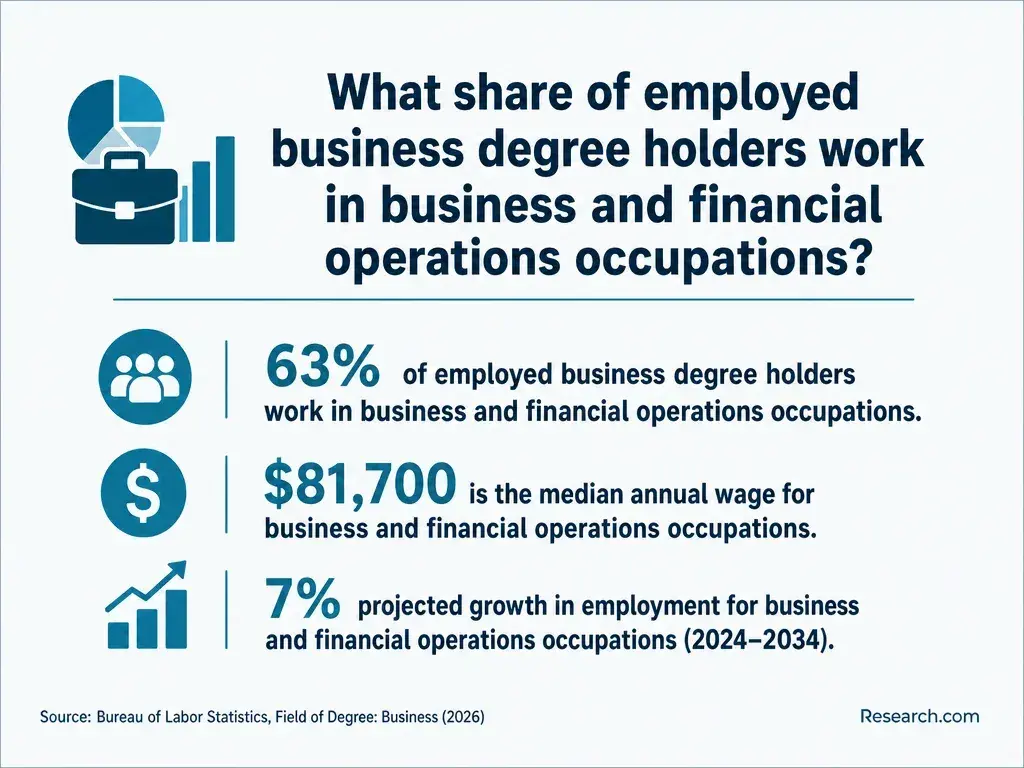
For salary context, the U.S. Bureau of Labor Statistics reports a May 2025 median annual wage of $78,760 for market research analysts. That is an occupation-wide median, not an expected starting salary for business administration graduates; the role also calls for research and analytical skills. If your target is specifically supply chain work, use tuition and time comparisons for supply chain students to weigh a specialized pathway against finishing a broader business degree with relevant electives.
What Job Outlook and Certifications Apply to Business Administration Graduates?
Job outlook varies by occupation, not by degree title. The Bureau of Labor Statistics projects 7% growth for market research analysts from 2025 to 2035. That projection describes the occupation nationally; it does not establish demand for every business concentration or guarantee a job in a particular location.
Certifications depend on the function you intend to enter. HR, project management, accounting, and financial services have different credentialing bodies and, in some cases, experience or licensing requirements. A business course or concentration does not automatically confer eligibility. Before paying for a credential, compare its current requirements with your target job postings and your existing experience. For project-oriented goals, project management degree tuition comparisons can help you assess whether additional formal study is justified rather than assuming another degree is necessary.
Other Things You Should Know About Business Administration
Often, a school records transferred credits without including their grades in its institutional GPA. Major admission, prerequisite, and graduation policies may still consider those grades. Check the receiving school's transcript and GPA rules.
A school may provide a preliminary equivalency or preapproval, but final credit usually depends on an official transcript showing completion and the required grade. Keep the written evaluation and confirm its conditions.
It depends on the receiving school's exam-credit policy and the business program's requirements. Ask whether the award satisfies a specific course, general education category, or elective slot.
Some institutions offer second-degree students a general education waiver, while others retain specific requirements. Business prerequisites, major courses, and residency rules may still apply. Request a second-degree audit before choosing that route.
- Higher Education: Students Need More Information to Help Reduce Challenges in Transferring College Credits | U.S. GAO https://www.gao.gov/products/gao-17-574
- Transferring Courses - The University of Texas at San Antonio https://catalog.utsa.edu/undergraduate/bachelorsdegreeregulations/transferringcourses/
- Transfer Credit Evaluation - TXST Admissions https://www.admissions.txst.edu/future-students/transfer-credit-evaluation.html
- Admission and Certification Requirements | Herbert Wertheim College of Business https://wertheim.fsu.edu/undergraduate/admission-and-certification-requirements
- Business Administration Major & Minor Requirements | robins https://robins.richmond.edu/undergraduate/departments/business-administration/major-minor.html
- Transferring Credits - Cuyahoga Community College Catalog https://catalog.tri-c.edu/transfer-information/transferring-credits/
- Transfer Credit Policy | SUNY Empire https://sunyempire.edu/policies/transfer-credit-policy.html
- How Do Transfer Credits Work When You Go Back to School? | Whitworth Online https://online.whitworth.edu/news-articles/how-do-transfer-credits-work-when-you-go-back-to-school/
- View Transfer Guide - AA - FSU - Business Administration (BS) - General Business - Fully Online, On-Campus https://coursetransfer.northcarolina.edu/guide/2024-2025/474
- Transfer Credit Policies - Georgia State Admissions https://admissions.gsu.edu/transfer-and-transition-resource-center/transfer-to-gsu/transfer-credit-policies/