
2027 Cheapest Online Business Administration Degrees

Co-Founder and Chief Data Scientist
Choosing the cheapest online Business Administration degree is not just a tuition comparison. The better question is whether a program is accredited, transferable, flexible enough for your schedule, and likely to support the career outcome you want. This guide is for prospective undergraduate business students, transfer students, working adults, and career changers who want an affordable online path into management, finance, marketing, operations, human resources, entrepreneurship, or graduate business study.
Below, you will find a practical breakdown of low-cost online business administration options in the USA, what these programs usually include, how long they take, what they cost beyond tuition, how employers view online degrees, and how to compare programs without relying only on rankings.
Quick Answer: What is the cheapest online Business Administration degree worth considering?
The cheapest online Business Administration degree is usually found at a public university, especially when the school offers in-state tuition, flat-rate online tuition, or a degree-completion format for transfer students. However, the lowest sticker price is not always the best value. Students should prioritize regional accreditation, business-school accreditation when available, transfer credit acceptance, total fees, career support, and whether the curriculum matches their career goals.
- Best for affordability: Public universities with low per-credit online rates.
- Best for working adults: Asynchronous programs, multiple start dates, and degree-completion formats.
- Best for business credibility: Programs accredited by AACSB or offered by regionally accredited institutions.
- Best cost-saving strategy: Transfer lower-division credits from a community college before completing upper-division business courses online.
What are the benefits of getting an online business administration degree?
- Broad career options: Business administration graduates can pursue roles in finance, marketing, healthcare management, operations, human resources, consulting, nonprofit management, and entrepreneurship.
- Flexible learning: Online programs can make it easier to study while working, caregiving, serving in the military, or managing other responsibilities.
- Relevant salary potential: Reported salaries include around $87,016 for financial analysts, about $88,285 for marketing managers, and approximately $108,790 for business analysts.
- Graduate-school foundation: A bachelor’s degree in business administration can prepare students for MBA programs, specialized master’s degrees, or doctoral study later.
What can I expect from an online business administration degree?
An online business administration degree teaches the core functions of organizations: how money is managed, how teams operate, how products are marketed, how decisions are made, and how strategy is executed. Most programs combine foundational business theory with applied assignments, case studies, presentations, team projects, and data-based decision-making.
Students can usually expect the following components:
- Core business coursework: Common subjects include financial accounting, marketing principles, organizational behavior, business ethics, business law, management, operations, economics, and strategic management.
- Applied business problem-solving: Many programs ask students to analyze companies, build plans, interpret financial information, evaluate markets, or recommend operational improvements.
- Online learning systems: Coursework is typically delivered through a learning platform with video lectures, readings, discussion boards, quizzes, group work, file submissions, and virtual meetings.
- Flexible scheduling: Some programs are asynchronous, while others include scheduled class meetings, deadlines, or live sessions. Working students should check this before enrolling.
- Career preparation: A strong program should help students build communication, leadership, analytical, teamwork, and technology skills that transfer across industries.
Where can I work with an online business administration degree?
Business administration is a generalist degree, which means it can support many career directions. The best path depends on your concentration, internships, prior work experience, certifications, and networking. Graduates often work in the following settings:
| Industry or setting | Common roles | Best fit for students interested in |
| Corporate business | Financial analyst, operations coordinator, marketing manager, human resources specialist, project coordinator | Private-sector growth, management tracks, analytics, team leadership |
| Healthcare organizations | Healthcare administrator, practice manager, patient services coordinator | Healthcare operations, compliance, service delivery, people management |
| Nonprofit organizations | Program manager, development officer, operations manager | Mission-driven work, fundraising, program planning, community impact |
| Startups and small businesses | Founder, business consultant, account manager, general manager | Entrepreneurship, sales, strategy, hands-on business operations |
| Government and public agencies | Administrative analyst, budget assistant, procurement specialist | Public service, budgeting, policy implementation, operations support |
How much can I make with an online business administration degree?
Salary outcomes vary by role, location, experience, employer, industry, and specialization. A business administration degree can support entry into several well-paid business functions, but no degree guarantees a specific salary. Students interested in people operations, for example, may want to compare broader business outcomes with a human resources degree salary to decide whether a general business degree or HR-focused path is more practical.
Reported salary figures for selected business-related roles include:
- Financial analysts: Average annual salary of $87,016.
- Marketing managers: Around $88,285 per year.
- Business analysts: Approximately $108,790 annually.
- Business Administration graduates: Average annual salary of $65,000, according to the U.S. Bureau of Labor Statistics (BLS) as cited in the source material.
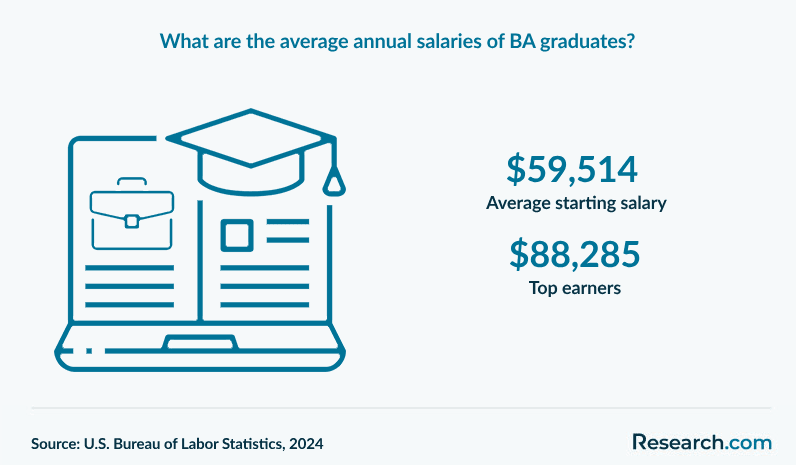
- BA graduates: Average starting salary of $59,514, with top earners reaching $88,285 annually.
- 2027 Cheapest Online Business Administration Degrees
- How long does it take to complete an online business administration degree program?
- How does an online business administration degree compare to an on-campus program?
- What is the average cost of an online business administration degree program?
- What are the financial aid options for online business administration students?
- What are the prerequisites for enrolling in a business administration degree program?
- What courses are typically in an online business administration degree program?
- What types of specializations are available?
- Is an online business administration degree worth the investment?
- What industry trends should business students monitor?
- How do you choose the best online business administration degree program?
- What career paths are available after graduation?
- What career advancement resources do online programs offer?
- What advanced academic opportunities are available after earning the degree?
- What is the job market for business administration graduates?
- What role does accreditation play?
- How can effective study strategies improve online student success?
- What is the return on investment of an online business administration degree?
- Do employers value online business administration degrees equally to campus degrees?
- What factors affect the true cost of an online business administration degree?
- Can complementary certifications improve career outcomes?
2027 Cheapest Online Business Administration Degrees
How do we rank schools?
Because business degrees require a meaningful financial commitment, program comparisons should be based on transparent and credible data rather than marketing claims. Research.com considers respected sources such as the IPEDS database, Peterson's database including the Distance Learning Licensed Data Set, the College Scorecard database, and the National Center for Education Statistics. Students should still verify current tuition, fees, admission requirements, and online availability directly with each school before applying.
| School | Program format | Listed tuition | Credits | Accreditation noted |
| California State University-Fullerton | Online BA in Business Administration degree-completion pathway | $500 per unit; approx. $30,000 total | 120 credits | AACSB |
| Florida Atlantic University | Online Bachelor of Business Administration | $201 per credit in-state; $719 per credit out-of-state | 120 credits | AACSB |
| Florida International University | Online Bachelor of Business Administration | In-state: $229.29 per credit; Out-of-state: $346.29 per credit | 120 credits | AACSB |
| Lamar University | Fully online BBA in General Business | $314 per credit hour for both in-state and out-of-state students | 120 credits | AACSB |
| Murray State University | BBA with on-campus and regional flexibility; fully online BBA not currently available | In-state: $9,708 per year; Out-of-state: $19,452 per year | 120 credits | AACSB International |
| San Diego State University | Online BSBA degree-completion program | $500 per unit; approximately $22,000 total | 120 credits; 49 credits completed online | AACSB and WASC Senior College and University Commission |
| University of Illinois Chicago | Online BBA degree-completion program | Approximately $475 per credit hour in-state; $798 per credit hour out-of-state | 120 credits; 60 completed online | AACSB and Higher Learning Commission |
| University of Illinois Springfield | Online BBA | $362 per credit hour in-state; $744 per credit hour out-of-state | 120 credits | AACSB and Higher Learning Commission |
| University of North Carolina at Greensboro | Online BSBA with Business Studies concentration | $235 per credit hour in-state; $623 per credit hour out-of-state | 120 credits | AACSB and SACSCOC |
| Wayne State College | Online BSBA with management focus | $254 per credit hour in-state; $254 per credit hour out-of-state | 120 credits | Higher Learning Commission |
1. California State University-Fullerton
The online Bachelor of Arts in Business Administration program at California State University-Fullerton (CSUF) is built for students who have already completed part of their lower-division coursework and want to finish a bachelor’s degree in a flexible format. The program covers major business areas such as accounting, finance, management, communication, critical thinking, and data analysis. Because it leads to the same degree offered through the campus, students should focus their comparison on transfer policies, advising support, term structure, and total cost.
- Program Length: 3 years (9 terms)
- Tracks/Concentrations: Accounting, Marketing, Finance, Human Resources, Operations, Business Analytics, and others
- Tuition Cost: $500 per unit (approx. $30,000 total)
- Required Credits to Graduate: 120 credits
- Accreditation: AACSB (Association to Advance Collegiate Schools of Business)
2. Florida Atlantic University
Florida Atlantic University offers an Online Bachelor of Business Administration designed for students who need to balance school with professional and personal obligations. The program is AACSB-accredited and reflects the structure of FAU’s campus-based business offerings. Students can choose from majors such as Accounting, Economics, Finance, Hospitality & Tourism Management, Management, and Marketing. Before enrolling, applicants should compare the large difference between in-state and out-of-state tuition and confirm how transfer credits apply.
- Program Length: Typically 2 years (for upper-division courses)
- Tracks/Concentrations: Accounting, Economics, Finance, Hospitality & Tourism Management, Management, Marketing
- Tuition Cost: $201 per credit (in-state); $719 per credit (out-of-state)
- Required Credits to Graduate: 120 credits
- Accreditation: AACSB (Association to Advance Collegiate Schools of Business)
3. Florida International University
Florida International University (FIU) provides an online Bachelor of Business Administration with a strong foundation in business principles and several globally oriented areas of study. Its concentrations include International Business, Marketing, and Logistics and Supply Chain Management. The program is a good fit for students who want exposure to global markets, multicultural business environments, logistics, and cross-border business issues.
- Program Length: Typically 4 years (full-time study)
- Tracks/Concentrations: International Business, Marketing, Logistics and Supply Chain Management
- Tuition Cost: In-state: $229.29 per credit; Out-of-state: $346.29 per credit
- Required Credits to Graduate: 120 credits
- Accreditation: Association to Advance Collegiate Schools of Business (AACSB)
4. Lamar University
Lamar University offers a fully online Bachelor of Business Administration in General Business. The program is structured around broad business fundamentals, including economics, finance, marketing, management, ethics, communication, and the influence of public policy on organizations. Because it offers multiple start dates, it may suit students who need a more flexible enrollment calendar.
- Program Length: Typically 4 years (standard full-time enrollment)
- Tracks/Concentrations: General Business, Management, Marketing
- Tuition Cost: $314 per credit hour for both in-state and out-of-state students (subject to change)
- Required Credits to Graduate: 120 credits
- Accreditation: AACSB (Association to Advance Collegiate Schools of Business)
5. Murray State University
Murray State University offers a Bachelor of Business Administration focused on preparing students for management-oriented careers. The undergraduate BBA emphasizes areas such as international business, economic development, strategic marketing, internships, clubs, and study-abroad opportunities. Students should note an important limitation: while the school offers business-related online graduate programs and certificates, a fully online BBA is not currently available.
- Program Length: Typically 4 years
- Tracks/Concentrations: No specified tracks for the undergraduate BBA; general business focus with electives in related areas
- Tuition Cost: In-state: $9,708 per year; Out-of-state: $19,452 per year
- Required Credits to Graduate: 120 credits
- Accreditation: AACSB International (Association to Advance Collegiate Schools of Business)
6. San Diego State University
San Diego State University offers an online Bachelor of Science in Business Administration degree-completion program through Global Campus. It is designed for students who have completed prior coursework and want to finish upper-division business requirements online. The curriculum covers management, marketing, finance, operations, and general business problem-solving, with collaborative online assignments and faculty-led instruction.
- Program Length: Approximately 2 years (for degree completion, assuming prior coursework is completed)
- Tracks/Concentrations: General Business Administration
- Tuition Cost: $500 per unit; approximately $22,000 total (in-state and out-of-state rates are the same for this program)
- Required Credits to Graduate: 120 credits (including transfer credits); 49 credits completed online
- Accreditation: AACSB and WASC Senior College and University Commission
7. University of Illinois Chicago
The University of Illinois Chicago (UIC) offers an online Bachelor of Business Administration degree-completion program for students who already have 60 transferable credits. The program is organized around finance, marketing, operations, and management and is taught by UIC faculty. It is best suited for transfer-ready students who want a structured two-year completion pathway.
- Program Length: 2 years (after transferring 60 credits)
- Tracks/Concentrations: General Business Administration
- Tuition Cost: Approximately $475 per credit hour (in-state) and $798 per credit hour (out-of-state)
- Required Credits to Graduate: 120 credits (60 must be completed online)
- Accreditation: AACSB and Higher Learning Commission
8. University of Illinois Springfield
The University of Illinois Springfield (UIS) offers an online Bachelor of Business Administration with coursework in marketing, finance, management, operations, and general business. The program is designed for flexibility and includes experiential learning expectations, including internships that help students connect classroom learning with workplace experience.
- Program Length: Typically 4 years for first-time students; shorter for transfer students with prior credits
- Tracks/Concentrations: Marketing, Finance, and General Business Administration
- Tuition Cost: $362 per credit hour (in-state), $744 per credit hour (out-of-state)
- Required Credits to Graduate: 120 credits
- Accreditation: AACSB and Higher Learning Commission
9. University of North Carolina at Greensboro
The University of North Carolina at Greensboro (UNCG) offers an online Bachelor of Science in Business Administration with a Business Studies concentration. Students complete seven-week, asynchronous online classes covering finance, management, marketing, and supply chain management. The program may appeal to students who want an accelerated class format and possible graduate progression through the Accelerated Master’s Program, which can allow students to earn both a BSBA and MBA in as little as five years.
- Program Length: 4 years for first-time students; shorter for transfer students
- Tracks/Concentrations: Business Studies (online); Human Resources and Management (on-campus only)
- Tuition Cost: $235 per credit hour (in-state); $623 per credit hour (out-of-state)
- Required Credits to Graduate: 120 credits
- Accreditation: AACSB and Southern Association of Colleges and Schools Commission on Colleges (SACSCOC)
10. Wayne State College
Wayne State College offers an online Bachelor of Science in Business Administration with a management focus. Students study business law, accounting, marketing, operations, strategic management, and applied business topics. The equal online tuition listed for in-state and out-of-state students can make this program especially worth comparing for learners outside the institution’s home state.
- Program Length: Typically 4 years for new students; shorter for those with transfer credits
- Tracks/Concentrations: Management
- Tuition Cost: $254 per credit hour (in-state); $254 per credit hour (out-of-state, no differentiation for online students)
- Required Credits to Graduate: 120 credits
- Accreditation: Higher Learning Commission (HLC)
How long does it take to complete an online business administration degree program?
Most online business administration bachelor’s programs take two to four years, depending on whether the student enters as a first-time college student, transfers prior credits, studies full time, or enrolls part time.
| Student situation | Typical timeline | What to watch for |
| First-time bachelor’s student | Typically 4 years | General education, business prerequisites, and major requirements all apply |
| Transfer student with many credits | Often 2 years, depending on accepted credits | Not every prior course may transfer or apply to the major |
| Full-time online student | Often faster than part-time study | Requires enough weekly time for multiple courses |
| Part-time working student | May take 4 years or more | Better schedule fit, but longer total time to graduation |
| Accelerated student | Can progress more quickly where available | Short terms and heavier course loads can be demanding |
Students who want a faster route should compare accelerated online business degree options, but speed should not be the only priority. A shorter program is only helpful if it is accredited, manageable, affordable, and aligned with your transfer-credit situation.
- Course load matters: More credits per term usually means faster progress but less flexibility.
- Transfer policy matters: A generous transfer policy can reduce both time and cost.
- Program structure matters: Cohort-based programs may follow a fixed sequence, while self-paced or asynchronous programs may offer more scheduling control.
- Personal capacity matters: Work hours, family responsibilities, and study habits affect realistic completion time.
How does an online business administration degree compare to an on-campus program?
An online business administration degree can be academically comparable to an on-campus degree when the institution is properly accredited and the curriculum, faculty standards, and graduation requirements are equivalent. The main difference is the learning format, not necessarily the credential itself.
| Factor | Online business administration degree | On-campus business administration degree |
| Schedule | Often more flexible; may include asynchronous coursework | Usually requires scheduled class attendance |
| Location | Can be completed from anywhere with reliable internet access | Requires regular campus presence or relocation |
| Networking | Virtual networking, online groups, alumni events, and digital career fairs | More informal face-to-face interaction and campus activities |
| Learning style | Best for self-directed students with strong time management | Best for students who prefer in-person structure and immediate interaction |
| Technology use | Requires comfort with learning platforms, video tools, and online collaboration | May use technology, but not always as intensively |
| Cost considerations | Can reduce commuting or relocation costs, but may include technology fees | May include campus fees, housing, transportation, and meal costs |
Online learning is often a strong choice for working adults, parents, military students, rural students, and learners who need schedule flexibility. On-campus learning may be better for students who want daily in-person interaction, campus organizations, residential life, or immediate access to local internships.
The same trade-off appears in graduate education as well, including affordable online masters programs. The format should match how you learn, not just how quickly you want to finish.
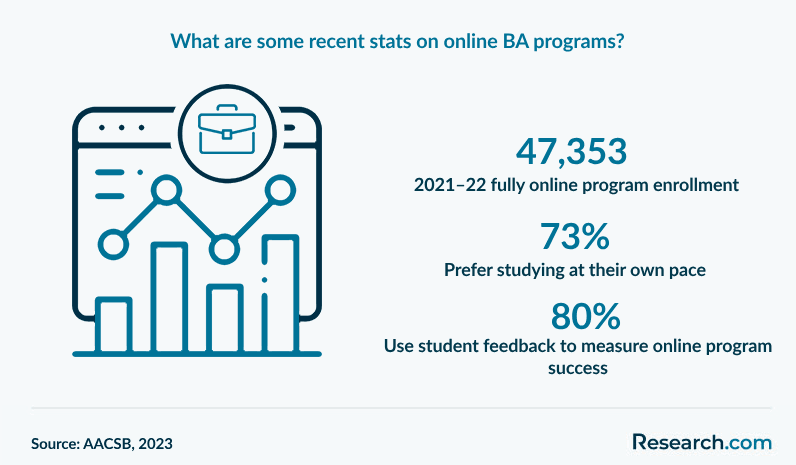
Recent statistics from AACSB (2023) show the continued growth of online graduate business education. In 2021-22, 47,353 students were enrolled in fully online programs across AACSB-accredited schools. The same source reported that 73% of prospective MBA students preferred studying at their own pace, and 80% of online programs used student feedback to measure program success.
What is the average cost of an online business administration degree program?
The cost of an online business administration degree can range from a few thousand dollars to over $50,000 per year. That wide range exists because schools price online programs differently and because students enter with different numbers of transfer credits.
Main cost drivers
| Cost factor | Why it matters | Question to ask |
| Public vs. private institution | Public universities generally charge lower tuition than private institutions | Is the listed tuition different for online students? |
| In-state vs. out-of-state status | Some public universities charge much more to out-of-state students | Is there a flat online rate for all students? |
| Transfer credits | Accepted credits can reduce the number of courses you must pay for | How many of my credits will apply to the major, not just transfer as electives? |
| Program level | Undergraduate and graduate business degrees often have different pricing structures | Am I comparing bachelor’s programs with bachelor’s programs? |
| Fees | Technology, course, student service, and graduation fees can raise the total cost | What is the full estimated cost to graduate? |
| Course materials | Textbooks, access codes, software, and simulations may be required | Are materials included in tuition or billed separately? |
Students comparing undergraduate business programs should avoid using MBA costs as a direct substitute, although graduate pages such as online MBA no GMAT options can help illustrate how business tuition varies by institution type and program format.
Cost should also be weighed against earnings potential. BA graduates can expect an average starting salary of $59,514, while top earners in this field can make up to $88,285 annually, as shown below.
What are the financial aid options for students enrolling in an online business administration degree program?
Online business administration students may qualify for many of the same financial aid options as campus-based students, provided the institution and program meet eligibility requirements. The most important first step is to complete the Free Application for Federal Student Aid (FAFSA).
- Federal grants: The Pell Grant may be available to eligible undergraduate students with financial need.
- Federal student loans: Undergraduate and graduate students may qualify for federal loans with specific interest rates, borrowing limits, and repayment terms.
- University scholarships: Schools may award funds based on academic achievement, financial need, transfer status, major, military affiliation, or other criteria.
- Private scholarships: Foundations, employers, professional associations, and community organizations may support business students.
- Employer tuition reimbursement: Some companies pay part of the cost for employees earning job-relevant degrees.
- Military and veteran benefits: Active-duty service members and veterans may be able to use GI Bill or related education benefits.
How to reduce the cost before enrolling
- Ask for a transfer-credit evaluation before committing.
- Compare the total cost to graduate, not only the per-credit tuition rate.
- Check whether online students pay out-of-state tuition.
- Ask whether textbooks, software, proctoring, or platform access fees are extra.
- Apply for school scholarships early, because deadlines may be before admission deadlines.
- If employed, ask HR whether tuition reimbursement is available and whether you must stay with the company after reimbursement.
What are the prerequisites for enrolling in an online business administration degree program?
Admission requirements depend on the level of the program and whether it is a full bachelor’s program or a degree-completion program. Always check the exact admissions page for each school because requirements can change.
| Program type | Common prerequisites | Important note |
| Undergraduate bachelor’s program | High school diploma or GED; sometimes SAT or ACT scores | Some schools are test-optional, but applicants should verify current policy |
| Transfer or degree-completion program | Prior college credits, minimum GPA, completed general education or lower-division courses | Admission may depend on whether credits are transferable and applicable |
| Graduate business program | Bachelor’s degree in any field; sometimes GMAT or GRE scores | Requirements also vary for fast track MBA 6 months online programs |
| Selective programs | Letters of recommendation, statement of purpose, resume, or prerequisite business courses | Stronger programs may review work experience and career goals |
Students who are not ready for a bachelor’s degree may want to begin with an associate pathway. Research.com also covers the best online associate degrees in business administration for learners who want a lower-cost starting point.
The 2023-2024 MBA application cycle also shows that business education remains competitive at the graduate level. Wharton received 7,322 applications, an 18% increase. Harvard experienced a 21% increase, Stanford saw an 18% jump, and MIT Sloan reported a 16% increase, along with a record-breaking 49% female enrollment and a class with a record-high undergraduate GPA of 3.7. Other reported increases included Kellogg at 23%, Yale at 21.5%, Tuck at 36%, NYU Stern at 48%, Duke Fuqua at nearly 16%, Olin with applications doubling, and Michigan Ross exceeding a 35% increase.
What courses are typically in an online business administration degree program?
Online business administration programs usually begin with a broad business core before allowing students to choose electives or concentrations. Even programs marketed as flexible or career-friendly usually require quantitative, communication, management, and analytical coursework.
- Principles of management: Introduces planning, organizing, leadership, decision-making, and organizational control.
- Financial accounting: Covers financial statements, budgeting, cost concepts, and the use of accounting information in business decisions.
- Managerial economics: Applies economic reasoning to pricing, production, markets, and managerial decision-making.
- Marketing: Explores consumer behavior, market research, product strategy, pricing, promotion, and distribution.
- Human resource management: Covers recruiting, selection, training, compensation, employee relations, and workforce development.
- Operations management: Focuses on production systems, process improvement, inventory, logistics, quality, and efficiency.
- Business law and ethics: Helps students understand legal responsibilities, contracts, compliance, and ethical decision-making.
- Business analytics or information systems: Builds skills in data interpretation, reporting, systems thinking, and technology-supported decisions.
- Strategic management: Often a capstone-style course that integrates finance, marketing, operations, leadership, and competitive analysis.
Students should expect serious business coursework even in the easiest business majors available online. “Easy” should not mean low-quality; it should mean better aligned with your strengths and career plans.
What types of specializations are available in online business administration degree programs?
Specializations help students turn a broad business degree into a more targeted career pathway. They are especially useful when they connect to internships, certifications, portfolios, or prior work experience.
| Specialization | What you study | Possible career direction |
| Finance | Financial management, investments, risk, markets, budgeting | Financial analyst, financial advisor, investment-related roles |
| Marketing | Brand strategy, market research, advertising, digital campaigns, sales | Marketing manager, market research analyst, advertising specialist |
| Human Resources | Recruitment, employee relations, training, compensation, organizational development | HR specialist, recruiter, training and development roles |
| International Business | Global trade, cross-cultural management, international operations, market entry | International business development, export management, global marketing |
| Healthcare Administration | Healthcare organizations, operations, compliance, finance, patient services | Healthcare administrator, hospital manager, healthcare consultant |
| Entrepreneurship | Business planning, startup finance, innovation, small business operations | Founder, small business owner, consultant |
| Supply Chain or Operations | Logistics, procurement, process improvement, inventory, quality management | Operations analyst, logistics coordinator, supply chain roles |
Students who want to specialize further after graduation can consider related graduate options, such as online Masters in HR degrees for people-focused leadership roles. Others may combine a business administration foundation with economics in graduate school; becoming an economist is one of the best economics masters degree best career options discussed by Research.com.
According to the U.S. Bureau of Labor Statistics (BLS), Business Administration graduates can expect to earn an average annual salary of $65,000. Related role-level figures cited in the source material include $87,016 per year for Financial Analysts, $88,285 for Marketing Managers, around $80,220 annually for Project Managers, and $108,790 for Business Analysts.
Is an online business administration degree worth the investment?
An online business administration degree can be worth the investment when the program is accredited, affordable, transferable, career-aligned, and completed with a clear plan for internships, projects, certifications, or advancement. It is less likely to pay off if a student overborrows, chooses a poorly supported program, ignores accreditation, or enters without a realistic career target.
To judge value, compare the total price of the degree with expected career opportunities, current work experience, regional job markets, and the strength of the school’s career services. Students still deciding whether the major itself fits their goals can review Research.com’s guide on is business administration a good major.
What emerging industry trends should online business administration students monitor?
Business education is changing because employers increasingly expect graduates to understand data, digital tools, remote collaboration, automation, and technology-supported decision-making. Online business administration students should pay attention to the following trends:
- Data-driven decision-making: Business roles increasingly involve dashboards, metrics, forecasting, and evidence-based recommendations.
- AI and automation: Routine reporting, customer segmentation, workflow automation, and administrative tasks may be reshaped by AI tools.
- Digital transformation: Organizations continue to modernize operations, sales, service delivery, supply chains, and internal systems.
- Credential stacking: Students may strengthen a general business degree with certifications in analytics, project management, HR, digital marketing, or software platforms.
- Flexible graduate pathways: Some students pair a business degree with specialized graduate study, including options such as the cheapest online data science master's programs.
How do you choose the best online business administration degree program?
The best online business administration program is the one that fits your goals at the lowest realistic total cost while meeting quality standards. Do not choose based only on ranking position or advertised tuition.
1. Verify accreditation first
At minimum, the institution should hold recognized institutional accreditation. Business-specific accreditation, such as AACSB International, can add credibility, especially for students who may pursue graduate school or competitive business roles.
2. Check whether the program fits your starting point
Some programs are full four-year online bachelor’s degrees. Others are degree-completion programs that expect 60 or more transfer credits. Applying to the wrong format can delay graduation or increase cost.
3. Compare total cost, not just tuition
Ask for an estimated full program cost that includes tuition, mandatory fees, technology fees, course materials, proctoring, graduation fees, and any residency or campus requirements.
4. Review the curriculum against your career goal
A student aiming for finance should not choose a program with limited quantitative coursework. A student interested in HR should look for people management, employment law, training, and organizational behavior coursework. Students wanting an economics foundation may also compare online economics degree cheap or affordable programs.
5. Evaluate online student support
- Academic advising: Helps with course sequencing, transfer credits, and graduation planning.
- Technical support: Essential for online exams, learning platforms, and virtual collaboration.
- Online library access: Important for research assignments and case analysis.
- Tutoring: Especially valuable for accounting, statistics, economics, and finance courses.
- Career counseling: Should include resume reviews, interview practice, job-search planning, and employer connections.
6. Ask about outcomes
Request available data on retention, graduation rates, job placement support, internship access, alumni networks, and graduate-school pathways. Be cautious if a school makes salary promises or cannot explain how online students receive career support.
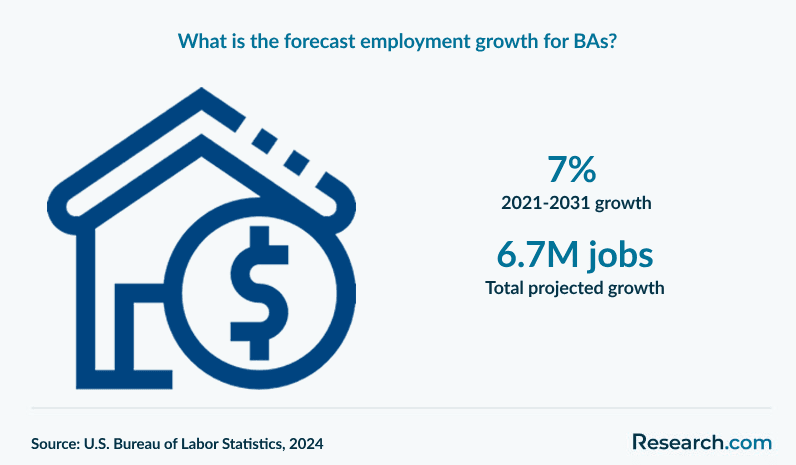
Business and finance occupations are projected to experience 7% job growth between 2021 and 2031, creating an estimated 715,000 new positions. This growth aligns with the overall employment projection of 6.7 million new jobs across all sectors from 2023 to 2033, as shown below.
What career paths are available for graduates of online business administration degree programs?
Graduates can pursue many business roles, but the strongest applicants usually pair the degree with experience, internships, measurable projects, certifications, or technical skills. Entry-level graduates may begin in coordinator, analyst, associate, or assistant manager roles before advancing into management.
| Career area | Example roles | Skills that help |
| Management | Project Manager, Operations Manager, Human Resources Manager | Leadership, scheduling, budgeting, communication, performance tracking |
| Finance | Financial Analyst, Financial Advisor, Accountant | Accounting, Excel, financial modeling, reporting, attention to detail |
| Marketing | Marketing Manager, Market Research Analyst, Advertising Specialist | Research, writing, campaign analysis, customer segmentation, digital tools |
| Sales | Sales Manager, Sales Representative, Business Development Manager | Negotiation, CRM systems, relationship building, presentation skills |
| Entrepreneurship | Founder, small business owner, business operator | Business planning, finance, marketing, operations, risk management |
| Consulting | Business Consultant, Management Consultant | Problem-solving, research, client communication, data interpretation |
| Nonprofit management | Nonprofit Organization Manager, program coordinator, development officer | Budgeting, grant awareness, stakeholder communication, program evaluation |
Your career options will depend on several factors: your specialization, GPA where relevant, internships, work history, industry contacts, location, and ability to demonstrate job-ready skills.
What career advancement resources do online business administration programs offer?
Strong online business programs do more than post lectures. They help students convert coursework into employable experience. Useful career resources may include virtual career fairs, alumni networks, employer panels, internship assistance, mentorship programs, resume feedback, interview coaching, and workshops on business analytics, leadership, communication, or digital workplace tools.
Students who plan to move into executive, consulting, research, or academic leadership may later consider doctoral business education, including DBA online pathways.
What advanced academic opportunities are available after earning an online business administration degree?
A business administration bachelor’s degree can lead to several graduate options. The right choice depends on whether you want leadership advancement, specialization, research training, or a career change.
- MBA: Best for broad management, leadership, strategy, and career mobility.
- Master’s in finance, accounting, marketing, HR, analytics, or data science: Best for students who want a specialized professional identity.
- Doctorate in business or leadership: Best for senior leadership, consulting, applied research, or teaching-oriented goals.
- Organizational leadership doctorate: Students interested in strategy, change management, and executive leadership can explore online doctoral programs in leadership.
What is the job market for graduates with an online business administration degree?
The job market for business administration graduates is broad rather than tied to one occupation. That is an advantage for flexibility, but it also means students must be intentional about specialization and experience.
Salary considerations
- Average starting salary: Graduates can expect an average starting salary of around $59,514 per year.
- Selected higher-paying roles: Financial Analysts and Marketing Managers can earn $87,016 and $88,285 per year, respectively.
- Role variation: Business analysts, project managers, HR specialists, operations roles, and marketing roles may have different salary trajectories.
Employment projections
- Business and finance growth: The U.S. Bureau of Labor Statistics projects a 7% increase in job openings in business and finance by 2031, providing around 715,000 opportunities.
- Overall employment: Total employment is projected to grow by 6.7 million jobs from 2023 to 2033.
Regional differences
Salary and job availability can vary by state and metro area. Regions with dense finance, healthcare, technology, logistics, consulting, or corporate headquarters activity may offer more business roles than areas with fewer large employers. For example, states with a higher concentration of financial institutions, like New York and California, may offer higher salaries and more job opportunities compared to other states.
What role does accreditation play in enhancing the value of online business administration degrees?
Accreditation is one of the most important quality checks for an online business degree. It affects transfer credit, graduate-school eligibility, employer confidence, and access to some forms of financial aid. Students should understand two levels of accreditation:
- Institutional accreditation: Confirms that the college or university meets recognized academic and operational standards.
- Business-school accreditation: AACSB, for example, is a specialized business accreditation associated with rigorous standards for faculty, curriculum, assessment, and continuous improvement.
Students comparing graduate business options can review AACSB accredited online schools to understand why business accreditation is often used as a quality signal. For bachelor’s students, it is still important to verify both the institution and the business program before enrolling.
What key questions should I ask when evaluating an online business administration program?
Before applying, ask questions that reveal real cost, quality, support, and career fit. These questions are more useful than relying only on a school’s promotional language.
- Is the institution regionally or otherwise properly accredited?
- Does the business school hold AACSB or another recognized business accreditation?
- Is the program fully online, hybrid, or only partially available online?
- How many transfer credits will count toward the degree requirements?
- What is the total estimated cost to graduate, including fees and course materials?
- Are courses asynchronous, synchronous, self-paced, or cohort-based?
- How often are courses offered, and can delayed course availability postpone graduation?
- What career services are available specifically to online students?
- Are internships, capstones, simulations, or consulting projects included?
- What technology, software, or proctoring requirements should students expect?
- Can the program support my target career path or graduate-school goal?
Students comparing accelerated graduate pathways after the bachelor’s degree may also review the fastest MBA online programs for future planning.
How can effective study strategies enhance success in online business administration programs?
Online business programs reward students who are organized, proactive, and comfortable communicating digitally. The flexibility is valuable, but it also removes some of the external structure that campus students receive automatically.
- Plan weekly study blocks: Treat online classes like scheduled work shifts, not optional tasks.
- Read the syllabus early: Identify major exams, group projects, presentations, and assignment deadlines at the start of each term.
- Participate actively: Use discussion boards, office hours, webinars, and group chats to stay visible and engaged.
- Build a portfolio: Save strong projects, analyses, presentations, and reports that can demonstrate skills to employers.
- Ask for help quickly: Accounting, finance, statistics, and analytics courses can become difficult if students wait too long to seek support.
- Connect coursework to career goals: Choose projects, electives, and internships that support your target role.
Students planning for graduate study can compare expectations with an online accredited MBA program to understand how business education becomes more advanced at the master’s level.
What is the return on investment of an online business administration degree?
The return on investment of an online business administration degree depends on what you pay, how much time you need to finish, whether you continue working while enrolled, and how the credential improves your career options. A lower-cost program with strong transfer credit acceptance can produce a better ROI than a higher-priced program with similar outcomes.
Simple ROI checklist
- Calculate your full cost to graduate, including tuition, fees, books, software, and lost income if you reduce work hours.
- Compare the cost against realistic salary outcomes for your target role, not the highest-paying role in the field.
- Check whether your chosen concentration leads to specific job postings in your region.
- Ask whether the school provides internship support, employer connections, and alumni networking for online students.
- Review debt carefully and avoid borrowing based on optimistic salary assumptions.
For broader cost benchmarking, students can review Research.com’s guide to online business degree cost.
Do employers value online business administration degrees equally to traditional ones?
Many employers focus less on whether a degree was online and more on whether it came from an accredited institution, what skills the graduate can demonstrate, and whether the candidate has relevant experience. Online graduates can strengthen employer confidence by completing internships, earning certifications, building portfolios, contributing to team projects, and clearly explaining what they learned.
Employer perceptions are usually strongest when the online program is offered by a recognized college or university and the diploma does not signal a lower-quality or separate credential. Students considering future graduate programs should compare rigor carefully, including options such as the easiest MBA programs, and make sure convenience does not come at the expense of credibility.
What factors affect the true cost of an online business administration degree?
The true cost of an online business administration degree is often higher than the advertised tuition rate. Some schools separate tuition from mandatory fees, technology charges, textbooks, proctoring, course software, graduation fees, and transcript fees. Others charge different rates based on residency, enrollment load, or program format.
| Hidden or overlooked cost | Why it matters | How to manage it |
| Technology fees | Online platforms, software, and digital systems may be billed separately | Ask for a full fee schedule before enrolling |
| Course materials | Textbooks, access codes, and simulations can add up each term | Ask whether open educational resources are used |
| Transfer credit loss | Credits that do not apply to the major can extend time in school | Request a degree audit before committing |
| Out-of-state tuition | Some online students pay significantly more based on residency | Look for flat-rate online tuition when available |
| Reduced work hours | Lost income can be part of the real cost | Choose a course load that does not jeopardize employment |
| Graduate-school plans | A low-quality bachelor’s program may limit future options | Prioritize accreditation and academic reputation |
Students planning to continue into graduate business education can compare these factors with the average cost of online MBA programs to understand how costs may change after the bachelor’s degree.
Can complementary certifications boost career outcomes?
Certifications can strengthen a business administration degree when they validate a specific job skill. They are especially useful for students whose degree is broad and who want to stand out in a targeted field.
- Project management: Useful for operations, consulting, technology, healthcare, and team leadership roles.
- Digital marketing: Helpful for students targeting marketing, advertising, social media, analytics, or ecommerce work.
- Data analytics: Valuable for business analyst, operations analyst, finance, and reporting roles.
- Human resources: Helpful for recruiting, employee relations, workforce development, and HR compliance paths.
- Software and platform credentials: CRM, spreadsheet, analytics, accounting, and visualization tools can show immediate workplace readiness.
Students drawn to project leadership may compare degree and credential options such as a fast track bachelor's degree in project management online. The best certifications are those that match real job postings in your target industry and location.
Common mistakes to avoid when choosing an online business administration degree
| Mistake | Why it can hurt you | Better approach |
| Choosing only by lowest tuition | A cheap program can become expensive if credits do not transfer or support is weak | Compare total cost, completion time, accreditation, and outcomes |
| Ignoring accreditation | May affect financial aid, transfer credits, graduate school, and employer trust | Verify institutional accreditation and business accreditation when relevant |
| Assuming all online programs are fully online | Some programs include campus visits, hybrid requirements, or limited online coursework | Ask whether every required course can be completed online |
| Overlooking transfer policies | Lost credits can add semesters and thousands of dollars | Get a written transfer evaluation and degree plan |
| Relying only on rankings | Rankings may not reflect your cost, schedule, state residency, or career goals | Use rankings as a starting point, then verify program fit |
| Assuming salary outcomes are guaranteed | Pay depends on role, experience, location, and performance | Research job postings and salary ranges for your target role |
Key Insights
- The cheapest online business administration degree is usually a public, accredited program with strong transfer-credit acceptance and low per-credit or flat-rate online tuition.
- Business administration is valuable because it is flexible, but students need a career direction. Finance, marketing, HR, operations, analytics, healthcare administration, and entrepreneurship require different electives and experiences.
- Online and on-campus degrees can carry similar value when the institution is accredited and academic standards are comparable. The bigger difference is learning style and student support.
- Costs can range from a few thousand dollars to over $50,000 per year, so students should calculate total cost to graduate, not just listed tuition.
- BA graduates can expect an average starting salary of $59,514, while selected roles such as Financial Analysts, Marketing Managers, Project Managers, and Business Analysts show higher reported salary figures.
- Business and finance occupations are projected to experience 7% job growth between 2021 and 2031, creating an estimated 715,000 new positions, while overall employment is projected to grow by 6.7 million jobs from 2023 to 2033.
- Accreditation, transfer policy, curriculum relevance, online career services, and total cost are more important than choosing the program with the most polished marketing.
- Certifications in project management, digital marketing, data analytics, HR, or business software can help turn a broad business degree into a more targeted employment profile.
References:
- AACSB International. (2023). How MBA programs are changing with the market. AACSB International.
- Bureau of Labor Statistics. (2023). Business and financial occupations. U.S. Department of Labor. Bureau of Labor Statistics.
- Byrne, J. A. (2024). Boom! Applications skyrocket at the world's MBA programs. Poets & Quants.
- National Association of Colleges and Employers. (2023). Salary survey: Starting salaries for new college graduates. National Association of Colleges and Employers.
- State of New York. (2023). Employment opportunities in finance. State of New York.
Other Things You Should Know About Online Business Administration Degree Programs
Yes. Cheapest online business administration degrees should come from institutions accredited by a U.S. Department of Education-recognized regional accreditor. For business programs, AACSB, ACBSP, or IACBE accreditation is a strong quality marker, and many employers and graduate schools expect it.
In 2027, the cheapest online business administration degrees typically require 120 to 130 credit hours for completion. Programs may include required core courses, elective options, and potential internship credits. Specific requirements can vary based on the institution and program.


