2027 Cheapest Online Economics Degree Programs

Co-Founder and Chief Data Scientist
Choosing the cheapest online economics degree is not just about finding the lowest tuition. The better question is whether a program gives you recognized accreditation, transferable credits, useful quantitative training, and career support at a price that will not weaken your long-term financial position. Economics can lead to roles in finance, policy, analytics, consulting, market research, government, and business strategy, but the value of the degree depends heavily on program quality, total cost, and how well the curriculum matches your career goals.
This guide is for students comparing affordable online economics degree programs, working adults who need a flexible path to a bachelor’s degree, transfer students trying to reduce time to graduation, and career changers who want stronger analytical and data skills. You will learn what online economics programs usually include, how costs compare, what financial aid may be available, how to evaluate accreditation and ROI, and which lower-cost programs deserve closer review.
Quick answer: What is the cheapest online economics degree worth considering?
The cheapest online economics degree is usually a regionally accredited bachelor’s program with a low per-credit rate, generous transfer credit policies, and limited added fees. Based on the programs listed in this guide, Eastern Oregon University has one of the lowest stated per-credit costs at $316, while UMass Dartmouth lists $359 per credit and Oregon State University lists $366 per credit. However, the lowest per-credit price is not always the lowest total cost because programs differ in required credits, transfer rules, fees, and financial aid packages.
For most students, the best-value online economics degree is the one that combines affordability with accreditation, strong coursework in microeconomics, macroeconomics, econometrics, statistics, and policy analysis, plus support services that help online learners complete the degree rather than simply enroll.
Why earn an economics degree online?
- Career flexibility: Economics graduates can pursue work in finance, consulting, government, public policy, market research, data analysis, banking, and international organizations.
- Income potential: Professionals with an economics degree earn a median salary of around $60,000 to $75,000 per year, with higher earnings possible as experience, technical skills, and responsibility increase.
- Lower indirect costs: Online study may help students avoid relocation, commuting, and campus housing costs while continuing to work or manage family responsibilities.
- Transferable skills: Economics develops quantitative reasoning, statistical analysis, research, forecasting, writing, and decision-making skills that apply across many industries.
What can I expect from an online degree in economics?
An online economics degree teaches students how markets, institutions, businesses, governments, and consumers make decisions under constraints. At the bachelor’s level, students usually build a foundation in economic theory, statistics, calculus or applied math, data interpretation, and policy analysis. At the master’s level, coursework is typically more quantitative and may focus on econometrics, forecasting, economic modeling, and applied research.
| Program feature | What it usually means for students | Why it matters |
| Tuition range | Online bachelor’s programs typically range from $10,000 to $30,000, while master’s programs may range from $20,000 to $60,000 depending on school and level. | Total cost affects ROI, borrowing needs, and how much flexibility you have after graduation. |
| Common coursework | Microeconomics, macroeconomics, econometrics, game theory, international trade, financial markets, and public policy are common subjects. | Employers often value economics graduates who can combine theory with data analysis and practical problem-solving. |
| Time to completion | Bachelor’s programs often take 3 to 4 years, while master’s programs commonly take 1 to 2 years. Some schools offer accelerated options. | Your timeline depends on transfer credits, course load, program format, and whether you study full time or part time. |
| Online delivery | Programs may use asynchronous courses, live class sessions, discussion boards, recorded lectures, virtual advising, and online exams. | The format should match your schedule, learning style, and need for interaction with faculty and classmates. |
| Career preparation | Many programs include capstones, research projects, internships, or applied assignments in policy, finance, or analytics. | Hands-on work helps you show employers more than a transcript. |
Where can I work with an online degree in economics?
An accredited online economics degree can support employment in both public and private sectors. In government, graduates may analyze labor markets, inflation trends, regional development, tax policy, public spending, or regulatory effects. In nonprofit and policy settings, economics training can support research, grant evaluation, program assessment, and social impact analysis.
In the private sector, economics graduates often move into finance, market research, business intelligence, risk analysis, management consulting, banking, insurance, and operations strategy. The exact role you qualify for will depend on your degree level, internship or work experience, software skills, quantitative preparation, and ability to explain data clearly to nontechnical audiences.
How much can I make with an online degree in economics?
Salary outcomes vary by role, region, employer, experience, and degree level. Entry-level roles often start around $50,000 to $60,000 annually. With experience, many professionals may move into the $70,000 to $90,000 range. Senior roles such as economic consultant, financial analyst, or policy advisor can exceed $100,000 annually, especially when paired with advanced training, strong modeling skills, or industry specialization.
Students should treat salary figures as planning benchmarks rather than guarantees. Your earnings will depend on how well you build complementary skills in statistics, spreadsheet modeling, programming, research design, financial analysis, and communication.
- Cheapest online economics degree programs for 2027
- How long does an online economics degree take?
- Online economics degree vs. on-campus economics degree
- Average cost of an online economics degree
- Financial aid for online economics students
- Admissions requirements and prerequisites
- Typical economics courses online students take
- Common economics specializations
- How to choose the right online economics program
- Career paths for economics graduates
- How an economics degree can strengthen MBA applications
- Job market for online economics graduates
- Online economics degree cost compared with an online MBA
- Starting with an affordable online business associate degree
- ROI of an online economics degree
- Challenges of online economics study
- Using executive programs to build on an economics degree
- Lifelong learning and career development
- Combining economics with accelerated business programs
- Using economics training for entrepreneurship
- References and sources
List of the Cheapest Online Economics Degree Programs for 2027
How we rank and review schools
Finding an affordable online economics degree can be difficult because schools report tuition, fees, residency rates, transfer policies, and program requirements differently. Research.com evaluates programs using verified education datasets and program-level information where available. Students should still confirm current tuition, fees, accreditation, and transfer policies directly with each school before applying.
- Integrated Postsecondary Education Data System (IPEDS database)
- Peterson’s database, including the Distance Learning Licensed Data Set
- College Scorecard database
- National Center for Education Statistics
| Rank | School and program | Estimated cost per credit | Credits required | Accreditation listed |
| 1 | Liberty University — Bachelor of Science in Business Administration, Economics specialization | $390 | 120 | Accreditation Council for Business Schools and Programs |
| 2 | Regent University — B.S. in Business with an Economics concentration | $450 | 120 | Accreditation Council for Business Schools and Programs |
| 3 | UMass Dartmouth — B.S. in Economics | $359 | 120 | New England Commission of Higher Education |
| 4 | Eastern Oregon University — Bachelor’s Degree in Economics | $316 | 180 | Northwest Commission on Colleges and Universities |
| 5 | Penn State University — Bachelor of Science in Economics | $632 | 180 | Middle States Commission on Higher Education |
| 6 | Colorado State University — Bachelor of Arts in Economics | $476 | 120 | Higher Learning Commission |
| 7 | Arizona State University — Bachelor of Science in Economics | $744 | 120 | Accreditation Council for Business Schools and Programs |
| 8 | University of Wisconsin-Whitewater — Bachelor of Business Administration in Economics | $412 | 120 | Accreditation Council for Business Schools and Programs |
| 9 | Oregon State University — Bachelor of Arts in Economics | $366 | 180 | Accreditation Council for Business Schools and Programs |
| 10 | Utah State University — Bachelor of Science or Arts in Economics | $394 | 60 | Northwest Commission on Colleges and Universities |
1. Liberty University Bachelor of Science in Business Administration
Liberty University offers an online Bachelor of Science in Business Administration with an Economics specialization for students who want business training with a focused economics track. The program emphasizes analytical reasoning, business decision-making, problem-solving, and data interpretation, which can be useful for students aiming for finance, consulting, public policy, or management roles.
- Program length: 8 weeks
- Track or concentration: Economics
- Estimated cost per credit: $390
- Required credits to graduate: 120
- Accreditation: Accreditation Council for Business Schools and Programs
2. Regent University B.S. in Business with an Economics concentration
Regent University provides an online B.S. in Business with an Economics concentration for students seeking a business-centered economics program taught from a Christian perspective. Coursework is designed to strengthen analysis, communication, and problem-solving skills for careers in banking, financial analysis, market research, and related fields.
- Program length: 4 years
- Track or concentration: Economics
- Estimated cost per credit: $450
- Required credits to graduate: 120
- Accreditation: Accreditation Council for Business Schools and Programs
3. University of Massachusetts-Dartmouth B.S. in Economics
UMass Dartmouth offers an online B.S. in Economics that combines economic theory, data analysis, policy evaluation, and market interpretation. The program includes asynchronous coursework and one-on-one advising, which may benefit working adults and transfer students who need a structured but flexible degree path.
- Program length: 4 years
- Track or concentration: Economics
- Estimated cost per credit: $359
- Required credits to graduate: 120
- Accreditation: New England Commission of Higher Education
4. Eastern Oregon University Bachelor's Degree in Economics
Eastern Oregon University offers an online bachelor’s degree in economics with lower-division and upper-division coursework in microeconomics, calculus, statistics, research methods, economic theory, and econometrics. The program also includes a faculty-supervised capstone, giving students a chance to apply economics concepts to a more practical project.
- Program length: 4 years
- Track or concentration: Economics
- Estimated cost per credit: $316
- Required credits to graduate: 180
- Accreditation: Northwest Commission on Colleges and Universities
5. Penn State University Bachelor of Science in Economics
Penn State University offers an online Bachelor of Science in Economics for students who want a broad understanding of economic systems, markets, and applied analysis. Students can choose electives in economics and supporting social science fields, which may help them tailor the degree toward public policy, business, analytics, or graduate study.
- Program length: 4 years
- Track or concentration: Economics
- Estimated cost per credit: $632
- Required credits to graduate: 180
- Accreditation: Middle States Commission on Higher Education
6. Colorado State University Bachelor of Arts in Economics
Colorado State University offers an online Bachelor of Arts in Economics focused on economic principles, quantitative reasoning, and the role of human behavior in economic systems. Courses are taught by the same faculty who teach on campus, and online office hours support student interaction with instructors.
- Program length: 4 years
- Track or concentration: Economics
- Estimated cost per credit: $476
- Required credits to graduate: 120
- Accreditation: Higher Learning Commission
7. Arizona State University Bachelor of Science in Economics
Arizona State University offers an online Bachelor of Science in Economics through a business-oriented curriculum. Students study microeconomics, macroeconomics, applied statistics, and business applications, with electives available in areas such as international economics and labor markets.
- Program length: 4 years
- Track or concentration: Economics
- Estimated cost per credit: $744
- Required credits to graduate: 120
- Accreditation: Accreditation Council for Business Schools and Programs
8. University of Wisconsin-Whitewater Bachelor of Business Administration
The University of Wisconsin-Whitewater offers an online Bachelor of Business Administration in Economics for students who want economics within a business school framework. The curriculum emphasizes economic literacy, quantitative analysis, and critical thinking, while online learners can access advising, library services, financial aid, technical support, mentoring, and career services.
- Program length: 4 years
- Track or concentration: Economics
- Estimated cost per credit: $412
- Required credits to graduate: 120
- Accreditation: Accreditation Council for Business Schools and Programs
9. Oregon State University Bachelor of Arts in Economics
Oregon State University offers an online Bachelor of Arts in Economics that develops quantitative reasoning, analytical thinking, and understanding of incentives, institutions, and market behavior. The program can support career preparation in business, public policy, law, and graduate study.
- Program length: 4 years
- Track or concentration: Economics
- Estimated cost per credit: $366
- Required credits to graduate: 180
- Accreditation: Accreditation Council for Business Schools and Programs
10. Utah State University Bachelor of Science or Arts in Economics
Utah State University offers an online Bachelor of Science or Arts in Economics for students interested in production, distribution, consumption, markets, and applied decision-making. The online structure gives students flexibility, while faculty experience helps connect abstract economic concepts to real-world applications.
- Program length: 4 years
- Track or concentration: Economics
- Estimated cost per credit: $394
- Required credits to graduate: 60
- Accreditation: Northwest Commission on Colleges and Universities
How long does it take to complete an online degree in economics?
The completion timeline depends on degree level, transfer credits, course load, and whether the program is built for first-time students or degree-completion students. A full bachelor’s degree commonly takes four years, while some completion programs can take about two years for students who already have substantial college credit. A master’s degree can often be completed in about 20 months, depending on pacing and program design.
Bachelor’s degree timeline
- Standard full-time path: Most online bachelor’s programs in economics require around 120 credits and take approximately four years for full-time students.
- Accelerated or completion path: Some students with prior college credit can finish faster. This can be similar in planning to the fastest way to get a finance degree, where transfer credit and condensed terms can shorten the overall timeline.
- Part-time study: Students taking fewer courses each term may need five years or more to finish.
Master’s degree timeline
- Typical duration: Online master’s programs, including examples such as the MA in Economics at American University, generally take about 20 months and often require around 30 credit hours, 10 courses, and a capstone project.
- Working-professional pacing: Many graduate programs allow students to slow down or adjust course loads, which can extend the timeline but make study more manageable.
Some students begin with a related associate degree in business administration, although an associate degree is not typically required before entering a master’s program. If you are still early in your academic path, comparing the best associate degree in business administration online options may help you decide whether to start with a lower-cost credential before pursuing a bachelor’s degree.
How does an online degree in economics compare to an on-campus program?
Online and on-campus economics degrees can lead to similar academic outcomes when the programs are accredited and academically rigorous. The main differences are delivery format, scheduling, access to campus experiences, cost structure, and the level of face-to-face interaction.
| Factor | Online economics degree | On-campus economics degree |
| Schedule | Often more flexible, especially when courses are asynchronous. | Usually follows fixed class meeting times. |
| Cost considerations | May reduce commuting, relocation, and housing costs. | May involve campus fees, transportation, and housing expenses. |
| Course availability | Some specialized electives may be limited online. | May offer broader access to seminars, labs, and in-person electives. |
| Networking | Requires intentional effort through virtual events, discussion boards, alumni networks, and internships. | More spontaneous access to classmates, faculty, clubs, and campus events. |
| Best fit | Working adults, parents, military learners, transfer students, and students who cannot relocate. | Students who want a traditional college environment and frequent in-person interaction. |
Online programs vary widely in quality. Some offer polished course design, active faculty engagement, and strong advising, while others may rely on older materials or limited interaction. This is why students should compare sample courses, technology requirements, faculty access, advising availability, and outcomes before enrolling. Many students also compare economics with other online options, including the easiest bachelor degree to get online, but ease should never replace fit, accreditation, and career value.
Students interested in interdisciplinary careers sometimes pair economics with adjacent fields. For example, those interested in social policy, public finance, or community development may also review accredited BSW online programs to understand how social services and economic policy can intersect.
What is the average cost of an online degree in economics?
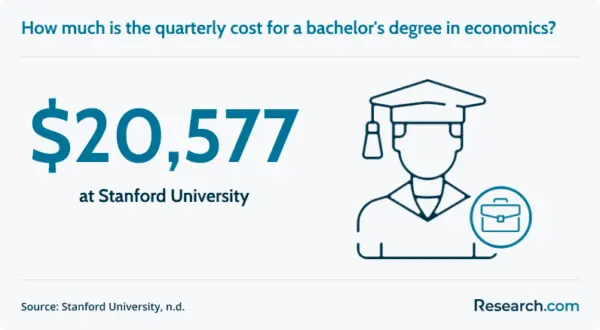
The total cost of an online economics degree varies by school, residency status, fees, number of required credits, transfer credits, and institutional pricing. A bachelor’s degree generally ranges from $30,000 to $70,000 overall. Public universities may offer lower rates than private institutions, but students should compare total program cost rather than tuition alone.
For example, Liberty University lists around $390 per credit, while Penn State University lists about $626 per credit. Eastern Oregon University’s total program cost is approximately $56,880, and Oregon State University lists about $366 per credit. The average annual tuition for online bachelor’s degrees in economics can range from $9,000 to $35,000.
Students comparing economics with adjacent business credentials should remember that a certificate and a bachelor’s degree are priced very differently. For example, the cost structure for an online certificate in accounting may not resemble the cost of a full economics bachelor’s program.
What are the financial aid options for students enrolling in an online degree in economics?
Online economics students may qualify for several types of financial aid, but eligibility depends on the school, accreditation status, enrollment level, financial need, academic record, and program structure. Always confirm that the program is eligible for federal aid before assuming loans or grants will apply.
Federal financial aid
- FAFSA: The Free Application for Federal Student Aid is the main application for federal aid eligibility.
- Pell Grants: These need-based grants may be available to eligible undergraduate students.
- Federal student loans: Subsidized and unsubsidized loans can help cover tuition and required fees.
State financial aid
- State grants: Some states offer grants or scholarships that can be used for online programs.
- State loans: Eligible students may have access to state-sponsored borrowing options.
Institutional aid
- Scholarships: Colleges may offer merit-based, need-based, transfer, military, or program-specific scholarships for online students.
- Grants: Some schools provide institutional grants that reduce tuition or fees.
Private and employer-based aid
- Private scholarships: Professional groups, foundations, businesses, and local organizations may fund students pursuing economics or business-related degrees.
- Employer tuition reimbursement: Some employers help pay for approved coursework when the degree supports professional development.
What are the prerequisites for enrolling in an online degree in economics?
Admissions requirements differ by school, but online economics programs usually expect applicants to show readiness for college-level quantitative work. Requirements may overlap with business-related programs such as a BS in finance online.
- High school diploma or GED: Most bachelor’s programs require proof of secondary school completion.
- Math preparation: Algebra, statistics, calculus, and sometimes Calculus I and II may be required or strongly recommended.
- English proficiency: International applicants may need TOEFL, IELTS, or another approved English-language assessment.
- Transfer credits: Students with prior college coursework may be able to apply credits toward general education, electives, or major requirements.
- Technology access: Online learners need a reliable computer, stable internet, and the ability to use the school’s learning management system.
What courses are typically in an online degree in economics?
Online economics programs combine theory, math, statistics, research, and applied analysis. The strongest programs help students connect classroom models to actual decisions made by businesses, governments, consumers, and financial institutions.
Core economics courses
- Microeconomics: Study of households, firms, markets, pricing, incentives, competition, and consumer behavior.
- Macroeconomics: Analysis of national and global economic performance, including inflation, unemployment, fiscal policy, monetary policy, and growth.
- Econometrics: Use of statistical methods to analyze economic data, test theories, and estimate relationships.
Common specialized courses
- International economics: Covers trade, exchange rates, global markets, and cross-border economic policy.
- Financial economics: Examines financial markets, risk, securities, investments, and economic forces affecting capital markets.
- Labor economics: Focuses on employment, wages, labor supply, labor demand, and workforce trends.
- Public finance: Studies taxation, government spending, budgeting, and the economic effects of public policy.
- Environmental economics: Looks at pollution, resource use, environmental regulation, climate-related costs, and policy trade-offs.
What types of specializations are available in an online degree in economics?
Specializations differ by institution and degree level. Before applying, review the actual course catalog rather than relying only on program marketing pages, because some schools list economics broadly but offer only a limited number of upper-division electives online.
| Specialization | Best fit for students interested in | Typical career relevance |
| Financial economics | Markets, banking, investments, securities, and risk. | Financial analysis, banking, investment research, and risk-related roles. |
| International economics | Trade, exchange rates, international development, and global policy. | Global business, trade analysis, policy research, and international organizations. |
| Public economics | Taxation, government spending, regulation, and public-sector decision-making. | Policy analysis, government research, nonprofit work, and public administration. |
| Environmental economics | Climate policy, pollution, natural resources, and sustainability trade-offs. | Environmental policy, consulting, public agencies, and sustainability analysis. |
| Econometrics | Statistical modeling, causal inference, forecasting, and applied data analysis. | Research, analytics, graduate study, and quantitative roles. |
| Health economics | Healthcare costs, insurance, public health policy, and healthcare markets. | Health policy, healthcare consulting, insurance analysis, and public health research. |
| Development economics | Economic growth, poverty, institutions, and low-income countries. | International development, policy research, NGOs, and government agencies. |
| Labor economics | Employment patterns, wages, workforce policy, and labor market behavior. | Workforce analytics, HR strategy, policy analysis, and research roles. |
How to choose the best online degree in economics?
The best online economics degree is not automatically the cheapest or the highest-ranked. It is the program that meets your academic needs, supports your career target, fits your schedule, and keeps borrowing at a manageable level. Use the following criteria before committing.
- Confirm accreditation: Make sure the institution is accredited by a recognized agency. Accreditation affects financial aid eligibility, credit transfer, employer recognition, and graduate school options. Degree value matters more than surface-level comparisons, just as students researching a high MFA degree salary must still consider program quality and fit.
- Review the curriculum: Look for microeconomics, macroeconomics, econometrics, statistics, research methods, and applied electives aligned with your goals.
- Compare total cost: Include tuition, fees, books, software, technology costs, residency pricing, and the number of credits you actually need after transfer evaluation.
- Check transfer credit policies: A slightly higher per-credit rate may still cost less if the school accepts more of your previous coursework.
- Evaluate online format: Decide whether you prefer asynchronous courses, live sessions, short terms, traditional semesters, or self-paced options.
- Ask about support services: Strong advising, tutoring, library access, technical help, and career services can improve completion odds for online learners.
- Look for applied experience: Capstones, research projects, internships, and portfolio assignments can help you demonstrate job-ready skills.
- Use cost examples carefully: Tuition varies significantly. For instance, some programs may cost around $6,168 for in-state students at Florida International University, but your actual cost depends on your residency, aid, and credit load.
Questions to ask before enrolling
- Is the institution regionally accredited or otherwise recognized by an appropriate accreditor?
- How many of my transfer credits will apply directly to the degree?
- Are all required upper-level economics courses available online?
- Are courses asynchronous, synchronous, or mixed?
- What fees are charged in addition to tuition?
- Does the program include econometrics, statistics, and applied data work?
- What career services are available to online students?
- Can I access internships, research projects, or faculty mentorship remotely?
What career paths are available for graduates of an online degree in economics?
Economics graduates often compete for roles that require quantitative thinking, research, financial analysis, forecasting, and policy interpretation. Some also move into technology-adjacent jobs where data literacy and business reasoning are important. Students who want a less traditional route can compare economics with technology-oriented pathways, including the easiest information technology jobs, especially if they plan to add skills in databases, programming, or business intelligence.
Some graduates continue into advanced degrees, including business, public policy, data science, law, or leadership-focused doctorates. Those considering senior management or organizational strategy may also compare affordable doctoral programs in leadership with economics graduate programs.
| Career path | What the role typically does | Skills that matter |
| Economist | Analyzes economic data, forecasts trends, and advises organizations or policymakers. | Econometrics, research design, modeling, writing, and policy interpretation. |
| Data analyst | Collects, cleans, analyzes, and explains data to support business decisions. | Statistics, spreadsheets, visualization, databases, and communication. |
| Financial analyst | Evaluates investments, financial statements, markets, and business performance. | Financial modeling, valuation, economics, accounting, and Excel skills. |
| Actuary | Uses math and statistics to assess risk, often in insurance or finance. | Probability, statistics, modeling, and risk analysis. |
| Policy analyst | Studies policy proposals and evaluates economic effects for agencies or nonprofits. | Research, writing, cost-benefit analysis, and public finance. |
| Market research analyst | Studies markets, customers, competitors, and demand for products or services. | Survey analysis, statistics, consumer behavior, and reporting. |
| Investment banker | Supports capital raising, mergers, acquisitions, and financial advisory projects. | Finance, valuation, modeling, presentation, and client communication. |
| Management consultant | Diagnoses business problems and recommends ways to improve performance. | Structured problem-solving, analytics, strategy, and communication. |
Market research analyst is often cited as one of the best careers to pursue with an economics masters degree because the role uses research, data interpretation, and business judgment. Median annual wages for economists in May 2023 varied across top industries. Economists in scientific research and development services earn $140,940.
How can an online economics degree boost your MBA prospects?
An economics degree can strengthen MBA preparation by building comfort with quantitative analysis, market behavior, pricing, incentives, risk, and policy effects. These skills are useful in MBA coursework involving finance, strategy, operations, analytics, and managerial economics. Students planning to move into leadership may compare economics preparation with the most affordable MBA programs to decide whether an MBA is a logical next step after completing the bachelor’s degree.
What is the job market for graduates with an online degree in economics?
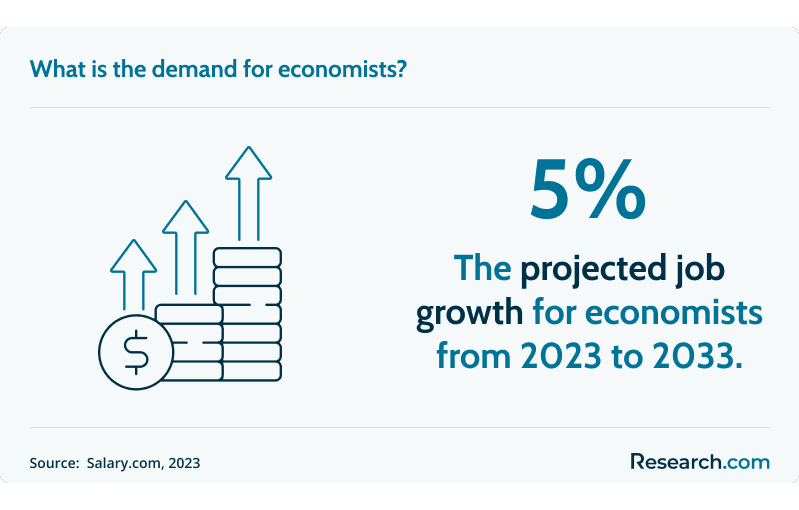
The job market for economics graduates is shaped by demand for analytical workers who can interpret data, evaluate trade-offs, and explain economic conditions. Employment opportunities for economists are projected to grow by 5% from 2023 to 2033, significantly faster than the national average for all occupations. Graduates may pursue roles as economists, financial analysts, data analysts, policy analysts, and market research analysts across business, finance, government, nonprofit, and consulting settings.
The degree is valuable partly because its skills transfer well. Critical thinking, statistical reasoning, economic modeling, and research writing can apply in many roles beyond the title “economist.” For example, nearly 96% of graduates from American University’s MA in Economics program are actively employed or pursuing further education. Still, students should be realistic: many economics roles reward candidates who pair the degree with internships, software skills, strong writing samples, and evidence of applied analysis.
Current trends affecting economics graduates
- Data-driven decision-making: Employers increasingly expect analysts to use data tools, not just theory.
- AI and automation: Routine reporting may become more automated, making interpretation, model judgment, domain knowledge, and communication more important.
- Demand for applied skills: Economics graduates who can work with spreadsheets, statistical software, visualization tools, and large datasets may have more options.
- Cross-functional roles: Economics training is often useful in finance, operations, policy, product strategy, and market intelligence rather than only in economist positions.
Are online economics degree programs accredited?
Many online economics degree programs are accredited, but students must verify the status of each school and program before enrolling. Accreditation signals that an institution meets recognized academic standards. It can affect federal financial aid eligibility, transfer credit acceptance, graduate school admission, and employer confidence in the credential.
When comparing programs, check the accreditor listed on the school’s website and confirm it through official databases. Business-oriented economics programs may also list programmatic accreditation. Students comparing flexible business pathways can also review the fastest online business degree programs to understand how accreditation and delivery format affect business education options.
How does an online economics degree compare in cost to an online MBA?
An online economics bachelor’s degree and an online MBA serve different purposes, so cost comparisons should account for degree level, credits required, tuition rate, and career objective. A bachelor’s degree is often a first major credential for entry-level and mid-level roles, while an MBA is a graduate business degree usually pursued after some academic or professional foundation.
If your goal is analytical work, policy research, finance, or data-oriented business roles, an economics degree may be the more focused starting point. If your goal is management, executive leadership, or career pivoting into broader business functions, an MBA may become useful later. Reviewing the cost of an MBA online can help you benchmark graduate-level costs before deciding whether to pursue economics first, business first, or both over time.
Should I start with an affordable online business associate's degree before pursuing an online degree in economics?
Starting with an associate degree can make sense if you want a lower-cost entry point, need to improve your academic record, or plan to complete general education and business basics before transferring into a bachelor’s program. This route can be especially useful for students who are unsure about committing to a four-year economics degree immediately.
The risk is transfer loss. Before enrolling, confirm whether credits from the associate program will apply to the future economics degree. If you want a staged approach, compare an affordable online business associate's degree with bachelor’s completion policies at your target schools.
Do employers view online economics degrees as credible?
Employers are generally more concerned with accreditation, skills, experience, and evidence of performance than whether the degree was completed online or on campus. An accredited online economics degree can be credible when the curriculum is rigorous and the student can demonstrate quantitative ability, communication skills, and applied experience.
Credibility improves when graduates complete internships, build a portfolio of analysis projects, learn relevant software, and continue professional development. Some professionals later add graduate business education, including affordable executive MBA programs online, when they are ready for leadership-focused roles.
What is the ROI of an online economics degree?
The ROI of an online economics degree depends on total cost, debt, completion time, salary growth, career fit, and how effectively the student uses the degree. A low-cost program with strong transfer credit acceptance and clear career alignment may produce better ROI than a more expensive program with limited support or weak completion outcomes.
To evaluate ROI, estimate your total cost after grants and scholarships, subtract transfer credits, consider lost work time if any, and compare the result with realistic earnings in your target roles. Students who later want management training may consider programs such as the best online MBAs, but an MBA should be evaluated as a separate investment rather than an automatic next step.
Common ROI mistakes to avoid
- Comparing only tuition per credit without checking required credits and fees.
- Ignoring transfer credit limits that can add extra semesters.
- Assuming every economics graduate will earn a senior-level salary immediately.
- Choosing a program without verifying accreditation.
- Overlooking the need for internships, software skills, and applied projects.
- Borrowing heavily for a program that does not match your career goals.
What challenges might I encounter with an online economics degree?
Online economics programs can be demanding because they combine independent learning with quantitative coursework. Students may struggle with math-heavy classes, limited in-person interaction, time management, and staying motivated without a campus routine. Networking may also require more intentional effort than in an on-campus environment.
To manage these challenges, use tutoring early, attend virtual office hours, form online study groups, schedule weekly problem-set time, and practice explaining concepts in writing. Students who later need leadership training can compare options such as fast MBA programs online, but strengthening economics fundamentals should come first.
How can combining my online economics degree with specialized executive programs enhance my career advancement?
An economics degree can provide the analytical foundation, while executive education can build leadership, management, and strategic decision-making skills. This combination may help professionals move from analyst roles into team leadership, consulting, operations, finance management, or executive-track positions.
However, executive programs are most valuable when they match your experience level and career direction. A program such as the best 1 year DBA program online may appeal to experienced professionals seeking advanced business training, but students should compare admissions expectations, cost, time commitment, and career outcomes before enrolling.
How do online economics programs foster lifelong learning and continuous career development?
Economics is a field where continued learning matters because markets, policy, technology, and employer expectations change. Strong online programs help students build habits that support long-term growth: reading data carefully, questioning assumptions, updating models, and communicating trade-offs clearly.
After graduation, professionals can continue developing through certificates, graduate study, industry training, alumni networks, and professional communities. Those seeking broader management preparation may consider a credential such as the most affordable AACSB online MBA, especially if they want business leadership training with recognized business-school accreditation.
How can an online economics degree support entrepreneurial ventures?
Economics can help entrepreneurs evaluate demand, pricing, market entry, competition, risk, incentives, and resource allocation. These skills are useful when testing a business idea, building revenue models, deciding whether to expand, or interpreting customer and market data.
The online format can also allow students to continue working on a business while earning the degree. If entrepreneurship is your main goal, compare economics with more venture-focused pathways and review our guide to careers with entrepreneurship degree to understand how different business credentials support startup, consulting, and self-employment goals.
Can an online economics degree be integrated with accelerated business programs for rapid career growth?
Combining economics with accelerated business study can make sense for students who want both analytical depth and practical business training. Economics helps explain markets and incentives, while business coursework can add management, marketing, accounting, finance, and operations knowledge.
This route works best when the programs are coordinated, accredited, affordable, and not so compressed that students lose depth. If speed is a major priority, compare an online bachelor's degree in business fast track with economics programs that accept transfer credits or offer shorter terms.
What graduates say about earning an economics degree online
-
: "
“My online economics program gave me the flexibility to keep working while finishing my degree. The structure helped me manage family responsibilities, and the courses pushed me to think more analytically about business and policy decisions.” — Tom
"
-
: "
“I was unsure about online learning at first, but the discussions and group projects helped me connect with classmates from different backgrounds. Applying economic theory to real examples made the material feel practical.” — Cara
"
-
: "
“The biggest advantage was being able to study around my schedule. Recorded lectures, quizzes, and discussion forums made it easier to review difficult topics and build confidence over time.” — Nate
"
Key Insights
- The cheapest online economics degree is not always the best value; compare total cost, accreditation, transfer credits, fees, and career support.
- Professionals with an economics degree earn a median salary of around $60,000 to $75,000 per year, while senior roles can exceed $100,000 annually.
- Most online bachelor’s programs in economics require around 120 credits, though some listed programs require 180 credits and one lists 60 credits.
- A bachelor’s degree commonly takes four years, while part-time students may need five years or more. Some master’s programs can be completed in about 20 months.
- The strongest online economics programs include microeconomics, macroeconomics, econometrics, statistics, applied research, and opportunities to complete projects or capstones.
- Accreditation is essential. It affects financial aid, credit transfer, graduate school options, and employer trust.
- Economics graduates improve job prospects when they add practical skills in data analysis, financial modeling, software tools, research writing, and communication.
- Before enrolling, ask how many credits will transfer, whether all major courses are online, what fees apply, and what career services online students can use.
References:
- Aarons, A. (N.D.). What is better: a B.A. or a B.S. in economics? https://education.seattlepi.com/better-ba-bs-economics-2704.html.
- U.S. Bureau of Labor Statistics. (2023, April 25). 15-2051 Data Scientists. Bureau of Labor Statistics. Retrieved January 15, 2024, from https://www.bls.gov/oes/current/oes152051.htm
- U.S. Bureau of Labor Statistics. (2023, April 25). 19-3011 Economists. Bureau of Labor Statistics. Retrieved January 15, 2024, from https://www.bls.gov/oes/current/oes193011.htm
- U.S. Bureau of Labor Statistics. (2023, September 6). Financial Analysts : Occupational Outlook Handbook: : U.S. Bureau of Labor Statistics. Retrieved January 13, 2024, from https://www.bls.gov/ooh/business-and-financial/financial-analysts.htm
- Zippia. (2023, July 21). Best Colleges and Degrees For Economists. Zippia. Retrieved January 15, 2024, from https://www.zippia.com/economist-jobs/education
Other Things You Should Know About Online Degrees in Economics
Accreditation is crucial when selecting an online economics degree in 2027. Accredited programs meet educational standards ensuring quality education. Look for programs accredited by recognized bodies like the AACSB or regional accreditors, as this influences recognition by employers and eligibility for federal financial aid.
Yes. Many accredited programs accept up to 90 transfer credits toward a 120-credit bachelor’s degree, which can cut tuition by one or more semesters. Schools usually require official transcripts and a minimum grade of C in transferable courses before approving the credit evaluation.
Yes, many online economics degree programs in 2027 offer financial aid options. Students can typically apply for federal financial aid, scholarships, or grants specifically geared towards online learners, helping to reduce the overall cost of their education.