2027 Fastest Online Master's Degree in Environmental Management Programs

Co-Founder and Chief Data Scientist
Demand for green talent is outpacing supply, with job postings requiring these skills growing 8% annually while the talent pool lags behind at just 6%. This creates a critical gap between corporate sustainability goals and the qualified leaders needed to execute them.
For ambitious professionals aiming to fill this void, an accelerated online master's in environmental management offers the most direct path to developing executive-level competencies.
This guide, meticulously crafted by seasoned career planning experts, is designed to be far more than just a list of programs. It is your strategic roadmap for selecting the best-fit degree and launching your high-impact career in sustainability leadership.
What are the benefits of getting a degree from the fastest online master's in environmental management programs?
- This degree is a direct route to senior roles. In the environmental sector, where 70% of professionals hold advanced degrees, a master's is often the key that unlocks leadership positions. This can translate to a significant salary increase, with VPs in sustainability earning over $50,000 more annually than managers.
- An advanced degree makes you a more sought-after candidate across the board. Hiring managers are 54.6% more likely to recruit a candidate with a master's degree over one with only a bachelor's, giving you a clear advantage in a competitive field.
- The accelerated online format is designed for working professionals. You can immediately apply what you learn on the job, building critical skills and earning a valuable credential without sacrificing your current income or professional momentum.
What can I expect from the fastest online master's in environmental management programs?
You can expect a demanding and fast-paced academic environment that requires a high degree of self-discipline and time management. These are not passive programs; they are intensive, graduate-level courses condensed into a shorter timeframe.
Today’s top programs are built on a cohort model, where you move through the curriculum with a consistent group of experienced peers from diverse industries and locations. This structure is intentionally designed to build a powerful professional network.
You will engage in collaborative projects, case study discussions, and virtual seminars, often connecting with professionals you would never meet in a traditional, geographically limited campus setting. The credential you earn holds the exact same weight and academic rigor as its on-campus equivalent, but with the added benefit of a flexible schedule built for a working professional's life.
Where can I work with a degree from the fastest online master's in environmental management program?
Graduates from these programs work in virtually every sector of the economy—private, public, and non-profit. The idea that this is a niche degree for conservationists is completely outdated. Today, sustainability expertise is a core business function.
You will find opportunities in the corporate social responsibility (CSR) departments of Fortune 500 companies, in consulting firms that advise on energy efficiency, and in government agencies that shape environmental policy. The demand is especially high in surprising sectors.
Industries such as utilities, construction, and technology are actively seeking leaders who can manage environmental risks, ensure regulatory compliance, and drive sustainable innovation. This degree doesn't just prepare you for a "green job"; it equips you to be the sustainability leader in any industry you choose, making you a valuable asset wherever you go.
How much can I make with an online master's in environmental management degree?
Your earning potential with this degree is significant and directly tied to leadership responsibility. While entry-level and mid-career salaries are strong, this master's is your launchpad into senior management, where compensation increases substantially.
On average, professionals in environmental management can expect to earn a baseline salary in the range of $74,000 to $98,000. However, the true financial value of this degree is its ability to qualify you for executive-level positions. Roles like Sustainability Director or Vice President of Environmental Strategy often command salaries well over $150,000. This credential is the key to accessing those high-impact, high-reward roles, making it a powerful investment in your long-term financial future.
- List of the Fastest Online Master's Degree in Environmental Management Programs for 2027 List of Programs
- How long does it take to complete the fastest online master's in environmental management programs? Program Length
- How does an online master's in environmental management program compare to an on-campus program? Online vs. Traditional
- What is the average cost of the fastest online master's degree in environmental management programs? Program Cost
- What are the financial aid options for students enrolling in the fastest online master's degree in environmental management programs? Financial Aid
- What are the prerequisites for enrolling in the fastest online master's degree in environmental management programs? What are the prerequisites for enrolling in the fastest online master's degree in environmental management programs?
- What courses are typically in an online master's in environmental management program? What courses are typically in an online master's in environmental management program?
- What types of specializations are available in online master's in environmental management programs? What types of specializations are available in online master's in environmental management programs?
- How to choose the best fastest online master's in sustainability program? How to choose the best fastest online master's in sustainability program?
- What are the challenges of pursuing an accelerated online master's in environmental management program? What are the challenges of pursuing an accelerated online master's in environmental management program?
- What career paths are available for graduates of the fastest online master's degree in environmental management programs? What career paths are available for graduates of the fastest online master's degree in environmental management programs?
- What is the job market for graduates of online master's degrees in environmental management programs? Job Market
- How Does Interdisciplinary Collaboration Amplify Environmental Management Careers? How Does Interdisciplinary Collaboration Amplify Environmental Management Careers?
- What Emerging Trends Are Shaping the Future of Environmental Management? What Emerging Trends Are Shaping the Future of Environmental Management?
Fastest Online Master’s Degree in Environmental Management Programs for 2027
Choosing an accelerated online master’s in environmental management is a practical career decision: you want a graduate credential that builds sustainability, compliance, resource management, and leadership skills without putting your career on hold for several years. The challenge is that “fastest” does not always mean “best.” A shorter program only makes sense if it is accredited, academically credible, financially manageable, and aligned with the roles you want after graduation.
This guide explains how fast online environmental management master’s programs work, how to compare them, what they cost, what admissions committees usually expect, and which career paths they can support. It is designed for working professionals, career changers, environmental science graduates, business professionals moving into sustainability, and technical specialists who want to step into management or policy-focused roles.
Quick Answer: What Is the Fastest Online Master’s in Environmental Management?
The fastest online master’s programs in environmental management can often be completed in about ~1 year to ~2 years, depending on credit load, transfer policies, course scheduling, and whether the student enrolls full-time or part-time. The shortest options usually use accelerated terms, year-round coursework, and applied capstone projects rather than lengthy thesis requirements. Students should still verify accreditation, total cost, faculty expertise, and whether the curriculum fits their target career in sustainability, environmental compliance, policy, energy, conservation, or occupational safety.
How We Rank Schools
Because graduate school is a major financial and professional commitment, our ranking process emphasizes transparent, decision-useful information rather than marketing claims. The programs below were reviewed for speed, online availability, academic structure, cost information, accreditation, and relevance to environmental management careers.
Our research draws on institutional and program data from the IPEDS database maintained by the National Center for Education Statistics (NCES), along with program information from Peterson’s database, including its Distance Learning Licensed Data Set.
We also reviewed information from the College Scorecard for cost, financial aid, and student outcome context, as well as current institutional data from the National Center for Education Statistics.
For a fuller explanation of how Research.com evaluates programs, including online delivery, completion speed, and academic quality indicators, see our methodology page.
| Program | Best Fit | Stated Completion Time | Credits | Cost Information |
| Harvard University — Master of Liberal Arts (MLA) in Sustainability | Students who want a customizable sustainability degree with thesis or capstone options | ~2 to 3 years | 48 | $860 per credit |
| Georgia Institute of Technology — Master of Sustainable Energy and Environmental Management (MSEEM) | Professionals seeking an energy, policy, business, and engineering-centered program | ~2 years | 30 | $601 in-state; $1,302 out-of-state per credit |
| Arizona State University — Master of Science in Environmental and Resource Management | Students who want thesis, applied project, or coursework-only culminating options | ~1 to 2 years | 30 | $10,890 annual tuition |
| University of Massachusetts – Boston — Master of Science in Environmental Sciences | Students interested in environmental science, research, policy, and coastal or marine systems | ~2 years | 30 | $992.52 in-state; $1,937.34 out-of-state per credit |
| University of Maryland Global Campus — Professional Science Master’s (PSM) in Environmental Management | Working professionals who want an employer-informed, applied environmental management program | ~2 years | 36 | $544 in-state; $659 out-of-state per credit |
| University of Houston-Clear Lake — Master of Science in Environmental Management | Students seeking a hybrid, management-oriented program with legal, business, and compliance content | ~2 years | 36 | $9,920 in-state; $19,352 out-of-state annual tuition |
| Wilmington University — MBA in Sustainability | Business professionals who want sustainability training inside an MBA structure | ~1 year | 36 | $537 per credit |
| Columbia Southern University — Master of Science in Occupational Safety and Health | Professionals focused on safety, health, environmental compliance, and GSP eligibility | ~1 year | 36 | $359 per credit |
1. Harvard University — Master of Liberal Arts (MLA) in Sustainability
Harvard University offers a sustainability-focused graduate program for students who want flexibility in shaping their academic path. The curriculum can support interests such as corporate sustainability, natural resource management, applied sustainability leadership, or research. Students may choose a thesis route if they are interested in deeper scholarly work or a capstone route if they want to solve an applied professional problem.
- Program Length: ~2 to 3 years
- Required Credits to Graduate: 48
- Cost per Credit: $860
- Accreditation: New England Commission of Higher Education (NECHE)
2. Georgia Institute of Technology — Master of Sustainable Energy and Environmental Management (MSEEM)
Georgia Institute of Technology delivers a multidisciplinary program that combines public policy, business, engineering, and environmental problem-solving. It is a strong fit for students who want to analyze energy and environmental issues using technical evidence, policy tools, and professional management strategies. The program is especially relevant for learners interested in energy systems, urban climate adaptation, and resource management.
- Program Length: ~2 years
- Required Credits to Graduate: 30
- Cost per Credit: $601 (in-state); $1,302 (out-of-state)
- Accreditation: Southern Association of Colleges and Schools Commission on Colleges (SACSCOC)
3. Arizona State University — Master of Science in Environmental and Resource Management
Arizona State University gives students multiple culminating experience options, including a thesis, applied project, or coursework-only pathway. The program is designed for students who want to apply environmental management principles in corporations, agencies, and other organizations responsible for environmental resources, sustainability initiatives, or environmental policy implementation.
- Program Length: ~1 to 2 years
- Focus Areas: Environmental Management; International Environmental Management and Sustainable Development
- Required Credits to Graduate: 30
- Annual Tuition: $10,890
- Accreditation: Higher Learning Commission (HLC)
4. University of Massachusetts – Boston — Master of Science in Environmental Sciences
The University of Massachusetts – Boston program approaches environmental science as an interdisciplinary field that connects natural science, social science, policy, and applied environmental analysis. Students interested in coastal and marine systems, climate change, environmental research, or policy analysis may find this type of curriculum especially relevant. Applicants should verify program details directly with the university; the Research.com college profile linked in the source data is available through this institutional profile.
- Program Length: ~2 years
- Required Credits to Graduate: 30
- Cost per Credit: $992.52 (in-state); $1,937.34 (out-of-state)
- Accreditation: New England Commission of Higher Education (NECHE)
5. University of Maryland Global Campus — Professional Science Master’s (PSM) in Environmental Management
The University of Maryland Global Campus offers an employer-informed Professional Science Master’s program centered on applied environmental management. Its career-oriented capstone uses consulting-style work with real organizations, making it a practical option for working professionals who want to strengthen skills in environmental policy, auditing, risk assessment, and ecosystem-based management.
- Program Length: ~2 years
- Required Credits to Graduate: 36
- Cost per Credit: $544 (in-state); $659 (out-of-state)
- Accreditation: Middle States Commission on Higher Education (MSCHE)
6. University of Houston-Clear Lake — Master of Science in Environmental Management
The University of Houston-Clear Lake offers a flexible hybrid program shaped with input from industry, government, and nonprofit stakeholders. The curriculum emphasizes business, legal, compliance, sustainability, and risk-management perspectives, making it suitable for students from varied undergraduate backgrounds who want to move toward environmental leadership roles.
- Program Length: ~2 years
- Required Credits to Graduate: 36
- Annual Tuition: $9,920 (in-state); $19,352 (out-of-state)
- Accreditation: Southern Association of Colleges and Schools Commission on Colleges (SACSCOC)
7. Wilmington University — Master of Business Administration (MBA) in Sustainability
Wilmington University structures sustainability as a business leadership concentration within an MBA. This format is best for students who want finance, analytics, operations, and decision-making skills alongside sustainability strategy. The program may appeal to entrepreneurs, managers, and working professionals who want a business-first route that can be completed in one year.
- Program Length: ~1 year
- Concentration: Sustainability
- Required Credits to Graduate: 36
- Cost per Credit: $537
- Accreditation: Middle States Commission on Higher Education (MSCHE)
8. Columbia Southern University — Master of Science in Occupational Safety and Health
Columbia Southern University offers an occupational safety and health master’s program with an environmental management concentration. The program is recognized as a Qualified Academic Program (QAP) by the Board of Certified Safety Professionals (BCSP), which allows graduates to pursue the Graduate Safety Practitioner (GSP) designation. This option is best suited to students interested in environmental compliance, workplace safety, health systems, and organizational risk management.
- Program Length: ~1 year
- Concentration: Environmental Management
- Required Credits to Graduate: 36
- Cost per Credit: $359
- Accreditation: Southern Association of Colleges and Schools Commission on Colleges (SACSCOC); Accreditation Council for Business Schools and Programs (ACBSP)
How Long Does It Take to Complete an Accelerated Online Master’s in Environmental Management?
Most accelerated online master’s programs in environmental management are built for completion in 10 to 24 months. The right pace depends on your work schedule, financial situation, course load, and tolerance for intensive terms. Like an accelerated master’s in adult education online, a fast environmental management program can save time, but it also compresses reading, projects, discussion work, exams, and capstone requirements into a tighter schedule.
What Affects Completion Time?
| Factor | How It Can Speed Up or Slow Down Graduation | What to Ask Before Enrolling |
| Enrollment pace | Full-time, year-round study may allow completion in 10 to 12 months, while part-time study often takes 18 to 24 months. | How many courses can working students realistically take each term? |
| Course format | Cohort programs follow a fixed sequence; flexible programs may let students accelerate when their schedule allows. | Are courses offered every term, or only once per year? |
| Transfer credits | Approved graduate credits may reduce the number of courses required, depending on school policy. | How many credits can transfer, and what documentation is required? |
| Capstone or thesis | Applied projects may fit working professionals better, while thesis tracks can take longer depending on research scope. | Is the culminating experience thesis-based, project-based, or coursework-only? |
| Work and family commitments | Students with demanding jobs may need a slower path to avoid burnout. | What is the expected weekly workload per course? |
Speed should not be the only deciding factor. Related areas, including the top environmental policy degree programs, often offer different pacing models because students have different goals: some need a rapid credential for promotion, while others need more time for research, fieldwork, or policy specialization.
Online vs. On-Campus Master’s in Environmental Management: Which Format Is Better?
An accredited online master’s in environmental management can carry the same academic value as an on-campus degree when it is offered by a properly accredited institution and follows the same graduate-level standards. The better question is not whether online is “easier” or “less legitimate.” It is whether the format supports the way you learn, network, collaborate, and apply new skills while managing your current responsibilities.
Students comparing environmental programs with other accelerated graduate options, such as accelerated online master’s in teacher leadership programs, should look at delivery structure, faculty access, career services, and applied learning opportunities rather than assuming all online degrees function the same way.
| Format | Advantages | Potential Trade-Offs | Best For |
| Online | Flexible scheduling, no relocation, easier to continue working, broader peer network | Requires strong self-direction; fewer spontaneous campus interactions | Working professionals, career changers, students outside major metro areas |
| On-campus | In-person labs, local networking, easier access to campus events and faculty offices | Less schedule flexibility; may require commuting or relocation | Students who want face-to-face learning or campus-based research access |
| Hybrid | Combines online flexibility with some in-person collaboration or field experience | May still require travel on specific dates | Students who want structured interaction without full-time campus attendance |
Networking and Applied Learning Online
Strong online programs do more than post lectures. They create structured interaction through group projects, live sessions, capstones, discussion boards, employer-informed assignments, and faculty feedback. For environmental management students, this can be valuable because classmates may already work in government, energy, consulting, logistics, corporate sustainability, conservation, or environmental health and safety.
The main risk is passivity. Online students who wait for networking to happen may miss the value of the cohort. Students who introduce themselves, attend optional sessions, build relationships with faculty, and use capstone work to solve real workplace problems are more likely to benefit from the format.
How Much Do the Fastest Online Master’s in Environmental Management Programs Cost?
Online master’s programs in environmental management vary widely in price. Based on the cost ranges cited for these types of programs, students can generally expect total tuition between $15,000 and $30,000 for public universities and $35,000 to $60,000 or more for private institutions. Individual program costs may differ depending on residency status, credit requirements, technology fees, course materials, and whether the school charges online students separately from campus students.
Online study can reduce some indirect costs, such as commuting, relocation, and housing near campus. However, it does not automatically make a program affordable. Students should calculate the total cost of attendance, not just the tuition line.
How to Evaluate Return on Investment
Return on investment depends on your current salary, target role, tuition cost, employer support, time to completion, and whether the program helps you qualify for higher-responsibility positions. A degree may be financially worthwhile if it helps you move from technical or coordinator-level work into management, consulting, compliance leadership, or sustainability strategy.
Career outcomes are not guaranteed, and salary varies by employer, region, experience, and industry. Still, senior sustainability roles can be financially meaningful. The original program analysis notes that a Vice President of Sustainability can earn over $150,000 annually, which is why students should compare program cost against long-term advancement potential rather than viewing tuition only as an expense.
| Cost Factor | Why It Matters | Question to Ask the School |
| Per-credit tuition | Programs with similar names may require different numbers of credits. | What is the total tuition for the full degree? |
| Residency pricing | Public universities may charge different rates for in-state and out-of-state students. | Do online students pay in-state, out-of-state, or special online tuition? |
| Fees | Technology, graduation, course, and student service fees can raise total cost. | What mandatory fees apply to online graduate students? |
| Time in program | Longer enrollment can increase fees and opportunity costs. | Can I complete the program year-round? |
| Employer reimbursement | Tuition assistance can significantly reduce out-of-pocket cost. | Does the program provide documentation for employer reimbursement? |
What Financial Aid Options Are Available for Online Environmental Management Master’s Students?
Graduate students in online environmental management programs may have access to several funding sources, including federal loans, private loans, institutional scholarships, external awards, employer tuition reimbursement, and payment plans. Funding is not limited to recent college graduates. Working professionals should pay close attention to employer benefits and professional association scholarships.
Students comparing funding options may find it useful to review how aid works in other accelerated online graduate fields, such as an accelerated master’s degree in gifted education online, because many of the same graduate financial aid principles apply.
Common Funding Sources
- Federal and private loans: Graduate students may use federal student loans if they meet eligibility requirements, and private loans may be available for remaining costs.
- University scholarships and grants: Some schools offer merit-based or program-specific awards for environmental, sustainability, science, or public policy students.
- External scholarships: Professional organizations, foundations, and industry groups may support students preparing for environmental careers.
- Employer tuition assistance: Companies with sustainability, compliance, ESG, safety, or resource-management goals may help fund relevant graduate study.
- Military and public service benefits: Eligible students should ask each school how veteran, military, or public-service education benefits apply to online graduate programs.
How to Make Employer Assistance More Likely
If you plan to ask your employer for tuition support, frame the degree around business value. Explain how coursework in environmental risk, compliance, sustainability strategy, reporting, or resource management could help the organization reduce risk, meet regulatory obligations, improve operations, or support long-term sustainability goals.
Before enrolling, ask whether reimbursement requires a minimum grade, a specific employment commitment after graduation, annual funding caps, or approval before the semester begins.
What Are the Admission Requirements for Accelerated Online Master’s in Environmental Management Programs?
Admission requirements vary by university, but most online environmental management master’s programs evaluate academic preparation, professional readiness, writing ability, and fit with the program’s goals. Career changers should not assume they are disqualified if their bachelor’s degree is not in environmental science. Many programs value applicants with experience in business, policy, operations, engineering, logistics, communications, analytics, or project management.
Admissions processes are similar in structure to other accelerated graduate programs, including an accelerated online master’s degree for early childhood education, but environmental management programs usually place greater emphasis on interdisciplinary problem-solving and career goals.
| Requirement | What It Shows | How to Strengthen It |
| Bachelor’s degree from an accredited institution | You have completed undergraduate-level academic preparation. | Confirm that your institution and transcript meet the school’s standards. |
| Minimum GPA, typically around 3.0 | You can handle graduate-level coursework. | Use professional experience or recent coursework to offset a weaker older GPA when allowed. |
| Resume or CV | You have relevant work, leadership, technical, or project experience. | Highlight compliance, data analysis, budgeting, supervision, operations, or sustainability work. |
| Personal statement | You understand the program and have realistic career goals. | Connect your background to environmental management problems you want to solve. |
| Letters of recommendation | Others can speak to your readiness and professional potential. | Choose supervisors, faculty, or colleagues who can provide specific examples. |
| GRE or GMAT scores | Some schools use standardized tests as an additional academic indicator. | Check whether the program waives this requirement. |
How Career Changers Can Position Their Experience
If you are moving into environmental management from another field, your application should make the connection clear. A logistics background can translate into supply chain sustainability. Finance experience can support ESG analysis and cost-benefit evaluation. Communications experience can support stakeholder engagement and environmental reporting. Project management experience can support implementation of compliance or sustainability initiatives.
This differs from more role-specific public service paths, such as the education requirements for a park ranger, where agencies may expect more specific field, enforcement, or natural resource preparation. Environmental management master’s programs often serve students who want to combine previous professional expertise with environmental decision-making.
What Courses Are Common in an Online Master’s in Environmental Management?
An online master’s in environmental management usually blends environmental science, policy, business, law, analytics, communication, and leadership. The goal is not only to understand environmental systems but also to manage projects, advise organizations, evaluate risk, interpret regulation, and implement sustainable practices.
Typical Course Topics
| Course Area | What Students Learn | Career Relevance |
| Environmental Law and Policy | Regulatory frameworks, policy tools, compliance obligations, and legal decision-making | Useful for compliance, consulting, agency, and policy analyst roles |
| Ecological Principles and Risk Assessment | Environmental systems, hazards, exposure, impacts, and risk evaluation | Supports resource management, environmental health, and project review work |
| Geographic Information Systems (GIS) for Environmental Analysis | Spatial data, mapping, land-use analysis, and environmental monitoring | Valuable for planning, conservation, climate, and infrastructure projects |
| Sustainable Business Strategy and Corporate Social Responsibility | How organizations integrate sustainability into operations, reporting, and strategy | Relevant for corporate sustainability, ESG, and CSR positions |
| Environmental Economics and Cost-Benefit Analysis | Economic trade-offs, valuation, incentives, and investment decisions | Useful for policy, consulting, and executive decision support |
| Leadership and Communications for Environmental Professionals | Stakeholder communication, team leadership, persuasion, and project delivery | Essential for management, consulting, and cross-functional sustainability work |
Why the Curriculum Is Interdisciplinary
Environmental management problems rarely fit inside one discipline. A water quality issue may involve science, law, community engagement, infrastructure, finance, and politics. A corporate carbon strategy may involve operations, supply chains, energy procurement, reporting, and investor expectations. Good programs help students practice moving between technical evidence and organizational decision-making.
This is different from more enforcement- or field-centered pathways, such as meeting conservation officer job requirements. Environmental management degrees are generally designed for students who want to manage systems, lead teams, shape policy, advise organizations, or implement sustainability strategies.
What Specializations Are Available in Online Environmental Management Master’s Programs?
Specializations help students connect the degree to a specific career direction. The right concentration depends on whether you want to work in corporate sustainability, environmental policy, natural resources, energy, water, compliance, consulting, or environmental health and safety.
| Specialization | Focus | Best For Students Interested In |
| Corporate Sustainability and Social Responsibility | Sustainable operations, ESG, reporting, stakeholder strategy, and business transformation | Sustainability manager, CSR lead, ESG analyst, sustainability consultant |
| Environmental Policy and Law | Regulation, policy analysis, environmental governance, and compliance frameworks | Policy analyst, regulatory specialist, nonprofit advocate, agency professional |
| Conservation Science and Natural Resource Management | Land, wildlife, habitat, ecosystems, and resource planning | Resource manager, conservation program manager, environmental planner |
| Climate Change and Energy | Climate risk, mitigation, adaptation, renewable energy, and decarbonization strategy | Climate analyst, energy program manager, sustainability strategist |
| Water Resource Management | Water quality, supply, watershed planning, policy, and infrastructure challenges | Water resource specialist, watershed manager, environmental consultant |
How to Choose a Specialization
Start with the job you want, then work backward. If your goal is a corporate sustainability role, prioritize courses in ESG, strategy, operations, reporting, and stakeholder communication. If you want government or nonprofit policy work, focus on law, regulation, economics, and policy analysis. If you want field-adjacent resource work, look for GIS, ecology, conservation, and natural resource management.
A specialization should not be chosen only because it sounds interesting. It should match the employers, industries, and problems you want to work with after graduation.
How to Choose the Best Fast Online Master’s in Environmental Management or Sustainability Program
The best program is the one that fits your goal, not necessarily the one with the shortest timeline or the most recognizable name. A one-year program can be a good choice if you already have relevant experience and can handle an intense workload. A two-year program may be better if you need flexibility, deeper specialization, or more time to build a portfolio.
Program Selection Checklist
- Confirm institutional accreditation. Accreditation affects transferability, financial aid eligibility, employer recognition, and overall credibility.
- Match the curriculum to your target role. Corporate sustainability, environmental policy, natural resources, climate, energy, and safety careers require different course mixes.
- Review faculty backgrounds. Look for instructors with professional experience in environmental consulting, sustainability leadership, policy, compliance, energy, or resource management.
- Ask about capstone projects. Applied projects can help you build work samples and solve problems connected to your career interests.
- Evaluate career support. Ask about alumni outcomes, employer partnerships, resume support, networking, and internship or project opportunities.
- Calculate total cost. Include tuition, fees, books, technology costs, and the opportunity cost of reducing work hours if needed.
- Check online student support. Strong advising, library access, technical help, writing support, and faculty availability matter in accelerated programs.
Who Should Choose an Accelerated Program?
| Choose an Accelerated Program If... | Consider a Slower Program If... |
| You can dedicate consistent weekly time to intensive graduate study. | Your job schedule is unpredictable or travel-heavy. |
| You already have some relevant professional or academic background. | You need more foundational science, policy, or business preparation. |
| You need the credential quickly for promotion, transition, or internal mobility. | You want to complete a thesis, research project, or deeper specialization. |
| You are comfortable learning independently online. | You rely heavily on in-person support, labs, or campus networking. |
Common Mistakes to Avoid
- Choosing only by speed. The fastest degree is not useful if it lacks the coursework or recognition needed for your target role.
- Ignoring accreditation. Always verify institutional accreditation before applying.
- Comparing only tuition per credit. A lower per-credit price may still cost more if the program requires more credits or fees.
- Assuming all online programs are flexible. Some have fixed cohorts, live attendance expectations, or limited course availability.
- Skipping transfer credit review. Prior graduate credits may reduce time and cost, but only if the school accepts them.
- Relying only on rankings. Rankings are one input; curriculum fit, faculty, cost, and career outcomes matter more.
- Assuming salary outcomes are guaranteed. A degree can improve qualifications, but pay depends on experience, location, employer, and industry.
Students who are still comparing environmental fields may also want to review the cheapest online environmental science programs to understand lower-cost options at other degree levels or in related academic tracks.
What Are the Challenges of an Accelerated Online Master’s in Environmental Management?
Accelerated online programs can be demanding. Students must manage compressed coursework, independent reading, group projects, research assignments, and professional responsibilities at the same time. The format rewards discipline, but it can lead to burnout if students underestimate the weekly workload.
Main Challenges and How to Manage Them
| Challenge | Why It Happens | Better Strategy |
| Burnout | Students try to maintain full-time work, family responsibilities, and heavy coursework without adjusting expectations. | Plan your schedule before the term starts and avoid overloading during peak work seasons. |
| Limited immediate feedback | Online courses may rely on asynchronous communication. | Use office hours, discussion boards, email, and peer groups proactively. |
| Technology friction | Students may need to use multiple platforms for lectures, assignments, data tools, or collaboration. | Test systems early and contact technical support before deadlines. |
| Networking gaps | Online students may not naturally meet classmates outside required assignments. | Join live sessions, message classmates, and participate in professional associations. |
| Hands-on learning concerns | Some environmental topics benefit from fieldwork, labs, or site-based experience. | Choose programs with applied projects, local field options, GIS work, or employer-based capstones. |
What Careers Can You Pursue With an Online Master’s in Environmental Management?
A master’s in environmental management can help professionals move from technical, coordinator, or analyst roles into positions with more responsibility for strategy, compliance, sustainability programs, resource planning, and organizational decision-making. Common job titles include Sustainability Manager, Environmental Compliance Officer, Corporate Social Responsibility (CSR) Lead, Climate Policy Analyst, Environmental Health and Safety Manager, and Director of Environmental Health and Safety.
| Career Path | Typical Responsibilities | Relevant Program Focus |
| Sustainability Manager | Lead sustainability initiatives, track goals, coordinate stakeholders, and improve organizational practices | Corporate sustainability, ESG, business strategy, communications |
| Environmental Compliance Officer | Monitor regulatory obligations, prepare reports, support audits, and reduce compliance risk | Environmental law, policy, risk assessment, auditing |
| CSR Lead | Develop social and environmental responsibility programs and communicate progress to stakeholders | CSR, sustainability reporting, stakeholder engagement |
| Climate Policy Analyst | Analyze climate-related policies, risks, adaptation strategies, and mitigation options | Climate change, policy, economics, data analysis |
| Director of Environmental Health and Safety | Oversee safety, health, environmental compliance, training, and risk management systems | Occupational safety, environmental management, leadership |
Sample Career Progression
A common path begins with work as a sustainability coordinator, environmental analyst, compliance specialist, or project associate. With experience and graduate training, professionals may move into manager roles where they lead projects, supervise teams, and advise decision-makers. Later, they may progress into director-level positions responsible for strategy across a department, business unit, region, or organization.
Senior environmental and sustainability leadership can eventually lead to executive roles such as Vice President of Sustainability or Chief Sustainability Officer. Compensation can vary substantially, but these leadership paths may become competitive with other high-paying business careers, including those discussed in this pharmaceutical sales rep salary guide.
What Is the Job Market for Environmental Management Master’s Graduates?
The job market for environmental management graduates is shaped by regulation, climate risk, corporate sustainability goals, infrastructure planning, investor attention to ESG, and public demand for environmental accountability. Employers need professionals who can translate technical environmental information into policies, programs, budgets, reports, and operational decisions.
Private-Sector Demand
In the private sector, environmental management is no longer limited to compliance departments. Companies may need sustainability professionals in operations, supply chain management, finance, product development, reporting, consulting, risk management, and corporate strategy. This creates opportunities for graduates who can combine environmental knowledge with business judgment.
Public and Nonprofit Opportunities
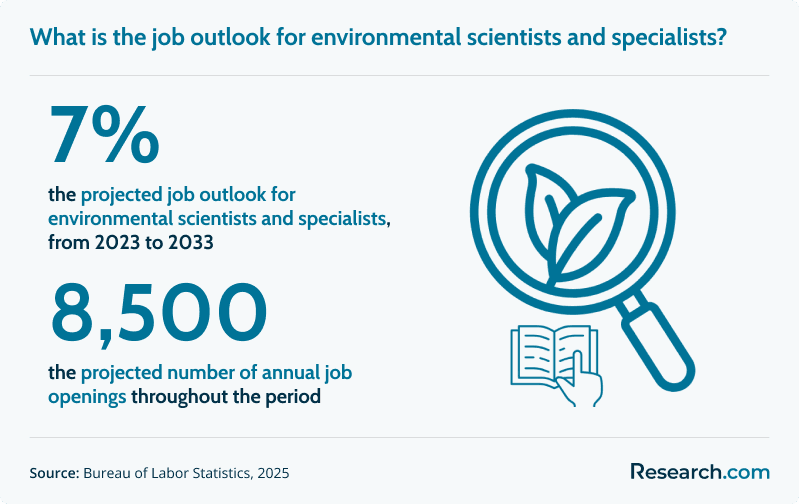
Government agencies and nonprofit organizations continue to need professionals who can analyze environmental problems, manage programs, interpret policy, communicate with communities, and support science-based decision-making. According to the U.S. Bureau of Labor Statistics, employment for environmental scientists and specialists is projected to grow by 7% through 2033, which is faster than the average for all occupations. The same source reports approximately 8,500 job openings each year for these professionals.
Growth in specialist roles can also create demand for managers who lead teams, supervise projects, and connect scientific findings to policy or implementation. Students considering science-centered career paths may want to compare this management route with the environmental biologist career path.
How Does Interdisciplinary Collaboration Strengthen Environmental Management Careers?
Environmental management work increasingly requires collaboration across technical, business, policy, and scientific fields. Sustainability professionals may work with engineers on renewable energy systems, finance teams on ESG reporting, operations teams on resource efficiency, legal teams on compliance, and community partners on environmental justice or conservation initiatives.
For example, students comparing sustainability work with technical energy or infrastructure roles may benefit from understanding how environmental management connects with engineering education, including pathways such as an affordable online electrical engineering degree. Professionals who can communicate across disciplines are often better positioned to lead complex projects.
What Emerging Trends Are Shaping Environmental Management?
Environmental management is being reshaped by digital monitoring, data analytics, GIS mapping, climate risk planning, ESG reporting, renewable energy transitions, supply chain sustainability, and cross-sector collaboration. These trends are changing what employers expect: graduates increasingly need not only environmental knowledge but also data literacy, communication ability, business fluency, and comfort working with technical teams.
Interdisciplinary work is also expanding the field. Environmental managers may collaborate with professionals in renewable energy, public health, agriculture, infrastructure, and biotech careers to design nature-based, technology-supported, or science-driven solutions.
What Graduates Say About Online Master’s Programs in Environmental Management
-
: "After ten years in logistics, I thought I would have to start over to enter environmental work. Instead, the program helped me connect project management, operations, and sustainability. That made my previous experience part of my advantage.
— Daniel"
-
: "I treated the degree like a financial decision. I kept working full time, completed the program in 18 months, and moved into a sustainability manager role. The salary increase covered the tuition in just under two years.
— Kevin"
-
: "The online cohort gave me perspectives I would not have found in a local classroom. One project brought together classmates from agriculture, technology, and consulting, and the discussion changed how I approach water and resource problems in my own work.
— Yasmin"
Key Insights
- The fastest online master’s in environmental management programs generally take about ~1 year to ~2 years, but some require ~2 to 3 years depending on credits, structure, and culminating experience.
- Speed is useful only when paired with accreditation, strong curriculum design, faculty expertise, and a clear connection to your target career.
- Program costs vary widely. Students should compare total tuition, fees, residency pricing, employer reimbursement, and indirect savings from online study.
- Common admissions requirements include an accredited bachelor’s degree, a minimum GPA typically around 3.0, a resume or CV, a personal statement, recommendations, and sometimes GRE or GMAT scores.
- Career changers can be strong applicants if they clearly connect prior experience in business, operations, analytics, communications, finance, logistics, or project management to environmental problems.
- Specialization matters. Corporate sustainability, policy, conservation, climate, energy, water, and safety pathways lead to different jobs and require different course strengths.
- The U.S. Bureau of Labor Statistics projects employment for environmental scientists and specialists to grow by 7% through 2033, with approximately 8,500 job openings each year.
- The biggest mistakes are choosing only by speed, ignoring accreditation, underestimating workload, failing to calculate total cost, and assuming a degree alone guarantees a salary increase.
References:
- Bureau of Labor Statistics. (2025). Environmental Scientists and Specialists. Retrieved July 8, 2025, from https://www.bls.gov/ooh/life-physical-and-social-science/environmental-scientists-and-specialists.htm
- Data USA. (2025). Environmental studies. Retrieved July 8, 2025, from https://datausa.io/profile/cip/environmental-studies
- LinkedIn. (2024). Global Green Skills Report 2024. Retrieved July 8, 2025, from https://economicgraph.linkedin.com/content/dam/me/economicgraph/en-us/PDF/Global-Green-Skills-Report-2024.pdf
- National Registry of Environment Professionals. (2025). 10 Compelling Reasons Why an Environmental Career is For You. Retrieved July 8, 2025, from https://www.nrep.org/blog/environmental-careers-compelling-reasons
- Trellis. (2024). The State of the Sustainability Profession 2024. Retrieved July 8, 2025, from https://info.greenbiz.com/rs/211-NJY-165/images/State%20of%20the%20Sustainability%20Profession%202024.pdf?version=0
- Zippia. (2025). Environmental manager demographics and statistics in the US. Retrieved July 8, 2025, from https://www.zippia.com/environmental-manager-jobs/demographics/
Other Things You Should Know About Online Master's Degree in Environmental Management Programs
In 2027, fast online master's degree programs in environmental management may include options like West Virginia University's accelerated one-year track or the University of Denver's flexible program. These offer intensive schedules, enabling students to complete their degrees efficiently while balancing other commitments.
For an Environmental Management program, seek regional accreditation from recognized agencies such as the Higher Learning Commission (HLC) or the Southern Association of Colleges and Schools (SACS). Additionally, program-specific accreditation like AASHE can ensure alignment with sustainability and environmental standards.