
2027 Most Affordable Online Public Relations Degrees

Co-Founder and Chief Data Scientist
Choosing an online public relations degree is really a decision about how you want to build a career in communication, reputation management, media strategy, and audience engagement. PR professionals help organizations explain decisions, respond to public scrutiny, earn media attention, manage crises, and build trust with customers, employees, voters, donors, patients, investors, and communities. Because so much of that work now happens across digital platforms, employers increasingly look for graduates who can combine clear writing, ethical judgment, campaign planning, analytics, and fast decision-making.
This guide is designed for students comparing online public relations bachelor’s programs, transfer students looking for flexible completion options, and working adults who want communication training without relocating. You will learn what online PR programs usually include, how much they may cost, how long they take, which schools offer online options, what careers are available, and how to decide whether this degree fits your goals.
Quick Answer: Is an Online Public Relations Degree Worth Considering?
An online public relations degree can be a practical option if you want a communication-focused career and need the flexibility to study around work, family, or other responsibilities. Most online undergraduate PR programs require 120 credits and take about four years for full-time students. Graduates may pursue roles in public relations, corporate communication, media relations, digital marketing, nonprofit communication, government affairs, healthcare communication, and related fields. Based on our research, entry-level public relations specialists earn an average of $60,000, while senior public relations specialists in the U.S. earn an average of $93,860. Outcomes depend on your experience, location, portfolio, internships, writing ability, and professional network.
What are the main benefits of earning a public relations degree online?
- Flexible scheduling: Online PR programs can make it easier to complete coursework while working, caregiving, serving in the military, or living far from campus.
- Career-focused communication training: Students typically study media writing, strategic communication, digital campaigns, brand messaging, crisis response, and ethics.
- Lower indirect costs: Online learning may reduce commuting, relocation, parking, and campus housing expenses, although tuition and fees still vary widely by school.
- Relevant entry-level pathway: Based on our research, an entry-level public relations job pays an average of $60,000.
What can I expect from an online public relations program?
An online public relations program usually teaches students how organizations communicate with the public, the media, internal teams, and key stakeholders. Coursework often blends writing, research, campaign planning, digital media, persuasion, ethics, branding, reputation management, and crisis communication. Strong programs also require students to produce real work samples, such as press releases, media pitches, campaign plans, social media calendars, audience research briefs, crisis response statements, and portfolio projects.
Online delivery varies by school. Some programs use asynchronous courses, where you complete weekly assignments on your own schedule. Others include synchronous sessions, group meetings, live presentations, or instructor-led discussions. Before enrolling, check whether the program includes internships, capstone projects, portfolio development, access to career services, and faculty with current public relations or strategic communication experience.
| Program element | What it usually means for students | Why it matters for PR careers |
| Strategic communication | Learning how to plan messages for specific audiences and goals | PR work requires purpose-driven communication, not just general writing |
| Media relations | Practicing pitches, press materials, interview coordination, and media response | Many PR roles involve earning or managing coverage from journalists and outlets |
| Digital and social media | Using online platforms, content calendars, analytics, and audience engagement tools | Modern PR campaigns often depend on digital visibility and real-time response |
| Crisis communication | Preparing statements, stakeholder updates, and response plans during high-pressure events | Employers value PR professionals who can protect trust during disruption |
| Portfolio or capstone | Completing a final project or professional sample collection | Employers often want proof of writing, strategy, and campaign thinking |
Where can I work with an online degree in public relations?
A public relations degree can prepare you for communication roles across sectors because nearly every organization needs to manage messages, relationships, visibility, and reputation. Graduates may work in:
- Public relations agencies
- Corporate communications departments
- Nonprofit organizations
- Government agencies
- Entertainment and media companies
- Technology companies
- Healthcare institutions
- Travel and hospitality organizations
The best setting depends on your interests. Agency work can expose you to several clients and fast deadlines. Corporate communication may offer deeper involvement with one brand or employer. Nonprofit and government roles often emphasize public service, advocacy, community education, and stakeholder trust.
How much can I make with an online degree in public relations?
Public relations salaries vary by job title, location, industry, employer size, experience, portfolio quality, and management responsibility. Based on our research, entry-level public relations specialists earn an average of $60,000. With additional experience, specialized skills, and leadership responsibilities, professionals may move into senior roles; senior public relations specialists in the U.S. earn an average of $93,860.
Ways to strengthen earning potential include building a portfolio, completing internships, developing digital analytics skills, learning crisis communication, gaining industry-specific expertise, pursuing relevant certifications, and expanding your professional network. A degree can open doors, but salary is never guaranteed by the credential alone.
- Best Online Public Relations Degree Programs for 2027
- How long does an online public relations degree take?
- Online vs. on-campus public relations degrees
- Average cost of an online public relations degree
- Financial aid options for online PR students
- Admission requirements for online public relations programs
- Common courses in an online PR degree
- Public relations specializations
- How to compare online public relations programs
- How creative writing supports PR strategy
- Whether an online PR degree is a good investment
- How social media training can complement PR
- Career paths for public relations graduates
- Challenges of earning a public relations degree online
- How a communications degree can support a PR career
- How visual storytelling improves PR campaigns
- Public relations compared with other digital media careers
- Job market for online public relations graduates
- Emerging trends and skills in public relations
- Whether employers value online public relations degrees
- How to stand out in the PR job market
- How to choose the best online public relations program
Best Online Public Relations Degree Programs for 2027
How Research.com ranks schools
Research.com evaluates online public relations programs by reviewing factors that affect student decision-making, including cost, curriculum, program length, accreditation, delivery format, and available concentrations. Our rankings are built using our methodology and supported by education data sources that help verify institutional and program information.
| School | Degree or focus | Cost per credit | Credits | Accreditation |
| Southern New Hampshire University | BA in communication with public relations concentration | $330 | 120 | New England Commission of Higher Education (NECHE) |
| University of Florida | BS in public relations | $129 | 120 | Southern Association of Colleges and Schools Commission on Colleges (SACSCOC) |
| University of Central Missouri | BS in public relations and strategic communications | $277.50 | 120 | Higher Learning Commission (HLC) |
| Southern Illinois University, Edwardsville | Online undergraduate public relations degree completion program | $430 | 120 | Higher Learning Commission |
| Waldorf University | Bachelor of applied science in public relations | $325 | 120 | HLC |
| Montana State University-Billings | Bachelor of science in public relations | $420 | 120 | Northwest Commission on Colleges and Universities (NWCCU) |
| Texas Tech University | BA in public relations and strategic communication management | $350 | 120 | Southern Association of Colleges and Schools Commission on Colleges (SACSCOC) |
| University of Arkansaw at Little Rock | BA in mass communication and strategic public relations | $292 | 120 | HLC |
| Louisiana State University | Bachelor’s in mass communication with strategic public relations emphasis | $399 | 120 | Accrediting Council on Education in Journalism and Mass Communications (ACEJMC) |
| Northwest Missouri State University | BS in public relations | $320 | 120 | HLC |
1. Southern New Hampshire University
Southern New Hampshire University offers a BA in communication with a concentration in public relations. The program does not require an application fee or SAT/ACT scores. Students study stakeholder collaboration, ethical communication, strategic planning and execution, and communication development and delivery. SNHU’s online courses have no set meeting times, giving students 24/7 access to the online classroom. The program ends with a capstone project that can help students create an online portfolio for job applications.
- Program Length: Four Years
- Tracks/concentrations: public relations
- Cost per credit: $330
- Required Credits to Graduate: 120
- Accreditation: New England Commission of Higher Education (NECHE)
2. University of Florida
The University of Florida provides an online BS in public relations program centered on persuasive and strategic communication. Students take courses in writing, strategy, research, mass communication law, visual communication, and other core PR areas. UF also offers two specialization options: a corporate track for students targeting entry-level corporate PR roles and a public interest track for students interested in science-based communication that supports positive social change in the country and globally.
- Program Length: Four Years
- Tracks/concentrations: corporate and public interest communications
- Cost per credit: $129
- Required Credits to Graduate: 120
- Accreditation: Southern Association of Colleges and Schools Commission on Colleges (SACSCOC)
3. University of Central Missouri
The University of Central Missouri offers an online BS in public relations and strategic communications program. The program combines traditional publicity and media training with applied skills such as social media strategy, video production, and story pitching. Coursework is delivered through both synchronous and asynchronous formats using the school’s learning management system, giving students a mix of structure and flexibility.
- Program Length: Four Years
- Tracks/concentrations: N/A
- Cost per credit: $277.50
- Required Credits to Graduate: 120
- Accreditation: Higher Learning Commission (HLC)
4. Southern Illinois University, Edwardsville
Southern Illinois University, Edwardsville offers an online undergraduate program in public relations designed to strengthen writing, research, creativity, and communication practice. Students study public relations trends, marketing, advertising, ethics, crisis communication, brand development, design, and reputation management and repair.
- Program Length: Four Years
- Tracks/concentrations: N/A
- Cost per credit: $430
- Required Credits to Graduate: 120
- Accreditation: Higher Learning Commission
5. Waldorf University
Waldorf University’s bachelor of applied science in public relations degree program blends media studies, marketing communication, brand building, and strategic message campaign writing. The BAS structure may be useful for students who bring in transfer credits and want to finish faster. Course topics include visual theory, mass communications and society, human resource management, team building, and leadership.
- Program Length: Four Years
- Tracks/concentrations: N/A
- Cost per credit: $325
- Required Credits to Graduate: 120
- Accreditation: HLC
6. Montana State University-Billings
Montana State University-Billings offers an online bachelor of science in public relations for students preparing for careers that require communication, marketing, and media knowledge. The program includes theoretical and applied PR training, significant communication coursework, and an internship opportunity near the end of the program. The curriculum is modeled on the Public Relations Society of America’s certification in education guidelines.
- Program Length: Four Years
- Tracks/concentrations: N/A
- Cost per credit: $420
- Required Credits to Graduate: 120
- Accreditation: Northwest Commission on Colleges and Universities (NWCCU)
7. Texas Tech University
Texas Tech University offers an online BA in public relations and strategic communication management through its College of Media and Communication. Students learn to create messages and content, manage integrated communication programs, and develop campaigns. TTU also offers the degree on campus, and both online and campus students are taught by faculty with experience in public relations and strategic communication.
- Program Length: Four Years
- Tracks/concentrations: N/A
- Cost per credit: $350
- Required Credits to Graduate: 120
- Accreditation: Southern Association of Colleges and Schools Commission on Colleges (SACSCOC)
8. University of Arkansaw at Little Rock
University of Arkansaw at Little Rock offers an online BA in mass communication and strategic public relations that emphasizes critical thinking, writing, content creation, media studies, journalism, and strategic communication. Students may choose between a media studies option focused on how media affect social systems and a professional option focused on journalism or strategic public relations.
- Program Length: Four Years
- Tracks/concentrations: media studies and professional studies
- Cost per credit: $292
- Required Credits to Graduate: 120
- Accreditation: HLC
9. Louisiana State University
Louisiana State University Online offers an online bachelor’s in mass communication with a strategic public relations emphasis. Offered through the LSU Manship School of Mass Communication, the program focuses on strategic communication for diverse audiences. Course topics include media writing, principles of marketing, public relations campaigns, and media ethics and responsibility.
- Program Length: Four Years
- Tracks/concentrations: public relations
- Cost per credit: $399
- Required Credits to Graduate: 120
- Accreditation: Accrediting Council on Education in Journalism and Mass Communications (ACEJMC)
10. Northwest Missouri State University
Northwest Missouri State University offers an online BS in public relations degree program that develops communication skills for use across media platforms. Students study writing, social media, information management, public relations techniques, and verbal communication. The profession-based learning model is influenced by the Professional Advisory Board at Northwest, helping connect coursework with real-life communication settings.
- Program Length: Four Years
- Tracks/concentrations: N/A
- Cost per credit: $320
- Required Credits to Graduate: 120
- Accreditation: HLC
Key Findings
- Most online undergraduate public relations programs require 120 credits and take about four years for full-time students.
- Common coursework includes strategic communication, mass communication, media relations, writing, brand management, digital media, and crisis communication.
- Online PR degrees may cost less than campus-based options when commuting, relocation, and housing costs are considered, but tuition varies by institution.
- Employment of public relations specialists is projected to grow by 6% from 2022 to 2032.
- Graduates may work in corporations, agencies, nonprofits, government, media, healthcare, technology, hospitality, and related sectors.
How long does it take to complete an online public relations degree program?
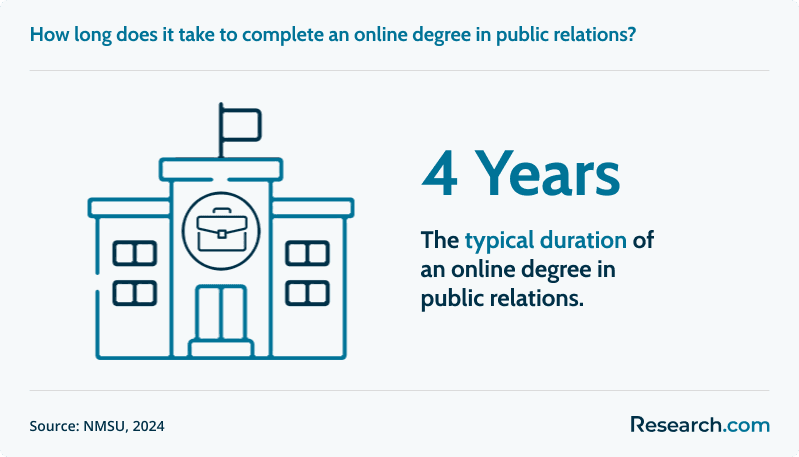
A typical online undergraduate public relations degree requires 120 credit hours and takes around four years for full-time students. This timeline is similar to many on-campus bachelor’s programs. Students with transfer credits, associate degrees, military credit, or prior college coursework may finish sooner if the school accepts those credits toward the major and general education requirements.
Part-time students may need longer than four years. Accelerated formats may shorten the timeline, but they often require heavier workloads and strict assignment pacing. Students who already hold a bachelor’s degree and want graduate-level communication training may also compare public relations or communication options with the best one-year master’s programs, especially if they are targeting leadership or managerial roles.
| Student situation | Likely timeline | What to confirm before enrolling |
| First-time full-time student | About four years | Total credits, course sequence, and whether summer terms are available |
| Transfer student | Potentially less than four years | Transfer credit limits and how prior courses apply to the PR major |
| Part-time student | Often longer than four years | Maximum completion time and course availability each term |
| Accelerated student | May finish faster | Weekly workload, term length, and whether the format is realistic |
How does an online public relations degree program compare to an on-campus program?
Online and on-campus public relations degrees can cover similar academic content, but the learning experience is different. Online programs are often best for students who need scheduling flexibility, live far from campus, or want to continue working while studying. On-campus programs may be stronger for students who want in-person networking, student media participation, campus events, face-to-face collaboration, and easier access to local internships.
| Factor | Online public relations degree | On-campus public relations degree |
| Schedule | Often more flexible, especially in asynchronous courses | Usually built around fixed class meeting times |
| Networking | Requires more intentional outreach through virtual events, alumni groups, and internships | May offer more spontaneous contact with faculty, classmates, clubs, and campus media |
| Costs beyond tuition | May reduce commuting, relocation, and housing costs | May involve transportation, campus fees, housing, or relocation |
| Hands-on learning | Can be strong if the program includes projects, internships, and portfolio work | May provide easier access to campus publications, agencies, events, and labs |
| Best fit | Working adults, remote learners, military-affiliated students, and transfer students | Students who prefer face-to-face learning and campus-based opportunities |
What is the average cost of an online public relations degree program?
The cost of an online public relations degree depends on the school, residency status, program format, tuition rate, fees, transfer credits, and financial aid. Based on our research, an online BS degree program in public relations can range between $15,480 for in-state students and $66,240 for out-of-state students. An online BS degree program in public relations and strategic communications can cost about $33,240. An online BA in communications can cost around $39,600. An online BAS in public relations program can cost around $39,000. Students comparing lower-cost options may also want to review affordable online colleges.
The chart below compares sample costs for online public relations degree options:
What are the financial aid options for students enrolling in an online public relations degree program?
Students pursuing an online public relations degree or a PR major may qualify for several forms of aid. Aid eligibility depends on the school, enrollment status, citizenship or residency rules, financial need, academic record, military affiliation, and program requirements.
- Federal Student Aid: Eligible students can complete the FAFSA to apply for federal grants, including the Pell Grant, and federal student loans.
- Scholarships: Colleges, universities, private foundations, and professional associations may offer awards based on merit, financial need, communication interests, leadership, or career goals.
- Military Benefits: Active-duty service members, veterans, and eligible dependents may be able to use military tuition assistance, GI Bill benefits, or related education benefits.
- State and Institutional Aid: Some states and schools provide grants, tuition discounts, or scholarships for online students. Students considering graduate study later can also compare the types of master's degrees that may qualify for institutional or state aid.
Cost questions to ask before enrolling
- Is the quoted tuition rate the same for online and campus students?
- Are there separate technology, distance learning, graduation, or course fees?
- How many credits will transfer into the degree?
- Will changing from full-time to part-time enrollment affect financial aid?
- Are internships unpaid, paid, optional, or required?
- Does the school offer scholarships specifically for online students or communication majors?
What are the prerequisites for enrolling in an online public relations degree program?
Admission requirements vary by school, but many online public relations bachelor’s programs ask for standard undergraduate application materials. Students comparing cheap online degrees should still verify admissions standards, accreditation, transfer policies, and student support rather than choosing by price alone.
- High School Diploma or GED: Most bachelor’s programs require proof of high school completion or an equivalent credential.
- Minimum GPA: Some schools require a minimum GPA, commonly between 2.0 and 3.0 on a 4.0 scale.
- Standardized Test Scores: Some programs may request SAT or ACT scores, although many online programs waive or do not require them.
- Prerequisite Courses: Certain programs may expect prior coursework in writing, communication, business, or general education before upper-division PR classes.
- Letters of Recommendation: Some schools ask for references from teachers, supervisors, or professionals who can comment on your readiness and character.
What courses are typically in an online public relations degree program?
Online public relations programs usually combine communication theory with applied writing, campaign planning, media strategy, and digital communication. The exact course names vary by institution, but students commonly encounter the following subjects:
- Introduction to Public Relations: Covers PR principles, professional roles, organizational communication, stakeholder relationships, and the place of PR within broader media systems.
- Writing for Public Relations: Develops practical writing skills for press releases, feature stories, social media posts, speeches, newsletters, web content, and promotional materials.
- Media Relations: Teaches students how to pitch stories, answer media requests, prepare spokespeople, and build constructive relationships with journalists and outlets.
- Digital Media and Social Media Strategy: Explores platform strategy, online audience engagement, content planning, community management, and performance measurement.
- Crisis Communication: Focuses on planning and delivering clear messages during emergencies, controversies, operational disruptions, or reputation threats. Students in related people-focused programs, such as a human resources degree, may also study communication in sensitive organizational situations.
- Public Relations Ethics and Law: Examines truthfulness, transparency, conflicts of interest, privacy, professional codes, media law, and legal boundaries in communication practice.
- Brand Management: Looks at positioning, voice, messaging, identity, reputation, and the relationship between brand promises and public perception.
What types of specializations are available in an online public relations degree program?
Specializations help students focus their portfolio and career direction. Not every school offers formal concentrations, so compare electives, capstone options, internships, and faculty expertise if a program does not list official tracks.
- Strategic Communication: Best for students interested in campaign planning, audience analysis, messaging, and leadership roles in communication teams.
- Digital Media and Social Media: Useful for students who want to work with platform strategy, digital content, online communities, social listening, and campaign analytics.
- Corporate Communication: Fits students interested in internal communication, employee engagement, executive messaging, investor-related communication, and corporate reputation.
- Media Relations: Supports careers focused on journalist outreach, earned media, interviews, news releases, and public visibility.
- Public Affairs: Prepares students for communication work involving policy, advocacy, government relations, public issues, and stakeholder engagement.
How do I choose the best online public relations degree program?
The best online public relations program is the one that matches your career goal, budget, learning style, transfer situation, and need for support. A fast program is not automatically the best program. Even if you are researching the quickest degree to get, you should confirm that the degree is accredited, respected, affordable, and relevant to the communication roles you want.
- Verify accreditation: Confirm that the institution is accredited by a recognized accrediting agency. Accreditation can affect credit transfer, graduate school eligibility, employer recognition, and access to federal financial aid. Program-specific standards matter in some fields; for example, students researching counseling programs may compare affordable online CACREP school counseling programs, while PR students should focus on institutional accreditation and communication curriculum quality.
- Review the curriculum: Look for media writing, strategic communication, digital media, research, ethics, crisis communication, campaign development, and portfolio-building assignments.
- Check specialization options: Choose electives or tracks that support your intended path, such as corporate communication, nonprofit PR, public affairs, healthcare communication, or digital media.
- Research faculty experience: Faculty with PR, journalism, corporate communication, agency, public affairs, or digital strategy backgrounds can bring practical context to coursework.
- Compare total cost: Look beyond tuition. Include fees, books, software, transfer credit policies, internship costs, and whether you can keep working while enrolled.
- Assess career support: Strong programs should provide advising, resume help, portfolio guidance, internship resources, alumni connections, and access to communication-related job leads.
| Common mistake | Why it can hurt you | Better approach |
| Choosing only the cheapest tuition | Low tuition may not include fees, limited support, or weak career preparation | Compare total cost, accreditation, curriculum, portfolio work, and outcomes |
| Ignoring transfer credit rules | You may pay for classes you have already completed | Request a transfer evaluation before committing |
| Assuming online means self-paced | Many online courses still have weekly deadlines or live sessions | Ask whether courses are asynchronous, synchronous, or blended |
| Skipping portfolio development | PR employers often want writing and campaign samples | Choose courses that produce press materials, campaign plans, and digital content |
| Relying only on rankings | A highly ranked school may not fit your schedule, budget, or career focus | Use rankings as one input, then compare fit and practical support |
Can creative writing skills enhance my public relations strategy?
Yes. Creative writing can strengthen PR work when it helps messages become clearer, more memorable, and more persuasive without sacrificing accuracy. PR professionals use storytelling in press releases, speeches, social media campaigns, executive statements, nonprofit appeals, brand narratives, and thought leadership content. Students who want deeper training in narrative structure, voice, and audience engagement may compare PR coursework with online degrees in creative writing.
Is an online public relations degree a worthwhile investment?
An online public relations degree may be worth it if it helps you build marketable communication skills, complete a recognized credential, create a portfolio, access internships, and move toward roles that match your goals. It may be a weaker investment if the program is not accredited, lacks career support, costs more than you can reasonably manage, or does not help you produce professional work samples. Students aiming for higher-level communication roles may later consider graduate study, including an affordable online master's degree in communications.
Can an online social media degree complement my public relations education?
Social media training can complement public relations because digital platforms now shape reputation, news cycles, audience feedback, and crisis response. PR students who develop skills in analytics, platform strategy, community management, paid and organic content, and trend monitoring may be more competitive for digital communication roles. An online social media degree may be useful for students who want deeper specialization in social media strategy beyond the PR core.
What career paths are available for graduates of an online public relations degree program?
Students often ask, what can you do with a public relations degree? The answer depends on your portfolio, internships, writing ability, industry knowledge, and career focus. Common paths include:
- Public Relations Specialist: Builds and protects public image by writing press materials, coordinating campaigns, preparing messages, and supporting media or stakeholder outreach.
- Media Relations Specialist: Develops relationships with journalists, pitches stories, coordinates interviews, responds to inquiries, and helps organizations communicate through news channels.
- Corporate Communications Manager: Oversees internal and external messaging, employee communication, executive communication, media response, and reputation strategy.
- Digital Marketing Specialist: Uses websites, email, social platforms, and analytics to promote brands, services, products, campaigns, or causes.
- Public Affairs Specialist: Works with policy issues, advocacy communication, government relations, public education, and stakeholder engagement for government, nonprofit, or corporate employers.
| Role | Typical focus | Skills to build while in school |
| Public Relations Specialist | Campaigns, press materials, stakeholder messaging, reputation support | PR writing, media kits, campaign planning, research, presentation skills |
| Media Relations Specialist | Journalist outreach, story pitching, interview coordination, coverage tracking | News judgment, pitching, press release writing, relationship management |
| Corporate Communications Manager | Internal and external communication, executive messaging, brand consistency | Strategic planning, leadership communication, employee messaging, crisis response |
| Digital Marketing Specialist | Online campaigns, social content, email, website messaging, analytics | SEO basics, content strategy, social media analytics, audience segmentation |
| Public Affairs Specialist | Policy communication, public issues, advocacy, government or community relations | Policy writing, stakeholder analysis, public speaking, issue monitoring |
Public relations specialists accounted for 297,100 employed workers in 2022. Related occupations also employed large numbers of professionals that year, including 105,700 public relations and fundraising managers, 389,000 marketing managers, and 868,600 market research analysts. The chart below compares employment for public relations specialists and similar occupations in the U.S. as of 2022:
What are the challenges of earning an online public relations degree?
The biggest challenge is making sure the online format still gives you practical experience. Public relations is not learned through reading alone. You need to write, revise, present, collaborate, analyze audiences, build campaigns, and respond to realistic scenarios. Online students must also be disciplined enough to manage deadlines without the structure of daily campus life.
- Limited informal networking: Online students may need to be more proactive about joining PR groups, contacting alumni, attending webinars, and requesting informational interviews.
- Technology dependence: Reliable internet, video access, file sharing, presentation tools, and learning platform access are essential.
- Variable program quality: Some online programs include strong projects and internship support, while others rely heavily on discussion posts and exams.
- Portfolio gaps: Students who do not save and refine coursework may graduate without strong samples for employers.
- Unrelated credential detours: Continuing education can help, but choose credentials that support your PR goals rather than unrelated options such as an affordable online masters in architecture degree.
Can a communications degree further enhance my PR career?
A broader communications background can support a public relations career by strengthening media literacy, organizational communication, public speaking, interpersonal communication, and message design. Students comparing paths may want to explore what can you do with a communications degree to see whether a wider communication major or a PR-specific major better matches their goals.
How can visual storytelling enhance public relations campaigns?
Visual storytelling helps PR campaigns communicate faster and with more emotional impact. Infographics, short videos, photo essays, social graphics, presentations, and brand visuals can make complex messages easier to understand. PR students do not need to become full-time designers, but they should understand basic visual hierarchy, accessibility, brand consistency, and platform-specific formatting. Students who want deeper creative training can review programs from the best school for graphic design.
How does an online public relations degree compare to other digital media careers?
Public relations focuses on reputation, strategic messaging, stakeholder trust, media relationships, and crisis response. Other digital media paths may focus more heavily on technical production, user experience, design, entertainment, analytics, or platform-specific marketing. For example, students comparing compensation across creative technology fields may research topics such as the game design degree highest salary, but PR is usually a better fit for students who want to write, persuade, manage public issues, and guide how organizations communicate.
What is the job market for graduates with an online degree in public relations?
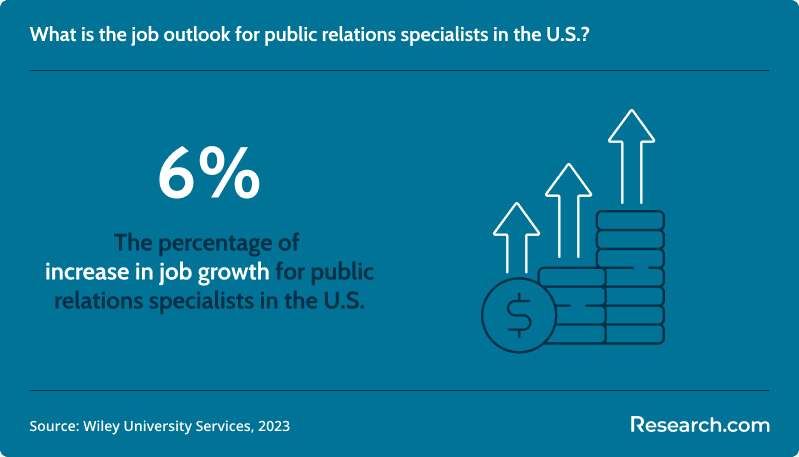
The job market for public relations graduates is supported by the continuing need for organizations to communicate clearly, manage reputation, and respond to public attention. Employment of public relations specialists is projected to grow by 6% from 2022 to 2032, with about 25,800 openings for professionals in the field each year, on average, over the decade. Demand is also influenced by digital media, social platforms, rapid news cycles, and the need for organizations to engage diverse audiences.
Students should still treat the market as competitive. Like graduates of affordable online software engineering degree programs, PR graduates improve their job prospects when they can demonstrate applied skills, not just completed coursework.
Emerging Trends and Skills in Public Relations
Public relations is changing as audiences consume information across more channels, expect faster responses, and demand greater transparency from organizations. Students should look for programs that address current PR practice rather than relying only on traditional publicity models.
1. Digital and social media PR
Social platforms, online communities, influencer outreach, and reputation monitoring are now core parts of many PR campaigns. Students should learn how to plan platform-specific content, respond appropriately online, and measure engagement.
2. Data-informed communication
PR teams increasingly use data to understand audiences, evaluate campaigns, monitor sentiment, and report results. Familiarity with analytics dashboards and campaign metrics can help graduates speak the language of employers and clients.
3. Crisis communication in a constant news cycle
Organizations may face public scrutiny quickly. PR professionals need to prepare holding statements, escalation plans, spokesperson guidance, and stakeholder updates before a crisis happens.
4. Diversity, equity, and inclusion in messaging
Communication that ignores audience differences can damage trust. PR students should learn to consider culture, accessibility, representation, language, and community context when building campaigns.
5. Ethics and corporate social responsibility
Public audiences often expect organizations to communicate honestly and align statements with action. PR professionals must understand transparency, accountability, conflicts of interest, and ethical decision-making.
How students can stay current
Choose courses and projects that include digital strategy, analytics, ethics, crisis response, and audience research. Students seeking advanced training without overspending may compare the quickest cheapest masters degree options, but graduate study should be tied to a clear career plan.
Do employers value online public relations degrees?
Employers are generally more interested in whether a degree is accredited, relevant, and supported by real skills than whether every course was completed on campus. For PR hiring, a strong writing portfolio, internship experience, campaign samples, digital fluency, communication judgment, and interview performance often matter more than the delivery format. Salary and career expectations can also be compared with broader communication pathways, including information on communications major salary.
How to stand out in the competitive public relations job market
A public relations degree can help you qualify for entry-level roles, but it is rarely enough by itself. Employers want candidates who can write well, think strategically, work under deadlines, understand audiences, and show evidence of completed communication work.
Build a professional portfolio
- Create a website or digital folder with writing samples, press releases, social media plans, campaign briefs, research summaries, and presentations.
- Revise class projects until they look employer-ready.
- Include short explanations of the goal, audience, strategy, and result for each sample when possible.
Gain experience before graduation
- Apply for internships with agencies, companies, nonprofits, government offices, media teams, or campus communication departments.
- Offer volunteer PR support to community groups or student organizations.
- Freelance carefully for small businesses or nonprofits if you can deliver professional-quality work.
Network with purpose
- Join PR associations and attend webinars, conferences, virtual events, and local meetups.
- Connect with alumni from your program and ask about career paths, internships, and portfolio expectations.
- Follow PR agencies, corporate communication leaders, journalists, and public affairs professionals to understand hiring trends.
Keep learning after the degree
- Build skills in social media analytics, SEO basics, crisis communication, public speaking, media monitoring, and content strategy.
- Consider short certifications in relevant tools or specialties.
- If you want a broader brand and consumer strategy background, an accelerated marketing degree program may complement PR training.
How to Choose the Best Online Public Relations Program
Use rankings as a starting point, not the final answer. A program that works well for one student may not be the best fit for another because transfer credits, tuition, schedule, career goals, and support needs differ.
- Confirm accreditation and recognition: Check the school’s accreditation before applying. You can also compare institutions through Research.com’s list of online schools.
- Match the curriculum to your target role: Agency-bound students may prioritize media relations and campaign work. Corporate communication students may want internal communication and brand strategy. Public affairs students should look for policy and advocacy communication.
- Evaluate flexibility honestly: Ask whether courses are asynchronous, synchronous, or blended. A flexible program still requires weekly time for reading, writing, group work, and revisions.
- Look for applied projects: The best PR programs help you graduate with work samples, not just grades.
- Check support services: Online students should have access to advising, library resources, technical support, career coaching, internship guidance, and faculty communication.
- Compare total cost and aid: Include tuition, fees, books, software, transfer credit policies, and the potential impact of your enrollment status on aid.
- Ask about outcomes: Look for alumni examples, internship partnerships, student work showcases, employer connections, and career placement support when available.
Key Insights
- An online public relations degree is best for students who want communication careers and need flexible study options without giving up practical writing, campaign, and portfolio development.
- Most online bachelor’s programs in public relations require 120 credits and take about four years, but transfer credits and accelerated formats can change the timeline.
- Based on our research, entry-level public relations specialists earn an average of $60,000, while senior public relations specialists in the U.S. earn an average of $93,860.
- Cost varies significantly. Online BS public relations programs can range between $15,480 for in-state students and $66,240 for out-of-state students, so compare total cost rather than tuition alone.
- Accreditation, curriculum quality, portfolio opportunities, internships, faculty experience, and career support are more important than whether the program is online or campus-based.
- Strong PR graduates can write clearly, plan strategically, respond ethically, use digital platforms effectively, and show real work samples to employers.
- The job outlook is positive but competitive: employment of public relations specialists is projected to grow by 6% from 2022 to 2032, with about 25,800 openings each year, on average, over the decade.
References:
- Northwest Missouri State University. (2024). Bachelor of Science in Public Relations Online. https://online.nwmissouri.edu/programs/undergraduate/bachelor-of-science-in-communication-public-relations
- Salary.com. (2024). Entry Public Relations Specialist Salary. https://www.salary.com/research/salary/alternate/entry-public-relations-specialist-salary
- Southern New Hampshire University. (2024). Public Relations Degree Online. https://www.snhu.edu/online-degrees/bachelors/ba-in-communication/public-relations
- U.S. Bureau of Labor Statistics. (2023). Occupational Outlook Handbook: Public Relations Specialists. https://www.bls.gov/ooh/media-and-communication/public-relations-specialists.htm
- University of Central Missouri. (2024). Tuition/Credit Hour Rates* (Fall 2023-Summer 2024). https://www.ucmo.edu/future-students/tuition-and-costs
- University of Florida Online. (2024). Tuition & Financial Aid. https://ufonline.ufl.edu/tuition
- Waldorf University. (2024). Online Tuition Rates. https://www.waldorf.edu/tuition-financing/online-tuition-rates
Other things you should know about online degree programs in public relations
To ensure that an online public relations program is accredited in 2027, verify that the program is recognized by agencies such as the Accreditation Council for Business Schools and Programs (ACBSP) or the Accrediting Council on Education in Journalism and Mass Communications (ACEJMC). Checking listings on the U.S. Department of Education's website can also provide confirmation.
A typical curriculum includes courses in media relations, campaign strategy, digital communications, and crisis management. Most programs require around 120 credit hours, blending theory and practical skills essential for a successful career in public relations.
Yes. Many accredited bachelor’s programs accept up to 90 transfer credits, and some schools cap major-specific credits at 30 to 45. Finishing general education requirements at a community college before transferring can lower total tuition and shorten completion time by one to two semesters.
Admission requirements typically include a high school diploma or equivalent, a minimum GPA, and standardized test scores such as the SAT or ACT. Some programs may also require a personal statement or letters of recommendation for 2027 admissions.


