
2027 What Can You Do With A Communications Degree: Requirements & Career Prospects

Co-Founder and Chief Data Scientist
A communication degree is still one of the most flexible ways to prepare for work in media, public relations, marketing, corporate messaging, nonprofit advocacy, and digital content. That matters more in 2026 than ever, because employers want graduates who can write clearly, explain complex ideas, work across digital platforms, and adapt as AI changes how content is created and distributed.
This guide breaks down what a communication degree actually covers, what careers it can lead to, how much it can cost, how long it usually takes, and how to tell whether an online or on-campus program is the better fit for your goals. It also includes the key factors that matter most when comparing schools so you can make a practical decision instead of choosing based on reputation alone.
Quick answer: is a communication degree worth it?
For many students, yes—if they want a broad degree that can lead to a wide range of people-focused, media-facing, and business communication roles. A communication degree is especially useful for students who want flexibility, strong writing and presentation training, and the option to move into fields like PR, journalism, content strategy, social media, and internal communications. It is less useful if you want a highly technical career path that requires a narrow professional license or a specialized STEM credential.
- It can support careers in public relations, journalism, marketing, digital media, and corporate communications.
- It builds transferable skills employers still value: writing, speaking, research, persuasion, and audience analysis.
- Online programs can make the degree easier to fit around work, family, or other commitments.
- Salary outcomes vary a lot by role, industry, location, and experience, so the degree itself does not guarantee a specific income.
What a communication degree is and what it prepares you for
A communication degree focuses on how people create, deliver, interpret, and respond to messages across interpersonal, organizational, public, and digital settings. Depending on the school, the program may be called communication, communication studies, mass communication, media communication, or strategic communication.
At the undergraduate level, the major usually combines theory with practical training. Students study speaking, writing, media analysis, research methods, persuasion, and digital communication. At the graduate level, the focus may shift toward leadership, research, message design, public affairs, or specialized areas such as health communication or media strategy.
The best programs do more than teach theory. They help students practice real communication tasks, such as giving presentations, creating campaigns, writing for different audiences, and evaluating how messages perform in the real world.
Who should consider a communication degree?
This degree is a strong fit if you want a career where writing, speaking, collaboration, or audience engagement matters. It can also be a smart option if you are still deciding between several people-centered careers and want a degree that keeps multiple doors open.
You may be a good fit if you want to work in public-facing roles, are interested in media or storytelling, enjoy shaping messages for different audiences, or want a degree that can pair well with a second major or minor. Students who want a more specialized path, such as engineering, nursing, accounting, or clinical work, may find a communication degree too broad unless they are pairing it with another credential.
Common career paths with a communication degree
Communication graduates can enter a wide range of industries, but the degree is especially useful in roles where clarity, persuasion, and audience understanding are essential. Many graduates begin in entry-level content, media, coordination, or communications support roles and then move into specialist or management positions with experience.
| Career path | Typical work | Why the degree helps |
| Public relations specialist | Writes press materials, supports media outreach, and helps shape an organization’s public image | PR depends heavily on writing, messaging, and reputation management |
| Journalist or reporter | Researches stories, interviews sources, and reports news for print, digital, or broadcast outlets | Strong reporting, writing, and interviewing skills are central to the role |
| Social media manager | Plans posts, monitors engagement, and adapts messaging for different platforms | Communication graduates often study audience behavior and digital media |
| Corporate communications specialist | Handles internal messaging, announcements, executive communications, and crisis support | The role requires polished writing and organizational communication skills |
| Content strategist or content creator | Develops articles, campaigns, webpages, newsletters, and branded content | Communication programs emphasize writing for purpose and audience |
| Technical writer | Explains processes, products, or systems in clear documentation | This career rewards clarity, structure, and audience awareness |
| Market research analyst | Studies consumer behavior and helps teams understand what audiences want | Communication training supports research, interpretation, and presentation |
How much you can earn with a communication degree
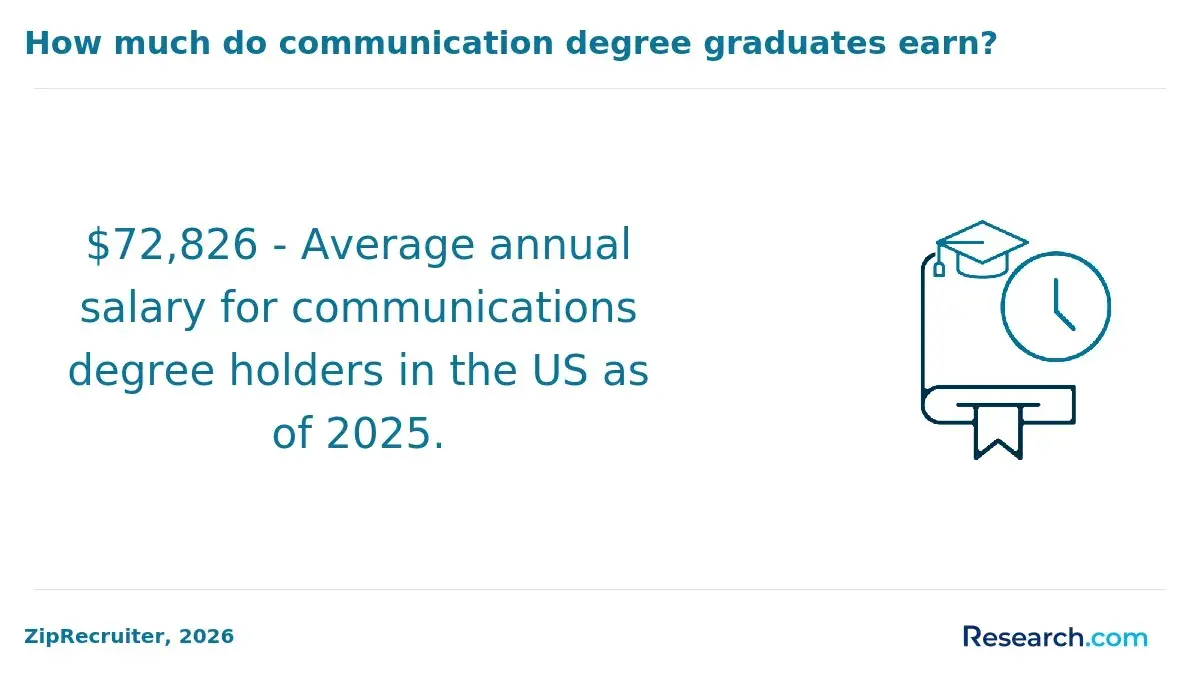
Earnings vary widely because communication is a degree field, not a single occupation. What you make depends more on the job you take than on the major itself. In the United States, media and communications workers had an average annual wage of $66,000 in 2024.
Here are the median annual salaries for selected communications occupations in 2024:
| Occupation | Median annual salary |
| Technical writers | $91,670 |
| Public relations specialists | $69,780 |
| Editors | $73,080 |
| Writers and authors | $73,150 |
| Film and video editors and camera operators | $62,420 |
| News analysts, reporters, and journalists | $55,960 |
| Broadcast, sound, and video technicians | $53,960 |
These numbers show why program choice matters. A communication degree can lead to strong outcomes, but income potential is usually higher when you pair the major with experience, digital skills, data literacy, or a focused specialization such as technical writing or strategic communication.
Best communication degrees for 2027
How we evaluate programs
Our school list is based on research using reliable higher education sources and outcome data. We rely on our methodology, the IPEDS database from the National Center for Education Statistics, Peterson's database, including the Distance Learning Licensed Data Set, and the College Scorecard for cost and outcome information. That said, the best program for you may not be the most famous one. It should match your budget, format preference, academic goals, and career plans.
1. University of California, Davis - BA in Communications
University of California, Davis offers a BA in Communications that studies communication across cultures, generations, and social settings. The program looks at communication at the individual, interpersonal, organizational, and societal levels, with attention to public education campaigns, media systems, and digital communication. It is a strong option for students who want research-informed training with broad career flexibility.
- Program Length: 4 years
- Required Credits to Graduate: 120
- Tuition and Fees (annual): $15,999.37
- Accreditation: Universities of the Western Association of Schools and Colleges (WASC)
2. Northwestern University - BA in Communication Studies
Northwestern University offers a BA in Communication Studies with a liberal arts foundation and a strong focus on organizational, cultural, interpersonal, and mass media communication. Students can explore areas such as digital media, health communication, strategic and organizational communication, and media and creative markets. This is a good choice for students who want broad academic depth and strong research training.
- Program Length: 4 years
- Required Credits to Graduate: 120
- Cost of Attendance (annual): $91,890
- Accreditation: Higher Learning Commission (HLC)
3. University of Texas - Austin - BS in Communication Studies
The University of Texas at Austin provides a BS in Communication Studies focused on how communication works in relationships, organizations, and mediated environments. Students build practical and analytical skills that support careers in business, media, and public communication.
- Program Length: 4 years
- Required Credits to Graduate: 120
- Cost per Credit: $1,689
- Accreditation: Southern Association of Colleges and Schools Commission on Colleges (SACSCOC)
4. Stanford University - BA in Communication
Stanford University's BA in Communication is designed for students who want a strong liberal arts education with a structured introduction to communication research, media, journalism, and society. The major includes two departmental orientations, a statistics course, elective study, and the option to complete an honors thesis. Students can also choose from four pathways: journalism, political communication, media psychology, and digital media studies.
- Program Length: 4 years
- Required Credits to Graduate: 120
- Tuition (per quarter): $82,308
- Accreditation: Western Association of Schools and Colleges Senior College and University Commission (WSCUC)
5. University of Pennsylvania - BA in Communication
The University of Pennsylvania offers a BA in Communication through the Annenberg School for Communication, one of the nation’s oldest undergraduate communication programs. The curriculum examines how communication shapes social, political, economic, and cultural life while training students in qualitative and quantitative research methods. Graduates often move into media, entertainment, law, consulting, education, politics, and nonprofit work.
- Program Length: 4 years
- Optional Concentrations: Advocacy & Activism; Audiences and Persuation; Culture & Society; Data & Network Science; Politics & Policy
- Required Credits to Graduate: 120
- Tuition (annual): $58,620
- Accreditation: Middle States Commission on Higher Education (MSCHE)
6. University of Florida - BS in Public Relations
The University of Florida offers a BS in Public Relations for students who want a more career-focused route into strategic messaging, social media, multimedia news releases, and communication planning. The program is useful for students who want both entry-level preparation and room to grow into management roles. It also includes an international communication certificate option.
- Program Length: 4 years
- Required Credits to Graduate: 120
- Cost per Credit: $212.71 (in-state); $955.28 (out-of-state)
- Accreditation: Accrediting Council for Education in Journalism and Mass Communication (ACEJMC); Southern Association of Colleges and Schools Commission on Colleges (SACSCOC)
7. University of Georgia - BA in Communication Studies
The University of Georgia's BA in Communication Studies emphasizes practical skills such as conflict negotiation, persuasion, group collaboration, cultural competence, and problem-solving. Students study public speaking, interpersonal communication, research methods, and rhetorical criticism, making this a strong option for learners who want both theory and applied communication training.
- Program Length: 4 years
- Required Credits to Graduate: 120
- Tuition (annual): $9,790 (in-state); $28,830 (out-of-state)
- Accreditation: Southern Association of Colleges and Schools Commission on Colleges (SACSCOC)
8. Boston University - BS in Media Science
Boston University's BS in Media Science focuses on media theory, research, and strategic message design. Students build skills in content creation, media analysis, dissemination, and digital media development. The program is a fit for students interested in media strategy, research, or graduate study in communication-related fields.
- Program Length: 4 years
- Required Credits to Graduate: 120
- Tuition (annual): $63,798 (in-state); $63,798 (out-of-state)
- Accreditation: New England Commission of Higher Education (NECHE)
9. University of North Carolina at Chapel Hill - BA in Communication Studies
The University of North Carolina at Chapel Hill offers a BA in Communication Studies centered on communication for the public good. Students analyze communication in personal, social, political, economic, and cultural contexts while developing the skills needed to create, critique, and understand communication responsibly. The program is well suited to students who care about civic engagement and public impact.
- Program Length: 4 years
- Required Credits to Graduate: 120
- Cost per Credit: $292.46 (in-state); $1,556.67 (out-of-state)
- Accreditation: Southern Association of Colleges and Schools Commission on Colleges (SACSCOC)
10. Cornell University - BS in Communication
Cornell University offers a BS in Communication that connects media, science, and technology. Students study communication theory, writing, presentation, and research methods, then choose from focus areas such as communication and information technologies, communication and social influence, or communication and environment. The program also includes internships and hands-on learning opportunities.
- Program Length: 4 years
- Required Credits to Graduate: 120
- Tuition (annual): $65,204
- Accreditation: Middle States Commission on Higher Education (MSCHE)
How long does a communication degree take?
A bachelor’s degree in communication usually takes 4 years of full-time study. A master’s degree generally takes about 2 additional years, while doctoral study can take 4 to 6 years or longer depending on research, exams, and dissertation requirements.
That timeline can change. Students with transfer credits may finish earlier. Working adults, part-time students, and those in accelerated programs may also move faster or slower depending on course load and term structure.
| Degree level | Typical time to complete | What it is best for |
| Associate degree | About 2 years | General entry into communications support roles or transfer to a bachelor’s program |
| Bachelor’s degree | About 4 years | Most entry-level communication careers |
| Master’s degree | About 2 years after the bachelor’s | Leadership, specialization, or advancement |
| Doctoral degree | 4 to 6 years or longer | Research, teaching, and high-level academic work |
Online vs. on-campus communication degree programs
The right format depends on how you learn best, how much flexibility you need, and how much in-person networking matters to you. Both online and campus-based programs can lead to strong outcomes if they are accredited and aligned with your goals.
| Format | Strengths | Trade-offs |
| Online | Flexible scheduling, easier to balance with work or family, often more accessible geographically | Less spontaneous face-to-face networking, requires self-discipline and time management |
| On-campus | More in-person interaction, easier access to campus resources, direct networking with faculty and peers | Less flexible, may require commuting or relocation, often harder to fit around full-time work |
If you are already working or need to avoid relocation costs, online study may be the better fit. If you want a highly social academic environment, direct access to faculty, or studio-based media training, an on-campus program may be more useful.
What does a communication degree cost?
The cost of a communication degree depends on the school, residency status, delivery format, and total credits required. Based on the figures provided in this article, the average cost per credit is $1,511.45 for in-state students and $1,884.17 for out-of-state students. That works out to an average total tuition of $49,889.98 for in-state students and $79,132.74 for out-of-state students.
At the high end of the examples listed here, the cost per credit is $3,063.00, which also corresponds to a total tuition of $91,890.00 for both in-state and out-of-state students in that program.
When comparing costs, do not look at tuition alone. Add in fees, books, technology costs, commuting, housing, and lost income if you attend full time. The most affordable option is not always the best value if it lacks strong advising, internships, or an outcome-focused curriculum.
Ways to pay for a communication degree
Students usually have several ways to reduce out-of-pocket costs or make a degree more manageable. The right mix depends on need, eligibility, and school policy.
- Scholarships and grants. These may come from federal, state, private, or institutional sources and do not usually need to be repaid.
- Federal student loans. Eligible students can borrow through federal programs, which often offer more flexible repayment protections than private loans.
- Work-study. Students with financial need may qualify for part-time jobs that help offset educational expenses.
- Private loans. These can fill funding gaps, but terms and repayment conditions can be less favorable than federal options.
- Employer assistance. Some employers help pay for education through tuition reimbursement or direct assistance.
- Financial aid counseling. Aid officers can help students compare package options and avoid borrowing more than necessary.
Admissions requirements for communication programs
Admission standards vary by degree level and institution, but the typical requirements are fairly consistent. Students should always verify the latest rules on the program’s official website before applying.
For bachelor’s programs
- High school diploma or GED. This is the usual baseline requirement.
- Minimum GPA. Many schools ask for a GPA around 2.5 to 3.0 on a 4.0 scale.
- Test scores. Some schools still use SAT or ACT scores, but many are test-optional.
- Letters of recommendation. These may be requested to support the application.
- Personal essay. Applicants often need to explain their goals and interest in the field.
For master’s programs
- Bachelor’s degree. Most programs require a completed undergraduate degree from an accredited institution.
- Minimum GPA. Many graduate programs look for a GPA around 3.0.
- Letters of recommendation. These usually come from faculty or professional supervisors.
- Statement of purpose. Applicants typically explain their research interests, career plans, and academic preparation.
For doctoral programs
- Master’s degree. This is commonly required, though some programs admit students with only a bachelor’s degree.
- Strong academic record. Graduate-level performance matters more at this stage.
- Research experience. Writing samples, a research proposal, or prior independent work may be expected.
- Letters of recommendation. These should speak to academic and research potential.
- GRE scores. Some programs still require them, though many have waived the test.
Typical courses in a communication degree
Most communication programs blend theory, analysis, and practical skill-building. The exact course names vary, but many programs include the following core topics:
- Introduction to Communication Studies. This course gives students the basic frameworks, history, and major concepts in the field.
- Media and Society. Students examine how media influences public opinion, representation, culture, and ethics.
- Interpersonal Communication. This class focuses on relationships, nonverbal cues, conflict resolution, and relational development.
- Public Speaking. Students practice speech organization, delivery, audience awareness, and confidence in presentation settings.
- Communication Research Methods. This course introduces surveys, interviews, content analysis, and other methods used to study communication.
Many programs also include writing-intensive work, group projects, campaign development, and portfolio assignments. Students who want a broader media-focused path may also benefit from exploring a media communications degree.
Common communication specializations
Specialization can make a communication degree more career-focused. Students who know what kind of work they want often benefit from choosing a concentration that matches their target field.
- Public Relations. Focuses on reputation, media relationships, crisis communication, and strategic messaging.
- Journalism. Centers on reporting, interviewing, news writing, and multimedia storytelling. Students interested in this path may also want to review a journalism major.
- Digital Media Production. Covers video, audio, design, editing, and online content creation.
- Strategic Communication. Emphasizes campaigns, persuasion, advertising, marketing communication, and organizational messaging. This area overlaps with topics often found in a marketing degree.
- Intercultural Communication. Examines how communication changes across cultures, languages, and global contexts.
In many programs, broad communication study is most common at the undergraduate level, while highly specialized tracks are more likely to appear in graduate study.
How to choose the right communication program
The best communication program is the one that fits your goals, budget, learning style, and intended career path. Rankings can help you build a shortlist, but they should not be the only factor.
- Check accreditation first. This affects credit transfer, employer recognition, graduate school eligibility, and in some cases licensure or professional certification pathways.
- Match the curriculum to your goals. A student interested in PR, for example, should not choose a program that is heavily journalism-focused unless the coursework still aligns with their interests.
- Review internship and practicum options. Experience often matters as much as classroom learning in communications careers.
- Look at faculty expertise. Faculty with real industry or research experience can shape better learning opportunities.
- Compare total cost, not sticker price. Tuition, aid, living costs, and commuting expenses all matter.
- Think about format. Online, hybrid, and campus-based programs each suit different students.
- Check career support. Resume help, alumni networks, career fairs, and employer partnerships can improve outcomes.
Questions to ask before enrolling
- Is the program accredited by a recognized institutional or programmatic accreditor?
- What kinds of internships or applied projects are required or available?
- Do graduates move into jobs that match my goals?
- How often are courses offered, and can I finish on my timeline?
- What technology or software will I be expected to use?
- Will this degree support graduate study, licensure, or a specific industry credential if I need one later?
What jobs can communication graduates pursue?
Communication graduates often start in roles that emphasize writing, coordination, audience engagement, or content support. Over time, many move into management, strategy, or specialized roles based on their skills and experience.
- Public relations specialist. Writes releases, supports media outreach, and helps manage public perception. Students interested in this route may also want to look at a PR degree.
- Journalist or reporter. Covers news stories and presents information to the public.
- Advertising account executive. Works with clients and creative teams to manage campaigns.
- Digital media producer. Creates video, audio, and social content for online audiences.
- Corporate communications specialist. Handles internal updates, announcements, and external messaging.
- Social media manager. Plans platform-specific content and monitors engagement.
- Content strategist. Builds content plans for websites, newsletters, and branded campaigns.
- Market research analyst. Studies consumer behavior and turns insights into action.
Many graduates of media communications programs also find work in related five-figure roles that reward strong writing, digital fluency, and audience awareness.
Job market outlook for communication majors
The job market is mixed, but still promising for students who build modern skills. Traditional media roles are under pressure from automation, digital publishing, and changes in how audiences consume information. At the same time, organizations continue to need professionals who can create clear messages, manage reputations, and communicate across digital channels.
In this article’s cited outlook, technical writers, public relations specialists, and film and video editors are expected to see positive job growth of 4% to 9% from 2024 to 2034, while editors and news analysts, reporters, and journalists are projected to decline by 2-4% over the same period. That means students should think carefully about which niche they enter.
In practical terms, the strongest opportunities are often in roles that combine communication with digital tools, analytics, marketing, or technical knowledge. Employers increasingly want graduates who can do more than write well. They want people who can measure impact, adapt content for different platforms, and work efficiently with new technology.
How digital marketing can strengthen a communication degree
Digital marketing can make a communication degree more marketable because it adds measurable, platform-specific skills. If you understand audience targeting, content performance, search visibility, email campaigns, and social analytics, you can contribute more directly to business goals.
This combination is especially useful for students who want to work in content strategy, brand management, social media, or integrated marketing communications. If that sounds like your path, a degree for social media marketing may be worth comparing alongside a general communication major.
Fastest path to a communication degree online
If your goal is speed, an accelerated online program can shorten your time to graduation. These programs often use shorter terms, such as 8-week or 6-week classes, so students can progress faster than they would in a traditional semester model.
You can usually move even faster if you transfer in credits, use prior learning credits, or take a heavier course load. This is especially helpful for working adults who want to finish without putting their career on pause. Students looking for similar options in other fields may also want to compare the fastest bachelor's degree options available.
The trade-off is intensity. Faster programs can be efficient, but they also demand strong time management and consistent study habits. The best accelerated option is the one you can realistically finish without sacrificing learning quality.
Why networking and mentorship matter in communications
Communication careers are built on relationships, so networking and mentorship can have a real impact on job access and long-term growth. Faculty connections, alumni networks, internships, and professional mentors can expose students to job leads, feedback, and industry expectations that do not always show up in coursework.
Programs with strong advising and employer links often help students build confidence, learn workplace norms, and move from classroom projects to professional portfolios. If you are trying to strengthen your writing side as well, you might also explore the cheapest online programs in creative writing degree programs as a complementary path.
Benefits of an accelerated online communication program
An accelerated communications degree online can be a practical choice for students who want to finish sooner, reduce time away from work, and start applying for communication roles earlier.
- Faster completion. Students may reach graduation sooner than they would in a standard full-length format.
- More flexible scheduling. Online delivery can make it easier to balance school with work or family responsibilities.
- Possible cost savings. Finishing in less time may reduce some total education-related expenses.
- Earlier career entry. Graduates can begin building experience and income sooner.
Before enrolling, make sure the pace is manageable. Accelerated does not mean easier. It usually means fewer breaks and a heavier weekly workload.
Can visual communication improve your career options?
Yes. Visual communication is increasingly important because employers expect professionals to communicate across slides, infographics, short videos, web pages, and social platforms. A student who understands layout, imagery, and design basics can stand out in communications, content, and digital media roles.
Visual skills are especially helpful when paired with storytelling and strategy. If you want to build that side of your skill set, you may want to compare options such as the best graphic design degree online.
Can an advanced degree help you grow in communications?
Yes, in some cases. A master’s or doctoral degree can help if you want to move into research, teaching, leadership, specialized strategy, or high-level policy and public affairs work. It can also make sense if your target role expects deeper analytic or managerial preparation.
That said, an advanced degree is not necessary for every communication career. For many roles, internships, a strong portfolio, and practical experience may matter more than graduate education. If you are comparing graduate formats, you may also want to look at executive masters degrees.
How creative writing skills can help in communications
Creative writing can sharpen storytelling, tone, and audience engagement. That matters in brand content, campaign copy, nonprofit messaging, and digital storytelling, where a message has to be both clear and memorable.
Employers often value communication professionals who can write well and think creatively at the same time. If you want to strengthen that side of your profile, explore what can you do with a masters in writing.
What shapes the return on investment of a communication degree?
ROI depends on more than tuition. A lower-cost program is not automatically the best investment if it lacks internships, career support, or relevant specialization. A higher-cost program may be worthwhile if it offers stronger employer connections, better outcomes, and access to a network that fits your goals.
Key factors that affect ROI include accreditation, school reputation, your local job market, internship access, digital skills, and how well the program matches a specific career path. If you want to compare earning potential more closely, review the average salary for communications degree.
Do employers value accelerated online communication programs?
Yes, when the program is credible and the graduate can show strong work. Employers usually care more about accreditation, skills, portfolio quality, internships, and results than about whether a program was online or on campus.
Accelerated online programs are most respected when they include rigorous coursework, practical assignments, and clear learning outcomes. If a school offers a similar level of quality to slower or campus-based options, the faster format can be a real advantage. Students comparing related fast-track degrees may also want to review the best accelerated online marketing degrees.
Can game design skills help in communications?
They can, especially in digital storytelling, interactive campaigns, user engagement, and branded experiences. Game design teaches audience interaction, feedback loops, and immersion—skills that can transfer well to modern communication work.
If you are curious about adjacent creative fields, you can also review the advantages of getting a game design degree.
Current trends shaping communication careers in 2027 and beyond
Communication careers are changing quickly, and students should plan for a field that is more digital, data-driven, and AI-aware than it was just a few years ago. The strongest programs now prepare students for both traditional communication work and modern platform-based execution.
- Digital-first communication. Employers want professionals who can create for social, web, email, and video channels.
- Crisis communication. Organizations increasingly need skilled responders who can protect trust during fast-moving public issues.
- AI tools. Communication workers are expected to understand how to use AI for drafting, editing, analysis, and workflow support without losing accuracy or judgment.
- Global communication. Cross-cultural competence matters as teams and audiences become more international.
- Ethical messaging. Transparency, sustainability, and social responsibility continue to influence how brands communicate.
- Data literacy. Employers expect communication professionals to interpret metrics and use evidence to improve messaging.
- Remote collaboration. Many teams work across locations, so digital coordination skills matter more than ever.
If you are still deciding which major best fits your interests and career goals, it may help to compare broader options in what degree should I get.
Other things to know before choosing a communication degree
What is a degree in communication?
A communication degree is a college program focused on how people exchange messages through speech, writing, media, and digital tools. It usually covers theory, research, audience analysis, and practical communication skills that can be applied in many industries.
Which degree is best for communication skills?
A communication studies degree is often the most direct choice if your goal is to build general communication ability. It usually offers the broadest mix of public speaking, writing, media analysis, and interpersonal communication.
Should I choose a BA or BS in communication?
A BA usually gives you a broader liberal arts foundation, while a BS often leans more toward applied, technical, or production-based coursework. Choose a BA if you want more theory and flexibility. Choose a BS if you want more hands-on training or a sharper professional focus.
Do I need to be a strong writer before starting?
No, but you should be ready to improve. Writing is important in communications, but most programs are designed to help students build that skill through practice, feedback, and assignments. If writing is not your strength yet, the degree can still be a good fit if you are willing to work on it.
Where are communication graduates most in demand?
Communication graduates are commonly hired in media and entertainment, public relations and advertising, corporate communications, nonprofit work, and government-related roles. Demand is often strongest where organizations need people who can explain, persuade, and manage public-facing messaging well.
How does the degree prepare students for communication careers?
It develops skills in writing, speaking, research, media literacy, editing, collaboration, and audience awareness. Many programs also include internships or projects that help students apply what they learn in professional settings.
How do students get hands-on experience?
Most students build experience through internships, class projects, student media, presentations, campus organizations, and portfolio work. Programs that make applied learning a requirement are often better for career preparation than programs that stay too theoretical.
Common mistakes to avoid
- Choosing a program without checking accreditation.
- Focusing only on sticker price instead of total cost and aid.
- Assuming every online program meets your state’s licensure or graduate-school needs.
- Ignoring internships, portfolio work, and career support.
- Assuming a communication degree automatically leads to one specific job or salary.
- Picking a school for its name alone without checking fit, format, and outcomes.
References:
- Data USA. (2024). Communications. Retrieved February 28, 2024, from Data USA.
- Fortune Business Insights. (2025). Telecommunication Market Size, Industry Share. https://www.fortunebusinessinsights.com/telecommunication-market-102099
- Indeed. (2025). What does a communications manager do? (Plus skills...). https://www.indeed.com/career-advice/finding-a-job/what-does-communication-manager-do
- U.S. Bureau of Labor Statistics. (2025). Writers and authors: Occupational outlook handbook. https://www.bls.gov/ooh/media-and-communication/writers-and-authors.htm
- ZipRecruiter. (2026). Communications salary in the United States. https://www.ziprecruiter.com/Salaries/Communications-Salary
Key insights
- A communication degree is most valuable when you want flexibility across PR, media, content, marketing, and corporate communication careers.
- The degree alone does not determine your salary. Your specialization, portfolio, digital skills, and experience matter a lot more.
- Accreditation, internships, and career support should matter as much as tuition when you compare programs.
- Online and accelerated formats can be excellent choices if you need flexibility, but they work best for students who can manage a fast pace.
- The strongest 2026 communication programs prepare students for AI-assisted workflows, data-informed messaging, and platform-specific content creation.
- If you want the best long-term value, choose a program that matches your target role instead of selecting a broad major without a plan.
Other Things You Should Know About Communications Degrees
In 2027, key sectors for communications graduates include digital marketing, public relations, content creation, media production, and social media management. The rise of digital platforms and the need for strong communication strategies in various industries have escalated the demand for skilled professionals with a communications background.
In 2027, common prerequisite courses for a communications degree typically include introductory sociology, basic psychology, public speaking, and media studies. These courses lay the foundational skills required to succeed and prepare students for advanced topics in communications.
Internships in public relations, corporate communications, media relations, and digital content are the most useful. Employers often expect 1 internship or about 120 to 150 hours of practical experience, plus samples such as press releases, social posts, or campaign materials in a portfolio.


