2027 Best Online Communication Management Degree Programs

Co-Founder and Chief Data Scientist
In a field where an estimated 70% of professionals hold a bachelor's degree, being a talented communicator is a great start—but it's often not enough to secure a leadership role. With only 12% possessing a master's, earning an advanced degree is one of the most direct ways to bridge the gap from executing communication tasks to directing enterprise-wide strategy.
This guide is your roadmap for making that leap. We've moved beyond a simple ranking to provide a decision-making framework designed to help you find the perfect online communication management degree to accelerate your career or pivot with confidence. Prepared by our experts in academic and career planning, this article will help you make a strategic investment in your professional future.
What are the benefits of getting an online communication management degree?
- This degree prepares you for leadership positions like Director of Corporate Communications or PR Manager, allowing you to shape strategy in corporate, nonprofit, and government sectors.
- You can unlock significant earning potential, as marketing managers with this level of expertise earn a median annual salary of $161,030.
- The online format gives you the critical flexibility to advance your education and career simultaneously, without having to step away from your current role.
What can I expect from an online communication management degree?
You can expect a curriculum that combines high-level communication strategy with core business and leadership principles. Think of it as a specialized business degree for running the communications function of an entire organization.
An online communication management degree is more focused on management and financial acumen than a traditional Master's in Communication, which often emphasizes theory and research. At the same time, it's more specialized than a general MBA, zeroing in on the unique challenges of leading corporate communications, public relations, and marketing teams. Most programs culminate in a capstone project, allowing you to apply what you've learned to a real-world business problem and build a portfolio that proves your strategic capabilities.
Where can I work with an online communication management degree?
Graduates are prepared for leadership roles across nearly every industry. You aren't limited to a single path. Instead, this degree equips you to direct communication strategy wherever it's needed—from Fortune 500 companies to innovative tech startups, major nonprofit organizations, and government agencies.
You'll be qualified for senior-level positions that guide an organization's voice and reputation. Common job titles include Director of Corporate Communications, Public Relations Manager, Internal Communications Director, and Chief Communications Officer. This credential is your entry ticket to the rooms where key decisions are made.
How much can I make with an online communication management degree?
While a public relations specialist earns a respectable median wage of $69,780, this degree is your springboard to a much higher salary bracket. It's designed to qualify you for management roles that come with significantly greater compensation.
For example, marketing managers, who are responsible for strategy and leadership, earn a median annual wage of $161,030. Earning this degree is the strategic step that helps you bridge that gap, providing a clear and substantial return on your educational investment.
- List of the Best Online Communication Management Degree Programs for 2027 List of Programs
- How long does it take to complete an online communication management degree program? Completion Time
- How does an online communication management degree program compare to an on-campus program? How does an online communication management degree program compare to an on-campus program?
- What is the average cost of an online communication management degree program? Program Cost
- What are the financial aid options for students enrolling in an online communication management degree program? Financial Aid
- What are the prerequisites for enrolling in an online communication management degree program? What are the prerequisites for enrolling in an online communication management degree program?
- What courses are typically in an online communication management degree program? What courses are typically in an online communication management degree program?
- What types of specializations are available in an online communication management degree program? What types of specializations are available in an online communication management degree program?
- How to Choose the Best Online Communication Management Program How to Choose the Best Online Communication Management Program
- What career paths are available for graduates of an online communication management degree? Career Paths
- What is the job market for graduates of an online communication management degree? Job Market
- What additional certifications can amplify your strategic impact? What additional certifications can amplify your strategic impact?
- How can combining creative disciplines with communication management elevate your career? How can combining creative disciplines with communication management elevate your career?
- How Do Emerging Digital Trends Shape Online Communication Management Education? How Do Emerging Digital Trends Shape Online Communication Management Education?
Best Online Communication Management Degree Programs for 2027
Choosing an online communication management degree is a career decision, not just an academic one. The right program can help you move from writing messages and managing campaigns into leading communication strategy, advising executives, handling reputation risk, and using data to guide decisions. This guide is designed for working professionals, career changers, and communication specialists comparing flexible graduate programs that can support advancement without requiring a campus-based schedule.
You will find a ranked program list, cost and time comparisons, admissions expectations, curriculum details, specialization options, career outcomes, and practical questions to ask before enrolling. If you are still exploring adjacent fields, you may also want to compare this path with the best online media communication degree programs.
Quick Answer: Is an Online Communication Management Degree Worth Considering?
An online communication management degree can be a strong fit if you already work in communications, marketing, public relations, media, operations, human resources, nonprofit leadership, or a related field and want to qualify for management-level responsibilities. Most programs emphasize strategic communication, leadership, research, digital media, audience analysis, crisis response, and organizational messaging.
The degree is most useful when the program is regionally accredited, the curriculum matches your target role, the total cost is realistic for your budget, and you can apply the coursework to projects that strengthen your portfolio. It may be less useful if you need a highly technical credential, a licensure-focused program, or a faster low-cost certificate for a narrow skill gap.
How the Programs Are Ranked
Because graduate education requires a major investment of time and money, the ranking process uses multiple data sources to support a transparent comparison. Research.com draws on information from the IPEDS database, Peterson's database, the College Scorecard database, and The National Center for Education Statistics. These sources help evaluate online communication management programs using consistent institutional and program-level information. You can review the broader ranking approach on Research.com's methodology page.
| Rank | University and Program | Length | Credits | Cost | Accreditation |
| 1 | University of Southern California — Master of Communication Management | 16-24 months | 32 | $2,467 per credit | WASC Senior College and University Commission (WSCUC) |
| 2 | Temple University — Master of Science in Communication Management | 1-4 years | 31 | $1,264 for PA residents; $1,693 for out-of-state residents | Middle States Commission on Higher Education (MSCHE) |
| 3 | Syracuse University — M.S. in Communications Management | 15-24 months | 36 | $1,945 per credit | Middle States Commission on Higher Education (MSCHE) |
| 4 | University of Denver — Masters in Communication Management | 6-18 months | 48 quarter credits | $859 per quarter credit | Higher Learning Commission (HLC) |
| 5 | Colorado State University — Master of Communications and Media Management | 2 years | 30 | $774 per credit | Higher Learning Commission (HLC) |
| 6 | DeVry University — Master’s in Network and Communications Management | 16-30 months | 45 | $802.22 per credit | Higher Learning Commission (HLC) |
| 7 | University of North Florida — Master of Science in Communication Management | 2 years | 36 | $493.68 for FL residents; $1,044.42 for out-of-state residents | Southern Association of Colleges and Schools Commission on Colleges (SACSCOC) |
| 8 | Towson University — Master’s Degree in Communication Management | 1-4 years | 36 | $739 per credit | Middle States Commission on Higher Education (MSCHE) |
1. University of Southern California — Master of Communication Management
USC Annenberg’s program is built for professionals who want to connect communication theory, analytics, organizational leadership, and applied strategy. The degree is especially relevant for students aiming to advise decision-makers, lead messaging across complex organizations, and translate research into communication plans that executives can act on.
- Program Length: 16-24 months
- Required Credits to Graduate: 32
- Cost per Credit: $2,467
- Accreditation: WASC Senior College and University Commission (WSCUC)
2. Temple University — Master of Science in Communication Management
Temple’s online program focuses on campaign development, audience research, conflict management, emerging media, and organizational communication. Its flexible format can work well for students who need a longer completion window while continuing to build professional experience.
- Program Length: 1-4 years
- Required Credits to Graduate: 31
- Cost per Credit: $1,264 for PA residents; $1,693 for out-of-state residents
- Accreditation: Middle States Commission on Higher Education (MSCHE)
3. Syracuse University — M.S. in Communications Management
Syracuse combines communication coursework with management-focused study through the Newhouse School of Public Communications and the Whitman School of Management. The program may appeal to experienced professionals who want stronger preparation in leadership, finance, digital strategy, applied research, and cross-functional decision-making.
- Program Length: 15-24 months
- Required Credits to Graduate: 36
- Cost per Credit: $1,945
- Accreditation: Middle States Commission on Higher Education (MSCHE)
4. University of Denver — Masters in Communication Management
The University of Denver program emphasizes strategic messaging, data-informed storytelling, communication planning, and inclusive practice. Students who want specialization choices and a faster possible timeline may find this structure useful, especially if they already know the type of communication leadership role they want to pursue.
- Program Length: 6-18 months
- Required Quarter Credits to Graduate: 48
- Cost per Quarter Credit: $859
- Accreditation: Higher Learning Commission (HLC)
5. Colorado State University — Master of Communications and Media Management
Colorado State’s program centers on media strategy, digital communication tools, analytics, and ethical decision-making. It is a practical option for professionals who want to manage internal and external communication across both traditional and digital channels.
- Program Length: 2 years
- Required Credits to Graduate: 30
- Cost per Credit: $774
- Accreditation: Higher Learning Commission (HLC)
6. DeVry University — Master’s in Network and Communications Management
DeVry’s Keller Graduate School of Management takes a more technical direction than many communication management programs. It is better suited to students interested in enterprise networks, infrastructure, systems communication, security, and technology leadership rather than public relations or brand messaging alone.
- Program Length: 16-30 months
- Required Credits to Graduate: 45
- Cost per Credit: $802.22
- Accreditation: Higher Learning Commission (HLC)
7. University of North Florida — Master of Science in Communication Management
The University of North Florida allows students to connect communication management with business, public health, or public management. This can be valuable for professionals who want to lead communication in healthcare, government, nonprofit, or organizational settings where public-facing messaging and internal leadership overlap.
- Program Length: 2 years
- Required Credits to Graduate: 36
- Cost per Credit: $493.68 for FL residents; $1,044.42 for out-of-state residents
- Accreditation: Southern Association of Colleges and Schools Commission on Colleges (SACSCOC)
8. Towson University — Master’s Degree in Communication Management
Towson’s program blends applied and research-based coursework, with emphasis areas that support roles in public relations, strategic communication, corporate messaging, government communication, and social media management. Its hybrid structure may work best for students who want online flexibility but can accommodate some format requirements.
- Program Length: 1-4 years
- Required Credits to Graduate: 36
- Cost per Credit: $739
- Accreditation: Middle States Commission on Higher Education (MSCHE)
How Long Does It Take to Complete an Online Communication Management Degree?
Most online communication management programs are designed for completion in 6 to 18 months for students taking an accelerated or full-time schedule. Students who enroll part time while working may need two to four years, depending on course load, term structure, transfer policies, and capstone requirements.
| Study Pace | Typical Fit | Advantages | Trade-Offs |
| Accelerated or full time | Students who can prioritize school heavily for a short period | Faster completion and quicker use of the credential for advancement | More weekly coursework, tighter deadlines, and less room for schedule disruption |
| Part time | Working professionals balancing employment, family, and school | More manageable workload and continued income while enrolled | Longer time to graduation and potentially more extended academic commitment |
When an Accelerated Format Makes Sense
A faster path can be worthwhile if you have employer support, a clear promotion target, or the ability to treat graduate school like a major weekly commitment. The workload can feel similar to intensive writing, strategy, and project-based programs, including options such as the fastest professional writing degree online pathways.
When a Part-Time Format Is the Better Choice
Part-time study is often the more realistic option for professionals who need to keep earning while they complete the degree. This approach lets you apply course concepts immediately at work, but it requires consistency across evenings, weekends, and busy professional seasons.
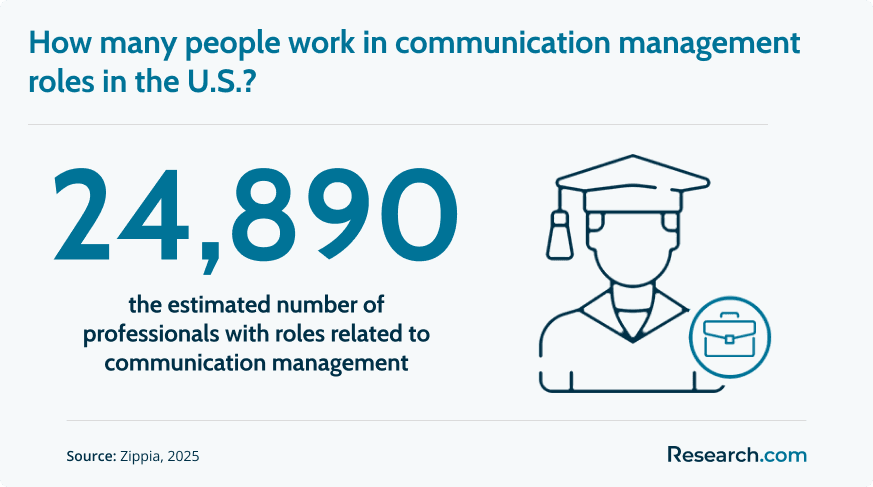
The field includes a broad professional community, including over 24,890 leaders directing communication strategy across the country. Students looking for ways to reduce the financial burden can also explore a communications scholarship while comparing school-based aid and employer support.
Online vs. On-Campus Communication Management Programs
At a reputable accredited institution, an online communication management degree typically follows the same academic standards as the campus version. The more important difference is not whether the diploma says “online,” but how the learning format fits your schedule, networking goals, and preferred way of studying.
| Factor | Online Program | On-Campus Program |
| Schedule | Often built for working adults with asynchronous or limited live requirements | Usually follows set class times and campus calendars |
| Networking | Depends on virtual discussions, group projects, alumni access, and optional events | Offers more face-to-face interaction and campus-based relationship building |
| Best for | Professionals who need flexibility and want to keep working | Students who want a traditional campus experience and more structured routines |
| Possible challenges | Requires strong self-management and comfort with digital tools | May require commuting, relocation, or schedule changes |
Who Should Choose Online Study?
An online program is usually the stronger choice if you are already employed, managing family responsibilities, or unable to relocate. The format lets you invest in career growth while maintaining your current role. This is similar to the flexibility students often look for in the best communication disorders online degree options, though communication management is not generally a licensure-driven field in the same way.
Who Might Prefer Campus Study?
An on-campus program may be a better match if you value in-person discussion, want deeper access to campus organizations, or learn best through scheduled classroom routines. It can also be useful for students who are changing careers and want more direct networking opportunities.
How Much Does an Online Communication Management Degree Cost?
Total tuition for an online communication management degree can range from around $41,600 for in-state public universities to over $45,800 for out-of-state and private institutions. The final cost may also include technology fees, books, residency fees, graduation fees, and any travel required for optional or mandatory in-person components.
Students should not evaluate programs by tuition alone. Start with the published cost, then calculate likely out-of-pocket expenses after aid, scholarships, employer support, and loan options. Many students begin by submitting the FAFSA to determine eligibility for federal aid.
How to Think About Return on Investment
The best-value program is not always the cheapest or the most expensive. A higher-cost degree may be defensible if it offers stronger career services, a respected alumni network, specialized coursework, or a capstone that helps you compete for leadership roles. A lower-cost program may be the smarter decision if it is accredited, aligned with your goals, and reduces debt risk.
| Cost Question | Why It Matters |
| Is the university regionally accredited? | Accreditation affects quality assurance, transferability, employer recognition, and financial aid eligibility. |
| What is the total program cost, not just cost per credit? | Fees, credit requirements, and term structure can change the real price. |
| Will my employer contribute? | Tuition assistance can significantly reduce the amount you borrow or pay directly. |
| Does the curriculum support my target job? | ROI depends on whether the degree helps you qualify for the roles you actually want. |
| Are there cheaper credentials that solve my immediate need? | Some professionals may only need a focused certificate instead of a full graduate degree. |
If your communication responsibilities overlap with cybersecurity, risk communication, or technology leadership, it may also be worth comparing a degree with shorter targeted credentials such as the best online CCSP training bootcamps. The right choice depends on whether you need broad management preparation or a narrow technical credential.
Financial Aid Options for Online Communication Management Students
Graduate students commonly use federal student loans, private loans, scholarships, assistantships where available, payment plans, employer tuition assistance, and professional association awards. The best funding mix depends on your income, credit profile, employer benefits, enrollment status, and willingness to take on debt.
Employer Tuition Assistance Can Be Especially Valuable
Working professionals should ask about tuition reimbursement before assuming loans are the only option. When making the request, connect the program directly to business outcomes: stronger crisis communication, better employee messaging, improved campaign planning, clearer stakeholder communication, or more effective leadership communication.
Look for Aid Connected to Your Sector
Students in government, public service, healthcare, education, or nonprofit work may find funding tied to their field. For example, professionals considering public-sector leadership can compare this degree with the fastest online master's degree in public administration to decide which credential better supports their advancement goals.
Admissions Requirements for an Online Communication Management Degree
Most programs require a bachelor’s degree from an accredited institution. Applicants are commonly asked to provide official transcripts, a resume, two or three recommendation letters, and a personal statement explaining their goals and readiness for graduate study. Some programs may have a minimum GPA requirement, while many place less emphasis on standardized tests such as the GRE.
Do You Need a Communication Background?
You do not always need an undergraduate communication degree to be a competitive applicant. Programs often value professional experience in sales, operations, media, marketing, project management, human resources, customer experience, public affairs, healthcare, education, or nonprofit work. Admissions committees may view those backgrounds as evidence that you understand audiences, organizations, conflict, and stakeholder needs.
Because the average age of professionals in this field is 41, many applicants bring substantial workplace experience. Instead of treating that experience as a weakness, use your application to show how your background gives you a practical understanding of communication challenges.
Application Materials to Prepare
- Resume: Highlight leadership, writing, campaign work, presentations, stakeholder management, crisis response, analytics, or cross-functional collaboration.
- Personal statement: Explain why communication management is the right next step and how the program connects to your career plan.
- Recommendations: Choose people who can speak to your judgment, communication ability, leadership potential, and reliability.
- Transcripts: Request these early so application deadlines are not missed.
- Writing sample or portfolio, if requested: Use work that shows strategic thinking, not only polished prose.
Common Courses in an Online Communication Management Program
Communication management curricula are designed to move students beyond task-level communication into planning, measurement, leadership, and executive advising. Instead of only learning how to write a press release or create social content, students study how communication supports organizational goals, reputation, employee alignment, public trust, and stakeholder decision-making.
| Course Area | What Students Learn | Why It Matters Professionally |
| Strategic Communication Principles | How to build communication plans tied to business or organizational objectives | Managers must connect messaging to measurable outcomes. |
| Communication Leadership | How to lead teams, advise executives, and manage communication functions | Promotion often depends on leadership capability, not writing skill alone. |
| Professional Research Methods | How to collect, interpret, and apply data to evaluate communication work | Employers increasingly expect evidence-based recommendations. |
| Communication Ethics and Law | How legal and ethical standards affect messaging, PR, marketing, and public information | Strategic communicators must manage risk and credibility. |
| Persuasion Theory | How audiences interpret, resist, and respond to messages | Effective campaigns require insight into behavior and decision-making. |
Technology is also changing what communication leaders need to know. Data literacy, platform analytics, and information systems knowledge can strengthen strategic decision-making, which is why some students compare this degree with the fastest online master's degree in management information systems when their goals lean toward digital operations or analytics-heavy leadership.
Popular Specializations in Online Communication Management Degrees
Specializations help you shape the degree around a target role or industry. The best concentration is the one that matches the problems you want to solve after graduation, whether those involve brand reputation, internal communication, crisis response, digital engagement, healthcare messaging, public affairs, or nonprofit advocacy.
| Specialization | Best For | Typical Focus |
| Corporate Communication | Students aiming for internal communication, executive communication, investor communication, or reputation roles | Organizational messaging, leadership communication, stakeholder alignment, and brand trust |
| Public Relations | Students interested in media relations, brand campaigns, and crisis communication | PR strategy, media engagement, issue management, and public visibility |
| Digital and Social Media | Students pursuing digital strategy, content leadership, or social media management | Platform strategy, analytics, audience engagement, and campaign optimization |
| Health Communication | Students working in healthcare, public health, patient education, or community outreach | Clear communication of health information, public campaigns, and trust-building |
| Nonprofit and Public Affairs | Students interested in advocacy, government communication, or mission-driven organizations | Public messaging, policy communication, donor and community engagement, and campaign strategy |
Students focused on digital engagement can also compare communication management concentrations with the fastest online social media degree programs to determine whether they need a broad leadership degree or a more platform-specific credential.
How Specialization Choice Can Affect Career Direction
A specialization should help you signal a clear professional identity. Corporate communication and public relations may support management roles in large organizations, agencies, and professional services. Health communication can be more relevant for healthcare systems, public health agencies, and patient-facing organizations. Nonprofit and public affairs can fit professionals who want to lead advocacy, policy, or community-focused messaging.
How to Choose the Best Online Communication Management Program
The best program is the one that fits your career goals, schedule, budget, and learning style. Rankings can help you build a shortlist, but they should not replace a careful review of curriculum, accreditation, faculty, career services, and total cost.
Use This Program Evaluation Checklist
- Confirm accreditation: Choose a regionally accredited institution and verify accreditation directly with the accreditor or school.
- Match the curriculum to your target role: Look for courses in the areas you need most, such as crisis communication, leadership, analytics, public relations, internal communication, or digital strategy.
- Review the capstone or final project: A strong capstone can become a portfolio piece that demonstrates strategic thinking to employers.
- Check faculty experience: Programs with instructors who understand current industry practice can offer more relevant examples and feedback.
- Compare flexibility: Ask whether classes are asynchronous, synchronous, accelerated, part time, or cohort based.
- Calculate total cost: Include credits, fees, books, travel, lost work time, and interest if you borrow.
- Ask about career support: Look for advising, alumni access, resume support, networking events, and employer connections.
Questions to Ask Before Enrolling
- What communication leadership roles do graduates commonly pursue?
- Are courses taught by full-time faculty, practitioners, or a mix of both?
- Can I complete the program while working full time?
- Does the program require campus visits, live sessions, or group meetings?
- What support is available if I struggle with online learning technology?
- Can I tailor projects to my current job or target industry?
- How often is the curriculum updated to reflect digital tools, analytics, and AI-related changes?
- What is the school’s policy on transfer credits or prior graduate coursework?
Make Sure the Degree Matches the Career You Actually Want
Communication management is not the right graduate path for every management goal. If your long-term plan is supply chain, logistics, procurement, or operations leadership, a specialized option such as the fastest online master's degree in supply chain management may be more relevant than a communication-focused program.
Career Paths With an Online Communication Management Degree
An online communication management degree can support advancement into roles that require planning, leadership, stakeholder management, and strategic judgment. Graduates may move from specialist or coordinator positions into management, director-level, or executive communication roles, depending on their experience and industry.
| Career Stage | Possible Roles | Main Responsibilities |
| Early to mid-career | Communication Specialist, Public Relations Specialist, Digital Communication Specialist | Create content, support campaigns, manage channels, coordinate messaging, and track engagement |
| Management | Communications Manager, Public Relations Manager, Media Relations Manager | Lead campaigns, supervise staff, manage budgets, advise stakeholders, and measure results |
| Senior leadership | Director of Communications, Director of Public Affairs, Director of Internal Communication | Set department strategy, oversee teams, manage reputation risk, and coordinate cross-functional communication |
| Executive level | Vice President of Communications, Chief Communications Officer | Guide enterprise communication strategy, counsel top leadership, manage major issues, and protect organizational credibility |
Industries That Use Communication Management Skills
Graduates can apply communication management training in corporations, agencies, consulting firms, technology companies, healthcare organizations, government agencies, universities, nonprofits, and advocacy organizations. Some professionals pursue roles with major consulting firms such as McKinsey & Company or technology companies such as Meta and Google, while others use the degree to lead public-sector or mission-driven communication.
If your career goals are centered on advocacy, fundraising, public service, or social impact, compare communication management with the fastest online master's degree in nonprofit management to decide whether you need communication leadership training or broader nonprofit administration preparation.
Job Market Outlook for Communication Management Graduates
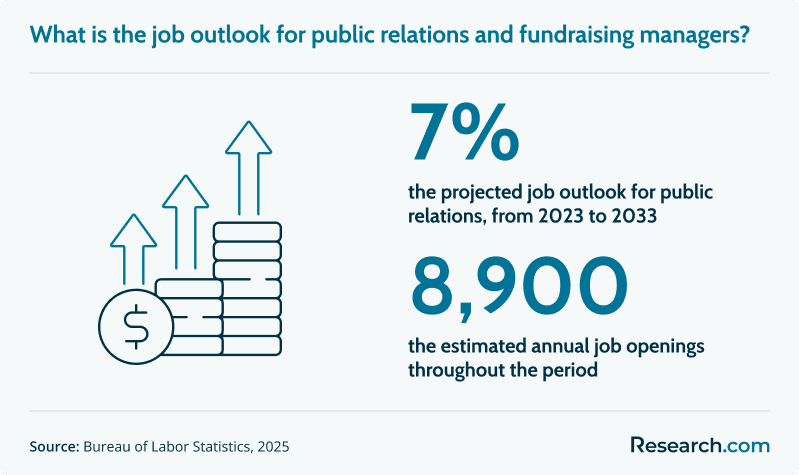
The labor market for communication leaders is supported by ongoing demand for professionals who can manage reputation, public trust, stakeholder relationships, internal messaging, and crisis response. According to the U.S. Bureau of Labor Statistics, employment for public relations and fundraising managers is projected to grow 7% over the next decade, with about 8,900 openings each year for qualified managers.
Why Strategic Communication Skills Remain Valuable
Organizations have more channels, faster news cycles, more public scrutiny, and greater need for consistent messaging than in the past. AI and automation may reduce some routine writing and production tasks, but they do not replace judgment, ethical reasoning, crisis leadership, audience interpretation, or executive advising. Those human skills are central to communication management work.
Certifications and Additional Training That Can Strengthen Your Profile
A graduate degree can provide the strategic foundation, while targeted certifications can help you deepen specific skills. Depending on your goals, you might pursue training in digital analytics, crisis communication, project management, social media strategy, change management, executive communication, or creative storytelling.
Creative credentials can also be useful for professionals who want to improve narrative strategy, brand voice, or audience engagement. Reviewing what jobs you can get with an MFA in creative writing can help you understand how advanced storytelling skills may complement communication leadership in brand, media, nonprofit, or public-facing roles.
Companies still need leaders who can manage uncertainty, build trust, guide teams, and make defensible communication decisions. A communication management degree is most powerful when paired with practical experience and a portfolio that proves you can turn strategy into action.
How Creative Disciplines Can Expand a Communication Management Career
Communication leaders increasingly need both analytical discipline and creative range. Data can show what audiences do, but strong storytelling helps explain why a message matters and how it should be delivered. Professionals who combine communication management with creative training may be better prepared to lead brand narratives, campaign development, content strategy, and audience-centered messaging.
If you want to build a stronger creative toolkit without committing to a high-cost campus program, compare options such as the most affordable masters of fine arts online programs. This path is not necessary for every communication manager, but it can be useful for professionals moving toward creative direction, brand storytelling, content leadership, or narrative strategy.
What Graduates Say About Online Communication Management Study
- Bruce: "I had managed communication projects for years, but I was not being considered for director-level roles. The program helped me understand budgeting, leadership, and strategy in a way I could immediately use at work. Studying online after work was demanding, but it let me keep my job while preparing for the promotion I wanted."
- Pamela: "I came from hospitality, so I worried that I would look like an outsider. Instead, the coursework helped me translate customer service, conflict resolution, and crisis experience into public relations language. That shift made my background feel like an advantage rather than a detour."
- Omar: "Before enrolling, I was confident as a writer but less confident as a strategist. The research, faculty feedback, and discussions with experienced classmates changed how I present recommendations. I now feel better prepared to lead a team and explain the reasoning behind communication decisions."
Digital Trends Shaping Communication Management Education
Modern communication management programs increasingly address AI-assisted workflows, social media analytics, digital audience behavior, content strategy, crisis monitoring, and cross-platform engagement. Students should look for programs that teach both tool use and strategic judgment, because technology changes faster than degree requirements.
Communication leaders also benefit from understanding user experience, design thinking, and audience-centered digital communication. Programs connected to design and technology fields, such as a user experience online degree, can provide useful points of comparison for students who want to work at the intersection of communication, digital products, and audience behavior.
Common Mistakes to Avoid When Choosing a Program
- Choosing only by ranking: Rankings can help you start, but your final decision should depend on fit, accreditation, cost, curriculum, and career support.
- Ignoring accreditation: Accreditation is essential for quality assurance, financial aid eligibility, and employer confidence.
- Comparing only cost per credit: Total credits, fees, and completion time can change the real cost.
- Assuming online means easier: Online programs still require reading, writing, group work, deadlines, and independent time management.
- Overlooking the capstone: A strong final project can become evidence of your strategic ability.
- Choosing a specialization too casually: Your concentration should match the roles, sectors, and problems you want to work on.
- Expecting salary guarantees: A degree may improve qualifications, but outcomes depend on experience, location, industry, networking, and job market conditions.
Key Insights
- An online communication management degree is best for professionals who want to move into strategic, managerial, or executive communication roles.
- Program length varies widely, from 6 to 18 months for accelerated study to two to four years for part-time students.
- Total tuition can range from around $41,600 for in-state public universities to over $45,800 for out-of-state and private institutions, so students should compare full cost rather than sticker price alone.
- Accreditation, curriculum fit, faculty experience, flexibility, capstone quality, and career support should matter more than brand name alone.
- Specializations in corporate communication, public relations, digital media, health communication, and public affairs can help align the degree with specific career goals.
- The U.S. Bureau of Labor Statistics projects 7% growth for public relations and fundraising managers over the next decade, with about 8,900 openings each year.
- AI may change routine communication tasks, but strategic judgment, ethical leadership, crisis response, and relationship management remain difficult to automate.
- The strongest applicants and graduates connect the degree to a clear career plan, a practical portfolio, and measurable workplace outcomes.
References:
- U.S. Bureau of Labor Statistics. (2024). Public relations & fundraising managers. Occupational Outlook Handbook. https://www.bls.gov/ooh/management/public-relations-managers.htm#tab-1
- U.S. Bureau of Labor Statistics. (2025, April). Advertising, promotions, and marketing managers. Occupational Outlook Handbook. https://www.bls.gov/ooh/management/advertising-promotions-and-marketing-managers.htm#tab-1
- U.S. Bureau of Labor Statistics. (2025, April). Media & communication occupations. Occupational Outlook Handbook. https://www.bls.gov/ooh/media-and-communication/
- U.S. Bureau of Labor Statistics. (2025, April). Public relations specialists. Occupational Outlook Handbook. https://www.bls.gov/ooh/media-and-communication/public-relations-specialists.htm#tab-1
- Zippia. (2025, January). What is a communications manager and how to become one. https://www.zippia.com/communications-manager-jobs/
- Zippia. (2025, August). Strategic communications consultant jobs. https://www.zippia.com/strategic-communications-consultant-jobs/
- O*NET Online. Public Relations Specialists summary. https://www.onetonline.org/link/summary/27-3031.00
- National University. Strategic communications career information. https://www.nu.edu/blog/what-can-i-do-with-a-strategic-communications-degree/
- Data USA. Communications profile. https://datausa.io/profile/cip/communications?redirect=true
- Additional retained source links: https://www.zippia.com/communications-manager-jobs/ https://www.bls.gov/ooh/media-and-communication/public-relations-specialists.htm#tab-1 https://www.bls.gov/ooh/media-and-communication/ https://www.bls.gov/ooh/management/advertising-promotions-and-marketing-managers.htm#tab-1 https://www.bls.gov/ooh/management/public-relations-managers.htm#tab-1
Other Things You Should Know About Online Communication Management Degree Programs
The 2027 Best Online Communication Management Degree Programs typically include courses such as Strategic Communication, Digital Media Management, Organizational Communication, and Public Relations. These courses aim to develop students' skills in managing communication strategies and enhancing corporate or organizational communication efficacy.
In 2027, online communication management programs cater to diverse professional backgrounds by offering tailored learning paths. These programs often include foundational courses for newcomers, while offering advanced modules or experiential projects for seasoned professionals, ensuring each student can progress in alignment with their experience level.
Students in online communication management programs typically have a wide range of professional experience. You will find classmates with a few years of experience looking to move up, as well as seasoned professionals with over a decade of experience who are switching careers or aiming for executive roles. This diversity creates a rich learning environment where students learn from each other's real-world knowledge.