
2027 Fastest Online Master’s Degree in Nonprofit Management

Co-Founder and Chief Data Scientist
If you want to move into nonprofit leadership but cannot pause your career for a traditional graduate program, a fast online master’s in nonprofit management can be a practical route. These programs are built for working adults who need advanced training in fundraising, budgeting, governance, program evaluation, advocacy, and mission-based strategy without relocating or attending campus full time.
The decision matters because the nonprofit sector is large, complex, and increasingly professionalized. More than 12.3 million employees and 64 million board members and volunteers work across the sector, and there are about 31,810 fundraising managers in the U.S. alone. A graduate credential will not guarantee a promotion, but it can help experienced nonprofit, public service, education, healthcare, and community organization professionals qualify for roles with more responsibility.
This guide explains what fast online nonprofit management master’s programs include, how long they take, what they cost, how they compare with campus programs, which careers they may support, and how to choose a program that fits your schedule, budget, and leadership goals.
Quick answer: Is a fast online nonprofit management master’s degree worth it?
A fast online nonprofit management master’s degree can be worth it if you already work in or near the nonprofit sector and need graduate-level leadership training to compete for roles such as program director, development manager, fundraising manager, or executive director. The strongest candidates usually have some professional or volunteer experience, clear career goals, and the discipline to handle accelerated online coursework.
Most fast programs can be completed in 12 to 18 months, and tuition often falls between $10,000 and $30,000 depending on the school, credit load, residency status, and financial aid. Before enrolling, confirm regional accreditation, total program cost, transfer credit rules, course format, career support, and whether the curriculum matches the type of nonprofit work you want to do.
What are the benefits of earning an online master’s in nonprofit management?
- Leadership preparation: The degree can support advancement into roles such as Program Director, Development Manager, Fundraising Manager, or Executive Director in nonprofits, NGOs, foundations, schools, healthcare organizations, and public service agencies.
- Career-focused salary potential: Mid-level nonprofit managers often fall within a median salary range of $70,000 to $90,000, with compensation varying by location, employer size, funding model, and seniority.
- Flexible graduate study: Many programs are delivered 100% online and may be completed in as little as 12 months, allowing students to continue working while building management credentials.
What is a fast online nonprofit management master’s degree?
A fast online nonprofit management master’s degree is a graduate program designed to prepare students to lead mission-driven organizations. Instead of focusing only on general business performance, these programs emphasize public value, community impact, donor stewardship, governance, ethical leadership, volunteer management, and accountability to multiple stakeholders.
Students typically study nonprofit law, fundraising, grant writing, financial management, strategic planning, program evaluation, public policy, and organizational leadership. Many programs also include a capstone, practicum, consulting project, or applied research assignment so students can connect coursework to real nonprofit challenges.
Online delivery is often asynchronous, meaning students can review lectures, complete assignments, and participate in discussions outside fixed class times. That flexibility is valuable for working professionals, but it also requires strong time management because accelerated courses move quickly.
| Feature | What it usually means for students |
| Program length | Many fast programs are designed for completion in 12 to 18 months. |
| Delivery format | Courses may be fully online, hybrid, asynchronous, synchronous, or a mix of formats. |
| Common focus areas | Fundraising, governance, budgeting, grants, advocacy, program evaluation, and leadership. |
| Applied learning | Programs may require a capstone, practicum, internship, portfolio, or field-based project. |
| Best fit | Working professionals, nonprofit staff, public service employees, volunteers, and career changers with clear goals. |
Where can graduates work with an online nonprofit management master’s degree?
Graduates can work in many mission-based settings, including charitable nonprofits, foundations, advocacy groups, schools, universities, healthcare organizations, religious and civic organizations, social service agencies, NGOs, and local government offices.
Fundraising managers are employed across multiple industries. Colleges and universities employ nearly 7,000 professionals in this field, while grantmaking and giving services employ close to 6,000. Social and community service managers also work in individual and family services (26%), religious and civic organizations (12%), nursing and residential care facilities (11%), and local government (9%).
The degree is especially relevant for roles that combine people management, budget oversight, donor engagement, public communication, and program accountability. However, graduates should still expect competition for senior executive roles, especially in large national organizations.
How much can you earn with an online nonprofit management master’s degree?
Pay varies widely in nonprofit management because compensation depends on the role, employer size, funding base, region, and level of responsibility. Many nonprofit management professionals earn within the $55,000 to $85,000 range. Fundraising and advocacy managers earn around $56,000 to $58,000 annually, while program directors and philanthropy managers can earn over $65,000. Development directors are often among the higher-paid roles, averaging about $85,000 per year.
According to BLS data cited for this guide, social and community service managers earn a median wage of $78,240 annually. Entry-level professionals may start in the mid-$50,000s, while experienced leaders in larger organizations or urban markets may earn more.
A master’s degree can strengthen promotion prospects, but salary outcomes are not automatic. Experience, fundraising results, budget size managed, leadership record, grant-writing ability, and board-facing experience often matter as much as the credential itself.
- Best Master’s in Nonprofit Management Degree Programs for 2027
- How long does a fast online nonprofit management master’s degree take?
- Online vs. on-campus nonprofit management master’s programs
- Average cost of a fast online nonprofit management master’s degree
- Financial aid options for nonprofit management graduate students
- Admission requirements for fast online nonprofit management master’s programs
- Common courses in an online nonprofit management master’s degree
- Specializations in nonprofit management master’s programs
- Challenges of accelerated online nonprofit management programs
- Trends shaping online nonprofit management education
- How to choose the fastest online nonprofit management master’s degree
- Career paths for nonprofit management master’s graduates
- Job market outlook for nonprofit management graduates
- Nonprofit management master’s vs. business administration degree
Best Master’s in Nonprofit Management Degree Programs for 2025 2027
How should students use this ranking?
This list is a starting point for comparing online and hybrid nonprofit management master’s programs. It should not be the only factor in your decision. The best program for you depends on your career goals, budget, schedule, learning preferences, transfer credits, and whether you want a nonprofit-specific degree, an MPA concentration, or a broader management credential.
Because tuition, fees, admissions policies, and course delivery can change, verify details directly with each school before applying. Pay special attention to the total number of credits, whether tuition differs by residency, and whether the program includes synchronous class meetings, fieldwork, or a capstone.
How do we rank the programs?
Research.com uses a data-informed ranking process designed to help students compare programs with more transparency. The ranking draws from established education data sources, including the IPEDS database, Peterson's database, the College Scorecard database, and The National Center for Education Statistics.
These sources support comparisons across institutions and programs. To learn more about the ranking process, review Research.com's methodology page.
1. Our Lady of the Lake University – Master of Science in Nonprofit Management
Our Lady of the Lake University offers an online Master of Science in Nonprofit Management for students preparing for leadership in mission-based organizations. Coursework covers strategic planning, financial decision-making, and leadership, with electives that allow students to explore fund development, marketing, and governance. The program is structured for working professionals who want applied nonprofit management training.
- Cost per credit: $630
- Total cost of program: $22,680 (36 credits)
- Accreditation: SACSCOC
2. Walden University – MS in Nonprofit Management and Leadership
Walden University provides a fully online MS in Nonprofit Management and Leadership. Students may choose specializations such as Global Leadership, Social Entrepreneurship, and General Program. The curriculum blends nonprofit theory with practical leadership applications, including ethics, sustainability, and community engagement.
- Cost per credit: $545
- Total cost of program: $22,890 (42 credits)
- Accreditation: HLC
3. Louisiana State University – Master of Public Administration with a Specialization in Nonprofit Administration
Louisiana State University offers a 100% online MPA with a Nonprofit Administration specialization. Students study budgeting, nonprofit law, fundraising, and data-informed decision-making for complex service organizations. This option may fit learners who want public administration training with a nonprofit leadership focus.
- Cost per credit: $481
- Total cost of program: $14,430 (30 credits)
- Accreditation: SACSCOC
4. Northeastern University – Master of Science in Nonprofit Management
Northeastern University offers an online MS in Nonprofit Management with specialization options in Fundraising, Social Innovation, Organizational Communication, and Human Services. The program incorporates experiential learning and industry-focused coursework for students pursuing careers in mission-driven organizations.
- Cost per credit: $730
- Total cost of program: $32,850 (45 credits)
- Accreditation: NECHE
5. University of Central Florida – Master of Nonprofit Management
University of Central Florida delivers its Master of Nonprofit Management online. The curriculum emphasizes financial management, strategic planning, program evaluation, ethics in public service, fundraising, and grant development. It is designed for students who want to manage nonprofit initiatives and organizational resources.
- Cost per credit: $772.69 (out-of-state)
- Total cost of program: $27,817 (36 credits, out-of-state)
- Accreditation: SACSCOC
6. Arizona State University – Master of Nonprofit Leadership and Management
Arizona State University offers a fully online Master of Nonprofit Leadership and Management through the Watts College of Public Service and Community Solutions. Students study strategic leadership, financial management, advocacy, and may choose electives in areas such as volunteer management, social entrepreneurship, or international nonprofits.
- Cost per credit: $750
- Total cost of program: $27,000 (36 credits)
- Accreditation: HLC
7. University of Houston–Downtown – Master of Arts in Non-Profit Management
University of Houston–Downtown provides a hybrid Master of Arts in Non-Profit Management. The program combines nonprofit theory with applied leadership preparation in grant writing, human resources, budgeting, and ethics. A capstone project gives students an opportunity to address practical nonprofit management problems.
- Cost per credit: $379.38 (resident), $834.38 (non-resident)
- Total cost of program: Approx. $13,657 (36 credits, resident)
- Accreditation: SACSCOC
8. Marywood University – Master of Public Administration with a Track in Nonprofit Leadership
Marywood University offers an MPA with a Nonprofit Leadership track. Delivered in a hybrid format, the program includes coursework in budgeting, ethics, and strategic planning. The nonprofit track is intended for students preparing to lead charitable, advocacy, and service-based organizations.
- Cost per credit: $600
- Total cost of program: $21,600 (36 credits)
- Accreditation: MSCHE
9. Ohio University – Online Master of Public Administration: Nonprofit Management
Ohio University offers an online Master of Public Administration with a concentration in Nonprofit Management. Students complete coursework in nonprofit budgeting, governance, and leadership, with interactive online learning and assignments tied to real nonprofit operations.
- Cost per credit: $595
- Total cost of program: $21,420 (36 credits)
- Accreditation: HLC
10. North Park University – Master of Nonprofit Administration
North Park University offers a fully online Master of Nonprofit Administration. Students can choose concentrations in Fundraising Management, Higher Education Administration, or Church Administration. The curriculum connects ethics, finance, and organizational strategy to nonprofit leadership environments.
- Cost per credit: $685
- Total cost of program: $24,660 (36 credits)
- Accreditation: HLC
How long does a fast online nonprofit management master’s degree take?
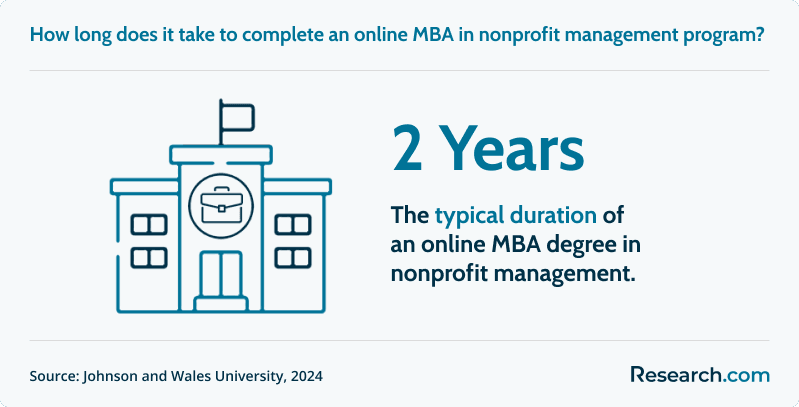
Most fast online nonprofit management master’s programs take 12 to 18 months to complete. The exact timeline depends on the number of credits required, whether courses are offered year-round, whether students enroll full time or part time, and whether transfer credits are accepted.
Accelerated nonprofit management programs often resemble the format of an accelerated master's in public administration online: shorter terms, compressed course schedules, and online delivery built around adult learners. This structure can save time, but it also increases weekly workload.
Demand for flexible graduate education has grown. Between 2011–12 and 2021–22, the total number of master’s degrees awarded increased by 16 percent, rising from 756,000 to 880,200. That growth reflects the continued value many professionals place on graduate credentials.
| Timeline option | Who it may fit | Trade-off |
| 12-month accelerated path | Students with strong time management, fewer outside obligations, or prior graduate credits. | Heavy workload and limited breaks between terms. |
| 15- to 18-month path | Working professionals who want speed but need a more manageable pace. | Still fast, but may require careful planning around work deadlines. |
| Part-time path | Students balancing demanding jobs, caregiving, or volunteer leadership roles. | Longer time to graduation, but often more sustainable. |
Some schools allow transfer credits, prior graduate coursework, or waived prerequisites, which may shorten the path to graduation. Always ask admissions advisors to confirm how many credits can transfer before you enroll.
How does a fast online nonprofit management master’s degree compare to an on-campus program?
A fast online nonprofit management master’s degree usually offers more scheduling flexibility than an on-campus program, while campus-based study may provide more in-person networking, faculty access, and local community engagement. The better choice depends on your work schedule, learning style, location, and need for face-to-face interaction.
Students comparing accelerated management credentials may also look at programs outside nonprofit management, such as the shortest online MBA programs human resource management, especially if they want broader HR leadership preparation.
| Factor | Fast online program | On-campus program |
| Schedule | Often asynchronous or built for working adults. | Usually requires attendance at set class times. |
| Completion speed | Often designed for 12 to 18 months. | May follow traditional semester pacing. |
| Networking | Virtual discussions, group projects, online events, and alumni networks. | In-person relationships with classmates, faculty, and local nonprofit partners. |
| Cost considerations | May reduce commuting, relocation, parking, and housing costs. | May include campus fees, transportation, and possible relocation expenses. |
| Best for | Professionals who need flexibility and cannot regularly travel to campus. | Students who learn best through in-person interaction and local networking. |
Flexibility and convenience
Online programs allow students to complete coursework from home or another location with internet access. This can be especially helpful for nonprofit employees who work evenings, attend community events, travel for outreach, or manage unpredictable program schedules.
Speed and cost
Accelerated online programs commonly compress the degree into 12 to 18 months. They can also reduce indirect expenses, such as commuting and housing. Cost-conscious students comparing online graduate options in related leadership fields may also review the cheapest online master's in sustainability to understand how tuition varies across mission-oriented disciplines.
Interaction and networking
On-campus programs often provide stronger face-to-face networking. Online programs can still build connections through video meetings, virtual office hours, discussion boards, group projects, and alumni communities, but students must be intentional about participating.
What is the average cost of a fast online nonprofit management master’s degree?
The average cost of a fast online nonprofit management master’s program typically ranges from $10,000 to $30,000. Some programs cost more depending on credit requirements, residency status, institutional fees, and whether tuition is charged per credit or as a flat program rate.
Do not compare programs by tuition alone. A lower per-credit rate may not mean a lower total cost if the program requires more credits. Also review technology fees, graduation fees, textbooks, residency requirements, travel costs for any in-person components, and whether tuition is locked for the length of the program.
Graduate education is a common investment for career advancement. Nearly 25.6 million adults aged 18 and older—about 9.9% of the U.S. population—hold a master’s degree as their highest education level.
Online study can reduce relocation, commuting, and housing expenses. The appeal of faster online education is not limited to graduate students; undergraduates pursuing a fast-track online entrepreneurship bachelor's degree may use a similar model to build business skills quickly.
| Cost item | Why it matters |
| Tuition per credit | Helps compare schools, but only after multiplying by total required credits. |
| Total credits | A 30-credit program and a 45-credit program can have very different total costs. |
| Residency rate | Public universities may charge different rates for resident and non-resident students. |
| Fees | Online, technology, graduation, and course fees can raise the final price. |
| Transfer credits | Accepted credits may reduce both time and tuition. |
| Employer assistance | Tuition reimbursement can significantly lower out-of-pocket costs. |
What financial aid options are available for fast online nonprofit management master’s students?
Students in fast online nonprofit management programs may qualify for several types of financial aid. The right mix depends on the school, enrollment status, citizenship or residency eligibility, employer benefits, and whether the program participates in federal aid. Similar affordability questions apply to other accelerated graduate options, including the fastest online taxation management degree programs.
- Federal financial aid: Eligible students may submit the FAFSA to be considered for federal loans and other available aid options through participating institutions.
- Scholarships: Schools, foundations, associations, and nonprofit organizations may offer awards based on financial need, academic record, service background, or career goals.
- Employer tuition assistance: Some nonprofit, public agency, healthcare, and education employers reimburse part or all of tuition for job-related graduate study.
- Institutional aid: Colleges may provide grants, discounts, fellowships, or online student tuition reductions.
- Payment plans: Monthly or term-based payment plans can make tuition easier to manage, though they do not reduce the total cost.
If affordability is your main concern, compare total program cost across several fields and schools. For example, reviewing the most affordable online master's in adult education programs can help you see how budget-friendly online graduate programs are structured in adjacent service-oriented areas.
Questions to ask about financial aid
- Does the program qualify for federal financial aid?
- What is the total cost after tuition, fees, books, and required technology?
- Are scholarships available specifically for nonprofit, public service, or online graduate students?
- Can employer reimbursement be applied before payment is due, or only after grades are posted?
- Will dropping below a certain credit load affect aid eligibility?
What are the admission requirements for a fast online nonprofit management master’s program?
Most fast online nonprofit management master’s programs require a bachelor’s degree from an accredited institution. Some applicants enter with backgrounds in business, social work, public administration, education, communications, political science, healthcare, or economics. Students who completed an accelerated online bachelor's degree in economics, for example, may bring useful preparation in financial analysis, resource allocation, and data-informed decision-making.
Academic requirements
Schools commonly request official transcripts and may expect a minimum undergraduate GPA, often around 2.5 to 3.0. Some programs also require a resume, statement of purpose, letters of recommendation, writing sample, or interview.
Professional background
Nonprofit experience is not always mandatory, but it can strengthen an application. Paid work, board service, AmeriCorps-style service, volunteer leadership, fundraising participation, grant support, community organizing, or public agency experience can show commitment to mission-based work.
Skills that help students succeed
Strong communication, leadership, problem-solving, and ethical judgment are important. Top-rated skills for nonprofit managers include judgment and decision making, financial resource management, systems analysis, personnel management, and coordination. Persuasion, active listening, and complex problem solving are also valuable because nonprofit leaders often manage competing stakeholder expectations with limited resources.
What courses are usually included in a fast online nonprofit management master’s degree?
Fast online nonprofit management programs are built around the practical responsibilities of leading mission-driven organizations. While course names differ by school, the core curriculum usually combines management, finance, fundraising, governance, public policy, and evaluation.
| Course area | What students learn | Why it matters in nonprofit leadership |
| Nonprofit leadership and governance | Board relations, executive leadership, ethics, accountability, and organizational direction. | Nonprofits must balance mission, legal duties, donor expectations, and community trust. |
| Fundraising and grant writing | Donor cultivation, campaigns, proposals, stewardship, and revenue strategy. | Leaders must secure sustainable funding without weakening mission integrity. |
| Financial management | Budgeting, financial reporting, restricted funds, and resource allocation. | Transparent financial oversight is essential for compliance and stakeholder confidence. |
| Program evaluation | Outcome measurement, impact assessment, data analysis, and continuous improvement. | Funders and boards increasingly expect evidence of results. |
| Human resource and volunteer management | Staff supervision, volunteer coordination, workplace policy, and organizational culture. | Many nonprofits rely on both employees and volunteers to deliver services. |
| Marketing and communications | Public messaging, storytelling, digital outreach, and community engagement. | Clear communication helps attract donors, volunteers, clients, and partners. |
| Public policy and advocacy | Policy analysis, advocacy strategy, regulations, and civic engagement. | Many nonprofits operate in areas shaped by public funding and regulation. |
| Capstone or practicum | Applied project, consulting assignment, portfolio, or field-based work. | Students demonstrate that they can solve real organizational problems. |
Students who want deeper workforce leadership training beyond the nonprofit curriculum may compare related options such as a fast-track online master's degree in human resources management, which focuses more heavily on talent strategy, organizational behavior, and workforce planning.
What specializations are available in fast online nonprofit management master’s programs?
Specializations help students align the degree with a specific nonprofit function or career path. Not every school offers concentrations, so review electives carefully if you want targeted preparation.
- Fundraising and Development: Best for students interested in donor relations, capital campaigns, annual giving, corporate partnerships, and grant strategy.
- Nonprofit Finance: Useful for students who want to manage budgets, financial reports, restricted funds, audits, and resource planning.
- Public Policy and Advocacy: A strong fit for learners who want to influence policy, mobilize communities, or work in advocacy organizations.
- Global Nonprofit Management: Relevant for students interested in international NGOs, cross-border partnerships, humanitarian work, or global development.
- Social Entrepreneurship: Designed for students who want to combine business models with mission-driven problem solving.
- Education and Community Outreach: Appropriate for professionals working with schools, after-school programs, literacy initiatives, workforce programs, or local development efforts.
Specialized training can matter because the sector is broad. There are more than 1.4 million registered 501(c)(3) organizations in the U.S., including nearly 1.3 million charitable nonprofits and over 126,000 private foundations.
Students interested in education-focused nonprofits may also compare the cheapest online master's in instructional design, especially if their work involves curriculum, training, digital learning, or community education.
What are the potential challenges of fast online nonprofit management master’s programs?
Accelerated online study can be convenient, but it is not easy. The same features that make these programs fast can also make them demanding. Students often complete dense readings, group projects, discussion posts, papers, and applied assignments in shorter academic terms.
| Challenge | Why it can be a problem | How to reduce the risk |
| Heavy weekly workload | Accelerated courses may require frequent deadlines while students are working full time. | Ask for sample syllabi and estimate weekly study hours before enrolling. |
| Limited in-person networking | Online students may have fewer spontaneous conversations with faculty, peers, and local employers. | Attend virtual events, join professional associations, and schedule faculty meetings. |
| Self-directed learning | Asynchronous courses require students to stay organized without a fixed classroom routine. | Use a weekly study calendar and set non-negotiable assignment blocks. |
| Uneven employer perceptions | Some employers may ask about program quality if they are unfamiliar with the school. | Choose a regionally accredited institution and be ready to discuss projects and skills gained. |
| Financial pressure | Fast programs may compress tuition payments into a shorter period. | Compare payment plans, employer assistance, scholarships, and total debt before committing. |
Students comparing the value of graduate management degrees more broadly may also review affordable business options such as a cheap MBA, particularly if they are weighing nonprofit leadership against private-sector management careers.
What trends are shaping online nonprofit management education?
Online nonprofit management education is changing as nonprofit work becomes more data-driven, digitally connected, and outcome-focused. Programs increasingly emphasize tools and strategies that leaders use to manage donors, measure impact, communicate online, and adapt to changing funding conditions.
- Data analytics and impact measurement: Funders, boards, and communities want clearer evidence that programs work, which makes evaluation and reporting skills more important.
- Digital fundraising: Students may study donor platforms, online campaigns, email strategy, and digital stewardship.
- Social media and community engagement: Nonprofits rely on digital channels to reach donors, volunteers, clients, advocates, and policymakers.
- Simulation and applied projects: Some programs use case studies, campaign simulations, or consulting-style assignments to help students practice decision-making.
- Interdisciplinary learning: Nonprofit leaders increasingly draw from business, public policy, social work, education, emergency management, communications, and technology.
Students interested in cross-disciplinary program design and community engagement may also compare fields outside nonprofit management, including the fastest bachelor's in sports management online, when exploring how leadership programs serve different audiences and industries.
How to choose the fastest online nonprofit management master’s degree program
To choose the right fast online nonprofit management master’s program, start with fit rather than speed alone. The fastest degree is not always the best value if the workload is unrealistic, the curriculum does not match your goals, or the total cost creates too much debt.
1. Confirm accreditation first
Choose a regionally accredited institution. Accreditation affects employer recognition, transferability of credits, access to federal financial aid, and confidence in academic quality.
2. Match the curriculum to your target role
If you want to become a development director, prioritize fundraising, donor analytics, grant writing, and campaign management. If you want executive leadership, look for governance, strategic planning, finance, and board relations. If you want advocacy work, policy and community organizing courses matter more.
3. Look closely at pace and format
Ask whether courses are asynchronous, synchronous, or hybrid. A 12-month program with live evening classes may feel very different from a 12-month program with flexible weekly deadlines.
4. Compare total cost, not only tuition
Calculate the full price, including credits, fees, books, travel, and lost work time. Then subtract realistic aid, scholarships, or employer benefits. Students comparing accelerated public service pathways may also review 1 year MSW programs online no BSW to understand how different service-oriented graduate degrees structure time and cost.
5. Evaluate support services
Strong online programs provide academic advising, library access, technical support, writing help, career coaching, internship or practicum guidance, and opportunities to connect with alumni.
6. Ask practical questions before applying
- Can the degree be completed in 12 to 18 months without taking an overload every term?
- How many hours per week do successful students spend on coursework?
- Are classes live, self-paced, or deadline-based?
- Does the school accept transfer credits?
- Is there a capstone, practicum, internship, or residency?
- What nonprofit employers, alumni, or partner organizations are connected to the program?
- What career support is available for online students?
Common mistakes to avoid when choosing a fast online nonprofit management degree
- Choosing only by speed: A very short program may not be realistic if you work full time or have caregiving responsibilities.
- Ignoring accreditation: Accreditation should be verified before you consider tuition, rankings, or program length.
- Comparing only per-credit tuition: Total cost depends on credits, fees, residency rates, materials, and payment timing.
- Assuming online means easier: Accelerated online courses can be more intense than traditional semester courses.
- Overlooking networking: Online students need to actively build relationships with faculty, classmates, alumni, and nonprofit professionals.
- Choosing a broad program when you need specialization: Fundraising, finance, policy, and executive leadership tracks can lead to different opportunities.
- Assuming salary increases are guaranteed: A degree can help, but compensation also depends on experience, role, employer size, geography, and funding.
What career paths are available for graduates of fast online nonprofit management master’s programs?
Graduates can pursue leadership, fundraising, operations, advocacy, and program management positions across the nonprofit and public service sectors. The degree is most useful when paired with relevant experience, measurable accomplishments, and a clear professional focus.
Students who want nonprofit expertise combined with broader business training may compare the fastest online MBA programs in nonprofit management, especially if they are considering executive, consulting, or cross-sector management roles.
| Career path | Typical responsibilities | Helpful preparation |
| Program Director | Oversees services, staff, budgets, reporting, and program outcomes. | Program evaluation, budgeting, leadership, and data analysis. |
| Development Manager or Director | Leads fundraising campaigns, donor relationships, grants, and stewardship. | Fundraising strategy, communications, grant writing, and donor analytics. |
| Fundraising Manager | Plans campaigns, manages donor pipelines, coordinates events, and tracks revenue goals. | Campaign management, CRM tools, storytelling, and relationship building. |
| Executive Director | Works with the board, manages strategy, oversees finances, and represents the organization publicly. | Governance, finance, strategic planning, advocacy, and senior leadership experience. |
| Volunteer Manager | Recruits, trains, schedules, and retains volunteers. | Human resources, training, communication, and community engagement. |
| Advocacy or Policy Manager | Builds campaigns, tracks policy, engages stakeholders, and mobilizes communities. | Public policy, advocacy, communications, and coalition management. |
Leadership and fundraising roles
Fundraising and donor engagement are central career areas for many graduates. Since 47% of nonprofit leaders cite donor acquisition as their biggest challenge, professionals who can build sustainable funding strategies can be valuable to organizations.
Community and volunteer management
Many nonprofits depend heavily on volunteers. With the value of a volunteer hour now averaging $33.49, leaders who can recruit, train, retain, and deploy volunteers effectively help organizations extend their capacity.
Strategy and operations
Graduates may also move into roles focused on donor retention, data analysis, compliance, budgeting, or organizational planning. These skills are important because 56% of nonprofits lack a clear donor engagement strategy, and year-end giving now accounts for only 5% of total annual online revenue.
Students comparing nonprofit management with social work career paths may review MSW vs LCSW salary to understand how education, licensure, and compensation differ across human service professions.
What is the job market for graduates with a fast online nonprofit management master’s degree?
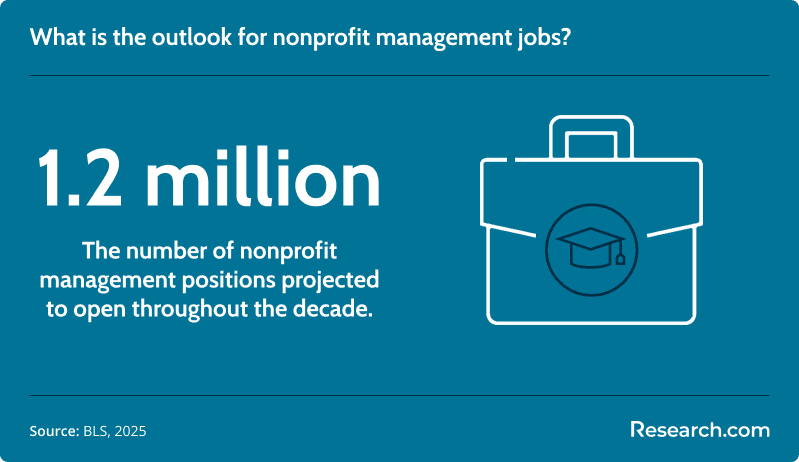
The job market for nonprofit management graduates is steady, but advancement depends on experience, leadership record, and specialization. According to the U.S. Bureau of Labor Statistics, employment of social and community service managers is projected to grow 9% from 2022 to 2032, which is faster than the average for all occupations.
Graduates may find opportunities in charities, advocacy organizations, schools, universities, foundations, healthcare nonprofits, community agencies, and public service organizations. Demand is connected to the need for social services, stronger program accountability, and better measurement of community impact.
However, nonprofit leadership has real constraints. Senior roles can be competitive, and compensation may lag behind private-sector management. Access to top leadership can also be uneven; only 29% of CEOs at large nonprofits are women, and many still earn less than their male counterparts.
Professionals who add specialized knowledge in crisis response, disaster planning, or humanitarian operations may also consider credentials such as the shortest online masters in emergency management degree programs to broaden their leadership profile.
Salary growth in the sector has also been limited, with a reported 1% increase in recent years. For many graduates, the strongest return on investment comes from combining the degree with practical achievements: funds raised, programs expanded, grants won, teams led, budgets managed, and measurable community outcomes.
How does a fast online nonprofit management master’s degree differ from a business administration degree?
A nonprofit management master’s degree focuses on leading organizations where mission, public trust, donors, boards, volunteers, clients, and community impact shape decisions. A business administration degree usually focuses more broadly on management, markets, operations, finance, strategy, and organizational performance across industries.
Students who want a broader business credential can compare nonprofit-focused options with the top online MBA degrees. The right choice depends on whether you want to specialize in mission-based work or keep your career options open across nonprofit, public, and private sectors.
| Degree type | Primary focus | Best fit |
| Master’s in Nonprofit Management | Fundraising, governance, volunteer management, nonprofit finance, advocacy, and community impact. | Students committed to nonprofit, foundation, NGO, public service, or community leadership careers. |
| MPA with nonprofit concentration | Public administration, policy, government systems, budgeting, and nonprofit administration. | Students interested in both public sector and nonprofit leadership. |
| MBA with nonprofit management focus | Business strategy, finance, operations, leadership, and nonprofit applications. | Students who want business flexibility plus mission-driven specialization. |
Key Insights
- A fast online nonprofit management master’s degree is best for working professionals who want leadership training in fundraising, governance, budgeting, advocacy, and program impact without leaving their jobs.
- Most accelerated online programs take 12 to 18 months, but the fastest option is not always the best choice. Workload, course format, accreditation, support services, and career fit matter more than speed alone.
- Tuition commonly ranges from $10,000 to $30,000, but students should calculate the full cost, including fees, books, credit requirements, residency rates, and payment timing.
- Career outcomes vary. Nonprofit managers often earn within the $55,000 to $85,000 range, while social and community service managers earn a median wage of $78,240 annually based on cited BLS data.
- The job outlook is favorable for related roles: employment of social and community service managers is projected to grow 9% from 2022 to 2032.
- Choose a program only after confirming regional accreditation, curriculum relevance, transfer credit options, financial aid availability, online student support, and whether the program connects you to nonprofit networks.
- The degree can help with advancement, but it does not guarantee a salary increase or executive role. Employers will also look for experience, fundraising results, budget responsibility, leadership ability, and measurable impact.
References:
- Data USA. (n.d.). Non-profit public organizational management. https://datausa.io/profile/cip/non-profit-public-organizational-management#counties_most_degrees
- Education Data Initiative. (n.d.). Education attainment statistics. https://educationdata.org/education-attainment-statistics
- Indeed Career Guide. (n.d.). Nonprofit management careers. https://www.indeed.com/career-advice/finding-a-job/nonprofit-management-careers
- National Center for Education Statistics. (n.d.). Graduate degree fields indicator. https://nces.ed.gov/programs/coe/indicator/ctb/graduate-degree-fields
- Nonprofit Impact Matters. (n.d.). Downloadable charts. https://www.nonprofitimpactmatters.org/data/downloadable-charts/
- NonprofitPRO. (2023). Donor acquisition tops list of challenges for nonprofit leaders. https://www.nonprofitpro.com/article/donor-acquisition-tops-list-of-challenges-for-nonprofit-leaders/
- NonprofitPRO. (2023). Independent sector releases new value of volunteer time of $33.49 per hour. https://www.nonprofitpro.com/article/independent-sector-releases-new-value-of-volunteer-time-of-33-49-per-hour/
- NonprofitPRO. (2023). Nonprofit salaries see marginal movement in 2023. https://www.nonprofitpro.com/article/nonprofit-salaries-see-marginal-movement-in-2023/
- NonprofitPRO. (2024). Candid releases 2024 nonprofit compensation report. https://www.nonprofitpro.com/article/candid-releases-2024-nonprofit-compensation-report/
- U.S. Bureau of Labor Statistics. (2023, May). Occupational employment and wages, May 2023: Social and community service managers. https://www.bls.gov/oes/2023/may/oes112033.htm
Other Things You Should Know about Fast Online Nonprofit Management Master's Degree Programs
The fastest online Master's in Nonprofit Management can typically be completed in as little as one year, depending on the program's structure and the student's ability to manage an accelerated course load.
Applicants typically need a bachelor's degree from an accredited institution and relevant experience in nonprofit organizations. Some programs may require letters of recommendation or a personal statement tailored to the nonprofit management field in 2027.
No, many accelerated online nonprofit management master’s programs can be finished without in-person fieldwork. Some schools still require a practicum, internship, or capstone, usually worth 3 to 6 credits, completed remotely or with a local nonprofit partner.


