2027 Most Affordable Online Master's Degree in Nonprofit Management

Co-Founder and Chief Data Scientist
Choosing an affordable online master’s degree in nonprofit management is not just a tuition decision. It is a career-planning decision for people who want to lead charities, foundations, advocacy groups, community programs, associations, public-service initiatives, or mission-driven departments without pausing their careers. The nonprofit sector is large: the US Bureau of Labor Statistics (BLS) reported that nonprofit organizations recently represented more than 300,000 establishments in the US and supported nearly 13 million private-sector jobs. Yet many professionals enter leadership roles with limited formal preparation in fundraising, governance, budgeting, compliance, and impact measurement.
This guide explains what an online master’s in nonprofit management includes, how to compare affordable programs, what the degree may cost, how long it can take, and which career paths it can support. It is designed for working adults, career changers, nonprofit employees seeking promotion, and public-service professionals who want a practical way to evaluate program value before enrolling.
Quick answer: Is an affordable online master’s in nonprofit management worth considering?
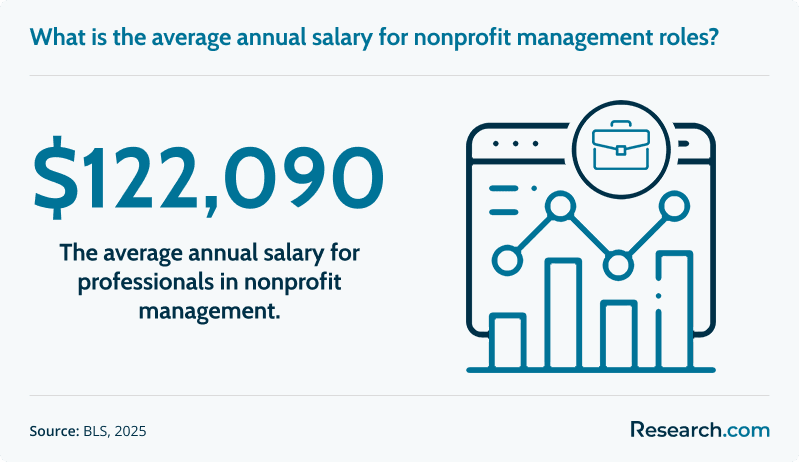
An affordable online master’s degree in nonprofit management can be a strong option if you want leadership training in fundraising, nonprofit finance, program evaluation, governance, public policy, and mission-based strategy while continuing to work. Graduates may pursue roles such as nonprofit executive director, development director, program manager, fundraising manager, policy analyst, or operations leader. According to Data USA, professionals in nonprofit management earn a median salary of $105,798 per year, while BLS reports an average annual salary of $122,090 for professionals in nonprofit management. Outcomes vary by employer, location, experience, organization size, and prior leadership background.
- Best fit: working professionals who want management roles in nonprofits, NGOs, foundations, associations, advocacy organizations, or public-service agencies.
- Main advantage: online study can make graduate education more manageable for students balancing work, family, and service commitments.
- Key caution: the cheapest program is not always the best value. Accreditation, curriculum quality, faculty experience, career support, and total cost matter.
What can I expect from an online master’s degree in nonprofit management?
An online master’s in nonprofit management teaches students how to run organizations that exist to serve a mission rather than maximize profit. The curriculum usually combines management theory with applied training in nonprofit law, fundraising, budgeting, grant writing, strategic planning, board relations, ethics, public policy, and program evaluation. Many programs also include case studies, simulations, capstone projects, internships, or applied consulting assignments so students can connect coursework to real organizational problems.
Most online programs are built for adults who are already employed. Courses may be asynchronous, meaning students can review lectures and complete assignments on their own schedule, or synchronous, meaning live online class meetings are required. The right format depends on how much structure, peer interaction, and schedule flexibility you need.
| What you study | Why it matters in nonprofit leadership |
| Fundraising and development | Helps leaders build donor relationships, plan campaigns, and support long-term revenue stability. |
| Nonprofit finance | Prepares students to manage budgets, grants, restricted funds, audits, and financial reporting. |
| Governance and nonprofit law | Explains board responsibilities, compliance expectations, tax-exempt operations, and ethical decision-making. |
| Program evaluation | Teaches students how to measure outcomes, improve services, and communicate impact to funders and communities. |
| Strategic leadership | Builds skills in planning, change management, staffing, partnerships, and mission alignment. |
Where can I work with a master’s degree in nonprofit management?
Graduates can work in many mission-focused settings, including charitable organizations, educational foundations, healthcare advocacy groups, international NGOs, religious organizations, museums, cultural institutions, social-service agencies, community development organizations, and public institutions. In these environments, leaders often manage staff, budgets, volunteers, donor relationships, community partnerships, and program outcomes.
The degree can also apply outside traditional nonprofit organizations. Some graduates move into government agencies, public affairs teams, corporate social responsibility departments, grant administration, association management, or community engagement roles. The common thread is mission-driven leadership: using management, finance, communication, and policy skills to deliver measurable public or community benefit.
How much can I make with a master’s degree in nonprofit management?
Compensation depends heavily on the role, region, organization size, funding model, and the graduate’s experience before entering the program. According to Data USA, the median salary for nonprofit management professionals is $105,798 per year. BLS reports an average annual salary of $122,090 for professionals in nonprofit management. These figures should be treated as reference points, not guarantees.
Entry- to mid-level roles such as program manager, development officer, or operations manager typically fall between $60,000 and $90,000 annually, depending on location and employer resources. Senior roles such as executive director, nonprofit CEO, development director, or senior operations leader may reach six figures, especially in larger or better-funded organizations.
| Career level | Example roles | Salary context from the article data |
| Entry to mid-level | Program manager, development officer, grant coordinator, operations manager | Typically between $60,000 and $90,000 annually, depending on employer, location, and responsibilities. |
| Experienced management | Development director, program director, public affairs director, community development manager | May approach or exceed the Data USA median salary of $105,798 per year with relevant experience. |
| Executive leadership | Executive director, CEO, vice president, senior nonprofit administrator | May reach six-figure compensation in large or well-funded organizations; BLS reports $122,090 as the average annual salary for nonprofit management professionals. |
- Most Affordable Online Master's Degrees in Nonprofit Management for 2027
- How long does it take to complete an online master’s degree in nonprofit management?
- How does an online master’s in nonprofit management compare to an on-campus program?
- What is the average cost of an online master’s degree in nonprofit management?
- What are the financial aid options for students enrolling in an online master’s in nonprofit management?
- What are the prerequisites for enrolling in an online master’s degree in nonprofit management?
- What courses are typically in an online master’s degree in nonprofit management?
- What types of specializations are available in online master’s in nonprofit management?
- What is the return on investment for an online master’s degree in nonprofit management?
- How can you verify the accreditation and quality standards of an online master’s in nonprofit management?
- Can enhancing financial expertise strengthen nonprofit leadership?
- How do you choose the most affordable online master’s degree in nonprofit management?
- What career paths are available for graduates of online master’s in nonprofit management?
- What is the job market like for graduates with an online master’s in nonprofit management?
- How can complementary certifications enhance nonprofit management expertise? Review job market context
Most Affordable Online Master's Degrees in Nonprofit Management for 2027
How do we rank schools?
Affordability is important, but a low sticker price is not enough. A useful ranking should help students compare total value: tuition, credit requirements, program length, accreditation, flexibility, and whether the curriculum matches their nonprofit career goals. Research.com compiled this list to help prospective graduate students identify affordable online nonprofit management programs using transparent data and consistent review criteria.
This ranking was prepared by Research.com’s education team using information from established sources, including the IPEDS database, Peterson’s Distance Learning Licensed Data Set, the College Scorecard, and the National Center for Education Statistics. To understand the broader evaluation process, visit the Research.com methodology page.
| Rank | School and program | Program length | Cost per credit | Credits | Accreditation |
| 1 | Louisiana State University at Shreveport — online Master of Science in Nonprofit Administration with a general nonprofit administration track | 10 months | $312 | 33 | Southern Association of Colleges and Schools Commission on Colleges (SACSCOC) |
| 2 | Post University — 100% online Master of Public Administration (MPA) with a nonprofit management concentration | 14 to 24 months | $570 | 36 | New England Commission of Higher Education (NECHE) |
| 3 | Lindenwood University — online Master of Arts in Nonprofit Administration | 12 to 24 months | $470 | 30 | Higher Learning Commission (HLC) |
| 4 | University of Houston — online Master of Arts in Nonprofit Management with no listed track or concentration | Two years | $338 | 36 | SACSCOC |
| 5 | University of Maryland Global Campus — online Master of Science in Management with a nonprofit and association management specialization | 18 to 24 months | $514 | 36 | Middle States Commission on Higher Education (MSCHE) |
| 6 | Concordia University, Nebraska — online Master of Arts in Human Services with a nonprofit management specialization | 24 months | $495 | 36 | HLC |
| 7 | Hope International University — online Master of Science in Management with a nonprofit management concentration | 12 to 24 months | $555 | 36 | WASC Senior College and University Commission (WSCUC) |
| 8 | Texas A&M University–Central Texas — online Master of Science in Public Administration with a nonprofit management focus | 18 to 24 months | $340 | 30 | SACSCOC |
| 9 | University of Central Florida — online Master of Nonprofit Management with no listed track or concentration | Two years | $490 | 36 | SACSCOC |
| 10 | Johnson & Wales University — online Master of Science in Nonprofit Management with a general nonprofit management track | 18 to 24 months | $665 | 36 | NECHE |
How to use this ranking
Start by calculating total tuition from the cost per credit and required credits, then compare program length, accreditation, and curriculum fit. For example, a 30-credit program may cost less overall than a lower-cost-per-credit program requiring more credits, while an accelerated format may be valuable if you can handle a heavier workload. Also check whether each program includes the learning experiences you need, such as grant writing, financial management, capstone work, internship options, or training in board governance.
How long does it take to complete an online master’s degree in nonprofit management?
Most online master’s programs in nonprofit management take 18 months to two years for full-time students. Part-time students may need three to four years, depending on how many courses they take each term and whether the school allows flexible pacing. Some accelerated programs can be completed in 12 to 24 months, but faster completion usually requires a more demanding schedule.
Students comparing graduate programs should look beyond the advertised completion time. Ask how often courses are offered, whether the program runs in eight-week or semester-long terms, whether summer courses are available, and whether a capstone, internship, or practicum can extend the timeline.
| Enrollment pace | Typical completion time | Best for |
| Accelerated | 12 to 24 months | Students who can manage intensive coursework and want to finish quickly. |
| Full-time | 18 months to two years | Students with enough weekly availability to take a steady graduate course load. |
| Part-time | Three to four years | Working professionals, caregivers, and students with unpredictable schedules. |
Flexible pacing is common across online professional degrees. Students who are comparing adjacent fields may also review online construction management schools or learn how long criminal justice school can take to understand how online program timelines differ by discipline.
How does an online master’s in nonprofit management compare to an on-campus program?
Online and on-campus nonprofit management programs often cover the same core subjects: governance, fundraising, nonprofit finance, program evaluation, ethics, strategic leadership, and policy. The bigger differences are schedule structure, location, networking style, and cost. Online study is usually more accessible for working adults, while on-campus study may provide more face-to-face interaction and local networking.
| Factor | Online master’s in nonprofit management | On-campus master’s in nonprofit management |
| Schedule | Often asynchronous or built for evening study; useful for students working full time. | Usually follows set class times and a campus-based academic calendar. |
| Location | Students can enroll without relocating if the program is fully online. | Students may need to commute or move near campus. |
| Networking | Networking happens through online discussions, group projects, virtual events, alumni platforms, and field-based work. | Networking may be easier through in-person classes, campus events, local internships, and faculty meetings. |
| Cost considerations | May reduce commuting, housing, and campus-related expenses, though online fees can still apply. | May include additional transportation, housing, parking, or campus fees. |
| Best fit | Working professionals who need flexibility and want access to programs outside their region. | Students who prefer in-person learning, local connections, and a traditional campus environment. |
Students who value online flexibility may also compare nonprofit management degrees with other professional programs, such as online MBA programs in human resource management, especially if they want broader management training.
What is the average cost of an online master’s degree in nonprofit management?
According to Data USA, the median cost of an online nonprofit management degree at an in-state public institution is around $8,400. For private out-of-state programs, the cost can reach up to $32,770. Based on those figures, median tuition for in-state private programs can be estimated at roughly $18,000 to $22,000, while out-of-state public programs can be estimated at about $12,000 to $16,000.
Cost comparisons should include more than tuition. Students should also review required credits, technology fees, textbooks, residency requirements, graduation fees, travel for any in-person components, and whether tuition differs for in-state and out-of-state online learners. A program with a lower per-credit cost may not be the cheapest overall if it requires more credits or adds significant fees.
| Cost item | Why it matters | Question to ask |
| Tuition per credit | This is the easiest number to compare, but it does not show the full program price. | What is the total tuition after multiplying cost per credit by required credits? |
| Required credits | Programs in this list require 30, 33, or 36 credits. | Can transfer credits or prior graduate credits reduce the total? |
| Online and technology fees | Fees can raise the final cost even when tuition looks affordable. | Are online fees charged per course, per credit, or per term? |
| Books and materials | Graduate textbooks, software, and case materials may add recurring costs. | Does the program use open educational resources or included digital materials? |
| Time to completion | A longer program may affect earning potential, workload, and financial planning. | Can I complete the degree at my preferred pace without paying extra fees? |
Students evaluating return on investment across different disciplines may also compare costs with programs such as top-ranked bachelor's degree programs in database management, where tuition, career outcomes, and skill demand may follow a different pattern.
What are the financial aid options for students enrolling in an online master’s in nonprofit management?
Graduate students can use several strategies to reduce out-of-pocket costs. Eligibility depends on the institution, enrollment status, citizenship or residency status, employer policies, and the student’s financial profile.
- Federal financial aid: The FAFSA is the starting point for federal aid, including eligible loans and other forms of assistance.
- University scholarships: Some institutions provide merit-based, need-based, or program-specific scholarships for graduate students.
- Employer tuition reimbursement: Nonprofits, public agencies, and companies with social impact teams may help pay for job-relevant graduate education.
- Fellowships and assistantships: These may be less common in fully online programs, but some schools still offer competitive funding or project-based opportunities.
- Military and veteran benefits: Eligible students may use tuition benefits, special tuition rates, or GI Bill benefits.
Ways to lower the total cost
- Ask whether the school offers tuition discounts for nonprofit employees, public servants, military-connected students, or alumni.
- Compare total program cost instead of only per-credit tuition.
- Check whether transfer credits, prior graduate coursework, or certificates can reduce required credits.
- Apply early for institutional scholarships because some awards have limited funding.
- Ask your employer whether tuition support requires a work commitment after graduation.
Professionals in other specialized career tracks, such as those researching the environmental health and safety manager career path, often face similar questions about whether graduate education will support advancement. Students comparing affordable online graduate options may also review the cheapest online master's programs in analytics to see how funding, tuition, and employer reimbursement differ across fields.
What are the prerequisites for enrolling in an online master’s degree in nonprofit management?
Admissions requirements vary by school, but most online nonprofit management master’s programs expect applicants to have a bachelor’s degree from an accredited institution. A related undergraduate major may help, but many programs accept students from business, public administration, social science, education, humanities, communications, social work, and other backgrounds.
- A bachelor’s degree from an accredited college or university.
- A minimum GPA, commonly around 2.5 to 3.0.
- A resume showing professional, volunteer, leadership, or nonprofit experience.
- Letters of recommendation from supervisors, faculty, or professional contacts.
- A statement of purpose explaining career goals and interest in nonprofit leadership.
- GRE or GMAT scores only if required; many programs now waive them.
According to Zippia, 55% of nonprofit managers hold a bachelor’s degree, 15% hold a master’s degree, and another 15% hold an associate degree. A master’s degree is not the only path into nonprofit work, but it may strengthen a candidate’s preparation for roles involving budgets, staff leadership, grant strategy, board relations, or cross-sector partnerships.
Applicants exploring leadership roles in mission-driven organizations may also find it useful to compare requirements with other career paths, such as learning how to become a hiring manager. Similarly, students asking whether they can get a teaching degree online should apply the same logic here: online delivery can be legitimate, but accreditation, field requirements, and employer expectations must be checked carefully.
What courses are typically in an online master’s degree in nonprofit management?
Coursework is usually designed around the practical responsibilities of nonprofit leaders: raising funds, managing limited resources, working with boards, measuring impact, following regulations, and leading staff or volunteers. Programs may differ in emphasis depending on whether the degree is housed in public administration, business, management, human services, or nonprofit studies.
| Common course | Typical focus | Skill developed |
| Nonprofit Financial Management | Budgeting, grants, donor funds, financial reports, and resource allocation. | Financial oversight and responsible stewardship. |
| Strategic Planning and Leadership | Organizational direction, growth, change management, and mission alignment. | Long-term planning and executive decision-making. |
| Fundraising and Development | Donor engagement, campaigns, stewardship, and fundraising tools. | Revenue generation and relationship management. |
| Legal and Ethical Issues in Nonprofits | Governance, compliance, nonprofit law, accountability, and ethical dilemmas. | Risk awareness and responsible leadership. |
| Program Evaluation and Impact Measurement | Outcome assessment, data collection, reporting, and continuous improvement. | Evidence-based management and funder communication. |
Some programs add coursework in data systems, analytics, information management, or digital operations. These skills are increasingly useful for nonprofits that rely on donor databases, online campaigns, impact dashboards, and remote service delivery. Students interested in technology leadership may also explore how to become an information systems manager.
What types of specializations are available in online master’s in nonprofit management?
Specializations help students align the degree with a specific career direction. A student aiming for fundraising leadership may need different electives from someone preparing for advocacy, global nonprofit work, or social enterprise management.
- Fundraising and Development: best for students who want to lead donor relations, major gifts, campaigns, grant strategy, or development departments.
- Nonprofit Leadership and Governance: useful for future executive directors, board-facing leaders, and senior administrators.
- Social Entrepreneurship: a fit for students interested in mission-driven ventures, hybrid models, innovation, and sustainable revenue strategies.
- Public Policy and Advocacy: appropriate for students who want to influence legislation, public funding, community organizing, or policy implementation.
- International or Global Nonprofit Management: relevant for students seeking NGO, humanitarian, development, or cross-border program roles.
According to Data USA, nonprofit management majors tend to require higher-than-average abilities in management of financial resources, management of material resources, and negotiation. Those capabilities matter across specializations because nonprofit leaders often operate with constrained resources, multiple stakeholders, and high accountability to funders and communities.
What is the return on investment for an online master’s degree in nonprofit management?
The return on investment depends on how much you pay, how much relevant experience you already have, and whether the degree helps you move into higher-responsibility roles. A master’s degree may be more valuable for students who already work in nonprofit operations, fundraising, public administration, social services, education, advocacy, or community programs and need advanced management credentials to compete for director-level roles.
| ROI factor | Why it affects value | How to evaluate it before enrolling |
| Total program cost | Lower tuition can improve ROI, especially in a sector where salaries vary widely by organization size and funding. | Calculate tuition, fees, books, financing costs, and lost time before comparing programs. |
| Current experience | Students with nonprofit or management experience may be better positioned to use the degree for promotion. | Compare job postings for your target roles and note whether they prefer or require a master’s degree. |
| Career services | Nonprofit leadership jobs often depend on networks, demonstrated results, and sector credibility. | Ask about alumni networks, internship support, employer partnerships, and career coaching. |
| Applied learning | Projects, capstones, and consulting work can help students build evidence of leadership ability. | Look for assignments that produce portfolio-ready work, such as grant proposals or evaluation plans. |
| Alternative degrees | An MPA, MBA, finance degree, or public policy degree may be a better fit for some goals. | Compare nonprofit-focused programs with affordable online MBA programs if you want broader business mobility. |
A practical ROI test is simple: identify three to five jobs you want after graduation, confirm their preferred qualifications, compare salary ranges with total program cost, and ask whether the curriculum builds the exact skills those jobs require.
How can you verify the accreditation and quality standards of an online master’s in nonprofit management?
Accreditation is one of the first items to verify because it affects institutional credibility, federal financial aid eligibility, transferability, and employer confidence. The schools in the ranking list institutional accreditors such as SACSCOC, NECHE, HLC, MSCHE, and WSCUC. Students should confirm accreditation directly through the institution and accreditor before enrolling.
Quality checks before you apply
- Confirm the institution’s current accreditation status.
- Review whether the curriculum includes nonprofit finance, governance, fundraising, ethics, and program evaluation.
- Check whether faculty have nonprofit, public administration, philanthropic, or social-sector leadership experience.
- Ask for career outcome information, including job titles, employer types, and alumni advancement examples.
- Review student support services for online learners, including advising, library access, writing support, career coaching, and technical help.
- Compare program structure with similar graduate management options, such as the best affordable executive MBA online program, if you are weighing nonprofit specialization against broader executive training.
Can enhancing financial expertise strengthen nonprofit leadership?
Yes. Financial skill is central to nonprofit leadership because mission delivery depends on stable funding, careful budgeting, compliance, and responsible stewardship of donor and grant resources. Leaders who understand financial statements, restricted funds, cash flow, grant budgets, and cost controls are better prepared to make sustainable decisions.
A nonprofit management master’s program may cover financial management, but students who want deeper quantitative preparation can add finance coursework, certificates, or related study. For example, an online bachelor's in finance can provide broader training in financial analysis, accounting foundations, and decision-making tools that may strengthen nonprofit leadership practice.
How do you choose the most affordable online master’s degree in nonprofit management?
The best affordable program is the one that keeps total cost manageable while still giving you the credentials, skills, flexibility, and support needed for your career target. Do not choose on tuition alone. A program that is slightly more expensive may offer stronger career services, better applied learning, more relevant electives, or a faster path to graduation.
Step-by-step program comparison process
- Define your target role. Decide whether you want fundraising, executive leadership, program management, advocacy, public administration, operations, or association management.
- Check accreditation first. Remove any school whose accreditation cannot be verified.
- Calculate total cost. Multiply cost per credit by required credits, then add fees and estimated materials.
- Compare curriculum fit. Look for required courses and electives tied to your target responsibilities.
- Review flexibility. Confirm whether courses are asynchronous, synchronous, accelerated, part-time, or cohort-based.
- Ask about applied experience. Capstones, internships, and consulting projects can be valuable for career changers.
- Evaluate support. Online advising, faculty access, career coaching, alumni networks, and writing support can affect completion and job search success.
- Request outcomes data. Ask for graduate job titles, promotion examples, employer types, and alumni testimonials where available.
Common mistakes to avoid
| Mistake | Why it can hurt you | Better approach |
| Choosing only the lowest tuition | The lowest advertised price may exclude fees, support gaps, or a curriculum that does not fit your goals. | Compare total cost, required credits, course quality, and career alignment. |
| Ignoring accreditation | Accreditation affects credibility, aid eligibility, and employer trust. | Verify institutional accreditation before applying. |
| Assuming online means easier | Online graduate study still requires discipline, writing, research, and weekly deadlines. | Ask about weekly workload and course format before enrolling. |
| Overlooking transfer credit policies | Accepted credits can reduce cost and time, but policies vary by school. | Request a transfer credit review early. |
| Relying only on rankings | A ranked program may not match your schedule, career field, or preferred learning style. | Use rankings as a shortlist, then evaluate fit personally. |
| Assuming salary outcomes are guaranteed | Pay depends on organization size, funding, location, experience, and role level. | Compare real job postings and talk with alumni or hiring managers. |
What career paths are available for graduates of online master’s in nonprofit management?
An online master’s in nonprofit management can support mid-level and senior roles in nonprofits, NGOs, associations, foundations, public-service agencies, advocacy groups, and mission-driven departments. The degree is most powerful when paired with relevant experience, measurable accomplishments, and sector knowledge.
| Career path | Typical responsibilities | Experience level |
| Program Manager or Director | Oversees services, staff, budgets, performance metrics, community partnerships, and reporting. | Entry- to mid-level roles may be accessible after graduation, depending on prior experience. |
| Development Director | Leads fundraising strategy, donor relations, campaigns, grant coordination, and stewardship. | Usually requires experience in fundraising, communications, or nonprofit advancement. |
| Operations Manager | Manages systems, staffing workflows, vendor relationships, compliance processes, and internal coordination. | Suitable for students with administrative, HR, finance, or project management backgrounds. |
| Chief Financial Officer (CFO) | Supervises financial strategy, budgets, audits, reporting, risk controls, and long-term sustainability. | Typically requires substantial finance or accounting experience in addition to leadership training. |
| Executive Director or CEO | Sets strategy, works with the board, leads fundraising, manages senior staff, represents the organization, and ensures mission delivery. | Most executive-level roles, including CEO or Vice President, require at least 10 years of experience in the field. |
Some graduates combine nonprofit leadership with sustainability, climate, conservation, or community resilience work. Students interested in that direction may consider pairing nonprofit management preparation with an affordable master's in sustainability online.
What is the job market like for graduates with an online master’s in nonprofit management?
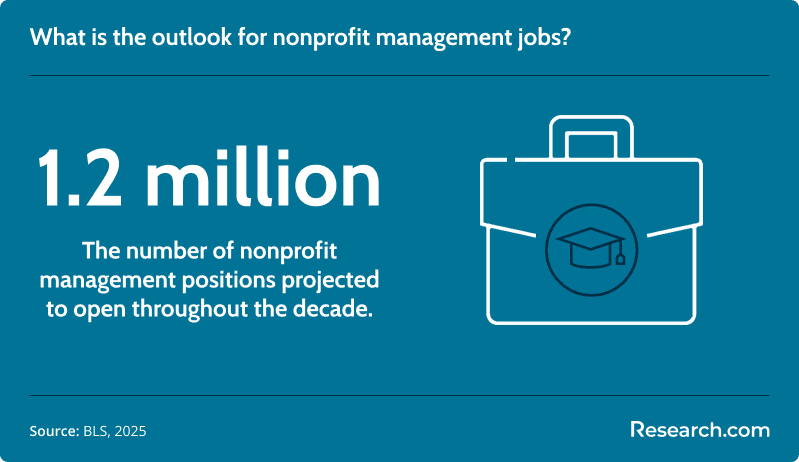
The broader management labor market is favorable. According to BLS, employment in management occupations is projected to grow faster than the average for all occupations from 2023 to 2033, with about 1.2 million job openings expected each year on average. These openings are expected to come from both new roles and the need to replace workers who leave the labor force or move into other occupations.
For nonprofit management graduates, the best opportunities may be in organizations that need leaders who can combine mission commitment with financial discipline, fundraising ability, data-informed decision-making, and operational skill. Competition can be strong for executive roles, so candidates should build a record of measurable results before expecting senior advancement.
Current trends affecting nonprofit management careers
- Greater demand for measurable impact: Funders, boards, and communities increasingly expect clear evidence that programs produce results.
- More complex funding environments: Leaders need skill in grants, donor diversification, budgeting, and financial risk management.
- Technology-enabled operations: Donor platforms, online outreach, remote service delivery, and data reporting are now part of many nonprofit workflows.
- Cross-sector collaboration: Nonprofits often partner with government agencies, schools, healthcare systems, corporations, and community groups.
- Leadership succession needs: As experienced managers retire or move roles, organizations need prepared leaders who understand both mission and operations.
When does the online format work best for nonprofit management students?
Online study is most useful for students who need to keep working while earning the degree, live far from campus-based programs, or want access to schools outside their local area. It can also benefit professionals who want to apply coursework immediately in their current nonprofit, public-service, or community role.
However, online learning requires self-management. Students should be comfortable reading independently, participating in virtual discussions, meeting deadlines without frequent in-person reminders, and communicating with faculty online. If you need a highly structured classroom environment or depend heavily on face-to-face networking, a campus or hybrid program may be a better fit.
How can complementary certifications enhance nonprofit management expertise?
Certifications and targeted credentials can help nonprofit professionals build specialized skills beyond the master’s curriculum. Depending on career goals, useful areas may include project management, grant writing, fundraising, financial management, data analysis, volunteer administration, digital marketing, or evaluation methods. These add-ons can be especially helpful for professionals changing sectors or preparing for roles with technical responsibilities.
For example, students who lead complex initiatives may benefit from project planning, budgeting, risk management, and implementation training. A related option such as a project management degree online can strengthen the operational side of nonprofit leadership, particularly for professionals managing grants, service launches, community programs, or cross-functional teams.
Questions to ask before enrolling
- Is the institution accredited, and is the accreditation current?
- What is the total program cost after tuition, fees, books, and required materials?
- Can I complete the program part-time, full-time, or on an accelerated schedule?
- Are courses asynchronous, synchronous, or a mix of both?
- Does the curriculum include fundraising, nonprofit finance, governance, ethics, and program evaluation?
- Are there capstone, internship, consulting, or applied project options?
- What support is available to online students?
- What roles have recent graduates moved into?
- Can transfer credits reduce the total number of required credits?
- Will my employer help pay for the degree?
Key Insights
- Nonprofit organizations recently accounted for more than 300,000 establishments and supported 12.8 million jobs, representing 9.9% of all private-sector employment in the US.
- An online master’s in nonprofit management is best suited for students who want leadership roles in fundraising, program management, operations, advocacy, public service, association management, or executive administration.
- Data USA reports a median salary of $105,798 per year for nonprofit management professionals, while BLS reports an average annual salary of $122,090; individual outcomes depend on experience, role, location, and organization size.
- Most programs can be completed in 18 months to two years full time, while part-time students may need three to four years. Accelerated options may take 12 to 24 months.
- Affordability should be measured by total cost, not tuition alone. Required credits, fees, transfer policies, financial aid, and completion time all affect value.
- Accreditation is non-negotiable. Verify it before applying, especially if you plan to use federal aid or want employer-recognized credentials.
- BLS projects faster-than-average growth for management occupations from 2023 to 2033, with about 1.2 million openings expected each year on average.
- The strongest applicants combine the degree with practical accomplishments, such as fundraising results, program improvements, budget responsibility, volunteer leadership, grant work, or measurable community impact.
References:
- BLS. (2024, August 15). Nonprofit sector research data. BLS.
- BLS. (2025, April 18). Management occupations. BLS.
- Data USA. (n.d.). Non-Profit, Public, & Organizational Management. Data USA.
- Zippia. (2025, January 8). Nonprofit Manager Demographics and Statistics [2025]: Number of nonprofit managers in the US. Zippia.
Other Things You Should Know About Online Master's in Nonprofit Management
Most affordable online master’s programs in nonprofit management do not require the GRE for admission in 2027. Schools usually ask for a bachelor’s degree, official transcripts, a résumé, and a statement of purpose instead. Some programs may still request test scores only for applicants with a low GPA.
In 2027, students enrolled in affordable online master's programs in nonprofit management can access federal financial aid, scholarships from nonprofit organizations, and state-specific grants. Eligibility typically requires enrollment in an accredited program and maintaining satisfactory academic progress.